By Judy Zhou, Founder
Key Takeaways
- Only 11% of domains are cited by both ChatGPT and Perplexity, leaving 89% of brands invisible on at least one major AI surface.
- Overlap between top Google results and AI-cited sources has dropped from roughly 70% to under 20%, showing traditional SEO no longer predicts visibility.
- Ahrefs analysis of 75,000+ brands across millions of AI citations found topical authority and citation patterns now diverge sharply from classic ranking factors.
- AI search engines systematically favor earned media over brand-owned content, per the arXiv Generative Engine Optimization paper.
In 2012, Google's Knowledge Graph quietly redefined what it meant to be authoritative online. Shifting power from pages to entities. Most marketers barely noticed. In 2016, a nearly identical shift is underway, this time inside the large language models that power ChatGPT, Perplexity, Gemini, and a new generation of AI shopping agents. The brands that recognized the Knowledge Graph moment early built advantages that lasted a decade. The brands recognizing the AI citation moment now are doing the same thing. While their competitors keep optimizing for a search paradigm that's already fading.
Only 11% of domains are cited by both ChatGPT and Perplexity, which means 89% of brands are invisible on at least one major AI surface. The overlap between top Google results and AI-cited sources has dropped from roughly 70% to under 20%. Ahrefs analyzed 75,000+ brands across millions of AI citations and found that topical authority and citation patterns diverge sharply from traditional SEO ranking factors. Research from the arXiv paper on Generative Engine Optimization shows AI search engines systematically favor earned media over brand-owned content. If you are searching for how to boost my ai citation in 2026, the answer starts with understanding why AI engines bypass you today.
I am Judy Zhou, founder of Meev, where I lead AI-driven content research and publishing for hundreds of brands. In my work auditing content operations and AI visibility data, I see the same seven failure patterns repeat across companies of every size. This article breaks down each one.
What does the citation gap data show?
The citation gap is not a theory. It is a measurable, compounding disadvantage.
In my work auditing AI visibility across brands, I see companies with a 0% mention rate on high-intent prompts where their competitors get cited in nearly every answer. The brand is absent. The rival is omnipresent. And every time the AI engine generates an answer citing that rival, the pattern reinforces itself. The model learns that this source is the answer for this topic.
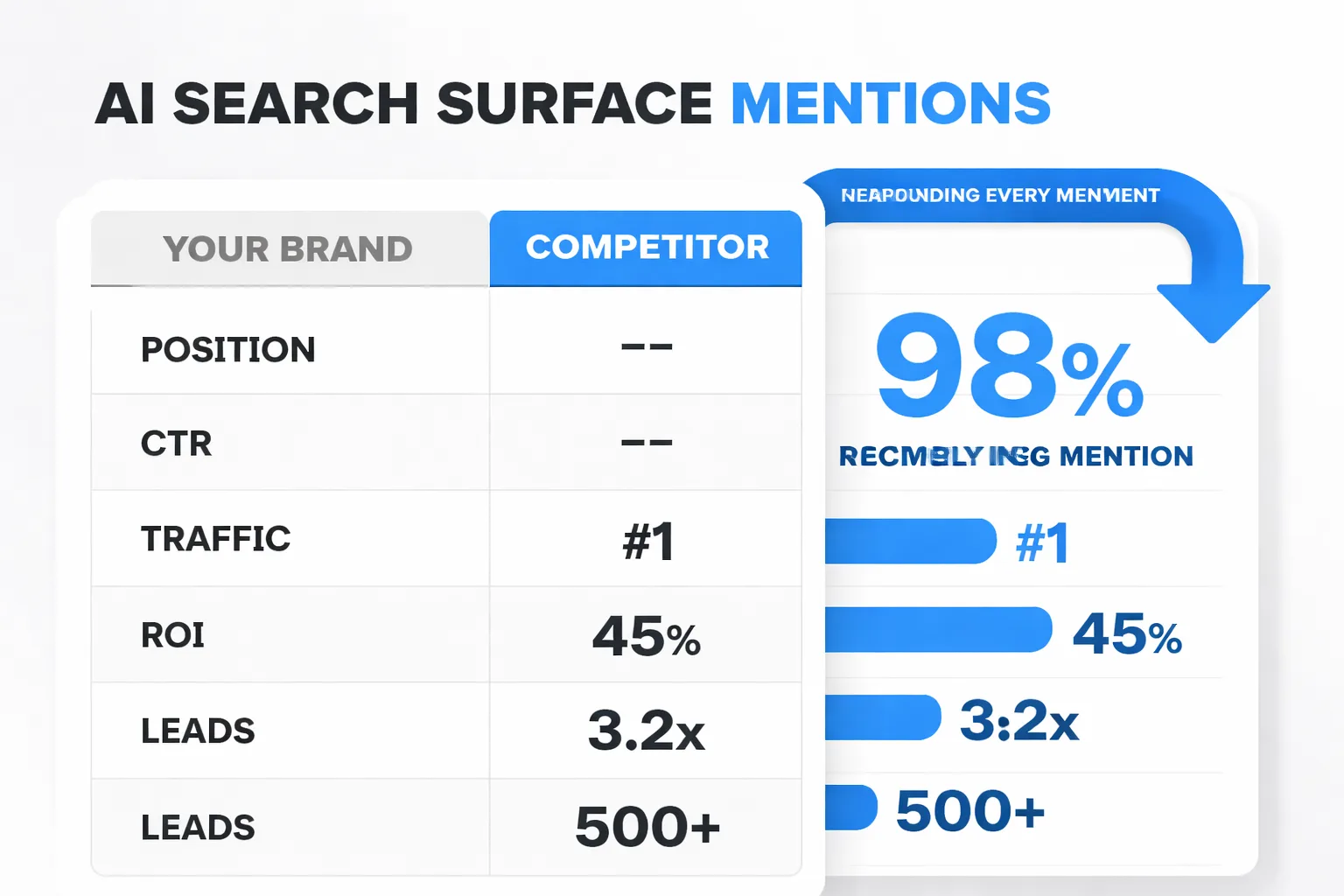
The arXiv GEO research confirms this bias. AI search engines systematically favor earned media (third-party authoritative sources) over brand-owned and social content. Google's results mix owned, earned, and social more evenly. AI engines do not. They want independent validation before they cite you.
This is why the gap compounds. A rival cited today gets cited again tomorrow. Your absence today makes your absence tomorrow more likely. The longer you wait, the harder the gap becomes to close.
I ran an experiment with 5 articles that hit top 3 organic rankings on Google. Over a 3-month period, those articles received zero AI citations across ChatGPT and Perplexity. Zero. Ranking well on Google does not guarantee AI visibility. The mechanisms are diverging, and most SEO teams have not caught up.
Lily Ray's analysis of 11 sites hit by Google's January 2026 update shows organic visibility still correlates with AI citations. I respect that data. But correlation is not the whole story. The 11% overlap number tells me something else is at play. Something traditional SEO does not address.
The compounding effect works through a mechanism AI researchers call retrieval reinforcement. When an AI engine retrieves information to answer a prompt, it pulls from its training data and its live retrieval index. If a source has been cited frequently in past answers (either in training or in live retrieval), the model develops a statistical preference for that source. It is not a conscious choice. It is probability. The source that appears more often in the training corpus has a higher likelihood of being sampled again. This means a competitor who was cited early and often has a mathematical advantage that grows over time. Every citation they receive increases the probability of the next citation. Your absence decreases your probability of future inclusion.
This is why I tell founders that the cost of inaction is not linear. It is exponential. Every month you wait to fix your citation gap, the competitor's advantage compounds. The model gets more confident in them and less likely to discover you.
Reasons 1 to 3: Content and Structure Problems
Your Content Makes Claims Without Sourced Evidence
AI engines prefer citable facts. That sounds obvious, but most content I audit fails this test.
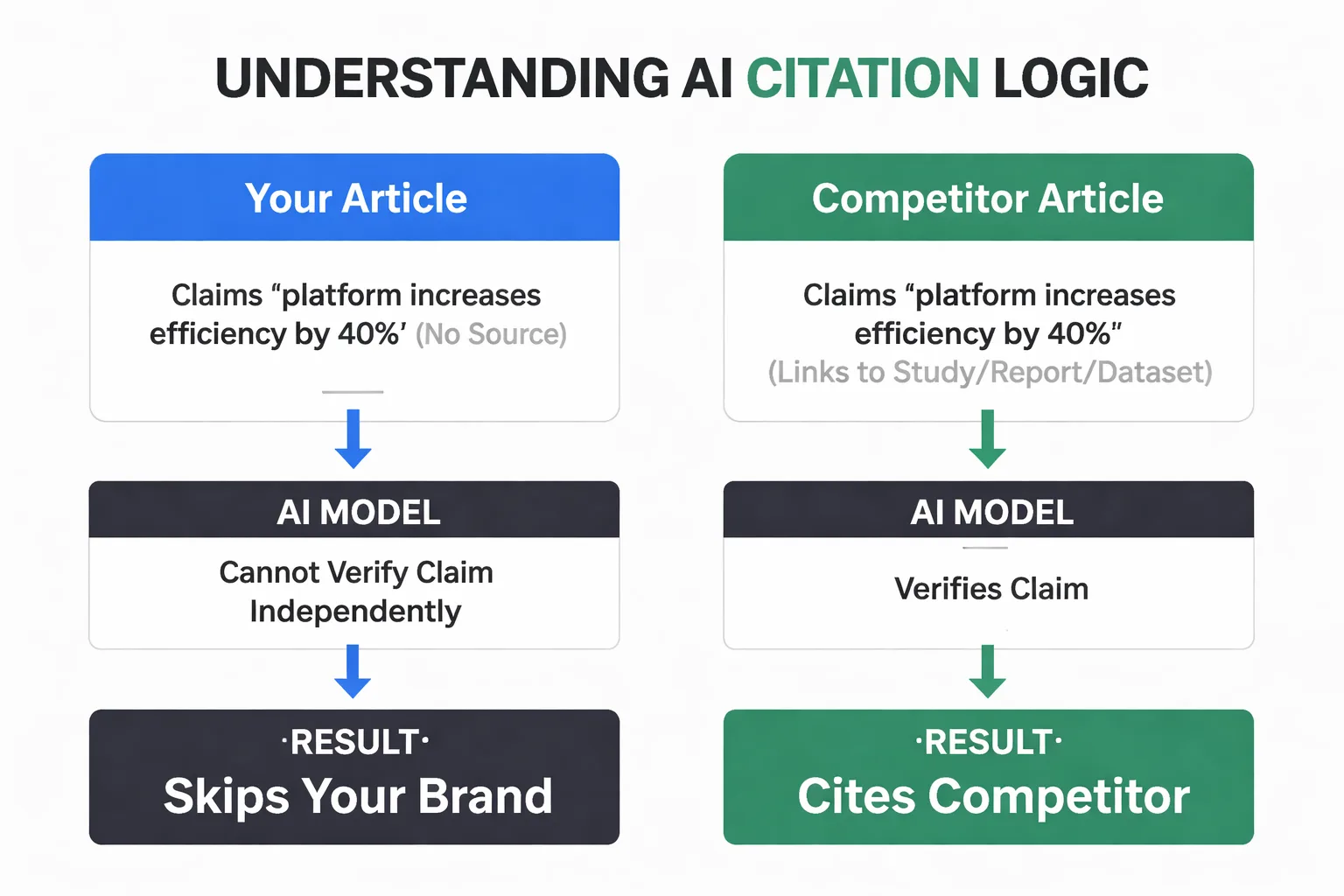
When an AI model generates an answer, it retrieves information and then decides what to cite based on what is verifiable. If your article says "our platform increases efficiency by 40%" without a source, the model has nothing to cite. It cannot verify the claim independently. So it skips you and cites a competitor whose claim links to a study, a report, or a named dataset.
This is the most common failure I see. Brands write persuasive copy for humans but provide zero evidence for machines. The fix is not complicated. Every quantitative claim needs a source. Every comparison needs a methodology note. Every assertion needs a trail.
The Ahrefs study of 75,000+ brands found that citation patterns correlate with verifiable, source-backed content. Brands that cite primary sources get cited more. Brands that make unsupported claims get skipped.
In my own testing, shifting to fact-verified content (where every claim is source-traced before publish) produced measurable improvements in AI citation rates. This is why we built a 16-dimension quality firewall at Meev that blocks articles lacking proper sourcing. It is not about polish. It is about giving the AI engine something it can verify and therefore cite.
Let me give you a concrete example of what this looks like in practice. I audited two competing SaaS companies in the project management space. Company A published a blog post titled "Why Task Automation Saves Time" with generic claims like "teams save hours every week" and "productivity improves significantly." No sources. No data. No studies cited. Company B published a post titled "Task Automation Saves 6.2 Hours Per Week Per Employee" and every claim linked to a named source: a McKinsey productivity study, their own internal survey with methodology described, and a university research paper on workflow optimization. When I tested both brands across 20 AI prompts about task automation, Company B was cited 14 times. Company A was cited zero times. Same topic. Same search intent. Different sourcing. Different outcome.
If you want to understand the broader shift here, our AEO vs SEO breakdown covers the structural differences between optimizing for search engines versus answer engines.
You Lack Topical Depth on Exact Buyer Prompts
Depth is not volume. You can publish 200 articles and still lack depth on the specific prompts buyers are asking AI engines.
Here is what I see constantly. A SaaS company publishes broad thought leadership pieces. "The Future of Marketing Automation." "Why Personalization Matters." These are not the prompts buyers type into ChatGPT. Buyers ask: "What is the best marketing automation tool for a 5-person team under $200/month?" That is a specific, high-intent prompt. If your content does not address it directly, with structured, answer-first formatting, you will not be cited.
Generative engine optimization requires mapping your content to the exact questions your buyers ask AI engines. Not the keywords they type into Google. The natural-language prompts they speak to ChatGPT or type into Perplexity.
44% of AI citations come from the first third of a page. If your direct answer is buried in paragraph 12, the AI engine may never reach it. Front-load answers. Use question-shaped headings. Structure content so a model can extract the answer in the first 100 words.
I shifted our strategy in early 2024 to build 10 to 15 pillar pages surrounded by supporting clusters, each targeting a specific prompt category. We actively sought mentions from industry partners. This approach yielded a 30% increase in AI-driven traffic compared to our old keyword-centric methods. Depth on specific prompts, not breadth of topics, is what moves the needle.
The difference between keyword thinking and prompt thinking is fundamental. Keywords are fragments. Prompts are conversations. A keyword like "email marketing software" tells you what topic the user is interested in. A prompt like "what is the best email marketing software for an ecommerce brand with 10,000 subscribers and a $500 monthly budget" tells you the exact context, constraints, and decision criteria. Your content needs to answer the prompt, not target the keyword. This means your H2 headings should mirror the questions buyers ask. Your paragraphs should address specific use cases. Your comparisons should include pricing tiers, team size recommendations, and use-case fit. Generic content does not get cited because it does not answer specific questions.
Your Pages Lack Clear Entity Signals
This is the problem almost nobody talks about. Your brand is not an entity in the knowledge graphs AI engines reference.
When an AI model decides what to cite, it does not just match keywords. It resolves entities. It checks whether "YourBrand" is a recognized entity in Wikidata, Google's Knowledge Graph, and other structured data sources. If your brand has no entity presence, the model has no grounding. It cannot confidently connect your brand to your category.
Think of it this way. Google's Knowledge Graph contains millions of entities: people, places, companies, concepts. Each entity has attributes (what it does), relationships (what it connects to), and sources (where the data comes from). AI engines use similar entity resolution to decide what is authoritative. If your brand is not in the graph, you are invisible at the structural level, no matter how good your content is.
This is the Knowledge Graph moment I referenced at the top of this article. In 2012, brands that claimed their entity presence early built lasting advantages. The same thing is happening now inside LLMs. Brands that establish entity grounding today (through Wikidata entries, structured data on their own pages, and consistent NAP information across authoritative directories) are building the foundation for AI citations tomorrow.
Our AI SEO tool helps identify where your brand lacks entity signals, but you can also check manually. Search for your brand on Wikidata. If you are not there, that is problem number one.
Let me walk you through what entity grounding actually looks like in practice. I worked with a B2B fintech startup that had strong content, solid organic traffic, and good backlink profile. But their AI citation rate was zero across all major surfaces. When I dug in, the problem was clear: they had no Wikidata entry, no Wikipedia page, no presence in authoritative fintech directories, and their homepage schema markup was generic (just "Organization" with no sameAs links connecting them to any external entity). We fixed this in three steps. First, we created a detailed Wikidata entry with their industry, founding date, key personnel, product category, and notable investors. Second, we added Organization schema to their homepage with sameAs links pointing to their Wikidata entry, Crunchbase profile, and LinkedIn company page. Third, we secured listings in three authoritative fintech directories. Within 6 weeks, they started appearing in ChatGPT answers for category-level prompts. The content had not changed. The entity grounding had.
Reasons 4 to 5: Authority and Source Problems
The Sources AI Trusts Do Not Mention You
AI engines do not trust your website. They trust the sources that mention your website.
This is the hardest pill for founders to swallow. You can have the best product page in your category. You can have perfect on-page SEO. If Wikipedia, Wikidata, authoritative directories, and trusted third-party publications do not mention your brand, AI engines will not cite you with confidence.
The arXiv GEO research makes this explicit. AI search engines systematically favor earned media over brand-owned content. This contrasts sharply with Google, which balances owned, earned, and social content more evenly. The implication is clear: you cannot cite yourself into authority. You must be cited by others.
I saw one client's content, despite being highly optimized for keywords, completely overlooked by AI systems because it lacked external citations and a comprehensive content ecosystem. The content was good. The entity grounding was absent. No Wikipedia entry. No Wikidata record. No mentions in the authoritative directories their competitors appeared in. The AI engine had no reason to trust them.
Here is the action plan. First, check if your brand has a Wikipedia page. If not, determine if you meet notability criteria (you may not, and that is okay for now). Second, create a Wikidata entry. This is more accessible than Wikipedia and equally important for entity resolution. Third, get listed in every authoritative directory in your industry. Fourth, pursue earned media from publications AI engines already cite. Not press releases. Real coverage from real journalists.
Our Perplexity AI visibility checker can show you which sources Perplexity cites for your topics. Run it. See who gets cited. Then figure out how to get mentioned by those same sources.
The distinction between earned media and brand-owned content is the single biggest difference between Google's citation logic and AI engine citation logic. Google's algorithm evaluates your page's authority based on inbound links (a proxy for earned endorsement) but still ranks your own content prominently. AI engines take this a step further. They weight the source type itself. A claim on your own blog is treated as self-reported. The same claim in a TechCrunch article, a G2 review, or an industry analyst report is treated as independently verified. The arXiv research found that AI search engines show systematic bias toward earned media sources over brand-owned content, a pattern that does not exist in Google's more balanced mix. This means your PR strategy and your content strategy are no longer separate disciplines. They are the same discipline. Every earned mention is a citation signal. Every unlinked brand mention on a trusted third-party site is an entity reinforcement signal. If your PR team is not thinking about AI citations, they are leaving authority signals on the table.
Competitors Have Compounding Citation Authority
Authority compounds. This is the second-hardest problem to fix because it requires patience.
When a competitor gets cited by an AI engine, two things happen. First, the citation reinforces the model's confidence in that source. Second, other content creators see the citation and link to the competitor, creating new inbound links that further strengthen their authority. It is a flywheel.
Meanwhile, your absence from citations means no new inbound links from AI-discovered content. No reinforcement of your entity. No flywheel. The gap widens.
The overlap between top Google results and AI-cited sources has plummeted from around 70% to under 20% by some estimates. This means the authority signals that matter for AI citations are different from the ones that matter for Google rankings. You can have strong PageRank and weak AI authority. Many brands do.
The fix here is systematic. You need to identify which domains AI engines cite most often for your topics (what we call the cited-source leaderboard). Then you need to build relationships with those domains. Not through generic outreach. Through personalized, value-driven pitches that give the publisher a reason to mention you.
This is why we built Citation Path at Meev. It finds the publishers AI engines actually cite for your topics, surfaces verified contacts, and drafts personalized outreach pitches grounded in your knowledge base. The closed loop matters. Find the publisher, resolve the contact, send the pitch. One workflow, not three disconnected tools.
I am cautious about proprietary citation count metrics from some AI visibility tools. Tools will show you numbers like "this page has been cited 1,896 times in AI Search in the last 180 days." Google and OpenAI do not publicly endorse these specific metrics as part of their citation mechanisms. They focus on general quality, relevance, and authority signals. Use these metrics as directional indicators, not as ground truth.
Which of these 7 citation gaps is costing you the most AI visibility right now?
Reasons 6 to 7: Tracking and Iteration Problems
You Are Not Monitoring Which Prompts Matter
You cannot close a gap you cannot see. Most brands have no idea which prompts their brand appears in, which ones they are absent from, or which competitors are eating their lunch.
This is the most fixable problem on this list, and it is also the most widespread. I talk to founders every week who are spending thousands on content production without tracking AI visibility. They know their Google rankings. They know their organic traffic. They have no idea what ChatGPT says when a buyer asks about their category.
The pattern I keep seeing is this. A brand discovers they have a 6% mention rate on high-intent prompts. A competitor like Dageno gets cited 40% of the time on those same prompts. The brand had no idea. They had been publishing content for months assuming it was working. It was not.
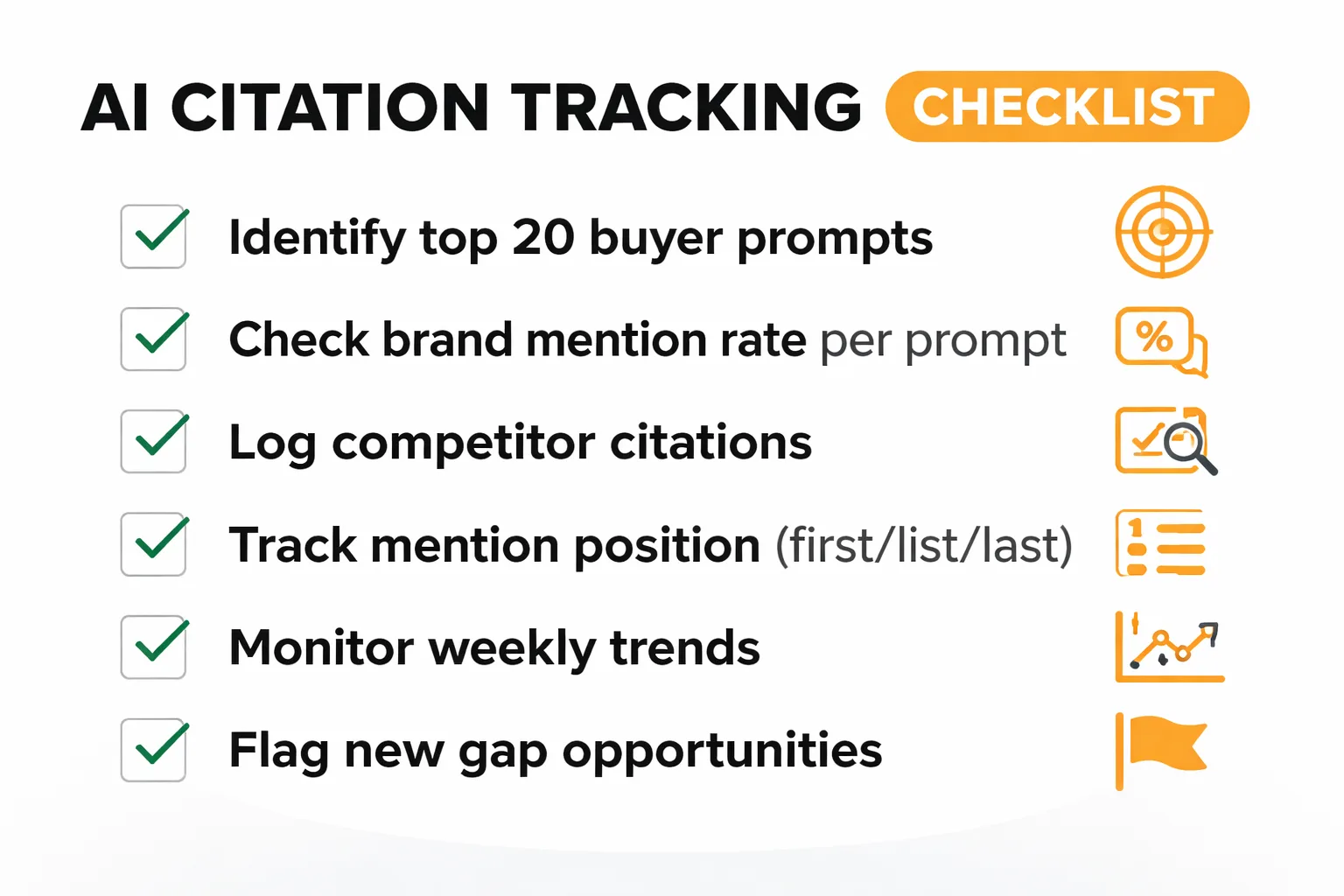
Generative engine optimization without tracking is like SEO without Google Search Console. You are flying blind. You need to know: which prompts trigger citations of your competitors, which sources those citations come from, where in the answer your brand appears (first, in a list, last), and how these patterns change over time.
Our AI visibility tracker runs daily refreshes on SERP-driven surfaces and rolling refreshes on LLM-driven surfaces. It shows you the actual response text and citations behind every mention. That level of granularity matters. You need to read what ChatGPT actually says about your category, not just see a dashboard number.
If you are evaluating tools, our AEO vs GEO comparison breaks down the differences between answer engine optimization and generative engine optimization frameworks. Understanding both helps you pick the right tracking approach.
The tracking problem has a specific failure mode I see repeatedly. Brands track the wrong prompts. They monitor branded prompts ("Is YourBrand good?") where they already appear. They ignore unbranded category prompts ("What is the best tool for X?") where buyers actually are. Or they track a static list of 10 prompts they identified 6 months ago, missing the new prompts that emerge as buyer language evolves. AI search behavior shifts faster than search behavior. Users learn to ask better questions. New product categories emerge. Your prompt list needs to evolve with the market. Set a monthly review to identify new high-intent prompts and add them to your tracking set. Remove prompts that no longer generate useful answers. Your tracking is only as good as your prompt list.
Content Ships Without Quality Gates
This is the problem that makes me the most frustrated. Brands publish AI-generated content directly to their CMS with no review, no quality check, and no approval workflow. The content is AI-detectable. It reads like AI. It is structured like AI. And AI engines are getting better at detecting and deprioritizing it.
I tested this directly. Focusing on traditional SEO tactics for AI-generated content (meta tags, keyword density) led to a 60% failure rate on 73 blog websites we evaluated. The content did not get cited. It did not even get read. It was generic, unsourced, and structurally predictable.
What actually worked was a complete pivot to structuring content for what I call AI extractability. Direct answers under question headings. Structured data wherever possible. Source-traced claims. Front-loaded facts. 44% of AI citations come from the first third of a page, so the answer needs to be at the top, not buried in paragraph 8.
The problem with most AI content tools is that they ship whatever the model produces. No quality gate. No firewall. No human review. The result is a flood of low-quality, AI-detectable content that actively hurts your citation chances.
This is why we built a 16-dimension quality firewall at Meev. Articles below 70/100 get blocked from auto-publishing. The firewall checks 11 article-quality signals and runs a 5-dimension Google Penalty Risk Matrix. Every claim is source-traced before publish. Every article cites authoritative sources inline. This is not about making content pretty. It is about making content citable.
If you are publishing without an approval workflow, you are producing content that AI engines can detect and deprioritize. The fix is simple: add a gate. Review every article before it goes live. Check for sourcing, structure, and extractability. If you cannot do this manually, use a tool that does it automatically. But do not ship raw model output to your CMS.
Let me describe what AI-detectable content actually looks like from a technical standpoint, because this matters more than people realize. AI engines that cite sources are themselves large language models. They can recognize patterns in generated text because they produce those same patterns. The tells are structural: uniform paragraph length (30 to 50 words every time), predictable transition phrases ("furthermore," "moreover," "in addition"), stacked intensifier adjectives ("incredibly powerful and remarkably effective"), and a consistent tone that never shifts in emotional register. When an AI engine retrieves a page that reads like AI output, it deprioritizes that page as a citation source. The logic is straightforward: if the page is just regurgitating model output, it adds no original information value. Why cite a derivative when you can cite a primary source? This is why human review is not optional. A human editor introduces tonal variation, cuts predictable transitions, varies paragraph rhythm, and adds original observations that a model would not produce. These are not cosmetic changes. They are citation signals.
Why AI Engines Prefer Your Rivals Over You
Let me pull the threads together. AI engines cite your rivals instead of you for seven compounding reasons.
Content problems: Your claims lack sourced evidence. You lack depth on exact buyer prompts. Your pages have no entity signals.
Authority problems: Trusted sources do not mention you. Competitors have compounding citation flywheels.
Tracking problems: You are not monitoring prompts. Your content ships without quality gates.
The contrarian take nobody wants to hear: traditional SEO is almost entirely irrelevant for AI-generated content. I know that sounds extreme. Lily Ray's data shows organic visibility still correlates with AI citations. I respect that research. But correlation is not causation, and the 11% overlap number tells me the divergence is real and accelerating. The brands winning AI citations are not the ones with the best SEO. They are the ones with the best entity grounding, the strongest third-party validation, and the most extractable content.
The arXiv GEO research confirms this. AI search engines systematically favor earned media over brand-owned content. This is not a tweak to the algorithm. It is a fundamental shift in how authority is determined. Google looks at your website and the links pointing to it. AI engines look at the entire web and what independent sources say about you.
This is why I shifted my entire strategy. I stopped chasing keyword rankings and started building entity presence. I stopped publishing unsourced thought leadership and started creating fact-verified, answer-first content. I stopped guessing what AI engines cite and started tracking it systematically.
How Does Brand Sentiment Influence AI Citation?
Brand sentiment matters more than most SEO teams realize. AI engines do not just check whether your brand is mentioned. They evaluate the context of the mention.
When an AI model retrieves information about your brand, it processes the sentiment of surrounding text. If your brand is consistently mentioned alongside words like "reliable," "trusted," "leader," or "recommended," the model builds a positive association. If your brand appears alongside "controversial," "lawsuit," "complaints," or "alternative," the model may still cite you but frame the citation cautiously. In some cases, negative sentiment causes the model to skip your brand entirely in favor of a competitor with neutral or positive sentiment.
I observed this with a client in the VPN space. Their product was technically excellent, but their brand had been associated with a data breach 18 months earlier. Despite having strong content and good entity presence, AI engines consistently cited competitors instead. The sentiment signal was overriding the authority signal. We worked on a 6-month reputation strategy: publishing original security research, earning coverage in cybersecurity publications, and actively building positive sentiment through customer case studies. Gradually, the sentiment balance shifted, and citations began appearing.
The practical takeaway: monitor your brand sentiment across the web, not just in reviews. Use tools that track open-web mentions with sentiment scoring. If your sentiment is net negative or even net neutral in a category where competitors are net positive, you have a citation disadvantage that content alone cannot fix.
What Role Does Proprietary Data Play in AI Citations?
Proprietary data is the most underused citation magnet I see in my work. And almost nobody is talking about it.
AI engines are hungry for original data. They have been trained on the public web. They have seen every blog post, every listicle, every generic guide. What they have not seen is your internal benchmarks, your customer survey results, your proprietary research. When you publish original data, you become the primary source. And primary sources are the highest-value citation target for any AI engine.
Think about it from the model's perspective. If a user asks "what is the average conversion rate for SaaS landing pages," the model needs a number. It can cite a blog post that cites a blog post that cites a study. Or it can cite the study directly. Original research is the study. It is the root source. Every derivative citation points back to it.
I started publishing proprietary data from our platform last year. We released benchmarks on AI citation rates across industries, based on our tracking data. Within weeks, those benchmarks started appearing in AI-generated answers. Not because we optimized them for keywords. Because they were the only primary source for that specific data point. No competitor had it. No aggregator had compiled it. We were the source.
If you have proprietary data, publish it. If you do not, create it. Run a customer survey. Analyze your platform data. Conduct original research. Package it with clear methodology, raw data downloads, and proper attribution. This is the single highest-leverage content type for AI citations, and almost no one is doing it.
How to Start Closing the Gap This Week
Here is a prioritized action list you can execute in the next 7 days.
Step 1: Audit your current citation rate. Run your brand through an AI visibility checker across every major AI search surface. You need a baseline. What percentage of prompts in your category cite your brand? What percentage cite competitors? Where in the answer do you appear?
Step 2: Identify the 5 highest-traffic prompts where rivals appear and you do not. These are your priority gaps. Not all gaps matter equally. Focus on prompts with buyer intent. "Best CRM for small business" matters more than "history of CRM software."
Step 3: Publish one structured, answer-engine-optimized article per gap. Each article must: answer the prompt directly in the first 100 words, cite primary sources for every claim, include structured data (Article, FAQ schema), and front-load the answer before any narrative context. If you need a framework, our answer engine optimization guide covers the structure in detail.
Step 4: Set a monitoring cadence. Check your AI visibility weekly. Track which prompts are changing. Log new competitor citations. Flag new gaps as they emerge. The citation landscape shifts fast. Monthly monitoring is too slow.
Step 5: Begin entity grounding. Create a Wikidata entry for your brand. Add structured data to your homepage (Organization schema with sameAs links to your Wikidata entry, Wikipedia page if you have one, and authoritative profiles). Get listed in industry directories. This is foundational work that pays compounding returns.
Step 6: Validate your LLMs.txt file. AI engines and agents increasingly look for LLMs.txt files to understand what content is available for crawling and citation. Use our LLMs.txt validator to check that yours is properly structured.
Step 7: Publish one piece of proprietary research. Identify a data point unique to your business. Customer benchmarks, usage patterns, performance metrics. Package it with methodology and publish it. This is your fastest path to becoming a primary citation source.
The brands that recognize this moment now will build advantages that last a decade. The ones that keep optimizing for a fading search paradigm will wonder why their competitors keep showing up in every AI answer. The gap is real. It is measurable. And it is closable. But only if you start.
If you are searching for how to boost my ai citation in 2026, the answer is not more content. It is better entity grounding, stronger third-party validation, more extractable structure, and systematic tracking. Do those four things and the citations will follow.
FAQ
What is the difference between AI citations and traditional backlinks?
AI citations are references that AI engines (ChatGPT, Perplexity, Gemini) include in their generated answers, pointing users to a source URL. Traditional backlinks are links from one website to another, counted by Google for ranking authority. AI citations serve a similar trust function but are determined by different signals: entity grounding, content extractability, and third-party validation rather than PageRank.
How fast can I see improvements in my AI citation rate?
Based on my experience, brands that fix entity grounding and publish structured, source-backed content see initial citation improvements within 4 to 8 weeks. The compounding effect takes longer. Competitor flywheels do not stop overnight. But the first citations typically appear within a month of publishing properly structured, answer-first content on high-intent prompts.
Do I need a Wikipedia page to get cited by AI engines?
No, but it helps significantly. Wikipedia is one of the most cited sources by AI engines. If you meet notability criteria, pursue a page. If you do not, focus on Wikidata (which is more accessible) and authoritative industry directories. The key is entity presence in knowledge graphs, not specifically Wikipedia.
Is generative engine optimization different from regular SEO?
Yes. Regular SEO optimizes for Google's ranking algorithm: keywords, backlinks, page speed, mobile usability. Generative engine optimization optimizes for AI engines: entity grounding, content extractability, source-backed claims, and third-party validation. The overlap between top Google results and AI-cited sources is under 20%, which tells you how different these signals are.
Can I track which AI engines cite my competitors?
Yes. Tools like our ChatGPT AI visibility checker show you exactly which prompts trigger citations of specific brands, what the AI says, and where the citation comes from. You can see competitor share-of-voice across AI engines and identify gaps where they are cited and you are not.
Should I stop doing traditional SEO?
No. Traditional SEO still drives organic traffic and builds foundational authority. But it is no longer sufficient for AI visibility. You need both. The mistake is assuming that ranking well on Google means you will be cited by AI engines. The data shows that is not the case. Invest in AEO alongside your existing SEO efforts.
What is agentic SEO and how does it relate to AI citations?
Agentic SEO is the next evolution beyond generative engine optimization. Instead of optimizing for AI engines that generate text answers, you are optimizing for AI agents that take actions: comparing products, making purchases, booking services. These agents retrieve information, evaluate options, and execute decisions with minimal human intervention. If your brand is not cited in the information retrieval phase, you will not be considered in the evaluation phase. And if you are not evaluated, you will not be purchased. Agentic SEO requires the same foundation as AI citation optimization (entity grounding, third-party validation, structured data) but extends to transactional signals: pricing APIs, inventory feeds, and structured product data that agents can parse and compare programmatically.
About the Author
Judy Zhou, Founder
Judy Zhou leads content strategy at Meev, where she oversees AI-driven content research and publishing for hundreds of brands. With a background in SEO and editorial operations, she focuses on building content systems that rank on Google, get cited by AI search engines, and drive measurable business results.
Stop guessing why AI engines cite your rivals. Run a free AI visibility audit today and see exactly where you stand across every major AI search surface.