
By Judy Zhou, Founder
Key Takeaways
- Semrush's traffic estimates achieve 10-15% accuracy for sites with 50,000+ monthly visitors but variance jumps to 20-40% for smaller domains.
- Google Search Console added AI Overviews performance reporting in 2025-2026, giving site owners the first free direct look at generative search impressions.
- Cloudflare Web Analytics offers unlimited cookieless measurement on its free plan while Similarweb's free tier caps at 10 websites per day.
- Companies spend an estimated $100M+ annually on AI visibility tracking despite zero peer-reviewed studies validating consistent brand recommendations from ChatGPT, Claude, or Google AI.
The best free website traffic checker in 2026 is probably not Semrush, not Ahrefs, and not Google Analytics. The tools dominating every ranked list were designed for a search landscape that no longer fully exists. One where Google's ten blue links were the only gatekeepers worth measuring. Answer engine optimization has reshuffled the deck. LLM citation tracking, AI visibility reporting, and entity grounding now determine whether your content surfaces at all. The traffic checkers worth your attention are the ones audacious enough to measure what AI search actually does to your numbers.
In my work auditing content ops at Meev, I've watched founders obsess over traditional traffic estimates while their AI visibility quietly erodes. SparkToro's research found zero peer-reviewed studies validating whether ChatGPT, Claude, or Google AI produce consistent brand recommendation lists, yet companies spend an estimated $100M+ annually on AI visibility tracking. Semrush's traffic estimates land within 10-15% accuracy for sites with 50,000+ monthly visitors, but variance jumps to 20-40% for smaller domains. Google Search Console added AI Overviews performance reporting in 2025-2026, giving site owners the first free, direct look at generative search impressions. Similarweb's free tier caps at 10 websites per day with limited historical data, while Cloudflare Web Analytics offers unlimited cookieless measurement on its free plan.
Why Free Traffic Checkers Still Matter in an AI Search World
Here's the honest truth: traditional traffic estimation is becoming a lagging indicator. I see it every week. A brand's organic traffic looks stable in GA4, but their share of voice in AI answers has collapsed. The traffic checker says everything is fine. The reality is anything but.
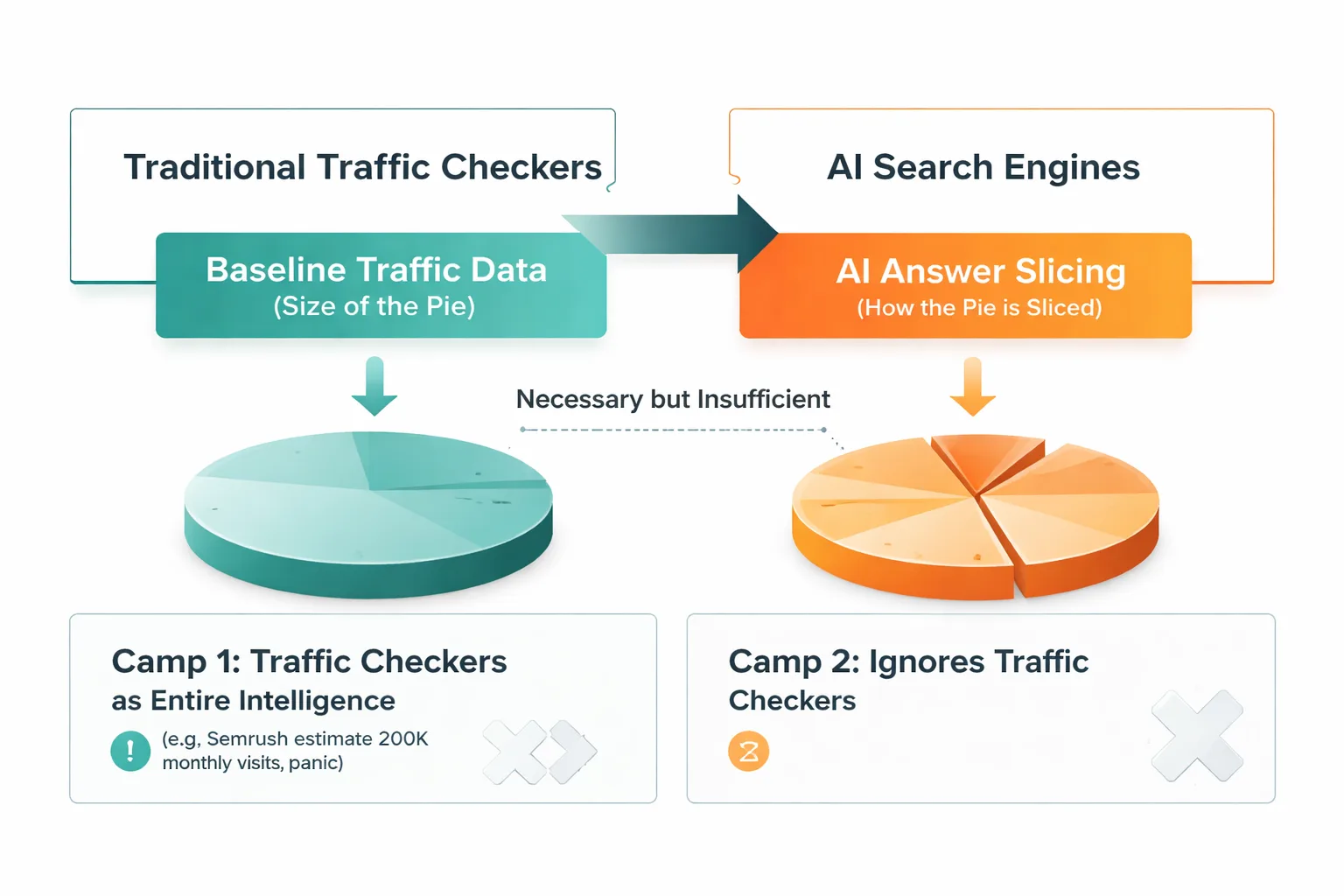
That doesn't make free traffic checkers obsolete. It makes them necessary but insufficient. You still need to know how much traffic a competitor gets, which channels drive it, and whether their organic search is growing or shrinking. A free website traffic checker gives you the baseline. It tells you the size of the pie. What it cannot tell you is how that pie is being sliced by AI search engines that cite some sources and ignore others.
The founders I work with fall into two camps. The first camp treats traffic checkers as their entire intelligence layer. They pull a Semrush estimate, see a competitor gets 200K monthly visits, and panic. The second camp ignores traffic data entirely and chases AI citations blindly. Both are wrong. You need the traffic data to understand the competitive landscape, and you need AI search visibility tracking to understand where that landscape is heading.
Free tiers have real limitations you should plan around. Semrush caps you at 10 searches per day. Ubersuggest gives you 3. Similarweb's free version strips out historical data. Ahrefs locks competitor analysis behind paid plans. These aren't dealbreakers. They are constraints that force you to be intentional about which domains you analyze and why.
How We Ranked These Tools
I evaluated every tool on five criteria that matter for 2026 SEO teams. Data freshness: how often do estimates update, and does the tool lag by weeks or months? Accuracy versus paid benchmarks: do free estimates align with GA4 first-party data when you can cross-reference? Depth of metrics: does the tool break down organic, paid, social, and referral traffic, or does it give you a single aggregate number? Ease of use: can a non-analyst open the dashboard and understand what they're looking at? AI search readiness: does the tool surface AI Overviews traffic, AI-referred visits, or any signal that connects traditional traffic to generative search?
That last criterion is where most tools fail. Google Search Console and GA4 now include AI Overviews reporting. Every other tool on this list is blind to it. That gap matters more than any feature difference between Semrush and Ahrefs.
I also weighed the practical reality of free-tier limits. A tool that gives you 3 searches per day is fine for a one-time competitive audit. It's useless for ongoing monitoring. I flagged which tools are built for quick lookups versus which can sustain weekly research workflows.
One more thing. I deliberately included tools that measure your own site (GA4, Search Console, Cloudflare) alongside tools that estimate competitor traffic (Semrush, Ahrefs, Similarweb). These serve different purposes. Conflating them is a common mistake I see in roundup articles. First-party data and third-party estimates are not interchangeable.
How do these checkers compare?
| Tool | Free Tier Limits | Data Source | Refresh Frequency | Standout Feature |
| Meev | 7-day free trial | Direct LLM APIs + GSC | Daily (SERP), rolling (LLM) | AI citation tracking across all major AI search surfaces |
| Google Analytics 4 | Unlimited (own site) | First-party tracking | Real-time | AI Overviews tab for generative search impressions |
| Google Search Console | Unlimited (own site) | Google's index | Daily | Direct AI Overviews performance data |
| Semrush Traffic Analytics | 10 searches/day | Clickstream data | Monthly | Side-by-side comparison of up to 4 domains |
| Ahrefs Traffic Checker | Free, no account required | Search index (171 countries) | Monthly | Keyword-level traffic attribution |
| Similarweb | 10 websites/day | Browser extension + clickstream | Monthly | Full channel-mix including email traffic |
| Ubersuggest | 3 searches/day | Search index | Weekly | Lifetime plans available as one-time purchase |
| SE Ranking | Free trial | Search index | Weekly | Organic vs. paid traffic split at $4.20/mo entry |
| Cloudflare Web Analytics | Unlimited (own site) | Server-side, cookieless | Real-time | Bot vs. human traffic including AI crawler classification |
| Sitechecker | Limited checks | Third-party models | Weekly | Combined traffic + uptime monitoring |
| Lookkle | Unlimited (premium $3.95/mo) | Third-party models | Monthly | No signup required for instant access |
Is Meev best for AI citation tracking?
Best for: Teams that want AI citation tracking plus a content engine they can trust to publish. Not just a dashboard that surfaces problems. Differentiated by the 12-dimension Quality Matrix and Helpful Content Risk score that gate every article before it ships.
Meev is an autonomous AI search visibility platform that tracks citations across every major AI search surface (ChatGPT, Claude, Gemini, Perplexity, Grok, DeepSeek, Google AI Overviews, AI Mode), writes quality-gated content that earns them, and proves which placements drove the lift. In my work leading content strategy here, I've seen how traditional traffic checkers miss the entire AI citation picture. Meev closes that gap by measuring what AI search actually does to your visibility, not just what Google Analytics reports about your past traffic.
Key features: - Citation tracking across ChatGPT, Claude, Gemini, Perplexity, and Grok on a rolling cadence; Google AI Overviews and AI Mode refresh daily. 12-dimension Quality Matrix plus Helpful Content Risk score. 70/100 publish gate on both. Knowledge Base enforcement. Articles grounded in your approved claims, not AI hallucination. Closed-loop Citation Path (roadmap) — each article mapped to the citation-rate delta it drove. Autopilot topic pool with gap detection from competitor citation patterns
Pricing: 7-day free trial. After the trial, services pause unless you subscribe. Your account stays open and your data stays readable. Lite $49/mo, Starter $99/mo, Pro $269/mo, Agency $599/mo. 20% annual discount. Cancel anytime; hard-cap quotas with no overage fees.
The honest assessment: Meev is not a traditional traffic checker. If you need to estimate a competitor's monthly visits, use Semrush or Ahrefs for that. Meev measures something those tools cannot: whether your brand appears in AI-generated answers, where in those answers you appear, and which content moves the needle. The quality firewall is the differentiator that matters most to me. Most AI content tools ship whatever the model produces. Meev blocks weak drafts before they reach your CMS. That's rare in this space.
Is GA4 best for first-party traffic data?
Best for: Website owners and marketers who need authoritative, first-party traffic data for their own site rather than competitor estimates.
GA4 is Google's free, first-party analytics platform that tracks every visitor to your own site with 100% accuracy across sessions, conversions, and traffic sources. It is the gold standard for understanding what happens on your own property. No estimation. No clickstream modeling. Just raw, verified data from the tracking code on your pages.
Key features: - First-party, 100% accurate traffic data for owned properties. Real-time visitor reporting with source/medium/campaign breakdowns. AI Overviews tab (launched late 2025) showing impressions and clicks from Google's generative results. Conversion tracking, funnel analysis, and audience segmentation
Pricing: Free forever for standard use; Google Analytics 360 (enterprise) starts at ~$50,000/year
GA4's limitation is obvious but worth stating plainly. It only measures your own site. You cannot use it to check competitor traffic. The AI Overviews tab is a meaningful addition, but it only covers Google's generative results. If ChatGPT or Perplexity sends you traffic, GA4 attributes it to referral or direct, not to a specific AI engine. For teams serious about answer engine optimization, GA4 is necessary but not sufficient.
Is Google Search Console best for search data?
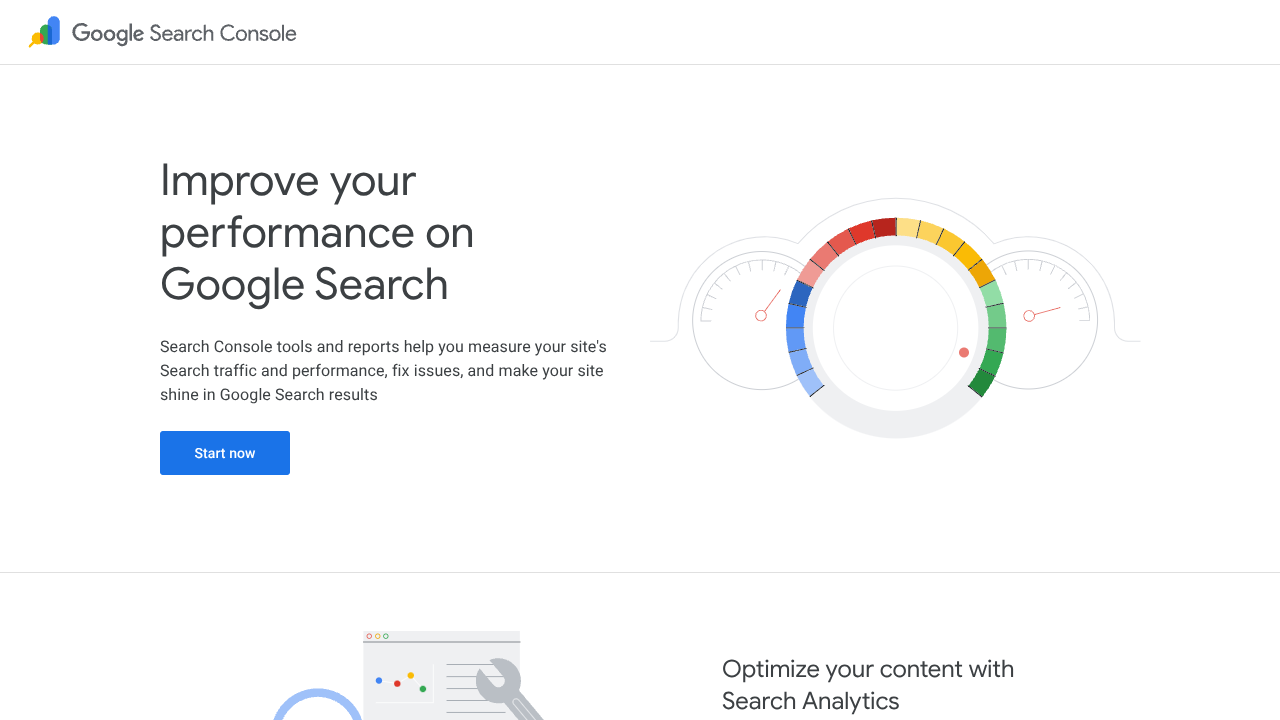
Best for: SEO professionals and site owners who need the most accurate, Google-sourced search traffic intelligence for their own verified properties.
Google Search Console delivers direct, verified search-performance data including clicks, impressions, CTR, and average position straight from Google's index. It is the only free tool that gives you unfiltered Google search data for your site. No estimation algorithms. No clickstream sampling. Google tells you exactly what it saw.
Key features: - Direct Google search traffic data: clicks, impressions, CTR, and average position. AI Overviews performance reporting for generative search visibility (2025. 2026) - Page and query-level breakdowns with country and device filters. Index coverage, Core Web Vitals, and manual action alerts
Pricing: Completely free. No paid tiers
The AI Overviews performance report is the feature I want to draw your attention to. For the first time, Google is showing you how often your site appears in generative answers and how many clicks those impressions generate. This is first-party AI search data, and it is free. The limitation is that it covers Google only. No ChatGPT, no Claude, no Perplexity. If you want to understand AEO vs SEO in practical terms, Search Console is where you see the difference in your own numbers.
Is Semrush best for competitor analysis?
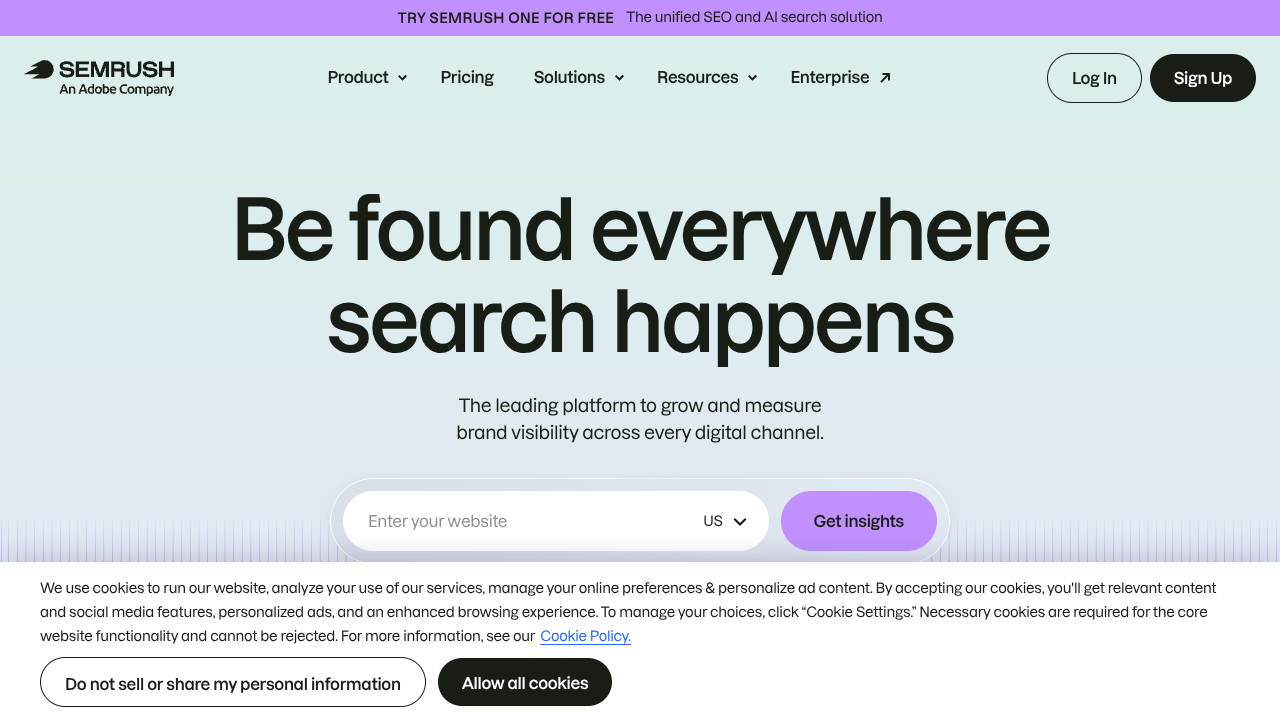
Best for: Digital marketers and agencies who need a comprehensive, all-in-one platform for competitor traffic analysis, keyword research, backlinks, and rank tracking.
Semrush estimates any website's traffic using clickstream data from millions of devices across organic, paid, social, and referral channels. It is the tool most marketers reach for first when they need a competitor's traffic numbers, and for good reason. The platform bundles traffic estimation with keyword research, backlink analysis, and rank tracking into a single workflow.
Key features: - Traffic estimates within 10. 15% accuracy for sites with 50,000+ monthly visitors. Side-by-side competitor comparison for up to 4 domains simultaneously. Channel-mix breakdown: organic, paid, social, referral, and direct traffic. Historical traffic data going back 2+ years with monthly trend tracking
Pricing: Free tier: 10 searches/day with limited data; Pro plan $139.95/month (5 projects, 500 keywords, full traffic analytics); Guru $249.95/month; Business $499.95/month; 7-day free trial available
The free tier gives you 10 searches per day. That is enough for a focused competitive audit but not for ongoing monitoring. The accuracy claim of 10-15% for sites above 50K monthly visitors is solid. Below that threshold, expect 20-40% variance. For smaller sites, Semrush's estimates are directional at best. The $139.95/month Pro plan is a steep jump from free, and I have seen too many founders pay for it before they need half the features.
5. Ahrefs Website Traffic Checker — Best for search-demand-driven estimates
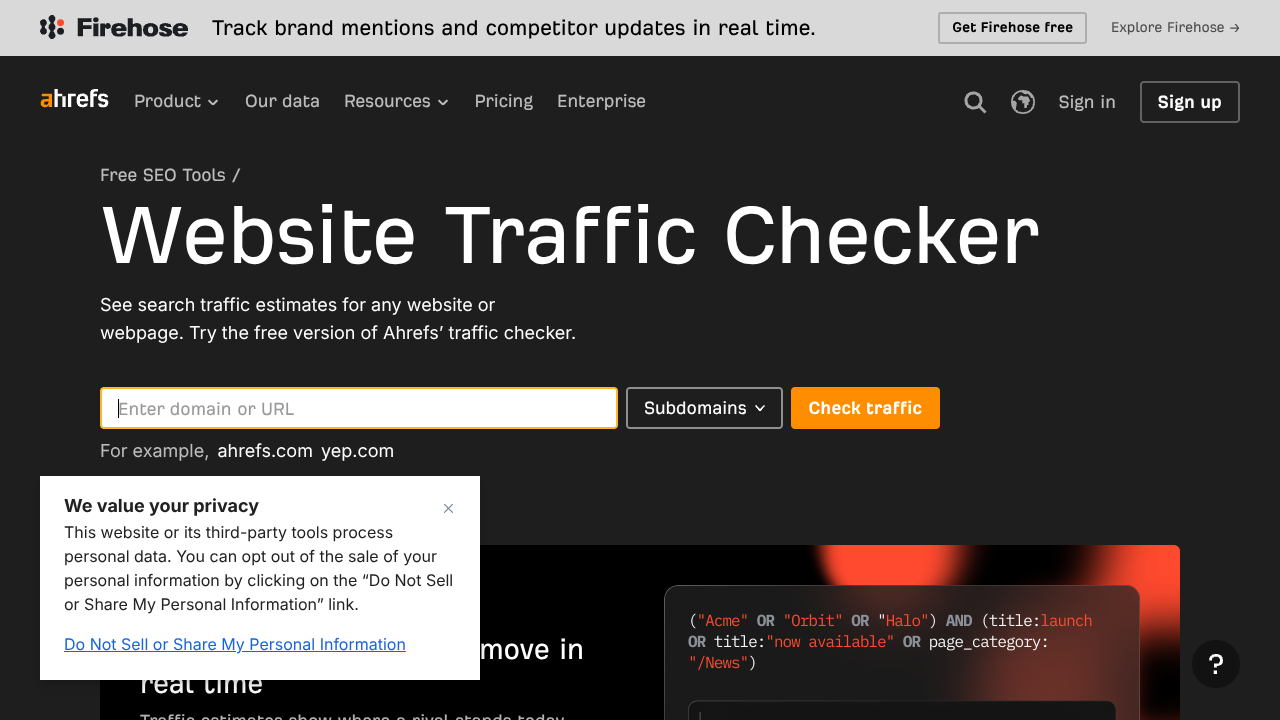
Best for: SEO specialists and content marketers who need search-demand-driven traffic estimates tied to specific keywords and pages rather than broad channel data.
Ahrefs takes a different approach than Semrush. Instead of clickstream data, Ahrefs builds traffic estimates from its search index, showing organic and paid traffic for any domain, subdomain, subfolder, or individual URL across 171 countries. The free traffic checker requires no account, which makes it the fastest tool on this list for a quick lookup.
Key features: - Search traffic estimates for domains, pages, subdomains, and subfolders. Organic and paid traffic breakdown across 171 countries. Keyword-level traffic attribution showing which terms drive visits. Ahrefs Webmaster Tools (free) for full crawl and backlink data on owned sites
Pricing: Free traffic checker tool available with no account required; Ahrefs Webmaster Tools free for your own site; Starter plan from $29/month; Lite plan $129/month; Standard $249/month
Ahrefs' keyword-level traffic attribution is its standout feature. When you see that a competitor gets 50K monthly organic visits, Ahrefs shows you exactly which keywords drive those visits. That is invaluable for content planning. The weakness is channel coverage. Ahrefs is search-focused. If you need social, direct, or referral traffic estimates, you are better served by Similarweb.
6. Similarweb. Best for broad competitive intelligence
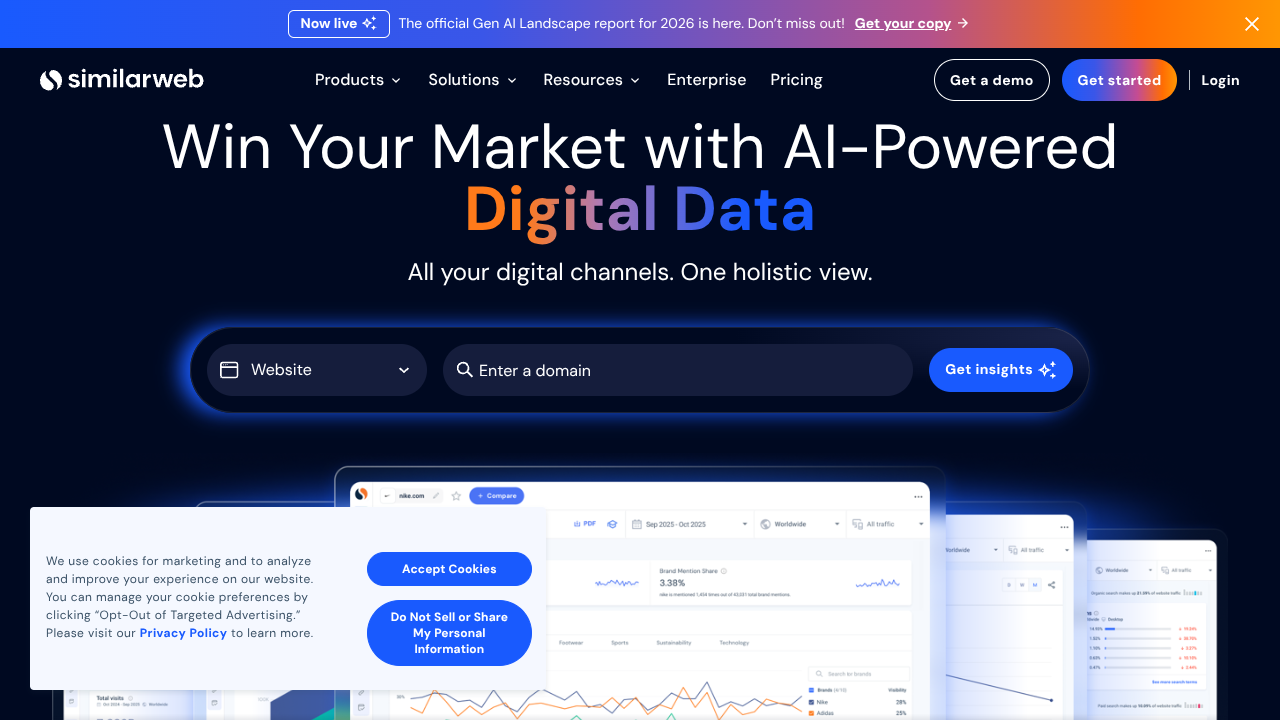
Best for: Marketing teams and enterprise analysts who need broad competitive intelligence across multiple channels, industries, and geographies.
Similarweb is the industry-standard competitive intelligence platform. It provides traffic estimates, global rankings, and full marketing-channel breakdowns for any website using browser extension and clickstream data. If you need to understand not just how much traffic a competitor gets but where it comes from and how it compares to industry benchmarks, Similarweb is the most comprehensive option.
Key features: - Traffic estimates with global and country-level rankings for any domain. Full channel-mix breakdown: organic, paid, social, referral, direct, and email. Industry-wide trend comparisons and competitor benchmarking. Mobile app performance tracking alongside web traffic data
Pricing: Free version available (limited historical data, up to 10 websites/day, basic traffic overview); paid Starter plan from $199/month; enterprise plans in the thousands annually
The free version is heavily restricted. You get 10 domain lookups per day and limited historical data. The paid plans start at $199/month, which puts Similarweb out of reach for most solo creators and small businesses. What you get for that price is the deepest channel-mix breakdown of any tool on this list, including email traffic that no other free checker surfaces.
7. Ubersuggest — Best for beginners on a budget
Best for: Solo bloggers, freelancers, and small business owners who want an affordable, easy-to-use traffic and keyword tool without a steep learning curve.
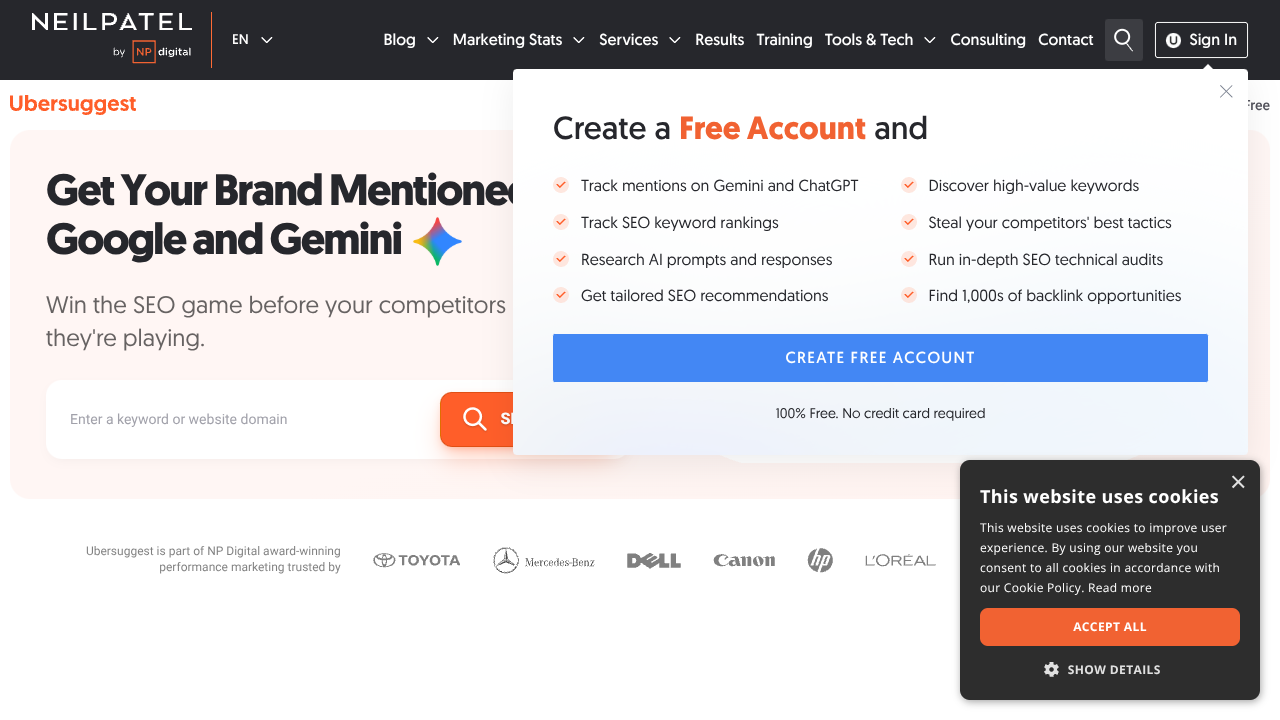
Ubersuggest is Neil Patel's beginner-friendly SEO tool. It blends organic traffic insights, keyword data, and backlink analysis into a simple dashboard. The Chrome extension is genuinely useful for instant traffic and keyword data while browsing competitor sites.
Key features: - 3 free searches per day with no credit card required. Chrome extension for instant keyword and traffic data while browsing. Organic traffic estimates with top-page and keyword breakdowns. Backlink analysis and SEO audit features on paid plans
Pricing: Free plan: 3 searches/day; Individual paid plan starts at $52/month (billed annually); lifetime plans also available as a one-time purchase
Three searches per day is tight. It works for a quick check but falls apart fast if you are auditing multiple competitors. The lifetime plan option is interesting. If you are a solo operator who wants a tool you pay for once and own forever, Ubersuggest is one of the few options that offers that. Traffic estimates are less reliable for low-traffic or niche sites compared to Semrush or Ahrefs.
8. SE Ranking Website Traffic Checker — Best for cost-effective all-in-one SEO
Best for: SEO freelancers, small agencies, and in-house marketers who need a cost-effective all-in-one platform with solid traffic estimation and rank tracking.
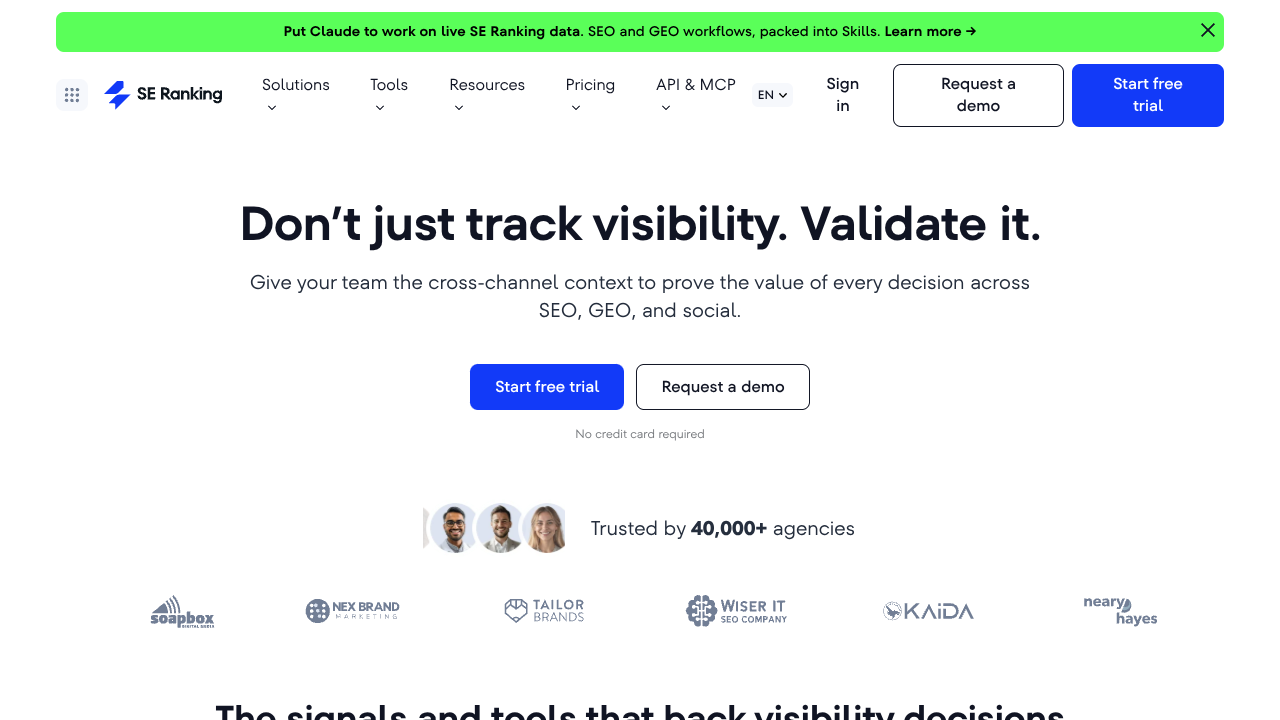
SE Ranking is an all-in-one SEO platform with a dedicated traffic checker that splits estimates into organic and paid search groups, with keyword, page, and geographic breakdowns. The entry price of $4.20/month (billed annually) makes it the most affordable paid option on this list by a wide margin.
Key features: - Organic vs. paid traffic split for any analyzed domain. Keyword, page-level, and geographic traffic breakdowns. Rank tracking, backlink checker, and website audit bundled in one platform. Competitor traffic comparison with trend analysis
Pricing: Free trial available; paid plans start at $4.20/month (billed annually) for the Essential tier, scaling up for agencies and enterprises
SE Ranking's traffic estimation accuracy is lower than Semrush or Ahrefs for high-volume competitive research. For small agencies and freelancers who need a Swiss Army knife at a fraction of the cost, the tradeoff is reasonable. Just do not treat its estimates as gospel for strategic decisions. Cross-reference with another source before you commit budget based on what SE Ranking reports.
Wondering if your brand is cited in AI answers? See your AI visibility score in 60 seconds.
9. Cloudflare Web Analytics — Best for privacy-first analytics
Best for: Privacy-conscious developers and site owners who want accurate, server-side traffic data without cookies, consent banners, or third-party tracking scripts.
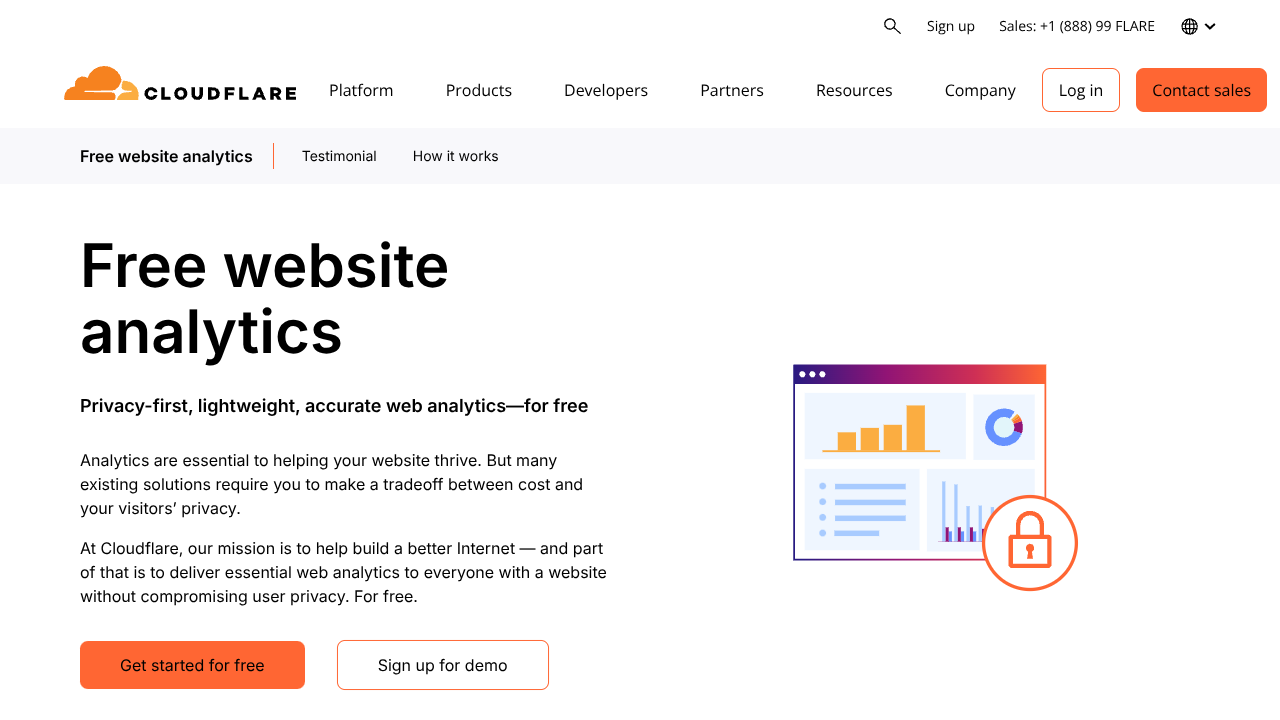
Cloudflare Web Analytics is a privacy-first, cookieless web analytics tool built into Cloudflare. It measures real page performance and visitor metrics without compromising user privacy or relying on client-side scripts. The fact that it is free on all Cloudflare plans, including the free tier, makes it one of the most generous free offerings on this list.
Key features: - Cookieless, privacy-preserving traffic measurement with no personal data collection. Available on all Cloudflare plans including the free tier. Page-level performance metrics without client-side JavaScript dependency. Identifies bot vs. human traffic including AI crawler classification (Mixed Purpose vs. Pure Training)
Pricing: Free on all Cloudflare plans, including the free Cloudflare tier. No paid upgrade required for core analytics
The AI crawler classification feature caught my attention. Cloudflare distinguishes between Mixed Purpose crawlers (AI engines that both index and train) and Pure Training crawlers. That distinction matters if you are thinking about what AEO is and how AI engines interact with your content. Cloudflare shows you which AI bots are hitting your site and how often. No other free analytics tool does this. The limitation is the same as GA4: it only measures your own site.
10. Sitechecker — Best for combined traffic and monitoring
Best for: Small business owners and in-house SEO teams who want a single tool that combines traffic checking, site monitoring, and rank tracking without juggling multiple platforms.
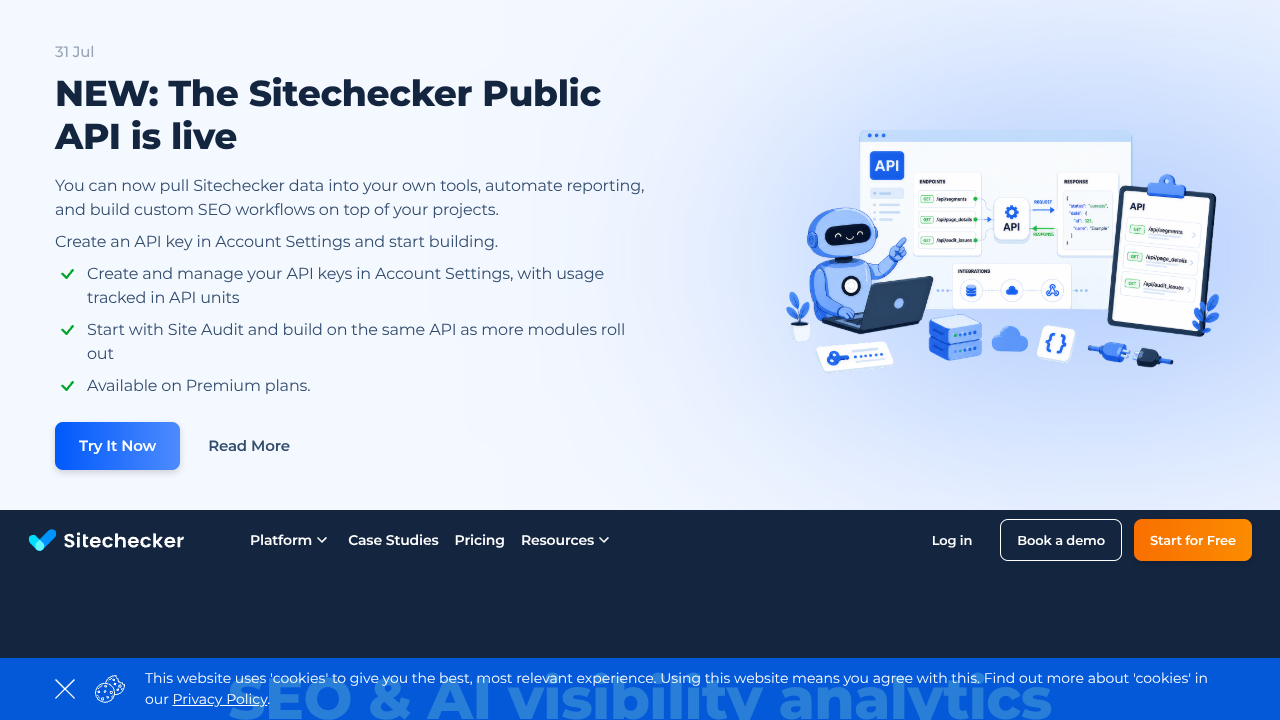
Sitechecker combines quick traffic analysis with website monitoring, rank tracking, and backlink analysis in a single dashboard. It is designed for teams that want one tool instead of five.
Key features: - Traffic overview combined with on-page SEO audit in one workflow. Website uptime monitoring and change-detection alerts. Rank tracking with keyword position history. Backlink analysis and new/lost link notifications
Pricing: Free plan available with limited checks; paid plans start at $41/month (billed annually); 7-day free trial on paid plans
Sitechecker's traffic estimates rely on third-party data models. They are less accurate than Semrush or Ahrefs for competitor research. Where Sitechecker adds value is in the combination of traffic data with uptime monitoring and SEO audits. If you are a small business owner who wants a single dashboard instead of a tech stack, Sitechecker fills that role at a reasonable price.
11. Lookkle Website Traffic Checker — Best for instant, no-signup lookups
Best for: Digital marketers, affiliate marketers, and content creators who need quick, frictionless competitor traffic snapshots without committing to a paid tool or creating an account.
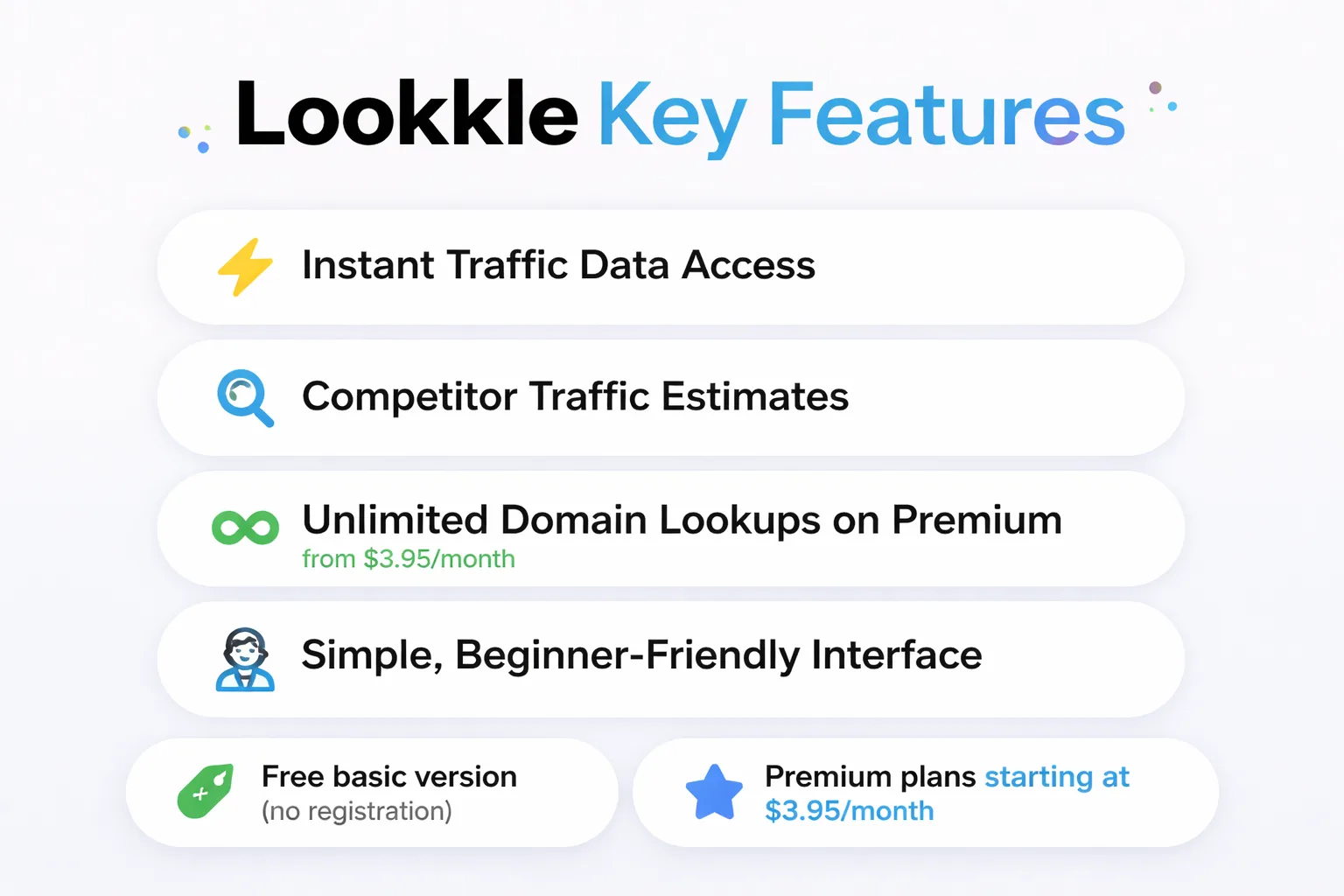
Lookkle is a no-signup, instant-access free traffic analysis tool. You type in a domain, and you get traffic data without authentication or account creation. The premium tier at $3.95/month for unlimited reports is the cheapest unlimited option on this list.
Key features: - Instant traffic data access with no account or signup required. Competitor traffic estimates with source and channel breakdowns. Unlimited domain lookups on premium plans starting at $3.95/month. Simple, beginner-friendly interface with no setup or installation needed
Pricing: Free basic version with no registration required; premium plans starting at $3.95/month for unlimited reports
Lookkle has a less established data infrastructure than Semrush, Ahrefs, or Similarweb. Estimate accuracy reflects that. Think of Lookkle as a quick-check tool for when you need a rough number in five seconds, not as your primary research platform. The free tier lacks historical data and advanced filtering. For $3.95/month, unlimited lookups are hard to argue with if your needs are basic.
How Accurate Are Free Traffic Estimates Really?
This is the question I get asked most often. The answer depends entirely on which tool you use and what size site you are checking.
For sites with 50,000+ monthly visitors, Semrush's clickstream-based estimates land within 10-15% of actual traffic. That is good enough for competitive benchmarking. Ahrefs' search-index-based estimates are similarly reliable for organic traffic but less so for other channels. Below 50K monthly visitors, accuracy degrades significantly. I have seen Semrush show 20-40% variance for smaller sites. Ahrefs has similar issues.
The fundamental problem is data sourcing. Clickstream panels (Semrush, Similarweb) rely on data from millions of devices, but that panel skews toward certain demographics and geographies. Search-index models (Ahrefs) estimate traffic from keyword rankings and search volume, which means they miss direct, referral, and social traffic entirely.
Here is my recommendation for cross-referencing. Use two tools. Pull Semrush or Similarweb for the channel-mix breakdown. Pull Ahrefs for the keyword-level attribution. Compare the organic traffic estimates from both. If they are within 15% of each other, you can trust the number. If they diverge significantly, the site is either too small for reliable estimation or has an unusual traffic pattern that clickstream panels cannot capture.
For your own site, always trust GA4 and Search Console over any third-party estimator. First-party data is ground truth. Third-party data is an educated guess.
Can Any Tool Show AI-Referred Traffic?
This is where the market has a massive gap. And it frustrates me.
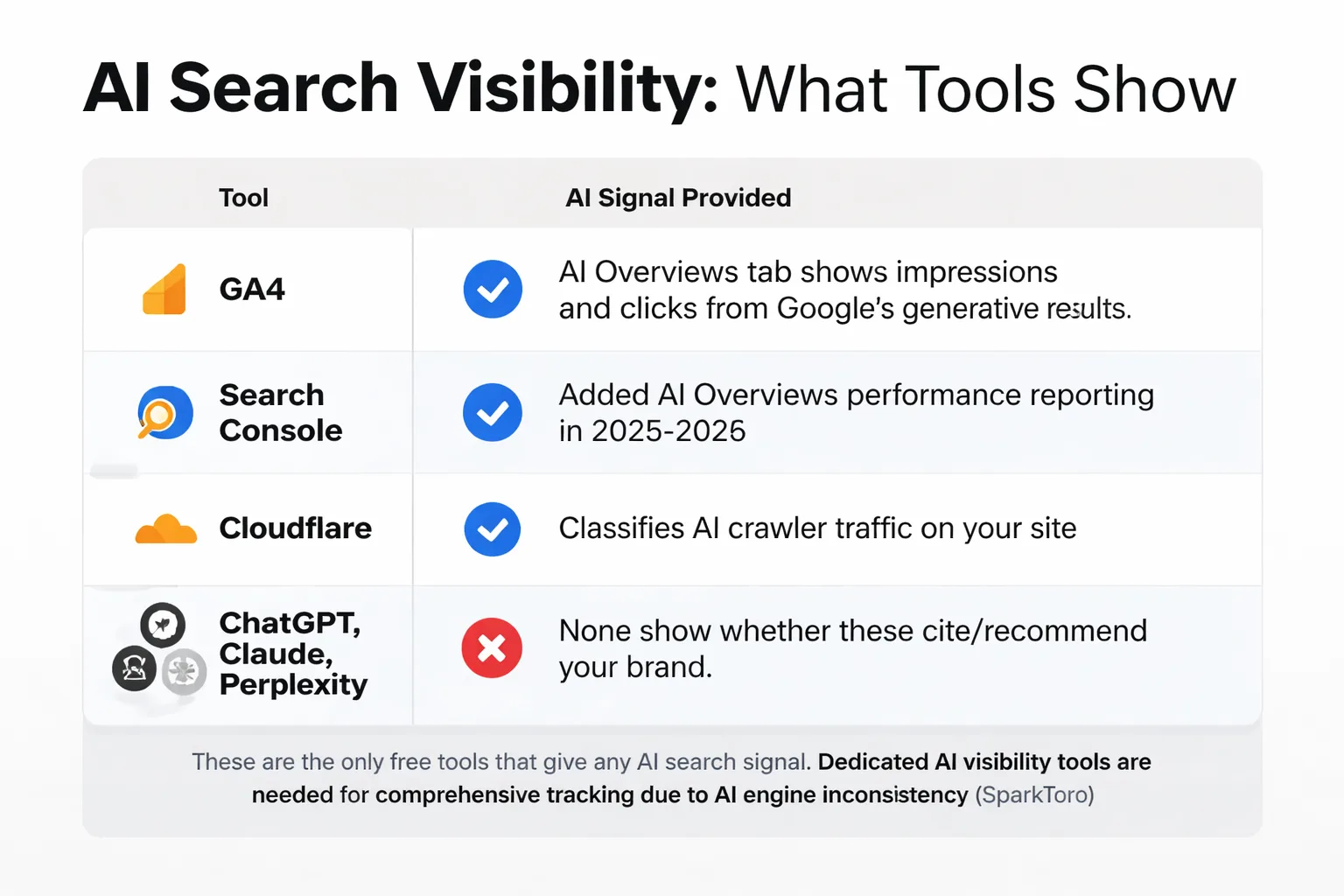
GA4's AI Overviews tab shows impressions and clicks from Google's generative results. Search Console added AI Overviews performance reporting in 2025-2026. Cloudflare classifies AI crawler traffic on your site. Those are the only free tools that give you any AI search signal at all.
None of them show you whether ChatGPT cites your brand. None of them show you whether Claude recommends your product. None of them show you whether Perplexity includes you in its sourced answers. That is an entirely different category of measurement, and it requires a dedicated AI visibility tool.
I want to be specific about why this matters. SparkToro's research found that AI engines are highly inconsistent when recommending brands. The same prompt can produce different brand lists across runs. That means any tool claiming to track AI visibility needs to account for that inconsistency through repeated sampling. A single prompt run is not data. It is anecdote.
According to SparkToro's research, zero peer-reviewed studies validate whether ChatGPT, Claude, or Google AI produce consistent brand recommendation lists suitable for tracking. Companies spend an estimated $100M+ annually on AI visibility tracking without this foundational validation. That should give every marketer pause.
The practical takeaway: use GA4 and Search Console to track AI Overviews traffic for free. For LLM citation tracking across ChatGPT, Claude, Gemini, Perplexity, and Grok, you need a specialized platform. Traffic checkers will not give you this data. They were not built for it.
When Free Is Enough and When to Upgrade
Free is enough when you need a one-time competitive snapshot. You are evaluating a new competitor. You want to know if a potential partner's site gets meaningful traffic. You are benchmarking your own site against an industry average. For these use cases, Semrush's 10 free searches, Ahrefs' free checker, or Similarweb's free tier will serve you well.
Free is not enough when you need ongoing monitoring. If you are tracking 5+ competitors weekly, free tiers will frustrate you within days. The search caps are designed to push you toward paid plans, and the data refresh cycles (monthly for most tools) are too slow for active competitive intelligence.
Here is the decision framework I use. If you check traffic data less than once a month, stay on free tiers. Rotate between tools to maximize your free lookups. If you check weekly, invest in one paid tool. Semrush or Ahrefs at the Pro/Lite level gives you the depth you need. If you check daily or manage multiple clients, you need an agency-tier subscription or a platform that bundles traffic data with rank tracking and content intelligence.
The upgrade I see most teams miss is not from a free traffic checker to a paid one. It is from traffic checking to AI visibility tracking. Traffic data tells you what happened. AI visibility data tells you what is happening. In a world where generative engine optimization determines whether your brand appears in the answers potential customers read, what is happening matters more than what happened.
Pair your traffic checker with an AI SEO tool that tracks citations across LLMs. The traffic checker gives you the baseline. The AI visibility tracker gives you the leading indicator. You need both.
Making the Right Choice for Your Team
The right choice depends on one question: what are you actually trying to learn?
If you want to know how much traffic your own site gets, use GA4 and Search Console. Both are free, both are accurate, and both now include AI Overviews data. There is no reason to pay for first-party traffic measurement.
If you want to estimate competitor traffic, use Semrush or Ahrefs. Semrush gives you better channel-mix data. Ahrefs gives you better keyword-level attribution. Pick the one that matches your question. Use the free tiers first. Upgrade when you hit the search caps consistently.
If you want to understand AI search visibility, none of the tools on this list (except Meev) will give you what you need. Traffic checkers measure visits. AI visibility tools measure citations. These are fundamentally different metrics. A site can get 100K monthly organic visits and zero AI citations. Another site can get 10K monthly visits and be cited in every ChatGPT answer for its topic. Traffic volume does not predict AI visibility.
That is the contrarian take I want you to walk away with. Traffic volume is becoming decoupled from AI visibility. The sites that AI engines cite are not always the sites with the most traffic. They are the sites with the strongest entity signals, the most authoritative third-party coverage, and the clearest structured data. If you are only tracking traffic, you are watching the wrong metric for 2026.
For teams that want to cover both bases, here is the stack I recommend. GA4 and Search Console for your own site (free). Semrush or Ahrefs for competitor traffic (free tier or paid). Meev for AI citation tracking and content generation (free trial, then paid). That combination gives you first-party data, competitive intelligence, and AI visibility in one workflow.
FAQ
How do I check web traffic of a website for free?
Use Ahrefs' free traffic checker for the fastest no-signup lookup. For deeper data, use Semrush's free tier (10 searches/day) or Similarweb's free version (10 domains/day). For your own site, install GA4 and Search Console for 100% accurate first-party data. None of these tools require payment for basic traffic estimates.
Is website traffic information free accurate?
For your own site, yes. GA4 and Search Console provide exact data from your tracking code and Google's index. For competitor sites, accuracy varies. Semrush estimates are within 10-15% for sites with 50,000+ monthly visitors but can show 20-40% variance for smaller sites. Ahrefs is similarly accurate for organic traffic but less comprehensive for other channels. Always cross-reference two tools for competitor data.
Can any tool show AI-referred traffic?
GA4 and Google Search Console now include AI Overviews reporting, showing impressions and clicks from Google's generative search results. Cloudflare Web Analytics classifies AI crawler traffic on your site. For AI citation tracking across ChatGPT, Claude, Gemini, Perplexity, and Grok, you need a dedicated AI visibility platform. Standard traffic checkers do not measure LLM citations.
What is rankability and does it affect traffic estimates?
Rankability refers to how easily a page can rank for a given keyword based on competition, content quality, and domain authority. It does not directly affect traffic estimates from tools like Semrush or Ahrefs. Those tools estimate traffic based on current rankings and search volume. However, rankability affects your actual traffic potential. A page with high rankability for a high-volume keyword will generate more traffic over time, which traffic checkers will eventually reflect in their estimates.
How often do free traffic checkers update their data?
Most free traffic checkers update monthly. Semrush, Ahrefs, and Similarweb refresh their estimates approximately every 30 days. Ubersuggest and SE Ranking update weekly on paid plans but less frequently on free tiers. GA4 and Search Console provide real-time or daily data for your own site. Cloudflare Web Analytics is real-time.
Should I use multiple traffic checkers?
Yes. No single tool is perfectly accurate for competitor estimates. I recommend cross-referencing Semrush and Ahrefs for organic traffic. If their estimates are within 15% of each other, the data is reliable. If they diverge significantly, the site is likely too small for accurate estimation. For your own site, GA4 and Search Console are sufficient and do not need cross-referencing.
The free website traffic checker you choose matters less than what you do with the data. Traffic estimates tell you where competitors stand today. AI visibility tracking tells you where you will stand tomorrow. Use both.
About the Author
Judy Zhou, Founder
Judy Zhou leads content strategy at Meev, where she oversees AI-driven content research and publishing for hundreds of brands. With a background in SEO and editorial operations, she focuses on building content systems that rank on Google, get cited by AI search engines, and drive measurable business results.
Stop guessing at AI search visibility. Run a free AI citation audit and see exactly where your brand appears across ChatGPT, Claude, Perplexity, and Google AI Overviews.