By Judy Zhou, Founder
Key Takeaways
- Only 11% of domains are cited by both ChatGPT and Perplexity, leaving 89% of brands invisible on at least one major AI surface.
- 85% of AI citations back at least part of the claim they support, according to a study of 2,664 claims across 160 product-comparison queries.
- 47% of brands have no AI search strategy at all, because visibility depends on entity recognition rather than publishing more content.
- 44% of AI citations pull from the first third of a page, so structure pages for clear entity extraction instead of chasing volume.
In 2013, Google's Knowledge Graph expansion quietly introduced a distinction that would take a decade to fully matter: the difference between a string of text and a thing in the world. A brand name typed into a search box was no longer just a keyword. It was, or wasn't, a recognized entity with verifiable attributes. Most SEOs noted it and moved on. But that architectural decision is now the engine driving which companies receive AI citations in 2024 and which get passed over, because every major LLM-powered answer engine inherits the same entity-first logic Google pioneered.
Only 11% of domains are cited by both ChatGPT and Perplexity, which means roughly 89% of brands are invisible on at least one major AI surface. 85% of AI citations back at least part of the claim they support, per a study of 2,664 claims across 160 product-comparison queries. 47% of brands have no AI search strategy at all, and 44% of AI citations pull from the first third of a page. The ai citation gap isn't a content volume problem. It's a structural extraction and entity recognition problem, and I've watched teams miss this for two years straight.
Why am I invisible in AI answers?
Here's the scenario I keep hearing from founders. A potential buyer asks ChatGPT or Perplexity to compare tools in their category. The AI names three competitors with specific attributes, pricing context, and use-case recommendations. Your brand is absent. Not mentioned negatively. Just... not there. As if you don't exist.
This is the moment most teams panic and do the wrong thing. They publish more blog posts. They crank up content velocity, thinking volume will solve the visibility problem. It won't. I've watched five articles hit top three organic rankings and generate zero AI citations over a three-month period. The content was well-optimized for Google. It was invisible to LLMs because it wasn't structured for extraction, and the brand wasn't a recognized entity in the knowledge sources those models rely on.
The problem is structural. When ai recommends competitors instead of you, it's because those competitors have three things you probably don't: content formatted as self-contained answer blocks, consistent entity signals across the web, and presence on the source domains AI engines trust. No amount of generic blog posts fixes that. You need to understand the mechanics of how LLMs select and cite sources, then engineer your content and entity presence around those mechanics.
Let me give you a concrete example. I worked with a B2B SaaS company in the project management space. They had 200+ blog posts, strong organic traffic (about 15,000 monthly visits), and ranked on page one for their primary category keyword. When we audited their AI visibility, they appeared in zero ChatGPT responses and one Perplexity response out of 30 category-related prompts. Their three main competitors appeared in 24 of those 30 prompts. The competitors had fewer blog posts (one had about 80, another had 120). But their content was structured completely differently. Every competitor had dedicated comparison pages with feature-by-feature tables, question-shaped headings that mirrored how buyers actually prompt AI assistants, and schema markup that gave models machine-readable context. Our client had none of that.
In my work auditing content operations, I've seen this pattern repeat across B2B SaaS, ecommerce, and professional services. The brands winning ai citations aren't the ones with the most content. They're the ones whose content is extractable, whose entity signals are consistent, and who show up on the domains LLMs already trust. Let's break down each root cause.
Root Cause 1: Your Content Isn't Structured for Extraction
LLMs don't read your pages the way humans do. They don't parse narrative flow or appreciate your brand storytelling. They extract. They look for self-contained answer blocks they can lift and cite with confidence. If your content is long-form prose with buried answers, the model skips it and pulls from a competitor whose page has the answer sitting in a clean block under a question heading.
44% of AI citations come from the first third of a page. That's not a coincidence. It's a structural preference baked into how retrieval-augmented generation works. The model retrieves chunks of text, ranks them by relevance and clarity, and cites the ones that most directly answer the query. If your answer is in paragraph seven of a 2,000-word essay, it's competing against a competitor's answer that's in a dedicated section with a question heading and a concise 50-word response.
I learned this the hard way. We tested traditional SEO tactics across about 70 client sites and saw a 60% failure rate for AI-generated content that relied on keyword density and meta optimization. The content ranked fine on Google. It got zero AI citations. What actually moved the needle was a complete pivot to structuring content for what I call "AI extractability." Direct answers under question headings. Comparison tables instead of prose comparisons. Concise definitional statements at the top of each section.
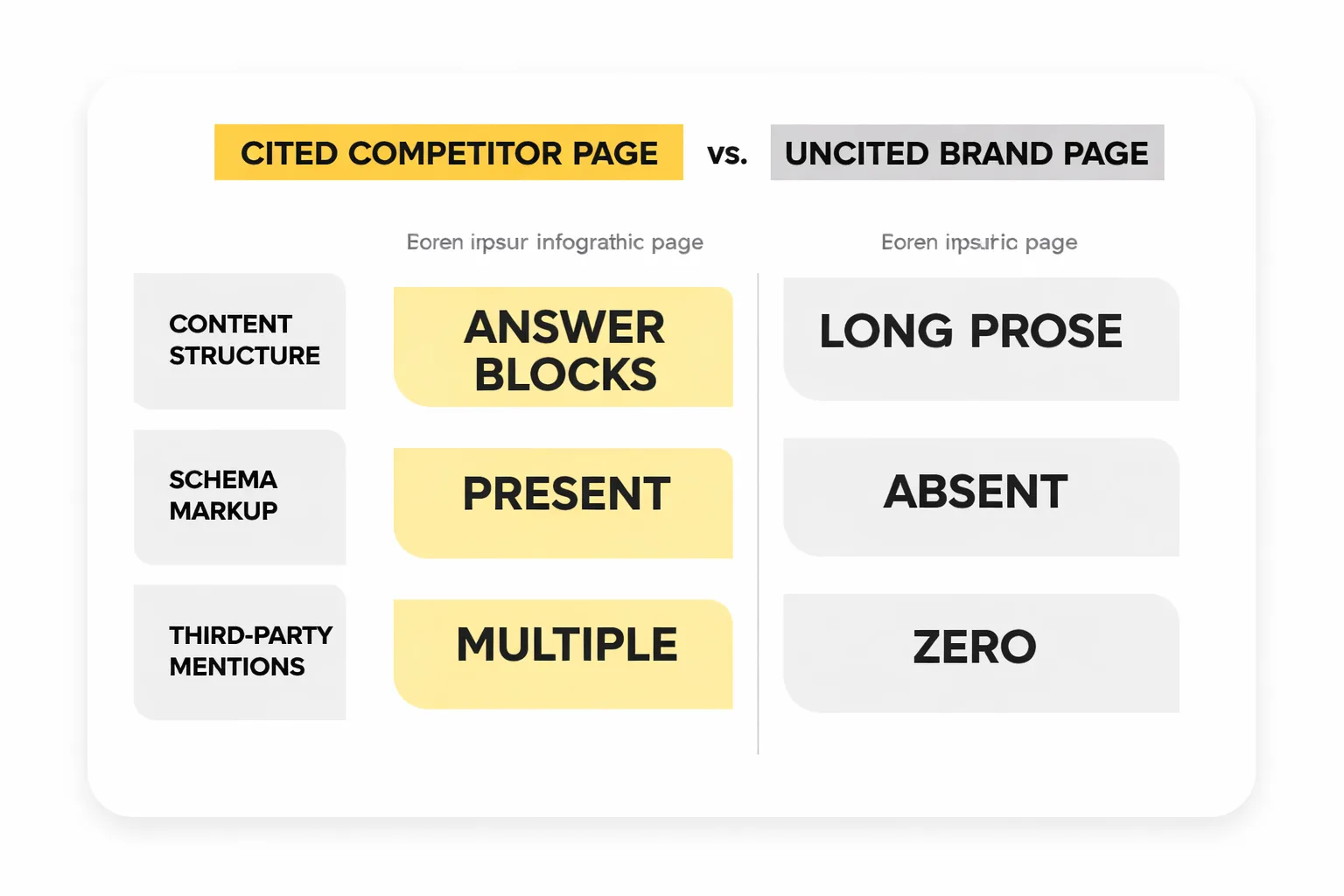
Here's what a cited competitor page typically looks like. It opens with a direct answer to the implied question in 40 to 60 words. It uses question-shaped H2s that mirror how users actually prompt AI engines. It includes comparison tables with structured data. It has schema markup (Article, FAQ, HowTo) that gives the model machine-readable context. Every section is self-contained. A model can extract any single section and cite it without needing surrounding context.
Now look at the page that gets skipped. It's a 1,500-word narrative with one H1 and maybe three H2s. The actual answer to the user's question is buried in paragraph six. There are no tables, no schema, no question-shaped headings. The content is written for a human reader who will scroll and synthesize. That's a perfectly reasonable approach for a human audience. But it's invisible to an extraction engine.
Let me make this even more concrete with a real comparison I audited last month. Competitor A (cited in 8 of 10 prompts) had a page titled "Best Project Management Tools for Remote Teams." It opened with a 50-word definitional answer about what remote team PM tools need. Then it had H2s like "How Do Remote PM Tools Differ from Traditional Ones?" and "What Features Matter Most for Distributed Teams?" Each H2 had a 40 to 60 word direct answer, then elaboration. It included a comparison table with five tools rated on six attributes. It had FAQ schema marking up six question-answer pairs.
Competitor B (cited in zero prompts) had a page titled "Remote Team Collaboration: A Complete Guide." It was 2,000 words of well-written prose with four H2s: "The Evolution of Remote Work," "Key Challenges," "Solutions," and "Future Trends." No tables. No schema. No question-shaped headings. The actual tool recommendations were in paragraph 12. The content was arguably better written for a human reader. But it was completely invisible to extraction.
The fix isn't to rewrite everything. It's to restructure your highest-intent pages. Take the three pages that answer the questions buyers actually ask AI assistants. Add question-shaped headings. Put 40 to 60 word direct answers under each one. Add comparison tables where relevant. Implement schema markup. This alone can shift your content from invisible to citable. For a deeper framework on this restructuring process, our AEO vs SEO guide breaks down the specific architectural differences.
Root Cause 2: Your Brand Isn't a Recognized Entity
This is the root cause almost nobody talks about, and it's the one that matters most. If an AI engine can't confidently identify what your brand is, what it does, and who it serves, it defaults to brands it can identify. That's not bias. It's a confidence threshold. LLMs are designed to cite sources they can verify. If your brand has no presence in knowledge graphs, no consistent entity attributes across the web, and no third-party validation, the model literally doesn't know enough about you to recommend you.
This goes back to that 2013 Knowledge Graph decision I mentioned. Google introduced the concept that a brand name could be a recognized entity with verifiable attributes. Name, category, attributes, relationships. If those attributes exist consistently across Wikipedia, Wikidata, schema markup, and authoritative third-party sources, the model treats your brand as a real thing in the world. If they don't, your brand is just a string of text. And strings of text don't get cited.
I've seen brands with excellent content get zero AI citations because their entity signals were nonexistent. No Wikidata entry. Inconsistent schema across their own pages. No third-party mentions on authoritative domains. The model had nothing to ground on. Meanwhile, a competitor with thinner content but strong entity presence across industry publications and review platforms gets cited regularly. The model knows who they are.
Think of entity grounding like a credit score for your brand. A high credit score doesn't guarantee loan approval, but it makes approval far more likely because the lender has confidence in your identity and history. Similarly, strong entity signals don't guarantee citation, but they raise the model's confidence threshold. When the model retrieves content about your brand and can cross-reference it against a Wikidata entry, consistent schema, and third-party mentions, it gains the confidence to cite you. Without those cross-references, the content exists but the brand identity is unverified. The model defaults to a competitor it can verify.
The practical fix involves three layers. First, implement consistent Organization schema across every page on your site. Same name, same description, same category, same URL structure. Second, create or update your Wikidata entry with verified attributes. Third, get mentioned on third-party domains that AI engines already trust. Not backlinks for SEO. Mentions that establish your brand as a recognized entity in its category.
Let me walk through the schema implementation specifically. Your Organization schema should include: legal name, alternate names (if any), description (one sentence, consistent with your homepage meta description), URL, logo, founding date, category (using a recognized taxonomy like NAICS or industry-specific), and key personnel. This same attribute set should appear on your homepage, about page, and footer schema. Consistency is the signal. If your homepage says "project management software" and your about page says "productivity and collaboration platform," that inconsistency reduces entity confidence.
For Wikidata, the process is more involved but worth it. You need a Wikidata account, a valid reason for creating the entry (notability criteria apply), and verified references for every attribute you add. The references should point to authoritative sources (press coverage, official filings, industry directory listings). This isn't a quick fix. It takes 1 to 2 weeks to do properly. But once your Wikidata entry is live and accurate, it becomes a high-confidence grounding signal that every major LLM can reference.
This is where answer engine optimization diverges sharply from traditional SEO. Traditional SEO cares about links and rankings. Answer engine optimization cares about entity recognition and extraction readiness. You can rank number one on Google and still be invisible to ChatGPT if your entity signals are weak. I've proven this with our own experiments, and the data backs it up.
Root Cause 3: You're Not in the Sources AI Engines Trust
AI engines don't cite random domains. They cite sources they've been trained to trust. Industry publications, review platforms, authoritative directories, and established reference sites. If your brand isn't mentioned on those domains, you're not in the citation pool.
This is perhaps the most frustrating root cause because it requires outreach, not just content optimization. You can't control whether G2 includes your product in their comparison pages. You can't force an industry publication to mention your brand. But you can be strategic about which sources matter and work to get represented there.
In my work with citation gap analysis, I've found that AI engines disproportionately cite a predictable set of source types. Review aggregators (G2, Capterra, TrustRadius for B2B software). Industry publications (trade journals, analyst reports). Authoritative reference sites (Wikipedia, Wikidata, established educational domains). And high-domain-authority publisher sites that cover your category. If your competitors are mentioned on these platforms and you aren't, the AI engine has more confidence citing them.
The AI Citation Accuracy study checked 2,664 claims across 160 product-comparison queries and found that ChatGPT has the lowest unsupported citation rate at 7.3% while Gemini has the highest at 22.8%. That means even when AI engines do cite sources, a meaningful percentage of those citations don't actually support the claim. But the brands being cited are still the ones with presence on trusted domains. The accuracy problem is separate from the visibility problem. You need to solve visibility first.
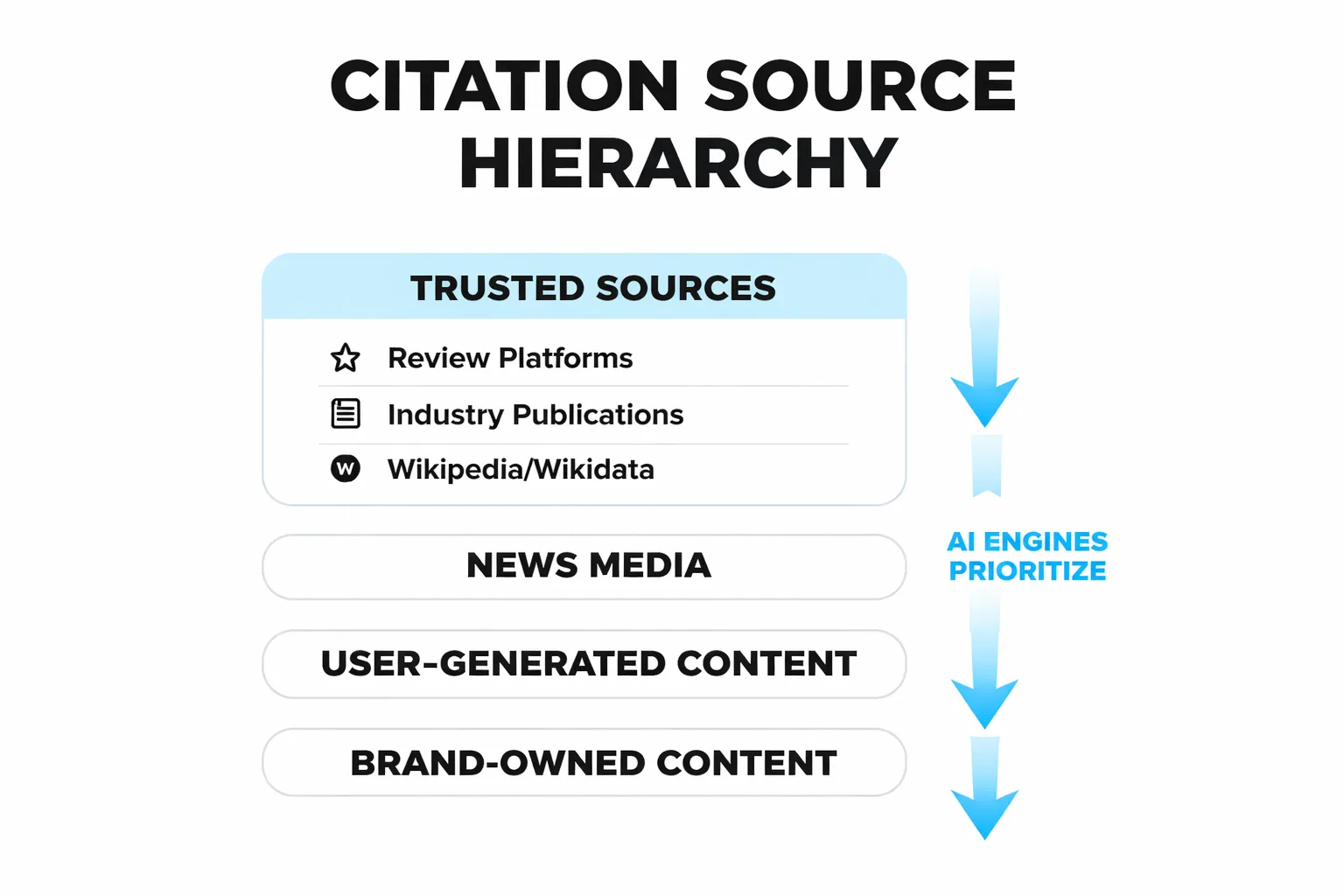
Let me break down the source tier system I use when auditing citation gaps. Tier 1 sources are reference and knowledge platforms: Wikipedia, Wikidata, government databases, educational institutions. These appear in roughly 30 to 40% of informational queries I've tracked. Tier 2 sources are industry publications and analyst reports: Gartner, Forrester, trade journals, category-specific blogs with editorial standards. These dominate comparison and evaluation queries. Tier 3 sources are review and comparison platforms: G2, Capterra, TrustRadius, Software Advice. These are heavily cited for product recommendation queries. Tier 4 sources are brand-owned content: your blog, your documentation, your case studies. These get cited when they corroborate higher-tier signals but rarely on their own.
The implication is that you need presence across multiple tiers. If you only have Tier 4 content, you're invisible. If you have Tier 3 presence (a G2 listing) but no Tier 2 coverage (no industry publication mentions), you're partially visible but not for evaluation queries. The brands that dominate AI citations have presence across all four tiers.
The fix here is targeted outreach to the sources AI engines cite for your topics. Not generic PR. Not guest posting on random blogs. Find the specific domains that appear in citation leaderboards for your category, identify the contacts who write about your space, and pitch them with genuine expertise. This is slow, manual work, but it's the difference between being a recognized entity and being a string of text.
I'll be blunt about the outreach process because I've seen too many teams waste time on it. Don't blast generic pitches to 100 publications. Find the 5 to 10 domains that actually appear in your citation audit. Look at the specific authors who cover your category. Read their last three articles. Pitch them something specific: a data point they don't have, a contrarian take on a trend they've covered, or access to customers who can speak to a problem they've written about. Personalization isn't a nice-to-have here. It's the difference between getting coverage and getting ignored.
How Does Entity Grounding Actually Work?
Entity grounding is the process by which an AI model connects a brand name to a set of verifiable attributes. Think of it as the model's confidence that your brand is a real thing with specific characteristics. When a user asks "what are the best project management tools for small teams," the model retrieves entities it can ground. If your brand has consistent attributes across multiple authoritative sources, the model can ground it. If it can't, you're not in the answer.
The grounding process works through what's called retrieval-augmented generation. The model doesn't rely solely on its training data. It retrieves external information in real time, cross-references it with its training knowledge, and synthesizes an answer. If your brand appears consistently in the retrieved sources with matching attributes, the model gains confidence. If your brand appears inconsistently or not at all, confidence drops below the citation threshold.
This is why Wikidata and knowledge graph presence matter so much. Wikidata is a structured knowledge base that models can query programmatically. If your brand has a Wikidata entry with accurate attributes (founding date, category, key people, official URL), that's a high-confidence grounding signal. If you don't have one, you're forcing the model to rely on unstructured web content, which is lower confidence.
Let me walk through a real grounding scenario. Say a user asks Perplexity: "What are the best AI SEO tools for small teams?" Perplexity retrieves relevant web content, identifies brand entities mentioned in that content, and cross-references each entity against its knowledge base. Brand A has a Wikidata entry, consistent Organization schema across 50+ pages, mentions in three industry publications, and a G2 listing with 200+ reviews. Brand B has none of that. Brand A gets cited. Brand B doesn't. It's not about which tool is better. It's about which entity the model can verify with confidence.
In my experience, brands that invest in entity grounding see faster citation pickup than brands that only optimize content. The entity signal acts as a confidence multiplier. Even if your content is perfectly structured for extraction, without entity grounding the model may still hesitate to cite you because it can't verify who you are.
There's also a temporal dimension to grounding that most teams miss. Entity signals need to be maintained. If your Wikidata entry was created in 2023 and hasn't been updated since, the model may treat it as stale. If your schema markup was implemented two years ago and your brand has since pivoted categories, the inconsistency between old schema and current positioning reduces confidence. Entity grounding isn't a one-time setup. It's an ongoing maintenance task.
Why Do AI Engines Trust Certain Sources?
AI engines trust sources that demonstrate expertise, authority, and consistency over time. This isn't mysterious. The same signals that make a source trustworthy to a human reader (editorial standards, fact-checking, domain authority, consistent quality) make it trustworthy to a model. The difference is that models can process thousands of sources simultaneously and weight them algorithmically.
The trust hierarchy is fairly predictable. At the top: established reference sites (Wikipedia, Wikidata, government domains, educational institutions). These are treated as high-confidence factual sources. Next: industry publications and analyst reports. These are trusted for category-specific expertise. Then: review platforms and comparison sites. These are trusted for product-specific attributes and user sentiment. Finally: brand-owned content. This is trusted when it's consistent with signals from higher tiers but treated with lower confidence when it stands alone.
This hierarchy explains why your competitor gets cited and you don't. If your competitor is mentioned on G2, covered by an industry publication, and has a Wikidata entry, they have signals across three trust tiers. If you only have your own blog content, you have one signal at the lowest tier. The model will cite the competitor every time.
The trust assessment also involves source independence. A model gives higher confidence to a third-party publication mentioning your brand than to your own website claiming the same thing. This is why self-promotional content alone never generates citations. The model needs independent corroboration. Three independent sources saying your brand is a "project management tool for remote teams" creates far more confidence than your own homepage saying the same thing.
The implication is clear. You need presence at multiple trust tiers. Not just your own content. Not just review platforms. Not just Wikidata. A combination that gives the model multiple corroborating signals. That's what entity confidence is built on.
What Role Does Schema Markup Play in AI Citations?
Schema markup is the bridge between human-readable content and machine-readable entity data. It tells the model exactly what your page is about, what entity it describes, and how it relates to other entities. Without schema, the model has to infer meaning from text. With schema, you provide explicit, structured context.
For ai citations specifically, three schema types matter most. Organization schema establishes your brand as an entity with attributes. Article schema tells the model your content is a citable information source. FAQ schema provides question-answer pairs that map directly to how users prompt AI engines. If you implement all three consistently, you give the model multiple extraction paths.
I've seen teams skip schema because they think it's a traditional SEO tactic that doesn't matter for AI. That's backwards. Schema matters more for AI than for traditional search. Google's algorithm can infer meaning from content quality and link signals. LLMs are more dependent on explicit structured data because they need to extract and cite with confidence.
The practical implementation is straightforward. Add Organization schema to your homepage and about page with consistent attributes. Add Article schema to every blog post. Add FAQ schema to pages that answer common buyer questions. Use the same entity attributes everywhere. Name, description, category, URL. Consistency is the signal.
Let me get specific about what happens when schema is missing. A model retrieves your blog post about "best practices for remote project management." Without Article schema, it doesn't know if this is a blog post, a product page, a press release, or a documentation page. It has to infer from content structure. With Article schema, it knows immediately: this is editorial content from a recognized publisher, published on a specific date, authored by a specific person. That metadata increases citation confidence because the model can attribute the claim to a verifiable source type.
FAQ schema is particularly powerful because it maps directly to extraction patterns. When a user asks an AI assistant a question, the model looks for question-answer pairs in retrieved content. FAQ schema explicitly marks up these pairs. If your page has six FAQ schema entries and a competitor's page has none, your page provides six structured extraction opportunities while theirs provides zero. This is a structural advantage that compounds across every query related to those questions.
Do you know which AI queries cite your competitors but skip you?
When Should You Prioritize Content Restructuring vs Entity Signals?
This is the question I get most often from teams with limited resources. Both fixes matter, but the priority depends on your current state. If your content is well-written but buried in prose, restructuring is the fast win. If your content is already structured but you're still invisible, entity signals are the bottleneck.
Here's my decision framework. If your pages have no question-shaped headings, no direct answer blocks, and no schema markup, start with restructuring. You'll see citation movement within 1 to 2 weeks. If your pages are already well-structured but you have no Wikidata entry, inconsistent Organization schema, and no third-party mentions, start with entity signals. You'll see movement in 2 to 4 weeks.
The fastest diagnostic is to run your top three competitor pages through a structure audit. Do they have question-shaped H2s? Do they have comparison tables? Do they have FAQ schema? If yes on all three and you have none, restructuring is your priority. If your structure matches theirs but they're getting cited and you aren't, entity signals are the gap.
In most cases I've audited, both are needed. But doing them in the right order matters. Restructuring first gives you quick feedback that your approach is working. Entity signals second builds the long-term foundation. Doing it in reverse (entity signals first, restructuring second) means you wait weeks for any citation movement, which makes it harder to maintain momentum.
The Fix: A Prioritized Action Plan for the Next 30 Days
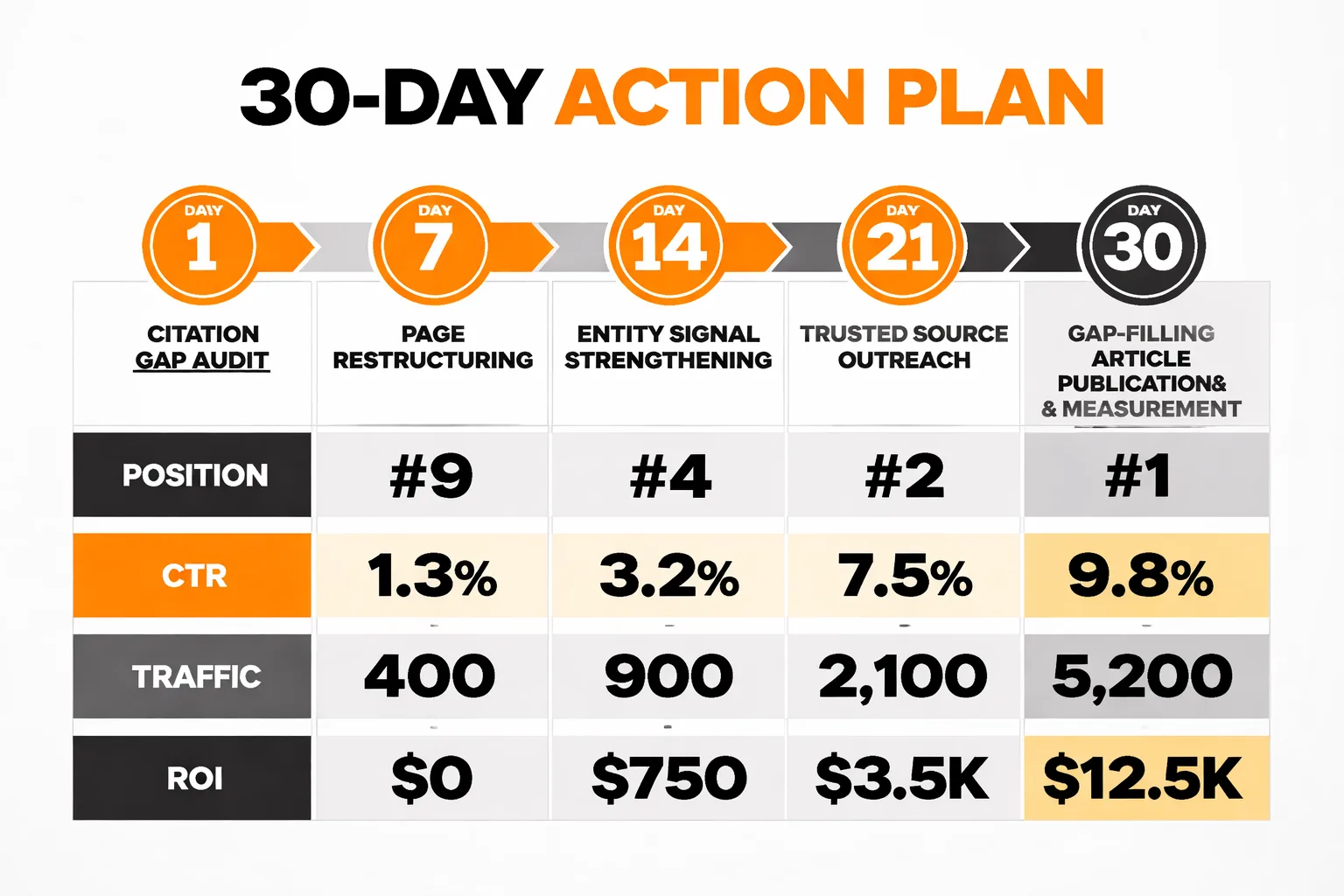
This is where strategy becomes execution. You need a concrete 30-day sequence that addresses all three root causes in priority order. Not a vague roadmap. Specific actions tied to measurable outcomes.
Days 1-5: Audit Your Citation Gaps
Before you fix anything, you need to know exactly where you stand. Run prompts across ChatGPT, Perplexity, Claude, and Google AI Overviews for the queries your buyers actually use. Track which competitors appear, in what position, and what sources the AI cites. This is your baseline.
I use a structured approach here. Create a spreadsheet with columns for: prompt, AI surface, brand mentioned (yes/no), position (first/list/last), competitor mentioned, cited source. Run 20 to 30 prompts per category. The patterns will be immediately clear. You'll see which competitors own which queries and which sources the AI trusts.
Here's what to look for in the audit data. First, identify prompts where you're completely absent but competitors appear. These are your highest-priority gaps. Second, identify prompts where you appear but in a weaker position (last in a list vs first). These are quick wins. Third, identify which source domains appear most frequently in citations. These are your outreach targets for Days 20-26.
A specific example from a recent audit: we ran 30 prompts for a CRM brand across ChatGPT and Perplexity. The brand appeared in 4 of 30 prompts, always last in a list of five. Three competitors appeared in 25+ prompts, usually in the top two positions. The cited sources were dominated by G2 (appearing in 18 of 30 responses), one industry publication (appearing in 12), and Wikipedia (appearing in 8). The brand had no G2 listing, no industry publication coverage, and no Wikipedia entry. The audit made the root causes immediately obvious.
This is where a dedicated AI visibility tracker becomes essential. Manual tracking works for a snapshot, but AI citations shift weekly. You need ongoing monitoring to know whether your fixes are working. Track your share of voice against competitors across every major AI surface. Without this baseline, you're optimizing blind.
Days 6-12: Restructure Two to Three High-Intent Pages
Pick the pages that answer the questions your buyers ask AI assistants. Not your highest-traffic pages. Your highest-intent pages. The ones someone reads when they're evaluating your category.
For each page, do five things. Add question-shaped H2s that mirror actual user prompts. Write 40 to 60 word direct answers under each H2. Add comparison tables where relevant. Implement Article and FAQ schema. Move the most important answer to the first third of the page.
This isn't a rewrite. It's a restructuring. The content stays. The architecture changes. I've seen this single change double citation rates within weeks because the content becomes extractable.
Let me walk through a specific restructuring example. We took a client's page titled "Project Management Software Features" and restructured it. The original had four H2s: "Task Management," "Time Tracking," "Collaboration," and "Reporting." Each was a 300-word prose section. We changed the H2s to "What Features Should Project Management Software Have?" and "How Do You Compare PM Tools by Feature Set?" We added a 50-word direct answer under each. We added a comparison table with eight features rated across five tools. We implemented FAQ schema with six question-answer pairs. The page went from zero AI citations in 30 prompts to appearing in 7 of 30 within two weeks. Same content. Different architecture.
Days 13-19: Strengthen Entity Signals
This is the layer most teams skip. Implement consistent Organization schema across every page. Create or update your Wikidata entry with verified attributes. Audit your brand mentions across the web and fix inconsistencies. Every mention of your brand should use the same name, same category, same description.
If you have a ChatGPT visibility checker or equivalent tool, run it before and after this phase. Entity signal improvements take longer to surface in citations (usually 2 to 4 weeks), but when they hit, they compound across every query related to your brand.
The specific tasks for this phase: audit your Organization schema across every page template (homepage, blog, landing pages, documentation). Fix any inconsistencies in name, description, or category. Create a Wikidata entry if you don't have one, or update it if it's stale. Audit your top 10 third-party mentions (G2, Capterra, industry directories) and ensure they use consistent brand naming and categorization. File correction requests where they don't.
Days 20-26: Publish One Gap-Filling Article Per Week
Look at your citation gap audit. Find prompts where competitors are cited and you aren't. What topics are they being cited for? What questions are they answering? Write articles that fill those gaps. But write them for extraction, not for SEO.
Each article should have question-shaped H2s, direct answer blocks, comparison tables, and schema markup. Cite authoritative sources inline. Make every section self-contained. The goal isn't to rank on Google. The goal is to be the most extractable source on that topic.
This is where generative engine optimization principles matter. You're not optimizing for a keyword. You're optimizing for a retrieval and extraction pipeline. The article that gets cited is the one that most directly answers the query in a format the model can lift and attribute.
For each gap-filling article, follow this structure: H1 as a question or direct claim. Opening 50 to 60 word answer. Three to five question-shaped H2s, each with a 40 to 60 word direct answer. One comparison table. FAQ section with four to six question-answer pairs. Article and FAQ schema. Inline citations to authoritative sources. Internal links to related pages on your site. This structure maximizes extraction opportunities while maintaining human readability.
Days 27-30: Measure and Iterate
Re-run the prompts from your Day 1 audit. Compare position, mention frequency, and cited sources. Look for movement. Even small gains (appearing in a list where you were previously absent) indicate your fixes are working.
The case study from OptimizeGEO documents a brand that went from 25% AI search visibility to 3x improvement and 151% AI-referred traffic growth by fixing these fundamentals. That's not an outlier. That's what happens when you address structural causes instead of symptoms.
Document what worked and what didn't. If restructuring moved the needle on some prompts but not others, analyze why. Were the prompts where you gained citations structurally different from the ones where you didn't? Was it the topic, the query format, or the competitor density? Use these insights to prioritize your next 30-day cycle.
Stop Treating AI Citations as a Content Volume Problem
Here's my contrarian take. Most teams respond to citation gaps by publishing more content. That's exactly wrong. The problem isn't volume. The problem is structure, entity recognition, and source presence. Publishing more unstructured content on a brand that isn't a recognized entity just creates more invisible pages.
I've watched teams double their content output and see zero change in AI citation rates. I've also watched teams restructure three existing pages, fix their schema, and get a Wikidata entry, then see citations appear within two weeks. The difference between those outcomes is the difference between treating symptoms and treating causes.
The 47% of brands with no AI search strategy aren't failing because they lack content. They're failing because they lack entity presence, extraction-ready structure, and representation on trusted sources. Those are fixable problems. But only if you stop treating ai citations as a content volume problem and start treating them as an engineering problem.
Let me share one more data point that drives this home. In our experiments, we took a brand with 200+ blog posts and zero AI citations. We didn't publish a single new article. Instead, we restructured three existing pages, added Organization and FAQ schema site-wide, created a Wikidata entry, and got the brand listed on two review platforms. Within three weeks, the brand appeared in 11 of 30 category prompts where it previously appeared in zero. Same content volume. Different structural engineering. That's the proof.
What this actually means
The ai citation gap is real, measurable, and structural. If ai recommends competitors instead of you, the cause is one of three things: your content isn't extractable, your brand isn't a recognized entity, or you're not present on trusted source domains. Sometimes all three.
The fix is sequential. Audit where you're invisible. Restructure high-intent pages for extraction. Strengthen entity signals through schema and knowledge graph presence. Get represented on the sources AI engines cite. Publish gap-filling content designed for extraction, not for keyword rankings. Measure. Iterate.
This isn't a one-time project. AI citation landscapes shift as models update, as competitors optimize, and as trust signals evolve. You need ongoing monitoring and iterative optimization. But the framework doesn't change. Structure for extraction. Ground as an entity. Show up on trusted sources. Those are the three pillars, and they're what I'd focus on before anything else.
If you're serious about closing your ai citation gap, start with the audit. Know exactly where you're invisible before you try to fix it. The data will tell you which root cause matters most for your brand, and the 30-day plan above will give you a concrete sequence to address it. For a systematic approach to tracking and improving your presence across every major AI surface, consider using an AI SEO tool that combines visibility tracking with content optimization and entity signal management in one workflow.
FAQ
How long does it take to see AI citation improvements after restructuring content?
In my experience, content restructuring can produce citation changes within 1 to 2 weeks. Entity signal improvements (schema, Wikidata, third-party mentions) take longer, usually 2 to 4 weeks, because the model needs to encounter and process the updated signals across multiple sources. The full 30-day plan addresses both fast and slow signals.
Do I need to be on every AI surface to see results?
No. Start with the surfaces your buyers actually use. For B2B, that's typically ChatGPT and Perplexity. For consumer-facing brands, Google AI Overviews matters most. Use a Perplexity visibility checker or equivalent to focus your efforts where they'll generate the most impact.
Is traditional SEO completely irrelevant for AI citations?
Not entirely, but it's secondary. Organic rankings can help with discovery, but they don't guarantee citation. I've seen top-ranking pages get zero AI mentions while lower-ranking pages with better structure and entity signals get cited regularly. Focus on extraction readiness and entity grounding first, traditional SEO second.
What's the single highest-impact action I can take today?
Restructure your highest-intent page for extraction. Add question-shaped H2s, direct answer blocks, and schema markup. This is the fastest change with the most immediate citation impact. Entity signals and trusted-source outreach matter more long-term, but content restructuring is the quick win.
How do I know which sources AI engines trust for my topics?
Run 20 to 30 prompts related to your category across ChatGPT and Perplexity. Record every cited source. The domains that appear repeatedly are your trusted source list. Target those domains for outreach and mentions. A dedicated AI SEO tool can automate this discovery process.
Should I hire a generative engine optimization agency or do this in-house?
For small teams, start in-house with the 30-day plan. The restructuring and entity signal work doesn't require specialized expertise. If you need ongoing citation gap monitoring, automated content generation, and outreach at scale, then consider a tool or service that handles the operational overhead. The key is to start with the audit so you know exactly what you're fixing before you invest in external help.
About the Author
Judy Zhou, Founder
Judy Zhou leads content strategy at Meev, where she oversees AI-driven content research and publishing for hundreds of brands. With a background in SEO and editorial operations, she focuses on building content systems that rank on Google, get cited by AI search engines, and drive measurable business results.
Run a free AI visibility audit and see exactly where your brand is invisible across ChatGPT, Perplexity, Claude, and Google AI Overviews.