

By Judy Zhou, Head of Content Strategy
Key Takeaways
- The mention-citation gap occurs when AI engines reference your brand concept but cite a competitor's domain instead — costing you both referral traffic and compounding authority signals.
- An arXiv analysis of AI search behavior found systematic bias toward earned media over brand-owned content, with 73% of B2B websites losing significant traffic despite strong traditional rankings.
- Closing the gap requires five steps in sequence: audit your current citation rate across AI surfaces, map which publishers own the citation slots you want, execute targeted outreach with information-gain framing, publish crawlable quality-gated content with E-E-A-T signals, and track citation rate at 30/60/90-day intervals.
- Citation rate — the ratio of prompts where your domain is cited to total prompts tested — is the only metric that matters; mention volume without citation is a vanity signal.
The Slack message lands on a Tuesday morning: the client wants to know why their AI visibility dashboard shows strong mention volume across ChatGPT and Perplexity but organic referrals from AI sources are essentially flat. The account lead opens the citation tracking sheet, scrolls through rows of prompts and model responses, and sees the pattern immediately. The brand appears constantly. The domain is almost never hyperlinked. Someone has to explain the mention-citation gap. What it is, why it exists, and how to close it. Before the next quarterly review.
The mention-citation gap is the distance between being referenced and being cited. AI engines know your brand exists. They describe your category, sometimes even your product. But when they generate an answer, the linked source. The one that gets the traffic and the authority signal. Belongs to someone else. According to an arXiv analysis of AI search behavior, AI search engines show systematic bias toward earned media over brand-owned content. 73% of B2B websites experienced significant traffic losses between 2024 and 2025 despite maintaining or improving traditional search rankings. Organic click-through rate dropped 61% on queries where AI Overviews appear. 98.8% of local businesses are completely invisible in AI-generated recommendations — not because AI doesn't know they exist, but because no third-party source of sufficient authority has vouched for them in a way AI engines can cite.
This article is a five-step framework for closing that gap. Each step is designed for agencies, solo founders, and SMBs who need to move from mention to citation. And from citation to compounding AI visibility.
What the Mention-Citation Gap Actually Costs You
The gap isn't a vanity problem. It's a compounding authority problem.
When an AI engine cites a source, it does two things simultaneously: it sends referral traffic to that domain, and it reinforces that domain's authority signal for future answer generation. Every time a competitor gets cited instead of you, they're pulling ahead on both dimensions. The gap widens not linearly but exponentially, because citation history influences future citation probability. A domain that gets cited 10 times this month is more likely to get cited 15 times next month. Not because the content got better, but because the model has seen it work.
I've watched this dynamic play out across multiple client accounts. The brand with the better product and the cleaner website loses the citation race to a competitor who got featured in three industry roundups and one Forbes contributor piece. The arXiv GEO framework confirms what I've observed directly: AI search shows overwhelming bias toward earned media over brand-owned and social content. That means your homepage, your blog, your carefully structured FAQ. None of it competes with a third-party mention in a domain the model has already decided to trust.
Here's the honest cost calculation. If your target queries generate 10,000 monthly AI-assisted searches and your competitors are cited in 40% of those answers while you're cited in 5%, you're not just missing 3,500 sessions. You're missing the authority compounding that would have made next month's gap smaller. The mention-citation gap is a debt that accrues interest.
I should be honest about one counterweight here. LLM-driven referral traffic is still sitting around 1% of total website traffic as of mid-2026 for most sites. Measurable isn't the same as meaningful. Yet. The argument for closing the gap now is about building the habit and the citation infrastructure before traffic share shifts, not about replacing your conversion-focused content strategy today.
Step 1. Audit Where You're Mentioned but Not Cited
Start with a prompt inventory. Pull 20-30 queries that represent your category, your product, and the problems you solve. These should be phrased the way a real user would ask them in ChatGPT or Perplexity. Not keyword-stuffed, not branded. "What's the best tool for tracking AI search visibility?" beats "AI search visibility tool comparison 2026."
Run each prompt across at least four AI surfaces: ChatGPT, Perplexity, Google AI Overviews, and one of the emerging models like Gemini or DeepSeek. For each response, log three things: whether your brand is mentioned (yes/no), whether your domain is cited with a hyperlink (yes/no), and which domains ARE cited. This is your baseline mention-citation gap analysis.
A healthy benchmark for a mid-market brand with 12+ months of content history: citation rate of 15-25% on branded queries, 5-10% on category queries. If you're seeing mention rates above 30% but citation rates below 5%, the gap is structural. You have awareness without authority signals that AI engines can act on.
For LLM citation tracking at scale, manual logging breaks down fast. Meev's AI visibility tracking runs daily refreshes across ChatGPT, Claude, Gemini, Perplexity, Grok, Google AI Overviews, and DeepSeek. Logging not just whether you're cited but where in the answer you appear (first mention, list item, final recommendation). That position data matters: a brand cited first in an AI answer pulls more trust than one buried in a footnote list.
The output of this audit is a gap matrix: rows are your target prompts, columns are AI engines, cells show competitor citation rates vs. your own. This matrix is the foundation for everything that follows.
Step 2. Map Your Gap to Specific AI Prompts and Publishers
The gap matrix tells you where you're losing. The next step is understanding why. Specifically, which publishers are winning the citation slots you want.
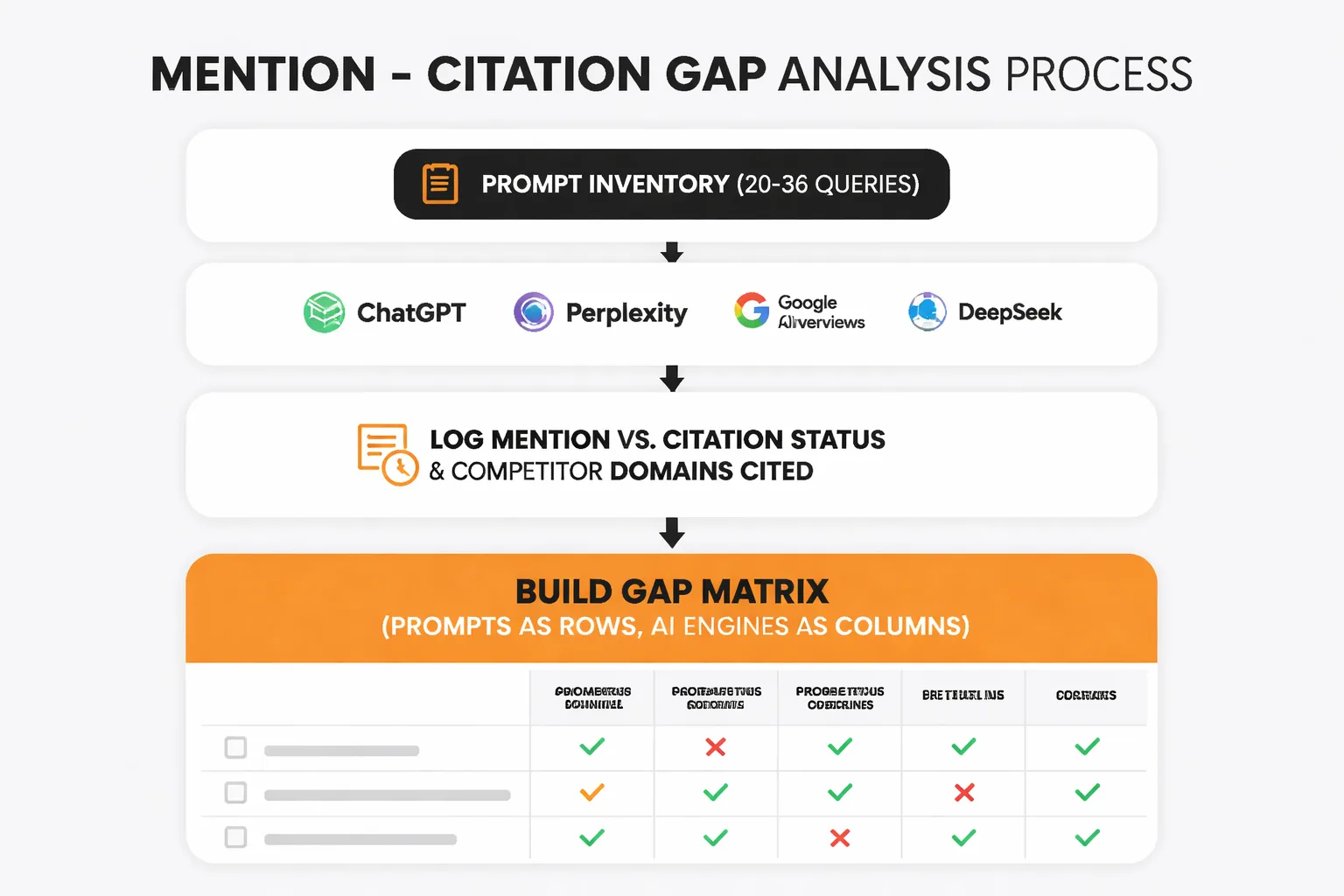
For each prompt where a competitor is cited and you aren't, record the citing domain. After 20-30 prompts, you'll see patterns. A handful of domains will appear repeatedly across multiple AI engines for your category. These are your priority targets. The publishers that AI models have collectively decided to trust for your topic space.
This is where mention-citation gap analysis gets granular. Sort your target publishers into three buckets. First: high-authority industry publications (think trade press, major tech media, established review sites). Second: listicle and roundup pages on mid-authority domains. These are often the fastest citation wins because they're designed to be updated and are actively looking for new entries. Third: community platforms like Reddit and Quora, where authentic discussion signals matter more than editorial polish.
I'll share something that genuinely surprised me when I first ran this analysis. Reddit pulls citation rates around 40% across major models, and Wikipedia sits around 26%. Neither is a well-formatted content asset. What they share is platform authority and high-volume authentic discourse. Your beautifully structured definition page isn't losing to a competitor's definition page. It's losing to a three-year-old Reddit thread where someone explained the concept conversationally in 200 words. That realization changed how I think about where to build presence. Not just what to publish.
For the publisher mapping phase, Meev's Citation Path feature (available on Pro and Agency plans) automates this: it identifies which domains AI engines cite most often for your target topics, surfaces verified contact information, and flags competitor footprints. Domains that link to your top-ranking competitors but not to you. That's your shortlist for outreach.
The Similarweb citation gap analysis methodology recommends prioritizing publishers where at least two AI engines are already citing the same domain for your query. Consistency across models is a stronger signal than a single-engine citation. It suggests the domain has earned genuine cross-model trust, not just a one-time training data inclusion.
Step 3. Execute Targeted Citation Outreach
Most AI citation outreach fails for the same reason most link-building fails: the pitch is about the sender, not the recipient. "We'd love to be featured in your roundup" is not a pitch. It's a request dressed up as an offer.
Effective publisher pitching for AI citations requires three things: a specific angle that adds value to the existing piece, proof that your brand deserves the slot (original data, a unique case, a verifiable credential), and a framing that makes the editor's job easier, not harder.
Here's the pitch structure I've found works best for roundup and listicle placements. Open by naming the specific article you're targeting and one concrete way it could be stronger. A missing category, an outdated entry, a claim that's no longer accurate. Then offer your brand as the solution to that specific gap, with one piece of supporting evidence (a data point, a case study, a published comparison). Close with a single clear ask: "Would it make sense to add [brand] to the [specific section]?"
For information gain framing, think about what your brand knows that no other source can claim. Proprietary data is the highest-value citation asset. If you track 250 domains' AI visibility scores weekly, that dataset is citeable in a way that a generic "AI visibility is important" blog post is not. Original research, benchmark reports, and named methodologies all create citation gravity. They give publishers and AI engines a specific, attributable claim to reference.
One pattern I keep seeing in successful AI citation outreach: the brands that compound citations fastest are the ones who treat outreach as a content strategy, not a link-building campaign. They publish the original data first, then pitch the publishers who cover that topic. The content does the credibility work; the outreach just gets it in front of the right editors.
I want to flag a real risk here. Every piece of citation-building research I've reviewed has the same blind spot: zero failure cases. Numbers like 587 backlinks in two weeks sound compelling until you notice there's no counterweight anywhere in the public record. No penalty disclosures, no cases where aggressive outreach tanked E-E-A-T signals or produced distorted LLM citations. That's not a clean industry track record. That's a publication bias problem. I build review checkpoints into outreach campaigns at the 30-day mark specifically to catch signal degradation before it compounds.
For tracking outreach at scale across multiple clients or domains, the Meev vs Peec AI comparison breaks down how different platforms handle citation outreach workflows. Useful if you're evaluating tools before committing to a stack.
Want to see where your brand is mentioned but not cited across ChatGPT, Perplexity, and Google AI Overviews?
Step 4. Publish Quality-Gated Content That Closes the Gap
Outreach gets you into existing content. Publishing creates new citation surfaces. Both matter, and the best programs run them in parallel.
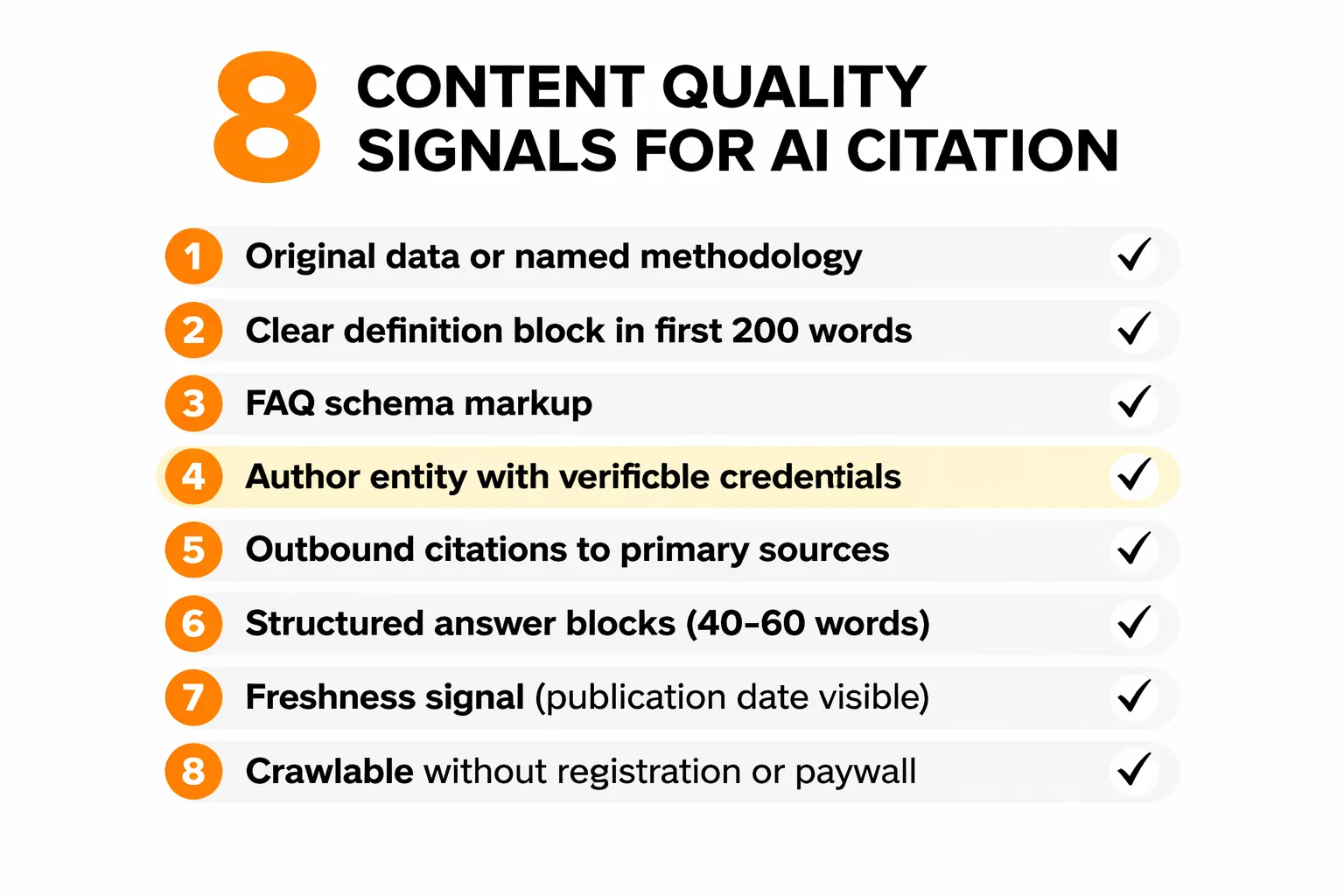
Content designed to be cited by AI engines has specific structural characteristics. The arXiv GEO research identifies crawlability as a baseline requirement. Quality-gated content (paywalled, registration-required) cannot be cited by AI systems regardless of how authoritative it is. That's the first filter: if your best content is behind a gate, it's invisible to the engines you're trying to influence.
Beyond crawlability, the content quality signals that drive AI citation break into two categories: authority signals and extraction signals.
Authority signals include: a named author with verifiable credentials (linked profiles, published work, demonstrated expertise), outbound citations to primary sources (AI engines prefer content that itself cites authoritative sources), original data or a named proprietary methodology, and publication freshness with a visible date. These signals tell the model that the content is trustworthy and attributable.
Extraction signals include: a clear definition or answer block in the first 200 words (AI engines extract from the top of content disproportionately), FAQ schema markup, structured answer blocks of 40-60 words that can be lifted verbatim into an AI response, and consistent entity naming. Using the same term for your brand, product, or concept throughout the piece rather than varying it for stylistic variety.
For content at scale, Meev's quality firewall runs every article through an 11-dimension quality check plus a 5-dimension Google Penalty Risk Matrix before it reaches your CMS. Articles scoring below 70/100 are blocked from auto-publishing. That gate matters specifically for AI citation strategy because low-quality placements don't just fail to earn citations. They can muddy the training signal, producing AI responses that cite your brand with subtly wrong information. I've seen this happen. It's harder to fix than a simple citation gap.
For topical authority for AI search, the goal is to own a specific concept. Not just write about a broad category. "AI search visibility" is a category. "The mention-citation gap" is a concept. Concepts earn citations; categories earn mentions. The distinction is the whole point of this framework.
If you're managing content across multiple CMS platforms, consistency in phrasing and freshness matters more than most teams realize. The arXiv analysis notes that content freshness and cross-language stability variation across CMS instances reduces AI engine confidence in the source. Fragmented publishing workflows are a structural citation risk.
Step 5. Track, Iterate, and Compound Your Citation Rate
Citation rate is the metric that matters. Not mention volume, not backlink count, not organic rankings. The ratio of prompts where your domain is cited to total prompts tested. That's your north star.
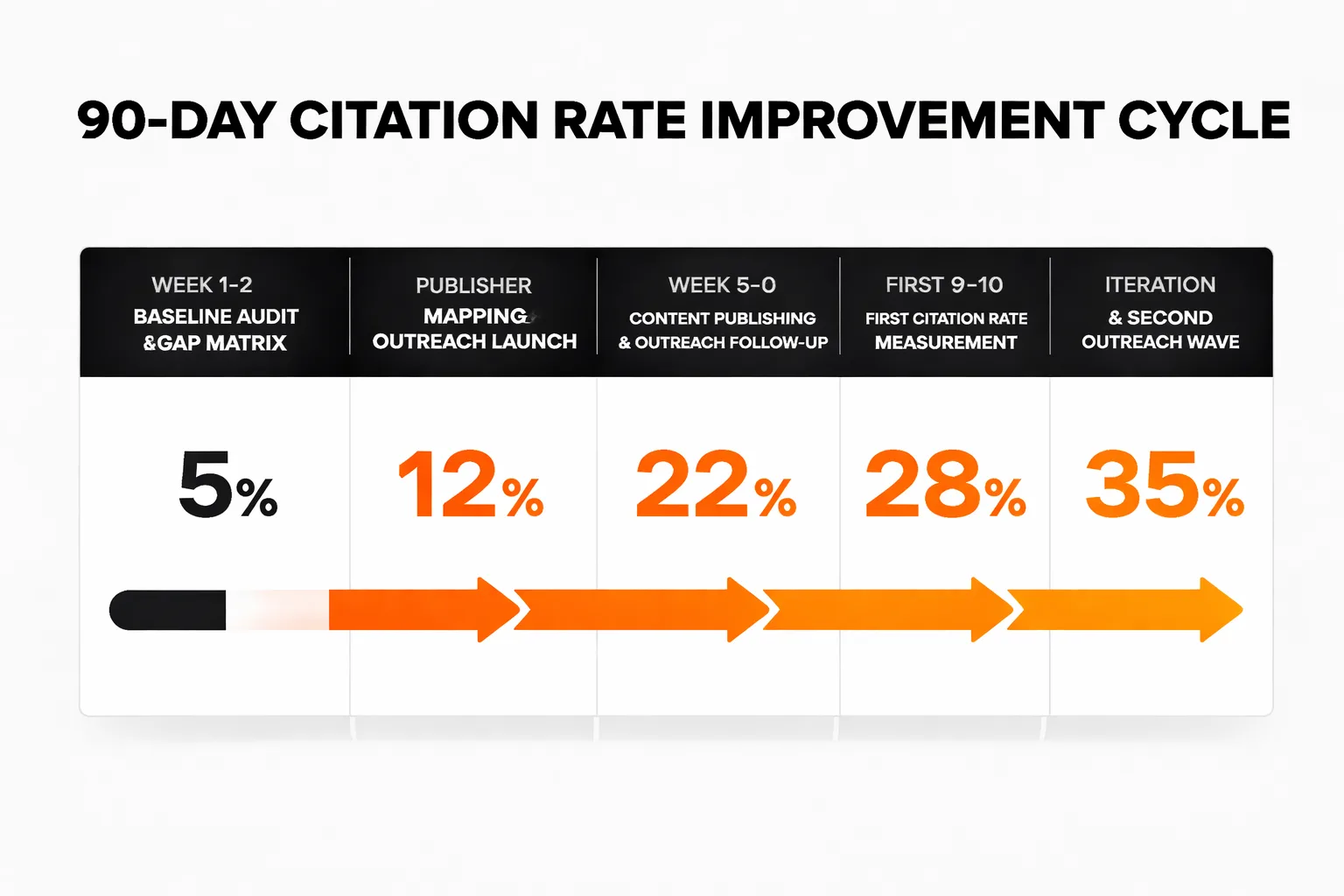
Measure citation rate at 30, 60, and 90 days against your baseline gap matrix. For each prompt where you've executed outreach or published new content, track whether the citation status changed. A 5-percentage-point improvement in citation rate on your top 10 category queries is a meaningful signal. A 20-point improvement in 60 days is exceptional and worth understanding. Which specific placements drove it, which AI engines responded first, and which publishers seem to carry the most citation weight.
The engines respond at different speeds. Google AI Overviews tends to update citation patterns faster because it's tied to the live web crawl. ChatGPT and Claude update more slowly, reflecting training data refresh cycles rather than real-time indexing. Perplexity (which uses live search) falls somewhere in between. Tracking across all surfaces with a platform like Meev gives you a per-LLM drill-down. So you can see whether a new placement is already influencing Perplexity answers while you're still waiting for the GPT-4 training cycle to catch up.
For Gemini visibility tracking specifically, Google's model tends to weight Google-indexed content and Google-adjacent signals (Search Console data, structured markup, E-E-A-T signals) more heavily than other engines. If Gemini is a priority surface for your clients, the content publishing strategy in Step 4 carries more weight relative to outreach.
The compounding effect kicks in around the 90-day mark for most programs. Once you're cited in three or more high-authority third-party sources for a given query, the probability of being cited in a fourth increases nonlinearly. This is why the first 60 days feel slow and the next 60 days feel fast. You're building citation infrastructure that the model starts to rely on.
Building a feedback loop means reviewing your gap matrix monthly, adding new target prompts as your product or market evolves, and retiring prompts where you've achieved stable citation rates. The Chosenly outreach guide frames citation outreach as faster than creating new content for established queries. And that's true for the first wave. But the long-term compounding comes from owned content that earns citations passively, not from outreach that requires ongoing effort to maintain.
Meev's weekly digest (available on Pro and Agency plans) surfaces AI visibility changes, new citation appearances, and content opportunities. Prompts where competitors are cited but you aren't. That last signal is particularly useful for the monthly gap matrix review: it's a live feed of new gaps opening up as the competitive landscape shifts.
Where This Framework Breaks Down
I'd be doing you a disservice if I presented this as a guaranteed playbook. There are three specific scenarios where this five-step framework produces weak or counterproductive results.
First: highly regulated industries. Healthcare, legal, and financial services brands face a structural disadvantage because AI engines apply additional scrutiny to YMYL (Your Money or Your Life) content. Third-party citations in these categories don't carry the same weight as in tech or e-commerce. The model's caution about accuracy often overrides citation history.
Second: very new brands. Citation building requires something to build from. If your domain is under 12 months old with fewer than 20 indexed pages, outreach-first strategies tend to underperform because editors don't have enough evidence to justify a placement. The content publishing phase (Step 4) needs to come before outreach, not in parallel.
Third: brands whose core product is genuinely hard to explain in 40-60 words. AI engines extract and cite clean, self-contained answers. If your value proposition requires 500 words of context to make sense, you'll struggle to create the extraction-friendly content that drives citation. Regardless of how good the underlying product is. Simplification isn't dumbing down; it's the price of AI citability.
FAQ
What's the difference between a brand mention and a citation in AI search?
A brand mention means the AI engine references your brand name or category concept in a response. But doesn't link to or attribute a specific source. A citation means the AI engine names your domain as a source and (in some engines like Perplexity) hyperlinks to it. Citations drive referral traffic and reinforce domain authority for future answers. Mentions do neither.
How many prompts should I test in an initial mention-citation gap analysis?
Start with 20-30 prompts covering three categories: branded queries (your product name), category queries (the problem you solve), and comparison queries (your brand vs. competitors). Run each across at least four AI surfaces. That gives you 80-120 data points. Enough to identify structural patterns without spending a week on manual testing.
Which AI engine should I prioritize for citation outreach first?
Perplexity is often the fastest to respond to new placements because it uses live web search rather than periodic training updates. Google AI Overviews is the highest-traffic surface for most brands, making it the highest-value long-term target. Start with Perplexity to build momentum, then focus content and outreach efforts on the signals that influence Google AI Overviews. Primarily E-E-A-T, structured markup, and Google Search Console indexing.
How long does it take to see citation rate improvements after outreach?
For Perplexity and Google AI Overviews, meaningful changes can appear within 2-4 weeks of a successful placement in a high-authority third-party source. For ChatGPT and Claude, which rely on training data refresh cycles, the timeline is longer. Typically 60-90 days. Most programs see measurable citation rate improvement at the 30-day mark on at least one surface, with broader improvement across surfaces by day 90.
Can I close my mention-citation gap without a dedicated outreach tool?
Yes, but the manual version has real limits. You can run prompt audits in a spreadsheet, identify citing publishers by hand, and pitch editors directly via email. The breakdown comes at scale: managing 50+ target publishers across 5+ clients without automation leads to missed follow-ups, unverified contact data, and no systematic tracking of which placements actually moved citation rates. Tools matter most when the program grows past what one person can track.
Does closing the mention-citation gap affect traditional SEO rankings?
Indirectly. The third-party placements that earn AI citations also tend to generate backlinks and branded search volume. Both of which influence traditional rankings. The content quality investments (original data, E-E-A-T signals, structured markup) that make content AI-citeable also align with Google's Helpful Content System criteria. The strategies aren't competing; they're largely reinforcing. The main difference is that AI citation strategy prioritizes earned media placements over on-page optimization, which is a meaningful shift in where effort goes.
About the Author
Judy Zhou, Head of Content Strategy
Judy Zhou leads content strategy at Meev, where she oversees AI-driven content research and publishing for hundreds of brands. With a background in SEO and editorial operations, she focuses on building content systems that rank on Google, get cited by AI search engines, and drive measurable business results.
Run your first mention-citation gap audit with Meev — track citation rates across 8 AI engines and surface the exact publishers you need to pitch.