By Judy Zhou, Founder
Key Takeaways
- Only 16% of brands systematically track AI search visibility despite ChatGPT reaching 900+ million weekly users and Google AI Overviews hitting 2.5 billion monthly searches.
- Average query length has jumped from 4 words to 23 words, making traditional keyword ranking reports fundamentally mismatched to AI-era discovery.
- The IAB framework shows 20+ AI visibility tools using contradictory methodologies, so most teams either track nothing or track it wrong.
- Brands with top Google rankings still get zero AI citations when content is built for ranking instead of entity-grounded extraction.
A senior SEO manager at a mid-sized e-commerce brand pulled up Perplexity on a Tuesday morning, typed in the exact product-category question their customers ask most, and watched a competitor they had never once tracked in Google rankings get cited three times in the answer. Their own brand did not appear once. They had a full SEO program, a content calendar, and monthly ranking reports. None of it had flagged this. That moment. Repeated in marketing teams across every vertical right now. Is exactly what a proper AI visibility measurement framework is designed to catch before it becomes a revenue problem.
Only 16% of brands systematically track their AI search visibility, despite ChatGPT having 900+ million weekly active users and Google AI Overviews reaching 2.5 billion monthly users across nearly half of all searches. The IAB's framework identifies 20+ companies selling AI visibility measurement tools with contradictory methodologies, meaning most teams either track nothing or track it wrong. Query length has grown from an average of 4 words to 23 words as search transitions from the link era to the language model era, making traditional keyword tracking fundamentally mismatched to how people now find brands. 71% of consumers expect personalized experiences from brands online, yet many AI SEO implementations fail to deliver because they skip entity grounding entirely.
That gap between AI search scale and measurement infrastructure is where revenue leaks happen. I have spent the last year building measurement systems at Meev to close it, and the patterns I keep seeing are consistent: brands with strong organic rankings get zero AI citations because no one measured the right signals, and brands with thin SEO footprints show up in AI answers because their content was structured for extraction, not for ranking. If you cannot measure AI search visibility, you are optimizing blind. Here is how to fix that.
Why Standard Analytics Miss AI Search Entirely
Google Analytics tells you what happened after someone clicked a link. Search Console tells you which queries triggered impressions in classic blue-link results. Rank trackers tell you where you sit on a SERP that fewer people actually scroll through. None of these tools can answer a simple question: when a potential customer asks ChatGPT, Perplexity, or Gemini for a recommendation in your category, does your brand appear in the answer?
The blind spot is structural, not incidental. AI search engines synthesize answers from training data, real-time retrieval, and knowledge graphs. They do not generate a SERP with ten blue links you can scrape. A brand can be the most relevant entity for a query and still get zero mentions because an LLM pulled its synthesis from a different source pool. Your rank tracker shows position 1. Your AI visibility is effectively zero. You would never know without a separate measurement layer.
This is not a theoretical problem. In my work auditing content operations, I have seen B2B SaaS companies with domain authorities in the 60s and hundreds of ranking pages get out-cited in AI answers by smaller competitors whose content was explicitly structured for answer extraction. The AEO vs SEO distinction matters here because the optimization signals are different. Classic SEO rewards depth, backlinks, and keyword relevance. AI search rewards extractability, entity clarity, and source diversity. If you measure only the first set of signals, you are flying blind on the second.
The cost of this blind spot compounds. Nearly 70% of marketers still rely on SEO as their most consistent long-term growth channel, according to HubSpot's 2025 State of Marketing Report. That is not wrong. SEO still matters. But it is incomplete. When a customer gets a full answer from Perplexity and never clicks through to any website, your organic traffic does not drop. You cannot see the lost opportunity in any dashboard. It just never shows up.
That is the insidious part. Traditional analytics do not show you what you lost. They show you what you kept. The AI search visibility gap is invisible by default.
How to Measure AI Search Visibility: The 4 Core Metrics
If you want to stop guessing, you need four measurable signals. Each one captures a different dimension of how AI search engines represent your brand. Together, they form a baseline you can track over time.
1. Citation Rate
This is the percentage of relevant prompts where your brand appears in the AI answer at all. If you run 50 prompts across ChatGPT, Perplexity, Gemini, and Claude, and your brand shows up in 12 answers, your citation rate is 24%. Simple. The hard part is defining a representative prompt set (which I will walk through in the next section). The metric itself is just division.
Citation rate is your top-of-funnel AI visibility metric. It tells you whether you exist in the conversation. It does not tell you whether you are positioned well or whether the mention is positive. But without it, you have nothing. In my testing, citation rate is the single most reliable signal for tracking whether your answer engine optimization efforts are working over time. If your citation rate is climbing month over month across a stable prompt set, your content and entity strategy is landing. If it is flat or declining, something is broken.
2. Mention-to-Citation Ratio
Not all citations are equal. Your brand might appear in an AI answer as a passing mention in a list of ten alternatives, or it might be the primary recommendation with a detailed explanation of why. The mention-to-citation ratio measures how often your brand is meaningfully cited versus merely listed.
A practical proxy: classify each AI answer where your brand appears into three tiers. Tier 1 means your brand is the primary recommendation or gets a dedicated explanation. Tier 2 means your brand appears in a named list with some context. Tier 3 means your brand is a passing mention in a long enumeration. Track the ratio of Tier 1 mentions to total mentions. If you appear in 20 answers but only 2 are Tier 1, your visibility is wide but shallow. You are being named but not recommended.
This maps to what the IAB framework calls the causal hierarchy of Presence, Prominence, Performance, and Preference. Presence is citation rate. Prominence is where in the answer you appear. Performance is whether the mention drives action. Preference is whether the AI recommends you over competitors. The mention-to-citation ratio is your proxy for Prominence.
3. Source Coverage
This is the metric most teams skip, and it is the one that reveals why you are or are not getting cited. Source coverage tracks which pages and domains AI engines actually pull from when they mention your brand (or when they do not).
When you run a prompt and your brand appears, note the citations the AI engine provides. Perplexity and Google AI Overviews cite sources explicitly. ChatGPT and Claude are less transparent, but you can often infer sources from the information in the answer. Over time, you build a map: which domains does the AI engine trust for your topic? Is it your own blog? Is it a third-party review site? Is it a Reddit thread? Is it a Wikipedia entry?
This matters because source coverage tells you where to focus your effort. If AI engines cite industry publications and review sites for your category but never your blog, you know that generative engine optimization requires earning coverage on those third-party domains, not just publishing more on your own site. If your blog is cited but only for tangential topics, you know your content strategy is misaligned with how AI engines categorize your brand.
4. Share of Voice Across LLMs
Share of voice measures your citation presence relative to competitors. If across 50 prompts, your brand appears in 12 answers, Competitor A appears in 20, and Competitor B appears in 8, your share of voice is 12 out of 40 total mentions, or 30%.
The critical nuance: share of voice varies by LLM. You might have strong visibility in Google AI Overviews (which lean heavily on organic search rankings) and weak visibility in ChatGPT (which leans on training data and community discussion). Tracking share of voice per engine reveals where you are winning and where you are losing. The AEO vs GEO distinction is relevant here because Google's AI Overviews behave differently from ChatGPT and Claude in how they select and weight sources.
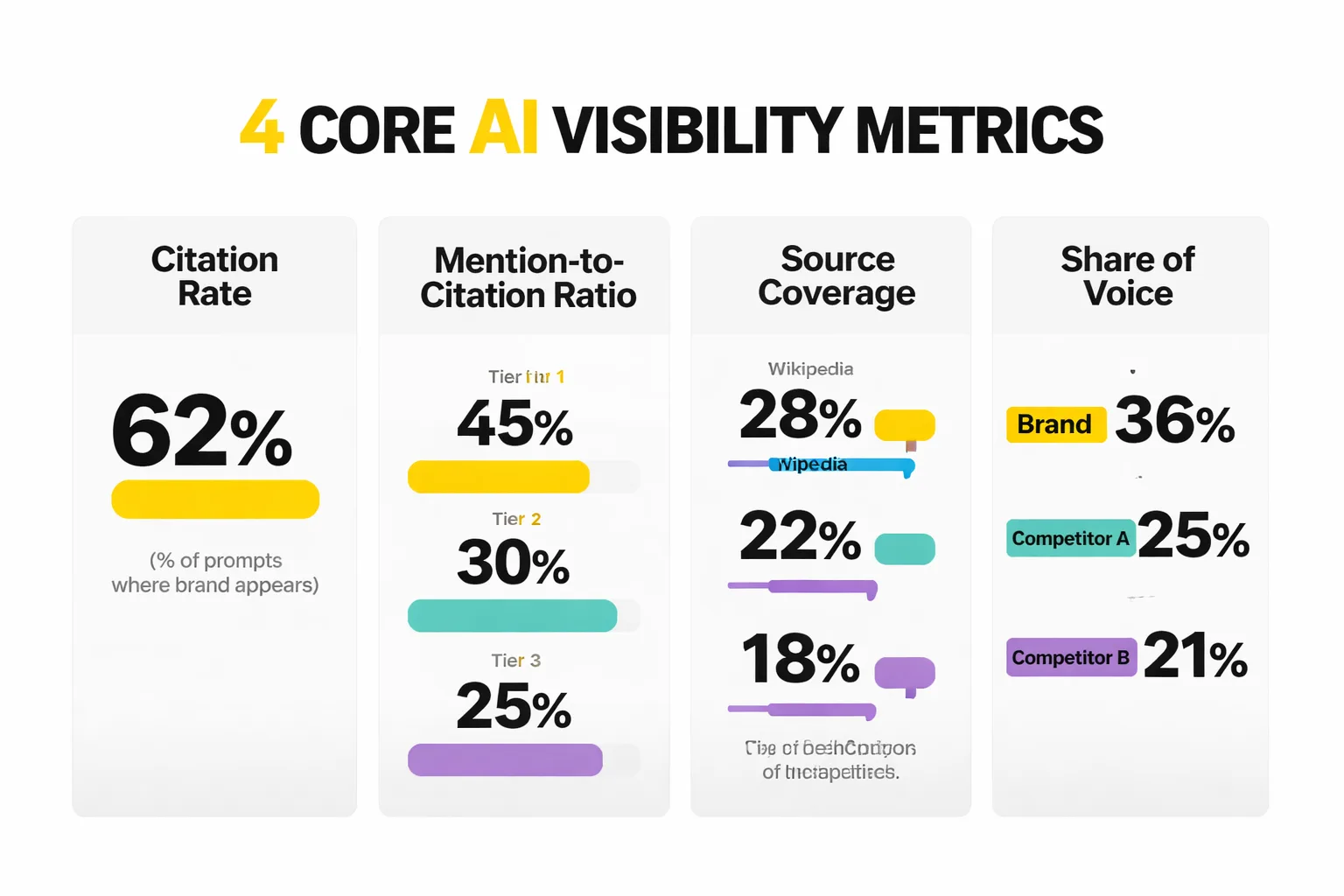
In my experience, share of voice is the metric that gets executive buy-in. Citation rate is abstract. Share of voice is competitive. When you show a founder that their brand has 5% share of voice while a competitor they have never heard of has 35%, the reaction is immediate. That gap is what drives investment in measurement and optimization.
How to Run Your First AI Visibility Measurement in Under an Hour
You do not need a paid tool to start. You need a spreadsheet, four AI search engines, and a representative set of prompts. Here is the exact process I use.
Step 1: Build a 20-prompt set (15 minutes)
Write 20 prompts that reflect how real customers search for your category. Not keyword-stuffed queries. Natural-language questions. Think about what someone would type into ChatGPT or Perplexity when they are evaluating solutions.
Mix three prompt types. Decision prompts: "What is the best [product category] for [use case]?" Comparison prompts: "How does [your brand] compare to [competitor]?" Problem prompts: "How do I solve [specific problem your product addresses]?" Aim for roughly 7 decision prompts, 7 comparison prompts, and 6 problem prompts.
The prompt set is the foundation of your measurement. If your prompts are too narrow, you overstate your visibility. If they are too broad, you understate it. The goal is a set that represents the queries your potential customers actually ask. Save this set. You will reuse it monthly to track changes.
Step 2: Run prompts across four engines (30 minutes)
Open ChatGPT, Gemini, Perplexity, and Claude. Run each of the 20 prompts in each engine. That is 80 total queries. It sounds like a lot, but most take under 30 seconds to answer.
For each answer, log three things in your spreadsheet. Does your brand appear? (Yes or No.) Where does it appear? (First mention, in a list, last mention, or not at all.) What sources does the AI cite? (List the domains.)
If you want to go deeper, also log whether the mention is positive, neutral, or negative. But for your first baseline, presence and position are enough.
Step 3: Calculate your baseline score (10 minutes)
Now you have data. Calculate your citation rate: count the number of answers where your brand appears, divide by 80 (total prompts across all engines), multiply by 100. That is your baseline citation rate.
Calculate per-engine citation rate: divide mentions by 20 for each engine. This tells you which engines you have visibility in and which you do not.
Log your share of voice: for each prompt where a competitor appears instead of you, note the competitor. Count total brand mentions (yours plus competitors) across all 80 prompts. Your mentions divided by total mentions is your share of voice.
Step 4: Save your template and set a monthly cadence (5 minutes)
Your spreadsheet now has four columns per prompt: engine, brand present, position, cited sources. Save it as your baseline. Set a calendar reminder to rerun the same 20 prompts in 30 days. Compare month-over-month.
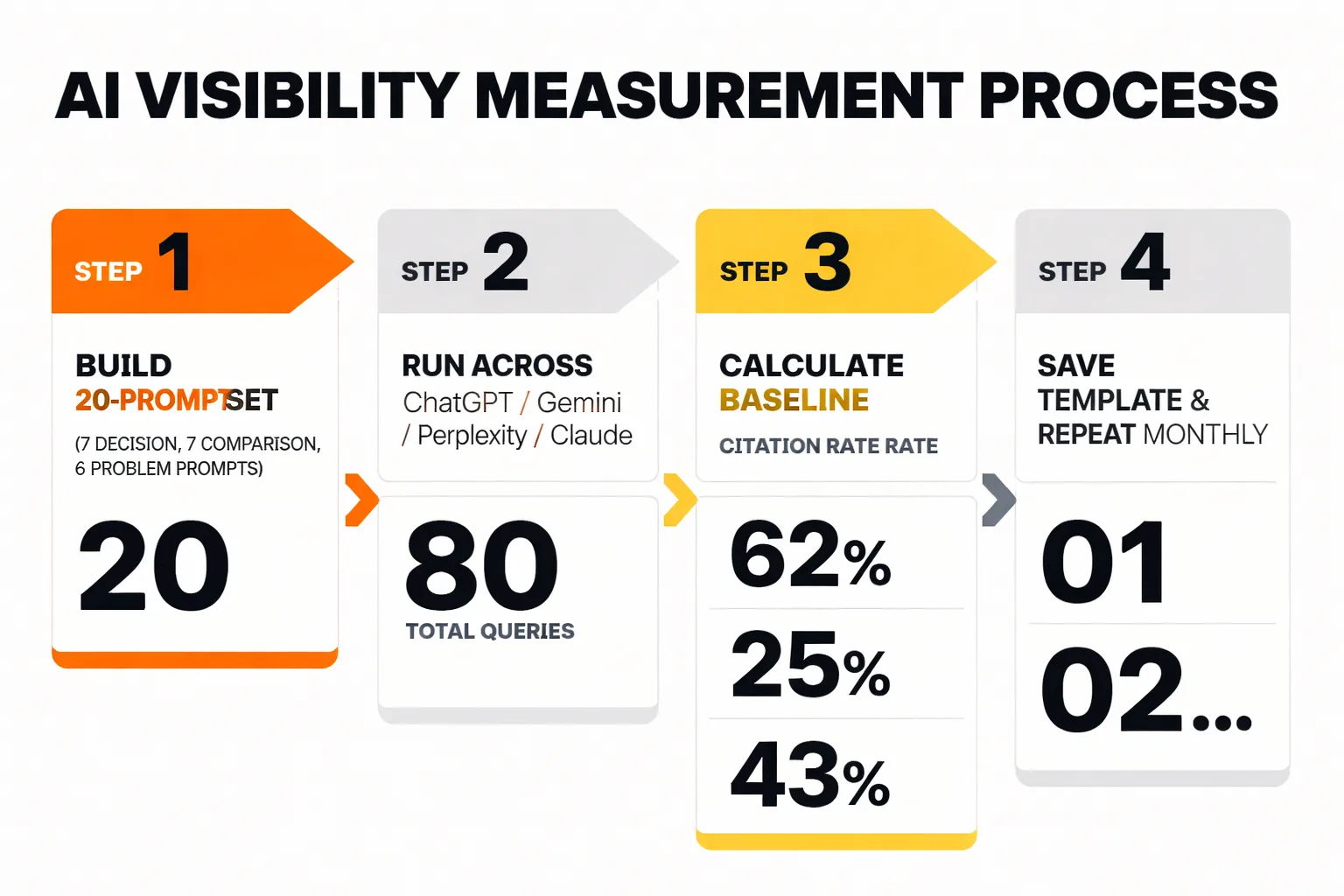
This is the same process I walked a client through last quarter. Their baseline citation rate was 8%. After three months of targeted content fixes (which I will cover next), it reached 23%. The point is not the number. The point is that without the baseline, they would have had no way to know whether their efforts were working.
If you want to automate this process, tools like the AI visibility checker can run prompts across multiple engines and track changes over time. But the manual process is valuable even if you later automate it, because running the prompts yourself teaches you what the AI engines actually say about your brand. You read the answers. You see the tone. You notice which competitors keep showing up. That qualitative understanding shapes your strategy in ways a dashboard cannot.
Which Gaps Matter Most for AI Citations?
Once you have a baseline, the question shifts from measurement to improvement. Your data tells you where you are absent. Now you need to figure out why.
The gaps fall into three categories, and each one maps to a specific fix.
Gap 1: Missing Entity Data
AI search engines do not just match keywords. They map entities. If your brand, product, or category is not represented in structured knowledge sources, AI engines cannot ground their answers in your entity. This is the problem the Runnwrite analysis identifies when it notes that ecommerce sites with strong traditional SEO rankings lose AI search visibility when entity grounding in knowledge graphs is missing.
The fix starts with Wikidata. Wikidata has 112 million human- and machine-readable entries and 12,000+ active editors. If your brand has a Wikipedia article, it likely has a Wikidata entry. If it does not, creating one is the highest-leverage entity grounding step you can take. The Wikipedia Embedding Project vectorized 19 million Wikidata entries, which means these entries are actively used by LLMs for entity resolution.
I used to think structured data was the silver bullet for AI visibility. My team spent months meticulously integrating schema markup and building out our internal knowledge base, expecting a direct line to AI citations. What I found is that schema markup helps AI engines understand your pages, but it does not get you into the source pool. For that, you need external entity presence. Wikidata, Wikipedia, and third-party editorial coverage are what put your brand on the map for LLMs. Schema is the foundation, not the house.
Gap 2: Thin Source Pages
Your baseline data shows which pages AI engines cite for your brand. If the answer is none, or if they cite your homepage but not your product pages or blog posts, you have a source coverage problem.
AI engines extract information from pages that answer questions directly. If your blog posts are 2,000-word thought leadership pieces with no clear answer to a specific question, they are not extractable. 44% of AI citations come from the first third of a page. If the first third of your article does not contain a direct, citable answer to the question the AI is trying to answer, you will not be cited.
The fix is structural. Rewrite your key pages so they lead with direct answers under question headings. Add structured data (Article, FAQ, HowTo schema) so AI engines can parse the content type. Include tables and lists where appropriate because AI engines extract structured information preferentially. This is what answer engine optimization actually means in practice. It is not a separate discipline from SEO. It is a content structure discipline that makes your existing content extractable.
Gap 3: No Structured Answers for Comparison Queries
If your comparison prompts ("How does [your brand] compare to [competitor]?") return answers that mention competitors but not you, the problem is usually that no source page exists where your brand is positioned in a comparison context. AI engines synthesize comparison answers from review sites, listicles, forum discussions, and product documentation. If your brand is absent from those source types, it will be absent from the comparison.
The fix has two parts. First, publish your own comparison content. Not as a hit piece on competitors, but as an honest positioning document that answers the comparison question directly. Second, earn coverage on third-party comparison sources. Industry publications, review aggregators, and even Reddit threads where your brand is mentioned favorably all feed into the source pool AI engines draw from.
In my experience, the third-party source problem is the hardest one for small teams to solve. You cannot control whether a review site covers you. You can control whether you reach out to publishers, offer expert commentary, and build relationships that result in coverage. That is why citation gap outreach is a core part of any serious AI visibility strategy. You measure the gap, identify which sources AI engines cite, and then work to earn presence on those sources.
What Good AI Visibility Numbers Actually Look Like
This is the question I get most often from founders and marketing leads: "Is my number good?" The honest answer is that it depends on your category, your brand maturity, and which engine you are measuring. But I can give you reference ranges based on patterns I have observed.
Citation Rate Benchmarks
For early-stage brands (under 2 years old, limited content footprint, domain authority below 30): a citation rate of 5-15% across a representative prompt set is a reasonable starting point. If you are below 5%, you have a fundamental visibility problem that likely traces to missing entity data or no extractable content. If you are above 15%, you are punching above your weight and should focus on deepening existing citations rather than expanding to new prompts.
For established brands (2+ years, solid content library, domain authority 30-50): a citation rate of 15-30% is typical. Below 15% suggests your content is not structured for extraction even though it ranks well organically. Above 30% means your answer engine optimization is working.
For category leaders (high domain authority, extensive content, established brand recognition): 30-50% citation rate is the expected range. Below 30% is a red flag. It means competitors are eating your lunch in AI answers despite your organic dominance. I have seen this pattern repeatedly with established brands that treated AI search as a future problem rather than a present one.
Share of Voice Benchmarks
Share of voice is more context-dependent because it depends on how many competitors are in your category. In a crowded space with 10+ active competitors, a 10-15% share of voice is respectable. In a niche with 3-4 competitors, you should aim for 25%+.
The key is not the absolute number. The key is the trend. If your share of voice is growing month over month, your strategy is working. If it is shrinking, a competitor is out-optimizing you. If it is flat, you are maintaining position but not gaining ground.
Per-Engine Variation
Expect significant variation across engines. Google AI Overviews correlate more strongly with traditional organic rankings, so if you have strong SEO, you will likely have better visibility there. ChatGPT and Claude lean on training data and community discussion, so brands with active Reddit presence, strong Wikipedia entries, and third-party editorial coverage tend to perform better. Perplexity sits in between, blending real-time web retrieval with LLM synthesis.
This variation is why tracking per-engine citation rate matters. A single aggregate number hides the fact that you might be dominating Google AI Overviews while being invisible in ChatGPT. The fix for each gap is different, and without per-engine data, you cannot prioritize.
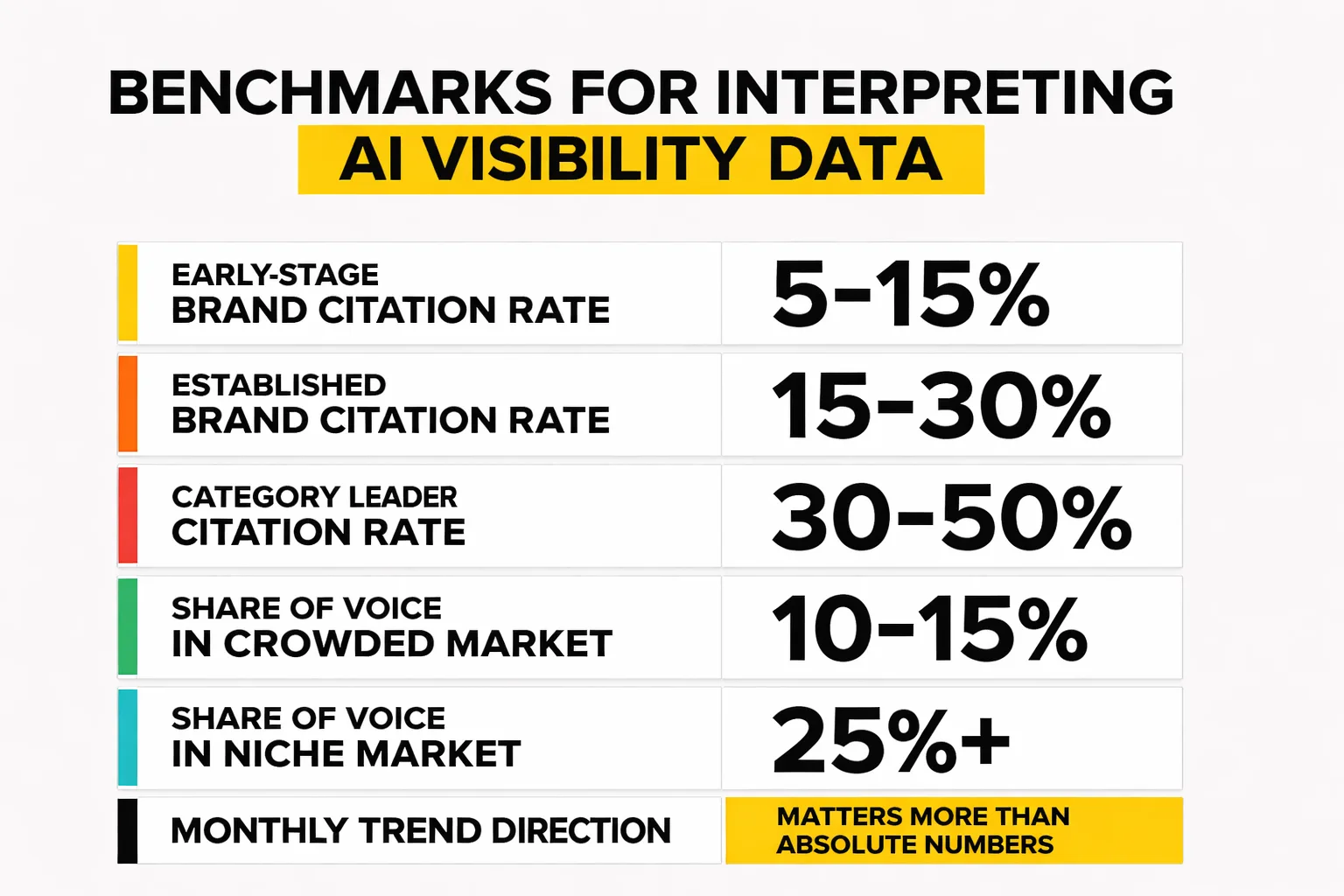
I want to be blunt about something. The numbers I just gave you are reference ranges based on my professional experience, not industry-standard benchmarks. The industry does not have standardized benchmarks yet. The IAB framework is working on it, but as of now, there is no authoritative source that says "the average B2B SaaS brand has a 12% citation rate." That is why I tell every team to focus on their own baseline and trend rather than comparing to an external standard. Your baseline is your benchmark. Your month-over-month change is your scorecard.
Do you know which AI engines cite your brand and which ones don't?
When Should You Automate AI Visibility Tracking?
Manual measurement works for a baseline. It does not scale. If you are tracking 20 prompts across 4 engines monthly, that is 80 queries and roughly an hour of work. If you want to track 100 prompts across 6 engines, you are looking at 600 queries. No one has time for that.
Automation becomes necessary when you hit one of three thresholds. First, when your prompt set grows beyond 30 prompts. Second, when you need weekly rather than monthly tracking. Third, when you want to track more than 4 engines. At any of those points, manual measurement breaks down and you need a tool.
The AI visibility tool market is fragmented right now. The IAB framework identifies 20+ companies selling measurement tools with different methodologies, which means comparing tools is hard. My advice is to evaluate any tool against three criteria. Does it track the four core metrics I defined above (citation rate, mention-to-citation ratio, source coverage, share of voice)? Does it let you see the actual AI answer text behind each mention so you can verify quality? Does it track per-engine so you can identify specific gaps?
If a tool gives you a single "AI visibility score" without showing you the underlying data, be skeptical. In my experience, proprietary scores without transparent methodology are closer to marketing fluff than measurement. You should be able to see every prompt, every answer, every citation, and every source. If you cannot, the tool is asking you to trust a black box.
The Perplexity AI visibility checker and ChatGPT AI visibility checker approaches are better because they are engine-specific. You see exactly what each engine says about your brand. That specificity is what makes measurement actionable. A aggregate score of 42 out of 100 tells you nothing. Knowing that Perplexity cites you in 30% of prompts but ChatGPT cites you in 5% tells you exactly where to focus.
The Contrarian Take: Stop Chasing Mentions
Here is where I push back on the conventional wisdom. Most AI visibility advice I read in 2026 says "get mentioned more." Track your mentions, increase your mentions, optimize for mentions. That is half right and half dangerous.
Mentions without context are noise. I tried focusing purely on raw mention volume for a client last quarter. The numbers looked great on a slide. We tripled mentions across 50 prompts. But when I dug into the actual answer text, most of those new mentions were Tier 3 passing references in lists of 15 alternatives. The client's share of voice improved marginally. Their actual recommendation rate (how often the AI engine recommended them as the primary choice) did not budge.
The metric that matters most is not mention volume. It is recommendation rate. How often does an AI engine recommend your brand as the answer to the question? That is the metric that connects to business outcomes. A brand cited as the primary recommendation in 5 out of 20 prompts is worth more than a brand mentioned in passing in 15 out of 20.
This is why the mention-to-citation ratio I defined earlier matters so much. It separates wide-but-shallow visibility from deep-but-narrow visibility. Wide visibility feels good in a dashboard. Deep visibility drives pipeline.
The industry is not there yet on measuring recommendation rate cleanly. The IAB framework hints at it with the Preference layer, but no standard methodology exists. For now, the best proxy is manual classification of AI answers into tiers. It is labor-intensive. It is also the difference between measuring vanity and measuring value.
Putting Measurement Into Practice
At Meev, I built our AI SEO tool around the principle that measurement comes first. You cannot optimize what you cannot see. The product tracks brand mentions and citations across every major AI search surface, shows you the actual answer text behind every mention, and then helps you close gaps by researching and publishing content designed for AI extractability.
The workflow is straightforward. Run a visibility audit to establish your baseline across the four core metrics. Identify which gaps are costing you citations: missing entity data, thin source pages, or no structured answers for comparison queries. Then prioritize fixes based on impact. Entity grounding (Wikidata, Wikipedia) is usually the highest-leverage fix for brands with low citation rates. Content restructuring (front-loading answers, adding schema, creating comparison pages) is the highest-leverage fix for brands with decent citation rates but poor mention quality.
The teams that succeed at AI visibility measurement share one trait. They treat it as an ongoing practice, not a one-time audit. You measure, you fix, you measure again. The cycle is monthly at minimum, weekly if you are in a competitive category where AI citations shift quickly. The brands that win in AI search are not the ones with the best content. They are the ones with the best feedback loop between measurement and action.
If you take one thing from this article, let it be this. Start measuring today. Pick 20 prompts. Run them across four engines. Calculate your citation rate. You will learn more in one hour of manual measurement than in a month of reading about AI visibility strategy. The data you collect will tell you exactly what to fix next. Everything else is commentary.
FAQ
What is the difference between AI search visibility and traditional SEO ranking?
Traditional SEO ranking measures where your pages appear on a Google SERP. AI search visibility measures whether your brand is mentioned and cited in answers generated by AI search engines like ChatGPT, Perplexity, and Gemini. A brand can rank #1 organically and still be absent from AI answers because AI engines synthesize responses from a different source pool that includes training data, knowledge graphs, and real-time retrieval, not just organic search results.
How many prompts should I use to measure AI search visibility?
Start with 20 prompts that reflect real customer queries. Mix decision prompts ("What is the best X for Y?"), comparison prompts ("How does X compare to Y?"), and problem prompts ("How do I solve Z?"). Run each prompt across at least four AI engines (ChatGPT, Gemini, Perplexity, Claude) for 80 total data points. This gives you a statistically meaningful baseline without overwhelming your time budget.
How often should I track AI search visibility?
Monthly is the minimum for most brands. Weekly tracking makes sense if you are in a competitive category or actively running an optimization campaign and want to see results faster. AI answer composition can shift based on model updates, new content indexed, and changes in third-party sources, so regular tracking catches drift early.
Can I measure AI search visibility for free?
Yes. The manual process I described costs nothing except time. You need a spreadsheet, access to ChatGPT, Gemini, Perplexity, and Claude, and a defined prompt set. Paid tools become necessary when you scale beyond 30 prompts, need weekly tracking, or want to monitor more engines than you can check manually. But for establishing your first baseline, free works.
What is a good AI search visibility citation rate?
For early-stage brands, 5-15% is a reasonable starting range. Established brands should aim for 15-30%. Category leaders should expect 30-50%. These are reference ranges based on professional observation, not industry standards. The more important signal is your month-over-month trend. A growing citation rate means your optimization strategy is working regardless of the absolute number.
Does having a Wikipedia page help AI search visibility?
It likely helps, but no published study isolates Wikipedia's specific effect on a brand's AI mention rate. Wikidata has 112 million entries vectorized through the Wikipedia Embedding Project, which LLMs use for entity resolution. If your brand has a Wikipedia article and Wikidata entry, AI engines can ground their answers in your entity. Without that presence, you may be invisible to AI engines even with strong organic rankings. The effect is strongest for brands in categories where AI engines need entity disambiguation.
About the Author
Judy Zhou, Founder
Judy Zhou leads content strategy at Meev, where she oversees AI-driven content research and publishing for hundreds of brands. With a background in SEO and editorial operations, she focuses on building content systems that rank on Google, get cited by AI search engines, and drive measurable business results.
Run your first AI visibility audit today and find out exactly where your brand stands across every major AI search surface.