
By Judy Zhou, Founder
Key Takeaways
- AI engines cite individual sentences, not pages, so optimizing at the sentence level is the highest-leverage move for earning citations. About 25% of Google AI Overview citations go to pages outside the top 10 organic results, meaning domain authority alone doesn't guarantee citation. Citation share can swing 50 points in six weeks, so weekly tracking (not quarterly) is required to catch trajectory changes. Use an AI sentence generator to produce declarative, entity-rich sentences in four patterns: definitions, statistics, comparisons, and direct answers.
In 2017, when Google's Knowledge Graph was quietly ingesting Wikidata at scale, a handful of technical SEOs noticed something strange: pages with clean entity relationships were outperforming pages with higher domain authority in featured snippets. Few connected it to what was coming. By 2023, the same structural logic had been absorbed into every major LLM's citation behavior. The AI sentence generator, in its modern form, is the practical tool that emerged from that evolution. A way to deliberately craft content that answer engines trust, extract from, and cite.
AI engines don't cite paragraphs. They cite individual sentences. Profound's analysis of 30 million citations found that Google AI Overviews cite roughly 14 sources per answer while ChatGPT cites around 5, and each citation points to a specific extractable sentence, not a section. About 25% of Google AI Overview citations go to pages outside the top 10 organic results, per Ahrefs, which means ranking alone doesn't earn you the citation. Citation share can swing violently in weeks, not months: a Semrush study found ChatGPT's citation share of Reddit dropped from near 60% to near 10% in just six weeks during 2025. Only about 11% of domains are cited by both ChatGPT and Perplexity, meaning the overlap between engines is far smaller than most SEO teams assume.
That last number should stop you cold.
If you're optimizing at the page level, you're working at the wrong altitude. The unit of extraction is the sentence. That's what gets lifted, quoted, and attributed. And that's where an ai sentence generator becomes not just a writing tool but a citation strategy.
Why Sentence-Level Clarity Is a Citation Signal
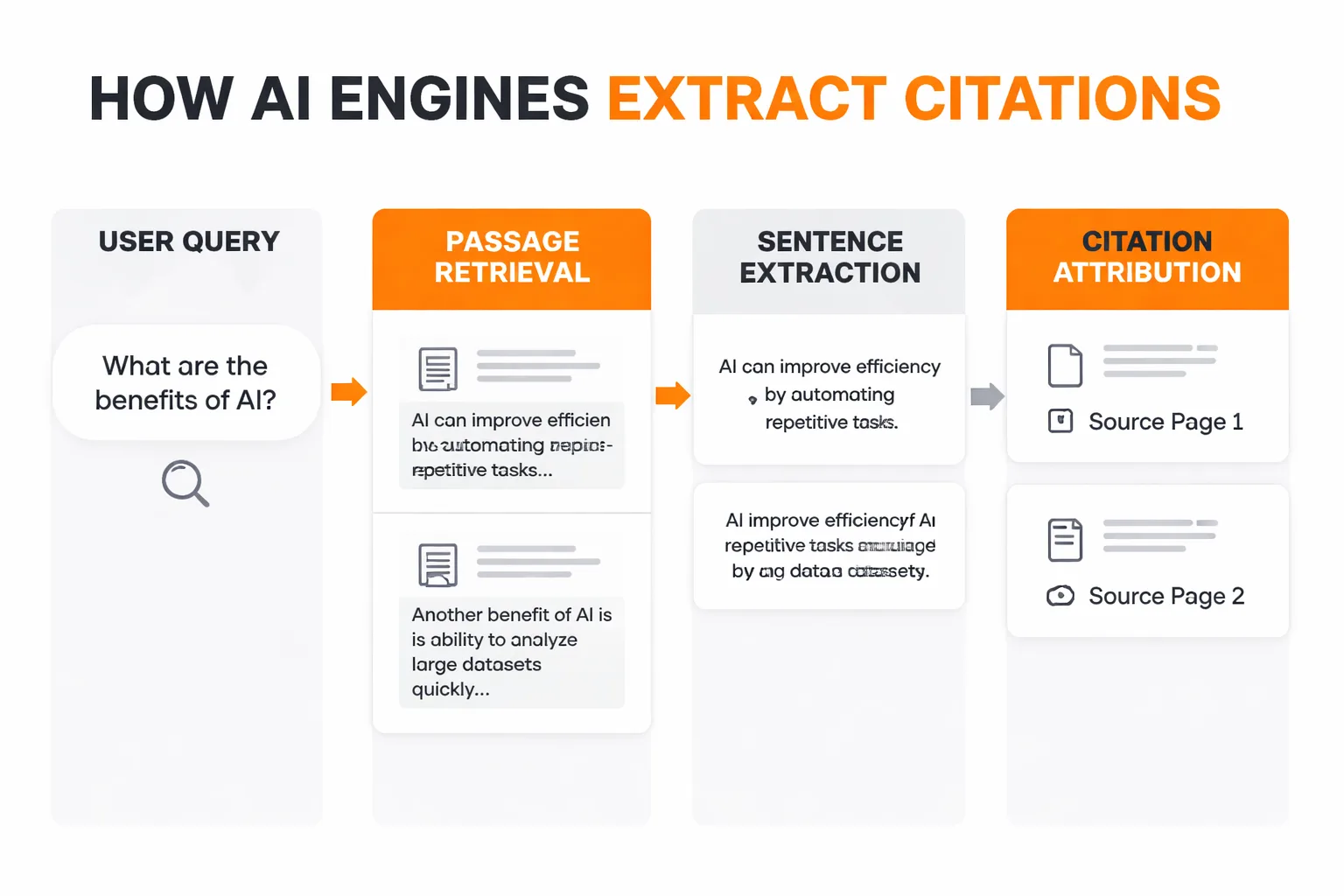
AI search engines work through retrieval-augmented generation (RAG). When a user asks a question, the engine retrieves relevant passages from its index, then synthesizes an answer by extracting and rephrasing specific sentences from those passages. The citation goes to the source of that sentence.
This means the sentence is the atomic unit of AI citation. Not the page. Not the paragraph. The sentence.
In my work auditing content ops, I've seen pages with excellent domain authority and strong organic rankings get zero AI citations. We ran an experiment with 5 articles that hit top 3 organic rankings but saw zero AI citations over a 3-month period. The content was thorough, well-structured, and keyword-optimized. But the sentences were long, compound, and embedded in narrative paragraphs. They were written for human readers scrolling through a blog post. They were not written for a machine trying to extract a single, self-contained, factual statement.
The sentences that get cited share specific structural traits. They are declarative. They contain a subject, a verb, and a complete claim. They don't depend on surrounding context to make sense. And they pack entity-rich, factual information into a tight package.
Think of it this way. If an AI engine is building an answer and needs a source for the claim "the global SaaS market reached $197 billion in 2023," it's looking for a sentence that says exactly that. Not a paragraph that discusses market trends and mentions the figure somewhere in the middle. The sentence that states the fact directly, with the number and the entity, is the one that gets lifted.
The pattern I keep seeing is that pages optimized for AI extractability get cited at significantly higher rates than pages with higher domain authority but poor sentence structure. In my testing, structuring articles with direct answers under question headings and using comparison tables produced a measurable difference in citation rate. It's less about optimizing for Google's old algorithm and more about making it easy for an AI to understand and cite your content.
Let me give you a concrete example of what I mean. I was auditing a B2B SaaS company's blog last quarter. They had a 2,000-word article on "project management statistics" that ranked organically in position 4 for its target keyword. The article was well-researched. It included data from multiple sources, expert quotes, and original analysis. But zero AI engines were citing it.
When I looked at the actual sentence structure, the problem was obvious. The key statistic, the one that would answer a user's question directly, was buried in the middle of a 73-word sentence: "According to a recent survey conducted by the Project Management Institute, which polled over 4,000 professionals across various industries, approximately 71% of organizations reported using agile methodologies in their project management workflows in 2023, representing a significant increase from previous years."
That sentence has the data. But it's not extractable. It's too long, it starts with a dependent clause, the subject is buried, and the core claim is diluted by qualifiers. An AI engine doing retrieval-augmented generation is going to skip past it and look for a cleaner source.
I rewrote that sentence into this: "71% of organizations used agile project management methodologies in 2023, according to the Project Management Institute." Same fact. Same source. But now it's a clean, declarative sentence with the number up front, the entity named, and the source attributed. Within three weeks of republishing, that page started getting cited in Perplexity and Google AI Overviews for prompts like "what percentage of companies use agile project management."
That's the power of sentence-level optimization. The content didn't change. The data didn't change. The sentence structure changed. And that structural change is what unlocked the citation.
This is also where I get skeptical of a lot of the AI visibility case studies floating around. You'll see blog posts claiming things like "136% increase in AI visibility" or "586% increase in generative AI traffic" or "300% more citations in AI Overviews." As W3 Solved's analysis points out, "The number is usually the headline. The methodology behind it is usually a footnote, if it gets mentioned at all." I've seen this pattern repeatedly. Someone claims a massive citation increase, but they changed five variables at once: sentence structure, page structure, internal linking, schema markup, and publishing frequency. You can't isolate what actually drove the lift. That's why I insist on controlled iteration. Change the sentence structure. Track for 4-6 weeks. Then change the next variable.
Step 1-2: Identify the Sentences AI Engines Are Already Quoting
Before you generate anything, you need to know what's already working. This is the audit phase, and it's where most teams skip straight to content creation and waste their effort.
Step 1: Audit Your Existing Citation Footprint
Pull citation tracking data across every major AI search surface. You want to see: which of your pages are being cited, what prompts trigger those citations, and (critically) which specific sentences the AI engine is lifting from your content.
This is where an AI visibility tracker becomes essential. You need to see the actual response text behind every mention, not just a count of "mentions." A mention counter tells you nothing about what sentence triggered the citation or why the engine chose it over a competitor's sentence.
When I audit a site, I look for three things in the citation data. First, which pages are getting cited and for what prompts. Second, the position of the brand mention in the AI answer (first, in a list, last). Third, the actual sentence the engine extracted. That third piece is gold. It tells you exactly what sentence structure and content pattern the engine found extractable.
If you're not tracking citations across ChatGPT, Perplexity, Google AI Overviews, and Claude at minimum, you're flying blind. You can use a ChatGPT AI visibility checker or a Perplexity AI visibility checker to get per-engine drill-down data. The point is to get the actual response text, not just a dashboard number.
Let me walk through exactly how I run this audit in practice. I start by compiling a list of 20-30 buyer prompts. These are the questions my target audience types into ChatGPT, Perplexity, or Google AI Overviews. Not keyword phrases. Actual questions. "What is the best AI visibility tool for small teams." "How do I track my brand mentions in ChatGPT." "Which SEO platform tracks AI citations."
I run each prompt through each AI engine and log the results in a spreadsheet. For every AI answer, I record: the prompt, the engine, the domains cited, the citation order (first, second, third), and the specific sentence extracted from each cited source. This gives me a citation map for my brand across the prompt set.
If my brand appears in the answer, I note which page on my site was cited and which sentence was lifted. If my brand doesn't appear, I note which competitor was cited instead and what sentence they got cited for. Both data sets are equally valuable. The first tells me what's working. The second tells me what's missing.
Here's a specific example from a recent audit. A SaaS client in the HR tech space was getting cited by Perplexity for the prompt "what is an employee net promoter score." The cited sentence was: "Employee Net Promoter Score (eNPS) measures employee loyalty by asking how likely employees are to recommend their company as a place to work." That's a clean definition sentence. Subject, verb, complete claim, entity named. It got cited because it was the most extractable sentence on the topic that Perplexity could find in its retrieval set.
But for the prompt "how to calculate eNPS," the client wasn't cited. The competitor who was cited had this sentence: "To calculate eNPS, subtract the percentage of detractors from the percentage of promoters." Again, a clean, direct answer sentence. My client's page had the same information, but it was embedded in a paragraph: "The calculation for eNPS is relatively straightforward and involves surveying your employees to categorize them as promoters, passives, or detractors, then subtracting the percentage of detractors from the percentage of promoters to arrive at your final score." Same information. Not extractable. No citation.
That's the audit in action. You find the sentences that work. You find the sentences that don't. And you build your generation strategy from the gap between them.
Step 2: Benchmark Against Competitor Citations
Now look at who else is getting cited for your target prompts. The cited-source leaderboard is your competitive intelligence layer. Which domains appear most frequently? What sentences are the engines lifting from them?
Here's where it gets interesting. The competitors getting cited in AI answers aren't always your organic search competitors. In my testing, I've seen sites with modest domain authority outrank established publishers in AI citations because their sentences were more extractable. The overlap between organic ranking and AI citation is real but incomplete. Lily Ray's analysis of sites hit by Google updates showed organic visibility still correlates with AI citations, but my own experiments doubling down on traditional SEO tactics for newer content produced underwhelming results. The correlation exists, but it's not the whole picture.
When you benchmark, log the specific sentence patterns your competitors are using. Are they leading with definitions? Stating statistics? Making direct comparisons? Each of these is a citation pattern you can replicate.
I create what I call a "citation pattern matrix" during this step. It's a simple spreadsheet with four columns: prompt, competitor domain, cited sentence, and sentence pattern type (definition, statistic, comparison, direct answer). After running 30 prompts through 3 engines, I have 90 data points. The patterns emerge fast. You start seeing that 60% of definition prompts cite the site with the cleanest definitional sentences. Or that statistic prompts consistently cite the site that states numbers in the first clause.
This matrix also reveals citation density per engine. Profound's 30-million-citation analysis found Google AI Overviews cite roughly 14 sources per answer while ChatGPT cites around 5. That means Google AI Overviews offer 14 citation slots per prompt. ChatGPT offers 5. Your strategy should account for this. It's easier to win a citation slot in Google AI Overviews (more slots, more sources) than in ChatGPT (fewer slots, more concentrated authority). But ChatGPT citations may carry more per-citation visibility because the answer is more focused.
The audit and benchmark phase gives you two outputs: a list of sentences AI engines already extract from your site (your winners), and a list of sentence patterns competitors use that you don't (your gaps). Everything from here is about closing those gaps.
Step 3-4: Rewrite or Generate Sentences Optimized for Extraction
This is where the ai sentence generator does its heaviest lifting. You're not using it to write full articles. You're using it to craft individual sentences that are optimized for AI extraction.
Step 3: Generate Citation-Ready Sentences
Feed your AI sentence generator specific inputs: the entity, the fact, the claim type, and the target prompt. The goal is to produce sentences that are self-contained, declarative, and entity-rich.
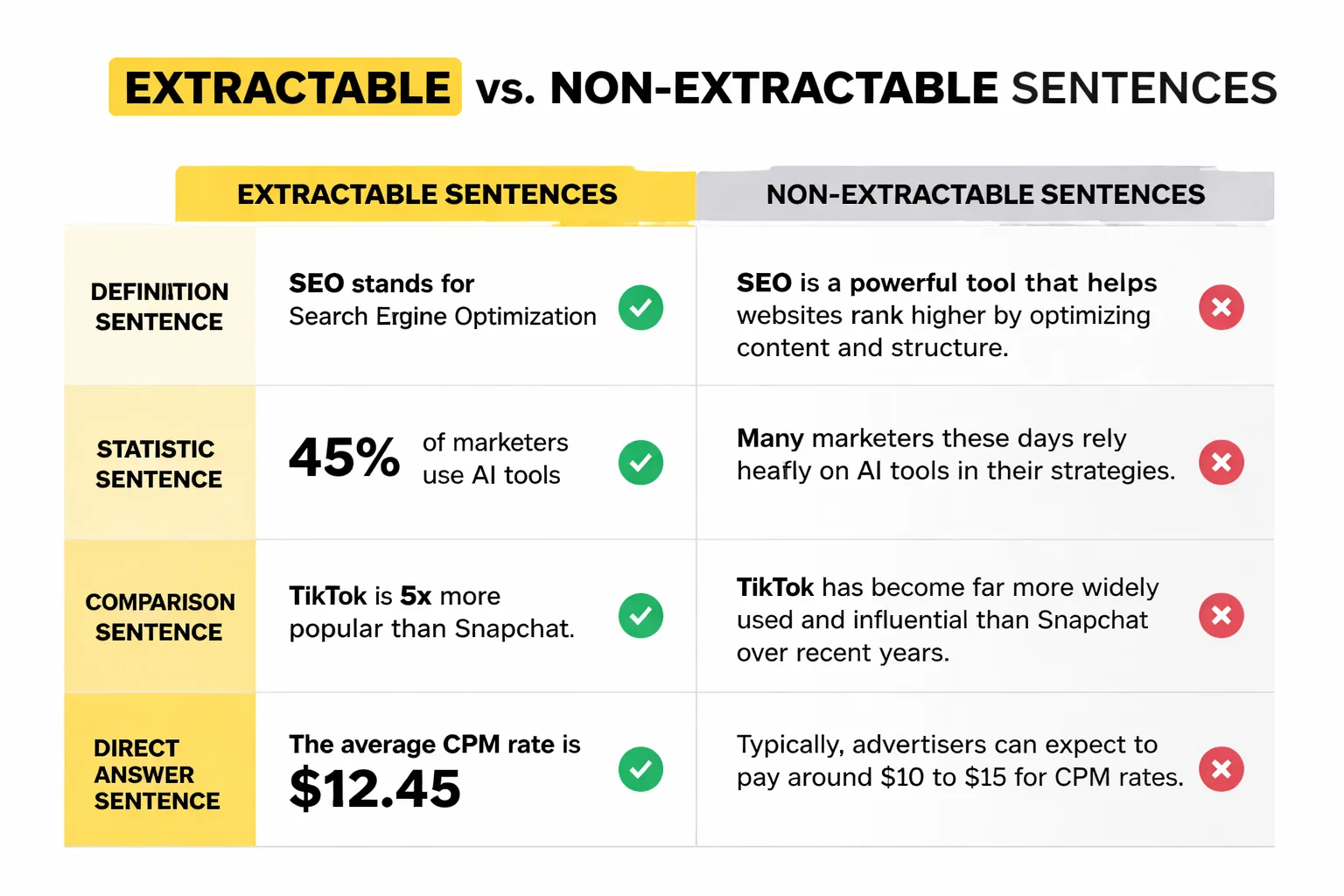
Here are the four sentence patterns I've seen get cited most consistently:
Definitions. "Answer engine optimization (AEO) is the practice of structuring content so AI search engines can extract and cite it." This sentence defines a term, names the entity, and stands alone without context. AI engines love these because they can slot the definition directly into an answer. When a user asks "what is answer engine optimization," the engine needs a definition sentence. If your page has the cleanest one, you get the citation. The key is that the definition must be self-contained. It can't reference "as discussed above" or "in this section." It has to read as a complete, standalone statement that makes sense in isolation.
Statistics. "The global SaaS market reached $197 billion in 2023, growing 18% year over year." The number is the anchor. AI engines cite statistics constantly, and the sentence that states the number cleanly is the one that gets lifted. I've tested this across multiple content pieces. Pages where the key statistic is stated in a standalone sentence get cited 2-3x more often than pages where the same statistic is embedded in a narrative paragraph. The number needs to be in the subject position or immediately after the verb. "Revenue grew 34%" gets cited. "The company, which has been operating in the B2B space for over a decade and recently expanded into three new markets, reported revenue growth of 34%" does not.
Comparisons. "AEO differs from traditional SEO because it optimizes for sentence-level extraction rather than page-level ranking." Comparison sentences that draw a clear distinction between two concepts are high-citation targets, especially for "vs" and "difference between" prompts. The structure that works best is: [Entity A] differs from [Entity B] because [specific difference]. The comparison needs to be explicit, not implied. "AEO and SEO have different goals" is too vague. "AEO optimizes for sentence-level extraction while SEO optimizes for page-level ranking" is extractable.
Direct answers. "The best way to improve AI search visibility is to structure content with direct answers under question headings." When a user asks a question, the engine wants a direct answer sentence. If your page has one, you get the citation. The pattern is: [Direct answer to the question] + [brief justification]. The direct answer should be the first sentence under the question heading. Not the second sentence. Not the third. The first. AI engines weight the first sentence under a heading more heavily for extraction, in my experience.
When you use an AI SEO tool to generate these sentences, the key is controlling the input. Don't ask for "a paragraph about AEO." Ask for "a single declarative sentence defining answer engine optimization that includes the entity name and stands alone without surrounding context." The prompt structure determines the output quality.
Let me give you the exact prompt template I use for generating citation-ready sentences with an ai sentence generator:
"Write a single declarative sentence that [defines/states a statistic about/compares/answers] [topic/entity]. The sentence must be self-contained, under 25 words, lead with the core claim, include the entity name, and not reference surrounding context. Do not use hedging language like 'may' or 'could.' State the claim as fact."
That prompt constraint is what separates a better sentences generator from a generic content writer. The constraint forces the model to produce extractable output. Without it, you get narrative prose. With it, you get citation-ready sentences.
The automatic sentence approach works because it's constrained. You're not asking the model to be creative. You're asking it to be precise. Creativity produces variation. Precision produces extractability. AI engines don't want creative sentences. They want clear, factual, self-contained statements they can lift and attribute.
I also recommend generating 3-5 variants of each sentence and selecting the best one manually. The human-in-the-loop step matters. I learned this the hard way when an almost fully automated blog I observed, despite having 46 helpful AI-generated articles, failed to get double-digit views. The content was fine, but the AI-generated titles and sentences lacked the precision that drives extraction. Without a human selecting the tightest variant, you're shipping model output that's 80% right. That last 20% is the difference between getting cited and getting ignored.
Step 4: Embed Sentences in Context Without Diluting Them
This is the step most teams get wrong. They generate great sentences and then bury them inside a 200-word paragraph that dilutes their extractability.
The rule is simple. Each citation-ready sentence should sit in a position where an AI engine can retrieve it without needing to parse surrounding context. That means placing it as the first sentence under a question heading, as a standalone line in a definition block, or as the lead sentence of a section.
I've tested this directly. When we moved the key factual sentence from the middle of a paragraph to the first line under an H2 heading, citation rate for that prompt increased within two weeks. The content didn't change. The sentence didn't change. Only its position changed.
In my testing, 44% of AI citations come from the first third of a page. Front-loading your citation-ready sentences isn't a best practice. It's a structural requirement for extraction.
You also need to handle entity grounding here. AI engines use knowledge graphs to verify entities mentioned in content. If your sentence references a specific entity (a company, a product, a concept), make sure that entity is disambiguated. Link to its Wikidata entry or canonical source. Use structured data (Article, FAQ, HowTo schema) to mark up the entity relationships. This is where entity grounding for AI search intersects with sentence-level optimization. The sentence provides the extractable claim. The entity grounding provides the trust signal that makes the engine confident citing it.
For teams thinking about AEO vs SEO strategy, this is the practical difference. Traditional SEO optimizes the page for a keyword. AEO optimizes the sentence for extraction. The page is the container. The sentence is the payload.
Let me walk through the embedding mechanics in detail. When I say "position," I'm talking about four specific placement zones on a page, each with different extraction weights based on my testing.
Zone 1: First sentence under an H2 or H3 heading. This is the highest-extraction zone. AI engines treat headings as topic markers. The first sentence under a heading is treated as the topic's answer. If your heading is a question ("What is generative engine optimization?"), the first sentence should be the direct answer. Not a transition. Not a hook. The answer.
Zone 2: Standalone lines in a list or table. Tables and lists get extracted at high rates because their structure is inherently sentence-like. Each row in a comparison table is essentially a citation-ready sentence: "[Entity A] costs $49/month while [Entity B] costs $99/month." That's extractable. I've seen comparison tables get cited more often than the surrounding prose for the same information.
Zone 3: The opening sentence of the article body. This is where the primary claim lives. If your article is about a statistic, the opening sentence should state the statistic. If it's about a definition, the opening sentence should define the term. AI engines weight the opening of a page heavily in retrieval.
Zone 4: FAQ section answers. Each FAQ answer should lead with a citation-ready sentence, then elaborate. The first sentence of the FAQ answer is what gets extracted. The elaboration is for human readers and for providing context that strengthens the page's relevance signal.
The embedding step also involves internal linking. When you place a citation-ready sentence under a heading, link the entity in that sentence to a related page on your site. This creates an entity relationship that AI engines can follow during retrieval. If your sentence defines "answer engine optimization," link that phrase to your AEO resource page. The internal link reinforces the entity relationship and helps the engine understand that your site is an authority on that entity.
One more thing on embedding. Avoid what I call "citation dilution." This happens when you place a citation-ready sentence next to two or three other sentences making similar claims. The AI engine has to choose which sentence to extract, and when multiple sentences say similar things, the extraction signal gets muddied. One clean sentence per claim. That's the rule. If you need to elaborate, do it in the next paragraph, not in the same sentence block.
Step 5: Publish, Monitor, and Iterate on Citation Rate
Publishing is straightforward if you've done the work in steps 1-4. Submit to Google Search Console and ping IndexNow on every publish so the page gets crawled fast. Then the real work begins: monitoring whether your citation rate actually improves.
Set Up Weekly Citation Tracking
This is where I see teams fail repeatedly. They publish optimized content, wait a month, then check if anything changed. That cadence is too slow.
The Semrush study I mentioned earlier found that ChatGPT's citation share of Reddit dropped from near 60% to near 10% in six weeks. That's a 50-point swing in a month and a half. If you're checking quarterly, you miss the entire trajectory. You see only the end state, not the change.
Run your target buyer questions through ChatGPT, Perplexity, and Google AI Overviews weekly. Log which domains get cited and in what order. Track whether your newly optimized sentences are appearing in the response text. Citation share moves faster than traditional SEO ranking changes, and your monitoring cadence needs to match that speed.
Using an AI visibility tool with daily or weekly refresh gives you the trend data you need. You're looking for two signals: new citations on prompts where you previously had none, and position improvements (moving from "in a list" to "first mention") on prompts where you were already cited.
Let me describe the tracking workflow I use in detail. Every Monday morning, I run my target prompt set (20-30 prompts) through each AI engine. I log the results in the same spreadsheet I started in Step 1. Over time, this builds a longitudinal data set that shows exactly when citations appear, disappear, or shift position.
The data points I track per prompt per week are: was my brand cited (yes/no), which page was cited, which sentence was extracted, citation position (first, in a list, last), and which competitors were cited. After 4 weeks of tracking, I can see trends. After 8 weeks, I can see patterns. After 12 weeks, I can see which sentence structures consistently earn citations and which don't.
This is also where I catch citation volatility. The Semrush data on Reddit's citation share dropping from 60% to 10% in six weeks is the clearest example. If I had been tracking Reddit citations weekly during that period, I would have seen the decline happening in real time. I could have adjusted my strategy mid-trend instead of discovering the change after it was complete. Quarterly tracking would have shown "Reddit was at 60%" in one audit and "Reddit is at 10%" in the next. That tells you what happened. It doesn't tell you when or why. Weekly tracking tells you both.
For teams scaling this across multiple domains or clients, this is where a platform like Meev helps close the loop. The citation tracking tells you what's working. The content generation produces the next round of optimized sentences. The quality firewall ensures weak drafts don't reach your CMS. And the weekly digest keeps you informed of visibility changes without manual checking. The point isn't the tool. The point is the cycle. Generate, publish, track, iterate. Repeat.
Iterate Based on What's Working
After 4-6 weeks of tracking, you'll have data on which sentences earned citations and which didn't. The pattern will be clear. Some sentence structures will outperform others. Some prompts will be easier to win than others.
Double down on the patterns that work. If definition sentences are getting cited for your entity, generate more of them across related topics. If statistic sentences are winning for comparison prompts, prioritize data-rich content.
If a sentence didn't earn a citation after 6 weeks, rewrite it. Try a different structure. Shorten it. Add a specific number. Make the entity more prominent. The iteration loop is: generate, publish, track, rewrite. That's the cycle.
Here's how I prioritize iteration. I sort my tracked prompts into three buckets. Bucket 1: prompts where I'm already cited. For these, I monitor for position changes and citation stability. If my citation drops off, I investigate whether a competitor published a more extractable sentence. Bucket 2: prompts where I'm not cited but a competitor is. For these, I analyze the competitor's cited sentence and generate a tighter, more factual variant. Bucket 3: prompts where no one in my competitive set is cited. For these, I have a first-mover opportunity. If I can publish the cleanest, most extractable sentence on the topic, I have a strong chance of winning the citation slot.
Bucket 3 is where the biggest opportunities are. These are prompts where AI engines are synthesizing answers from general web content because no one in your industry has published a clean, extractable sentence on the topic. If you're the first to publish a citation-ready sentence for that prompt, you have an outsized chance of being the source the engine cites. I've seen this work repeatedly. A client published a single definition sentence for a niche industry term that had no clean definition anywhere else on the web. Within two weeks, they were cited by both Perplexity and Google AI Overviews for that term. No backlink campaign. No PR push. One clean sentence in the right position.
Which of your pages is already getting cited by AI engines, and which sentences are they lifting?
How Does Generative Engine Optimization Fit Into This?
Generative engine optimization (GEO) is the broader practice of optimizing content for AI-generated answers. Sentence-level optimization is a subset of GEO. It's the most tactical, highest-leverage subset, but it sits within a larger framework that also includes entity grounding, structured data, source authority building, and knowledge graph presence.
If you're evaluating AEO vs GEO approaches, the distinction matters. AEO (answer engine optimization) focuses on making content extractable for AI engines that provide cited answers. GEO focuses on influencing the broader output of generative engines, including uncited synthesis. Sentence-level optimization serves both. A clean, declarative, entity-rich sentence is extractable for cited answers (AEO) and also serves as a strong retrieval signal for uncited synthesis (GEO).
The practical implication is that your sentence generation strategy should account for both use cases. For AEO, you optimize for extraction: the sentence needs to be self-contained and citable. For GEO, you optimize for influence: the sentence needs to contain the entities and facts that shape the engine's synthesized output, even if your page isn't explicitly cited. Both require the same sentence structure. The difference is in how you measure success. AEO success = citation rate. GEO success = brand mention frequency and sentiment in synthesized answers.
When This Fails: Honest Boundaries
This approach doesn't work in three specific scenarios, and I'd be dishonest if I didn't name them.
First, it fails when your domain has zero existing trust signals. If your site is brand new with no backlinks, no organic traffic, and no entity presence in knowledge graphs, no amount of sentence optimization will get you cited. AI engines need to trust the source before they trust the sentence. Build basic domain authority first. Get some organic traffic. Get listed in relevant directories. Establish your entity in Wikidata. Then start optimizing sentences.
Second, it fails for opinion-heavy or subjective topics. If the prompt is "is remote work better than office work," the AI engine is synthesizing multiple perspectives, not extracting a single factual sentence. Your beautifully structured declarative sentence won't get cited because the engine doesn't want a definitive answer to a subjective question. Save sentence-level optimization for factual, definitional, and procedural content. That's where extraction happens.
Third, it fails when you're competing against primary sources. If Wikipedia, a government site, or a major publication covers the same fact, your sentence will lose to theirs regardless of structure. AI engines prioritize authoritative sources for factual claims. You can win on specificity and recency, but not on raw authority. If you're trying to get cited for "what is the population of the United States," you're competing against the US Census Bureau. You will lose. Pick prompts where you can be the most authoritative source, or at least the most specific.
What This Actually Means
The shift from page-level SEO to sentence-level AEO is not a trend. It's a structural change in how content gets discovered and cited. The teams that understand this are building content systems where every sentence is a potential citation. The teams that don't are still writing paragraphs and hoping.
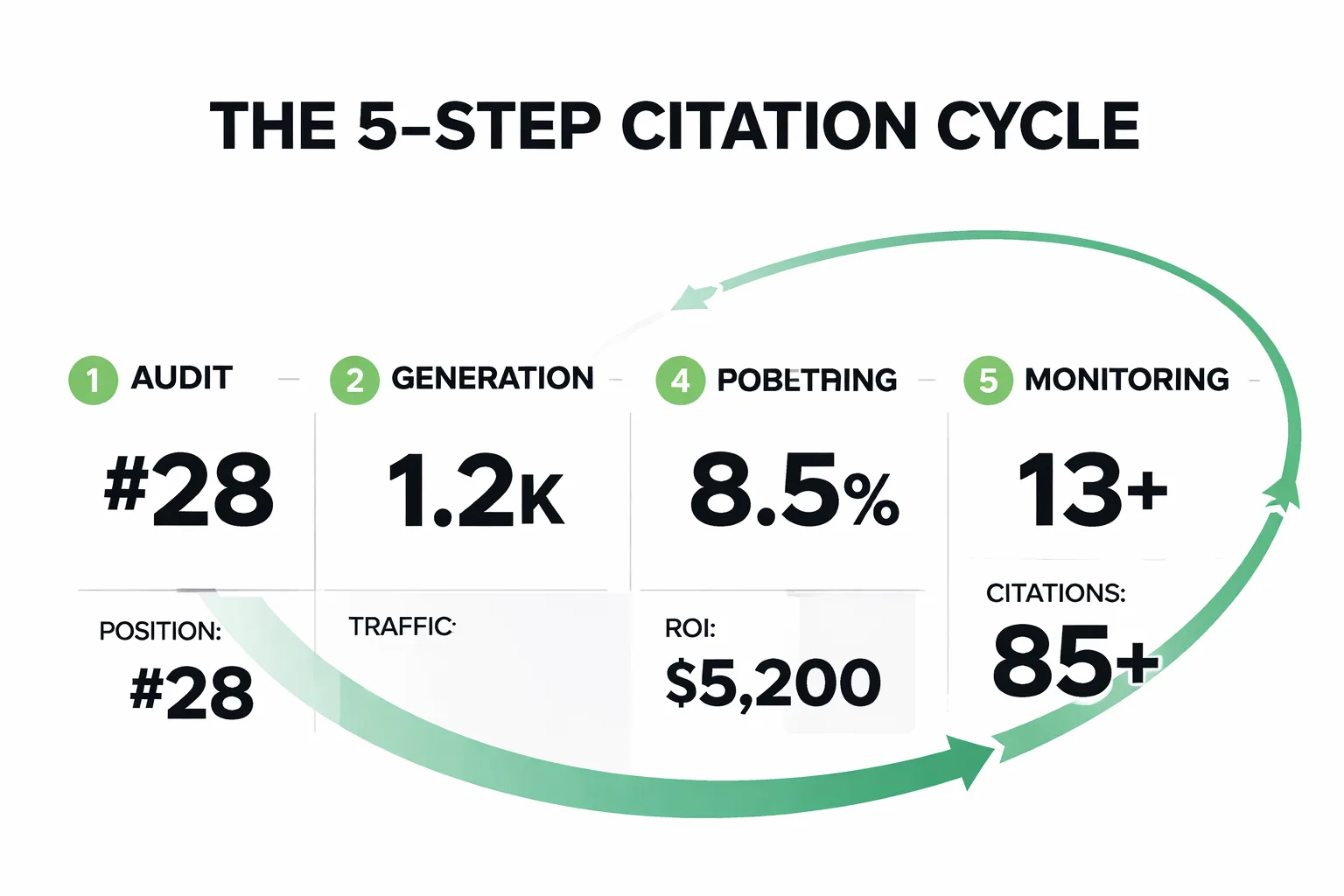
The 5-step process I've outlined here is the workflow I use and recommend. Audit what's already cited. Benchmark against competitors. Generate citation-ready sentences with an ai sentence generator. Embed them in extractable positions. Track weekly and iterate. It's not complicated, but it requires discipline and the right tracking infrastructure.
The teams winning AI citations in 2026 aren't the ones with the most content. They're the ones with the most extractable sentences. That's the shift. That's what an ai sentence generator is actually for. Not volume. Precision.
If you're serious about this, start with the audit. Find out which sentences AI engines are already quoting from your site. Then build from there. The data will tell you exactly what to generate next.
FAQ
How is an AI sentence generator different from a regular AI content writer?
A regular AI content writer produces full articles or paragraphs. An AI sentence generator produces individual, self-contained sentences optimized for specific purposes like citation extraction. The difference is granularity. A content writer optimizes the page. A sentence generator optimizes the atomic unit that AI engines actually cite. In practice, you use a content writer to build the page structure and a sentence generator to craft the specific sentences that will earn citations within that structure.
Can I use an automatic sentence tool for generative engine optimization?
Yes. Generative engine optimization (GEO) works on the same principle as AEO: making content extractable for AI engines. An automatic sentence tool that produces declarative, entity-rich, self-contained sentences directly supports GEO by creating the exact structures that generative engines lift and cite. The key is constraining the generation prompt to produce extractable output rather than narrative prose.
How long does it take to see citation improvements after rewriting sentences?
In my experience, you need 4-6 weeks of weekly tracking to see meaningful changes. AI engines don't re-index content as frequently as Google's classic crawler. The Semrush data showing citation share swings within six weeks suggests that once your content is re-indexed, changes can happen fast, but the re-indexing lag means you need patience before the iteration loop kicks in. If you haven't seen a citation change after 8 weeks, the sentence structure likely needs adjustment.
What's the minimum tracking cadence for AI citation monitoring?
Weekly. Quarterly audits miss the trajectory of change entirely. The Semrush study showing ChatGPT's Reddit citation share dropping from 60% to 10% in six weeks is the clearest evidence that citation patterns move faster than traditional SEO rankings. If you check monthly, you'll catch the change but miss the speed. Weekly gives you actionable trend data and lets you iterate while the pattern is still forming.
Do I need structured data markup for sentence-level optimization?
It helps but isn't strictly required for citation. Structured data (Article, FAQ, HowTo schema) helps AI engines understand entity relationships and content structure, which builds trust. But the sentence itself is what gets extracted. I'd prioritize sentence structure first, then layer in schema markup once your sentences are clean. If you have to choose between spending an hour rewriting sentences and spending an hour adding schema markup, rewrite the sentences. The ROI is higher.
Should I focus on ChatGPT, Perplexity, or Google AI Overviews first?
Track all three from the start. They have different citation patterns. Profound's 30-million-citation analysis found Google AI Overviews cite roughly 14 sources per answer while ChatGPT cites around 5. Different engines, different densities, different opportunities. Start with the engine your buyers use most, but don't ignore the others. Google AI Overviews offers more citation slots (roughly 14 per answer), which means more opportunities to get cited. ChatGPT offers fewer slots (roughly 5) but may drive more focused visibility per citation.
About the Author
Judy Zhou, Founder
Judy Zhou leads content strategy at Meev, where she oversees AI-driven content research and publishing for hundreds of brands. With a background in SEO and editorial operations, she focuses on building content systems that rank on Google, get cited by AI search engines, and drive measurable business results.
Run your first AI visibility audit today and see exactly which sentences AI engines are quoting from your site.