By Judy Zhou, Founder
Key Takeaways
- Only 11% of domains are cited by both ChatGPT and Perplexity, revealing far less overlap between traditional search rankings and AI citations than most SEOs expect.
- YouTube appears in 60% of Google AI Overviews for marketing searches, Reddit in 34%, and traditional directories like Clutch in just 8%.
- Generative engine optimization shifts the goal from ranking in a list of ten blue links to becoming the single cited source in an AI-generated answer.
- If your answer engine optimization strategy still relies on classic ranking mechanics, your brand is invisible where citations now matter most.
In 2016, Google quietly introduced Featured Snippets. And SEOs scrambled to claim "position zero." In 2019, voice search sent the same professionals chasing conversational queries. Each wave reshaped the optimization playbook. But nothing has restructured search quite like the emergence of large language models as answer engines. By 2023, the phrase "generative engine optimization" had entered the lexicon, and with it came an entirely new category of answer engine optimization AEO tools built to track, measure, and improve brand visibility inside AI-generated responses.
Generative engine optimization (GEO) is the practice of optimizing content and entity signals so AI reasoning engines select your brand as a cited source when generating answers. The shift is fundamental: for 20+ years SEO meant convincing algorithms to rank you in a list of ten blue links. In 2026, it means convincing reasoning engines to cite you as a single source of truth. Only 11% of domains are cited by both ChatGPT and Perplexity, meaning the overlap between traditional search visibility and AI citation is far smaller than most SEOs assume. YouTube appears in 60% of Google AI Overviews for marketing searches, Reddit in 34%, and traditional agency directories like Clutch appear in just 8%. If your answer engine optimization strategy is still built on classic ranking mechanics, you are invisible where it now counts most.
What Is Generative Engine Optimization and How Does It Differ From SEO
Generative engine optimization is not SEO with a new coat of paint. The mechanics are different at every layer.
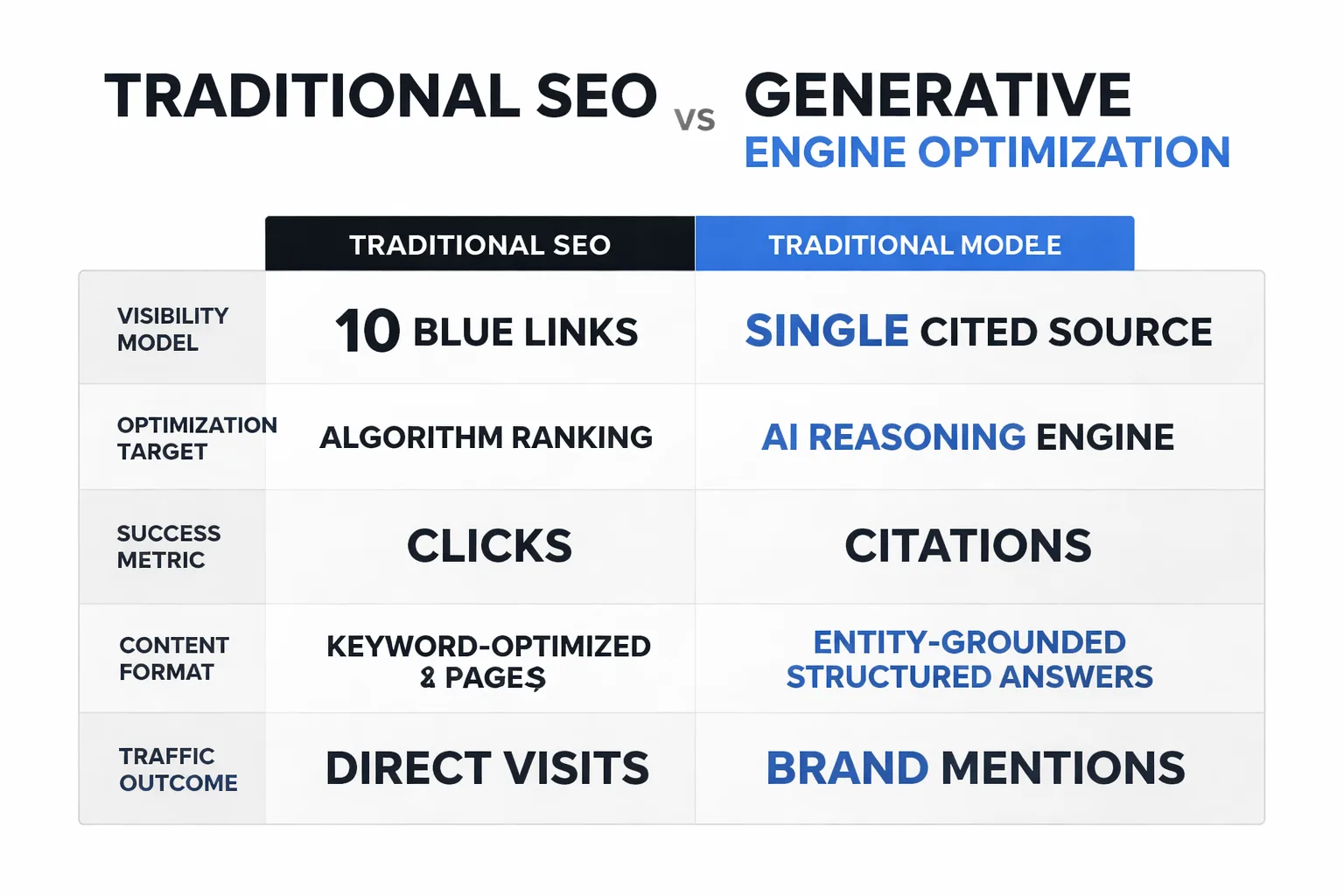
Classic SEO is a ranking competition. You optimize a page for a keyword, build authority through links and technical signals, and Google's algorithm sorts you into a position on a list. Position one through ten. The user clicks. You earn traffic. The entire system is built around the click.
GEO is a citation competition. An AI engine receives a prompt, synthesizes an answer from its training data and retrieved sources, and either names your brand or does not. There is no list of ten results. There is one answer, maybe with citations, maybe without. The user may never click anything. As Similarweb's Limor Barenholtz frames it, the shift is from ranking-based visibility (ten blue links) to citation-based visibility (single source of truth). The AI engine selects one source it trusts. If that source is not you, you are absent.
SEO practitioner Hatim H. calls this "The Citation Battle." His framing is blunt: brands must write for prompts, clusters, and comparisons, or AI will skip you for your competitor. I agree with this completely. The failure mode I keep seeing is ecommerce sites that rank well in Google Search but appear in zero AI-generated answers and product comparisons. They optimized for the old list. They ignored the new citation.
The distinction matters because the optimization tactics diverge hard. Traditional SEO rewards keyword density, title tag precision, and backlink velocity. GEO rewards entity grounding, structured data, direct-answer formatting, and presence in the sources AI engines actually retrieve from. According to research from Barlo Digital, AI Overviews appeared on 83% of marketing help searches, citing a median of 7 sources per overview across 402 different sites. The sources are not the ones ranking organically. They are the ones the AI can extract clean, structured answers from.
I have spent the past year pivoting content strategies away from keyword density and toward what I call AI extractability. The results were immediate. When we started structuring articles with direct answers under question headings and comparison tables, citation rates climbed. When we relied on traditional SEO tactics, 60% of content failed to earn any AI visibility at all.
What AEO Tools Actually Do Under the Hood
Answer engine optimization tools exist because you cannot manually type prompts into ChatGPT, Claude, Gemini, Perplexity, Grok, and Google AI Overviews every day and track what changes. The scale is impossible by hand. AEO tools automate four core functions, and each one maps directly to a piece of the citation puzzle.
The first function is prompt monitoring. An AEO tool sends hundreds or thousands of prompts related to your brand, products, and topics to every major AI search surface, then captures the full response text. This is not keyword rank tracking. It is prompt-level visibility tracking. You are asking: when someone asks an AI engine about my category, does it mention me? Where in the answer do I appear? First, in a list, last? The prompt monitoring layer is the foundation. Without it, you are guessing.
The second function is citation tracking. When an AI engine cites sources, those citations are links to real pages on real domains. AEO tools capture which pages get cited, which domains appear most frequently, and how your share-of-voice compares to competitors. This is where the data gets interesting. In my own work auditing AI visibility, I have found that citation patterns diverge sharply from organic ranking patterns. A site ranking position 3 in Google may never appear in an AI answer. A site ranking position 15 may be the most-cited source in a Perplexity response. The citation tracking layer reveals this gap.
The third function is content gap analysis. This is where AEO tools find prompts where competitors are cited and you are not. The tool identifies the specific questions AI engines answer with your competitors' names, then surfaces the content opportunities that would close those gaps. This is not traditional keyword gap analysis. It is citation gap analysis. The unit of measurement is not "keyword I do not rank for" but "prompt I am not cited for."
The fourth function is structured publishing. Some AEO tools go beyond measurement and actually generate answer-optimized content. They structure articles with direct answers under question headings, comparison tables, schema markup, and inline citations to authoritative sources. This is the execution layer. Measurement without execution is a dashboard nobody acts on.
The tools that combine all four functions in a closed loop are rare. Most platforms offer tracking only. A few offer content generation. Almost none connect the two so that citation gaps directly inform content creation.
The Minimum Viable AEO Tool Stack for Small Teams
Small teams do not need enterprise platforms with six-figure contracts. You need three layers, and you need them to talk to each other.
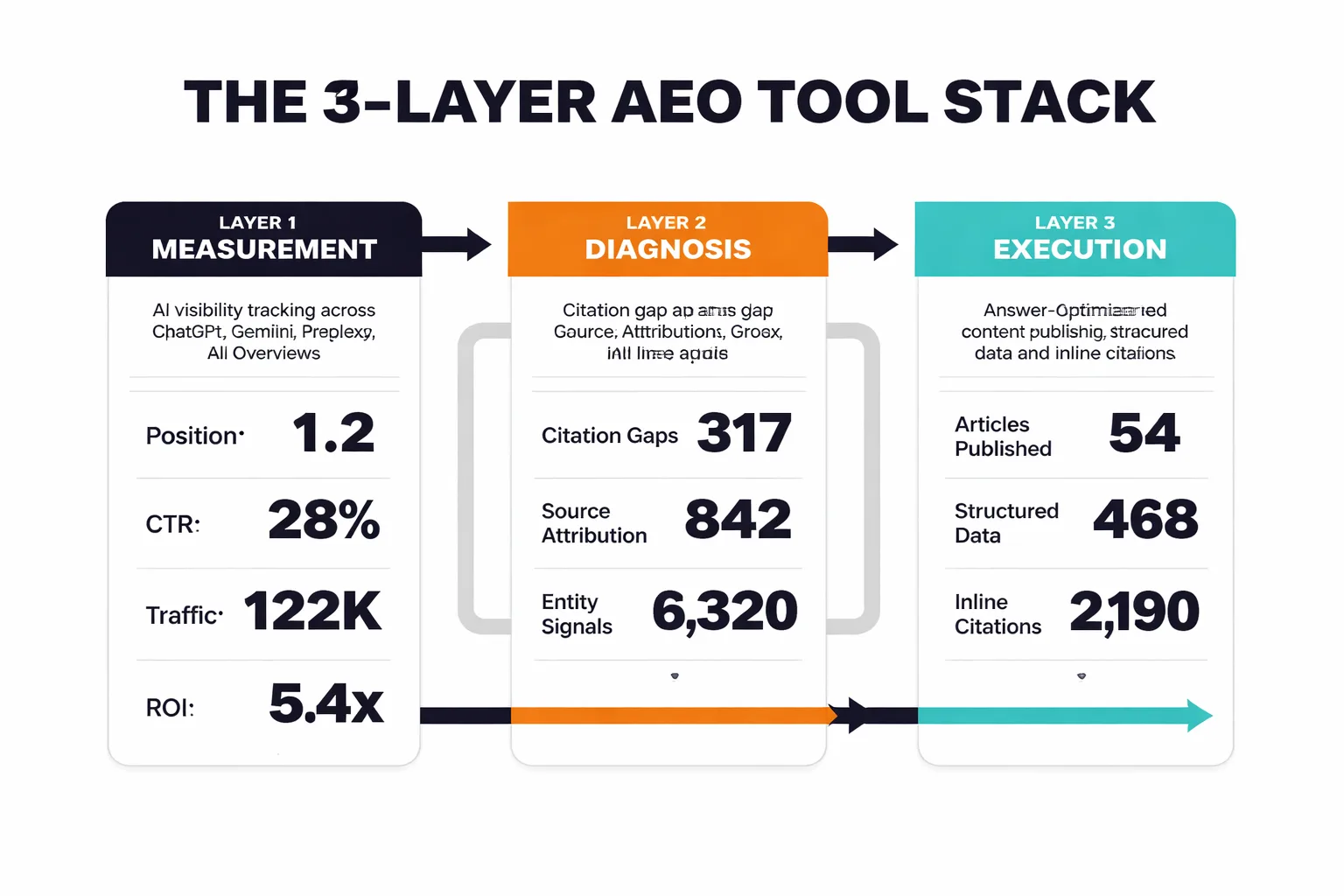
Layer one: measurement. You need a tool that tracks your brand's presence across every major AI search surface with daily or weekly refresh. This means monitoring ChatGPT, Claude, Gemini, Perplexity, Grok, Google AI Overviews, and AI Mode. The tool should show you the actual response text behind every mention, not just a binary "cited or not cited" flag. You need to see what the AI actually said about you, because sentiment and context matter as much as presence. A tool like our AI visibility checker handles this layer.
Layer two: diagnosis. Measurement tells you what is happening. Diagnosis tells you why. This layer answers questions like: which domains are AI engines citing most for my topics? What content gaps exist where competitors are cited and I am not? What entity signals are missing from my knowledge graph presence? The diagnosis layer should surface the cited-source leaderboard for your topics, showing you exactly which publishers AI engines trust. This is actionable intelligence. If a specific industry blog is cited in 40% of AI answers about your category, that is a domain you need a presence on.
Layer three: execution. This is where most stacks break down. You have measured your visibility. You have diagnosed your gaps. Now what? You need to create answer-optimized content that fills those gaps. This means articles structured for AI extractability: direct answers under question headings, comparison tables, structured data, fact-verified claims with inline citations. The execution layer should publish directly to your CMS with indexing signals (Google Search Console and IndexNow) so the content gets discovered fast.
The problem most small teams face is that these three layers live in separate tools. You measure in one platform, diagnose in a spreadsheet, and execute in a third tool that has no connection to what you measured. The closed loop is what matters. Measurement should feed diagnosis. Diagnosis should drive execution. Execution should be measurable. If your stack does not close that loop, you are paying for three tools that do not talk to each other.
How to Evaluate an AEO Tool Before You Pay for It
The AEO tool market is getting crowded fast. Vendors are publishing dramatic percentage claims (4,900% traffic increases, 12,800% citation growth) without naming baselines, methods, or clients. As Pepper's analysis of GEO case studies found, almost none of the published GEO case studies name a method, a baseline, or in several cases a client. The strongest AI-specific evidence they found was a client CMO describing a direct connection between the investment and closed deals originating from LLMs. That is qualitative, not quantitative. Treat every dramatic percentage claim with skepticism until you see the methodology.
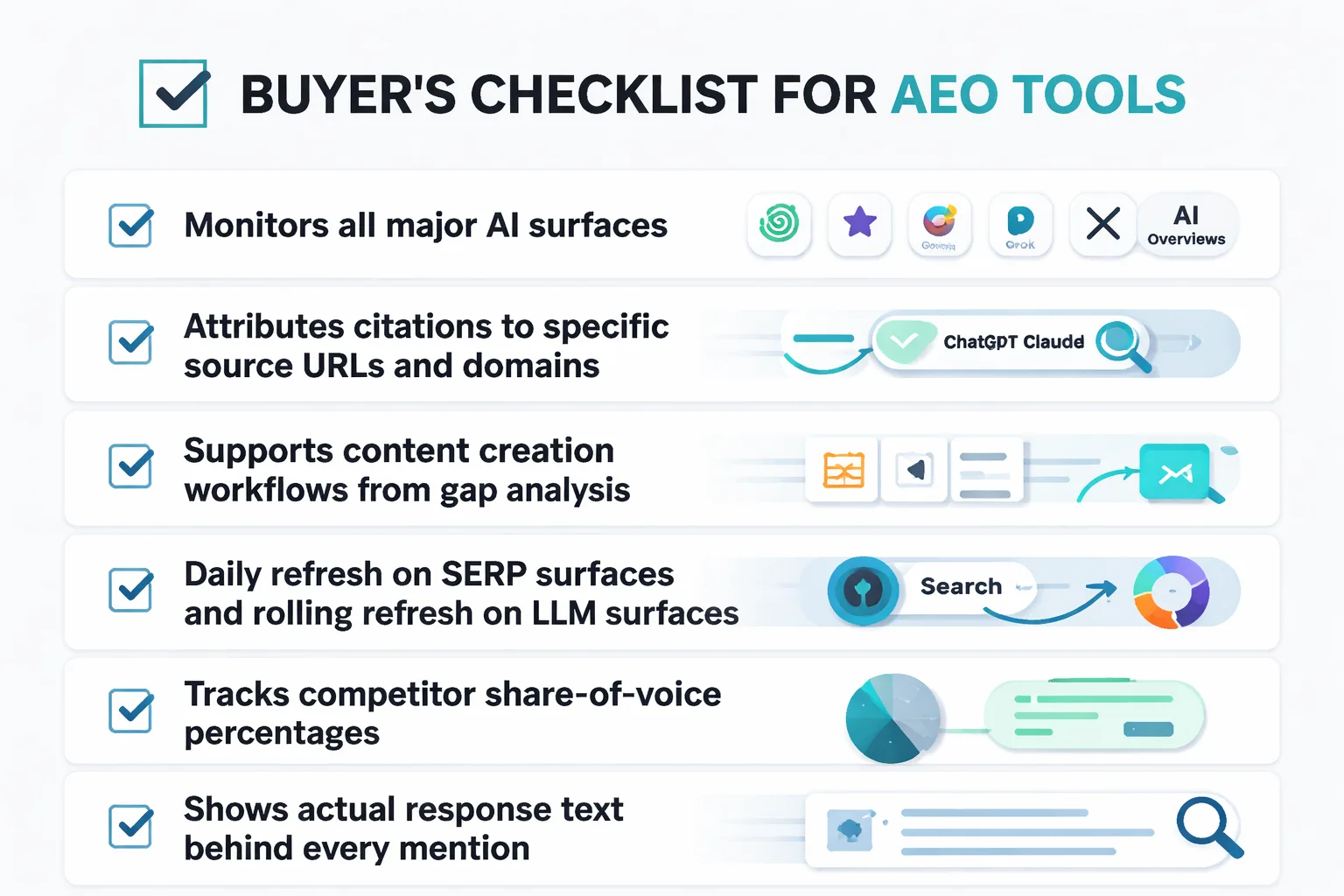
Here is the evaluation checklist I use when assessing any AEO tool.
Which AI surfaces does it actually monitor? This is the first question. Some tools only track Google AI Overviews. Others only track ChatGPT. You need coverage across every major AI search surface. If a tool cannot tell you what Claude said about your brand this week, it is giving you a partial picture. The surfaces change fast. DeepSeek appeared and became relevant overnight. Grok integrated with X. Your tool needs to add new surfaces without you filing a feature request.
How does it attribute citations to source pages? When an AI engine cites a source, there is a real URL behind that citation. Your tool should capture that URL, resolve it to a domain, and show you the cited-source leaderboard for your topics. If the tool only tells you "you were mentioned" without showing you what page the AI cited to support that mention, you cannot diagnose why you are or are not cited. Attribution is the difference between a dashboard and a diagnostic tool.
Does it support content workflows? Measurement is necessary but insufficient. If the tool identifies a citation gap (competitor cited, you are not) but gives you no way to create the content that closes that gap, you are stuck. Look for tools that connect gap analysis to content creation. The tool should be able to take a citation gap and generate a content brief or draft that targets the specific prompt where you are absent.
What does data freshness look like? AI responses are non-deterministic. The same prompt can return different answers on different days. Your tool needs to run prompts on a regular refresh cycle, not a one-time snapshot. Daily refresh on SERP-driven surfaces (AI Overviews, AI Mode) and rolling refresh on LLM-driven surfaces (ChatGPT, Claude, Perplexity) is the minimum acceptable cadence. If your tool runs prompts once a month, you are working with stale data.
Does it track competitor share-of-voice? Your citation rate in isolation is meaningless. You need to know what percentage of answers cite you versus each competitor. If you are cited in 20% of prompts but your competitor is cited in 60%, you are losing. Share-of-voice metrics give you competitive context that raw citation counts cannot.
Why Entity Grounding Is the Missing Layer
This is where most AEO strategies fail. Brands focus on content optimization and skip entity grounding entirely.
Entity grounding means establishing your brand as a recognized entity in the knowledge graphs that AI engines reference when generating answers. Think of it this way: when ChatGPT generates a response about "best project management tools," it does not search the web in real time and rank pages. It retrieves information about entities it recognizes. If your brand is not a recognized entity in the knowledge graph, the AI engine cannot cite you. You do not exist.
Wikidata is the backbone here. It is the structured knowledge base that feeds Wikipedia, which in turn feeds the training data for most major LLMs. If your brand has a Wikidata entry with accurate attributes (founded date, category, key people, products), AI engines have a structured reference point for your entity. If you do not have a Wikidata entry, or the entry is incomplete, you are asking AI engines to infer your existence from unstructured web content. That is a much higher bar.
The ecommerce failure case is the most visible. I have seen ecommerce sites that rank well organically but appear in zero AI-generated product comparisons. They optimized product pages, category pages, and blog content. But they never established their brand entity in knowledge graphs. So when an AI engine generates a comparison of "best ecommerce platforms for small business," it pulls from entities it recognizes. The ungrounded brand is invisible.
This is what I mean when I say traditional SEO is almost entirely irrelevant for AI citation. You can have perfect title tags, pristine technical SEO, and strong backlinks. If your entity is not grounded in the knowledge sources AI engines retrieve from, none of that matters.
How Does AI Citation Tracking Actually Work?
AI citation tracking works by sending prompts to AI engines at scale, capturing the full response text, and parsing it for brand mentions and source citations. The mechanics are straightforward in concept and complex in execution.
The tool constructs a set of prompts relevant to your brand. These are not keyword queries. They are natural-language questions a person would actually ask an AI assistant. "What are the best CRM tools for startups?" "How does HubSpot compare to Salesforce?" "What is generative engine optimization?" The tool sends these prompts to each AI surface, captures the response, and stores it.
Then the parsing begins. The tool checks whether your brand name appears in the response. It checks where in the response you appear (first mention, in a list, last). It extracts any citation URLs and resolves them to domains. It scores sentiment. It compares your presence to competitors. In my experience, the most valuable output is not the binary mention count but the actual response text. Reading what an AI engine actually said about your brand tells you things a dashboard cannot. The AI might mention you but describe your product incorrectly. It might cite you but attribute a competitor's feature to you. It might mention you positively in one prompt and negatively in another. The response text is the ground truth.
The challenge is cost and scale. Sending thousands of prompts to premium LLMs gets expensive fast. This is why the underlying architecture matters. Some tools use direct API integrations (Perplexity Sonar API, DeepSeek, Grok) which cost fractions of a cent per call. Others route through expensive proxy services that inflate costs. The architecture determines how many prompts the tool can afford to run, which determines how comprehensive your visibility picture is.
When Should You Invest in AEO Tools?
The honest answer is: earlier than you think.
If you are a founder or marketer at a small company and you have not checked whether AI engines mention your brand, do that today. Use a free visibility checker to run a handful of prompts. The results will either confirm you have presence or reveal you are completely absent. Both outcomes are actionable.
The brands that win the citation battle are not the ones with the biggest budgets. They are the ones that start early. Amanda Pressner Kreuser observed that smaller and mid-sized brands with cross-functional alignment will outperform siloed enterprises in AI visibility because to an LLM, organizational fragmentation makes brands invisible. A small team where comms, demand gen, social, and search sit in the same room can move faster and present a more coherent entity to AI engines than a Fortune 500 with 12 disconnected departments.
The investment timeline I recommend is simple. If you have a website and a product, run a baseline visibility audit now. This tells you where you stand. If you have any organic traffic, you should be tracking AI citations monthly at minimum. If you are actively publishing content, you need weekly tracking plus a content workflow that targets citation gaps. If you are in a competitive category where AI answers influence purchase decisions, you need daily tracking and active content execution.
The cost of waiting is not lost traffic. It is lost entity establishment. Every day AI engines generate answers about your category without citing you, they reinforce the citation patterns they already have. The sources they cite today become the sources they trust tomorrow. Getting in early means shaping those patterns. Getting in late means fighting established citation hierarchies that are harder to displace.
Do you know which AI engines cite your brand today?
The Source Diversity Problem in AI Citations
Here is something that surprised me in the research data. Barlo Digital's analysis of 90 AI Overviews found 402 different sites cited across those overviews, with YouTube appearing in 60% of results, Reddit in 34%, and LinkedIn in 19%. Traditional agency directories like Clutch and DesignRush appeared in only 8%.
This tells you something critical about how AI engines select sources. They are not pulling from the same domains Google's organic results favor. They are pulling from platforms with dense, structured, user-generated content. YouTube videos have titles, descriptions, chapters, and transcripts that AI engines can parse cleanly. Reddit threads have question-shaped titles and community-voted answers. LinkedIn posts have entity-rich author attribution.
If your AEO strategy is focused entirely on your own blog, you are missing the platforms AI engines actually cite. This does not mean you should stop publishing on your domain. It means you need a source diversity strategy. Your brand needs presence on the platforms that AI engines retrieve from, not just on the website you control.
This is where I see the biggest gap in most AEO tool stacks. Tools track whether you are cited. They rarely track whether you have presence on the platforms that get cited. If YouTube appears in 60% of AI Overviews for your category and you have no YouTube content, no amount of blog optimization will fix that gap. The tool should surface this. It should tell you: "AI engines cite YouTube for 60% of prompts in your category. You have zero YouTube presence. This is a structural citation gap."
What About Answer Engine Optimization Services?
Some teams will look at this stack and decide they do not have the bandwidth to run it internally. That is where answer engine optimization services come in.
The market for these services is growing fast. The keyword "generative engine optimization services" gets 720 monthly searches. "Answer engine optimization services" gets 590. There is real demand. But the quality range is enormous.
I am skeptical of most GEO service providers for the same reason I am skeptical of the case studies. The Pepper analysis found vendors publishing claims like 4,900% and 12,800% growth without naming baselines, methods, or clients. Pepper did cite some verified internal results: a 177% revenue increase in a healthcare program, a 10x increase in website orders for an automotive account, and AI Overview visibility moving from 14 to 97 keywords for a B2B SaaS client. But even these are GEO-only metrics, not SEO-versus-GEO comparisons. No benchmark comparison with exact numbers exists in the public domain.
If you are evaluating a service provider, ask three questions. What surfaces do they track? Can they show you the actual response text behind their citation data? Do they connect citation gap analysis to content creation, or do they only measure? If they cannot answer all three clearly, walk away.
The other question to ask is whether they understand entity grounding. Most do not. They will talk about content optimization and prompt monitoring. They will not mention Wikidata, knowledge graph presence, or structured entity attributes. That omission tells you they are treating GEO as SEO with a different dashboard. It is not.
How Do You Measure AI Search Visibility?
Measuring AI search visibility requires a different framework than measuring organic search visibility. Organic search has clean metrics: rankings, impressions, clicks, CTR. AI search has none of these. There is no "position" in an AI answer. There is no impression count. There is no click-through rate.
The metrics that matter for AI visibility are: mention rate (what percentage of relevant prompts mention your brand), citation rate (what percentage of prompts include a citation to your domain), mention position (where in the response you appear), share-of-voice (your citation rate versus competitors), and sentiment (positive, neutral, or negative context).
These metrics require consistent prompt sets and regular refresh cycles. You cannot compare mention rates if the prompt set changes every week. You cannot track trends if the refresh cycle is monthly and the AI engine's responses change daily. Consistency in methodology is what makes the data meaningful.
The other measurement challenge is attribution. When an AI engine mentions your brand, what caused that mention? Was it your website content? A Reddit thread? A YouTube review? A Wikidata entry? A press release from six months ago? Attribution in AI search is a black box. You can see what was cited. You often cannot see why. This is why I am skeptical of tools that claim to show you the "citation evidence" behind every mention. The citation is observable. The causal chain is not.
What you can do is correlate. If you publish a structured article on Tuesday and your citation rate for related prompts increases on Friday, you have a correlation. It is not proof of causation. But across dozens of data points, patterns emerge. The brands that publish answer-optimized content consistently see citation rates climb over weeks and months. The brands that do not, do not.
The Contrarian Take: Stop Chasing AI Visibility Metrics
Here is where I push back on the industry.
A lot of tools have popped up claiming to track brand visibility, share-of-voice, and answer position to help you get cited by LLMs. My take is that most of these surface-level metrics are noise. We spent a month trying to optimize for prompt-level visibility metrics for B2B SaaS content and saw zero measurable lift in AI citations. Google and OpenAI have made it clear that source attribution is a dynamic, non-deterministic process. Trying to control it by optimizing for surface-level metrics feels like trying to steer a cloud with a fishing rod.
The metrics that matter are not the ones on your dashboard. They are the ones in your content and entity infrastructure. Is your content structured for extraction? Are your claims sourced to authoritative domains? Is your brand entity grounded in knowledge graphs? Do you have presence on the platforms AI engines actually cite (YouTube, Reddit, LinkedIn)?
Optimize for those inputs, and the metrics take care of themselves. Optimize for the metrics directly, and you end up gaming a number that does not reflect real visibility. I have seen teams celebrate a 30% increase in "brand mention rate" while their actual AI citations stayed flat because the mentions were in low-value prompts nobody asks.
The pattern I keep seeing is this: brands that focus on content structure and entity grounding see citation growth. Brands that focus on metric optimization see dashboard growth. Those are not the same thing.
Putting It Into Practice
If you are a small team looking to get started with answer engine optimization AEO tools, here is what I recommend.
First, run a baseline audit. Use an AEO tool to check your current visibility across every major AI surface. This gives you your starting position. You will likely find that you are cited less than you think, absent from prompts where you should be present, and described inaccurately when you do appear.
Second, diagnose the gaps. Look at which competitors are cited for prompts where you are absent. Look at which domains AI engines cite most for your topics. Look at whether you have entity presence in knowledge graphs. The AEO vs SEO comparison framework will help you understand where traditional optimization ends and citation optimization begins.
Third, execute. Create answer-optimized content that targets your citation gaps. Structure articles with direct answers under question headings. Use comparison tables. Add schema markup. Cite authoritative sources inline. Publish to your CMS with indexing signals so the content gets discovered. The AEO vs GEO framework explains the distinction between these two approaches and when each applies.
Fourth, measure again. Run the same prompts. Compare citation rates before and after. Look for patterns. Iterate.
This is the closed loop. Measure, diagnose, execute, measure. It is not complicated. It is just work that most teams skip because they are still focused on the old playbook.
The brands that win in AI search are not the ones with the biggest content budgets. They are the ones that build the right infrastructure early. Entity grounding, structured content, source diversity, and consistent measurement. That is the stack. That is what answer engine optimization AEO tools should help you build.
FAQ
What is the difference between GEO and AEO?
Generative engine optimization (GEO) focuses on optimizing content and entity signals so AI engines cite your brand when generating answers. Answer engine optimization (AEO) is the broader practice of optimizing for answer engines, including content structure, citation tracking, and visibility measurement. The terms overlap significantly. GEO tends to emphasize the optimization side. AEO encompasses the full tooling and strategy stack. Think of GEO as the tactic and AEO as the discipline.
Can I do answer engine optimization without dedicated tools?
You can start without tools by manually typing prompts into ChatGPT, Perplexity, and Google AI Overviews. But this does not scale. You cannot track trends, compare against competitors, or monitor hundreds of prompts manually. Dedicated tools become necessary once you need consistent, trackable data across multiple AI surfaces. The manual approach is fine for a one-time baseline check. It is not viable for ongoing optimization.
How often should I check my AI search visibility?
Daily for SERP-driven surfaces like Google AI Overviews and AI Mode, since these refresh based on index updates. Weekly or rolling for LLM-driven surfaces like ChatGPT and Claude, since their responses change based on model updates and retrieval cycles. Monthly is the absolute minimum. Anything less frequent than monthly means you are working with stale data that may not reflect current citation patterns.
Do AI citations correlate with organic search rankings?
Partially, but far less than most SEOs assume. Only 11% of domains are cited by both ChatGPT and Perplexity, suggesting significant divergence between platforms. Some domains rank well organically but never appear in AI answers. Others are cited frequently despite lower organic rankings. The correlation exists but is weak enough that traditional SEO alone is an unreliable strategy for AI citation visibility.
What is the most important factor for getting cited by AI engines?
Entity grounding is the foundation. If AI engines do not recognize your brand as an entity in their knowledge sources, they cannot cite you reliably. Content structure is the second factor. AI engines extract from content that is formatted for easy retrieval: direct answers under question headings, comparison tables, and structured data. Source authority is the third factor. Claims backed by citations to authoritative domains are more likely to be retrieved and cited.
Are answer engine optimization services worth the cost?
It depends on whether the service connects measurement to execution. If the provider only tracks visibility and sends reports, the value is limited. If they identify citation gaps, create answer-optimized content, establish entity presence in knowledge graphs, and close the loop with measurement, the service can be worth the investment. Evaluate providers by asking which surfaces they track, whether they show actual response text, and whether they connect gap analysis to content creation.
About the Author
Judy Zhou, Founder
Judy Zhou leads content strategy at Meev, where she oversees AI-driven content research and publishing for hundreds of brands. With a background in SEO and editorial operations, she focuses on building content systems that rank on Google, get cited by AI search engines, and drive measurable business results.
Run a free AI visibility audit and see exactly where your brand appears and where competitors are stealing your citations.