

By Judy Zhou, Head of Content Strategy
Key Takeaways
- 96% of AI Overview citations come from sources with strong E-E-A-T signals (Wellows analysis of 2,400 citations) — making content quality a binary entry requirement, not a ranking factor.
- The mention-citation gap is the core problem AEO tools solve: your brand can appear across thousands of web documents and still never surface in a generated AI answer without deliberate citation strategy.
- Meev is the only platform that combines citation tracking across 7 AI engines with quality-gated content publishing — all plans start at $49/month with a 7-day free trial and no credit card required.
- Choosing a tool based on engine count alone is a mistake — ask vendors how many prompts they run, at what cadence, and whether they track citation-level or mention-level data before committing.
In 2022, "Answer Engine Optimization" was a fringe term debated in SEO forums by practitioners who suspected Google's growing reliance on featured snippets was a preview of something far more disruptive. They were right. By late 2023, ChatGPT had crossed 100 million weekly users and Perplexity was doubling its query volume every quarter. Brands that had spent years optimizing for the ten blue links suddenly needed a completely different discipline. One with its own metrics, its own citation logic, and its own tooling. By 2026, that tooling has arrived. Here's what's actually worth using.
The aeo tools market has matured fast. What started as a handful of brand-monitoring dashboards retrofitted for LLM tracking has become a distinct software category, with purpose-built platforms that measure citation rates, track mention-to-citation conversion, and in some cases publish the content that earns those citations. As someone who oversees AI-driven content research and publishing for hundreds of brands at Meev, I've watched this category evolve from "interesting experiment" to "line item in the Q1 budget" in under 18 months.
Why AEO Tools Are Now Non-Negotiable
The stakes changed when AI search stopped being a novelty. Semrush's 2025 AI Overviews study analyzed 200,000 queries and found that AI Overviews now appear for a significant share of informational searches — the exact query type that content marketers have historically owned. If your brand isn't cited in those answers, a competitor is. That's not a hypothetical.
What makes this harder than traditional SEO is the mention-citation gap. A brand can appear in thousands of web documents that LLMs train on and still never surface in a generated answer. The gap between "mentioned somewhere on the internet" and "cited in an AI response" is where most content marketing budgets are currently leaking value. Answer engine optimization tools exist specifically to measure that gap and help you close it.
There's also the E-E-A-T dimension. Wellows analyzed 2,400 AI Overview citations and found that 96% came from sources with strong E-E-A-T signals — which means E-E-A-T isn't just a ranking factor anymore. It functions as a binary gatekeeping filter for AI search. You either clear the bar or you don't appear. That finding changed how I think about content quality scoring: it's not a nice-to-have polish step, it's the entry ticket.
I'll be direct about something the industry tends to soften: if you're not tracking AI citations right now, you're making budget decisions based on incomplete data. Your organic traffic numbers don't capture the queries that resolved inside ChatGPT or Perplexity without a click. Those are real demand signals, and they're invisible to your current analytics stack.
How We Ranked These Tools
I evaluated each platform against five criteria, weighted by how much they matter to a working content team rather than an enterprise IT buyer.
Citation tracking depth was the primary filter. Does the tool actually query the AI engines and return citation-level data, or does it infer visibility from proxy signals? Tools that query LLMs directly score higher.
AI engine coverage mattered because the answer engine landscape is not monolithic. ChatGPT citation patterns differ from Perplexity's source selection logic, and Google AI Overviews behaves differently from both. A tool that covers only one engine gives you a partial picture at best.
Reporting quality separates tools you'll actually use from tools you'll open once a month. I looked for prompt-level breakdowns, competitor share-of-voice, and trend data over time. Not just a snapshot score.
Ease of integration with existing content workflows. Can the data feed into your CMS, your analytics platform, or your editorial calendar without a custom engineering project?
Pricing transparency is a real criterion, not a filler one. Several platforms in this category require a sales call to learn what you'll pay. That's a meaningful friction cost for smaller teams.
One thing I deliberately did not rank on: whether the tool produces AI-generated content. That's a separate capability, and conflating a citation tracker with a content engine muddies the comparison. Where tools do both, I note it. But the ranking reflects the citation-tracking core.
Comparison Table
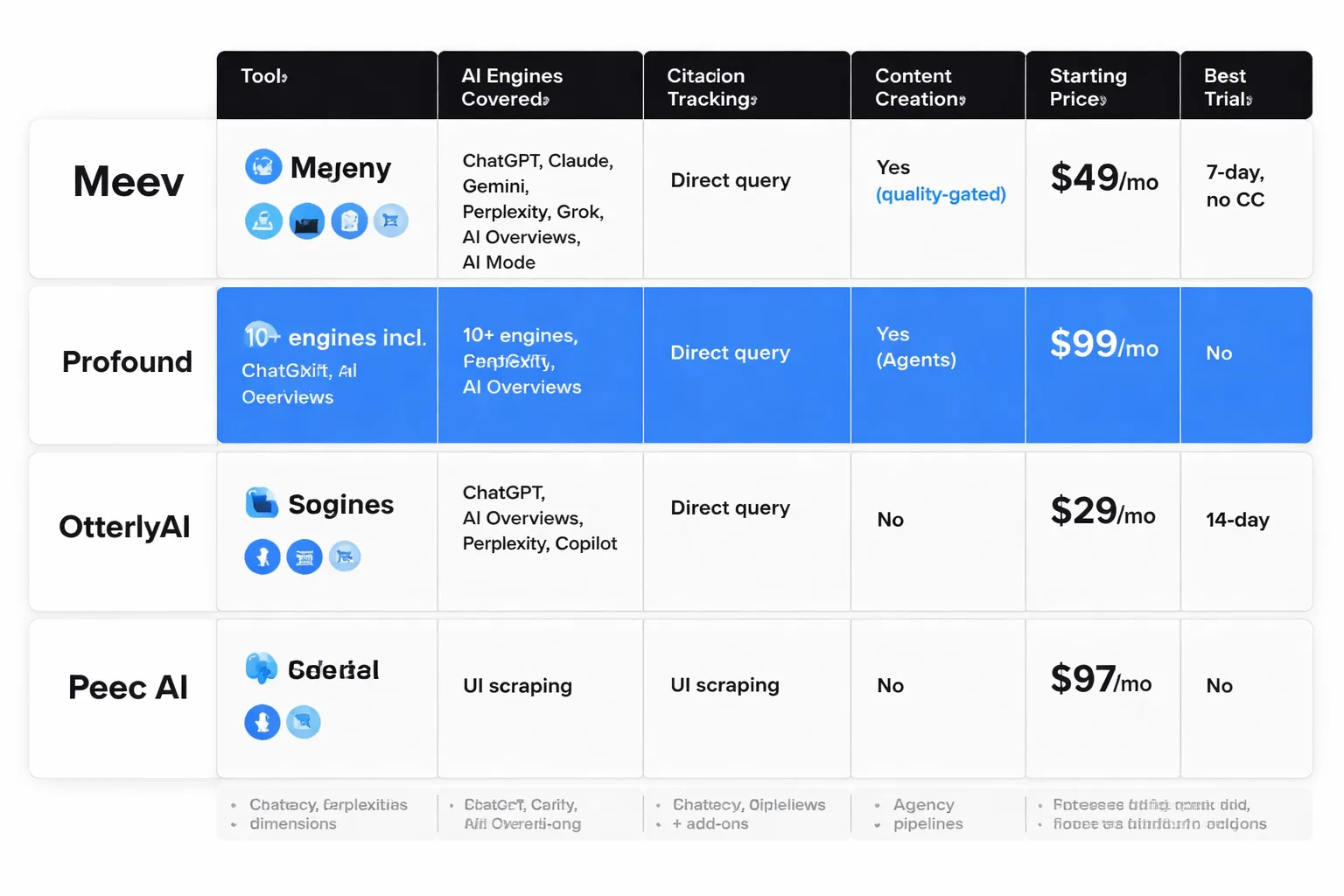
| Tool | AI Engines Covered | Citation Tracking | Content Creation | Starting Price | Best For | Free Trial |
| Meev | ChatGPT, Claude, Gemini, Perplexity, Grok, AI Overviews, AI Mode | Direct query | Yes (quality-gated) | $49/mo | Teams wanting tracking + publishing | 7-day, no CC |
| Profound | 10+ engines incl. ChatGPT, Perplexity, AI Overviews | Direct query | Yes (Agents) | $99/mo | Enterprise B2B/SaaS | No |
| OtterlyAI | ChatGPT, AI Overviews, Perplexity, Copilot | Direct query | No | $29/mo | Solopreneurs, SMBs | 14-day |
| Peec AI | ChatGPT, Perplexity, AI Overviews + add-ons | UI scraping | No | €89/mo | Global/multilingual brands | No |
| Scrunch | Multi-engine (AXP delivery) | Direct + AXP | No (2026 roadmap) | $250/mo | Technical sites, agencies | No |
| Semrush AI Toolkit | ChatGPT, AI Overviews, Gemini, Claude, Grok, Perplexity, DeepSeek | Direct query | No | $99/mo add-on | Existing Semrush users | No |
| Ahrefs Brand Radar | Web mentions (indirect AI signal) | Web crawl | No | $699/mo add-on | SEO-first teams on Ahrefs | No |
| SE Ranking | AI Overview, AI Mode, ChatGPT, Gemini, Perplexity | UI-based | No | $69/mo | Growing SEO teams | No |
| AthenaHQ | ChatGPT, Perplexity, AI Overviews | Direct query | No | ~$99/mo | B2B SaaS content teams | Demo req. |
| Writesonic GEO | Multi-engine (creation-first) | Secondary | Yes | $20/mo | High-volume content teams | Free plan |
| HubSpot AEO | ChatGPT, Perplexity, Gemini | Direct query | No | Free / $50/mo | Brand benchmarking starters | Free |
1. Meev — Best for Teams That Want Tracking and Publishing Together
Best for: Teams that want AI citation tracking plus a content engine they can trust to publish. Not just a dashboard that surfaces problems.
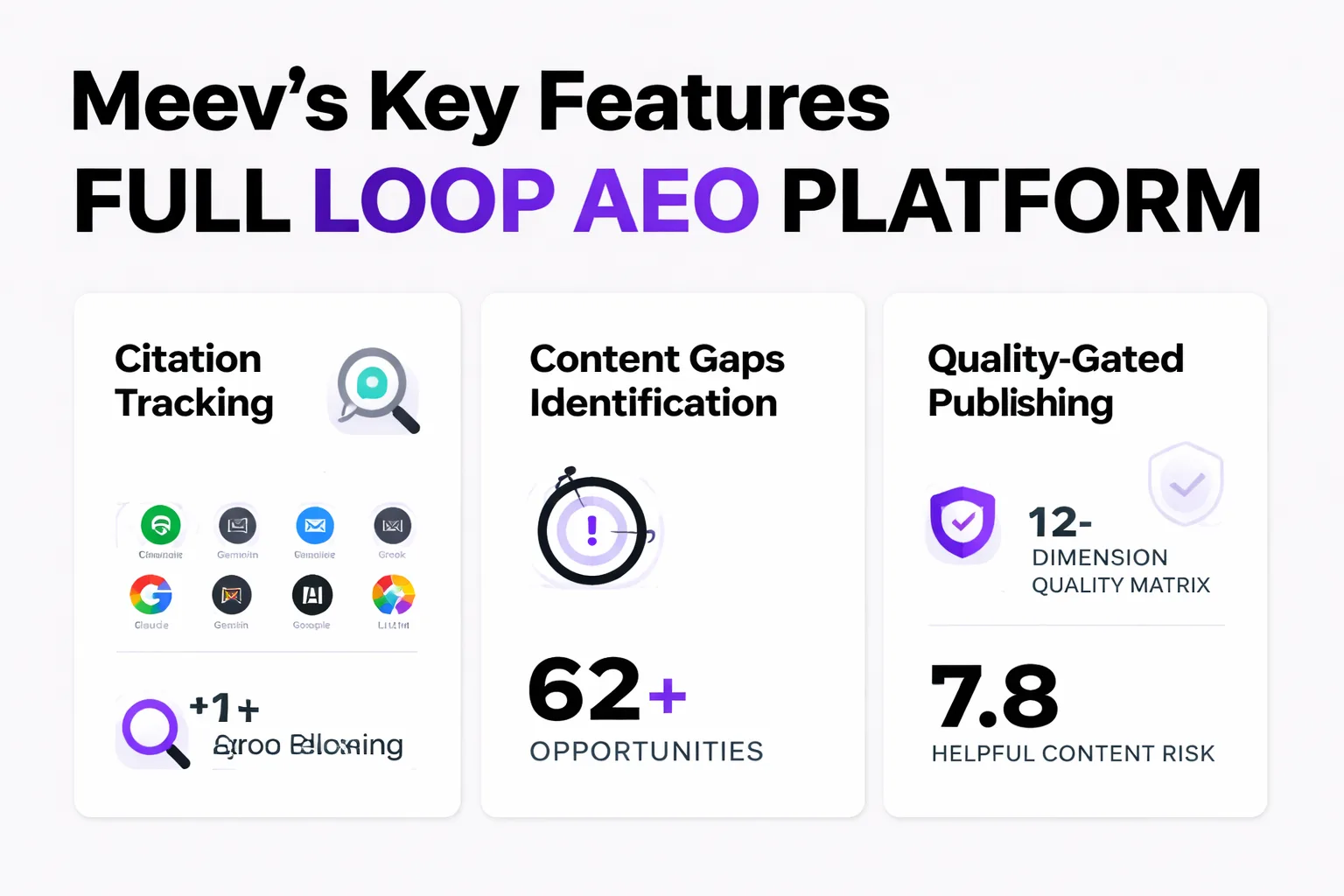
Meev is the only platform in this list that closes the full loop: it tracks where you're being cited (and where you're not), identifies the content gaps driving those misses, and publishes quality-gated articles designed to earn citations. The differentiator isn't the tracking itself. Several tools in this category do that well. It's the 12-dimension Quality Matrix and Helpful Content Risk score that gate every article before it ships. In a category where scaled content abuse is actively triggering Google manual actions, that quality gate isn't a marketing claim. It's a compliance mechanism.
Key features: - Citation tracking across ChatGPT, Claude, Gemini, Perplexity, and Grok on a rolling cadence; Google AI Overviews and AI Mode refresh daily. 12-dimension Quality Matrix plus Helpful Content Risk score. 70/100 publish gate on both. Knowledge Base enforcement. Articles grounded in your approved claims, not AI hallucination. Closed-loop Citation Path (roadmap) — each article mapped to the citation-rate delta it drove. Autopilot topic pool with gap detection from competitor citation patterns
Pricing: 7-day free trial (no credit card, no auto-charge). Lite $49/mo, Starter $99/mo, Pro $269/mo, Agency $599/mo. 20% annual discount. Cancel anytime; hard-cap quotas with no overage fees.
For teams comparing options, the Meev vs Profound breakdown is worth reading before you commit to either. The pricing structures diverge significantly at team scale, and the feature overlap is less than the marketing suggests.
2. Profound — Best for Enterprise B2B Marketing Teams
Best for: Enterprise marketing and SEO teams at B2B SaaS, fintech, or mid-market brands that need boardroom-ready AI visibility reporting and content creation in one platform.
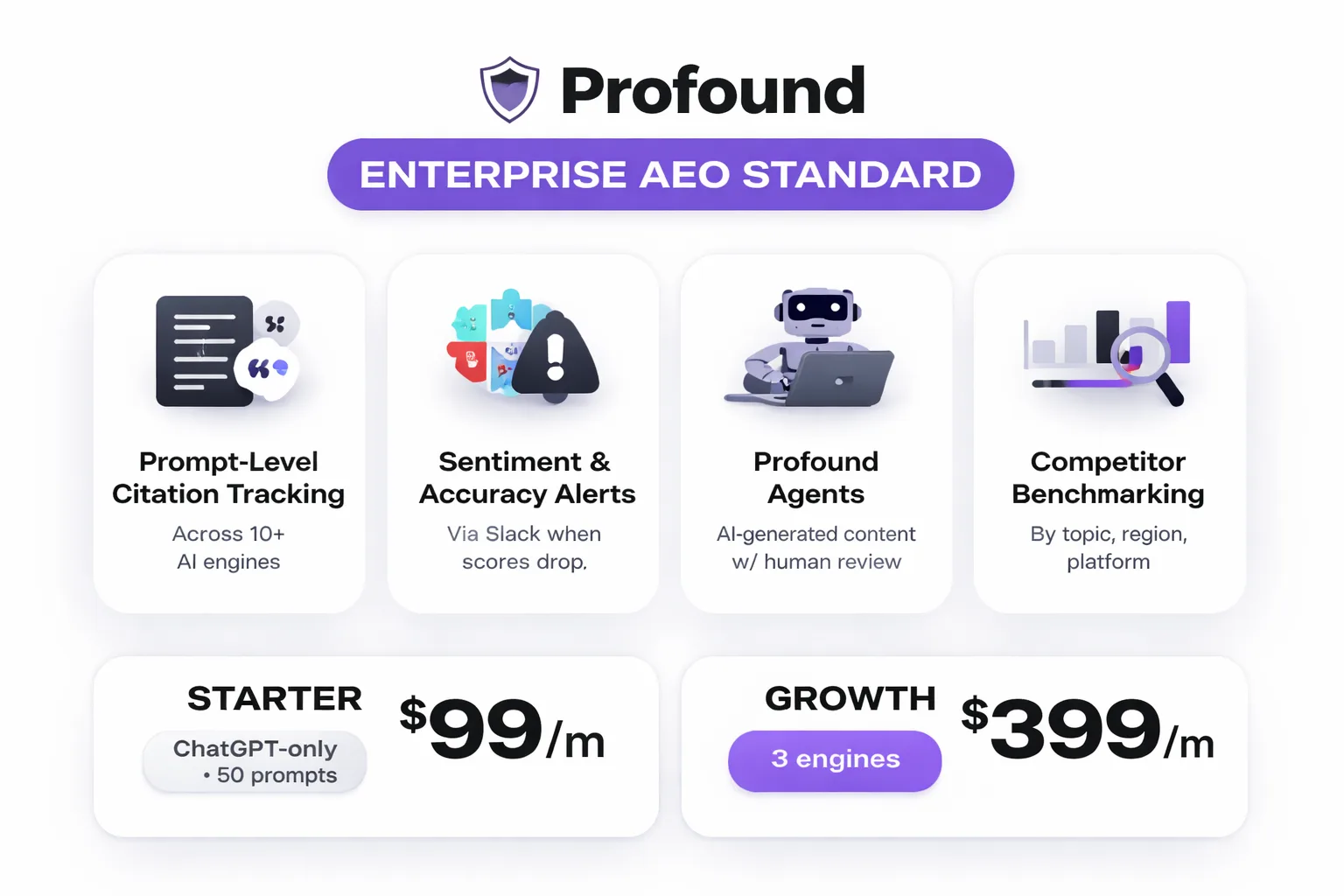
Profound is the closest thing the AEO category has to an enterprise standard. It tracks prompt-level brand citations across 10+ AI engines, sends Slack alerts when sentiment scores drop, and generates content through its Agents feature with human review built into the workflow. The G2 Winter 2026 AEO Leader designation reflects real adoption at the mid-market and enterprise tier.
Key features: - Prompt-level brand citation and mention tracking across 10+ AI engines. Sentiment and accuracy alerts via Slack when scores drop below thresholds. Profound Agents: AI-generated content (listicles, how-tos, comparisons) with human-in-the-loop review. Competitor share-of-voice benchmarking by topic, region, and platform
Pricing: Starter at $99/month (ChatGPT-only, 50 prompts); Growth at $399/month (3 engines, 200+ prompts, basic content tools); Enterprise custom pricing (up to 10 engines, multi-company tracking, SSO/SOC2). Named G2 Winter 2026 AEO Leader.
The Starter tier is genuinely limited. ChatGPT-only tracking at $99/month is a high price for a single-engine view. Growth is where Profound becomes useful, and at $399/month it's positioned squarely at teams with a real budget. Smaller operations should model the total cost carefully before signing up.
3. OtterlyAI — Best for SMBs and Solo Operators New to AEO
Best for: Solopreneurs, SMBs, and content marketers new to AEO who need an accurate, affordable entry point for multi-engine AI brand tracking without enterprise overhead.
OtterlyAI is the most accessible entry point in this category. At $29/month for the Lite tier, it covers ChatGPT, AI Overviews, Perplexity, and Copilot. Four of the five engines most content teams care about. The GEO URL audit feature is genuinely useful for diagnosing which pages are being ignored by AI crawlers, which is often the first question a team needs to answer before any optimization work begins.
Key features: - Brand citation and mention tracking across ChatGPT, AI Overviews, Perplexity, and Copilot. GEO URL audits to identify which pages are being cited or ignored by AI engines. Funnel-specific prompt tracking with share-of-voice and competitor visibility analysis. Brand sentiment analysis showing how AI describes your brand vs. competitors
Pricing: Lite at $29/month (15 prompts, 4 engines); Standard at $189/month (100 prompts); Premium at $489/month (400 prompts, 10,000 GEO URL audits). Google AI Mode and Gemini available as paid add-ons ($9–$149/month). 15% annual discount. 14-day free trial.
The weekly data refresh cadence is the main limitation to understand upfront. If you need to respond quickly to a citation drop. Say, after a product update or a PR incident. OtterlyAI won't give you same-day visibility. For teams running steady-state monitoring rather than reactive campaigns, the refresh cadence is fine.
4. Peec AI — Best for Global and Multilingual Brands
Best for: Global brands, international agencies, and multilingual content teams that need accurate, per-country AI visibility data across non-English markets.
Peec AI's 115-language coverage is genuinely differentiated. No other tool in this roundup comes close for non-English markets, and the UI-scraping methodology. Which simulates real user interactions rather than hitting APIs directly. Means the data reflects what users actually see, not what an API endpoint returns. For brands operating across EMEA, LATAM, or APAC, that distinction matters.
Key features: - UI-scraping methodology that tracks what users actually see, not just API responses. 115+ language and multi-country support. Broadest multilingual coverage in the category. Unlimited seats on all plans, making it cost-effective for larger teams. Competitor benchmarking and share-of-voice tracking across AI engines
Pricing: Starter at €89/month (25 prompts, ~2,250 answers/month, unlimited seats); Pro at €199/month (100 prompts, ~9,000 answers/month); Enterprise at €499+/month (300+ prompts, dedicated account rep). Add-ons for Gemini, AI Mode, Claude, DeepSeek, Llama, Grok.
The add-on pricing model for additional engines is the thing to watch. Base coverage includes ChatGPT, Perplexity, and Google AI Overviews, which covers most use cases. But if you need Claude visibility tracking or Grok, the monthly cost climbs faster than the tier pricing suggests.
5. Scrunch — Best for Technically Complex Sites
Best for: Mid-market brands and agencies with technically complex sites where AI crawlers struggle to extract content, and teams that need competitive citation benchmarking alongside visibility monitoring.
Scrunch's Agent Experience Platform (AXP) takes a different approach than most tools here. Instead of just monitoring whether AI engines cite you, it actively delivers AI-optimized content directly to LLMs. Addressing the technical delivery problem that prevents many sites from being cited regardless of content quality. For sites with complex JavaScript rendering, deep pagination, or non-standard content structures, this is a meaningful capability.
Key features: - Agent Experience Platform (AXP) that automatically delivers AI-optimized content directly to LLMs. Technical content delivery auditing. Identifies why AI engines cannot parse or cite your pages. Competitive AI citation benchmarking showing relative performance vs. direct rivals over time. Monitoring, auditing, and optimization workflow in a single platform
Pricing: Core at $250/month (brands); Agency Core at $500/month; Enterprise and Agency Enterprise at custom pricing. No free trial listed.
At $250/month with no free trial, Scrunch asks for a meaningful upfront commitment. The technical auditing capability justifies that for the right use case. But teams whose sites are already well-structured for AI parsing may find they're paying for a problem they don't have.
6. Semrush AI Toolkit — Best for Existing Semrush Users
Best for: SEO professionals and content teams already on Semrush who want to layer AI search visibility tracking onto their existing workflow without adding a separate vendor.
The Semrush AI Toolkit is the most defensible choice for teams already paying for Semrush. Layering AI citation tracking. Across ChatGPT, AI Overviews, Gemini, Claude, Grok, Perplexity, and DeepSeek. Onto your existing rank tracking and keyword research workflow eliminates a vendor relationship and keeps reporting consolidated. The ai model comparison capability across seven engines in a single dashboard is genuinely useful for understanding where your brand performs differently by platform.
Key features: - AI citation and mention tracking across ChatGPT, AI Overviews, Gemini, Claude, Grok, Perplexity, and DeepSeek. Competitor rankings and market share analysis within the same dashboard as traditional SEO metrics. Prompt-level visibility with AI-generated prompt suggestions to expand tracking coverage. Unified reporting combining organic rank tracking, keyword research, and AI visibility in one platform
Pricing: AI Visibility Toolkit add-on starts at $99/month per domain. Semrush One (full SEO + AI visibility) starts at $199/month. Enterprise AIO at custom pricing for multi-brand and agency scale.
The honest caveat: this is an add-on, not a bundled feature. If you're on a base Semrush plan and add the AI Toolkit, you're looking at $99/month on top of your existing subscription. For teams that aren't already on Semrush, starting here to get AI visibility tracking doesn't make economic sense. A dedicated aeo tracker will cost less and do more.
Not sure which AEO tool fits your team's citation tracking needs?
7. Ahrefs Brand Radar — Best for SEO-First Teams Already on Ahrefs
Best for: SEO-first content teams already invested in the Ahrefs ecosystem who want to strengthen brand monitoring and identify the off-site sources that feed AI citation authority.
Ahrefs Brand Radar is the most indirect AI visibility tool in this roundup. And I want to be clear about what that means. It doesn't query LLMs directly for citation data. It monitors web-wide brand mentions and identifies the third-party sources that are likely to influence AI citations over time. That's a legitimate and underrated capability, but it's a different thing from what the other tools here do.
Key features: - Web-wide brand mention discovery and monitoring across owned and third-party sources. Competitive share-of-presence tracking over time to identify citation gap opportunities. Source pattern analysis identifying which third-party domains are driving AI citation signals. Native integration with Ahrefs keyword research, backlink analysis, and content explorer workflows
Pricing: Brand Radar add-on at $699/month layered on top of an existing Ahrefs subscription. Full access to all 6 indexes requires the base Ahrefs subscription plus the Brand Radar add-on.
At $699/month as an add-on, this is the most expensive option in the roundup on a per-feature basis. The value case is strongest for teams already running large-scale Ahrefs workflows who need brand monitoring integrated into that environment. For everyone else, a dedicated AEO platform delivers more direct citation data at a fraction of the cost.
8. SE Ranking AI Visibility Tracker — Best for Cost-Conscious SEO Teams
Best for: Growing SEO teams and agencies that want a cost-effective all-in-one platform combining traditional rank tracking, keyword research, site audits, and AI visibility without managing multiple tools.
SE Ranking's AI visibility layer covers five engines. AI Overview, AI Mode, ChatGPT, Gemini, and Perplexity. At a starting price of $69/month. The MCP server integration is a genuinely forward-looking feature: it pipes AI visibility data directly into AI assistants and custom dashboards, which matters as more teams build internal reporting on top of LLM infrastructure.
Key features: - UI-based citation and mention tracking across AI Overview, AI Mode, ChatGPT, Gemini, and Perplexity. MCP server integration to pipe AI visibility data directly into AI assistants and custom dashboards. GA4 integration combining AI citation data with actual traffic performance in one view. SE Visible companion product for deeper prompt research, sentiment tracking, and AI competitor research
Pricing: Basic at $69/month (500 search checks, 10 content optimizations); Standard at $99/month (1,000 search checks, 100 content optimizations); Pro at $159/month (2,000 search checks, 200 content optimizations). SE Visible companion product extends LLM monitoring with deeper citation analysis.
The five-engine ceiling on base plans is a real constraint if your audience is distributed across Claude or Grok. And SE Visible. The deeper LLM monitoring layer. Is a separate product, which adds complexity to what's marketed as an all-in-one platform. Worth evaluating both products together before committing.
9. AthenaHQ — Best for B2B SaaS Content Teams
Best for: B2B SaaS and mid-market content marketing teams that want to connect AI citation gap discovery directly to content strategy and optimization workflows.
AthenaHQ sits at the intersection of citation tracking and content gap analysis. The platform identifies queries where competitors are cited but your brand is absent. Which is the actionable version of the mention-citation gap problem. For B2B content teams running topical authority strategies, that gap data is more immediately useful than a share-of-voice score.
Key features: - Brand citation and mention tracking across major LLMs including ChatGPT, Perplexity, and Google AI Overviews. Content gap analysis identifying queries where competitors are cited but your brand is absent. GEO optimization recommendations tied directly to citation gap discovery. Competitive share-of-voice benchmarking with topic and category-level breakdowns
Pricing: Pricing available on request; mid-market self-serve tiers reported in the $99–$399/month range typical for the category. Enterprise pricing custom. Demo required for full pricing details.
The pricing opacity is the main friction point. Requiring a demo to learn what you'll pay is a real barrier for teams doing a quick budget evaluation. AthenaHQ is a newer entrant with a thinner public case study library than Profound or Scrunch, so the due diligence process matters more here than with established platforms.
10. Writesonic GEO — Best for High-Volume Content Teams
Best for: Content marketers and growth teams that need to produce high volumes of AEO-optimized content at scale and want monitoring and creation in a single platform rather than stitching together separate tools.
Writesonic GEO is creation-first with monitoring as a secondary capability. That's a meaningful distinction from the other tools here. If your primary problem is producing enough AEO-optimized content to compete on topical authority. Listicles, how-tos, FAQs, comparison pages. Writesonic is the most affordable way to do it with built-in visibility feedback. The monitoring layer tells you whether published content is earning citations, which closes a loop that most content teams currently manage manually.
Key features: - AI-generated content optimized for GEO/AEO including listicles, how-tos, FAQs, and comparison pages. Built-in AI search visibility monitoring to track whether published content earns LLM citations. Content brief generation informed by AI answer patterns and citation gap analysis. Multi-channel publishing support with SEO and structured data optimization built into the content workflow
Pricing: Free plan available with limited credits. Individual plans start at $20/month. Teams plans from $19/user/month. Enterprise at custom pricing. GEO and AI visibility features included in paid tiers.
Here's the honest concern with Writesonic at scale: publishing velocity without quality gates is the exact pattern that triggered Google's June 2025 enforcement wave. The monitoring depth is less specialized than dedicated AEO trackers, and the content generation requires careful editorial oversight to avoid thin or repetitive output. Teams comparing this to Meev should read the Meev vs Copy.ai comparison and the Meev vs Jasper comparison — both cover the quality-gate question directly.
11. HubSpot AEO — Best for Brand Benchmarking Starters
Best for: Marketing leaders, brand managers, and content strategists who want a low-cost or free starting point to benchmark AI brand perception before committing to a full AEO platform investment.
HubSpot's AEO Grader is the most frictionless entry point in this category. It's free, requires no credit card, and delivers a five-dimension brand visibility score across ChatGPT, Perplexity, and Gemini in minutes. For a team that has never measured AI search visibility before, this is a reasonable first step. It gives you a baseline number to bring to a budget conversation.
Key features: - Free one-time AEO Grader diagnostic scoring brand across 5 dimensions out of 100 across ChatGPT, Perplexity, and Gemini. Weekly brand visibility monitoring tracking prompt-level performance and competitor comparisons over time. Prioritized optimization recommendations tied to lowest-scoring visibility dimensions. Native integration with HubSpot Marketing Hub for connecting AI visibility data to broader campaign reporting
Pricing: AEO Grader is free (one-time diagnostic snapshot, no credit card required). HubSpot AEO ongoing monitoring is $50/month standalone, or included in Marketing Hub Pro and Enterprise plans.
Three-engine coverage is a real limitation. Claude, Copilot, Grok, and Google AI Mode are absent, which means the score you're seeing represents a partial picture of your actual AI search visibility. Use HubSpot AEO to get started and understand the problem. Then graduate to a more complete platform once the business case is established.
Making the Right Choice for Your Stack
The right answer depends on three variables: what problem you're actually solving, what your team can operationalize, and what you can afford to pay before you've proven ROI.
Solo operators and small content teams should start with OtterlyAI or HubSpot's free AEO Grader. Both give you enough signal to understand your current citation position without a significant budget commitment. Once you have a baseline and can articulate the gap to stakeholders, you have the data to justify a more capable platform.
Mid-market content teams running active publishing programs should evaluate Meev, SE Ranking, or AthenaHQ. The decision point is whether you need content creation integrated with your tracking (Meev) or whether you have a separate content production system and just need the citation data (SE Ranking, AthenaHQ). Don't pay for a content engine you won't use.
Enterprise teams with board-level reporting requirements and multi-engine coverage needs should look at Profound or Scrunch. Profound is the better fit if you need content generation alongside tracking. Scrunch is the better fit if your site has technical delivery problems that are preventing AI engines from parsing your pages.
Global brands with non-English markets have one clear answer: Peec AI. The 115-language coverage is genuinely unmatched, and the unlimited seats model makes it cost-effective at team scale.
Teams already on Semrush or Ahrefs should evaluate whether the add-on cost is justified before buying a separate platform. The Semrush AI Toolkit is defensible if you're already a heavy Semrush user. Ahrefs Brand Radar is more expensive and more indirect. Worth it only if brand mention monitoring is a core workflow need.
One thing I'd caution against regardless of team size: choosing a tool based on the number of AI engines it claims to cover. Coverage breadth is only valuable if the tracking methodology is sound. A tool that queries seven engines with shallow prompt coverage is less useful than one that tracks three engines with depth. Ask vendors how many prompts they run, how often, and whether they're tracking citation-level data or just mention-level data. The answer tells you whether you're buying a real aeo tracker or a dashboard with a nice logo.
I'll also say this plainly: I've seen teams invest in citation tracking before they've fixed the underlying content quality problem. The E-E-A-T gatekeeping data is unambiguous. 96% of AI Overview citations go to sources with strong E-E-A-T signals. If your content doesn't demonstrate first-hand expertise, no amount of tracking data will change your citation rate. Fix the content first. Then track.
The multi-agent content workflows some teams are building to accelerate this process carry their own risks. GitHub's engineering team documented how multi-agent pipelines fail when agents make implicit assumptions about state and validation. Closing issues another agent just opened, shipping changes that fail downstream checks. The same failure mode applies to content pipelines: agents that publish without explicit quality gates produce output that looks complete but fails the E-E-A-T test. Quality-gated publishing isn't a nice-to-have in 2026. It's the only version of AI content at scale that doesn't eventually collapse.
FAQ
What does an AEO tracker actually measure?
A genuine aeo tracker submits prompts to AI engines and records whether your brand, URL, or specific claims appear in the generated response. The best tools distinguish between a mention (your brand name appears in passing) and a citation (your URL or content is explicitly referenced as a source). That distinction matters because mentions don't drive referral traffic. Citations do. Some tools also measure sentiment, tracking whether the AI describes your brand positively, neutrally, or negatively, and share-of-voice, showing how often you appear relative to competitors across a defined prompt set.
How often should you check AI citation data?
For most teams, weekly is the right cadence for review and monthly is the right cadence for strategic decisions. Daily monitoring is valuable only if you're running active citation outreach campaigns or responding to a PR situation that might affect how AI engines represent your brand. The tools with daily refresh cadences (Meev for AI Overviews and AI Mode, Profound for real-time alerts) are most useful in those reactive scenarios. For steady-state monitoring, weekly data is sufficient to identify trends and catch citation drops before they compound.
Can an AEO tool replace my SEO rank tracker?
No. These are measuring different things. An SEO rank tracker tells you where you appear in traditional search results for specific keywords. An AEO tracker tells you whether you appear in AI-generated answers for specific prompts. The query sets don't map cleanly onto each other, the ranking signals are different, and the optimization strategies diverge significantly. You need both. The tools that combine them (Semrush AI Toolkit, SE Ranking) are appealing for consolidation, but verify that the AI tracking depth is sufficient for your needs before you trade a dedicated aeo tracker for a bundled add-on.
What is the mention-citation gap and how do I close it?
The mention-citation gap is the difference between appearing in the training data or web documents an LLM draws on and actually being cited in a generated response. A brand can be mentioned thousands of times across the web and still rarely surface in AI answers. Closing the gap requires two things: content that demonstrates clear E-E-A-T signals (so AI engines trust it as a source), and distribution into the specific publications and domains that AI engines preferentially cite. The second part. Publisher pitching for AI citations and brand mention outreach. Is where most content teams underinvest. Tracking tools identify which domains are driving citations for your competitors. That list is your outreach target list.
Is structured content formatting (FAQ schema, definition blocks) proven to improve citation rates?
Honestly, no. Not with controlled evidence. I've looked at everything available: practitioner threads, vendor documentation, institutional research. What exists is pattern-matching dressed up as methodology. I restructured three pillar pages with heavy definition formatting specifically to chase AI citations, tracked for 60 days, and saw no measurable change in referral traffic from AI sources. That doesn't mean the approach is wrong. It means we genuinely don't know yet. Structured formatting probably doesn't hurt, and it may help with specific engines. But anyone selling you a guarantee on citation rates from formatting changes is selling you a hypothesis, not a proven system. Focus on E-E-A-T signals and genuine information gain first. The formatting is secondary.
About the Author
Judy Zhou, Head of Content Strategy
Judy Zhou leads content strategy at Meev, where she oversees AI-driven content research and publishing for hundreds of brands. With a background in SEO and editorial operations, she focuses on building content systems that rank on Google, get cited by AI search engines, and drive measurable business results.
Meev tracks citations across every major AI engine and publishes quality-gated content designed to earn them — start your 7-day free trial, no credit card required.