

By Judy Zhou, Founder
Key Takeaways
- AI Overviews now appear on over 47% of informational queries, causing the top organic result to lose roughly 58% of its click-through rate.
- 68% of US Google searches ended without a click to any website in the first four months of 2026, rendering traditional blue-link rank tracking obsolete.
- Genuine AEO tools track brand mentions inside AI answers, attribute the exact sources cited, and produce content engineered for citation instead of bolting ChatGPT widgets onto old SEO dashboards.
- Brands that win in AI search use tools treating citation as the new ranking, not position-one chasing.
In February 2023, when Microsoft embedded GPT-4 into Bing and served the first mass-market AI-generated search answers to millions of users, it quietly made a decade of rank-tracking infrastructure obsolete. There was no position one to chase inside a synthesized paragraph. There was no backlink that guaranteed inclusion. There was only whether a model had learned to trust your brand as a credible, citable entity. Two years later, an entire tooling category has been built to solve exactly that problem. And in 2026, the best answer engine optimization tools look nothing like what came before.
The best answer engine optimization tools in 2026 do three things that traditional SEO platforms cannot: they track brand mentions inside AI-generated answers, they attribute the specific sources those models cite, and they close the gap by producing content engineered for citation. According to Semrush's 2025 AI Overviews study, AI Overviews now appear on over 47% of informational queries. When they do, the top organic result loses roughly 58% of its click-through rate. Meanwhile, 68% of US Google searches ended without a click to any website in the first four months of 2026. If your tool only tracks blue-link positions, you are measuring a surface that is shrinking.
I have spent the last two years auditing content operations and building AI search visibility systems at Meev. The pattern I keep seeing is clear: brands that win in AI search use tools that treat citation as the new ranking. Here is how the field stacks up.
What to Look for in an AEO Tool
Most platforms calling themselves "AEO tools" are repurposed SEO dashboards with a ChatGPT widget bolted on. That is not the same thing. A genuine answer engine optimization tool needs to do work that a traditional website rank checker fundamentally cannot.
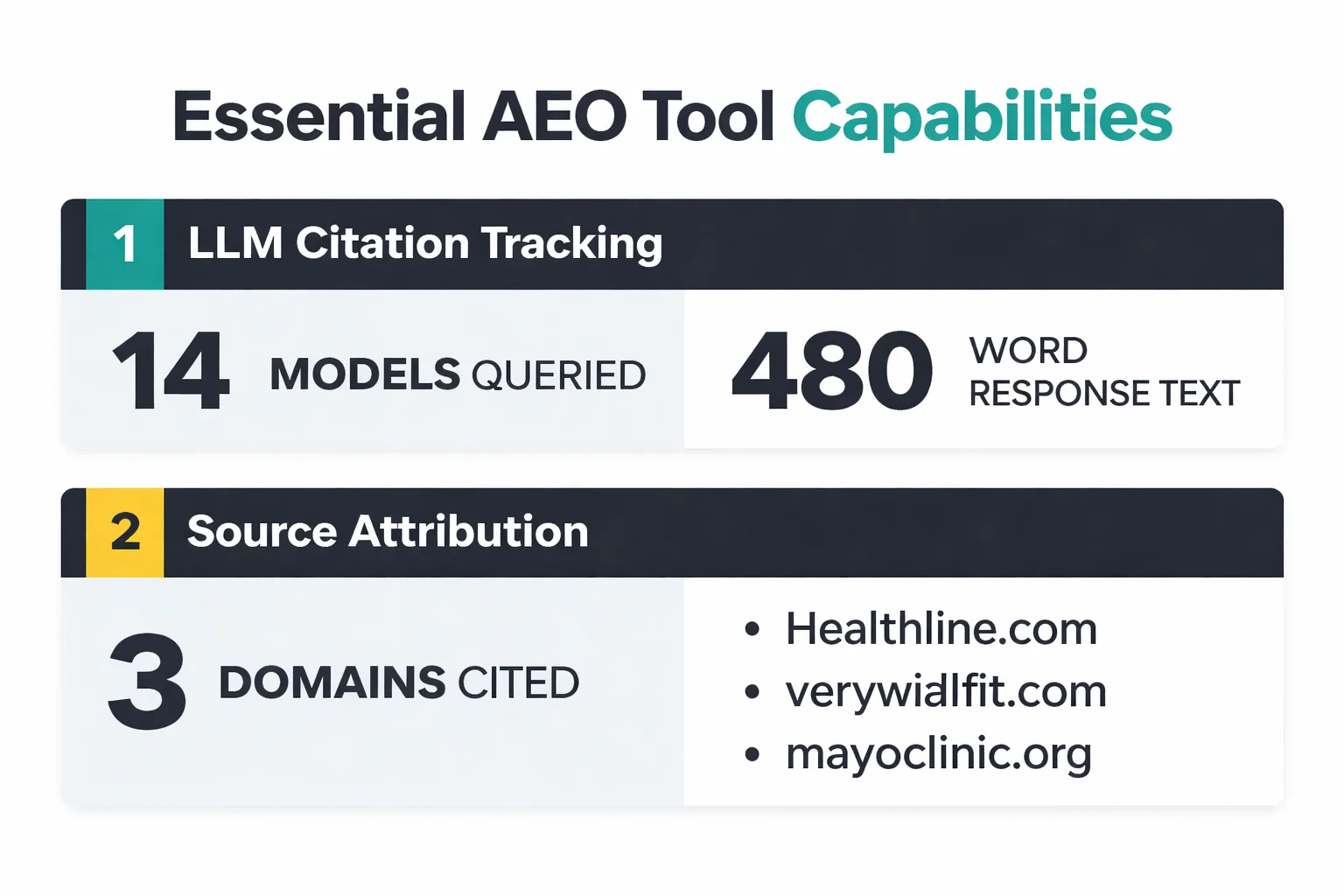
The first capability is LLM citation tracking. The tool must query actual AI models (ChatGPT, Claude, Gemini, Perplexity, Grok, Google AI Overviews, AI Mode, DeepSeek) and capture the full response text, not just a boolean "was the brand mentioned." Position within the answer matters. Being cited first in a synthesized paragraph carries different weight than appearing seventh in a list. If a tool only tells you that you were mentioned somewhere, it is giving you a fraction of the picture.
The second capability is source attribution. When Perplexity cites three domains in an answer, which ones are they? Are they your competitors? Are they publishers you have never heard of? Without a cited-source leaderboard, you cannot build a strategy to replace them. This is where entity grounding for AI search comes in. Models build their answers from training data and real-time retrieval. If your brand lacks a strong entity presence in knowledge graphs like Wikidata, models will not have a reliable structure to pull from. A real AEO tool surfaces those gaps.
The third capability is action. AirOps made a sharp observation in their AEO tools roundup: "Most tools in this category are visibility dashboards that show you where you stand but stop short of helping you act on what you find or measure whether your changes worked." I agree entirely. A dashboard without a workflow is a screenshot. The best tools in this space do not just diagnose. They help you publish content designed to earn citations, and they let you measure whether that content moved the needle.
How We Ranked These Tools
I evaluated each platform against five criteria. No tool scores perfectly on all five. That is expected. The goal is to help you understand the trade-offs so you can pick based on your team's actual needs.
Citation coverage breadth. Does the tool monitor every major AI search surface, or just one or two? Some tools only track Google AI Overviews. Others cover Perplexity and ChatGPT but miss Claude and Grok. The set of AI surfaces changes fast, so a tool that only covers two or three engines is already going stale. I weighted this heavily because partial coverage gives you a false sense of your visibility.
Data accuracy. Are the mentions real? I have seen tools report brand mentions that did not exist in the actual response. This happens when tools use cheap inference methods instead of direct API calls. A tool that measures AI visibility through inferred or cached data is fundamentally less trustworthy than one that queries the models directly. In my work building Meev's tracking architecture, I learned that direct API integration costs more but produces data you can actually act on.
Content creation features. Does the tool help you close the gaps it finds? This is where the market splits. Some tools are pure tracking dashboards. Others are content generators with AI visibility features bolted on. The best tools do both: they diagnose where you are absent and produce content designed to earn citations. But content generation without quality gates is dangerous. I have seen too many AI auto-blogging platforms ship what I call "AI slop" directly to CMSs. Google's E-E-A-T guidelines and helpful content system do not care how fast you published. They care whether the content demonstrates real expertise.
Pricing transparency. Can you find the price on the website, or do you have to book a demo? For small teams and founders, this matters. If a tool requires a sales call to reveal pricing, that is a signal. It usually means the price is high enough that they want to control the conversation around it.
Ease of use for small teams. Does the tool require a dedicated SEO specialist to operate, or can a founder run it in twenty minutes a week? Tools built for enterprise teams often have steep learning curves. That is fine if you have the headcount. If you do not, it is a tax on your time.
Comparison Table
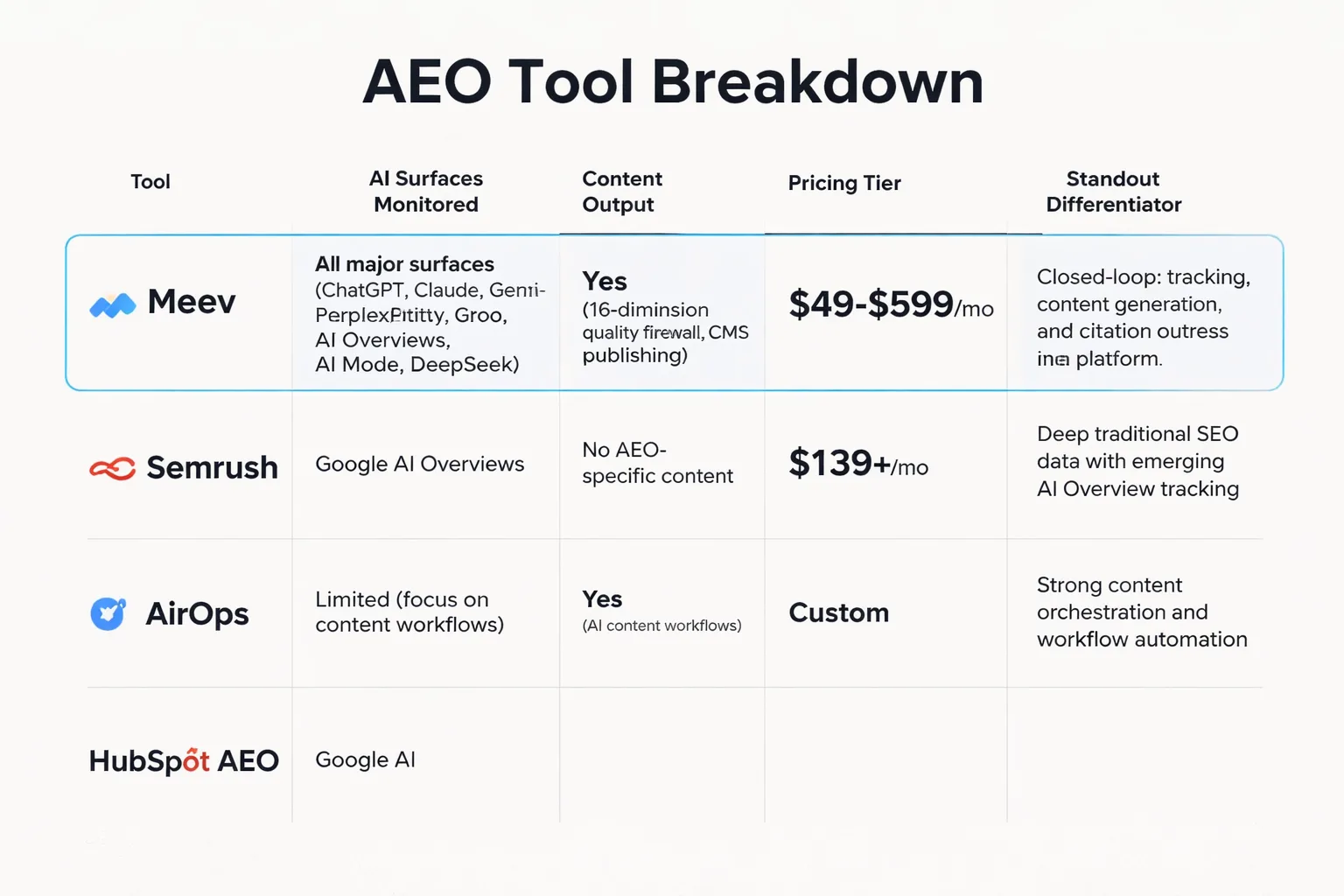
Here is the side-by-side breakdown. I focused on the dimensions that actually differentiate these tools: which AI surfaces they monitor, whether they can produce content, their pricing tier, and the one thing each tool does better than the rest.
| Tool | AI Surfaces Monitored | Content Output | Pricing Tier | Standout Differentiator |
| Meev | All major surfaces (ChatGPT, Claude, Gemini, Perplexity, Grok, AI Overviews, AI Mode, DeepSeek) | Yes, with 16-dimension quality firewall and CMS publishing | $49-$599/mo | Closed-loop: tracking, content generation, and citation outreach in one platform |
| Semrush | Google AI Overviews | No AEO-specific content | $139+ /mo | Deep traditional SEO data with emerging AI Overview tracking |
| AirOps | Limited (focus on content workflows) | Yes, AI content workflows | Custom pricing | Strong content orchestration and workflow automation |
| HubSpot AEO | Google AI Overviews (via existing SEO tools) | Yes, via Content Hub | $20-$3,600/mo | Best for teams already in the HubSpot ecosystem |
| Nightwatch | Google AI Overviews | No | $39+ /mo | Affordable rank tracking with AI Overview detection |
This table is not exhaustive. HubSpot's AEO tools list covers 13 tools, and AirOps lists 17. Neither provides head-to-head performance comparisons, which is a gap in the industry. No public benchmark study compares Tool X versus Tool Y on citation-tracking accuracy. You have to test them yourself.
Which Tool Is Right for Your Team?
This is the question that matters. A tool that is perfect for a 50-person SEO team is useless to a solo founder. Here is how I segment the recommendations.
For founders who need a quick diagnosis. You do not need a 17-tool stack. You need to know whether AI engines mention your brand at all, and if not, why. Start with a free AI visibility checker to get a baseline. If you find you are absent from answers where competitors appear, that is your signal to invest in a tool that does more than track. Meev's Lite tier at $49/mo is built for this exact scenario. You get tracking across all major AI surfaces, 10 prompts, and 10 articles per month to start closing gaps.
For SEO teams running ongoing tracking. You need historical data, trend lines, and share-of-voice metrics. If you are already paying for Semrush, their AI Overview tracking is a reasonable extension of what you already have. The limitation is that Semrush only tracks Google AI Overviews. If your audience uses Perplexity or ChatGPT for research, you are blind to those surfaces. For broader coverage, an AI visibility tracker that covers all major LLMs gives you the full picture. The per-LLM drill-down dashboards let you see the actual response text behind every mention, which is critical for understanding context.
For marketers who need both tracking and content publishing. This is the segment with the most options and the most confusion. The prompt "Give me 20 recommendations on AI Visibility tools that can do both AI visibility tracking and AI Article writing" is common. The honest answer is that very few tools do both well. Most are either tracking dashboards that stop at diagnosis or content generators that do not track AI visibility at all. AirOps has strong content workflows but limited visibility tracking. HubSpot has content publishing through Content Hub but no dedicated AEO tracking. Meev was built specifically to close this gap. It tracks mentions across every major AI surface, generates archetype-aware content, and publishes directly to WordPress, Ghost, Shopify, or Wix with a 16-dimension quality firewall that blocks weak drafts before they reach your CMS.
The contrarian take here: most teams do not need 20 tools. They need one tool that does the full loop. Diagnose. Generate. Publish. Measure. Repeat. Stitching together a visibility tracker, a separate AI writer, and a manual CMS workflow creates friction that kills consistency. And consistency is what moves citation rates.
Are you cited in AI answers where your competitors appear?
How Does AEO Differ from Traditional SEO?
Answer engine optimization differs from traditional SEO in three fundamental ways: the unit of success, the mechanism of retrieval, and the role of entities. Traditional SEO optimizes for position in a list of links. AEO optimizes for inclusion in a synthesized answer. Traditional SEO relies on crawlers indexing pages and ranking them by relevance signals. AEO relies on LLMs retrieving information from training data and real-time sources, then synthesizing it into natural language. Traditional SEO treats keywords as the primary unit. AEO treats entities as the primary unit.
I have seen this shift play out in the data. The overlap between top Google results and AI-cited sources has dropped from roughly 70% to under 20% by some estimates. You can be number one for a keyword and still be invisible in ChatGPT. That is because LLMs do not rank pages. They retrieve concepts. If your brand is not a recognized entity in the knowledge graph, the model has no structure to reference.
This is why AEO vs SEO is not a subtle distinction. It is a different optimization target. SEO asks: "How do I get Google to rank my page first?" AEO asks: "How do I get ChatGPT to mention my brand when someone asks a question I can answer?" The strategies overlap but they are not identical. Understanding what AEO actually means is the prerequisite to picking the right tool.
Why Does Entity Grounding Matter for AI Citations?
Entity grounding is the process of making your brand a recognizable, structured entity that AI models can reference with confidence. When ChatGPT generates an answer, it does not browse the web and pick the best page. It retrieves concepts from its training data and supplements with real-time retrieval. If your brand exists as a well-defined entity in Wikidata, Wikipedia, and structured web content, the model has a reliable reference point. If it does not, the model may hallucinate or simply omit you.
The risk of ignoring entity grounding is documented. A Wikidata postmortem published on Zenn.dev describes a contributor who created 109 Wikidata items over six weeks to improve AI discoverability. All 109 items were deleted in 2.5 minutes on July 16, 2026, when the account was banned for "Promotion-only account" activity. The individual edits complied with guidelines, but the pattern of bulk creation triggered moderation. This is a real failure scenario. Brands that rely on Wikidata presence for AI discoverability can lose it overnight.
The Wikidata Embedding Project, announced by Wikimedia.DE in October 2025 with MCP support, signals that Wikidata is becoming more directly integrated into AI retrieval pipelines. This makes entity grounding more important, not less. But it also means you have to do it correctly. Bulk-creating items with promotional intent will get you banned. Building entity presence through legitimate, well-sourced contributions is the only sustainable approach.
A good AEO tool should help you identify where your entity presence is weak. Does your brand have a Wikidata entry? Is it properly linked to your website, social profiles, and key personnel? Are there structured data gaps on your own pages? These are the questions that separate real AEO tools from dashboards that just count mentions.
When Should You Invest in an AEO Tool?
The short answer is now. The longer answer depends on where your audience is in their search journey.
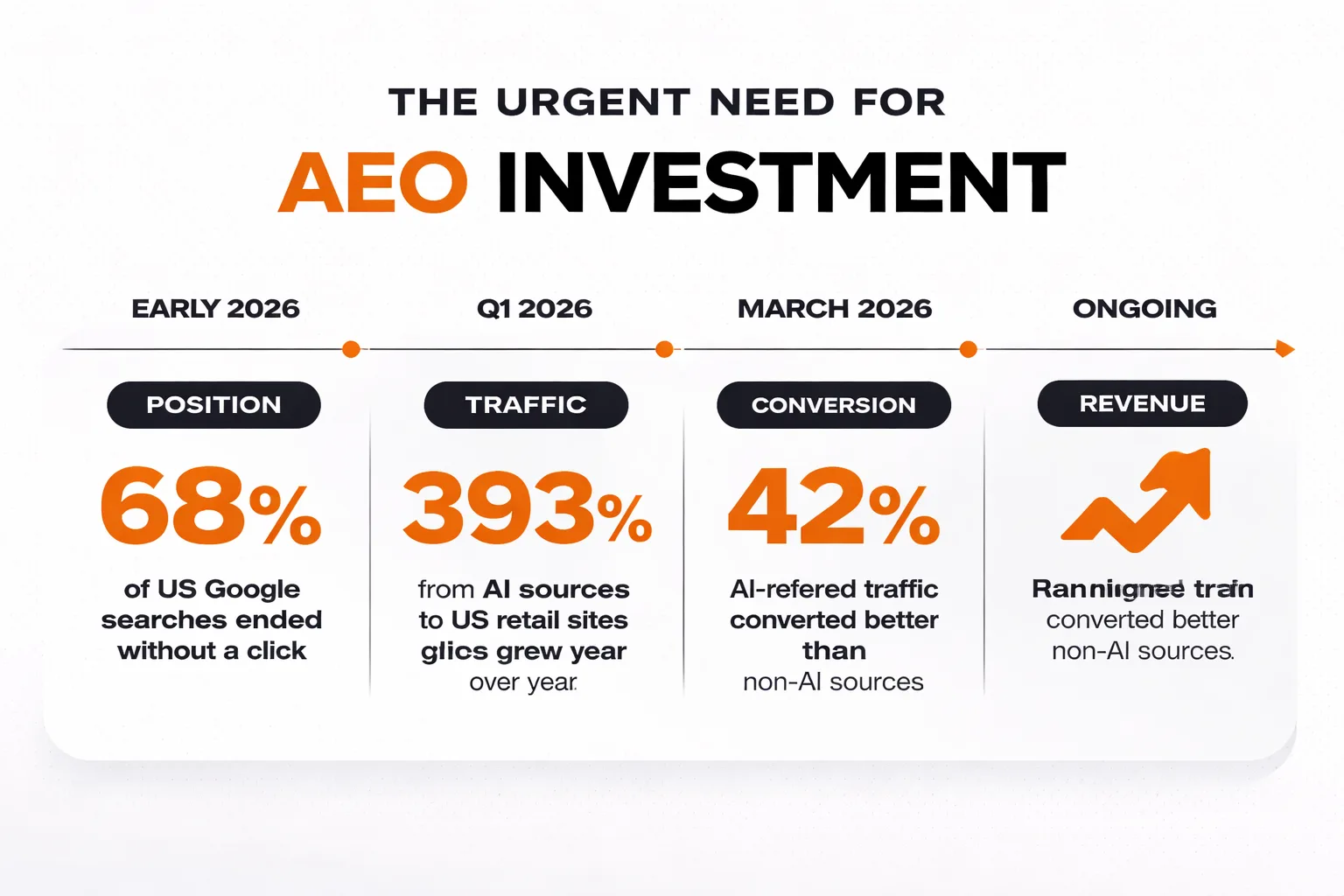
If your customers are asking questions that AI engines can answer, you need AEO. That sounds broad, but it is specific. Think about the queries your customers type into Google. How many of them are informational? How many could be answered by a synthesized paragraph? If the answer is "most of them," you are already losing traffic to AI Overviews. The data on zero-click searches is stark: 68% of US Google searches ended without a click in early 2026. Those users got their answer from the AI summary and left.
But here is the nuance. AI-referred traffic, when it does come, converts better. Traffic from AI sources to US retail sites grew 393% year over year in Q1 2026. AI-referred traffic converted 42% better than non-AI sources by March 2026. Revenue per visit from AI referrals ran 37% above non-AI traffic. These numbers tell a clear story: AI search users are high-intent. When they click through, they are closer to buying. But you have to be cited in the answer first.
For ecommerce specifically, the stakes are higher. Ecommerce sites that implemented structured content and entity-rich guides moved AI citation rates from below 5% to 20-40% within 60-90 days. Every brand that replaced thin promotional copy with structured guides saw citation rates double or more. This is not a marginal improvement. It is a step-change. If you are running an ecommerce store and you are not thinking about generative engine optimization, you are leaving high-converting traffic on the table.
What About AI SEO Agents and Agentic SEO?
This is the most hyped corner of the market, and I want to be blunt about it. The promise of agentic SEO is that an AI agent will research the SERP, draft and optimize content, watch published pages after they go live, and execute fixes at the autonomy level you set. That definition comes from Frase's agentic SEO guide. It sounds great. In practice, it is mostly unfulfilled.
I have been watching the AI SEO agent space closely for the past year. The promise of reducing tasks like keyword clustering from hours to seconds is real. But the promise of fully autonomous content publication is not. I have personally experimented with AI agents for content generation, and the output consistently required significant human oversight to meet basic quality standards. For YMYL (Your Money Your Life) topics, the risk is even higher. Generating inaccurate articles about health, finance, or legal topics could trigger Google's helpful content penalties and cause real harm to users.
No published case study documents a named company achieving top AI visibility rankings through agentic SEO tactics. The academic research on Generative Engine Optimization provides theoretical frameworks but no company-level results. The Siteimprove blog on agentic SEO defines the concept but does not validate it with data. This does not mean agentic SEO is worthless. It means it is early. The tools that will eventually deliver on this promise are the ones that build in human approval gates rather than removing humans entirely.
This is a core part of my philosophy at Meev. AI should do the heavy lifting. It should research, draft, and structure. But a human should approve before anything goes live. The 16-dimension quality firewall exists because I have seen what happens when you remove that gate. Content quality drops, engagement tanks, and you end up with a site full of articles that no AI engine would cite even if they ranked.
How Do You Evaluate AI Visibility Reporting?
AI visibility reporting is the feature most buyers underestimate. A good report does not just say "you were mentioned 12 times this week." It tells you where you were mentioned, in what context, with what sentiment, and compared to whom.
The baseline metric is share of voice. What percentage of answers in your topic space cite you versus your competitors? If you are cited in 8% of answers and your top competitor is cited in 35%, you have a 27-point gap to close. That gap is your content strategy.
The next layer is mention position. Being cited first in a synthesized paragraph is different from being cited last in a list of ten. Users read AI answers top to bottom. The first mention gets the most attention. A tool that only tracks whether you were mentioned, not where, is giving you incomplete data.
The third layer is source attribution. When an AI engine cites a source, that source is a domain. If Perplexity cites an article from a publisher you have never heard of, you need to know. That publisher is occupying a slot that could be yours. A cited-source leaderboard ranks the domains AI engines cite most often for your topics. That leaderboard is your outreach target list.
Finally, there is trend data. AI visibility is not static. It fluctuates as models update and as new content enters the training corpus. Weekly trend lines with sparklines give you a sense of direction. Are you gaining or losing ground? Without trend data, you are making decisions based on snapshots instead of motion.
The Gap Nobody Talks About: No Head-to-Head Benchmarks
Here is something that frustrates me about this market. There is no public benchmark study comparing AEO tools on citation-tracking accuracy. I searched for one. The HubSpot list covers 13 tools. The AirOps list covers 17. Neither benchmarks them against each other. Frase's GEO playbook discusses strategy but not tool comparison.
This means buyers are making decisions based on marketing pages, not performance data. The only way to know whether a tool's citation tracking is accurate is to test it against manual queries. That is time-consuming, but it is the only reliable method. When I built Meev's tracking architecture, I used direct API calls to Perplexity's Sonar API ($0.005 per call) and direct DeepSeek and Grok integrations. This costs more than inferred tracking methods, but it produces data that matches what a real user would see. If a tool does not tell you how it queries AI models, that is a red flag.
The absence of benchmarks also means the industry lacks a standard for what "AI visibility" even means. Some tools count any mention, including negative ones. Some only count citations with explicit source links. Some count brand name appearances in the response text without verifying whether the model actually used the brand as a source. These methodological differences produce wildly different numbers for the same query. Until there is a standard, you have to read the fine print.
What This Means for Your 2026 Strategy
The best answer engine optimization tools in 2026 are the ones that close the loop between diagnosis and action. Tracking alone is not enough. Content generation alone is not enough. You need both, connected by a workflow that measures whether your content actually moved your citation rate.
If you are a founder, start with a ChatGPT AI visibility checker or a Perplexity AI visibility checker to get a baseline. If you are an SEO team, invest in a tool that covers all major AI surfaces, not just Google. If you are a marketer who needs content publishing, look for a platform with quality gates. The best rated answer engine optimization tools are the ones that treat AI citations as the new ranking, and they build their entire workflow around earning them.
The teams that win in AI search will not be the ones with the most tools. They will be the ones with the tightest loop between seeing where they are absent and doing something about it. That is the standard I built Meev against, and it is the standard I recommend you evaluate every tool against.
FAQ: Answer Engine Optimization Tools
What is answer engine optimization?
Answer engine optimization (AEO) is the practice of optimizing content and brand entities so that AI search engines (ChatGPT, Perplexity, Gemini, Google AI Overviews) cite your brand in their synthesized answers. Unlike traditional SEO, which targets position in a list of links, AEO targets inclusion in a generated paragraph. It requires strong entity presence, structured content, and direct, concise answers that models can retrieve and cite.
What is the best AEO tool for a small team?
For small teams and founders, the best AEO tool is one that combines visibility tracking with content generation at an accessible price. Meev's Lite tier at $49/month covers tracking across all major AI surfaces, 10 prompts, and 10 articles per month. Semrush is an option if you already use it for traditional SEO, but its AI tracking is limited to Google AI Overviews. Nightwatch is affordable at $39/month but does not offer content generation.
How do AEO tools differ from traditional SEO rank trackers?
Traditional SEO rank trackers monitor your position in Google's organic results. AEO tools monitor whether AI models mention your brand in synthesized answers. The difference is not just the surface being tracked. It is the unit of measurement. Rank trackers measure position. AEO tools measure citation, mention position within an answer, share of voice against competitors, and source attribution. A traditional website rank checker cannot do this work.
Can AI visibility tools also write content?
Some can. Most cannot. The market is split between tracking-only dashboards and content-only generators. Meev does both: it tracks AI visibility across all major surfaces and generates archetype-aware content with a 16-dimension quality firewall. AirOps has strong content workflows but limited visibility tracking. HubSpot offers content publishing through Content Hub but lacks dedicated AEO tracking. If you need both capabilities in one platform, your options are narrow.
How accurate is AI visibility tracking?
Accuracy depends on how the tool queries AI models. Tools that use direct API calls to models like Perplexity and ChatGPT produce data that matches what real users see. Tools that use inferred or cached data may report mentions that do not exist in actual responses. No public benchmark study compares AEO tools on tracking accuracy. The only way to verify accuracy is to test the tool's reports against manual queries. If a tool does not disclose its tracking methodology, treat its data with caution.
Is agentic SEO ready for production use?
Not yet. Agentic SEO promises autonomous research, drafting, optimization, and post-publish monitoring. In practice, the content output requires significant human oversight to meet quality standards. No published case study documents a named company achieving measurable AI visibility gains through agentic SEO. The concept is promising but early. Tools that build in human approval gates (like Meev's quality firewall) are a safer bet than fully autonomous agents, especially for YMYL topics.
About the Author
Judy Zhou, Founder
Judy Zhou leads content strategy at Meev, where she oversees AI-driven content research and publishing for hundreds of brands. With a background in SEO and editorial operations, she focuses on building content systems that rank on Google, get cited by AI search engines, and drive measurable business results.
Find out which AI engines mention your brand and which ones cite your competitors instead. Run a free AI visibility scan today.