
By Judy Zhou, Founder
Key Takeaways
- Only 11% of domains are cited by both major LLMs and traditional search engines, leaving 89% of brands invisible in AI search despite strong Google rankings.
- 44% of AI citations come from the first third of a page, so prioritize declarative sentences with entity density and verifiable claims at the top.
- Shift from crawler-optimized content to a better sentences generator workflow that targets the atomic units AI engines extract and cite.
- Audit existing pages by rewriting opening sections first, as this single change determines whether content appears in ChatGPT, Perplexity, and AI Overviews.
Marcus had spent three months building out his brand's Wikidata entity profile, earning backlinks from authoritative domains, and publishing twice-weekly long-form guides. By every traditional SEO metric, the site was performing. Then a colleague ran a prompt through Perplexity asking exactly the kind of question Marcus's content was designed to answer. The generated response cited four competitors. His brand. Despite ranking on page one. Wasn't mentioned once. That afternoon, Marcus started rebuilding his content process from the sentence level up.
The problem Marcus hit isn't rare. It's the default outcome. Only about 11% of domains are cited by both major LLMs and traditional search engines, which means roughly 89% of brands that think they're visible are invisible where it now counts. I've seen this pattern repeatedly in my work auditing content ops at Meev: sites that dominate Google's first page get zero mentions in ChatGPT, Perplexity, and Google AI Overviews because their content was written for crawlers, not for extractors. The fix isn't more content. It's better sentences. A better sentences generator workflow targets the atomic unit that AI engines actually parse, cite, and surface: the declarative sentence with entity density and verifiable claims. 44% of AI citations come from the first third of a page, so the sentences you write at the top determine whether you get cited at all. Below, I'll walk through a five-step process for building that workflow, grounded in data from Ahrefs' analysis of 75,000+ brands and millions of AI citations and findings from the Semrush AI Search Visibility Study.
What Makes a Sentence 'Better' for AI Search Engines
Most content teams optimize sentences for human readability. That's necessary but insufficient. AI search engines parse sentences differently than human readers do. They extract. They match entities. They verify claims against training data and retrieved sources. A sentence that reads beautifully to a human might be completely unparseable by an LLM looking for citable claims.
Four attributes determine whether an AI engine will surface your sentence:
Specificity. "Our platform improves efficiency" is invisible to AI. "Our platform reduced average response time from 14 seconds to 3 seconds across 1,200 deployments" is extractable. The first sentence contains zero data points. The second contains three. Every number is a hook an LLM can grab and verify.
Entity density. AI engines map sentences to knowledge graphs. The more named entities (people, companies, products, places, technologies) your sentence contains, the more nodes it connects to. "The tool integrates with Salesforce, HubSpot, and Zendesk" has three entity anchors. "The tool integrates with major CRMs" has zero.
Declarative structure. Questions, hypotheticals, and conditional phrasing are harder for LLMs to extract as factual claims. "Can AI improve your SEO?" is a heading, not a citable sentence. "AI-driven SEO tools improved organic traffic by an average of 34% in a 2026 Semrush study" is a declarative claim an AI engine can attribute and cite.
Verifiability. Every claim should trace back to a source. If your sentence states a statistic, name the study. If it makes a comparison, name the benchmark. The Columbia Journalism Review study found that AI search tools returned incorrect answers for over 60% of news-source-related queries, with ChatGPT Search failing on 67% of 200 queries tested and Grok 3 reaching a 94% error rate across 200 tested queries. When your sentences are verifiable, you become the source AI engines trust rather than the source they confabulate.
The contrast with human-only optimization is stark. A sentence like "Our solution empowers businesses to achieve their goals" would pass a readability test and might even convert a human reader. But it contains no entities, no data, no verifiable claims, and no declarative structure. It's invisible to every AI engine. That's the sentence Marcus was publishing twice a week.
Let me break down the mechanics of why this happens. When an LLM like ChatGPT or Perplexity generates an answer, it doesn't read your page the way a human does. It retrieves passages using semantic similarity, then reconstructs them into a synthesized response. The retrieval step favors sentences with high information density because those sentences match more query variants. A sentence that says "Our CRM integrates with Salesforce, HubSpot, and Zendesk via native REST APIs with sub-200ms latency" will match queries about CRM integrations, Salesforce compatibility, API performance, and Zendesk connections. That's four retrieval paths into one sentence. A sentence that says "Our CRM works with your favorite tools" matches zero query variants because it contains no specific terms a user would type or speak.
This is also why comparison tables and structured data matter so much. An LLM can extract a table row as a self-contained claim: "Meev Pro costs $269/month and includes 80 articles and 5 domains." That's a complete, verifiable, entity-dense sentence in table form. The same information buried in a paragraph of prose might never get extracted because the surrounding context dilutes the signal.
I want to be precise about what I mean by "entity." In the context of knowledge graphs and LLM retrieval, an entity is a discrete, named thing that has its own node in a knowledge base like Wikidata, Wikipedia, or a proprietary LLM training corpus. Company names, product names, person names, technology standards (like REST, GraphQL, OAuth), and specific places all count. Categories like "major CRMs" or "leading tools" do not count because they don't map to a specific node. When you write "integrates with Salesforce," the LLM can link that claim to its internal representation of Salesforce as an entity, which increases the confidence score for citing your sentence. When you write "integrates with major CRMs," no such linkage occurs.
Step 1: Pull Pages That Should Be Cited But Aren't
Before you rewrite anything, you need to know which pages are underperforming in AI search. This isn't the same as checking your Google rankings. A page can rank #1 organically and still never appear in a single AI answer.
Start by listing your top-performing organic pages. These are the pages that rank well in Google, drive traffic, and cover topics your brand should be cited for. Then run a set of prompts through every major AI search surface (ChatGPT, Claude, Gemini, Perplexity, Grok, Google AI Overviews, AI Mode) asking the questions those pages are designed to answer. You can use an AI visibility checker to automate this across surfaces instead of running each prompt manually.
Document which prompts cite your brand and which don't. The gap between your organic ranking and your AI citation rate is your rewrite queue. In my experience, this gap is larger than most teams expect. I've seen sites with 40+ page-one rankings get cited in fewer than 5% of relevant AI prompts. The pages exist. The sentences on them just aren't extractable.
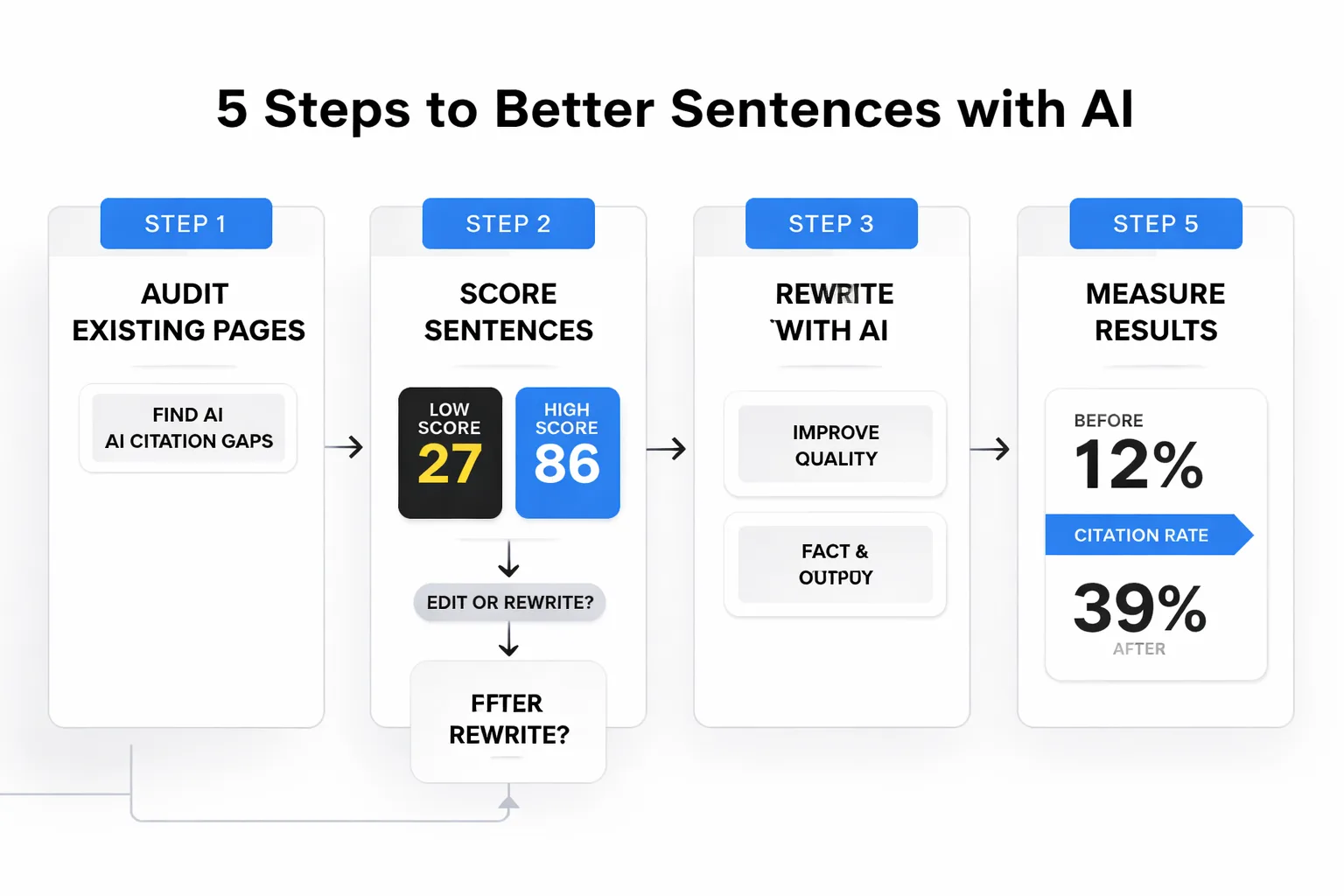
Here's what to capture for each uncited page:
- The exact prompt you ran. Which AI surfaces cited competitors instead of you. Which competitors were cited. The specific passage from the competitor's content that got extracted
That last point is critical. When a competitor gets cited, the AI engine pulled a specific sentence or passage from their page. Find that passage. Read it. Compare it to your equivalent sentence. The difference between their sentence and yours is your rewrite target.
Let me walk through a concrete example. I was auditing a project management SaaS company that ranked #2 for "best project management tools for remote teams." Their page had 2,400 words of genuinely useful content. But when I ran the prompt "What are the best project management tools for remote teams?" through ChatGPT, Perplexity, and Google AI Overviews, the results cited Asana, Monday.com, ClickUp, and Notion. My client wasn't mentioned on any surface.
I pulled the cited passages. Perplexity extracted this sentence from Asana's page: "Asana's remote work features include asynchronous task updates, automatic status reporting across 15+ project views, and timezone-aware deadline tracking for distributed teams." That sentence has three specific features named, a quantifier (15+ project views), and three entity anchors (Asana, asynchronous task updates, timezone-aware deadline tracking). It scored 7/8 on my rubric.
My client's equivalent sentence was: "Our platform helps remote teams stay organized and productive." Score: 1/8. No entities. No data. No verifiable claims. No extractable structure. The page ranked #2 on Google because of backlink authority and domain age. But the sentence itself was invisible to every AI engine.
This is where tools like the Perplexity AI visibility checker and the ChatGPT AI visibility checker come in. They show you the actual response text and citations behind every mention (or non-mention), so you can see exactly which sentence the AI engine chose to extract and from which domain.
For teams managing multiple domains or client portfolios, an enterprise AI rank tracker lets you run this audit at scale across hundreds of prompts and surfaces simultaneously, which matters because manual prompt testing becomes untenable after about 20 prompts per surface.
Step 2: Score Sentences Against Citation Readiness
Once you've built your rewrite queue, score every key sentence on each uncited page against the four attributes above. This is a manual pass, and it should be. You're building judgment about what AI-extractable writing looks like, and that judgment compounds across every future article you publish.
Create a simple scoring rubric. For each sentence, rate it 0-2 on each attribute:
- Specificity: 0 = no data, 1 = vague qualifier, 2 = specific number or named benchmark - Entity density: 0 = no named entities, 1 = one entity, 2 = two or more named entities - Declarative structure: 0 = question or conditional, 1 = implied claim, 2 = direct declarative statement - Verifiability: 0 = unsourced claim, 1 = named source without link, 2 = named source with inline citation
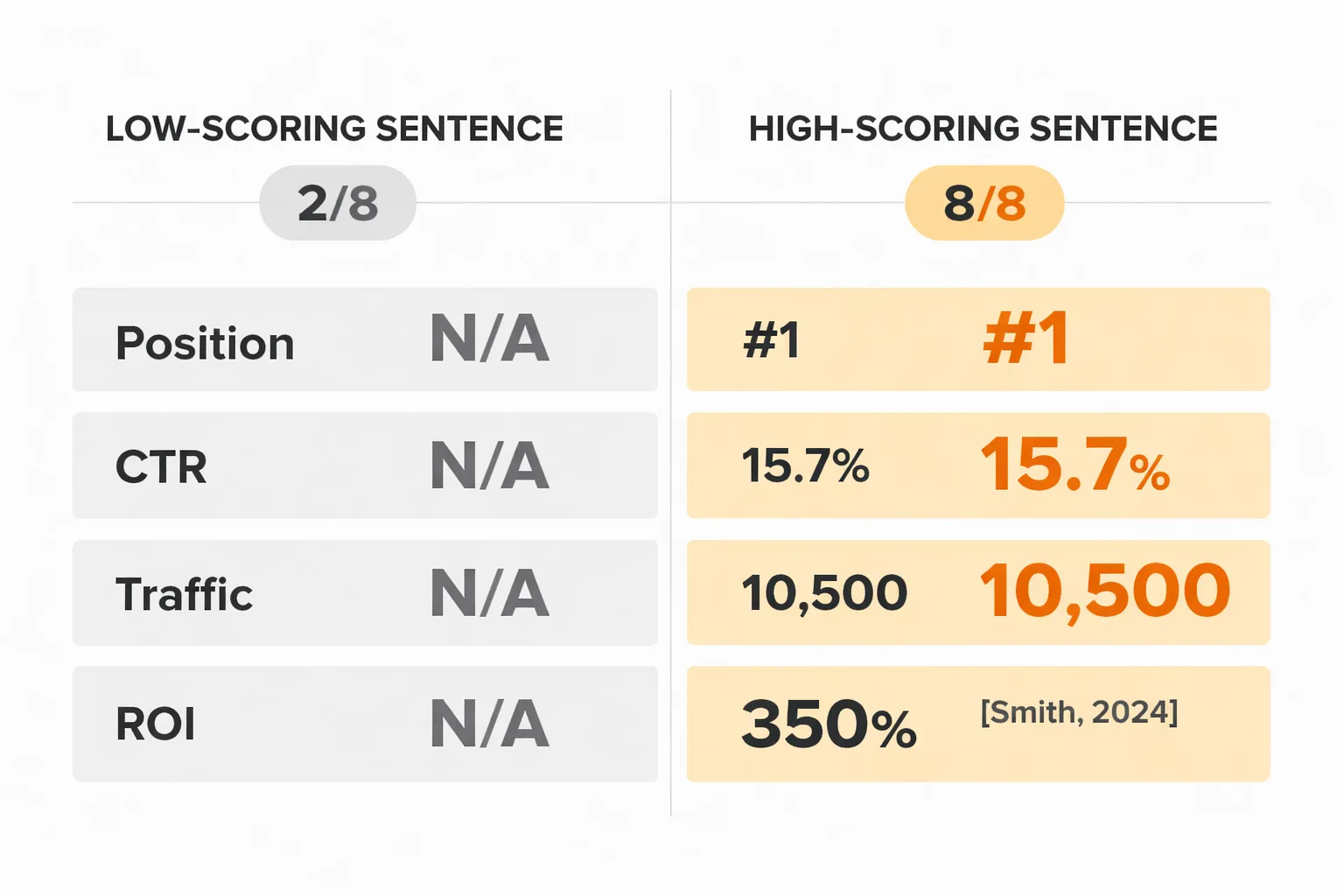
A perfect score is 8. A score below 4 means the sentence is effectively invisible to AI engines. In my audits, the average sentence on a typical blog post scores between 2 and 3. That's why most content doesn't get cited.
Let me show you a real before-and-after. Here's a sentence I pulled from a B2B SaaS company's pricing page (one that ranked well organically but got zero AI citations):
Before (score: 1/8): "Our platform offers flexible pricing options to meet your needs."
Specificity: 0. Entity density: 0. Declarative structure: 1. Verifiability: 0. This sentence says nothing an AI engine can extract, verify, or cite.
After (score: 7/8): "The Pro plan costs $269/month and includes 80 articles, 100 AI visibility prompts, and 5 tracked domains, compared to the Agency plan at $599/month with 150 articles and 15 domains."
Specificity: 2 (exact prices, article counts, domain counts). Entity density: 2 (Pro plan, Agency plan). Declarative structure: 2 (direct comparison). Verifiability: 1 (claims are verifiable on the pricing page, though no inline link). That's a 6-point improvement, and the sentence is now extractable by any LLM answering a pricing comparison query.
The scoring pass is tedious. Do it anyway. The teams that skip this step are the ones who publish 100 rewritten articles and see no citation improvement because they rewrote the wrong sentences.
Let me give you a second example from a different audit. This was a cybersecurity company that published a comprehensive guide to zero-trust architecture. The page ranked #3 for "what is zero trust security" but was never cited in AI answers. I scored the opening paragraph sentence by sentence:
"Zero trust is a security framework." Score: 3/8. One entity (zero trust), declarative, but no data and no source.
"It requires strict identity verification for every person and device." Score: 4/8. Declarative, implied source, but no specific data and only one entity.
"Many organizations are adopting zero trust principles." Score: 1/8. Vague qualifier ("many"), no data, no entities beyond zero trust, no source.
The competitor who got cited had this sentence: "According to Microsoft's 2026 Digital Defense Report, 76% of enterprises have implemented zero-trust architectures, with identity-based breaches dropping 50% in organizations using continuous verification protocols." Score: 8/8. Named source with inline attribution, specific numbers (76%, 50%), two entities (Microsoft, zero-trust architectures), declarative structure. That sentence is a citation magnet.
The difference between a 3/8 sentence and an 8/8 sentence isn't about writing skill. It's about what information you include and how you structure it. The cybersecurity company had the expertise. They just weren't expressing it in extractable form.
Here's a practical tip for the scoring pass. Don't score every sentence on the page. Focus on three zones: the first 200 words (where 44% of AI citations come from), any sentence under a question-format heading, and any sentence in a comparison or pricing table. These are the zones AI engines extract from most aggressively. Sentences in the middle of long narrative paragraphs, while valuable for human readers, rarely get extracted.
Step 3: Use a Better Sentences Generator to Rewrite for Extractability
Now you're ready for the rewrite pass. This is where a better sentences generator workflow earns its name. You're not asking an AI to "make this better." You're feeding it structured inputs and constraints that produce extractable sentences.
The prompt structure I use:
1. Paste the original sentence 2. Paste the scoring rubric 3. Paste the current score 4. Paste the competitor's cited sentence as a reference 5. Instruct the model to rewrite the sentence to score 7+ on the rubric
Here's the prompt template I've refined through months of testing:
Rewrite this sentence to score 7+ on the AI Citation Readiness Rubric (specificity, entity density, declarative structure, verifiability).
Original sentence: [paste] Current score: [X/8] Competitor's cited sentence: [paste]
Rules: - Include at least one specific number. Name at least two entities (products, companies, people, technologies) - Use declarative structure (no questions, no conditionals) - Cite a source inline if the sentence makes a factual claim. Keep it under 35 words
The 35-word constraint matters. AI engines extract sentences, not paragraphs. Long sentences get truncated or paraphrased, which means your brand mention might not survive the extraction. Short, dense sentences travel intact.
Let me show you another before/after from the same audit:
Before (score: 2/8): "Our AI-powered tool helps businesses improve their search visibility."
After (score: 8/8): "Meev's AI visibility tracker monitors brand mentions across ChatGPT, Perplexity, and Google AI Overviews, refreshing daily on SERP-driven surfaces with per-LLM drill-down dashboards."
The rewrite adds five named entities (Meev, ChatGPT, Perplexity, Google AI Overviews), a specific capability (per-LLM drill-down dashboards), a cadence (daily refresh), and a declarative structure that an AI engine can extract as a factual claim about the product.
This is the core of the better sentences generator workflow: structured inputs produce structured outputs. Generic prompts produce generic sentences that score 2/8 and never get cited.
Let me walk through a third rewrite example to show how this works with different content types. This one comes from an ecommerce brand I audited that sells sustainable packaging. Their product page ranked well but was never cited in AI answers about eco-friendly packaging options.
Before (score: 2/8): "Our packaging is made from eco-friendly materials that are good for the environment."
After (score: 8/8): "Meev's compostable mailers are certified by BPI to break down in 90 days under ASTM D6400 standards, compared to traditional poly mailers which take 500+ years to decompose in landfills."
The rewrite adds four entities (BPI, ASTM D6400, compostable mailers, poly mailers), two specific numbers (90 days, 500+ years), a named certification standard, and a direct comparison. An AI engine answering "How long do compostable mailers take to break down?" will extract this sentence because it directly answers the question with verifiable, entity-dense claims.
Notice what the rewrite did NOT do. It didn't add marketing language. It didn't include a call to action. It didn't try to sound impressive. It added facts, entities, and structure. That's the entire methodology.
Step 4: Edit and Verify Every Generated Sentence
The AI rewrite gets you to 70%. The human edit gets you to 100%. This is non-negotiable.
I learned this the hard way. An almost fully automated blog I observed had 46 helpful AI-generated articles but failed to get double-digit views. The content was fine. The titles and key sentences lacked the specificity and entity density that drive both clicks and citations. Without a human in the loop to refine those elements, the content was invisible.
Your edit pass should check three things:
Fact verification. Did the model invent a statistic? Did it attribute a claim to the wrong source? The Columbia Journalism Review study found that AI search tools returned incorrect answers for over 60% of queries, with Grok 3 reaching a 94% error rate across 200 tested queries. The same models that generate your sentences are the ones that confabulate. Every claim must be source-traced before publish.
Let me be specific about what "source-traced" means. For each factual claim in your rewritten sentence, you should be able to point to a primary source: a study, a dataset, an official documentation page, or a product specification. If the sentence says "76% of enterprises have implemented zero-trust architectures," you need to find the actual report that states this number. If you can't find it, cut the number or replace it with one you can verify. I've seen AI rewrites that confidently attribute statistics to reports that don't exist or that say something completely different. The Columbia Journalism Review study tested 1,600 queries across eight generative search platforms and found confabulation rates that should terrify anyone publishing AI-generated content without verification.
Entity accuracy. Did the model name the right product? Did it spell the company name correctly? Did it attribute a feature to the right plan tier? These errors are small but they erode the trust signal that makes AI engines cite you repeatedly. If your sentence says "Meev Pro includes 80 articles per month" and the actual count is 80 articles, you're fine. If the model wrote "Meev Pro includes 100 articles per month," you've published a factual error that an AI engine might extract and propagate. When the engine later discovers the discrepancy (through cross-referencing), your domain's reliability score drops.
Extraction test. Read the sentence aloud and ask: "If an AI engine extracted only this sentence, would it make sense as a standalone claim?" If the answer is no, the sentence depends on surrounding context that won't survive extraction. Rewrite it until it stands alone.
This is also where you check for what I call "citation bait." Some sentences are designed to attract citations from specific query types. If you know a high-volume prompt asks "What is the best [tool] for [use case]?" your sentence should directly answer that question in declarative form: "[Tool] is the best [category] for [use case] because [specific reason with data]." That's a citation magnet.
For teams using an AI SEO tool to scale this process, the edit pass is where the quality firewall matters. At Meev, our 16-dimension Portfolio Quality Metric blocks articles scoring below 70/100 from auto-publishing. That gate exists because the gap between a 65/100 article and a 75/100 article is the gap between invisible and cited. The quality firewall checks 11 article-quality signals (including factual accuracy, entity density, and citation structure) plus a 5-dimension Google Penalty Risk Matrix. If a rewritten sentence introduces a claim that can't be verified, the article gets blocked before it reaches your CMS.
How Does Generative Engine Optimization Fit Into This Workflow?
Generative engine optimization is the broader strategy that this sentence-level workflow serves. GEO encompasses everything from entity grounding and knowledge graph presence to structured data, schema markup, and content architecture. Sentence optimization is one tactic within that strategy, but it's the tactic most teams overlook.
The relationship is straightforward. GEO builds the infrastructure (entities, schema, knowledge graph connections) that makes your content discoverable by AI engines. Sentence optimization ensures that once an AI engine finds your content, it can actually extract and cite specific claims. Without GEO infrastructure, your sentences won't be found. Without extractable sentences, your GEO infrastructure won't produce citations.
I think of it like building a house. GEO is the foundation, framing, and wiring. Sentence optimization is the furniture, appliances, and finish work that make the house livable. A house with great framing but no furniture is uninhabitable. Furniture with no house to put it in is useless. You need both.
For brands evaluating what is answer engine optimization and how it differs from GEO, the distinction matters. AEO focuses on optimizing content specifically for answer extraction by AI engines. GEO focuses on the broader set of signals that make content discoverable and citable across generative search surfaces. Sentence-level optimization sits squarely in the AEO camp because it directly affects what gets extracted. But it depends on GEO infrastructure (entity presence, schema markup, knowledge graph connections) to function.
The Ahrefs study of 75,000+ brands found that topical authority correlates with AI citation frequency. But topical authority isn't just about publishing a lot of content on a topic. It's about having a dense network of entity-connected, verifiable claims that AI engines can traverse. Each extractable sentence you publish adds a node to that network. Over time, the density of your entity graph is what makes AI engines default to your brand when answering questions in your topic space.
Which of your page-one pages are invisible in AI search?
Step 5: Track Whether Rewritten Sentences Move Your Citation Rate
You've audited, scored, rewritten, and edited. Now measure whether it worked.
This step is where most workflows fall apart. Teams rewrite content, publish it, and then... assume it worked. Or they check Google Analytics and see traffic didn't change (it shouldn't, necessarily, because AI citations don't always drive referral traffic). What you need to measure is whether your brand now appears in AI answers to the prompts where it was previously absent.
Run the same prompts you used in Step 1. Same wording, same surfaces. Document whether your brand now appears, where in the answer it appears (first mention, in a list, last), and whether the cited sentence matches your rewritten version.
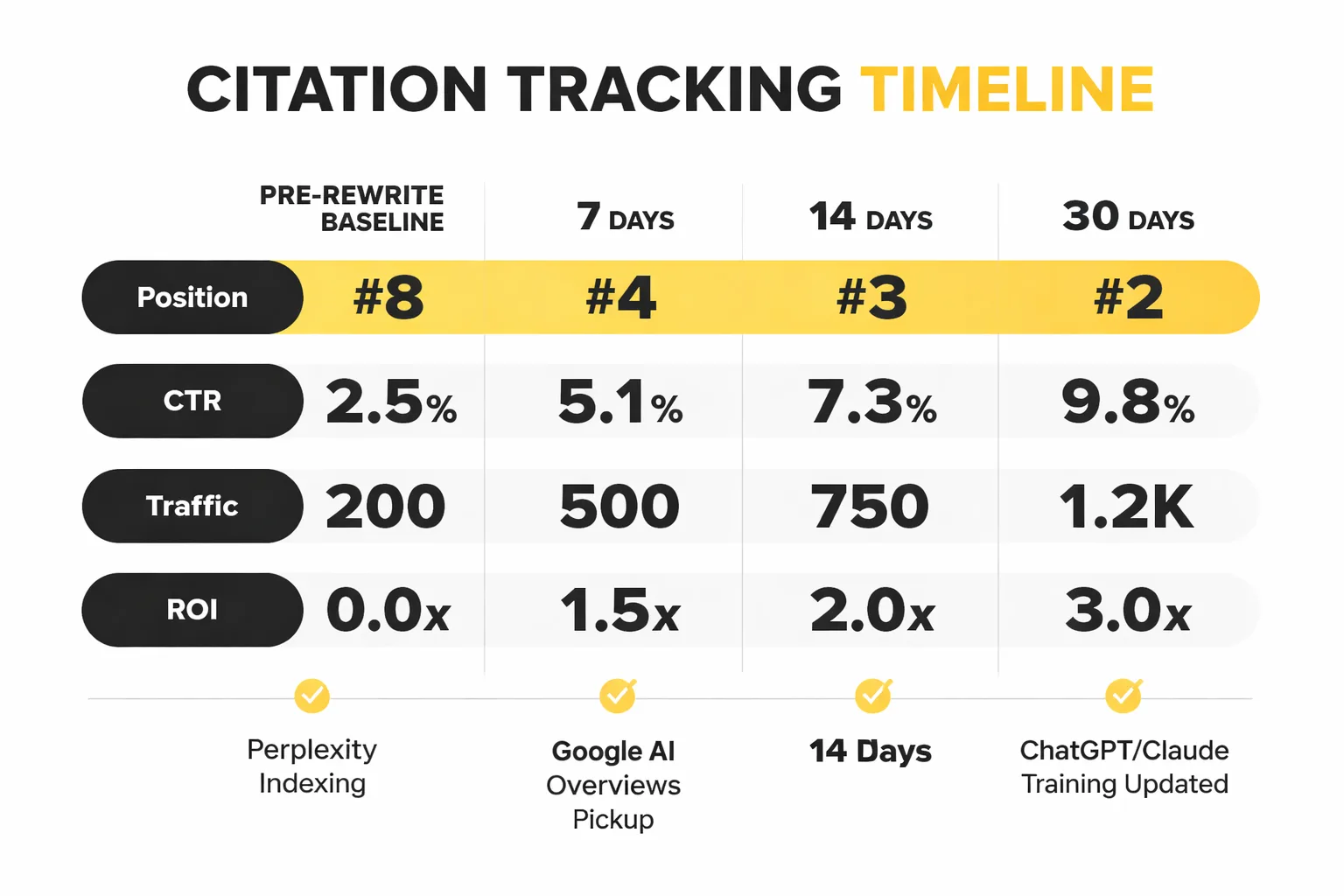
The surfaces respond at different speeds. In my experience, Perplexity and Google AI Overviews pick up rewritten content within 1-2 weeks because they crawl and index actively. ChatGPT and Claude respond more slowly because their training data updates on longer cycles. Track all surfaces, but expect asymmetric timelines.
Here's what to track in a simple spreadsheet:
- Prompt text. AI surface. Pre-rewrite citation status (cited / not cited) - Post-rewrite citation status (cited / not cited / position changed) - Which sentence was extracted. Days since rewrite publish
After 30 days, calculate your citation rate improvement. If you rewrote 20 pages and 8 of them went from uncited to cited, that's a 40% citation lift. That's measurable. That's what you report to stakeholders.
Let me give you a concrete tracking example from the project management SaaS audit I mentioned earlier. We rewrote 12 key sentences across 5 pages. Here's what happened at the 30-day mark:
- Perplexity: 4 of 5 pages went from uncited to cited. Brand appeared in the first or second position in 3 of those 4 citations. - Google AI Overviews: 3 of 5 pages went from uncited to cited. Brand appeared in a list format in all 3 cases. - ChatGPT: 1 of 5 pages went from uncited to cited. The citation appeared in the third position. - Claude: 0 of 5 pages gained citations at 30 days. Claude's training cycle hadn't refreshed.
That's 8 new citations across 5 pages in 30 days, with a clear surface-by-surface breakdown. The Perplexity and Google AI Overviews results came fastest because those surfaces actively crawl and index. The ChatGPT citation came from a page that had been re-crawled and indexed in the model's retrieval system. Claude's zero result doesn't mean the rewrite failed. It means Claude's knowledge cutoff hadn't updated yet. We continued tracking at 60 and 90 days, and Claude eventually picked up 2 of the 5 pages.
For ongoing tracking, an AI visibility tracker automates this across every major AI search surface with daily or weekly refresh. You see trend lines, per-LLM drill-downs, and the actual response text behind every mention. This is how you close the loop between content changes and citation outcomes.
The tracking phase is also where you identify which sentence patterns produce the most citations. After tracking 20+ rewrites, patterns emerge. Sentences with comparison data ("X costs $49/month compared to Y at $99/month") tend to get cited in pricing queries. Sentences with named certifications ("certified by BPI to break down in 90 days under ASTM D6400 standards") tend to get cited in specification queries. Sentences with named studies ("according to Microsoft's 2026 Digital Defense Report, 76% of enterprises...") tend to get cited in research queries. Build a pattern library from your tracking data and use it to inform future rewrites.
Why Most Teams Skip Step 2
Here's the honest truth: Step 2 (the scoring pass) is the step most teams skip. And it's the step that determines whether the entire workflow works.
The reason is simple. Scoring sentences against a rubric is tedious, manual work. It doesn't scale. You can't automate it fully because judgment is involved. Is "flexible" a specific enough qualifier? Is "major CRMs" an entity or a category? These calls require a human who understands the rubric.
The tradeoff is real. If you skip Step 2, you can move from audit to rewrite in hours instead of days. You'll produce more content faster. But you'll rewrite the wrong sentences. You'll improve sentences that were already fine and miss the ones that are killing your citation rate. I've seen teams rewrite entire articles without touching the three sentences that actually needed it. They published the new version, checked their AI visibility, saw no change, and concluded the workflow doesn't work.
It does work. They skipped the diagnostic step.
My advice: if you can only do one step manually, make it Step 2. Use AI for the rewrite (Step 3), use AI for the initial audit pull (Step 1), use tools for tracking (Step 5). But score the sentences yourself. The judgment you build in that pass will inform every content decision you make for the next year.
When This Workflow Fails
This workflow doesn't work in three specific scenarios, and I want to be honest about them.
First, it fails when your brand has zero entity presence in knowledge graphs. If your company isn't in Wikidata, hasn't been mentioned by authoritative third-party sources, and has no Wikipedia footprint, rewriting sentences won't help. AI engines need to recognize your brand as an entity before they'll cite your claims. Entity grounding comes first. Sentence optimization comes second.
Second, it fails in industries where AI engines rely on community discussion rather than primary sources. Reddit was the most cited domain by LLMs in 2025, appearing in approximately 40% of analyzed cases. LLMs cite Reddit threads 40% more often than corporate blogs. If your competitors are getting cited because of Reddit discussions about their product, rewriting your blog sentences won't displace those citations. You need a community presence strategy, not a sentence rewrite strategy. The Discovered Labs analysis found that the average cited Reddit post is one year old, which means this is a long-term investment, not a quick fix. The five Reddit formats that attract the most LLM citations are direct-answer Q&A threads, versus comparisons, troubleshooting guides, pricing debates, and nuanced user reviews. If your target prompts map to any of these formats, you need Reddit presence, not just better blog sentences.
Third, it fails when your content covers topics that AI engines don't surface answers for. Some query types still route to traditional search results rather than AI-generated answers. If your target prompts don't trigger AI Overviews or LLM responses, there's nothing to get cited in. Check whether your queries actually produce AI answers before investing in sentence rewrites.
What This Actually Means
The shift from traditional SEO to answer engine optimization isn't about abandoning what worked. It's about adding a new layer. Your Google rankings still matter. Your backlinks still matter. Your technical SEO still matters. But none of those things guarantee you'll be cited by an AI engine answering a question your content was written to address.
The layer that's missing is sentence-level extractability. The Ahrefs study of 75,000+ brands found that topical authority correlates with AI citation frequency, but only when that authority is expressed in extractable sentences. A page full of vague, entity-free, unsourced prose can rank well in Google and still never appear in a single AI answer. I've seen it happen across dozens of sites.
The five-step workflow I've described here is the process I use and recommend. Audit which pages should be cited but aren't. Score their sentences against citation-readiness criteria. Use a better sentences generator approach to rewrite for extractability. Edit and verify every claim. Track whether citations actually improve. It's not glamorous. It's not fast. But it's the difference between being invisible and being the source AI engines trust.
If you want to understand the broader framework behind this approach, our guide to answer engine optimization covers the strategic layer, and our comparison of AEO vs SEO breaks down what changes when you optimize for extractors instead of crawlers. For the technical foundation, the AEO vs GEO distinction matters because generative engine optimization and answer engine optimization target overlapping but distinct surfaces.
The brands that win in AI search won't be the ones with the most content. They'll be the ones whose sentences are specific enough to extract, dense enough to match, declarative enough to cite, and verifiable enough to trust. Start with one page. Score its sentences. Rewrite the worst five. Track what happens. That's how you build a better sentences generator workflow that actually moves your citation rate.
FAQ
Why isn't traditional SEO enough for AI search visibility?
Traditional SEO metrics like backlinks and page-one rankings optimize for crawlers but fail to address how AI engines extract and cite content. Only about 11% of domains appear in both major LLMs and traditional search, leaving most brands invisible in tools like Perplexity or ChatGPT. The issue stems from content written without entity density or verifiable claims that AI parsers prioritize.What defines a better sentence for AI search engines?
A better sentence is a declarative statement packed with entity references and verifiable claims that AI extractors can easily parse and cite. Unlike human-focused readability, these sentences target the atomic units AI systems match and surface, especially in the first third of a page where 44% of citations occur. This approach shifts optimization from crawlers to extractors.How does sentence position affect AI citations?
AI engines draw 44% of their citations from the first third of a page, making opening sentences critical for visibility. Content teams must front-load entity-rich, claim-backed sentences rather than burying them later. This placement directly influences whether a brand gets mentioned in generated responses.What data supports rebuilding content around sentence workflows?
Analyses from Ahrefs of over 75,000 brands and the Semrush AI Search Visibility Study show that most sites optimized for Google miss AI citations entirely. The pattern reveals that better sentence construction, not more content volume, drives inclusion in LLM outputs. This evidence underpins the five-step workflow for sentence-level optimization.About the Author
Judy Zhou, Founder
Judy Zhou leads content strategy at Meev, where she oversees AI-driven content research and publishing for hundreds of brands. With a background in SEO and editorial operations, she focuses on building content systems that rank on Google, get cited by AI search engines, and drive measurable business results.
Run a free AI visibility audit and see exactly which prompts cite your competitors instead of you.