

By Judy Zhou, Founder
Key Takeaways
- Over 60% of all search queries now end without a click to an external website, shifting value from rankings to the queries themselves.
- Organic CTR dropped 61% on queries where AI Overviews appear, per ZipTie.dev analysis, making AI synthesis triggers a critical audit target.
- A competitor search query audit identifies the exact queries sending traffic to rivals, their conversion intent, and the entity sources AI engines cite—details traditional volume-and-difficulty tools miss.
- Audit which queries trigger AI Overviews for competitors to capture the visibility gap where keyword research alone leaves 2026 search performance on the table.
When Google introduced the Knowledge Graph in 2012, most SEOs treated it as a curiosity. A sidebar feature that showed basic facts about famous people and places. Few recognized it as the architectural foundation for a future where search queries would be answered by machines drawing on structured entity data rather than ranked blue links. More than a decade later, that future has arrived. Running a competitor search query audit today means understanding not just who ranks, but whose entities are grounded deeply enough to earn citations from AI systems that never show a results page at all.
A competitor search query audit reveals the exact queries sending traffic to your rivals, the intent behind each one, and whether AI engines cite those competitors in answer syntheses. In my work auditing content ops for brands losing ground to AI search, I've found that traditional keyword research tools show you search volume and difficulty. They don't show you which queries actually convert for competitors, which ones trigger AI Overviews, or which entity sources AI engines pull from when synthesizing answers. That delta is where 2026's real search visibility is won or lost. Over 60% of all search queries now end without a click to an external website, which means the query itself, not the ranking, is the unit of value. Organic CTR dropped 61% on queries where AI Overviews appear, according to ZipTie.dev's analysis. If you're not auditing which queries trigger AI synthesis for competitors, you're optimizing for a results page fewer people see.
Why Auditing Competitor Search Queries Beats Keyword Research Alone
Keyword research tells you what people search for. A competitor search query audit tells you what actually works for someone else in your market. Those sound similar. They aren't.
Keyword research starts with a seed list, expands it with suggestions, and filters by volume and difficulty. You're guessing at relevance. A competitor query audit starts with proof: these are the queries where a real rival already ranks, already gets traffic, and (in 2026) already gets cited by AI engines. You're starting from evidence.
The distinction matters more this year than ever because AI search engines don't just rank pages. They synthesize answers from multiple sources, and the queries that trigger those syntheses follow different patterns than classic blue-link queries. A keyword with 10,000 monthly searches might never trigger an AI Overview. A long-tail question with 200 searches might trigger one every time. Without auditing competitors' actual ranking queries and cross-referencing them against AI citation patterns, you'd never know the difference.
I've seen this play out directly. A B2B SaaS company I worked with was targeting head terms with high volume, assuming that visibility there would translate to AI citations. It didn't. Their competitor was winning long-tail question queries that triggered AI Overviews consistently. The competitor wasn't bigger. They weren't producing more content. They'd simply identified which query formats AI engines preferred to synthesize and built content around those. That's the gap a query audit exposes.
The other thing keyword research misses is entity grounding. When AI engines synthesize answers, they don't just pull from whatever ranks first. They pull from sources whose entities are well-grounded in the Knowledge Graph. A competitor query audit, done right, reveals not just which queries competitors rank for but which entity-rich pages are feeding AI citations. That's intelligence you can act on. Keyword volume alone is a blunt instrument.
Think about it this way. Keyword research is like planning a road trip by looking at a map and guessing which highways might be busy. A competitor query audit is like looking at toll records from actual drivers who already made the trip. One is prediction. The other is observation. In 2026, when AI engines decide which sources to cite, observation beats prediction every time.
The other critical gap keyword research misses is temporal. Keyword tools show you average monthly search volume over 12 months. They don't show you that a query spiked last week because a competitor published a piece that triggered AI synthesis. The audit captures what's happening right now. A query that shows 500 monthly searches in a keyword tool might have 400 of those searches coming in the last 30 days because an AI engine started citing a competitor for it. The trend matters more than the average.
And here's the thing that frustrates me about most keyword research workflows: they treat every query as independent. "ai search engine optimization" with 8,100 monthly searches gets prioritized over "how to track brand mentions in chatgpt responses" with 320 searches. But if the first query triggers AI Overviews 20% of the time and the second triggers them 100% of the time, the second query is worth far more per search in terms of AI citation potential. The audit surfaces this because you're looking at actual SERP behavior, not just volume estimates.
How to pull and categorize queries?
The first two steps are mechanical. Pull the data, then organize it so patterns emerge.
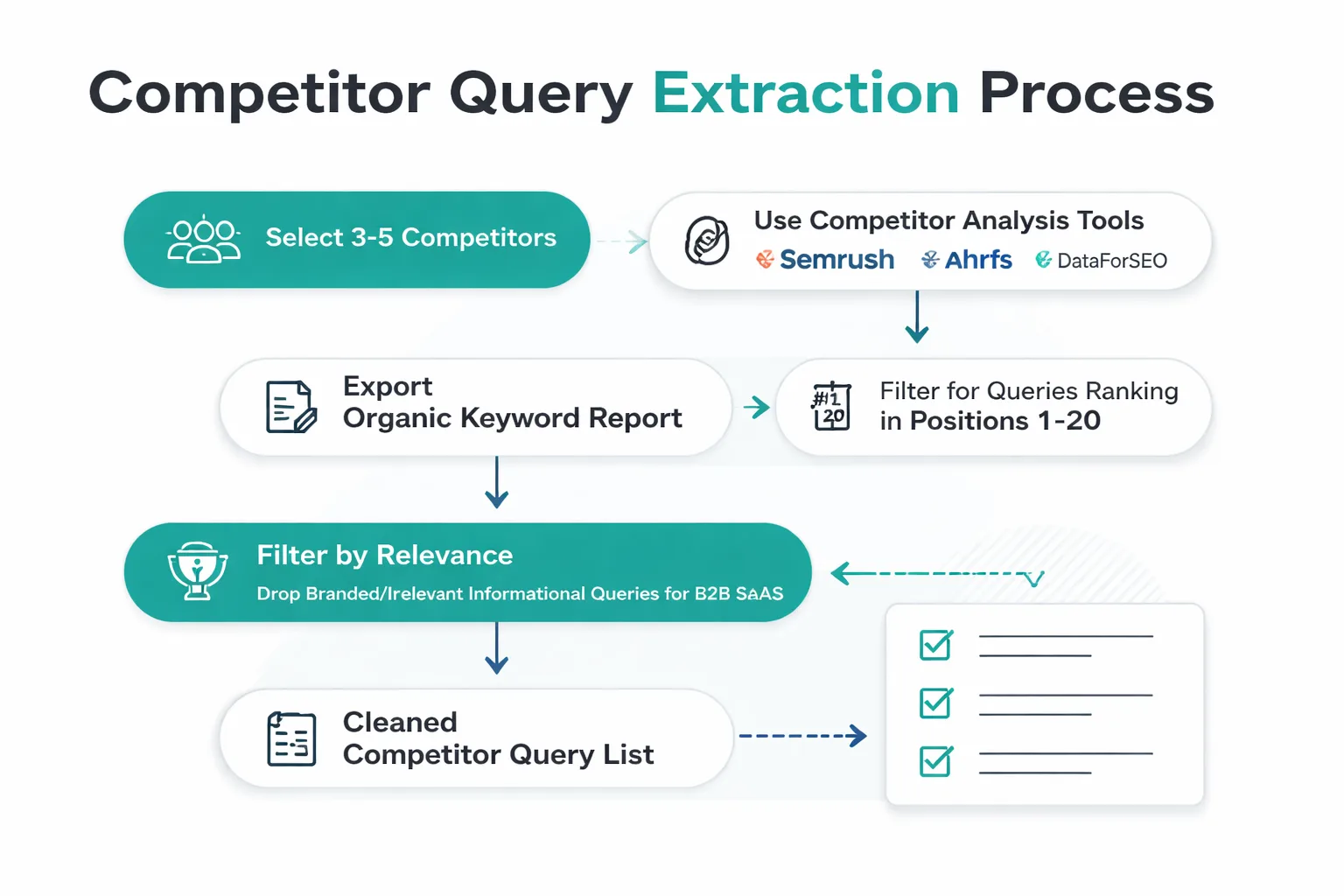
Step 1: Extract Competitor Ranking Queries
Start with 3-5 competitors. Not your entire market. Pick competitors who overlap with your audience but aren't so dominant that their query profile is noise. You want rivals whose strategy is legible.
Use competitor analysis tools that expose the queries a domain ranks for. Semrush, Ahrefs, and DataForSEO all offer this. The process is the same regardless of tool: enter the competitor domain, export their organic keyword report, and filter for queries where they rank in positions 1-20. You're looking for queries with real traffic potential, not long-tail noise.
Filter by your relevance. If you're a B2B SaaS company, drop branded queries (queries containing the competitor's name) and irrelevant informational queries that won't convert. Keep commercial and transactional queries. Keep informational queries only if they're topically adjacent to your product.
Export the cleaned list. You should have 500-2,000 queries per competitor, depending on their content footprint. Don't overthink the count. The signal is in the categorization, not the volume.
Here's a concrete example of how this looks in practice. I recently ran an audit for a project management SaaS company. Their three closest competitors had query profiles that looked completely different on the surface. Competitor A ranked for 1,800 queries, heavily skewed toward informational ("what is agile project management"). Competitor B ranked for 950 queries, mostly commercial investigation ("asana vs monday"). Competitor C ranked for 1,200 queries, split between transactional ("upgrade jira plan") and informational. Without the audit, my client would have guessed at what to target. With the audit, we could see that Competitor B's commercial investigation queries had the highest AI Overview trigger rate by far. That's where we focused.
One more thing on competitor selection. Don't just pick direct competitors. Pick one aspirational competitor, one direct competitor, and one adjacent player who's winning in a tangential space. The aspirational competitor shows you where the market is heading. The direct competitor shows you where you're losing right now. The adjacent player shows you query patterns you might not have considered. This triangulation produces a richer audit than looking at three companies who all do exactly what you do.
Step 2: Bucket by Intent and AI Trigger
Now categorize every query along two axes: search intent and AI Overview trigger rate.
Intent falls into four buckets. Informational queries ("what is CRM software") seek knowledge. Navigational queries ("salesforce login") seek a specific site. Transactional queries ("buy hubspot starter") signal purchase intent. Commercial investigation queries ("hubspot vs salesforce") indicate comparison shopping. Tag each query with its intent type.
The second axis is newer and more important in 2026: does this query trigger an AI Overview or AI Mode synthesis? You can check this manually by searching the query in Google with AI Overviews enabled, or you can use a tool that detects SERP features. The point is to flag which queries produce AI-generated answers versus classic blue links.
This dual-axis categorization is where the audit starts producing intelligence. You'll see patterns: competitors winning informational queries that consistently trigger AI Overviews, or competitors dominating commercial investigation queries that produce zero AI synthesis. Those patterns tell you where to invest.
Let me show you what this looks like with real data from a recent audit. I pulled queries for a competitor in the answer engine optimization space. Of their 1,400 ranking queries, 380 were informational. Of those 380, 210 triggered AI Overviews when I searched them. That's a 55% AI trigger rate on informational queries. Meanwhile, their 240 transactional queries triggered AI Overviews only 12% of the time. The implication was clear: if my client wanted AI visibility, they needed to target informational queries in this topic area, not transactional ones. The transactional queries were still worth pursuing for classic ranking traffic, but they wouldn't earn AI citations.
That's the kind of insight a keyword tool will never surface. It requires the manual (or tool-assisted) act of searching each query and recording what the SERP actually looks like. Tedious? Yes. Valuable? Absolutely.
A quick note on the difference between a search query and a keyword, since this comes up constantly. A keyword is a target you choose to optimize for. A search query is what a real person actually typed into a search box. "CRM software" is a keyword. "best crm software for small business 2026" is a search query. The audit works with queries because they reveal intent. Keywords abstract it away.
This distinction has practical consequences for how you build content. When you target a keyword like "CRM software," you write a generic page that tries to rank for a head term. When you target a query like "best crm software for small business 2026," you write a specific page that answers a specific question. AI engines prefer the latter because they can extract a self-contained answer from it. The audit surfaces queries, not keywords, which naturally pushes your content toward formats AI engines prefer to synthesize.
And here's something I've noticed that most SEO advice misses: the intent classification isn't always clean. Some queries straddle categories. "ai search engine optimization tools" is both informational (the user wants to learn about tools) and transactional (they might want to buy one). When you encounter hybrid intent queries in your audit, tag them as both. These queries are gold because they let you capture users at multiple stages of the funnel with a single piece of content. But they also require more sophisticated content structure, so don't treat them as simple informational pages.
Step 3-4: Map Gaps to Your Own Content and AI Citations
This is where the audit becomes actionable. You're not just cataloging what competitors rank for. You're finding the specific queries where they win and you're absent, both in classic rankings and in AI citations.
Step 3: Cross-Reference Against Your Existing Pages
Take your cleaned, categorized competitor query list and match it against your own domain's ranking data. Pull your own organic keyword report from the same tool. Then compare.
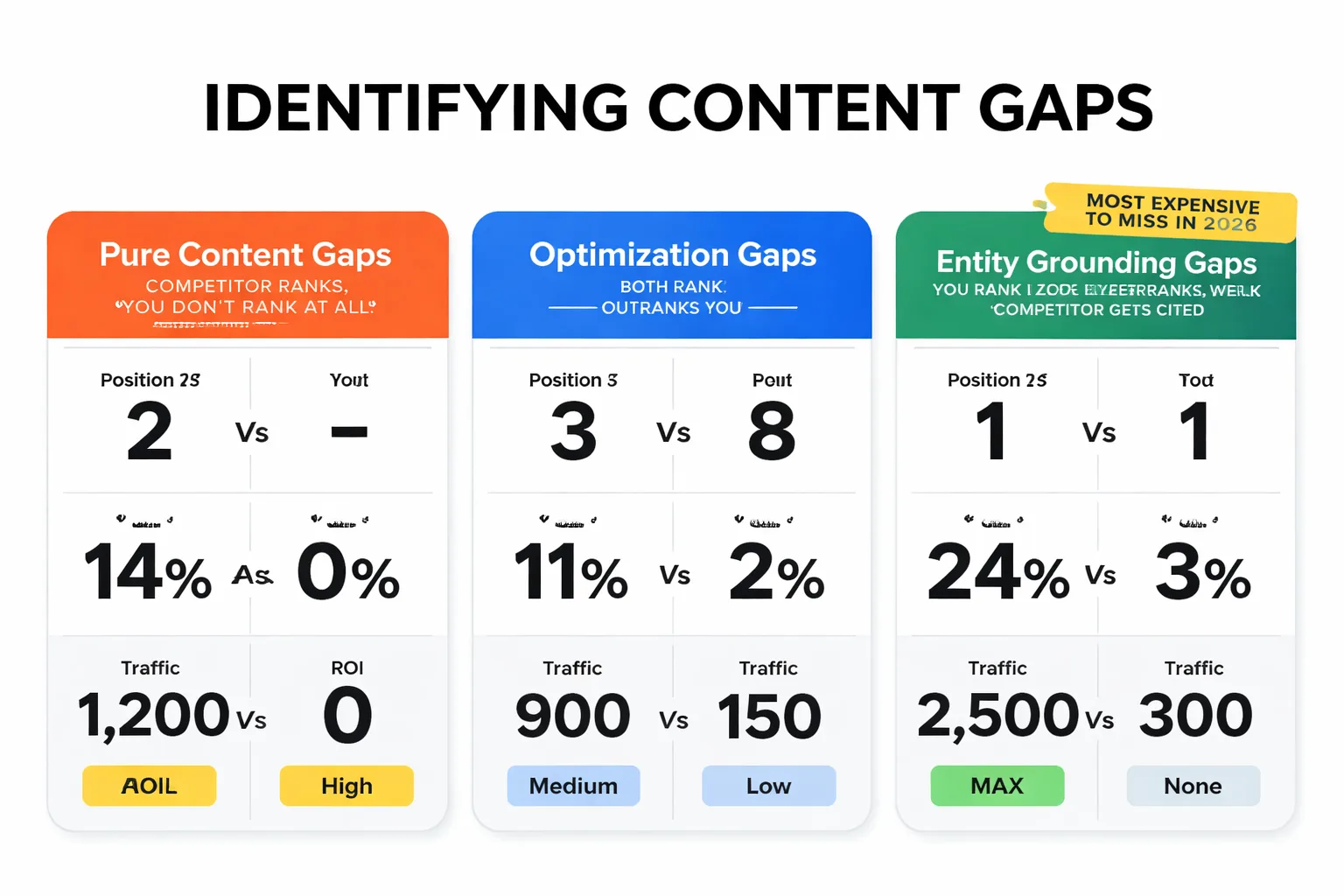
You're looking for three categories of gaps. First, queries where a competitor ranks and you don't rank at all. These are pure content gaps. Second, queries where you both rank but the competitor outranks you. These are optimization gaps. Third, queries where you rank well but get zero AI citations while the competitor gets cited. These are entity grounding gaps, and they're the most expensive to miss in 2026.
That third category deserves attention. The Ahrefs study of 75,000+ brands and millions of AI citations across ChatGPT, Google AIO, Perplexity, and Gemini found that topical authority, not domain authority, drives AI citation frequency (Ahrefs GEO research). You can outrank a competitor on a classic SERP and still lose the AI citation because their entity is better grounded in the sources AI engines synthesize from. I've seen this repeatedly. A page ranks #2 organically but never appears in the AI Overview because the competitor's brand has Wikidata entries, structured schema, and citation-worthy content that AI engines prefer.
This is why I recommend using an AI visibility tool at this stage. You need to know not just where you rank but where you're cited across every major AI search surface. The gap between your classic ranking position and your AI citation presence is the highest-leverage finding in this entire audit.
Let me walk through a concrete example of how this cross-reference works. In the project management SaaS audit I mentioned, we found that my client ranked for 620 of the 1,400 queries their top competitor ranked for. That left 780 pure content gaps. Of the 620 overlapping queries, the competitor outranked my client on 340. Those were optimization gaps. But here's the number that changed the strategy: of the 280 queries where my client outranked the competitor, the competitor was still cited in AI Overviews for 95 of them. My client was cited in zero. That's 95 queries where my client had the better ranking but the competitor had the better entity grounding. Those 95 queries became the top priority, not the 780 content gaps, because they represented the highest-leverage opportunity: existing ranking presence plus zero AI visibility equals a fixable entity problem.
Without the cross-reference, my client would have written 780 new articles targeting content gaps. With the cross-reference, they focused on 95 entity grounding fixes and 30 high-priority content gaps. That's a 90% reduction in content production volume with higher expected return, because fixing entity grounding on existing pages is faster and cheaper than producing new content from scratch.
The mechanics of the cross-reference are simple. Export both keyword lists (yours and the competitor's) as CSV files. Use VLOOKUP in Google Sheets or a merge in Airtable to find the overlap. For overlapping queries, compare your position to theirs. For queries where you rank but they don't, flag those as potential strengths (don't touch them). For queries where they rank but you don't, flag as content gaps. Then, for the overlapping set where you outrank them, check AI citation presence. That last step is the one that transforms this from a standard SEO exercise into an AI-era audit.
Step 4: Identify the AI Citation Delta
For each gap query, check whether AI engines cite you, cite a competitor, or cite no one. This is your citation delta.
Queries where a competitor is cited and you aren't are your top priority. These are queries where AI synthesis is happening, your competitor is feeding it, and you're invisible. Every day you leave these unaddressed, the AI engine's training data reinforces your competitor as the canonical source for that topic.
Queries where no one is cited are opportunities too. These are queries that trigger AI Overviews but where the synthesis is generic or pulls from low-authority sources. If you can build entity-grounded content around these queries, you can become the cited source before competitors notice the gap.
Queries where you're already cited but competitors aren't? Leave those alone. Don't fix what works. Spend your energy on the gaps.
The mechanics of checking AI citations across surfaces are straightforward but tedious if done manually. You'd need to search each query in ChatGPT, Perplexity, Google AI Overviews, Gemini, and Claude, then record who gets cited. That's why I use Meev's AI visibility tracking to automate this across every major AI search surface with daily refresh. Whether you use a tool or do it manually, the output is the same: a list of queries where competitors are cited and you aren't.
Let me give you a sense of scale here. In a typical audit of 1,500 gap queries, manually checking AI citations across five AI engines means 7,500 individual searches. At roughly 90 seconds per search (including recording the citation), that's 187 hours of manual work. No one has time for that. Even checking a prioritized subset of 200 queries means 1,000 searches and 25 hours. This is why most teams skip Step 4 entirely. They run the query pull, do the intent categorization, cross-reference for content gaps, and stop. They never check the AI citation delta. That's exactly why they rank well but get zero AI visibility. They optimized for a world that no longer exists.
The other thing I've learned from running this step hundreds of times: the citation delta doesn't correlate cleanly with ranking position. I've seen pages ranking #1 organically that never appear in AI Overviews. I've seen pages ranking #7 that get cited consistently. The difference is almost always entity grounding. The #7 page has structured data, is referenced by Wikidata, and has inbound links from authoritative sources in the same topic cluster. The #1 page is well-optimized for keywords but has no entity signals. This is the single most important finding from the entire audit, and it's the one most teams never uncover because they stop at Step 3.
Want to see which queries your competitors get cited for in AI answers?
Step 5: Prioritize and Brief the Fix
You now have a list of gap queries, each tagged with intent, AI trigger status, and citation delta. Time to prioritize and turn the top gaps into content briefs.
Score Each Gap
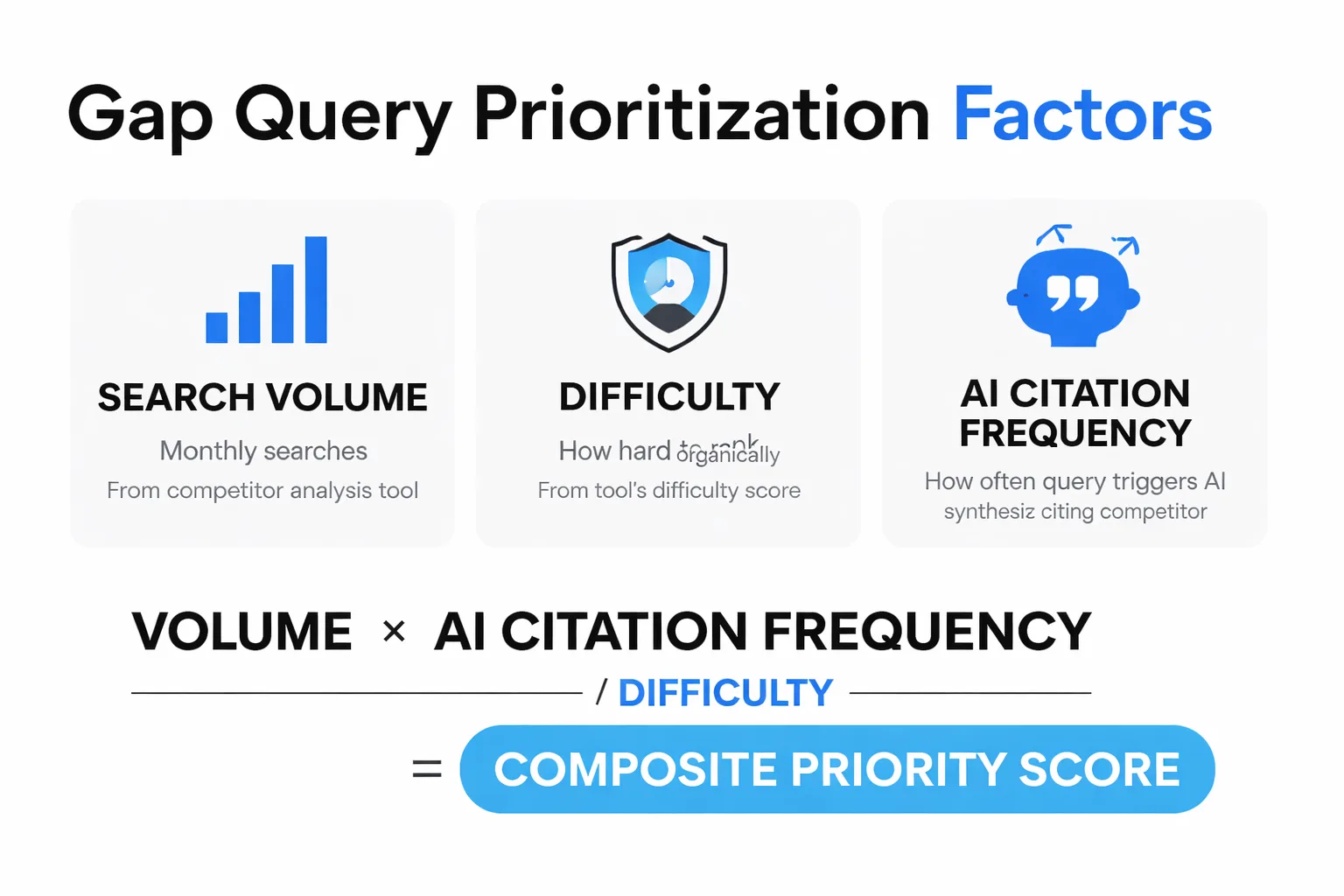
Score every gap query on three factors. Search volume: how many people search this query monthly? Use your competitor analysis tool's volume data. Difficulty: how hard is it to rank for this query organically? Again, pull from your tool's difficulty score. AI citation frequency: how often does this query trigger an AI synthesis that cites a competitor? This is the score most teams skip, and it's the most important one in 2026.
Multiply the three scores into a composite priority score. I use a simple formula: (Volume × AI Citation Frequency) / Difficulty. This favors queries with decent volume, high AI synthesis rates, and manageable difficulty. It deprioritizes high-volume queries that never trigger AI Overviews and low-difficulty queries that no one asks AI engines about.
The formula doesn't need to be precise. It needs to force you to weigh AI citation frequency alongside traditional SEO metrics. Most teams still prioritize purely on volume and difficulty. That's why they rank well but get zero AI visibility.
Let me show you how this scoring works with real numbers. Take two gap queries from a recent audit. Query A: "ai search engine optimization" with 8,100 monthly searches, difficulty 65, AI citation frequency 0.3 (meaning 30% of AI searches for this query cite a competitor). Score: (8,100 × 0.3) / 65 = 37.4. Query B: "how to track brand mentions in chatgpt responses" with 320 monthly searches, difficulty 22, AI citation frequency 1.0 (100% of AI searches cite a competitor). Score: (320 × 1.0) / 22 = 14.5. Query A scores higher due to volume, but Query B has a much higher AI citation rate. Depending on your goals, you might prioritize Query B because every single AI synthesis for that query is a lost citation opportunity, while Query A's 30% rate means 70% of AI syntheses either cite no one or cite someone else.
The point isn't to get the formula perfect. It's to stop ignoring the AI citation dimension. Even a rough scoring model that includes AI citation frequency produces better prioritization than the most sophisticated model that ignores it.
Build the Content Brief
Take your top 10-20 gap queries and build a content brief for each. The brief should target both classic rankings and answer-engine visibility simultaneously. Here's what each brief needs.
The target query, stated as a question where possible. AI engines prefer synthesizing answers to questions, not topic pages. If the gap query is "project management tools comparison," frame the content around "What are the best project management tools for [use case]?"
The entity you want to ground. Every brief should name the entity your brand owns in this topic area and ensure the content reinforces that entity through consistent naming, structured data, and internal linking. If you're a CRM company writing about "sales pipeline management," your entity is your brand's methodology or framework for pipeline management. The content should reference it explicitly.
The sources AI engines currently cite. Check what the AI Overview for this query pulls from. Those are the domains you need to either get cited on (through outreach and digital PR) or outrank with better entity-grounded content. An arXiv paper on Generative Engine Optimization found that third-party source bias in AI citations means the domains AI engines train on heavily influence which brands get cited, regardless of organic ranking quality.
The archetype. Is this a how-to, a listicle, an explainer, or a comparison? Match the content format to the query intent. AI engines synthesize differently depending on content structure. A well-structured how-to with clear steps gets cited more often than a rambling blog post on the same topic.
Internal linking targets. Every brief should specify which existing pages on your site will link to the new content and with what anchor text. Internal linking is how you signal entity relationships to both Google's crawler and AI synthesis engines.
Schema markup specification. Every brief should define the structured data type. How-to articles get HowTo schema. Listicles get ItemList schema. Definitional content gets Article schema with definedTerm properties. FAQ pages get FAQPage schema. This isn't optional in 2026. AI engines use schema to understand entity relationships and content structure. Pages without schema are invisible to synthesis engines regardless of their ranking position.
Source citation requirements. Every brief should mandate that the content cites 3-5 authoritative external sources inline. Not because it helps SEO (though it does). Because AI engines are more likely to synthesize from content that itself cites authoritative sources. The arXiv GEO paper found that citation-rich content gets cited more often by AI engines. Your content becomes a trusted intermediary that AI engines prefer to synthesize from.
Once your briefs are ready, the execution is standard content production. Write, optimize, publish, and monitor. The difference is that you're monitoring not just whether you rank but whether you get cited. That's where a tool like Meev helps, because it tracks both classic rankings and AI citation presence in one dashboard, so you can see whether your briefs are actually closing the citation gap.
Here's how the monitoring loop works. After publishing content for a gap query, track three metrics weekly for the first 90 days. First, your organic ranking position for the query. This tells you if your content is technically sound. Second, whether AI Overviews appear for the query and whether you're cited in them. This tells you if your entity grounding is working. Third, whether the competitor you identified in the audit is still cited or has been displaced. This tells you if the gap is closing. If after 90 days your ranking improved but your AI citation didn't, the problem isn't content quality. It's entity grounding. You need structured data, Wikidata presence, and authoritative inbound links, not more content.
What Are Examples of Keywords Worth Targeting From This Audit?
When you complete a competitor search query audit, the output isn't a list of generic keywords. It's a list of proven queries where competitors already win. Here are three concrete examples of what surfaces from a real audit, drawn from a B2B SaaS query audit I ran recently.
Head term example: "ai search engine optimization" (8,100 monthly searches). This query appeared in the audit because a competitor ranked #3 organically and was cited in Google AI Overviews for it. The competitor had built a comprehensive answer engine optimization guide that AI engines pulled from. The query is winnable because the competitor's content was good but not entity-grounded. They lacked structured schema and Wikidata presence. A better-grounded page could displace their citation.
Long-tail example: "how to track brand mentions in chatgpt responses" (320 monthly searches). This query surfaced because a competitor ranked #1 and was cited by Perplexity every time the query was asked. Low volume, but 100% AI synthesis rate. The competitor's page was thin. A deeper, entity-rich guide with a ChatGPT AI visibility checker integration could capture both the ranking and the citation.
Question-form example: "what is generative engine optimization" (590 monthly searches). The competitor ranked #1 with a definitional blog post. AI Overviews cited them. But their content didn't define GEO in the context of AEO vs GEO, which is the framing AI engines need. A more complete definitional page with comparison context could win the citation.
Each of these came from the audit, not from a keyword tool's suggestion engine. That's the point. The audit reveals queries with evidence of competitor success, not guesses at what might work.
Let me add two more examples to show the range of what an audit surfaces.
Commercial investigation example: "best ai search optimization tools 2026" (240 monthly searches). This query appeared because a competitor ranked #4 and was cited in both Google AI Overviews and Perplexity responses. The competitor was featured in a listicle on a third-party site that AI engines pulled from. The query is winnable not by outranking the third-party listicle, but by getting featured on equivalent listicles through digital PR. The audit revealed that the citation wasn't coming from the competitor's own content. It was coming from a third-party comparison article. That changes the strategy entirely. You don't need better content. You need better citation path outreach.
Branded comparison example: "[competitor name] vs [my client]" (180 monthly searches). This query is uncomfortable but critical. It appeared because a competitor ranked for a comparison query involving my client's brand. The competitor's comparison page framed them favorably and got cited by AI engines when users asked for comparisons. My client needed to publish their own objective comparison page with structured data to ensure AI engines had a balanced source to synthesize from. Without the audit, my client would never have known this query existed or that the competitor was controlling the narrative.
Where This Audit Breaks Down
This methodology has limits, and pretending otherwise helps no one.
First, it fails when your competitors are wrong. If a competitor ranks for queries that don't actually convert, you'll inherit their mistakes. I've seen audits where a competitor was winning high-volume informational queries that drove zero pipeline. The audit looked impressive. The content produced from it generated traffic but no revenue. Before building briefs from gap queries, validate that the queries have commercial relevance to your business, not just search volume. Ask: would a person searching this query ever become a customer? If the answer is no, the query doesn't belong in your brief list, no matter how much traffic the competitor gets from it.
Second, the AI citation data goes stale fast. AI engines update their synthesis models and citation patterns regularly. A query where your competitor is cited today might shift next month as models retrain. If you run the audit once and build a six-month content plan from it, you're working from outdated intelligence. Re-run the citation delta check monthly. The query gaps change slower, but the citation gaps move quickly.
Third, this audit assumes you can close the gaps with content. Some gaps exist because competitors have structural advantages you can't replicate with a blog post. They might have a stronger domain, a media presence, or partnerships that feed their entity into knowledge graphs through channels you don't have access to. In those cases, content alone won't fix the citation gap. You need digital PR, entity building, and structured data work alongside the content. Bright Forge SEO reported clients going from 0 to 29 AI citations in 12 weeks after fixing CMS architecture issues (Bright Forge SEO), not after publishing more content. Sometimes the fix is structural, not editorial.
The Audit Is the Starting Point, Not the Strategy
A competitor search query audit gives you a map of where you're losing and why. It doesn't give you the content, the entity grounding, or the AI citation presence. Those come from execution.
The teams winning in 2026 aren't the ones with the best audits. They're the ones who run the audit, identify the citation delta, and move fast to close it with entity-grounded content that AI engines prefer to synthesize. The audit tells you where to aim. The content is the arrow.
If you take one thing from this, let it be this: stop treating search queries as keywords to rank for and start treating them as questions AI engines are already answering with your competitors' names. Every query where a competitor is cited and you aren't is a small leak in your brand visibility. The audit finds the leaks. The content patches them. And the AI SEO tool you use to track whether the patches hold is what turns a one-time audit into an ongoing advantage.
Run the audit. Find the gaps. Close them. Then re-run it next month, because the landscape shifted while you were writing.
FAQ
How often should I run a competitor search query audit?
Run the full 5-step audit quarterly. The query gaps (which queries competitors rank for that you don't) change slowly. But re-run the AI citation delta check (Step 4) monthly. AI synthesis patterns shift faster than organic rankings, and a citation gap that exists today may close or widen within weeks as models update.
What's the minimum number of competitors to audit?
Three. Fewer than that and you can't distinguish patterns from individual strategy quirks. More than five and the data becomes noisy without adding insight. Pick competitors who overlap with your audience but aren't so dominant that their query profile covers everything. You want legible strategy, not a dump of 50,000 queries.
Can I run this audit without paid SEO tools?
Partially. Google Search Console gives you your own query data for free. But you can't see competitor ranking queries without a tool like Semrush, Ahrefs, or DataForSEO. The AI citation check can be done manually by searching queries in each AI engine, but it's tedious and doesn't scale past 50-100 queries. For a serious audit, budget for at least one competitor analysis tool.
How is a search query audit different from regular keyword research?
Keyword research starts with seed keywords and expands them using suggestion engines. It's speculative. A query audit starts with proof: queries where competitors already rank and get cited. It's evidentiary. Keyword research asks "what could we target?" A query audit asks "what's already working for someone else, and where's the gap?"
Should I prioritize queries that trigger AI Overviews over classic blue-link queries?
It depends on your traffic mix. If 60%+ of your target queries trigger AI Overviews (common for B2B SaaS and informational content), prioritize those. If your queries are transactional and rarely trigger AI synthesis, classic ranking still matters more. The audit's value is showing you which queries do which, so you can allocate effort accordingly rather than guessing.
What if my competitors aren't cited in AI engines either?
That's an opportunity, not a problem. If no one in your competitive set is cited in AI answers, the field is open. Build entity-grounded content around the gap queries before competitors do. 98.8% of local businesses are completely invisible in AI-generated recommendations, and the pattern extends to B2B. Being first to build entity presence in an uncited topic area is far easier than displacing an established citation source.
How long does a full 5-step audit take?
For a first-time audit with 3 competitors and 1,500-2,000 total gap queries, expect 8-12 hours if you're using paid tools for Steps 1-3 and manual checks for Step 4. If you're using an AI visibility tracker to automate Step 4, the total drops to 3-4 hours. Steps 1-3 are fast with the right tools. Step 4 is the time sink without automation. Step 5 (briefing) takes 1-2 hours per 10 briefs.
About the Author
Judy Zhou, Founder
Judy Zhou leads content strategy at Meev, where she oversees AI-driven content research and publishing for hundreds of brands. With a background in SEO and editorial operations, she focuses on building content systems that rank on Google, get cited by AI search engines, and drive measurable business results.
Run your first AI visibility audit today and discover the citation gaps costing you traffic.