

By Judy Zhou, Founder
Key Takeaways
- Maya's content held #1 rankings but lost 31% of leads in two quarters because competitors with weaker domain authority stole every AI citation in Perplexity and ChatGPT.
- Overlap between top Google results and AI-cited sources fell from 70% to under 20%, proving organic rank no longer guarantees visibility in answer engines.
- Semrush's study of 10 million keywords showed AI Overviews appearing for 25% of queries in July 2025 before settling at 15.69% by November, confirming the surface is still volatile.
- An SEO writer in 2026 must structure content to be both crawlable by search engines and easily parsed for LLM citation, or risk becoming invisible to the 72% of consumers increasing AI-assisted shopping.
Maya had spent three years building a content program that dominated Page 1 for every target keyword in her niche. Then her analytics showed something she couldn't explain: traffic was flat, rankings were holding, but leads had dropped 31% in two quarters. A colleague ran the same queries in Perplexity and ChatGPT. A competitor. One that barely registered in Google's top 20. Appeared in nearly every AI-generated answer. Maya's content was technically ranking. It just wasn't being cited. That distinction is what separates a legacy SEO writer from one built for 2026.
The conventional wisdom about SEO writing is stale. An SEO writer in 2026 produces content structured to rank in search engines and to be cited by AI answer engines, which requires a fundamentally different skill set than keyword optimization alone. The overlap between top Google results and AI-cited sources has plummeted from roughly 70% to under 20% by some estimates, meaning a page can rank first organically and still be invisible to ChatGPT, Perplexity, and Google AI Overviews. In my work auditing content operations at Meev, I've watched brands hold #1 positions while competitors with weaker domain authority steal every AI citation. The role of an SEO writer has split in two: one path optimizes for crawlers, the other for LLM citation. Only one of those paths has a future.
Semrush's AI Overviews study, analyzing over 10 million keywords, found that AI Overviews appeared for 6.49% of keywords in January 2025, peaked at nearly 25% in July 2025, then declined to 15.69% by November 2025. That volatility tells you the surface is still settling. But the direction is clear. HubSpot's State of AEO report warns that if your content isn't structured for or easily parsed by answer engines, your brand won't appear. And 72% of consumers plan to use AI for shopping more frequently, according to HubSpot's Consumer Trends Report. The question isn't whether AI search arrives. It's whether your content is ready for it.
What Is an SEO Writer?
An SEO writer creates content designed to be discovered through search. In 2026, that means ranking in Google AND being cited by AI answer engines like ChatGPT, Perplexity, Claude, and Google AI Overviews. The role has evolved from stuffing keywords into paragraphs to building fact-verified, entity-grounded content that both crawlers and LLMs can parse, trust, and surface.
Here's the tension I keep seeing. Most teams still define an SEO writer by 2018 standards: someone who identifies target keywords, hits a density target, and ships 1,500-word blog posts. That definition is a liability. When I look at content that actually earns AI citations, it looks nothing like traditional SEO copy. It's structured around entities, not phrases. It cites primary sources inline. It uses schema markup. It answers questions in self-contained blocks that an LLM can extract verbatim.
The Semrush team documented this firsthand. When they launched their Enterprise AIO and AI Visibility Toolkit, ChatGPT named every competitor but not Semrush when asked about AI monitoring tools. Their blog content was being cited by LLMs hundreds of times, yet their blog traffic was declining. That paradox (high citation count, falling traffic) reveals why the SEO writer's job has fundamentally changed. You're no longer writing to capture clicks. You're writing to become a source that AI engines quote by name.
This is where answer engine optimization diverges from traditional SEO. The goal isn't just traffic. It's citation. It's mention. It's being the entity an LLM reaches for when it constructs an answer.
How SEO Writing Has Changed for AI Search in 2026
The shift from crawler optimization to LLM citation optimization is the most significant change in content strategy since mobile-first indexing. Here's what's different and why it matters.
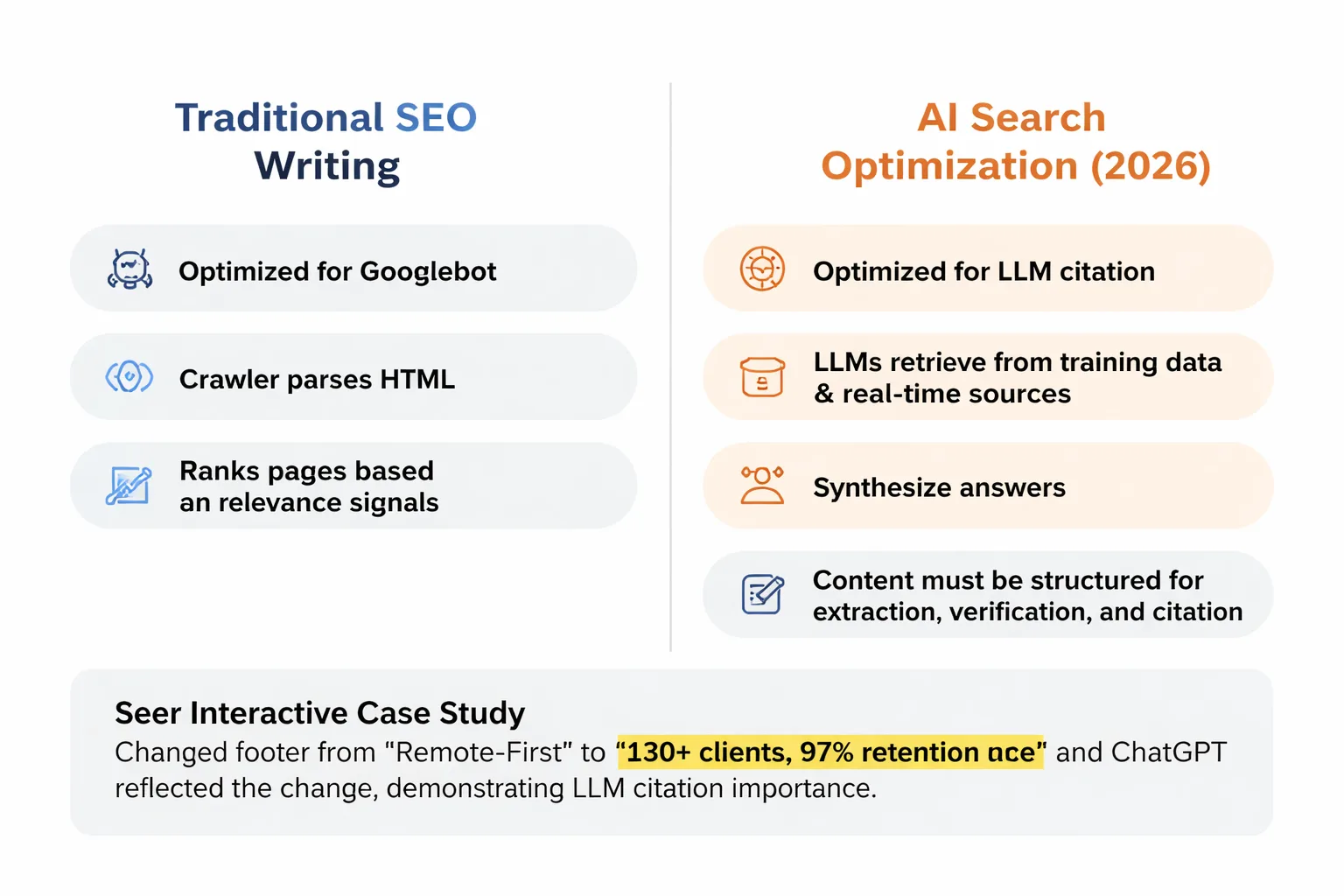
Traditional SEO writing optimized for Googlebot. You wrote for a crawler that parsed HTML, followed links, and ranked pages based on relevance signals. The LLMs powering AI search work differently. They don't crawl your page and rank it. They retrieve information from their training data and from real-time sources, then synthesize answers. If your content isn't structured in a way that an LLM can extract, verify, and cite, you don't exist in the answer.
The Seer Interactive case study illustrates this perfectly. Chris Long documented on LinkedIn how Seer changed their footer text from "Remote-First" to "130+ clients, 97% retention rate" and saw ChatGPT reflect that change within 36 hours. That's not keyword optimization. That's entity manipulation. The LLM was reading their site, extracting factual claims, and incorporating them into generated answers. An SEO writer who understands this dynamic writes content differently. Every sentence becomes a potential citation candidate.
The mechanics break down into three areas: structure, sourcing, and format.
Structure. LLMs extract from well-organized content. H2 and H3 headings that match natural-language questions. Short, self-contained answer paragraphs (40-60 words) that an AI engine can lift verbatim. Tables for comparative data. Lists for sequential processes. If your content is a wall of prose, the LLM has to work harder to parse it, and it will skip you for a source that's cleaner.
Sourcing. This is where most SEO writers fail the AI test. LLMs are trained to prefer content that cites primary sources. If you make a claim and link to the original study, the LLM treats your page as a verified intermediary. If you make the same claim with no source, you're noise. I've seen this pattern repeatedly: pages with dense inline citations to authoritative sources get cited by AI engines at far higher rates than pages with identical information but no sourcing.
Format. Schema markup, clean HTML, and structured data signals matter more than ever. Google's Knowledge Graph pulls from structured data to build entity relationships. If your content marks up an article with Article schema, includes FAQ schema for question-answer pairs, and uses Speakable schema for voice-optimized answers, you're giving AI engines a roadmap to your content. Most SEO writers in 2026 still aren't doing this. That's the gap.
SEO Writer vs. Content Writer vs. AI Writer
These three roles overlap but optimize for different outcomes. Understanding the distinction determines who you hire, what you pay for, and what results you get.
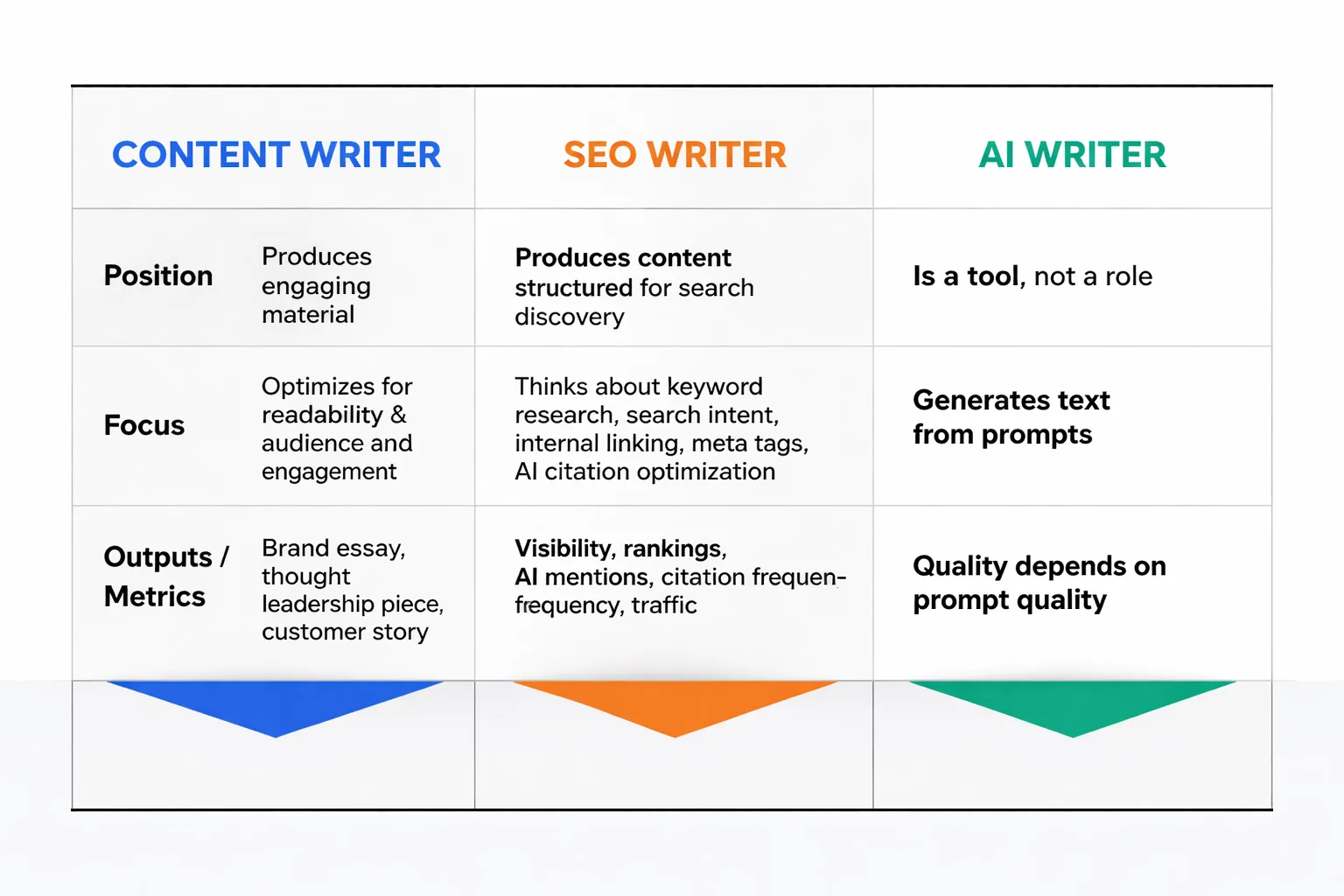
A content writer produces engaging material that builds brand awareness, educates readers, and supports a narrative. They optimize for readability and audience engagement. They don't necessarily think about search engines, entity graphs, or citation structures. A brand essay, a thought leadership piece, a customer story. These are content writer outputs.
An SEO writer produces content structured to be discovered through search. They think about keyword research, search intent, internal linking, meta tags, and (in 2026) AI citation optimization. They write for both humans and machines. Their success metric is visibility: rankings, AI mentions, citation frequency, and the traffic (or lack thereof) that follows.
An AI writer is a tool, not a role. It generates text from prompts. The quality depends entirely on the system behind it. I've tested AI writing tools extensively, and the output consistently requires human oversight to meet basic editorial standards. Raw AI output without a quality gate is what I call "AI slop": factual errors, choppy sentences, and a machine voice that kills engagement. The SEO writer's job in 2026 is to direct, refine, and verify AI-generated drafts, not to be replaced by them.
Here's the practical takeaway for small teams. You need an SEO writer (or someone operating as one) if your goal is search visibility and AI citation. You need a content writer if your goal is brand storytelling. You need an AI writing tool if you want to scale drafting volume, but only if you pair it with a human editor who understands AI and search engine optimization. Using an AI tool without an SEO writer is like using a power saw without a carpenter. The tool is fast. The output is dangerous.
What Skills Define a Strong SEO Writer Today
The 2026 SEO writer needs a skill set that didn't exist five years ago. Here's what I look for when evaluating whether someone can actually produce content that earns AI citations.
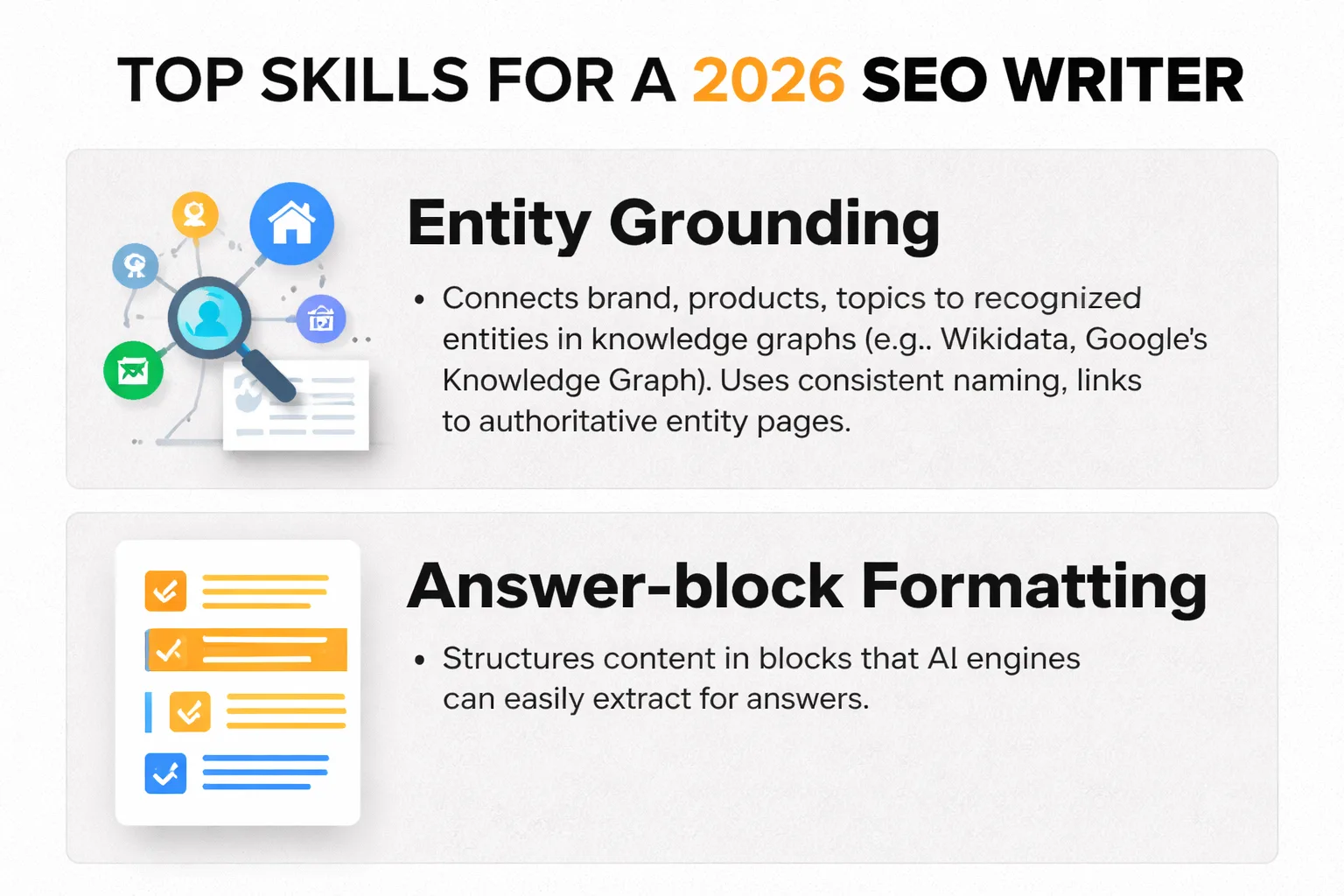
Entity grounding. This is the single most important skill, and almost no one talks about it. Entity grounding means writing content that connects your brand, products, and topics to recognized entities in knowledge graphs like Wikidata and Google's Knowledge Graph. When an LLM constructs an answer, it pulls from its internal entity graph. If your brand isn't connected to the entities relevant to your topic, you won't be cited. An SEO writer who understands entity grounding uses consistent naming, links to authoritative entity pages, and structures content to reinforce entity relationships. Ahrefs explains this well in their breakdown of how Google's Knowledge Graph works.
Answer-block formatting. AI engines extract from structured blocks. A strong SEO writer writes in a way that makes extraction easy. Self-contained answer paragraphs under H2s that match natural-language questions. Bolded lead claims with specific numbers. Tables for comparative data. Lists for sequential steps. This isn't about writing for machines at the expense of humans. It's about writing in a way that serves both. The Semrush AI Overviews study analyzed over 10 million keywords and found that AI Overviews favor content with clear hierarchical structure and extractable answer blocks.
Structured data awareness. I'm not saying every SEO writer needs to write JSON-LD by hand. But they need to understand what schema markup does, which types matter (Article, FAQ, HowTo, Speakable), and how to structure content so that schema can be applied automatically. If your CMS generates schema from your content structure, your writer needs to know how to format headings, lists, and tables so the schema is accurate.
Prompt-intent mapping. This is the skill that replaces keyword research in the AI era. Instead of asking "what keywords does my audience search for," the 2026 SEO writer asks "what prompts does my audience type into ChatGPT and Perplexity?" Those prompts are different from Google queries. They're longer, more conversational, and often ask for recommendations rather than information. A strong SEO writer maps content to prompt intent, not just keyword intent.
Fact verification and source tracing. LLMs hallucinate. That's a known failure mode. An SEO writer who wants to be cited by AI engines must produce content that's factually airtight, with every claim sourced to a primary document. If an LLM cites your page and the claim turns out to be wrong, the LLM's next training cycle may deprioritize your domain. Fact verification isn't just editorial hygiene. It's a citation preservation strategy.
AI visibility reporting literacy. The SEO writer of 2026 doesn't just publish and hope. They track whether their content is being cited, by which AI engines, and for which prompts. Tools like an AI visibility tracker or a ChatGPT AI visibility checker give you the data to know what's working. A strong SEO writer reads that data and adjusts. If a piece isn't being cited, they restructure it. If a competitor is being cited instead, they analyze what the competitor did differently.
Is your content being cited by AI engines or just ranking in Google?
Why Does AI Citation Require Different Content?
AI citation requires different content because LLMs process information differently than crawlers. A crawler reads your page, indexes the text, and ranks it against keyword signals. An LLM reads your page, extracts factual claims, verifies them against its training data and other sources, and decides whether to include your content in a synthesized answer. The difference is extraction versus indexing.
When I audit content for AI visibility, the most common failure I see is content that ranks well but isn't extractable. It's well-written, keyword-optimized, and internally linked. But it buries answers in long paragraphs, doesn't cite sources, and uses vague language instead of specific claims. An LLM scanning that page finds nothing it can confidently extract and attribute. So it skips the page entirely.
The fix is structural. Write answer-first paragraphs under question-shaped headings. Cite primary sources for every data point. Use specific numbers instead of vague qualifiers. Format comparative data in tables. Mark up your content with schema. These aren't optional enhancements. They're the baseline for AI citation.
The ecommerce case is instructive. One brand achieved 82.9% brand mention coverage in AI results after restructuring their content for answer extraction. They didn't change their product. They didn't build new backlinks. They reformatted their content to be parseable by LLMs. That's the power of writing for citation instead of ranking.
When Should You Shift from SEO to AEO?
The shift from SEO to AEO isn't a switch you flip. It's a transition you phase in, and the timing depends on your audience, your industry, and your current visibility.
Start now if your audience includes developers, marketers, or technical buyers. These segments adopted AI search early and use it daily for research. If your target queries include "how to," "what is," or "best tool for," you're already losing ground to competitors who optimize for AI citation. The Semrush study on AI search's impact on SEO traffic projects that AI search visitors will surpass traditional search visitors by early 2028 for digital marketing and SEO-related topics. That's 18 months away. If you wait until the crossover happens, you're 18 months behind.
Start now if you've already seen traffic plateaus or declines despite stable rankings. That's the signal Maya saw in the opening story. Rankings holding, traffic dropping. The cause is AI search intercepting queries that used to click through to your site. You can confirm this by running your target queries in ChatGPT, Perplexity, and Google AI Overviews. If your competitors appear and you don't, you have an AEO gap.
Start now if you're in a YMYL (Your Money, Your Life) category. AI engines are especially cautious about citing sources for health, financial, and legal queries. They default to high-authority, well-sourced content. If you produce YMYL content, your fact verification and source tracing need to be impeccable. This is where an AI SEO tool with quality gates becomes essential, not optional.
Don't start if you have zero Google presence yet. AI engines pull heavily from top-ranking content. If you're not ranking in Google at all, focus on traditional SEO fundamentals first. Build your baseline, then layer AEO on top. Understanding the difference between AEO and SEO helps you sequence the work correctly.
How Do You Measure SEO Writer Success in 2026?
Measuring SEO writer success in 2026 requires metrics that didn't exist two years ago. Here's what I track and what I ignore.
Track: AI citation frequency. How often does your content get cited across ChatGPT, Perplexity, Claude, Gemini, and Google AI Overviews? This is the new ranking. Use a Perplexity AI visibility checker or a broader LLM visibility tool to get baseline numbers, then track weekly.
Track: Mention position. When your brand appears in an AI answer, where does it appear? First mention, in a list, or last? First-position mentions drive the most recall. If you're always listed third behind two competitors, you have work to do.
Track: Prompt coverage. What percentage of relevant prompts in your space mention your brand? If you track 100 prompts related to your product category and your brand appears in 12 while a competitor appears in 60, you know exactly where the gap is.
Track: Citation source domains. Which domains are AI engines citing for your topics? If you know that AI engines cite specific publications for your category, you can target those publications for guest contributions, PR, or link building. This is what AEO vs. GEO analysis reveals: different engines cite different source types.
Ignore: Keyword density. It was never a good metric. In 2026, it's actively misleading. LLMs don't care about keyword density. They care about entity relevance, factual accuracy, and extractability.
Ignore: Word count targets. Longer isn't better. Extractable is better. A 900-word article with clean structure, sourced claims, and schema markup will outperform a 3,000-word opus that buries answers in narrative prose.
Ignore: Organic traffic as the sole success metric. This is the hardest shift for traditional SEO teams. Traffic matters, but it's no longer the only signal. Semrush's team discovered that their blog content was cited by LLMs hundreds of times while blog traffic declined. If they'd only tracked traffic, they would have concluded their content strategy was failing. In reality, it was succeeding in a new channel they weren't measuring.
What Are the Ethical Responsibilities of an AI-Era SEO Writer?
The ethical stakes for SEO writers have risen sharply with AI search. When an LLM cites your content, it's presenting your claims as verified information to a user who may not click through to check. That changes the weight of factual accuracy.
Preventing hallucination amplification. If your content contains a factual error and an LLM cites it, you've contributed to hallucination propagation. The LLM may repeat that error across thousands of answers. I've seen this happen with outdated statistics that writers copied from secondary sources without checking the original. The fix is simple but non-negotiable: every statistic links to its primary source. Every claim is verifiable. If you can't source it, you don't publish it.
Transparency about AI assistance. If you use AI tools to draft content, disclose it. Not because Google penalizes AI content (it doesn't, as long as it's helpful), but because transparency builds trust with both human readers and AI engines that evaluate source credibility.
Avoiding citation manipulation. There's a temptation to structure content specifically to game AI extraction. Stuffing answer blocks with brand mentions. Formatting every paragraph as a "fact" to increase extraction probability. This is the AI equivalent of keyword stuffing, and it will backfire. LLMs are trained to detect and deprioritize manipulative content. Write for the reader first. Structure for extraction second. Never reverse that order.
The HubSpot State of AEO report frames this well: the goal isn't to trick AI engines into citing you. The goal is to produce content that's so well-sourced, well-structured, and factually reliable that AI engines prefer you as a source naturally.
What Does Agentic SEO Mean for Writers?
Agentic SEO is the next evolution, and it changes how SEO writers interact with automation. Itay Malinski describes Agentic SEO on LinkedIn as a structured approach using specialist agents, each encoded with domain expertise, rather than a single generic AI tool. The distinction matters. A generic AI writer produces flat, undifferentiated content. A specialist agent trained on SEO principles produces structured, entity-aware drafts that a human writer can refine in minutes instead of hours.
For the SEO writer, this means the job shifts from drafting to directing. You define the entity map. You set the citation requirements. You approve the final structure. The agent handles the mechanical work of assembling research, drafting answer blocks, and formatting schema-ready content. I've experimented with AI agents for content generation over the past six months, and the output consistently required significant human oversight to meet basic quality standards. The agents are fast, but they lack the editorial judgment to know which sources matter, which claims need verification, and which structures earn citations. That judgment is the SEO writer's value. The agent accelerates the workflow. The writer ensures the quality.
The risk is real, especially for YMYL topics. I've seen too many instances where automated content for niche or health-related queries falls flat. The risk of generating low-quality or inaccurate articles that trigger Google's helpful content penalties far outweighs the perceived efficiency gains. An agentic SEO workflow without a quality gate is a liability. An agentic workflow with a 16-dimension quality firewall blocking weak drafts before publish is a competitive advantage.
Putting It Into Practice: Building an AI-Ready Content Workflow
In my work at Meev, I've seen what separates teams that earn AI citations from teams that don't. The difference isn't budget or headcount. It's workflow. Here's what an AI-ready content workflow looks like for a small team.
Start with diagnosis. Before writing anything, run your brand through an AI visibility checker to see where you're cited and where you're absent. You can't fix what you haven't measured. The diagnostic tells you which topics you own, which topics competitors own, and which prompts trigger AI answers in your space.
Plan around prompts, not keywords. Traditional keyword research tools give you search volume and competition scores. They don't tell you what prompts people type into ChatGPT. Use a combination of Google Search Console data, AI visibility tracking, and direct prompt testing to identify the questions your audience asks AI engines. Those questions become your content briefs.
Write for extraction. Every article should follow a structure that makes AI citation natural. Question-shaped H2s. Self-contained answer paragraphs. Inline source links. Comparative tables. Schema markup. This isn't a style preference. It's a citation strategy.
Gate everything. I've been burned by shipping AI-generated content without a quality check. The result was factual errors and a machine voice that killed engagement. At Meev, every article passes through a 16-dimension quality firewall before it reaches the CMS. Articles below 70/100 get blocked. No exceptions. If you're not using Meev, build your own gate: fact-check every claim, verify every source, read every draft aloud. The gate slows you down by about 50% compared to raw AI output. It also prevents the 80% of problems that get AI content penalized.
Publish and track. After publishing, monitor whether your content earns citations. Use an AI visibility tracker to watch for new mentions. If a piece isn't getting cited after 2-3 weeks, restructure it. Tighten the answer blocks. Add more primary sources. Reformat comparative data into tables. Iterate.
This is the loop: diagnose, plan, write, gate, publish, track, iterate. It's not complicated. But it requires discipline that most teams skip. The teams that run this loop weekly are the ones showing up in AI answers. The teams that don't are wondering where their traffic went.
FAQ
What does an SEO writer do?
An SEO writer produces content structured to rank in search engines and be cited by AI answer engines. In 2026, that includes keyword and prompt research, entity grounding, answer-block formatting, inline source citation, schema markup, and AI visibility tracking. The role has evolved from writing keyword-optimized blog posts to building fact-verified, extractable content that both Google and LLMs surface.
Do I need an SEO writer or an AI tool?
You need both, but they serve different functions. An AI tool generates drafts at scale. An SEO writer directs, refines, and verifies those drafts to meet search and citation standards. Using an AI tool without an SEO writer produces content that's fast but unreliable. Using an SEO writer without AI tools produces content that's reliable but slow. The optimal setup pairs AI drafting with human editorial oversight and a quality gate.
How do I find keywords for a blog?
Start with Google Search Console to see what queries already drive traffic to your site. Then use a keyword combiner tool to expand those queries into related variations. Test your target queries in ChatGPT and Perplexity to see what prompts trigger AI answers in your space. Those prompts are your 2026 keyword opportunities. Prioritize prompts where competitors are cited and you aren't.
What are blog keywords?
Blog keywords are the search terms and prompts your target audience uses when looking for information related to your topic. In traditional SEO, keywords drive organic search ranking. In 2026, keywords also inform prompt-intent mapping for AI search. The most valuable keywords aren't always the highest-volume ones. They're the ones that trigger AI answers where your brand should be cited but isn't.
Can an AI tool replace an SEO writer?
No. AI tools can draft content, but they can't perform entity grounding, prompt-intent mapping, source verification, or AI visibility analysis. They also can't apply editorial judgment about which claims need sourcing, which structures earn citations, and which topics align with brand strategy. An AI tool is a drafting accelerator. An SEO writer is the strategist and editor who ensures the output earns visibility.
How long does it take to see AI citations from new content?
In my experience, well-structured content can earn AI citations within 2-3 weeks of publication. The Seer Interactive case showed ChatGPT reflecting footer changes within 36 hours. But that's for entity-level updates, not new articles. For full articles, the timeline depends on how quickly AI engines crawl and index your content, how authoritative your domain is, and how well-structured the content is for extraction. Publishing via IndexNow and submitting sitemaps to Google Search Console speeds this up.
The role of an SEO writer has fundamentally split. One path clings to keyword density and organic traffic as the sole success metric. The other path builds content that AI engines cite by name. The first path is shrinking. The second is where every content strategy needs to go. If your SEO writer isn't thinking about entity grounding, answer extraction, and AI visibility, they're optimizing for a search world that's already fading. The writers who adapt will define the next era of search visibility. The ones who don't will keep ranking first while losing every conversation that matters.
About the Author
Judy Zhou, Founder
Judy Zhou leads content strategy at Meev, where she oversees AI-driven content research and publishing for hundreds of brands. With a background in SEO and editorial operations, she focuses on building content systems that rank on Google, get cited by AI search engines, and drive measurable business results.
Stop guessing whether AI search engines cite your brand. Run a free AI visibility audit and see exactly where you stand across ChatGPT, Perplexity, Claude, and Google AI Overviews.