

How to Measure Whether Your SEO Writer Is Helping AI Rankings
By Judy Zhou, Founder
Key Takeaways
- The overlap between top Google results and AI-cited sources has dropped from roughly 70% to under 20%, so a #1 organic ranking no longer ensures visibility in ChatGPT, Perplexity, or AI Overviews.
- A Semrush study found only 51% domain overlap between Google AI Mode citations and the top 10 organic results, proving traditional rank reports miss the AI layer.
- Require your SEO writer to track brand citations in AI engines for core queries instead of reporting only keyword rankings and organic traffic.
- Run monthly AI visibility checks on product questions, because AI answers satisfy queries before clicks and classic metrics no longer capture the full job.
Marcus had hired three SEO writers in eighteen months. Each one handed over monthly reports packed with keyword movement, impressions, and click-through rates. Each one was technically improving the numbers. But when Marcus typed his company's core product question into Perplexity one Tuesday afternoon, a competitor he'd never heard of appeared in the AI's cited sources. Twice. His writers had been optimizing for a search experience that was quietly becoming secondary. Nobody had told them the target had moved.
The overlap between top Google results and AI-cited sources has dropped from roughly 70% to under 20%, meaning a page can rank #1 organically and still be invisible to ChatGPT, Perplexity, and Google AI Overviews. A Semrush study of Google AI Mode found only 51% domain overlap between AI Mode sidebar citations and Google's top 10 organic results. Traditional SEO metrics like rank position and organic traffic are insufficient for AI search reporting because AI answers satisfy queries before clicks occur, as Semrush's AI visibility measurement guide documents. If your seo writer reports only on keyword rankings and click data, you're measuring the wrong surface.
I see this constantly in my work auditing content operations at Meev. Founders hand me beautiful monthly reports showing traffic growth, and then I run an AI visibility check and find their brand is absent from every major AI engine for the queries that matter. The writer did their job. The metrics just didn't capture the job that mattered.
Why Classic Metrics Miss the AI Search Layer
Here's the problem in one sentence: your SEO writer can win every traditional metric and still lose the AI search layer.
Traditional SEO measurement is built on a click-based model. You rank for a keyword, a user sees your result, they click, and you count that click. Every metric in your writer's monthly report (impressions, CTR, average position, organic sessions) traces back to that assumption. But AI search engines don't work that way. When someone asks ChatGPT or Perplexity a question, the engine synthesizes an answer from its training data and retrieved sources, cites the domains it pulled from, and the user often never clicks through to any website. The query is satisfied in the answer itself.
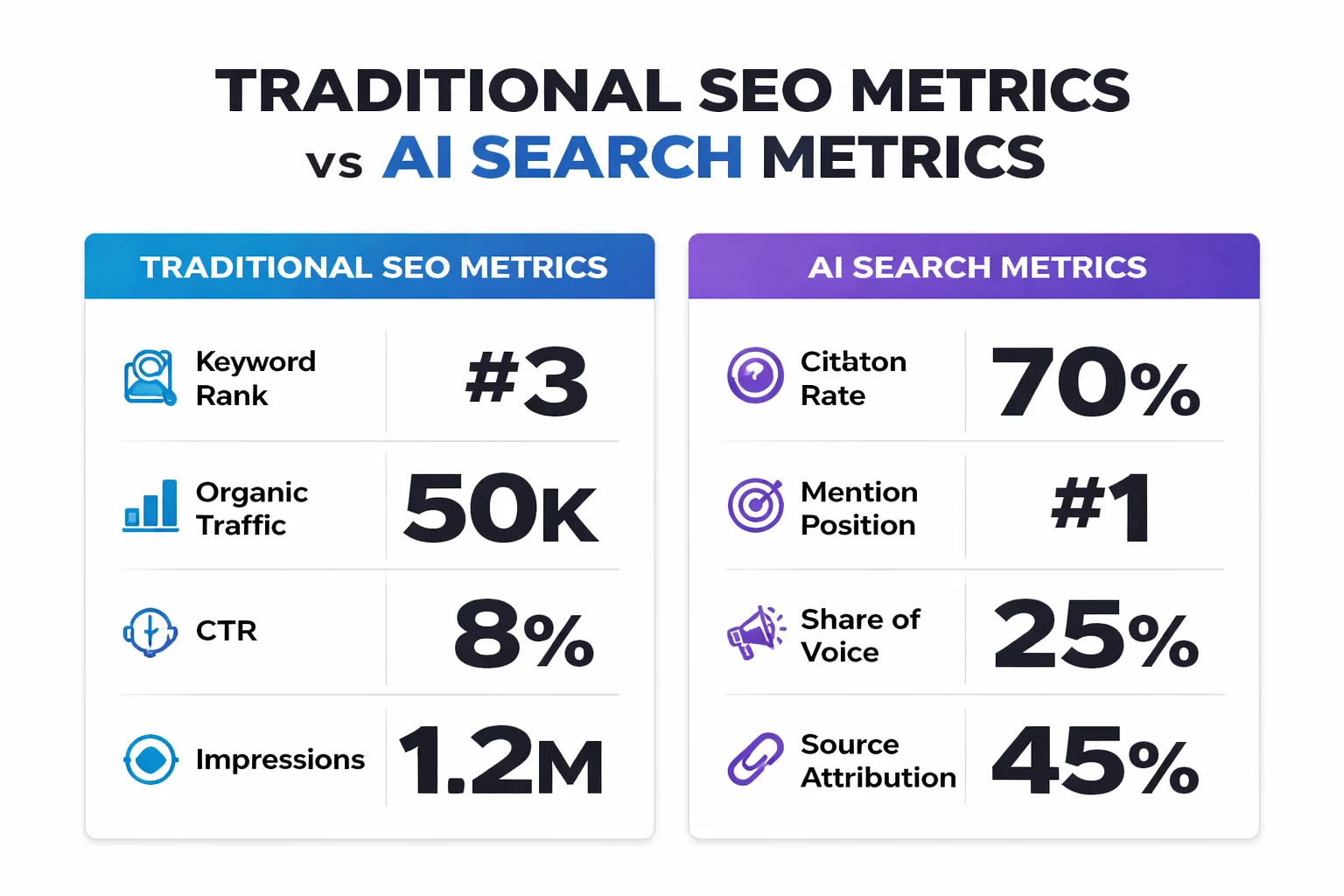
This means the entire reporting layer most SEO writers use is blind to where the real visibility is happening. A Semrush study on Google AI Mode found that 92% of AI Mode responses feature a sidebar with approximately 7 unique domains cited. But only 51% of those cited domains overlap with Google's top 10 organic results. When organic links appear below the AI response, overlap jumps to 89%. The implication is stark: ranking organically helps, but it's no longer a prerequisite for AI citation. And it's certainly not a guarantee.
The old generic SEO tricks that might have given marginal gains in traditional search, like keyword stuffing or dropping links without context, are now largely ineffective for AI visibility. I've seen them backfire, making content less likely to be picked up by AI models. What worked even two years ago is now a liability.
So when your writer hands you a report showing position 3 for a primary keyword and a 12% traffic increase, ask one question: "Are we cited by AI engines for this query?" If they can't answer, the report is incomplete. Not wrong, just incomplete in a way that's becoming expensive.
The shift from AEO vs SEO isn't about abandoning traditional metrics. It's about adding a second measurement layer that captures what happens when the search engine itself becomes the answer. Your writer needs to report on both. Most report on one.
Let me give you a concrete example. A SaaS company I worked with recently had a writer who published a deeply researched comparison guide targeting "best project management tools." The article ranked in position 4 on Google within three weeks. Organic traffic climbed steadily. By every traditional metric, the writer was succeeding. But when I ran the prompt "what are the best project management tools for small teams" through ChatGPT, Perplexity, and Claude, the company wasn't mentioned in any of the responses. Not once. Three competitors who ranked below them on Google were cited consistently. The writer had optimized for the wrong retrieval system. The article was structured for crawlers that match keywords to pages, not for engines that synthesize answers from entity graphs and source diversity.
The difference comes down to how AI engines select sources. Google's organic algorithm evaluates hundreds of ranking signals to determine which page best satisfies a keyword query. AI engines use retrieval-augmented generation (RAG) to pull from multiple sources simultaneously, then synthesize an answer. The selection criteria overlap with traditional ranking factors (domain authority, content relevance, freshness) but also include factors traditional SEO doesn't measure: how well the content states discrete, extractable facts, how consistently the brand entity appears across the web, and whether the content is referenced by other sources the AI already trusts. Your writer can hit every traditional SEO checkpoint and miss every AI-specific one.
How Do You Baseline AI Citation Rate?
Before you can measure whether your writer's content is moving the needle, you need to know where the needle sits today. That means running a prompt audit across every major AI search surface and recording what comes back.
A baseline prompt audit works like this. You assemble a list of 15-30 prompts that represent the questions your customers actually ask when researching your product category. Not keywords. Prompts. Full natural-language questions like "what's the best tool for tracking AI search visibility" or "how do small teams measure LLM citation tracking." You then run each prompt through ChatGPT, Perplexity, Claude, Gemini, Google AI Overviews, and Grok, and you record four things for each response: whether your brand is mentioned, where in the answer it appears (first, in a list, last), which sources the AI cited, and which competitors appear.
This is tedious if you do it manually. I've done it manually and it takes a full day for 20 prompts across 6 engines. Tools like our AI visibility tool automate this with daily refresh on SERP-driven surfaces and rolling refresh on LLM-driven surfaces, but the methodology matters more than the tool. The point is to establish a concrete starting point: "As of today, we are cited in 3 of 20 prompts across Perplexity and 0 of 20 across ChatGPT."
Without that baseline, any future claim about improvement is anecdotal. "I think we're showing up more in ChatGPT" is not a metric. "Our citation rate on Perplexity went from 15% to 35% across 20 tracked prompts in 8 weeks" is a metric.
The baseline also reveals where your writer should focus. If you're already cited for branded queries but absent for category queries, the content strategy needs to target category-level prompts. If you're cited by Perplexity but not ChatGPT, the issue might be source diversity. ChatGPT pulls from a different mix of training data and retrieved sources than Perplexity does. Understanding what AEO actually means at the prompt level is what separates writers who move AI rankings from writers who just write more content.
Let me walk through a real baseline scenario. Say you run a B2B SaaS company in the data analytics space. Your prompt list might include: "best data analytics platforms for mid-market companies," "how to choose a data analytics tool," "what are the alternatives to [competitor name]," "data analytics platform comparison 2026," and "affordable data analytics tools for startups." That's five prompts. You'd want 15-25 more covering feature-specific questions ("which data analytics tools support real-time dashboards"), use-case questions ("best data analytics platform for ecommerce"), and comparison questions ("[your brand] vs [competitor]"). For each prompt, you record the AI's response, extract every cited domain, note your brand's position if it appears, and log which competitors show up. After running 20 prompts across 6 engines, you have 120 data points. That's your baseline.
The baseline often surfaces surprises. I've run audits where a company was cited for 40% of branded prompts but 0% of category prompts. That tells you the AI knows who you are but doesn't think of you when the category comes up. The content fix is different from what most writers default to. Instead of more branded content, the writer needs to publish category-level thought leadership that positions the brand within the broader landscape. The baseline tells you exactly where the gap is. Without it, you're guessing.
Is your SEO writer measuring AI citations or just keyword positions?
Step 2: Tag Articles by Target Prompt and Entity
Once your baseline is set, every article your writer publishes needs to be tied to a specific AI prompt it was designed to earn citations for. This is the step most teams skip, and it's the reason they can never measure impact.
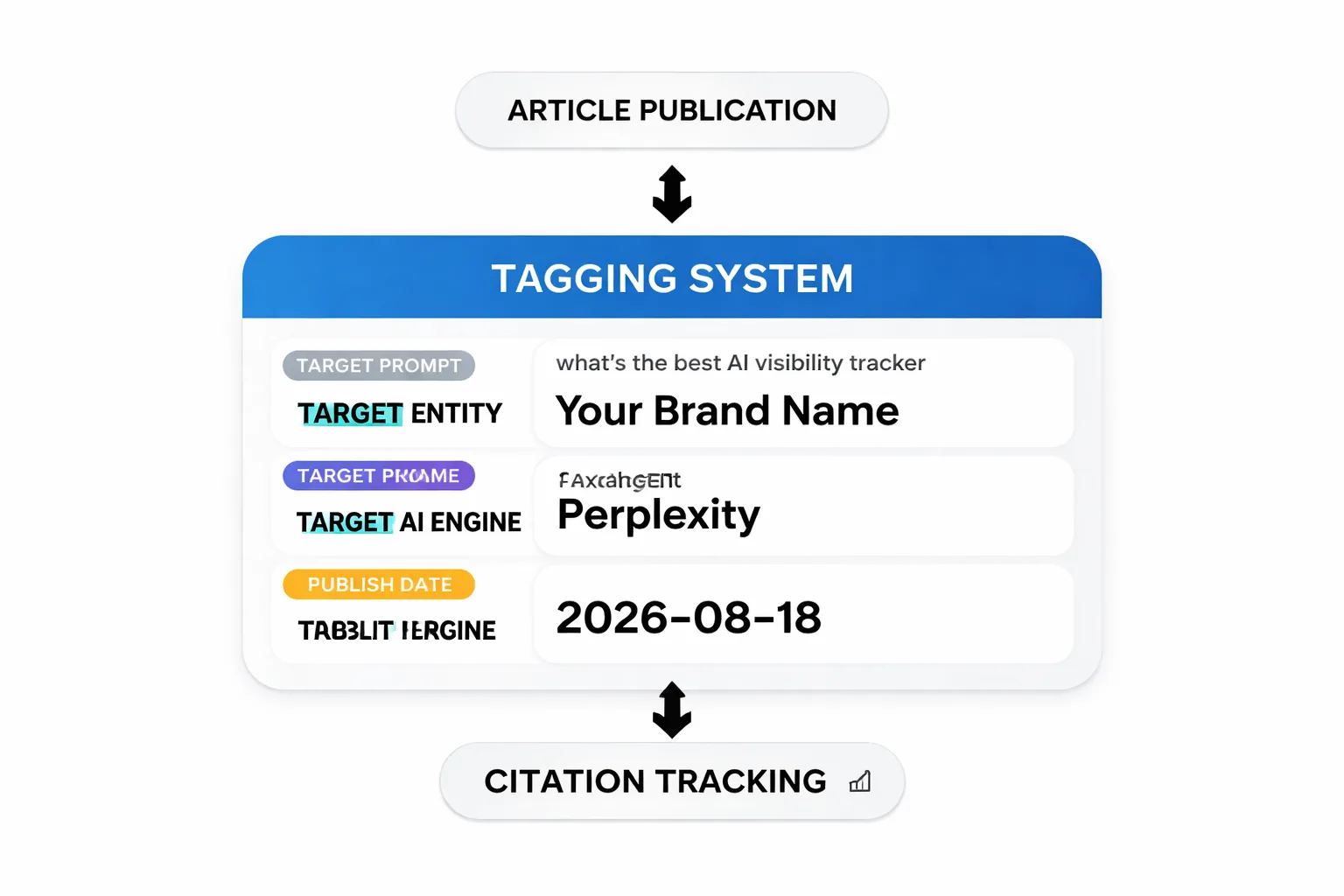
Here's what the tagging system looks like in practice. Each published article gets a simple metadata record with four fields: target prompt, target entity, target AI engine, and publish date. For example, if your writer publishes an article titled "How to Choose an AI Visibility Tracker," the record would read: target prompt = "what's the best AI visibility tracker," target entity = your brand name, target engine = Perplexity (or whichever engine you're prioritizing), publish date = 2026-08-18.
This sounds simple. It is simple. But almost nobody does it because most content workflows were built for keyword targeting, not prompt targeting. Keywords and prompts are different animals. A keyword is a compressed signal: "ai search optimization tools." A prompt is a full question: "what are the best ai search optimization tools for a small marketing team." Your writer might be targeting the keyword, but the AI engine is answering the prompt. If you don't map articles to prompts, you can't trace which articles are earning citations and which are dead weight.
Entity tagging matters because AI engines don't just match text. They ground answers in entities. If your brand isn't recognized as an entity in the knowledge graph the AI references, your content is less likely to be cited even if it's factually correct and well-structured. This is where entity grounding for AI search becomes part of the writer's job. The writer needs to ensure brand mentions are consistent, that the brand has a Wikidata entry, and that the content reinforces the same entity attributes across every published piece.
I've seen writers produce excellent content that never gets cited because the brand entity is fragmented across the web. Different name spellings, inconsistent descriptions, no Wikidata presence. The AI can't connect the content to a coherent entity, so it picks a competitor whose entity is clean.
The tagging system also prevents cannibalization. If two articles target the same prompt, they split the signal. A good tagging system surfaces that overlap before publish, not after.
Here's a practical tagging template you can implement today. Create a spreadsheet or Notion database with these columns: Article Title, URL, Target Prompt, Target Entity, Secondary Entity (e.g., a product feature or executive), Target AI Engine(s), Publish Date, Baseline Citation Rate (at publish), 2-Week Citation Rate, 4-Week Citation Rate, 8-Week Citation Rate, and Notes. When your writer pitches an article, they fill in the first five columns before drafting. The citation rate columns get filled in during the tracking phase. This simple system creates a direct line from content investment to AI visibility outcome. Every article has a hypothesis ("this article will earn citations for prompt X on engine Y") and a measurement ("did it?"). If you're publishing 10 articles a month, that's 10 hypotheses you can test and learn from. Without the tag, you're just publishing into the void and hoping something sticks.
The tagging system also enables a feedback loop that makes your writer smarter over time. After tracking 20-30 tagged articles, patterns emerge. Maybe listicle-format articles earn citations 3x more often than explainer articles for your category. Maybe articles that include original data get cited within 2 weeks while opinion pieces take 6. Maybe articles targeting Perplexity earn citations faster than articles targeting ChatGPT because Perplexity retrieves from the live web more aggressively. These insights let your writer double down on what works and stop producing what doesn't. But you only get these insights if every article is tagged from the start.
What Does a Healthy Citation Curve Look Like?
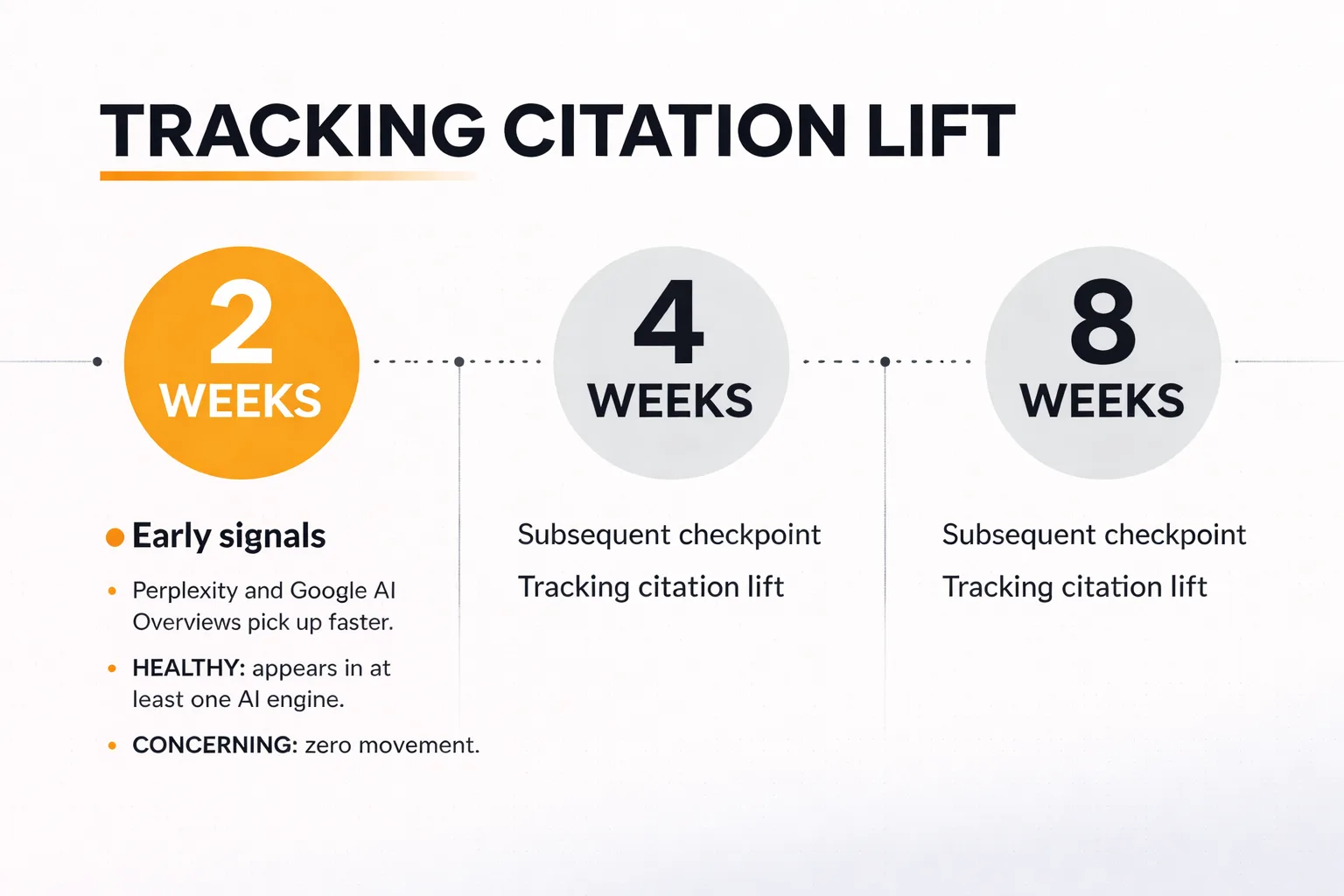
After publishing, you need to track citation lift at specific intervals: 2 weeks, 4 weeks, and 8 weeks. These checkpoints aren't arbitrary. They map to how long it takes for AI engines to ingest and surface new content.
At the 2-week mark, you're looking for early signals. Perplexity and Google AI Overviews tend to pick up new content faster because they retrieve from the live web. If your article was published on a domain that AI engines already cite for related topics, you might see a citation appear within 10-14 days. ChatGPT and Claude are slower because they rely more on training data refreshes, though ChatGPT's browsing capability has narrowed this gap.
A healthy 2-week result: your brand appears in at least one AI engine's response for the target prompt, even if it's not in the top position. A concerning 2-week result: zero movement across all engines. That doesn't mean the content failed, but it means you need to investigate. Is the article indexed? Is it on a domain AI engines trust? Are there inbound links pointing to it? Is the entity consistent?
At 4 weeks, the picture should clarify. A healthy curve shows citation rate increasing. If you started at 0% for the target prompt across all engines, you'd expect to see 10-20% citation rate by week 4. That means 2-4 of the tracked engines now cite your brand or your article for that prompt. If the line is flat, the content isn't being picked up and you need to diagnose why before investing more.
At 8 weeks, you should see stabilization. The citation rate might fluctuate a few points week to week because AI responses aren't deterministic. The same prompt can return different sources on different days. But the trend should be clearly upward or stable at a higher level than baseline. If you're at 8 weeks and the citation rate is still at baseline, the article didn't work for AI visibility. It might still be driving organic traffic, and that's worth something. But it didn't move the AI metric.
Here's where it gets interesting. A flat citation line doesn't always mean the content is bad. Sometimes the prompt is too competitive. Sometimes the AI engine has a preferred source it cites for that topic and it takes multiple touchpoints to dislodge it. That's why I recommend iterating before abandoning. Update the article with new data, add a unique perspective the AI can't get elsewhere, and build inbound links from domains the AI already trusts. Then re-measure.
The Semrush AI Mode study found that AI Mode responses feature roughly 7 unique domains per sidebar. That means there are approximately 7 slots. If your competitor holds one of those slots, your content needs to be demonstrably better or better-sourced to replace it. This isn't about word count or keyword density. It's about whether your article provides information the AI can't synthesize from existing sources.
Let me give you a specific example of what iteration looks like. A company I advised published an article targeting the prompt "how to measure AI search visibility" in January 2026. At the 4-week mark, citation rate was 0%. The article was well-written, factually accurate, and ranked on page 2 of Google. But AI engines weren't citing it. The diagnosis: the article covered the same ground as three existing sources that AI engines already cited (a Semrush blog post, an Ahrefs guide, and a Search Engine Journal article). The AI had no reason to switch. The iteration: the company added an original benchmark study with data from 50 brands showing average citation rates by industry. That data didn't exist anywhere else. Within 10 days of the update, Perplexity started citing the article. By week 8, ChatGPT followed. The lesson: AI engines cite content that adds new information to the ecosystem, not content that rephrases what's already available.
Step 4: Report Results Founders Actually Read
Most SEO reports are unreadable. They're dense tables of keyword positions, impression counts, and CTR percentages that mean nothing to a founder who wants one answer: are more people finding us?
The AI search visibility report needs to be different. One page. Three sections. Clear next action.
Section 1: AI Mention Rate. This is your headline metric. Express it as: "Our brand is cited in X% of tracked prompts across all major AI search surfaces, up from Y% at baseline." Break it down by engine: ChatGPT, Perplexity, Claude, Gemini, Google AI Overviews, Grok. Show the trend line. If you're using a tool like our LLM visibility tool, this is automated. If you're doing it manually, a simple spreadsheet with weekly snapshots works.
Section 2: Source Attribution. This is where most reports fail. It's not enough to say "we're cited 35% of the time." You need to show which of your pages are being cited. This connects the writer's output to the AI visibility outcome. If the article tagged to "best ai search optimization tools" is the one getting cited, your writer is doing their job. If citations are coming from pages the writer didn't create, you have a different story.
Also track which sources AI engines cite alongside you. If a competitor appears in 60% of responses where you appear, that's your real competitive set in AI search. The cited-source leaderboard concept, where you see which domains AI engines cite most for your topics, is one of the most actionable data points you can put in a founder report.
Section 3: Next Recommended Action. Every report should end with one sentence: "Next month, we should [specific action]." Not "continue monitoring." Not "optimize content." A specific action like "publish 3 articles targeting prompts where competitors are cited and we aren't" or "build Wikidata presence for the brand entity to improve grounding."
This reporting format works because it answers the question founders actually ask. Not "how are our keywords doing" but "are we winning in the places where our customers are now searching?" The Position Digital AI SEO statistics compilation aggregates trends showing CTR impact and citation patterns across AI platforms, and the data consistently shows that traditional click metrics don't capture the full picture of how users encounter brands in AI-generated answers.
Here's what a one-page report template looks like in practice. Top of the page: a single large number showing your overall AI mention rate (e.g., "23% of tracked prompts cite our brand, up from 11% at baseline 8 weeks ago"). Below that, a simple bar chart showing citation rate by engine: ChatGPT 15%, Perplexity 40%, Claude 10%, Gemini 20%, Google AI Overviews 30%, Grok 5%. Then a table listing the top 5 cited sources for your tracked prompts, with your domain highlighted if it appears. Next to that, a list of 3 prompts where competitors are cited but you aren't, with the specific competitor names. Finally, one bolded sentence at the bottom: "Next action: Publish 2 articles targeting prompts 7 and 12 where [Competitor A] is currently cited." That's the entire report. A founder can read it in 90 seconds and know exactly where things stand and what happens next. Compare that to a 15-page SEO report with keyword position tables and impression charts. The founder doesn't read those. They nod, file them away, and wonder whether the investment is paying off.
How Does Entity Grounding Affect Citations?
Entity grounding is the mechanism that determines whether an AI engine can confidently associate your content with your brand. If the entity is weak, the content won't cite you even if it's the best source.
Think of it this way. When an AI engine answers a question, it doesn't just retrieve documents and string them together. It retrieves documents, extracts entities (people, companies, products, concepts), and then grounds its answer in the entity graph it has built. If your brand is a strong entity with consistent attributes across multiple trusted sources, the AI can confidently say "according to [your brand]" and cite your content. If your brand is a weak entity with inconsistent naming, no Wikidata entry, and few inbound references from authoritative domains, the AI might retrieve your content but attribute the information to a stronger entity in the same space.
I've seen this happen with companies that have great content and zero Wikidata presence. Their articles get read by AI crawlers, the information gets absorbed, but the citation goes to a competitor whose entity is better grounded. The writer did everything right on the content side. The entity side was never addressed.
Your SEO writer needs to understand this. Not as a theoretical concept but as a practical content requirement. Every article should reinforce the brand entity: consistent name usage, clear product descriptions, structured data markup, and outbound references to authoritative sources that themselves reference the brand entity. This is where answer engine optimization diverges from traditional SEO. It's not just about ranking. It's about being a citable entity.
The practical checklist for entity grounding: (1) ensure your brand has a Wikidata entry with accurate attributes, (2) use consistent naming across all published content, (3) implement schema markup that defines your organization as an entity, (4) build inbound links from domains that AI engines already cite as sources, and (5) monitor whether your brand is mentioned in the open web with consistent sentiment. These are not traditional SEO tasks. They're AEO tasks that your writer either needs to handle or coordinate with someone who can.
Let me explain the Wikidata piece specifically, because it's the most overlooked. Wikidata is the structured knowledge base that Wikipedia draws from, and it's one of the primary sources AI engines use to verify entity attributes. If your company has a Wikipedia page, you likely have a Wikidata entry. But many smaller companies don't have either. Creating a Wikidata entry isn't about self-promotion. It's about giving AI engines a structured reference point that says "this entity exists, here are its attributes, here are verified sources that confirm these attributes." Without that entry, the AI engine has to infer your entity from unstructured web content, which is less reliable and more likely to result in your brand being confused with similarly named companies or omitted entirely. I've seen brands with identical names in different industries get conflated in AI responses because neither had a clean Wikidata entry disambiguating them. The writer can publish 50 articles and it won't matter if the entity is ambiguous.
What Role Does an AI SEO Agent Play?
The rise of AI SEO agents has created a new question for founders: should your writer be using an AI agent to automate content research and publishing, and does that affect how you measure AI rankings?
AI SEO agents can reduce tasks like keyword clustering from hours to seconds. They can scan SERPs, identify content gaps, and even draft articles. The promise is efficiency. The reality is more complicated. I've been watching the AI SEO agent space closely, and while the promise of reducing tasks like keyword clustering from hours to mere seconds is compelling, much of it is still hype, especially for content publication. I've seen too many instances where automated content, particularly for niche or YMYL topics, falls flat. The risk of generating low-quality or inaccurate articles that could easily trigger Google's helpful content or E-E-A-T penalties far outweighs the perceived efficiency gains.
I've personally experimented with AI agents for content generation over the past six months, and the output consistently required significant human oversight and editing to meet even basic quality standards, let alone provide real value or rank effectively. The core issue isn't the initial content generation. Many tools can draft quickly. But the absolute lack of a robust post-generation quality gate is the problem. I tried pushing content directly from AI tools for a few weeks, and the results were abysmal: factual errors, choppy sentences, and an unmistakable machine voice that tanked engagement. Without a human or AI-driven quality control step for live keyword validation, citations, and editorial oversight, you're just publishing noise.
This matters for measurement because if your writer is using an AI agent without a quality gate, the content they produce is less likely to earn AI citations. AI engines don't cite generic, rephrased content. They cite content that adds new information, demonstrates real expertise, and is published on domains with strong entity grounding. An AI agent that drafts 30 articles in an hour without fact-verification or editorial review produces content that AI search engines will ignore. You'll see it in the citation curve: flat lines at 2, 4, and 8 weeks across every engine.
The right role for an AI SEO agent in your measurement framework is in the research and planning phase, not the publishing phase. Use agents to identify content gaps, analyze competitor citations, and surface prompt opportunities. But the actual content that goes live needs a quality gate. At Meev, we use a 16-dimension quality firewall that blocks articles scoring below 70/100 from auto-publishing. No AI agent should bypass that gate. Your writer's job is to ensure the content that reaches your CMS is citable, and that means human review of every article, regardless of how it was drafted.
How to Differentiate Traditional SEO vs. AI Search Contributions
One of the hardest questions founders ask is: "How do I know which results came from my writer's traditional SEO work versus their AI search optimization?" The answer requires separating your measurement into two tracks that run in parallel.
Track 1 is traditional SEO. You measure this with Google Search Console data: keyword rankings, impressions, CTR, organic sessions, and conversion rate from organic traffic. This track tells you whether your writer's content is performing in Google's organic results. It's the track most writers already report on.
Track 2 is AI search visibility. You measure this with prompt-level citation tracking across AI engines: citation rate, mention position, share of voice, and source attribution. This track tells you whether your writer's content is being cited by AI search engines. It's the track most writers don't report on at all.
The two tracks are related but not identical. Content that ranks well on Google is more likely to be cited by AI engines, but the correlation is weakening. The Semrush AI Mode study showed that when organic links appear below AI Mode responses, there's 89% domain overlap with Google's top 10. But when the AI Mode sidebar is the primary citation mechanism, overlap drops to 51%. This means traditional SEO still helps, but its predictive power for AI citation is declining.
To separate the contributions, look at the source attribution data. If AI engines are citing pages that also rank well on Google, the writer's traditional SEO work is driving AI visibility indirectly. If AI engines are citing pages that don't rank well on Google, the writer's AEO-specific work (entity grounding, fact-structured content, source diversity) is driving AI visibility independently. Both are valuable. But you need to know which is doing the heavy lifting so you can allocate budget accordingly.
A practical way to visualize this: create a two-axis chart for each tracked prompt. The X-axis shows Google rank position. The Y-axis shows AI citation rate. Prompts in the top-right quadrant (high Google rank, high AI citation) are your wins. Prompts in the top-left (low Google rank, high AI citation) tell you your AEO work is outperforming your traditional SEO. Prompts in the bottom-right (high Google rank, low AI citation) are the danger zone: you're winning on Google but invisible to AI. Prompts in the bottom-left need work on both fronts. This chart takes 10 minutes to build from your tracking data and gives you a strategic map that no traditional SEO report can provide.
When Should You Iterate vs. Publish New Content?
This is the hardest decision in AI content strategy, and most teams get it wrong by defaulting to "publish more."
The instinct when a citation rate is flat is to produce more content. More articles, more prompts, more surface area. Sometimes that's right. But often the problem isn't volume. It's that the existing content isn't citable. Publishing more uncitable content doesn't fix the root cause.
Here's the decision framework I use. If an article has been live for 8 weeks and hasn't earned a single citation, ask three questions. First, is the article on a domain that AI engines already cite for related topics? If no, the domain authority problem needs to be solved before content volume matters. Second, does the article contain information that isn't available from the sources AI engines currently cite? If no, the AI has no reason to cite you over existing sources. Third, is the brand entity consistent and well-grounded? If no, fix the entity before producing more content.
If the answer to all three is yes and you're still not getting cited, iterate on the article. Add original data, a unique framework, a contrarian perspective. AI engines favor content that adds something new to the information ecosystem. A rephrased version of what 5 other sites already said won't earn citations, no matter how well-optimized it is.
If the answer to any of the three is no, fix that problem first. Then decide whether to iterate or publish new content targeting a different prompt.
The agentic SEO approach, where AI agents handle keyword clustering and content distribution in seconds, is seductive. But the content quality gate is where it breaks down. I've experimented with AI agents for content generation, and the output consistently required significant human oversight to meet basic quality standards. For ecommerce GEO and agentic commerce specifically, the stakes are even higher because product-related queries often fall into YMYL territory where accuracy matters enormously.
Why Most Teams Skip the Baseline Step
Almost every team I've worked with skips the baseline prompt audit. They jump straight to publishing content because baselining feels like overhead with no immediate output. The writer wants to write. The founder wants to see articles. Nobody wants to spend a day running prompts through 6 AI engines and recording results in a spreadsheet.
The honest tradeoff is this: baselining delays your first published article by 1-2 days, but it makes every subsequent measurement meaningful. Without a baseline, you cannot prove your writer is helping AI rankings. You can show traffic. You can show keyword positions. You cannot show citation lift. And citation lift is the metric that matters in 2026.
Some teams rationally skip it because they're under pressure to show content output immediately. I understand that pressure. But I've also seen those same teams come back 3 months later with 40 published articles and no idea whether any of them moved the AI needle. They spent the budget. They produced the content. They can't answer the founder's question: "Did this work?"
Run the baseline. It takes a day. It saves you from spending three months flying blind.
What This Won't Fix
This measurement framework tells you whether your writer's content is earning AI citations. It does not fix three problems that are upstream of content.
First, it won't fix a weak brand entity. If your company has no Wikidata entry, inconsistent naming across the web, and zero presence on domains AI engines trust, your content won't get cited no matter how well it's written. Entity grounding is a prerequisite, not an outcome.
Second, it won't fix a domain authority problem. If your site has low authority and few inbound links from trusted sources, AI engines are less likely to retrieve your content. Content quality matters, but so does the domain it lives on.
Third, it won't fix a product-market mismatch. If customers aren't asking AI engines about your category, there's nothing to cite. AI visibility tracking only matters for prompts people actually ask.
Measure what your writer produces. But also address what your writer can't control.
FAQ
How often should I check AI citation rates?
Weekly is ideal for active content campaigns. AI responses fluctuate, so a single snapshot is noisy. Weekly tracking over 4-8 weeks reveals the real trend. For brands not actively publishing, biweekly or monthly checks suffice. The key is consistency: same prompts, same engines, same time window.
Can my SEO writer control whether AI engines cite our content?
Partially. The writer controls content quality, structure, entity consistency, and source attribution. They don't control the AI engine's retrieval algorithm, training data refresh cycle, or which competitors are also publishing. The writer's job is to maximize citability. The measurement framework tells you whether it's working.
What's the difference between AI visibility tracking and traditional rank tracking?
Traditional rank tracking measures where your page appears in Google's organic results for a keyword. AI visibility tracking measures whether your brand is mentioned and cited in AI-generated answers across engines like ChatGPT, Perplexity, and Claude. The metrics, methodologies, and tools are different. A page can rank #1 on Google and be absent from AI answers.
Should I fire my SEO writer if they only report traditional metrics?
Not necessarily. Most SEO writers are skilled professionals operating with an outdated measurement framework. The fix is often to update the reporting requirements, not replace the writer. Introduce AI citation tracking as a required metric, provide the tooling, and give the writer time to adapt. If they resist after 60 days, that's a different conversation.
How many prompts should I track?
Start with 15-20 prompts that represent your highest-value customer questions. Expand to 30-50 as you scale. More than 50 becomes noisy and hard to act on. Quality of prompt selection matters more than quantity. Each prompt should map to a real customer question, not a keyword.
Does LLM citation tracking work for B2B and B2C equally?
Yes, but the prompt sets differ. B2B prompts tend to be longer and more technical ("what's the best tool for tracking AI search visibility for a SaaS company"). B2C prompts tend to be shorter and more transactional ("best AI search optimization tools"). The methodology is the same. The prompt selection changes.
The bottom line is simple. If your seo writer can't tell you whether your brand is cited by AI engines, they're measuring the wrong thing. The tools exist. The methodology is clear. The only question is whether you're asking for the right metric. In my work building content systems at Meev, I've seen the gap between traditional SEO success and AI search invisibility close fast once teams start measuring what actually matters. Run the baseline. Tag your articles. Track the curve. Report what founders need to hear. The writers who adapt to this framework will be the ones whose content actually gets cited. The ones who don't will keep reporting on metrics that are becoming secondary.
About the Author
Judy Zhou, Founder
Judy Zhou leads content strategy at Meev, where she oversees AI-driven content research and publishing for hundreds of brands. With a background in SEO and editorial operations, she focuses on building content systems that rank on Google, get cited by AI search engines, and drive measurable business results.
Run your baseline AI visibility audit today and find out exactly where your brand stands across every major AI search surface.