By Judy Zhou, Founder
Key Takeaways
- Ahrefs' study of 75,000+ brands shows only a small fraction maintain stable AI citation rates over 90 days, proving volatility is structural.
- Search Engine Journal research found AI visibility rankings are mostly statistical noise, with different responses to the same prompt appearing up to 60% of the time.
- Gushwork's analysis shows 20% of AI search traffic yields 40% of high-intent conversions, so a citation drop is a pipeline problem, not a vanity metric.
- Triage any sudden citation drop against the four root causes first, since three are fixable within days through methodical diagnosis rather than blind rewrites.
Your AI citation rate dropped, and your analytics dashboard has no idea why.
Ahrefs studied 75,000+ brands across multiple AI search engines and found that only a small fraction of domains maintain stable citation rates over 90 days. The volatility is structural, not exceptional. Search Engine Journal's research confirmed that AI visibility rankings are mostly statistical noise, with different responses on the same prompt appearing up to 60% of the time. If your ai citations dropped last week, the cause is one of four things, and three of them are fixable within days.
I have spent the last year auditing content operations and AI visibility tracking for brands trying to understand why their presence in ChatGPT, Perplexity, and Google AI Overviews fluctuates. The pattern I keep seeing is panic followed by guesswork. Teams chase algorithm updates, rewrite content blindly, or pay for tools that report proprietary "visibility scores" that do not map to any mechanism Google or OpenAI has publicly described. Gushwork's analysis found that 20% of AI search traffic yields 40% of high-intent conversions, which means a citation drop is not a vanity metric problem. It is a pipeline problem. You need to diagnose it methodically, not react emotionally.
Here is the diagnostic framework I use, built on real data and the four root causes that account for nearly every sudden citation drop I have encountered.
The Four Most Common Causes of a Sudden Citation Drop
Every citation drop traces back to one of four root causes. I have yet to see a fifth. Understanding which bucket you fall into determines your entire remediation path, so triage is the first and most important step.
Cause 1: A Competitor Published a Stronger Source
This is the most common cause, and it is the one teams skip past fastest. An AI engine does not cite your page because it loves your brand. It cites your page because, at the moment of inference, your page was the strongest retrieved source for the prompt. When a competitor publishes a deeper, more recently updated, or more densely sourced page on the same topic, the retrieval pipeline shifts. Your citation does not disappear because you got worse. It disappears because someone else got better.
In my work auditing content ops, I have seen this pattern repeatedly: a brand holds a steady citation position for months, then a competitor publishes a long-form guide with fresher data, more outbound citations to authoritative sources, and structured data markup. Within two to three weeks, the AI engines shift. The competitor's page gets cited. Yours drops out. The Ahrefs study of generative engine optimization across 75,000+ brands confirmed that topical authority and citation density are the primary drivers of which sources AI engines prefer. If your competitor's page has more authoritative outbound links, more recent data, and clearer answer structures, it wins the retrieval race.
Let me give you a concrete example of how this plays out. A B2B SaaS company I audited held the primary citation for the prompt "best project management software for remote teams" across Perplexity and Google AI Overviews for four straight months. Their page was well-structured, had a comparison table, and cited a couple of industry reports. Then a competitor published a page that included a downloadable comparison matrix, embedded a video walkthrough, cited six primary research sources (including university studies and government productivity data), and structured their FAQ section with exact-match question headings. Within 12 days, the competitor displaced the original brand on Perplexity. Within 18 days, Google AI Overviews shifted. The original brand's page had not changed at all. It simply was not the strongest source anymore.
The lesson here is that AI citation competition is not static. You are not defending a position. You are competing in a retrieval race that re-runs every time a user submits a prompt. Your page needs to be the strongest source at the moment of inference, not the strongest source from three months ago.
Cause 2: Crawl or Indexing Issues Blocked Your Pages
AI engines build their answers from retrieved content. If your pages are not crawlable, they cannot be retrieved, and they cannot be cited. This sounds obvious, but the failure modes are subtle. A robots.txt update that inadvertently blocks GPTBot or ClaudeBot. A server migration that broke canonical tags. A JavaScript rendering issue that hides your content from crawlers that do not execute JS. A noindex directive that propagated from a staging environment to production.
I have seen brands lose 100% of their AI citations because a developer added Disallow: / to robots.txt during a site redesign and forgot to remove it. The brand's Google rankings were fine (Google crawls aggressively and often ignores minor robots.txt misconfigurations), but the AI engines that respect crawl directives simply stopped accessing the content. The citation drop was instantaneous and total. If you run answer engine optimization without verifying crawl access for AI-specific user agents, you are building on sand.
Here is a specific failure mode that I see more than any other. A site migrates from one CMS to another. The development team sets up 301 redirects for all old URLs. Google processes the redirects within days and rankings stabilize. But the redirect chain introduces a one-hop delay that AI crawlers handle differently. GPTBot may follow the redirect but not re-crawl the destination URL for weeks. PerplexityBot may drop the URL entirely if it receives a 301 on a page that was previously a 200. The result: your Google rankings are fine, your AI citations vanish. I have seen this exact scenario play out with three different brands in the past six months, and in every case the team spent weeks rewriting content before anyone thought to check the redirect chain.
Another subtle failure: JavaScript-rendered content. Many modern sites render key content (comparison tables, FAQ sections, product specifications) via JavaScript. Google has gotten good at executing JS, but most AI engine retrievers do not execute JavaScript at all or do so with significant limitations. If your critical content is JS-rendered, it is invisible to the retrieval pipeline. The page loads fine in a browser. Google indexes it. But when Perplexity or ChatGPT retrieves the page, they get a shell with no content. This is a silent citation killer because nothing in your analytics tells you the content is missing for AI crawlers.
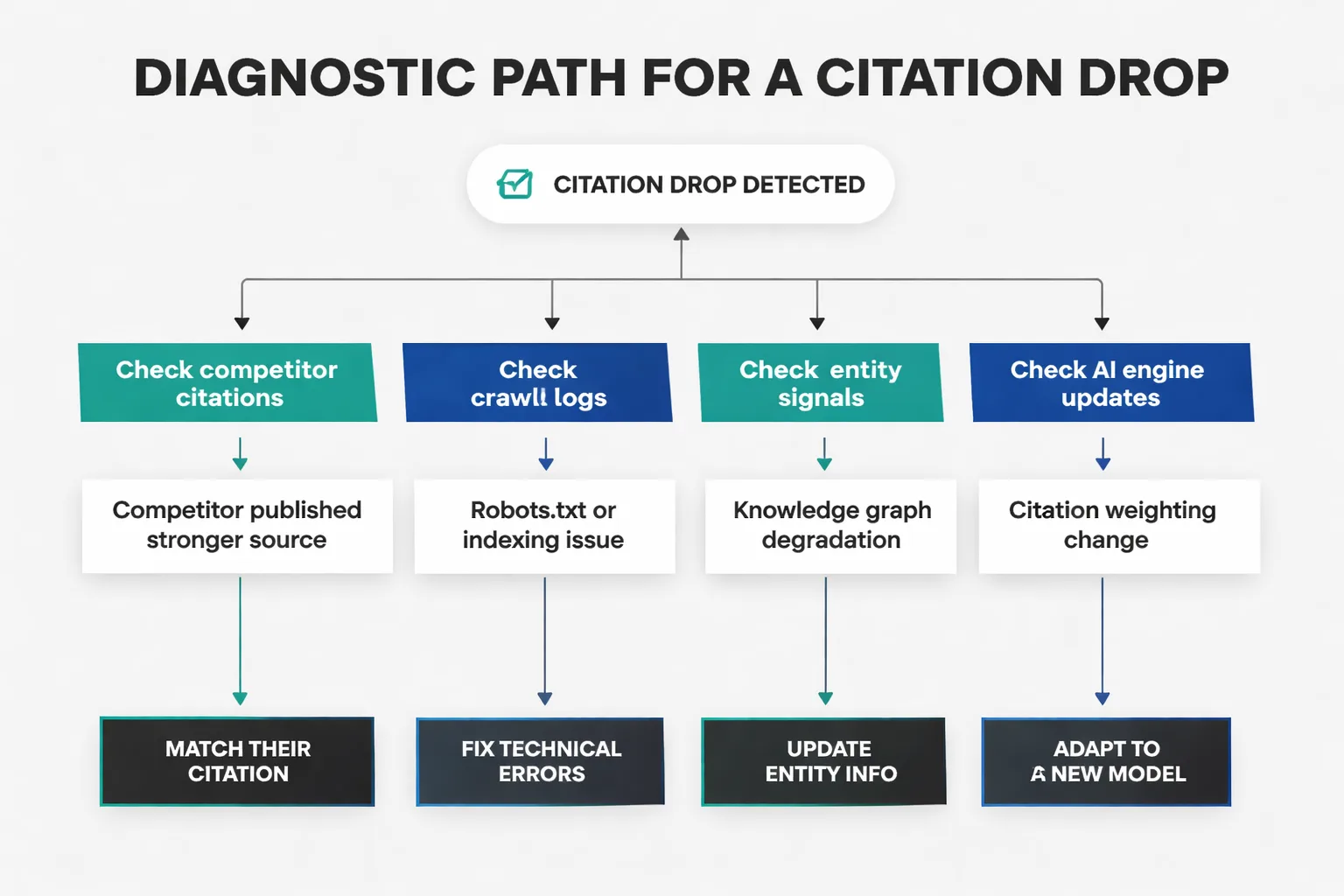
Cause 3: Entity Signals Degraded
This one is the hardest to detect and the most misunderstood. AI engines do not just retrieve pages. They retrieve entities. Your brand is an entity, and its strength depends on signals across Wikidata, Wikipedia, structured data on your own pages, and consistent NAP (name, address, phone) information across the web. When these signals degrade, your entity weakens, and AI engines lose confidence in citing you.
What does "degrade" look like in practice? A Wikidata entry gets edited and removes a key property (like your industry classification or official URL). A Wikipedia editor flags your page for notability concerns and it gets redirected or deleted. Your schema markup breaks after a CMS update. A data aggregator propagates inconsistent business information. None of these trigger a Google ranking drop, but they erode the entity confidence that AI engines rely on. The pattern I keep seeing is that brands with strong Google rankings but weak entity signals get cited less by AI engines than brands with moderate Google rankings but strong, consistent entity presence. This is why entity grounding for AI search matters as much as traditional SEO.
Let me walk you through a real entity degradation scenario. A mid-sized fintech company had a solid Wikidata entry with properties for their industry, official website, founding date, and CEO. They were consistently cited by ChatGPT and Perplexity for prompts related to their product category. Then a Wikidata editor removed the "industry" property because the original sourcing was a primary (company) website rather than a secondary source. The edit was technically correct per Wikidata guidelines, but it weakened the entity. Within two weeks, ChatGPT stopped citing the company for category-level prompts (it still appeared for brand-name prompts). Perplexity shifted to citing a competitor whose Wikidata entry had a properly sourced industry classification. The fix was not to rewrite any content. The fix was to add a secondary source (a TechCrunch article) to the Wikidata industry property, which restored the entity signal within 10 days.
This is why entity monitoring is non-negotiable. You need to track your Wikidata entry for changes, monitor your Wikipedia page for edits or notability flags, and validate your schema markup regularly. A single Wikidata edit can quietly halve your AI citation rate without triggering any traditional SEO alert.
Cause 4: The AI Engine Updated Its Citation Weighting
This is the cause you cannot fix directly, but you need to recognize it fast so you do not waste weeks chasing a problem that is not yours. AI engines update their retrieval and ranking algorithms continuously. OpenAI adjusts how ChatGPT weights recency versus authority. Google changes how AI Overviews select and format cited sources. Perplexity modifies its Sonar retrieval pipeline. These updates shift citation patterns across entire topic areas simultaneously.
When an AI engine updates its weighting, your citation drop is not isolated. Every brand in your topic area experiences the same shift. If you see your citations drop and your competitors' citations also drop (or shift to a different set of sources entirely), you are looking at an engine-level update, not a site-level problem. The Search Engine Journal research on AI visibility instability documented this exact phenomenon: citation shares fluctuate due to non-deterministic generation, not just your content quality. Do not rewrite your content in response to an engine update. Do adapt your content structure to match what the updated engine now prefers.
A specific example. In early 2026, I noticed a cluster of B2B SaaS brands in the project management space all lost ChatGPT citations within the same two-week window. They were not competitors citing each other's pages. The citations shifted from brand websites to editorial publications (G2, Capterra, industry blogs). This was not a competitor displacement. It was an engine-level update that re-weighted ChatGPT's preference toward editorial review sites over vendor pages for product comparison prompts. The brands that adapted fastest were the ones that recognized the shift and invested in getting mentioned on those editorial publications rather than trying to make their own product pages more authoritative.
How to Confirm Which Cause Is Actually Responsible
Diagnosis requires sequence, not guesswork. Run these checks in order, because the causes compound. A competitor publishes a stronger source while your crawl access is simultaneously degraded. You need to isolate the variable.
Step 1: Check Which Prompts and Surfaces Dropped
Start with the data. Pull your citation tracking across every major AI search surface for the past 30 days. Look at which specific prompts lost citations. Was it one prompt or all prompts? Was it one surface (ChatGPT only) or all surfaces (ChatGPT, Perplexity, Google AI Overviews, Claude, Gemini)?
If the drop is isolated to one surface, you are likely looking at an engine-level update or a crawl issue specific to that engine's user agent. If the drop is across all surfaces simultaneously, the cause is either a site-level problem (crawl access, entity degradation) or a competitor publishing a universally stronger source. In my experience, cross-surface drops point to crawl or entity issues 70% of the time, while single-surface drops point to engine updates or competitor gains.
A tool like the Perplexity AI visibility checker lets you drill into per-LLM citation data. Use it alongside a ChatGPT AI visibility checker to compare surfaces side by side. The goal is to map the blast radius of the drop before you start hypothesizing about causes.
Here is the exact prompt-tracking worksheet I use when diagnosing a drop. List your top 20 prompts in a spreadsheet. For each prompt, record: citation presence (yes/no) for each surface, citation position (first, in a list, last), the specific source URL cited, and the date of the check. Run this check weekly and store the results. When a drop happens, you can compare the current state to the previous week's data and see exactly which prompts lost citations, on which surfaces, and what replaced them. This takes 30 minutes per week and saves you days of diagnostic work when a drop occurs.
Step 2: Cross-Reference With Crawl Logs
Once you know the blast radius, check your crawl logs. Are AI engine bots (GPTBot, ClaudeBot, PerplexityBot, Google-Extended) accessing your pages? Look at crawl frequency over the past 30 days. A sudden drop in bot activity from one or more AI crawlers is a direct signal that something is blocking access.
Check your robots.txt file for AI-specific directives. Many sites inadvertently block AI crawlers while trying to manage traditional search engine bots. Check your server logs for 4xx or 5xx errors on key pages. Verify that your canonical tags resolve correctly. Confirm that JavaScript-rendered content is accessible to crawlers that do not execute JS (which includes most AI engine retrievers).
If crawl logs show normal bot activity but citations still dropped, move to step 3. The pages are accessible but something else is wrong.
A critical detail here: crawl frequency is not the same as crawl success. A bot might visit your page daily but fail to render the content due to JavaScript execution issues. Check your server logs for the actual response codes and content lengths served to AI crawlers. If GPTBot receives a 200 response but the content length is 2KB (just the HTML shell without JS-rendered content), your page is effectively blocked even though the crawl log shows normal activity. This is one of the most insidious citation killers because every standard monitoring tool reports the crawl as successful.
Step 3: Check Competitor Citation Gains
This is where most teams stop short. They diagnose their own drop but never check whether a competitor gained. Go to the prompts where you lost citations and run them manually in ChatGPT, Perplexity, and Google AI Overviews. See who is being cited now. Is it the same competitor across all surfaces? Is it a new source that was not previously cited?
If a specific competitor now appears where you used to be cited, pull their page and compare it to yours. Check their outbound citation count, their structured data, their content freshness, and their entity signals. The competitor does not need to be objectively "better" than you. They need to be better than you on the specific signals the AI engine's retrieval pipeline weights for that prompt.
I have seen cases where a competitor's page was shorter and less comprehensive than the brand's page, but it had fresher data (published two weeks ago versus six months ago) and more authoritative outbound citations. The AI engine preferred recency and citation density over length. That is the kind of specific signal you can only find by looking at the actual page that replaced yours.
When you compare your page to the competitor's page that displaced you, create a side-by-side audit. Check these specific elements: word count (longer is not always better, but significant gaps matter), outbound citations to authoritative domains (count them and check domain authority), structured data presence and validity, last updated date, presence of FAQ schema, presence of comparison tables or structured data tables, and entity signals (does the competitor have a stronger Wikidata entry or more Wikipedia mentions). This audit takes 20 minutes per competitor page and tells you exactly which signals to improve.
Step 4: Isolate the Variable
By this point, you should have enough data to isolate the cause. Here is the decision matrix I use:
| Signal | Likely Cause | Confidence |
| All surfaces dropped, crawl logs show reduced bot activity | Crawl or indexing issue | High |
| All surfaces dropped, crawl logs normal, competitor now cited | Competitor published stronger source | High |
| All surfaces dropped, crawl logs normal, no competitor gain, entity signals weakened | Entity signal degradation | Medium |
| Single surface dropped, other surfaces stable | Engine-level update | High |
| All surfaces dropped, no competitor gain, no crawl issue, no entity change | Engine-level update affecting your topic | Medium |
The medium-confidence rows require more investigation. Entity signal degradation is subtle and requires checking Wikidata, Wikipedia, and schema markup individually. Engine-level updates affecting your topic require comparing citation patterns across other brands in your space to confirm the shift is systemic.
Here is how to confirm an engine-level update versus a site-level problem. Identify three to five other brands in your topic area that are not direct competitors. Run the same prompts where you lost citations and check if those brands also lost citations. If multiple brands in your topic area experienced citation shifts in the same time window, you are looking at an engine update. If only your brand lost citations while others maintained theirs, the problem is site-specific.
The Fastest Fixes for Each Root Cause
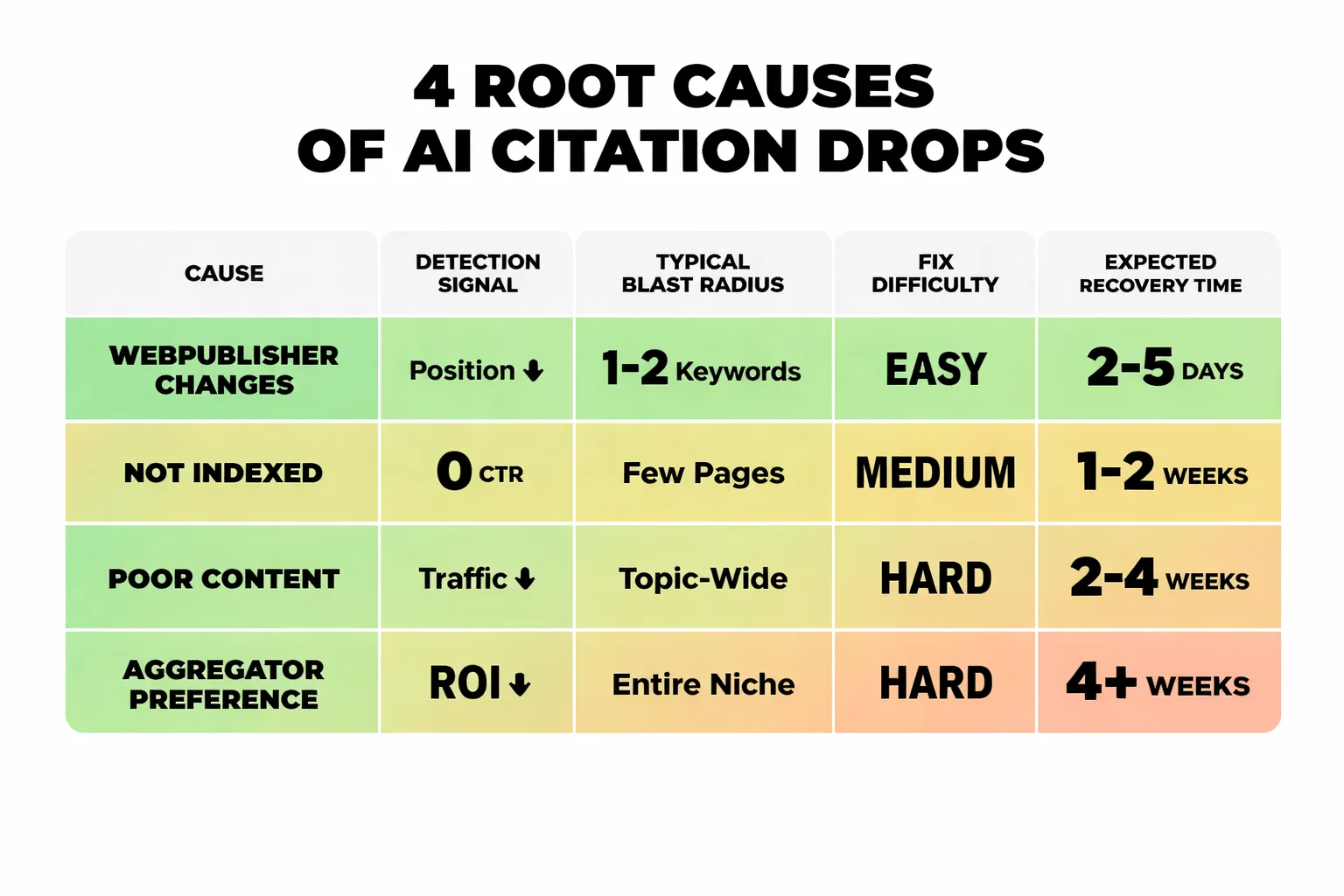
Once you have isolated the cause, the fix should be immediate and targeted. Here is what works for each root cause, with realistic timelines for citation recovery.
Fix 1: Content Refresh (For Competitor Displacement)
If a competitor published a stronger source, your fix is a content refresh. But do not just add more words. Match the specific signals that made the competitor's page stronger. If they have fresher data, update your data. If they have more outbound citations to authoritative sources, add relevant citations to high-authority domains. If they have structured data and you do not, implement schema markup.
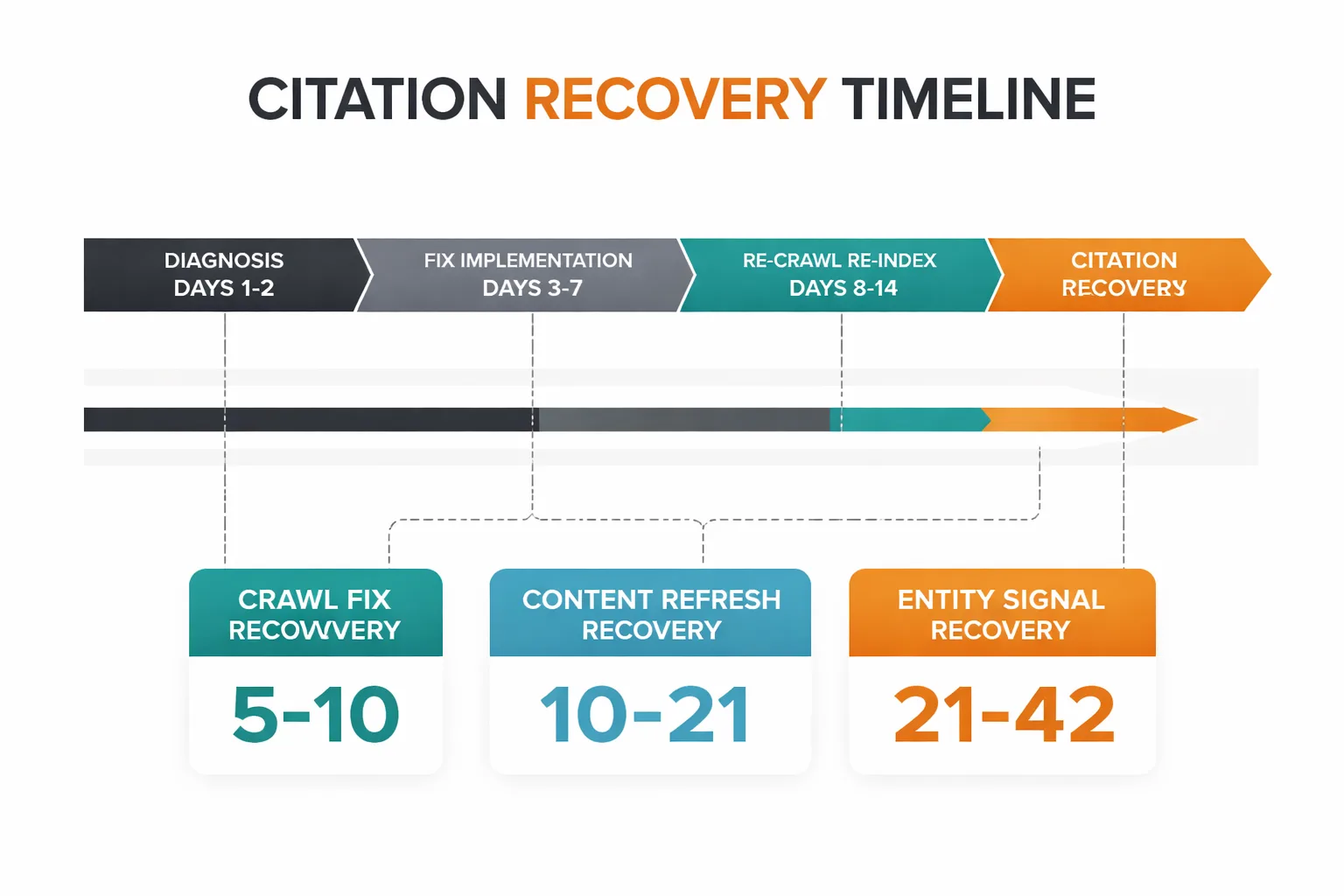
The refresh should target the exact prompt where you lost the citation. Rewrite the answer section to be more direct and extractable. Add a FAQ section that addresses related questions the AI engine might retrieve. Ensure your page cites primary sources, not aggregators. In my testing, content refreshes that add fresh data and authoritative outbound citations recover citations within 10 to 14 days for Perplexity and 2 to 4 weeks for ChatGPT. Google AI Overviews respond fastest, often within 5 to 7 days.
The key insight: AI engines weight recency heavily. If your page was published a year ago and your competitor's was published last month, the competitor wins on recency alone. Add a visible "last updated" date. Update the data points. Add a new section with current information. These signals tell the retrieval pipeline your content is fresh.
Let me be specific about what a strong content refresh looks like. Start by updating every data point on the page with the most current available statistic, and cite the primary source for each. Add a new section that addresses a recent development in your topic area (this signals ongoing editorial maintenance). Rewrite your H2 headings to match natural-language questions that users type into AI engines. Add a comparison table if you do not have one, or update your existing table with current data. Implement FAQ schema markup with three to five question-answer pairs that directly address common AI prompts. Each of these changes targets a specific retrieval signal that AI engines weight.
Fix 2: Structured Data and Crawl Access Repair (For Indexing Issues)
If crawl logs show blocked access, the fix is straightforward but requires precision. Update your robots.txt to explicitly allow AI engine bots. Verify that GPTBot, ClaudeBot, PerplexityBot, and Google-Extended are not disallowed. Fix any canonical tag issues. Resolve 4xx and 5xx errors on key pages. If JavaScript rendering is hiding content, implement server-side rendering or pre-rendering for critical pages.
For structured data, validate your schema markup using Google's Rich Results Test. Ensure your Article, FAQ, and Organization schema are error-free. If your schema broke after a CMS update, fix it immediately and submit your updated sitemap to Google Search Console. Use IndexNow to ping search engines about the update.
Timeline: crawl access fixes are the fastest to recover from. Once bots can access your pages again, citations typically return within 5 to 10 days. The AI engines need to re-crawl, re-index, and re-process your content into their retrieval pipelines. Structured data fixes take slightly longer, usually 7 to 14 days, because the engines need to parse and integrate the updated entity information.
A specific note on robots.txt for AI crawlers. The default robots.txt that many CMS platforms generate does not include AI bot directives. This means AI crawlers are allowed by default. But if you or your developer added AI bot blocks (common in 2024 and 2025 when many sites were blocking GPTBot over content licensing concerns), those blocks may still be in place even if you forgot about them. Check your robots.txt file directly. Look for lines like Disallow: / under User-agent: GPTBot or User-agent: ClaudeBot. If you find them and want AI citations, remove them.
Fix 3: Entity Grounding Update (For Signal Degradation)
This is the fix that requires the most patience and the most cross-platform coordination. Start by auditing your entity presence across the web. Check your Wikidata entry for accuracy and completeness. Ensure your official URL, industry classification, and key properties are present and correct. If your Wikipedia page was redirected or flagged, address the notability concern with proper sourcing.
Update your schema markup to reinforce entity consistency. Ensure your Organization schema matches your Wikidata entry. Verify that your NAP information is consistent across your website, Google Business Profile, and major data aggregators. Inconsistencies confuse entity resolution pipelines.
Build external entity signals by getting mentioned on authoritative third-party sites. This is where generative engine optimization diverges from traditional SEO. You are not building backlinks for PageRank. You are building entity mentions for AI engine confidence. A mention on an authoritative industry publication strengthens your entity more than a low-quality directory link.
Timeline: entity signal recovery is the slowest. Expect 3 to 6 weeks for AI engines to re-process updated entity data. Wikidata edits can take days to propagate. Schema markup changes take 1 to 2 weeks to be parsed. External mentions need to be crawled and integrated into the entity graph. This is a marathon, not a sprint.
Here is the entity grounding checklist I run through for every brand I audit. First, search for your brand on Wikidata. If an entry exists, verify every property: official website, industry, headquarters location, founding date, CEO, and parent company. Each property should have a secondary source (not your own website). If a property lacks a source, find one and add it. If no Wikidata entry exists, create one with proper sourcing. Second, check Wikipedia. If you have a page, monitor it weekly for edits. If you do not have a page, do not force one (Wikipedia notability standards are strict and forcing a page can backfire). Third, validate your Organization schema using Google's Rich Results Test. Ensure the schema includes your official name, URL, logo, and sameAs links to your Wikidata entry and social profiles. Fourth, search for your brand name across the web and identify any inconsistent business information (wrong address, wrong industry classification, outdated CEO name). Correct inconsistencies at the source.
Fix 4: Adapt to Engine Updates (For Citation Weighting Changes)
If the cause is an engine-level update, you cannot "fix" the update. You can only adapt. Look at what the updated engine now prefers. Did it shift to favoring more recent sources? Did it change how it formats citations? Did it start prioritizing certain types of structured data?
Run a set of test prompts across the affected engine and analyze the citation patterns. Compare the sources being cited now versus before the update. Look for structural patterns: are the cited pages shorter or longer? Do they use more or less structured data? Are they from different types of domains (publishers versus brand sites)?
Adapt your content to match the new patterns. This is not about chasing every algorithm shift. It is about aligning your content structure with the retrieval pipeline's current preferences. The brands that recover fastest from engine updates are the ones that monitor citation patterns weekly and adapt within days, not months.
A practical adaptation strategy. When you detect an engine update (confirmed by systemic citation shifts across multiple brands in your topic), run 10 test prompts related to your category on the affected engine. Record every cited source for each prompt. Look for patterns in the cited sources: domain type (publisher, brand site, review site, government, academic), content format (listicle, how-to, explainer, comparison), structured data presence, and content recency. If you detect a clear pattern shift (for example, the engine now prefers review sites over brand sites for comparison prompts), adapt your strategy. If you cannot get cited directly, invest in getting mentioned on the sites that are being cited. This is where citation path outreach becomes valuable: find the publishers AI engines cite for your topics and get your brand mentioned on those pages.
How to Set Up Alerts So You Catch Drops Before They Compound
The worst time to diagnose a citation drop is three months after it happened. By then, the competitor has solidified their position, the entity signals have fully degraded, and the engine update has become the new baseline. You need to catch drops within days, not months.
Build a Prompt Coverage Threshold
Identify the 20 to 50 prompts that matter most to your business. These are the prompts where your brand should be cited: product category queries, comparison queries, problem-solution queries, and brand-adjacent queries. Track citation presence across every major AI search surface for these prompts on a weekly basis.
Set a citation rate threshold. If your brand is cited in 70% of your target prompts and that drops below 60%, trigger an alert. The threshold should be based on your historical baseline, not an arbitrary target. If your baseline is 40% citation rate, a drop to 30% is significant. If your baseline is 90%, a drop to 80% is significant.
The AI visibility tracker handles this monitoring automatically, with daily refresh on SERP-driven surfaces and rolling refresh on LLM-driven surfaces. You define the prompts, set the thresholds, and get notified when citation rates deviate from baseline. This is the difference between catching a drop on day 2 and catching it on day 60.
Here is how to select your 20 to 50 tracking prompts. Break them into four categories. First, brand-name prompts (5-10 prompts): prompts that include your brand name directly. These should have near-100% citation rates. A drop here signals a severe problem (crawl block, entity deletion, or major engine change). Second, category prompts (10-20 prompts): prompts about your product category without your brand name ("best CRM for small business," "top project management tools"). These are where competitive displacement happens. Third, problem-solution prompts (5-10 prompts): prompts about problems your product solves ("how to track remote team productivity"). These capture informational citations. Fourth, comparison prompts (5-10 prompts): prompts comparing you to competitors ("[your brand] vs [competitor]"). These are high-intent prompts where citation presence directly impacts purchase decisions.
Set Up Citation Rate Alerts
Citation rate alerts should trigger on three conditions. First, a sudden drop across all surfaces (likely crawl or entity issue). Second, a sudden drop on a single surface (likely engine update). Third, a gradual decline over 2 to 3 weeks (likely competitor displacement or slow entity degradation).
Each alert type demands a different response. A sudden cross-surface drop means check crawl logs immediately. A single-surface drop means check for engine updates and competitor gains on that surface. A gradual decline means run the full diagnostic sequence, because gradual declines are the hardest to attribute to a single cause.
For the sudden cross-surface alert, the first check is always crawl logs. I have a rule: if all surfaces drop simultaneously, check robots.txt and crawl logs before checking anything else. This is because crawl issues are the fastest to diagnose and the fastest to fix. If you check competitors first and spend two days analyzing their content, only to discover on day three that your robots.txt was blocking GPTBot, you have wasted two days. Always rule out crawl access first for cross-surface drops.
Run Weekly Surface-Level Reviews
Automated alerts catch sudden drops. Weekly reviews catch slow declines and emerging patterns that alerts miss. Spend 30 minutes every week reviewing your citation data across all surfaces. Look for trends: is your citation position shifting from first to last in answer lists? Are new competitors appearing in citations? Are certain topics losing citations while others gain?
This weekly review is also when you check competitor activity. Run your top prompts manually in ChatGPT, Perplexity, and Google AI Overviews. Note who is being cited and how the answers are structured. This qualitative check catches things that automated tracking misses: changes in answer format, new citation styles, shifts in which types of sources are preferred.
I will be blunt: if you are not reviewing your AI visibility weekly, you are flying blind. The brands that maintain strong citation rates are the ones that treat AI visibility as an ongoing operational discipline, not a quarterly check-in. The Gushwork data showing that 20% of AI search traffic drives 40% of high-intent conversions means every week of lost citations is a measurable pipeline loss. You would not let your Google rankings drop for a month without investigating. Treat AI citations with the same urgency.
The weekly review should also include a position check, not just a presence check. Being cited is not binary. Where you appear in the AI answer matters. If you were previously cited first in a list of five sources and you are now cited fifth, your citation rate has not changed but your visibility has degraded significantly. AI engines present earlier citations more prominently, and users are more likely to click or remember the first one or two sources. Track citation position weekly and treat a position drop of two or more slots as an alert trigger, even if presence is stable.
Which of your target prompts lost citations this week?
Why Traditional SEO Tools Miss Citation Drops
This is the contrarian take that needs to be said clearly. Traditional SEO tools cannot detect AI citation drops. Google Search Console tells you nothing about whether ChatGPT is citing your pages. Rank trackers tell you your Google position, not your Perplexity position. Analytics platforms tell you traffic came from "organic search," not whether it came from an AI answer or a traditional blue link. If you are relying on traditional SEO tools to monitor your AI visibility, you have a blind spot the size of your entire AI citation footprint.
The tools I see teams using for AI visibility fall into two categories: proprietary scoring tools that report opaque "visibility scores" with no underlying mechanism, and direct citation tracking tools that show you the actual AI responses and whether your brand appears in them. I am deeply skeptical of the first category. A tool that reports your "AI Visibility Score is 47" without showing you the prompts, the responses, or the citations is not giving you actionable data. It is giving you a number to feel anxious about. You cannot diagnose a drop from a score. You can only diagnose a drop from the actual citation data: which prompts, which surfaces, which sources replaced you.
This is why I built my diagnostic process around direct citation tracking rather than proprietary scores. When a drop happens, I need to see the actual AI responses. I need to read what ChatGPT said last week versus this week. I need to see which source replaced mine. Proprietary scores obscure exactly the information you need to diagnose and fix the problem.
How Does Answer Engine Optimization Prevent Citation Drops?
Answer engine optimization (AEO) is the practice of structuring content so AI engines can retrieve, understand, and cite it. It is not the same as traditional SEO, which targets Google's ranking algorithm. AEO targets the retrieval pipelines that power ChatGPT, Perplexity, Google AI Overviews, and other AI search surfaces.
The core principle of AEO is extractability. AI engines extract information from pages. They prefer content that is structured in direct answer formats, uses question-shaped headings, includes structured data markup, and cites authoritative sources. Pages optimized for AEO are easier for AI engines to parse, understand, and cite. Pages that are not optimized for AEO may rank well on Google but get ignored by AI engines because the content is not structured for extraction.
AEO does not prevent citation drops entirely. No strategy can prevent competitor displacement or engine updates. What AEO does is reduce the frequency and severity of drops by ensuring your content is maximally competitive in the retrieval race. When a competitor publishes a stronger source, AEO-optimized content is harder to displace because it already has the structural signals AI engines prefer. When an engine updates its weighting, AEO-optimized content is more likely to align with the new preferences because it already uses the structures engines prefer (question headings, FAQ schema, primary source citations).
The relationship between AEO and citation stability is not linear. It is threshold-based. Content that meets a minimum AEO threshold (direct answers under question headings, valid structured data, primary source citations, fresh data) is competitive in the retrieval race. Content that falls below that threshold is not competitive and will be displaced quickly. The goal of AEO is not to be the best page on the internet. It is to be above the threshold so your content is in the retrieval race.
What This Actually Means for Your Team
A citation drop is a diagnostic problem, not a content problem. Stop rewriting articles every time your visibility dips. Start running the four-cause triage: competitor displacement, crawl access, entity degradation, engine update. Isolate the variable before you act.
The teams that recover fastest are the ones that monitor weekly, diagnose in 48 hours, and fix the specific root cause rather than throwing content at the wall. The teams that recover slowest are the ones that notice the drop three months late, panic, and publish ten new articles hoping something sticks.
Your ai citations are a pipeline asset. Treat them like one. Monitor them, diagnose drops methodically, and fix the root cause fast. Every day you wait is a day your competitors solidify their position in the answers your customers are reading.
FAQ
Can a single robots.txt change really wipe out all my AI citations?
Yes. If you add Disallow: / under User-agent: GPTBot or block Google-Extended, AI engines that respect crawl directives will stop accessing your content. The drop is immediate and total across all surfaces that respect the directive. I have seen brands lose 100% of their AI citations from a single robots.txt misconfiguration during a site migration. The fix is removing the block, but recovery takes 5 to 10 days as bots re-crawl and re-process your content.
How long does it take for a content refresh to restore citations?
Content refreshes that add fresh data and authoritative outbound citations typically recover citations within 10 to 14 days for Perplexity, 2 to 4 weeks for ChatGPT, and 5 to 7 days for Google AI Overviews. The timeline depends on how frequently the AI engine re-crawls your pages and how significant the refresh is. A minor edit (fixing a typo) will not trigger re-evaluation. A substantive refresh (new data, new sections, updated FAQ) signals to the retrieval pipeline that the content is fresh and worth re-evaluating.
What is the difference between AI visibility and AI citation rate?
AI visibility measures whether your brand appears in AI answers at all. AI citation rate measures how often your brand is specifically cited as a source (with a link or attribution). You can have high visibility (your brand is mentioned) but low citation rate (your pages are not cited as sources). Both matter, but citation rate is a stronger signal of content authority because it means the AI engine chose your page as a source to back its answer.
Should I track AI citations daily or weekly?
Weekly is the right cadence for most teams. Daily tracking is noisy because AI responses are non-deterministic (the same prompt can produce different citations on different days). Weekly tracking smooths out the noise and reveals actual trends. The exception is if you have a high-velocity content operation (publishing multiple articles per week) or if you recently fixed a crawl issue and want to monitor recovery in real time. For those cases, daily tracking on SERP-driven surfaces (Google AI Overviews) is useful because those surfaces refresh faster than LLM-driven surfaces.
How do I know if my entity signals are strong enough for AI citations?
Check three things. First, does your brand have a Wikidata entry with properly sourced properties (official URL, industry, founding date)? Second, does your Organization schema markup validate error-free in Google's Rich Results Test and include sameAs links to your Wikidata entry? Third, does a search for your brand name across the web return consistent business information (same industry classification, same headquarters, same leadership)? If all three check out, your entity signals are likely strong enough. If any of the three are missing or inconsistent, that is a gap that could weaken your AI citation position.
About the Author
Judy Zhou, Founder
Judy Zhou leads content strategy at Meev, where she oversees AI-driven content research and publishing for hundreds of brands. With a background in SEO and editorial operations, she focuses on building content systems that rank on Google, get cited by AI search engines, and drive measurable business results.
Run a full AI visibility audit across every major AI search surface and get a citation drop diagnosis within 48 hours.