

By Judy Zhou, Founder
Key Takeaways
- 76.95% of cited URLs in AI answers fall outside the organic top 10, so rank tracking reveals almost nothing about your brand's visibility in LLMs.
- Wikipedia alone drives 12-15% of ChatGPT citations, requiring brands to monitor external sources that dominate AI recommendations.
- 50-90% of LLM citations fail to fully support the claims they reference, making it essential to audit both presence and accuracy of framing.
- Run manual citation tracking across ChatGPT, Claude, Gemini, Perplexity, and Grok using a spreadsheet before adopting any paid dashboard.
Your brand is being recommended. Or ignored. By AI, and you have no idea which.
LLM citation tracking is the practice of systematically measuring whether AI search engines name, link, and favorably frame your brand when answering buyer questions. In my work leading content strategy at Meev, I've found that 76.95% of cited URLs in AI answers fall outside the organic top 10, which means traditional rank tracking tells you almost nothing about your AI visibility. Wikipedia alone accounts for 12-15% of ChatGPT citations, and 50-90% of LLM citations don't fully support the claims they're attached to. If you're not running structured citation tracking across ChatGPT, Claude, Gemini, Perplexity, and Grok, you're flying blind on the fastest-growing discovery channel.
The conventional wisdom says you need a tool to do this. That's partially true. But most teams skip the fundamentals, jump to a dashboard, and then can't interpret what they're seeing because they never built the manual tracking muscle first. This guide walks through the five steps I use to track AI citations from scratch. You can do steps 1-4 with a spreadsheet and free access to every major LLM. Step 5 is where tools like Meev's AI visibility platform accelerate the process, but only after you understand the underlying mechanics.
Why Citation Tracking Is Different from Rank Tracking
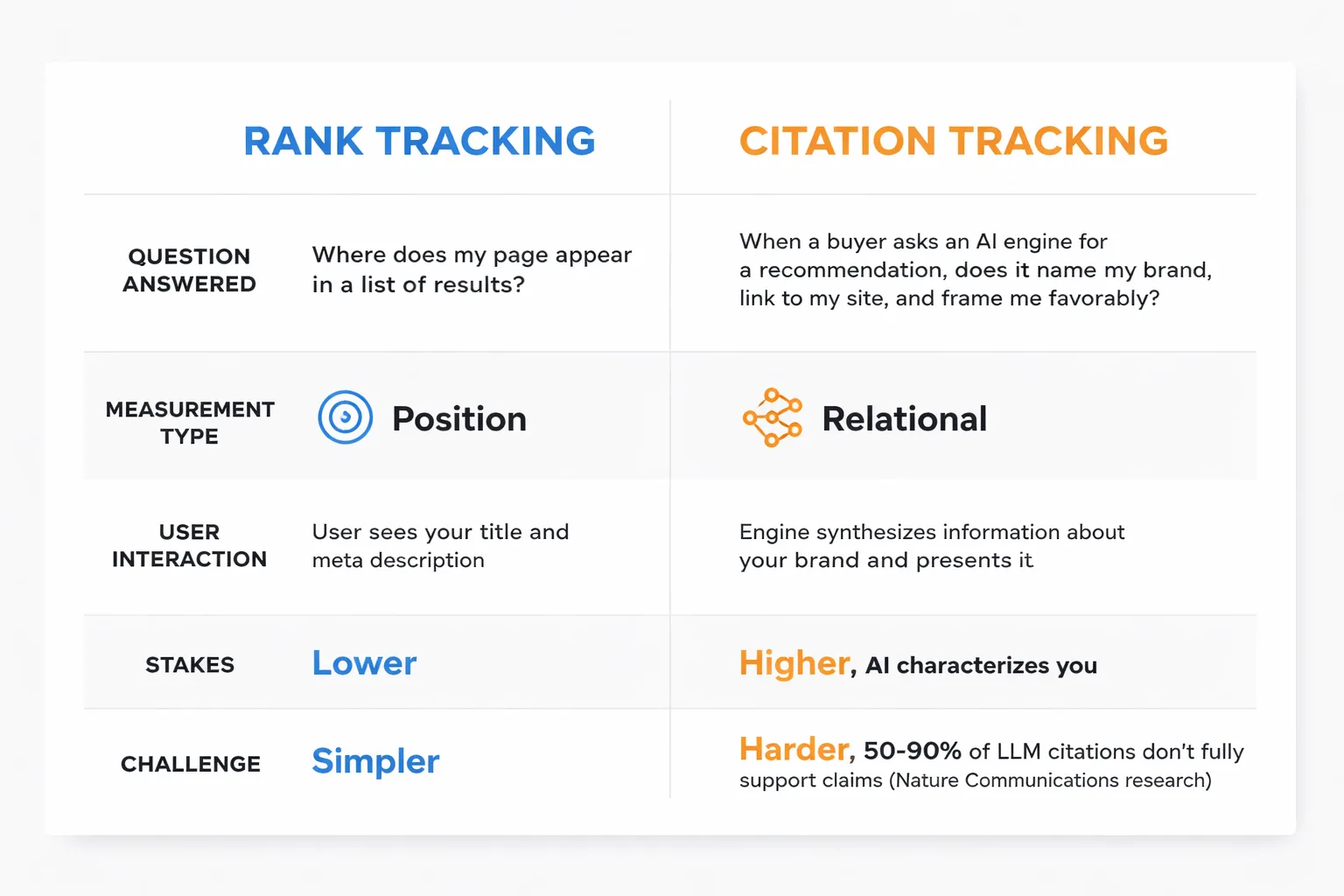
Rank tracking answers a simple question: where does my page appear in a list of results? Citation tracking answers a much harder one: when a buyer asks an AI engine for a recommendation, does it name my brand, link to my site, and frame me favorably?
These are fundamentally different measurements. Rank tracking is positional. Citation tracking is relational. A position 3 ranking on Google means a user sees your title and meta description. A citation in an AI answer means the engine has synthesized information about your brand and chosen to present it as part of its synthesized response. The stakes are higher because the AI doesn't just list you. It characterizes you.
Here's what makes this harder. Research from Nature Communications found that 50-90% of LLM citations don't fully support the claims they're attached to. So even when you ARE cited, the context might be wrong, outdated, or actively harmful to your brand. I've seen cases where a brand gets cited as "a budget option" when they've repositioned as premium. The citation exists. The framing destroys the deal.
That's why ai visibility tracking can't stop at counting mentions. You need to track three things: whether you appear (mention rate), where you appear in the answer (position), and how you're described (framing). Rank tracking gives you one dimension. Citation tracking gives you three, and the third one is the only one that actually matters for B2B buying decisions.
Think about it this way. A Google ranking at position 2 gets you roughly 12-15% of search traffic for that query. You control the title tag, the meta description, the URL. The user clicks through to YOUR site. An AI citation is fundamentally different. The AI reads your content, synthesizes it, and then presents its interpretation directly in the answer. The user may never visit your site at all. They get the AI's summary of who you are. If that summary is wrong, you lose the deal before the buyer ever lands on your page.
What prompts matter for your brand?
Most teams skip this step. They type their brand name into ChatGPT, see if it comes up, and call it citation tracking. That's like checking if your company ranks for its own name on Google and calling it SEO.
Real citation tracking starts with a structured prompt set that mirrors how buyers actually ask questions. Not how you want them to ask. How they actually ask. There are three prompt categories you need to cover.
Navigational prompts test whether the AI knows you exist. These are brand-adjacent: "What is [your brand]?" "Who makes [your product category]?" "What are alternatives to [your competitor]?" If the AI doesn't recognize your brand name in a navigational prompt, you have an entity recognition problem, not a content problem. Your brand isn't in the model's knowledge graph, and no amount of blog posts will fix that without entity grounding work first.
Comparison prompts test how the AI positions you against competitors. "Compare [your brand] vs [competitor]." "What's the difference between [your product] and [competitor product]?" "Which is better for [use case]: [your brand] or [competitor]?" These prompts reveal framing. The AI might mention you but describe you as "simpler" or "more basic" while positioning the competitor as "more advanced." In B2B, that framing is lethal.
Recommendation prompts test whether the AI recommends you unprompted. "What's the best [product category] for [use case]?" "What tools should I consider for [job to be done]?" "Who are the top providers of [service]?" This is where citation tracking gets painful. You might appear in comparison prompts (because you asked about yourself) but never surface in recommendation prompts (because the AI doesn't think of you spontaneously).
Here's a worked example. Say you run a B2B SaaS tool for email automation. Your prompt set would look like this:
- Navigational: "What is [Brand Name]?" / "Who makes email automation software for small businesses?" - Comparison: "[Brand Name] vs Mailchimp" / "Compare [Brand Name] and Klaviyo for B2B email" - Recommendation: "What's the best email automation tool for B2B companies?" / "What email tools should I shortlist for a 50-person SaaS team?"
Aim for 15-25 prompts total. Five to eight per category. Write them down in a spreadsheet with columns for prompt text, category, and the date you last tested it. This prompt set becomes the foundation for everything that follows. If your prompts are weak, your tracking data is worthless.
One more thing on prompt construction. Pay attention to specificity. "What's the best CRM?" is a weak prompt because it's too broad and the AI will default to naming the biggest brands. "What's the best CRM for a 20-person nonprofit with limited technical resources?" is much better because it narrows the context and reveals whether the AI associates your brand with specific use cases. The more specific your prompts, the more diagnostic your citation data becomes. You're not trying to recreate every possible buyer question. You're trying to capture the 20 questions that actually matter to your sales cycle.
Step 2. Run Prompts Across ChatGPT, Claude, Gemini, Perplexity, and Grok
This is where most teams burn out. Running 20 prompts across 5 AI engines feels like 100 individual tests. It is. But you need that volume because LLM responses are non-deterministic. Ask the same question twice and you might get different answers.
Here's how to do it systematically without losing your mind.
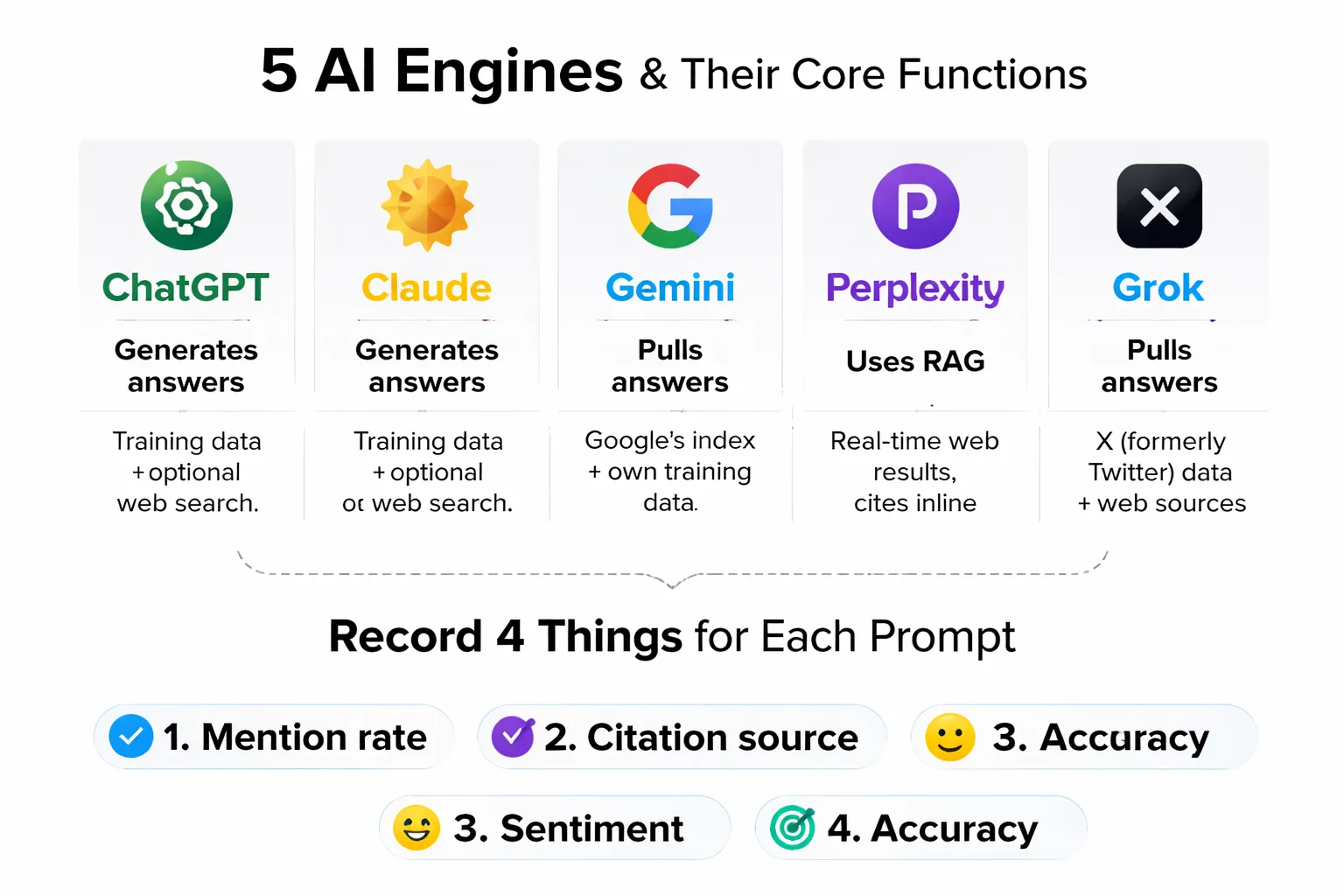
First, understand what each engine actually does. ChatGPT and Claude generate answers from training data with optional web search. Gemini pulls from Google's index and its own training data. Perplexity uses RAG (retrieval-augmented generation) to pull real-time web results and cite them inline. Grok pulls from X (formerly Twitter) data plus web sources. These different architectures mean your citation profile will look completely different across engines. You might be cited heavily on Perplexity (which links to web sources) and invisible on Claude (which synthesizes from training data).
For each prompt, you need to record four things:
1. Mention rate: Did your brand appear at all? (Yes/No) 2. Position: Where in the answer did you appear? (First mention, in a list, last, not mentioned) 3. Citation source: If the AI linked to a source, what URL did it link to? (Your site, a third-party review site, a competitor's site, Wikipedia) 4. Framing: How did the AI describe you? (Quote the exact text)
Run each prompt at least twice per engine. Three times is better. LLMs vary their responses, and a single run gives you a false positive or false negative rate that's unreliable. If your brand appears in 1 of 3 runs, your citation rate for that prompt is 33%, not 100% or 0%.
Use a fresh chat session for each prompt. Don't chain prompts in the same conversation because the context window contaminates results. If you ask "What is [Brand]?" and then ask "What's the best [product category]?" in the same thread, the AI remembers your brand from the first question and might mention it in the second. That's not a real citation. That's context leakage.
Log out of personal accounts where possible. Some engines personalize responses based on your account history. You want the cold-start response that a new buyer would get, not the personalized version that knows you've been researching your own brand.
This is tedious. I won't pretend it isn't. But this manual baseline is what makes any future tool investment worthwhile. When you eventually use a platform like Meev's ChatGPT visibility checker or Perplexity visibility checker, you'll know whether the automated results match reality. If they don't, you'll catch the discrepancy because you built the manual muscle first.
Timing matters more than people think. Run your prompts at the same time of day, on the same day of the week. I've seen citation rates fluctuate based on when model updates roll out, and if you test at random times, you can't tell whether a change is real or just noise from a mid-week model push. Monday mornings between 9 and 11 AM have become my standard window because it's before most platforms push updates and the results feel stable week to week. Document your testing window and stick to it.
Step 3. Identify Which Source Pages the AI Is Actually Citing
This is the step that separates citation tracking from citation understanding. Knowing you're mentioned is one thing. Knowing WHY you're mentioned (or why you're not) requires tracing the sources the AI used to build its answer.
Perplexity makes this easy because it cites sources inline. Each claim links to a URL. You can click through and see exactly what page fed the answer. ChatGPT's web search feature also surfaces sources, though less consistently. Claude and Gemini are harder because they synthesize from training data and don't always show their work.
For engines that do cite sources, build a source inventory. Create a column in your spreadsheet for "cited URL" and "cited domain." After 20 prompts across 5 engines, you'll start seeing patterns. Maybe Perplexity cites G2 review pages for comparison prompts. Maybe ChatGPT pulls from Wikipedia for category definitions. Maybe Gemini references Reddit threads for recommendation prompts.
Those patterns are your content roadmap.
Here's why this matters. 76.95% of cited URLs in AI answers fall outside the organic top 10. That means the pages AI engines cite are NOT the same pages ranking on Google. If you've been optimizing for Google rankings and ignoring broader web presence, you're invisible to AI even if you rank #1. The sources AI trusts are different from the sources Google ranks.
Common source types I see AI engines cite include: G2 and Capterra review pages (for comparison and recommendation prompts), Wikipedia entries (for category and entity definitions), Reddit threads (for authentic user experience and recommendations), industry publications and analyst reports (for authority claims), and company blogs and documentation (for feature and capability claims). When I audit a brand's AI visibility, the first thing I look at is which of these source types are present for their category. If the AI cites G2 for every recommendation prompt and you have no G2 presence, that's your gap. If it cites Wikipedia for category definitions and you have no Wikipedia entry (or a stub), that's your gap.
Wikidata deserves special mention here. It's not a directly cited source in most cases. You won't see "wikidata.org" in a citation link. But Wikidata is the infrastructure layer that helps AI models disambiguate entities. If your brand has a Wikidata entry with a QID (unique identifier), AI engines can more reliably connect your brand name to the correct entity. Without it, you risk being conflated with similarly named companies or simply not recognized as a distinct entity. Volume Nine's analysis signals that Wikidata presence can shape how (or if) you show up in AI-driven search. Treat it as plumbing, not publicity.
The GEO research from Princeton University and the arXiv paper on Generative Engine Optimization both emphasize that citation inclusion in AI answers is heavily influenced by source authority and relevance. But authority in the AI context is different from Google's domain authority. It's about whether the source is structurally positioned as a trusted reference for that specific claim type. G2 is authoritative for feature comparisons. Wikipedia is authoritative for entity definitions. Reddit is authoritative for user sentiment. You need presence on the right source type for the right prompt category.
Let me give you a concrete example of how this source tracing changes your strategy. I was looking at a B2B project management tool that ranked position 1-3 on Google for "project management software" but was completely absent from ChatGPT and Claude recommendation prompts. When I traced the sources those engines cited, the pattern was clear: both pulled heavily from G2 comparison pages and a specific Reddit thread titled "best project management tools for 2026." The brand had no G2 presence (they'd never claimed their profile) and zero mentions in that Reddit thread. Their Google rankings were irrelevant to the AI's citation decision. The fix wasn't more blog content. The fix was claiming their G2 profile, getting reviews flowing, and participating in the Reddit conversation where buyers were actually asking for recommendations. Within six weeks of closing those two source gaps, they started appearing in ChatGPT recommendation prompts for the first time.
Do you know which AI engines are citing your competitors instead of you?
Step 4. Set a Baseline and Build a Weekly Reporting Cadence
You've run your prompts. You've logged your sources. Now you need to turn that raw data into a tracking system that doesn't require a full-time analyst to maintain.
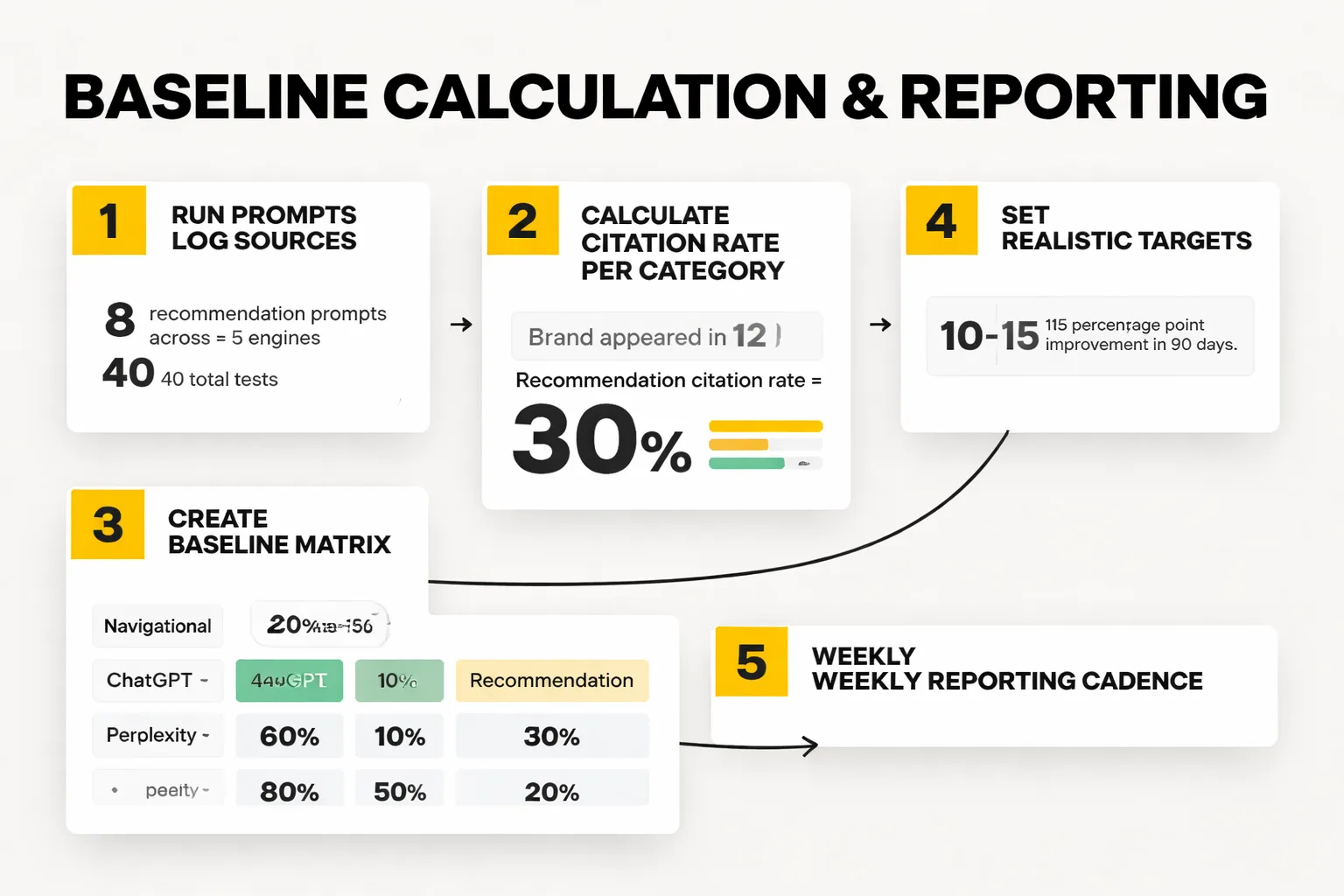
Your baseline is simple. For each prompt category (navigational, comparison, recommendation), calculate your citation rate: what percentage of prompts in that category mentioned your brand? If you ran 8 recommendation prompts across 5 engines (40 total tests) and your brand appeared in 12, your recommendation citation rate is 30%.
Do this for each category and each engine. You'll end up with a matrix that looks something like: ChatGPT navigational 60%, comparison 40%, recommendation 10%. Perplexity navigational 80%, comparison 50%, recommendation 20%. And so on. That matrix is your baseline. Every improvement target should be measured against it.
Set realistic targets. A 10-15 percentage point improvement in 90 days is aggressive but achievable if you're starting from a low baseline. If you're at 10% recommendation citation rate, getting to 25% in a quarter is a meaningful win. Trying to get to 80% is fantasy.
Your weekly report doesn't need to be fancy. A Google Sheet with five columns: date, prompt, engine, mentioned (Y/N), framing notes. Add a summary row at the top that calculates your rolling citation rate by category. Update it weekly. The whole thing takes 30-45 minutes if you're disciplined about it.
The discipline is in the cadence, not the tooling. I've seen teams build elaborate dashboards in Looker Studio that they update once and then abandon. And I've seen teams track everything in a plain spreadsheet that they religiously update every Monday morning. The spreadsheet team wins every time because they actually have trend data after 12 weeks. The dashboard team has a pretty chart with one data point.
This is also where ai search visibility platforms start to earn their keep. Manual tracking is essential for building understanding. But once you've done it for 4-6 weeks and you know what you're looking at, automating the data collection frees you up to focus on the strategic work: interpreting patterns and closing gaps. The key is to use automation as a scaling layer on top of manual understanding, not as a replacement for it.
One critical addition to your weekly report: track competitor citation rates alongside your own. Add columns for your top two competitors and record whether they appeared in each prompt. This transforms your report from a vanity metric ("we got cited 12 times") into a competitive intelligence tool ("we got cited 12 times, competitor A got cited 28 times, competitor B got cited 19 times"). If your competitor is cited 2.5x more often than you on recommendation prompts, that's a concrete gap to close. Raw citation numbers without competitive context are meaningless. Share of voice in AI answers is the metric that actually matters, and you can't calculate it without tracking competitors.
Step 5. Close the Gap with Targeted Content
Tracking citations without acting on the data is like checking your weight every morning without changing your diet. Interesting. Useless.
Every citation gap maps to a content opportunity. The trick is knowing which type of content actually moves citation rates. In my experience, three content types consistently influence AI citations.
Definition content answers "What is [X]?" prompts. If AI engines don't mention your brand when defining your product category, you need authoritative definition content published on a source the AI trusts. This could be a Wikipedia entry (if you meet notability requirements), a comprehensive glossary page on your own site, or a contributed article on an industry publication. The goal is to make sure that when the AI synthesizes a definition, your brand is part of the corpus it draws from.
Comparison content answers "[X] vs [Y]" prompts. If the AI mentions competitors but not you in comparison prompts, you need comparison content that includes your brand. G2 comparison pages, alternative-to lists, and head-to-head blog posts all feed this. The key is that the comparison needs to exist on sources the AI actually cites. A comparison page on your own blog helps, but a G2 comparison page or an industry publication roundup carries more citation weight.
Process guide content answers "How do I [X]?" prompts. If your category involves a process (how to choose, how to implement, how to migrate), process guides that name your brand as a solution in context can improve recommendation citation rates. These need to be genuinely helpful, not thinly veiled product pitches. AI engines are surprisingly good at distinguishing between content that helps and content that sells.
Here's how to prioritize. Sort your citation gaps by prompt category. Recommendation gaps are the most valuable to close because they represent unprompted discovery. Comparison gaps are second. Navigational gaps are third (if buyers are already searching for you by name, the citation matters less). Within each category, prioritize gaps where competitors are consistently cited and you're absent. Those are the prompts where you're losing deals you don't even know about.
The content you create should be archetype-aware. A listicle works for "top 10 tools" prompts. A how-to guide works for process prompts. An explainer works for definition prompts. Answer engine optimization isn't about creating one type of content. It's about matching content format to prompt intent.
This is where a platform like Meev can scale the process. Once you've identified your top citation gaps through manual tracking, Meev's content engine can research, draft, and publish articles targeted at those specific gaps. The 16-dimension quality firewall ensures the content meets the bar for both Google rankings and AI citation worthiness. And the Citation Path feature identifies which publishers AI engines actually cite for your topics, so you can pitch contributed content to the right outlets instead of guessing.
But the strategy comes first. Tools accelerate execution. They don't replace understanding.
Let's walk through a prioritization example. Say your baseline tracking reveals these gaps: you're absent from 8 of 10 recommendation prompts, absent from 5 of 8 comparison prompts, and absent from 2 of 5 navigational prompts. Your competitor is cited in 7 of those 10 recommendation prompts. Start with the recommendation gaps where the competitor is present. For each gap, identify the source type the AI cited. If the AI cited a G2 list for 4 of those gaps, your first action is claiming and enriching your G2 profile. If it cited a blog post titled "best tools for [use case]," your second action is pitching a guest contribution to that blog or creating a superior version on your own site. If it cited a Reddit thread, your third action is monitoring that thread (set a Google Alert) and participating authentically when relevant. Each gap maps to a specific source, and each source maps to a specific action. That's how you turn tracking data into a content roadmap.
How Do You Correct Inaccurate AI Citations?
This is the question I get most often from founders who start tracking their AI citations. They find the AI saying something wrong about their brand. Maybe it lists an outdated pricing tier. Maybe it describes a feature you discontinued. Maybe it confuses you with a competitor. How do you fix it?
The hard truth is you can't directly edit what an LLM says. These models are trained on vast corpora and you can't submit a correction ticket to ChatGPT the way you can request a Google review takedown. What you can do is change the information environment the model draws from.
For factual errors, the fastest path is updating the sources the AI likely used. If the AI cites a G2 page with outdated pricing, update your G2 profile. If it references a Wikipedia entry with incorrect information, edit the Wikipedia page (with proper citations). If it pulls from your own documentation, update your docs and ensure the corrected version is crawlable.
For framing issues, the fix is harder. If the AI positions you as "basic" or "entry-level," you need to change the corpus of text that describes you. This means getting authoritative sources to describe you in the terms you want. Press coverage, analyst reports, industry publications, and review sites all contribute to how the model understands your brand. One blog post won't change the framing. A sustained presence across multiple authoritative sources will.
Google's guide to optimizing for generative AI features recommends focusing on well-structured, crawlable content with clear factual claims. That's table stakes. The real work is ensuring the facts about your brand across the broader web are accurate, current, and consistently framed.
What Is the Difference Between Explicit and Implicit Citations?
This distinction matters more than most practitioners realize, and it affects how you interpret your tracking data.
An explicit citation is a direct link. The AI answer includes a clickable URL or a named source reference like "According to [domain]..." that you can trace. Perplexity is the most explicit-citation-heavy engine because its RAG architecture is built around surfacing and linking to sources. ChatGPT's web search mode also produces explicit citations when it pulls from live web results. These are the easiest to track because the URL is right there in the response.
An implicit citation is harder to detect. The AI synthesizes information from its training data or from retrieved documents without linking to a specific source. The answer mentions your brand (or doesn't), but there's no clickable link to trace. Claude and Gemini lean heavily on implicit citations because they generate from training data without consistently surfacing source URLs. ChatGPT in its default mode (without web search) also uses implicit citations.
Here's why this distinction changes your tracking methodology. For explicit citations, you can trace the source and fix it directly. You see the URL, you go to that page, you update the content. For implicit citations, you can't trace the source because there isn't one to trace. The model is synthesizing from a vast corpus of training data, and you have no way to know which specific documents fed the answer.
This means your correction strategy differs by engine. For Perplexity, you fix explicit sources (web pages). For Claude, you fix the broader information environment (press coverage, review sites, documentation) and wait for the model to retrain or for RAG to pull updated content. Implicit citations take longer to influence because you're not fixing a single page. You're shifting the weight of evidence across the entire web.
When you track citations, note whether each mention is explicit or implicit. If you're only tracking explicit citations (the easy ones), you're missing the implicit mentions that might be damaging your brand framing on engines like Claude and Gemini. A brand might have zero explicit citations on Claude but be mentioned negatively in implicit synthesis. You'd never know if you only tracked links.
What This Won't Fix
Citation tracking has limits, and pretending otherwise does you no favors.
First, tracking won't help if your brand lacks basic entity recognition. If no authoritative source has ever written about you, no amount of prompt testing will make you appear in AI answers. You need PR, partnerships, and presence on platforms like G2 and Crunchbase before citation tracking reveals anything actionable. Tracking is a diagnostic tool, not a cure for obscurity.
Second, citation tracking can't fix a bad product. If users on Reddit and G2 describe your product as buggy or overpriced, the AI will reflect that sentiment. You'll see it in your framing notes. The fix isn't more content. The fix is fixing the product or changing the audience you're targeting.
Third, manual citation tracking doesn't scale past a certain point. Twenty prompts across five engines is manageable. Two hundred prompts across seven engines with daily tracking requires automation. The manual method is for building understanding and baseline data. Once you have that, invest in tooling.
Frequently Asked Questions
How often should I track my AI citations?
Weekly is the sweet spot for manual tracking. Daily is overkill because LLM training data doesn't change that fast (except for Perplexity, which pulls real-time web results). Monthly is too infrequent because you'll miss shifts caused by content publishes, competitor moves, or model updates. If you're using an automated tool, daily refresh on SERP-driven surfaces and weekly on LLM-driven surfaces is the standard.
Which AI engines should I prioritize for citation tracking?
Start with ChatGPT and Perplexity. ChatGPT has the largest user base and represents the general knowledge baseline. Perplexity is the most citation-transparent, which makes source tracking easier. Add Gemini and Claude next. Grok is worth tracking if your audience is active on X. Don't try to track all five on day one. Start with two, build your process, then expand.
What's a good citation rate to target?
It depends on your category and brand maturity. For established brands in competitive categories, 40-60% citation rate on navigational prompts and 15-25% on recommendation prompts is a reasonable target. For newer brands, even 10% on recommendation prompts is a meaningful start. The absolute number matters less than the trend. If your citation rate is climbing 2-3 percentage points per month, you're heading in the right direction.
Can I pay to get cited by AI engines?
No. AI engines don't have a paid citation placement model (unlike Google Ads). Citations are determined by the model's training data and retrieval systems. The only way to improve citation rates is to improve your presence in the sources those systems draw from. Anyone selling "guaranteed AI citations" is selling snake oil.
How does llm citation tracking differ from generative engine optimization?
Citation tracking is the measurement layer. Generative engine optimization is the strategy and execution layer. You track citations to identify gaps. You do generative engine optimization to close those gaps through content, entity grounding, and source presence. Tracking tells you where you are. GEO is how you move the needle. You need both, but tracking always comes first.
What should I do if my brand is completely absent from AI answers?
Start with entity grounding. Create or expand your Wikidata entry. Ensure your Wikipedia page exists and is accurate (if you meet notability). Build presence on G2, Capterra, or equivalent review platforms. Get listed in industry directories. Publish foundational content on your own site that clearly defines what your brand does. Then run your prompt set again after 4-6 weeks. You should see movement on navigational prompts first, followed by comparison prompts. Recommendation prompts take the longest to influence because they require the model to spontaneously associate your brand with a category.
In my work auditing content operations at Meev, the pattern I see most often is teams jumping to content production before they've done the diagnostic work. They publish articles hoping to get cited without knowing which prompts they're absent from, which sources the AI trusts, or what framing they're fighting against. LLM citation tracking is the diagnostic foundation that makes every downstream content decision smarter. Run the baseline. Understand the gaps. Then create content that closes them.
About the Author
Judy Zhou, Founder
Judy Zhou leads content strategy at Meev, where she oversees AI-driven content research and publishing for hundreds of brands. With a background in SEO and editorial operations, she focuses on building content systems that rank on Google, get cited by AI search engines, and drive measurable business results.
Stop guessing about your AI visibility. Run a full citation audit across every major LLM and get a prioritized action plan to close the gaps.