

Why AI Engines Ignore Your Brand (and How to Fix It Fast)
By Judy Zhou, Founder
Key Takeaways
- Domain Authority correlates with AI citations at just r=0.18, explaining less than 20% of visibility in ChatGPT, Perplexity, or Google AI Overviews.
- Google maintains a database of 54 billion real-world entities, and brands absent from it stay invisible to AI engines regardless of SEO performance.
- Replace extra blog posts with entity grounding in knowledge graphs to fix the root cause of AI brand invisibility.
- Structure content for direct LLM extraction and secure mentions in sources AI engines trust to close the gap between Google rankings and AI citations.
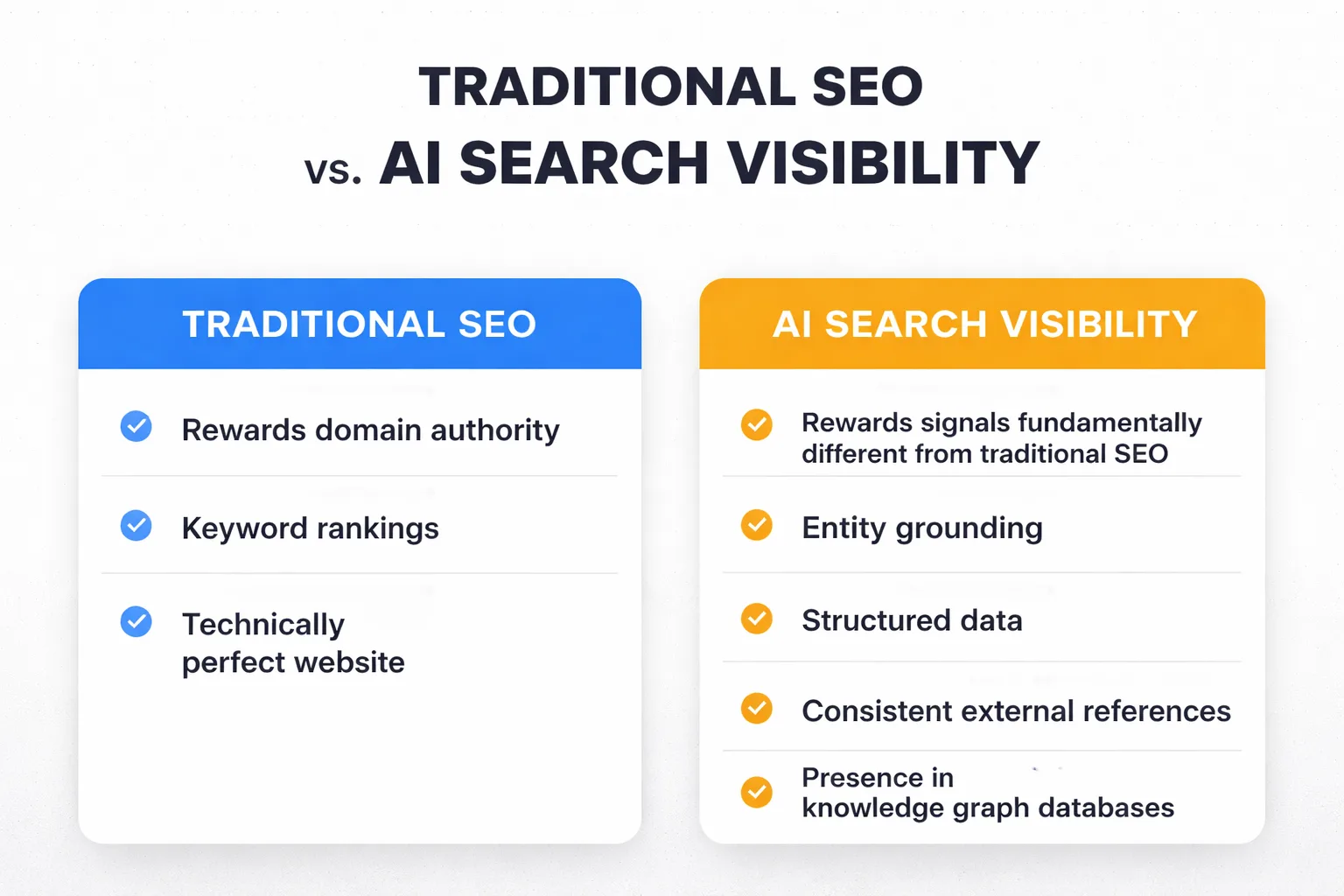
Your SEO score is irrelevant to whether AI engines recommend your brand. Domain authority, keyword rankings, even a technically perfect website. None of it guarantees a single citation inside ChatGPT, Perplexity, or Google's AI Overviews. The signals that large language models use to decide which brands are trustworthy and worth surfacing are fundamentally different from what search engines have rewarded for the past two decades. Optimizing for ai search visibility requires unlearning almost everything that made traditional SEO work.
I see this every week. A founder reaches out, confused. They rank page one for their primary keyword on Google. Their domain authority is solid. Their content is technically clean. Then they type their brand name into ChatGPT and get a competitor recommended instead. Or worse, they get a generic answer that doesn't mention any brand at all. The frustration is real, and it's justified. The Wellows study of Google AI Overviews ranking factors found that Domain Authority has a correlation of just r=0.18 with AI citations, meaning traditional SEO metrics explain less than 20% of why a brand gets cited. That's a staggering gap. It means the other 80% comes from signals most teams aren't tracking, let alone optimizing.
In my work leading content strategy at Meev, where I oversee AI-driven content research and publishing for hundreds of brands, I've become convinced that the gap between Google rankings and AI citations comes down to four root causes. Google has built a database of 54 billion real-world entities, and if your brand isn't recognized as one of them, you're invisible to AI engines no matter how good your content is. The fix isn't more blog posts. It's structural.
The Real Reason AI Engines Skip Your Brand
Here's the pattern I keep seeing. A company invests heavily in content. They publish weekly. They've got clean schema markup on their pages. Their backlink profile looks respectable. But when you run their brand through any AI visibility tool, the results are grim. ChatGPT doesn't mention them. Perplexity cites a competitor. Google's AI Overviews give a generic answer with no brand attribution.
The problem isn't content quality. The problem is that the content exists in a format and context that AI engines can't easily extract, verify, or ground to a recognized entity. Let me break this down into the four root causes I see repeatedly.
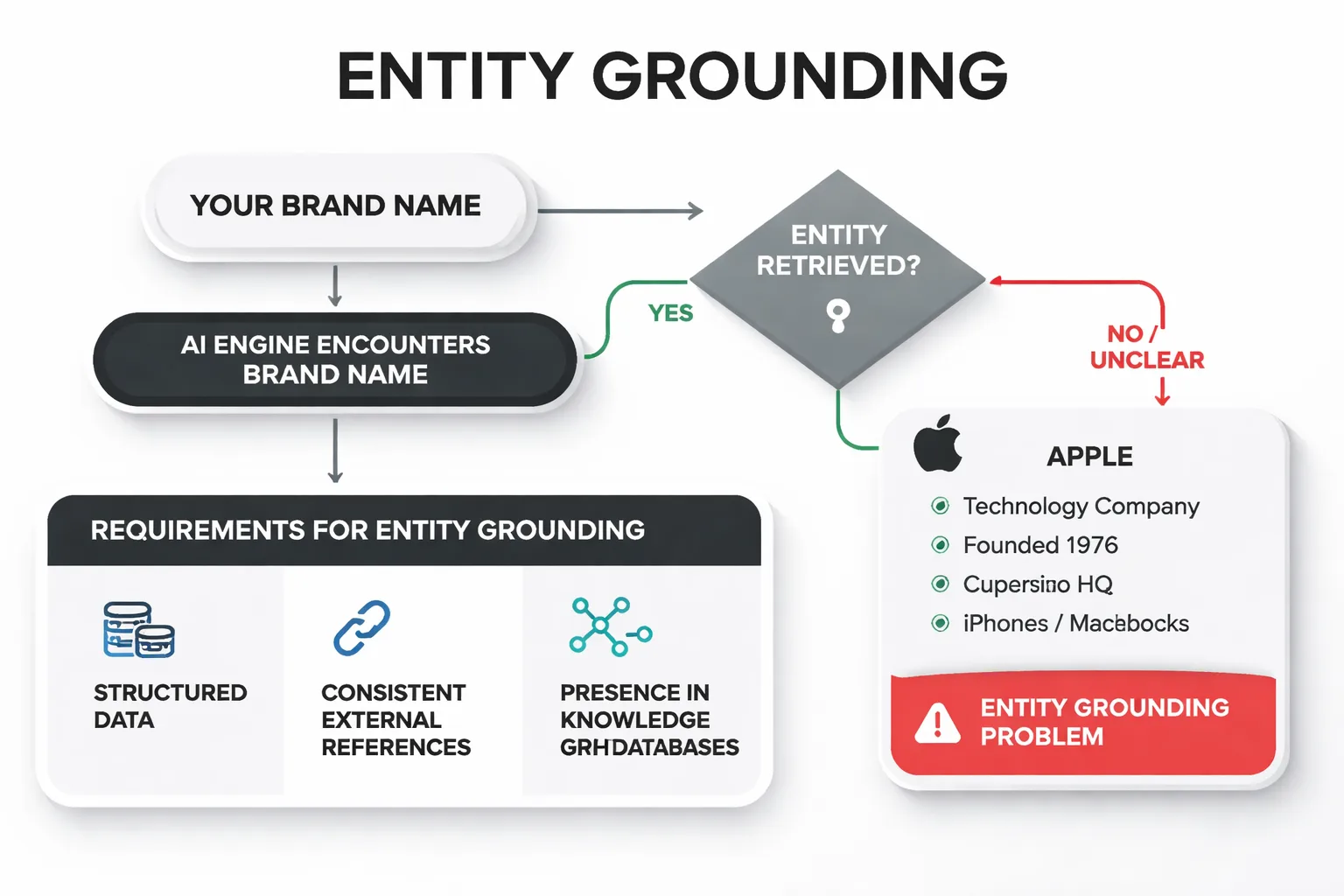
Root cause one: no entity grounding. This is the biggest one. Entity grounding means an AI engine can confidently identify your brand as a specific, real-world entity with defined attributes. Who you are, what you do, who you serve. If you're not in the knowledge graph databases that LLMs train on and retrieve from, you're a string of text, not an entity. Strings get paraphrased or dropped. Entities get cited. As Search Engine Land put it, entity authority is now the foundation of AI search visibility. The webpage has been replaced by the entity as the atomic unit of retrieval.
Root cause two: content not structured for extraction. LLMs don't read pages the way humans do. They chunk content, extract claims, and look for verifiable facts they can attribute. If your content is narrative-heavy with no statistics, no clear data points, and no quotable sentences, AI engines have nothing to grab onto. The Princeton/Georgia Tech GEO study found that adding statistics to content produced a 41% increase in AI citation visibility. That's not a marginal gain. That's the difference between being cited and being ignored.
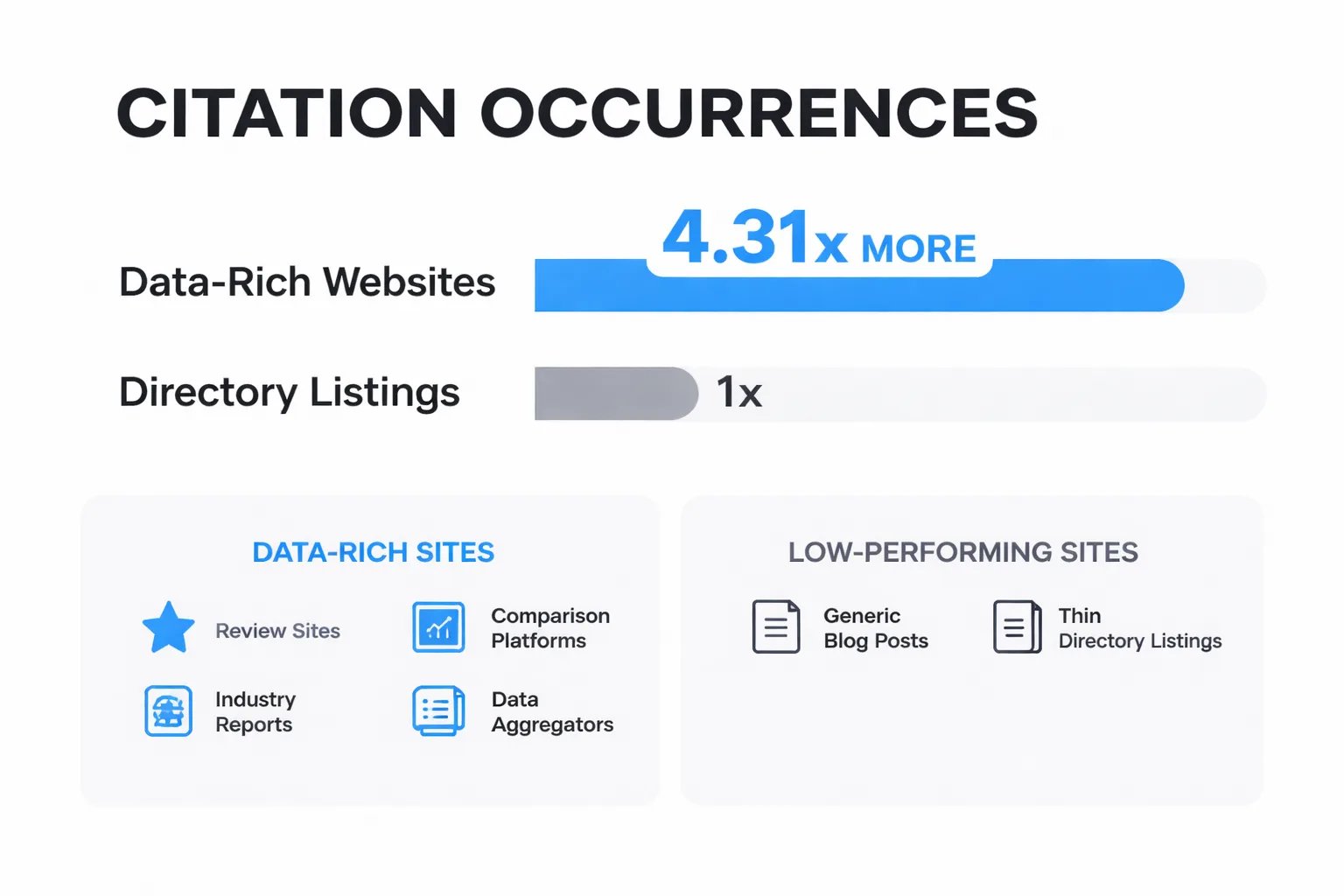
Root cause three: no presence on sources AI engines trust. AI engines don't just generate answers from vacuum. They retrieve from a set of sources they've learned to trust for specific topics. If those sources don't mention your brand, you can't be cited. Yext's AI Citation Refresh research found that data-rich websites receive 4.31x more citation occurrences than directory listings. The sources AI engines prefer are data-rich, authoritative, and structurally clear. If your brand exists only on your own blog and a few social profiles, you're not where AI engines look.
Root cause four: low citation rate on foundational prompts. This one is subtle but critical. Foundational prompts are the basic queries a user types into an AI engine when researching your category. Things like "best CRM for startups" or "top project management tools." If your brand isn't cited on these foundational prompts, AI engines have no baseline reference point for you. Every subsequent query builds on prior context. If you're absent from the foundation, you're absent from the entire conversation. This is where llm citation tracking becomes essential. You need to know which foundational prompts mention competitors and which ones mention you.
These four causes compound. No entity grounding means AI engines don't know who you are. Unstructured content means they can't extract your claims. No presence on trusted sources means they have nowhere to find you. And no baseline citations means you never enter the conversation. It's a vicious cycle, but it's also a fixable one.
Symptom 1. You Rank on Google but AI Never Mentions You
This is the most common symptom I encounter. A brand ranks well on Google for commercially valuable keywords. Their organic traffic is steady. But when they check their ai search visibility across ChatGPT, Claude, Gemini, Perplexity, and Google AI Overviews, they're nowhere.
The disconnect happens because Google and AI engines evaluate content through completely different retrieval mechanisms. Google indexes pages. AI engines retrieve claims. Google ranks based on relevance, authority, and link signals at the page level. AI engines synthesize answers based on entity recognition, source credibility, and extractability at the claim level.
I've seen this firsthand. Pages that rank well on Google often have long, narrative paragraphs that read beautifully for humans but offer nothing for LLM extraction. No statistics. No quotable definitions. No structured data. The Princeton/Georgia Tech research on generative engine optimization showed that specific optimization techniques like adding quotations and statistics significantly increased AI citation rates. The content that ranks on Google isn't always the content that gets cited by AI.
This is where the shift from traditional SEO to answer engine optimization becomes urgent. You're not optimizing for a ranking algorithm. You're optimizing for a retrieval and synthesis system that decides which claims to include in a generated answer. The mechanics are different. The signals are different. The content structure that wins is different.
The fix starts with auditing your content through an extraction lens. Take your top-performing organic pages. Now read them as if you're an LLM trying to extract a citable claim. Can you find a specific statistic? A clear definition? A quotable sentence with attribution? If not, your content is invisible to AI engines even if it ranks page one on Google.
Let me give you a concrete example of what this looks like in practice. I reviewed a SaaS company's pricing page recently. It ranked page one for "best [category] software." The page had 1,800 words of narrative explaining their philosophy, their team's expertise, their approach to customer success. Beautiful writing. But when I asked ChatGPT to recommend software in that category, the company wasn't mentioned. Why? Because the page contained zero extractable data points. No pricing numbers. No feature comparison table. No customer count. No statistics. The AI had nothing to grab. Meanwhile, a competitor with a lower-ranking page but a clean feature comparison table and pricing data got cited. The competitor's content was extractable. The first company's content was not.
This is the gap that matters. It's not about writing better prose. It's about writing content that an LLM can chunk, parse, and cite. That means every page should contain discrete, self-contained claims that work when extracted from context. "Our platform processes 2.3 million API calls daily with 99.97% uptime." That's a citable claim. "We're committed to providing reliable service." That's not. The difference is specificity, verifiability, and structure.
How Does Entity Grounding Actually Work?
Entity grounding is the process by which an AI engine connects your brand name to a specific, well-defined entity in its knowledge base. Think of it like this. When you say "Apple," the AI doesn't just see a string of five letters. It retrieves an entity with attributes: a technology company, founded in 1976, headquartered in Cupertino, makes iPhones and MacBooks. That entity exists in Google's Knowledge Graph, in Wikidata, and across thousands of authoritative web pages that consistently describe it the same way.
Now think about your brand. When an AI engine encounters your brand name, what entity does it retrieve? If the answer is "nothing" or "unclear," you have an entity grounding problem. The AI might find your name mentioned somewhere, but it can't confidently define what you are, what you do, or why you matter. So it skips you.
Entity grounding requires three things: structured data, consistent external references, and a presence in knowledge graph databases. Siteimprove's analysis of schema and AI search visibility breaks this down well. Schema markup helps AI engines understand what your pages are about, but schema alone isn't enough. Your brand needs to be referenced consistently across multiple authoritative sources. Wikipedia, Wikidata, industry publications, review sites, data aggregators. Each reference reinforces the entity definition.
I've seen practitioners like Neil Patel's team explicitly shift to entity-based work to get clients cited in AI results. As Patel noted on LinkedIn, organic traffic is declining for many brands while AI citations represent a growing opportunity. The teams winning are the ones treating entity grounding as a deliberate strategy, not a byproduct of content publishing.
The practical steps for entity grounding look like this. First, ensure your brand has a Wikidata entry with accurate attributes. Second, implement Organization schema markup on your homepage with all relevant properties. Third, build consistent brand references across authoritative external sources. Fourth, maintain a consistent brand description across your own properties. The goal is for every source that mentions your brand to reinforce the same entity definition.
Let me walk through the Wikidata piece specifically, because it's the one most teams skip. Wikidata is a structured knowledge base that machines read directly. Each entity has a Q-number (a unique identifier), a set of properties (P-numbers), and values. When you create a Wikidata entry for your brand, you're creating a machine-readable definition that LLMs can retrieve during answer synthesis. The entry should include your official name, industry classification, founding date, headquarters location, website URL, and key personnel. If your brand has been covered by reputable publications, those references should be linked as sources within the Wikidata entry. This creates a verified, structured entity definition that AI engines can ground to with confidence.
The disambiguation problem is real and worth understanding. If your brand name is similar to another entity (a common problem for startups with generic names), AI engines may conflate the two. I've seen a fintech startup whose name was similar to a regional bank. Every time someone asked ChatGPT about the startup, the AI retrieved the bank's entity instead. The startup was invisible because it shared a name string with a better-established entity. The fix was aggressive entity disambiguation: creating a Wikidata entry with clear "different from" references, building consistent brand descriptions across 20+ authoritative sources, and using structured data to reinforce the distinction. Within six weeks, the AI engines started retrieving the correct entity.
Why Does Content Structure Determine Whether You Get Cited?
Because LLMs extract claims, not pages. When an AI engine generates an answer, it retrieves relevant claims from its training data and from real-time search results, then synthesizes them into a coherent response. If your content doesn't contain easily extractable claims, it doesn't matter how authoritative you are. The AI can't cite what it can't extract.
The Princeton/Georgia Tech study on GEO optimization tested multiple content optimization strategies and measured their impact on AI citation rates. The results are specific and actionable. Adding statistics increased citation visibility by 41%. Adding quotations improved citation rates significantly. Including clear, definitive answers to questions in the opening of content boosted extractability. These aren't vague recommendations. They're tested techniques with measured outcomes.
Here's what I've observed in practice. Content that gets cited by AI engines tends to share a few structural characteristics. It leads with clear, specific claims. It includes verifiable data points. It uses structured formats like lists, tables, and Q&A blocks. It cites primary sources. And it avoids long, meandering paragraphs that bury the key insight.
The content that doesn't get cited is equally recognizable. It's narrative-heavy. It uses vague language. It makes claims without supporting data. It buries key insights in the middle of long paragraphs. It doesn't cite sources. And it treats every topic with the same generic structure rather than matching format to intent.
This is why answer engine optimization requires a fundamentally different content approach. You're not writing for a human reader who will patiently scroll through 2,000 words. You're writing for a retrieval system that will chunk your content, extract claims, and decide whether those claims are worth including in a synthesized answer. Every paragraph needs to earn its place by containing a citable claim.
Let me break down what a citable claim actually looks like versus a non-citable one. A citable claim is specific, verifiable, and self-contained. "Companies using our platform reduce customer onboarding time by 47% on average, based on data from 1,200 deployments." That claim contains a statistic, a sample size, and a clear outcome. An LLM can extract it, verify it against your source, and include it in a synthesized answer. Compare that to: "Our platform helps companies onboard customers faster." That's a marketing statement. It's not extractable because it contains no verifiable data, no specific claim, and no source attribution. The LLM has nothing to cite.
The structural elements that matter most for extraction are the ones that create natural claim boundaries. Tables force you to organize information into discrete cells, each of which can be extracted as a separate claim. Q&A sections create explicit question-answer pairs that map directly to how users query AI engines. Numbered lists create sequential claims that can be extracted individually. Bold lead sentences at the start of paragraphs create quotable assertions that LLMs can grab without reading the full paragraph. These aren't stylistic choices. They're extraction strategies.
Stop Publishing Content AI Can't Extract
This is where I get blunt. Most brand content is structurally hostile to AI extraction. I see it constantly. Companies invest in long-form blog posts that read like magazine features. Beautiful prose. No statistics. No quotable sentences. No structured data. No clear answers to questions. Then they wonder why AI engines never cite them.
The fix isn't complicated, but it requires discipline. Every piece of content you publish should pass an extraction test. Can an LLM reading this page identify at least three specific, citable claims? If the answer is no, the content needs revision before publication.
I'm not suggesting you abandon long-form content. I'm suggesting you structure it differently. Lead with the answer. Include statistics with sources. Use Q&A formats for key sections. Add structured data markup. Break long paragraphs into shorter, claim-dense units. Make your content easy to extract from, not just easy to read.
Jessica Bowman warned on LinkedIn that producing large amounts of low-quality AI content can actively hurt SEO performance. She's right. The answer isn't more content. It's better-structured content. One well-structured article with three citable claims and supporting data is worth more for AI visibility than ten narrative pieces that say nothing extractable.
This is also why tools that auto-generate content without quality gates are dangerous. If the AI writing tool doesn't enforce extraction-friendly structure, you're publishing content that's invisible to AI engines. The content exists but it can't be cited. At Meev, our 16-dimension quality firewall exists specifically to catch this. Articles that don't meet structural and factual quality thresholds get blocked before they reach your CMS. The quality gate isn't about grammar. It's about extractability.
Let me describe the extraction test I run on every piece of content before it ships. I open the page and scan for three things in the first 200 words: a specific number, a named source, and a bolded claim that answers the page's core question. If all three are present, the content has a fighting chance of being cited. If any are missing, the content goes back for revision. This test takes 30 seconds to run. It catches 80% of extraction problems. The remaining 20% are structural issues deeper in the page: missing alt text on data visualizations, claims buried in image captions, or key statistics presented only in video embeds that LLMs can't parse. Every citable claim should exist in text form, not just in visual or video format.
Are you ranking on Google but invisible in AI answers? See what's blocking your citations.
Which Sources Drive AI Citations for Your Category?
This is the question most teams never ask. They focus on their own content and their own rankings. But AI engines build answers from sources. If you don't know which sources AI engines cite for your category, you can't build a presence on those sources.
The Yext AI Citation Refresh research revealed something I found striking. Data-rich websites receive 4.31x more citation occurrences than directory listings. This tells you something important about how AI engines evaluate sources. They prefer sources that contain structured, verifiable data over sources that are just lists or directories. Review sites, comparison platforms, industry reports, and data aggregators all perform well. Generic blog posts and thin directory listings don't.
In my work auditing content operations, I've started mapping the source landscape for every category. Which domains does ChatGPT cite when users ask about CRM software? Which sources does Perplexity pull from when someone researches project management tools? Which publications appear most frequently in Google AI Overviews for your industry's key queries? This mapping exercise tells you exactly where you need to build a presence.
The practical approach is straightforward. Run a set of category-relevant prompts through every major AI search surface. Catalog every source cited. Identify which sources appear most frequently. Then build a presence on those sources through contributed content, PR, data partnerships, or direct outreach. This is what we call the Citation Path at Meev. Find the publishers AI engines actually cite, get your brand mentioned on those publishers, and watch your citation rate climb.
This is also where llm citation tracking delivers its highest value. You need to know not just whether your brand is cited, but which sources are driving those citations. If a competitor is getting cited because they're mentioned on a specific industry publication, that publication becomes a target for your outreach. The source landscape is your roadmap.
The source landscape varies by category, and understanding the variation is critical. In B2B SaaS, AI engines tend to cite G2, Capterra, and TrustRadius for product comparisons. They cite industry analyst reports from Gartner and Forrester for category definitions. They cite technical documentation and API references for implementation questions. If you're a SaaS brand and you're not present on G2 with detailed product data, you're missing one of the most frequently cited sources in your category. In ecommerce, the landscape shifts to review aggregators, product comparison sites, and structured data feeds. The sources AI engines trust for "best running shoes 2026" are different from the sources they trust for "best CRM for enterprise." You need to map your specific category landscape, not assume it mirrors someone else's.
One pattern I've noticed across categories: AI engines favor sources that publish original data over sources that aggregate others' data. A site that conducts its own survey and publishes the results gets cited more than a site that writes commentary about someone else's survey. This is why original research and data publishing are such powerful ai search engine optimization strategies. When you publish original data, you become a primary source. Primary sources are the highest-trust sources in the AI retrieval hierarchy. They get cited first, cited most, and cited across multiple related queries. If you can publish one piece of original research per quarter, you create a compounding citation asset that outperforms any volume of generic blog content.
The Fast Fix. Building Entity Authority in Weeks
Here's where the conversation shifts from diagnosis to action. You can improve your AI citation rate quickly if you focus on the right signals. Not overnight, but in weeks, not months.
The fast fix has three phases. Phase one is entity definition. Create or update your Wikidata entry. Implement comprehensive Organization schema on your homepage. Ensure your brand's NAP (name, address, phone) information is consistent across every web property. This phase takes days, not weeks, and it establishes the entity foundation that AI engines need.
Phase two is content restructuring. Take your top 10 organic pages and revise them for extractability. Add statistics with source links. Create Q&A sections that directly answer category questions. Break long paragraphs into claim-dense units. Add FAQ schema markup. This phase takes one to two weeks and immediately improves your content's citation potential.
Phase three is source presence building. Identify the top 10 sources AI engines cite for your category. Build a presence on at least three of them through contributed content, expert quotes, or data partnerships. Each mention on a trusted source reinforces your entity definition and creates a new citation pathway for AI engines. This phase takes two to four weeks but compounds over time.
I've seen this three-phase approach work. The key is sequence. Entity definition first, because without it, nothing else sticks. Content restructuring second, because it makes your existing assets extractable. Source presence third, because it expands the surface area AI engines can find you on. Skip any phase and the system breaks.
Let me detail what each phase looks like operationally. In phase one, the entity definition work, you're creating a single source of truth about your brand that machines can read. Start with Wikidata. Search for your brand. If an entry exists, verify every property is accurate. If not, create one. The essential properties are: instance of (P31) set to "business" or "software company," official website (P856), headquarters location (P159), industry (P452), and founded date (P571). Add as many verified properties as you can source. Each property strengthens the entity definition. Next, implement Organization schema on your homepage using JSON-LD. Include name, URL, logo, description, founding date, number of employees, contact information, and same-as links to your Wikidata entry, Wikipedia page (if it exists), and authoritative profiles. This schema tells search engines and LLMs exactly what your entity is and where to verify it.
In phase two, the content restructuring work, the goal is to make every page pass the extraction test I described earlier. Start with your highest-traffic pages because they're the ones AI engines are most likely to encounter during retrieval. For each page, identify the core claim it should be cited for. That claim goes in the first 100 words, bolded, with a specific number and source. Then restructure the body into Q&A format for key subtopics. Add a table for any comparative data. Add FAQ schema markup so the Q&A pairs are machine-readable. This restructuring typically takes 2-3 hours per page for a skilled editor. Ten pages, 20-30 hours of work. That's one week for a single focused writer.
In phase three, the source presence work, you're building citations on the sources that matter. Start by running 20-30 category-relevant prompts through ChatGPT, Perplexity, and Google AI Overviews. Document every source cited. Rank sources by frequency. The top 10 sources are your target list. Now prioritize by accessibility. Which of these sources accept contributed content? Which publish expert roundups? Which have product listing pages you can claim? Build a presence on the three most accessible sources first. A product listing on G2 with detailed specifications. A contributed article on an industry publication. An expert quote in a roundup post. Each placement creates a new citation pathway and reinforces your entity definition across the web.
When Should You Invest in Agentic SEO?
Agentic SEO is the next evolution beyond traditional optimization. It's about proactively influencing how AI agents understand, evaluate, and recommend your brand when they make purchasing recommendations on behalf of users. As AI engines move from answering questions to making decisions, the stakes get higher. An AI agent doesn't just cite your brand. It might recommend your product, compare your pricing, or steer a user toward a competitor based on how it understands your entity.
You should invest in agentic SEO when your customers start using AI agents for purchasing research. If you're in B2B SaaS, that time is now. If you're in ecommerce, it's arriving fast. The AEO vs GEO distinction matters here. AEO is about optimizing your content for answer extraction. GEO is about optimizing for generative engine synthesis. Agentic SEO goes further. It's about ensuring AI agents can accurately retrieve your product specifications, pricing, availability, and competitive positioning when making recommendations.
For ecommerce brands, agentic commerce means AI agents will compare products, evaluate reviews, and make purchase recommendations. If your product data isn't structured, your reviews aren't aggregated on trusted sources, and your specifications aren't machine-readable, you lose. The best GEO tools can help you audit where you stand, but the strategic work is about making your brand agent-ready.
The investment question is really about timing. If you wait until AI agents are the dominant purchasing interface, you're too late. The entity definitions, source presence, and content structure you build now will determine how AI agents represent your brand for years. Building that foundation while it's still early gives you a compounding advantage.
Agentic commerce deserves a closer look because the mechanics are fundamentally different from traditional ecommerce SEO. In traditional ecommerce SEO, you optimize product pages for keyword relevance and build links to rank on Google. In agentic commerce, AI agents retrieve product data from structured feeds, compare specifications across brands, and synthesize recommendations. The agent doesn't read your product page the way a human does. It pulls structured data: price, availability, specifications, ratings, review count. If that data isn't structured and machine-readable, the agent can't include your product in its comparison. You lose the sale before the user ever sees your brand.
The fix for agentic commerce is product data structuring. Ensure every product page has Product schema markup with all properties populated: price, availability, brand, description, SKU, rating, review count. Ensure your product feed is submitted to Google Merchant Center and syndicated across comparison shopping engines. Ensure your product reviews are aggregated on trusted review platforms that AI agents retrieve from. And ensure your product specifications are presented in structured tables, not narrative paragraphs. These changes make your products agent-readable, which is the prerequisite for being included in AI-generated purchase recommendations.
How Do You Measure AI Search Visibility Progress?
You can't fix what you don't measure. This sounds obvious, yet most teams have no systematic way to track their AI citation rate over time. They run a few prompts manually, see whether their brand appears, and call it a day. That's not measurement. That's spot-checking.
Real ai search visibility measurement means tracking your brand's presence across every major AI search surface on a consistent schedule, with documented prompts, and with trend data over time. You need to know four things: how often your brand is mentioned, where in each answer it appears (first, in a list, last), what context surrounds the mention, and which sources are cited alongside it.
The mention position matters more than most teams realize. Being mentioned first in an AI answer is worth dramatically more than being mentioned last. Users read AI answers top to bottom and give more weight to the first recommendation. If your brand is consistently mentioned third or fourth in a list of five, you're getting visibility but not influence. Tracking position over time tells you whether your optimization efforts are moving you up the list or just maintaining your position.
The context surrounding your mention is what I call framing. An AI might mention your brand but frame it negatively: "Brand X is a budget option for small teams, while Brand Y offers more advanced features." That mention counts as visibility, but it's actively steering users toward a competitor. This is why raw mention rate is a misleading metric. You need to track not just whether you're mentioned, but how you're framed. I learned this the hard way in my early work with AI visibility tools. I celebrated a high recommendation rate until I read the actual responses and realized the AI was positioning our brand as a "good starting point" before recommending a more advanced competitor. That's not a win. That's a funnel to our competition.
The fourth metric, source tracking, closes the loop. When you know which sources AI engines cite alongside your brand mention, you know which sources are building your entity authority. You also know which sources are building your competitors' authority. If a competitor is consistently cited alongside mentions from a specific industry publication, that publication is a target for your own source presence building.
What This Actually Means for Your Brand
The teams that win ai search visibility in 2026 won't be the ones with the most content. They'll be the ones with the most grounded entities, the most extractable claims, and the most strategic source presence. The traditional SEO playbook optimized for a ranking algorithm. The new playbook optimizes for a retrieval and synthesis system that evaluates entities, extracts claims, and builds answers from trusted sources.
The Wellows study found that Domain Authority correlates with AI citations at just r=0.18. That means 82% of what determines whether AI engines cite your brand comes from signals most teams aren't measuring. Entity grounding. Content extractability. Source presence. Citation rate on foundational prompts. These are the signals that move the needle, and they require a fundamentally different approach from traditional SEO.
If you're ranking on Google but invisible in AI answers, the problem isn't your content quality. It's your content structure and your entity presence. If you're cited but framed unfavorably, the problem isn't your visibility. It's your narrative control. If you're absent from foundational prompts, the problem isn't your keyword strategy. It's your source landscape.
The fix is structural, not incremental. Define your entity. Restructure your content. Build source presence. Track your citations across every major AI search surface. And do it now, before your competitors build the entity authority that makes them the default answer for every query in your category. Your ai search visibility depends on it.
FAQ
Why does my brand rank on Google but not appear in ChatGPT answers?
Google ranks pages based on relevance, authority, and link signals. ChatGPT synthesizes answers based on entity recognition, claim extraction, and source credibility. If your brand isn't grounded as a recognized entity and your content doesn't contain easily extractable claims, AI engines can't cite you even if you rank well. The Wellows study found Domain Authority correlates with AI citations at just r=0.18, meaning traditional SEO metrics explain less than 20% of AI citation decisions.
How long does it take to improve AI citation visibility?
With focused effort, you can see improvements in two to four weeks. The fastest gains come from entity grounding (creating a Wikidata entry, implementing Organization schema) and content restructuring (adding statistics, Q&A sections, and structured data). The Princeton/Georgia Tech GEO study found that adding statistics alone produced a 41% increase in citation visibility. Source presence building takes longer but compounds over time.
What is the difference between a brand mention and an entity citation in AI search?
A brand mention is when an AI engine includes your brand name in its response. An entity citation is when the AI confidently grounds your brand as a recognized entity with defined attributes and cites a specific source for that information. Entity citations are more valuable because they establish your brand as a trusted authority, not just a name that appeared in the training data. Entity grounding is what transforms a mention into a citation.
Do I need to be on Wikidata to get cited by AI engines?
Wikidata is one of the most important knowledge graph databases for entity grounding, but it's not the only path. Google's Knowledge Graph, consistent brand references across authoritative sources, and comprehensive schema markup all contribute to entity recognition. However, Wikidata provides the structured, machine-readable entity definition that many LLMs reference directly. Having a Wikidata entry significantly improves your chances of being recognized as a defined entity rather than an ambiguous string of text.
How do I track which sources AI engines cite for my category?
Run a set of category-relevant prompts through every major AI search surface (ChatGPT, Claude, Gemini, Perplexity, Google AI Overviews) and catalog every source cited in the responses. Look for patterns in which domains appear most frequently. Tools like the ChatGPT AI visibility checker and Perplexity visibility checker can automate this process and show you exactly which sources are driving citations for your topics.
Is generative engine optimization different from traditional SEO?
Yes, fundamentally. Traditional SEO optimizes pages for ranking algorithms based on keywords, links, and relevance signals. Generative engine optimization optimizes content for retrieval and synthesis systems that extract claims, ground entities, and build answers from trusted sources. The AEO vs SEO distinction is critical. The content structure, signals, and success metrics are different. Ranking on Google doesn't guarantee AI citations, and AI citations don't require traditional rankings.
About the Author
Judy Zhou, Founder
Judy Zhou leads content strategy at Meev, where she oversees AI-driven content research and publishing for hundreds of brands. With a background in SEO and editorial operations, she focuses on building content systems that rank on Google, get cited by AI search engines, and drive measurable business results.
Stop guessing why AI engines ignore your brand. Track your citations across every major AI search surface, find your entity gaps, and close them before competitors do.