

By Judy Zhou, Founder
Key Takeaways
- Adding statistics and citations boosts AI visibility by 40%, per the GEO study on arxiv.
- Overlap between top Google results and AI-cited sources has fallen from 70% to under 20%, so a #1 ranking no longer guarantees citation.
- 86% of SEO professionals now integrate AI into workflows, yet most still combine 3-5 separate tools.
- Retrieval-augmented generation (RAG) is the real differentiator that determines whether content gets cited by AI engines or ignored.
The next frontier isn't ranking," Lily Ray, Senior Director of SEO at Amsive, noted in a 2024 industry panel. "It's being the source the AI chooses to believe." That distinction. Between ranking and being cited. Defines the entire modern landscape of AI powered content creation services. As answer engines like Perplexity, ChatGPT Search, and Google's AI Overviews absorb intent that once drove organic clicks, content strategy has shifted from keyword coverage to entity authority, LLM citation tracking, and what practitioners are now calling generative engine optimization.
The data backs this up. A GEO study published in arxiv found that adding statistics and citations to content can boost AI visibility by 40%. Separately, research on grounded language models shows that when models have entity grounding, they name specific individuals in 25.8% of responses, with real estate professionals named 35.4% of the time. Meanwhile, 86% of SEO professionals have already integrated AI into their workflows, yet most still stitch together 3-5 separate tools. The overlap between top Google results and AI-cited sources has plummeted from roughly 70% to under 20%, meaning a #1 ranking no longer guarantees an AI citation. The solution isn't more content. It's structurally different content built for machines that read, synthesize, and cite.
What technology stack powers AI content?
Most discussions of AI powered content creation services stop at "an LLM writes the draft." That surface-level explanation hides the actual mechanics. The underlying stack matters because it determines whether content gets cited by AI engines or ignored entirely.
The foundation is large language models trained on massive text corpora. But the real differentiator in 2026 is retrieval-augmented generation, or RAG. RAG allows a model to pull from a knowledge base, live web sources, and structured data before generating a response. When ChatGPT or Perplexity answers a question, it doesn't just rely on training data. It retrieves relevant documents, weighs their authority, and synthesizes an answer with citations. Content that isn't structured for this retrieval process doesn't get pulled. Period.
Knowledge graphs play a critical role here. Google's Knowledge Graph, Wikidata, and proprietary entity databases give models structured facts about people, companies, and concepts. If a brand lacks Wikidata and knowledge graph presence, it exists in a gray zone where LLMs might know the name but can't confidently cite facts about it. Entity grounding bridges this gap. It connects unstructured content to structured entity records, making it easier for AI engines to verify claims and attribute them correctly.
Natural language processing handles the syntactic layer. Named entity recognition identifies people, places, and organizations in text. Semantic parsing converts questions into structured queries. Transformer architectures weigh the relevance of different source documents. Together, these technologies form a pipeline where content must be discoverable, parseable, and citable. A platform that generates content without considering this pipeline is just a writing tool. An ai powered content platform worth using integrates content generation with visibility tracking, citation analysis, and entity optimization.
How Do AI Powered Content Creation Services Actually Work?
AI powered content creation services operate as a multi-stage pipeline that combines autonomous research, structured drafting, quality verification, and publishing. The process begins with topic discovery, where the system identifies keywords and questions that matter for AI visibility. This isn't just search volume. It's about finding prompts where target audiences ask AI engines questions related to a brand's expertise.
Once a topic is selected, the retrieval layer pulls relevant information from the brand's knowledge base, live web sources, and competitor analysis. The writing engine then drafts content using archetype-specific structures. A listicle follows different retrieval weights and quality criteria than a how-to guide or an explainer. This archetype-aware approach matters because AI engines extract information differently depending on content structure. A well-structured listicle with clear H2s and bolded claims gets picked up by AI Overviews more reliably than a rambling essay.
The critical stage is quality verification. Without a robust gate, the system produces what the industry calls "AI slop": plausible-sounding content riddled with factual errors, choppy transitions, and an unmistakable machine voice. The best services run multi-dimensional quality checks before anything reaches a CMS. This includes fact verification where every claim is source-traced, originality checks to avoid duplicate content, and a Google penalty risk assessment to catch potential quality issues. Articles below a quality threshold get blocked from publishing.
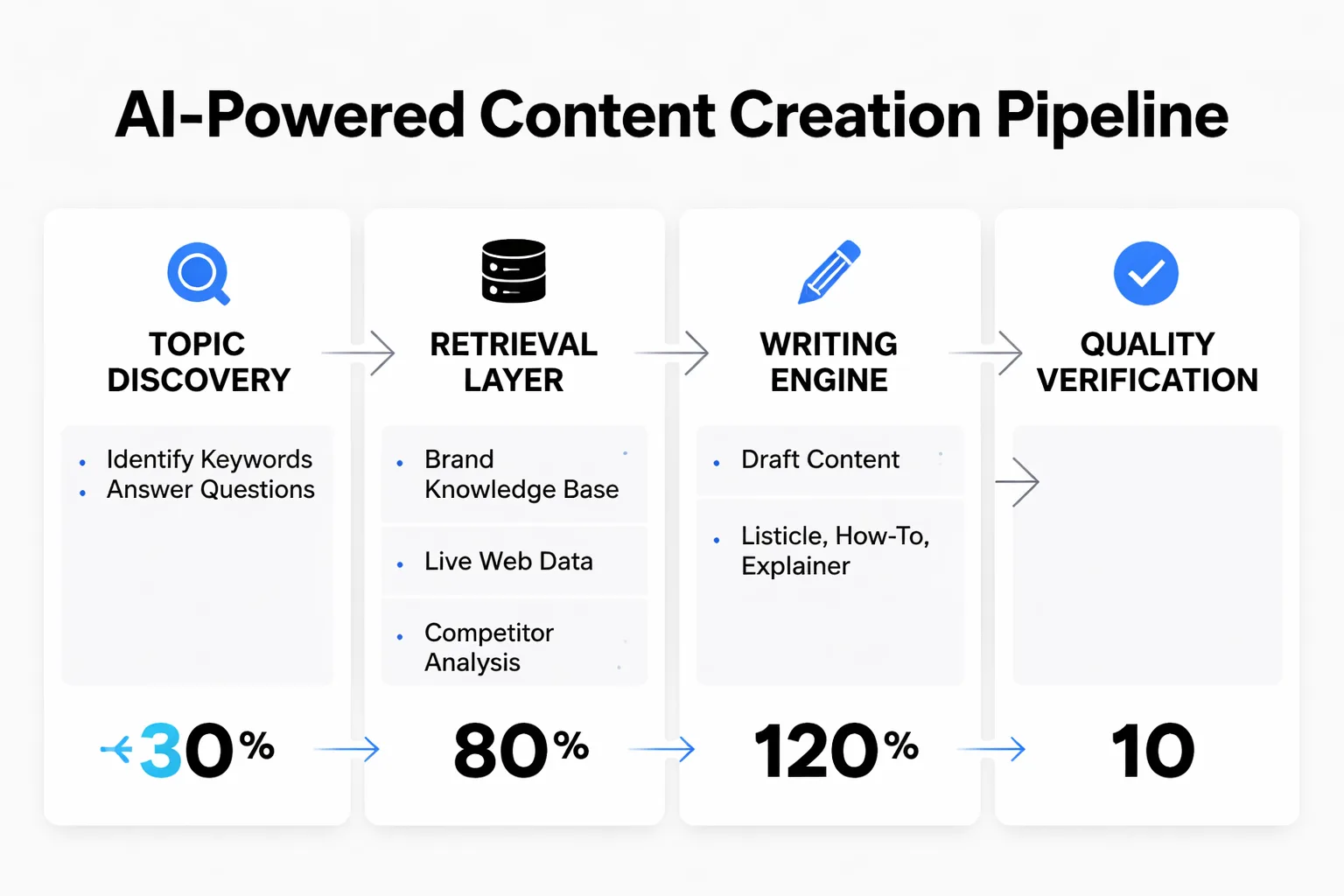
Finally, the publishing layer pushes approved content to WordPress, Ghost, Shopify, or custom webhooks. It submits sitemaps to Google Search Console and pings IndexNow for rapid indexing. The closed loop doesn't end at publish. It tracks whether the published content actually moves AI visibility metrics, identifies citation gaps, and feeds that data back into the next topic discovery cycle.
Why Traditional Content Strategies Fail in AI Search
The conventional playbook is broken. Teams pour resources into keyword optimization, internal linking, and publishing frequency. Then they watch their AI visibility stay flat. The problem isn't effort. It's a fundamental mismatch between what traditional SEO optimizes for and what AI engines actually reward.
Research indicates that companies ignoring AI search optimization are missing 70% of potential visibility. The breakdown is stark: traditional SEO captures roughly 30% of modern search visibility. Adding answer engine optimization brings that to 60%. Generative engine optimization pushes it to 70%. Most companies sleep on the latter two categories entirely.
The failure pattern is predictable. A brand publishes a well-researched article optimized for a target keyword. The article ranks well on Google. But when a user asks ChatGPT or Perplexity the same question, the brand's content never appears in the answer. Why? Because AI engines rely heavily on third-party mentions and external validation. A brand can be the best in its category, but if no one else talks about it, the model has no signal to weight it.
One analysis found that a B2B services firm's own website didn't crack the top 30 domains AI cites about its own category. Meanwhile, a university in the same study saw 75% of AI citations point to its own domain. The difference wasn't content quality. It was entity authority, external mentions, and structured data presence. The university had decades of cited research, Wikidata entries, and incoming links from authoritative sources. The B2B firm had a well-optimized blog that no AI engine considered authoritative.
This is the hard truth. High organic ranking no longer guarantees AI citation. The overlap between top Google results and AI-cited sources has collapsed. A brand can rank #1 for a term and still be invisible to ChatGPT, Claude, and Perplexity. The strategy that worked for the last decade doesn't work for the next one.
Why shift from keywords to entity authority?
Keyword optimization was the foundation of SEO for twenty years. It's now table stakes. The new currency is entity authority: how well AI engines understand who a brand is, what it does, and why it should be trusted.
Entity grounding is the mechanism that connects content to structured knowledge. When a model encounters a brand name in an article, it checks its knowledge graph for context. Does this entity have a Wikidata entry? Is it referenced by authoritative domains? Does it have consistent NAP (name, address, phone) data across the web? If the answers are yes, the model can confidently cite the brand. If not, it skips it.
The research on grounded language models reveals fascinating patterns. When models have entity grounding, they name specific individuals in 25.8% of responses. But the rate varies dramatically by category. Real estate professionals get named 35.4% of the time. Car dealerships: 32.9%. Insurance: just 9.1%. The model difference is even more striking. Grok names individuals in 38.0% of grounded responses. Gemini manages only 9.3%.
What does this mean for content strategy? It means that creating content without entity grounding is like writing a book without your name on the cover. The information might be valuable, but no one can attribute it to the author. Brands need to actively build their entity presence through Wikidata entries, structured data markup, and consistent mentions across authoritative third-party domains.
This is where most ai search engine optimization tools fall short. They optimize content for keywords and readability. They don't check whether the brand's entity is recognized by major LLMs. They don't track whether content is being cited or ignored. A true AI visibility platform tracks brand mentions across every major AI search surface, shows where the brand appears in each answer, and identifies the specific sources those answers are built from.
Can Free AI Tools Compete with Paid Platforms?
The short answer is no, but the nuance matters.
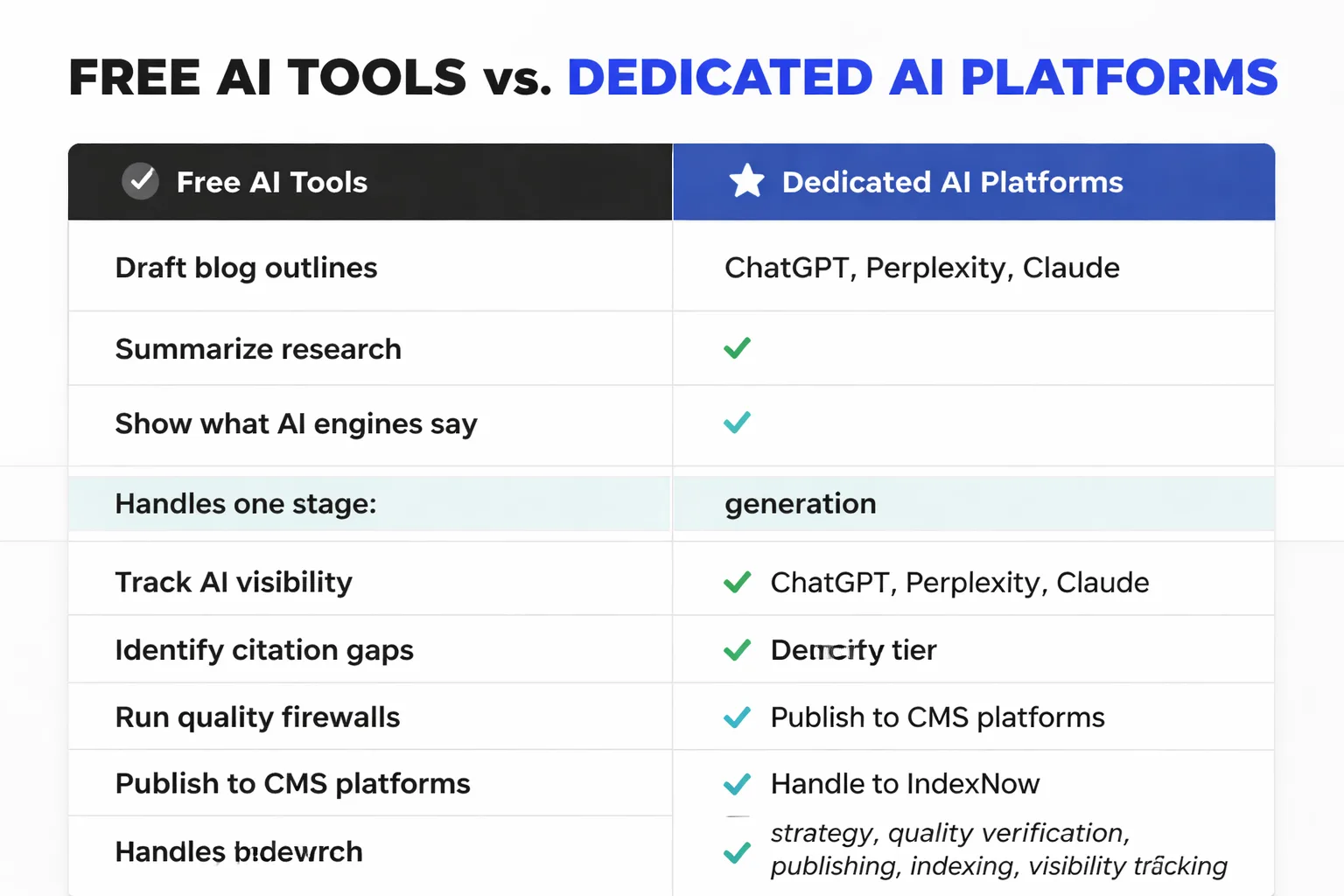
Free AI tools for content creation have legitimate value. ChatGPT's free tier can draft blog outlines. Claude's free tier can summarize research. Google's AI Overviews can show what AI engines already say about a topic. For solopreneurs testing the waters, these tools provide a starting point without financial commitment.
But the gap between free tools and a dedicated platform becomes apparent quickly. Free tools don't track AI visibility. They don't show whether a brand is cited in ChatGPT, Perplexity, or Claude. They don't identify citation gaps where competitors are mentioned but the brand isn't. They don't run quality firewalls on generated content. They don't publish to CMS platforms or submit to IndexNow.
The practical reality is that free ai for content creation handles one stage of the pipeline: generation. A complete service handles research, strategy, writing, quality verification, publishing, indexing, and visibility tracking. That's the difference between a tool and a system.
Consider the workflow a small team faces. A founder uses a free AI tool to draft an article. They manually check facts, format for SEO, upload to WordPress, submit to Google Search Console, and then... what? They have no way to know if the article improved their AI visibility. They can't see whether ChatGPT started citing them. They're flying blind on the metrics that matter most in 2026.
Paid platforms close this loop. They connect content creation to visibility measurement, so every published article feeds data back into the next content decision. The question isn't whether free tools work. It's whether a team can afford to operate without visibility data in a landscape where AI citations increasingly determine market presence.
How Does RAG Differ from Fine-Tuning for Content?
Retrieval-augmented generation and fine-tuning are often conflated. They serve fundamentally different purposes in AI content creation.
Fine-tuning involves training a model on a specific dataset to change its behavior. A brand might fine-tune a model on its existing content to match brand voice. This is expensive, time-consuming, and brittle. When the model updates, the fine-tuning may need to be redone. Fine-tuning is good for consistent tone but bad for factual accuracy on new topics.
RAG takes a different approach. Instead of baking knowledge into the model, it retrieves relevant documents at inference time. When a user asks a question, the model searches a knowledge base, pulls the most relevant sources, and generates an answer grounded in those specific documents. This is how Perplexity works. It's how ChatGPT Search works. And it's the architecture that makes LLM citation tracking possible.
For content creation services, RAG is the superior architecture. It allows the system to pull from a brand's knowledge base, live web sources, and structured data to produce content that's factually grounded. If the knowledge base updates, the next article automatically reflects the new information. No retraining required.
The implication for content strategy is significant. Content created with RAG-based systems is more likely to be cited by AI engines because it mirrors the retrieval process those engines use. When a brand's knowledge base contains well-structured, factually accurate information, AI engines can retrieve and cite it directly. Content created with fine-tuned models but no retrieval layer may sound on-brand but lacks the structural signals that make it citable.
The Human Oversight Layer
AI generated content without human oversight is a liability. The industry has learned this the hard way.
When teams push content directly from AI tools to their CMS, the results are predictable. Factual errors slip through. Sentences repeat themselves. Brand voice oscillates between corporate and casual. Engagement drops. Google's quality algorithms may flag the content as low-effort. The initial speed advantage of unedited AI drafts evaporates when the team has to go back and fix everything.
The solution isn't to abandon AI generation. It's to build a verification layer between generation and publishing. This layer should check factual accuracy by tracing every claim to a source. It should verify originality to prevent duplicate content issues. It should assess readability, structure, and alignment with brand voice. And it should flag potential Google penalty risks before they become problems.
The tension is real. Quality verification slows the publishing loop. In practice, it cuts content velocity by at least 50% compared to unedited AI drafts. But that velocity reduction is the price of credibility. A published article with a factual error damages brand trust far more than a slightly slower publishing cadence.
The most effective approach combines automated quality checks with human editorial review. Automated systems handle the mechanical checks: fact verification, originality, structure, penalty risk. Human editors handle the judgment calls: tone, nuance, strategic alignment, and whether the content genuinely serves the reader. This hybrid model produces content that's fast enough to scale and accurate enough to cite.
Structuring Content for AI Citation
Creating content that AI engines cite requires structural choices that traditional SEO doesn't address. The goal isn't just to rank. It's to be the source an AI engine retrieves, synthesizes, and attributes.
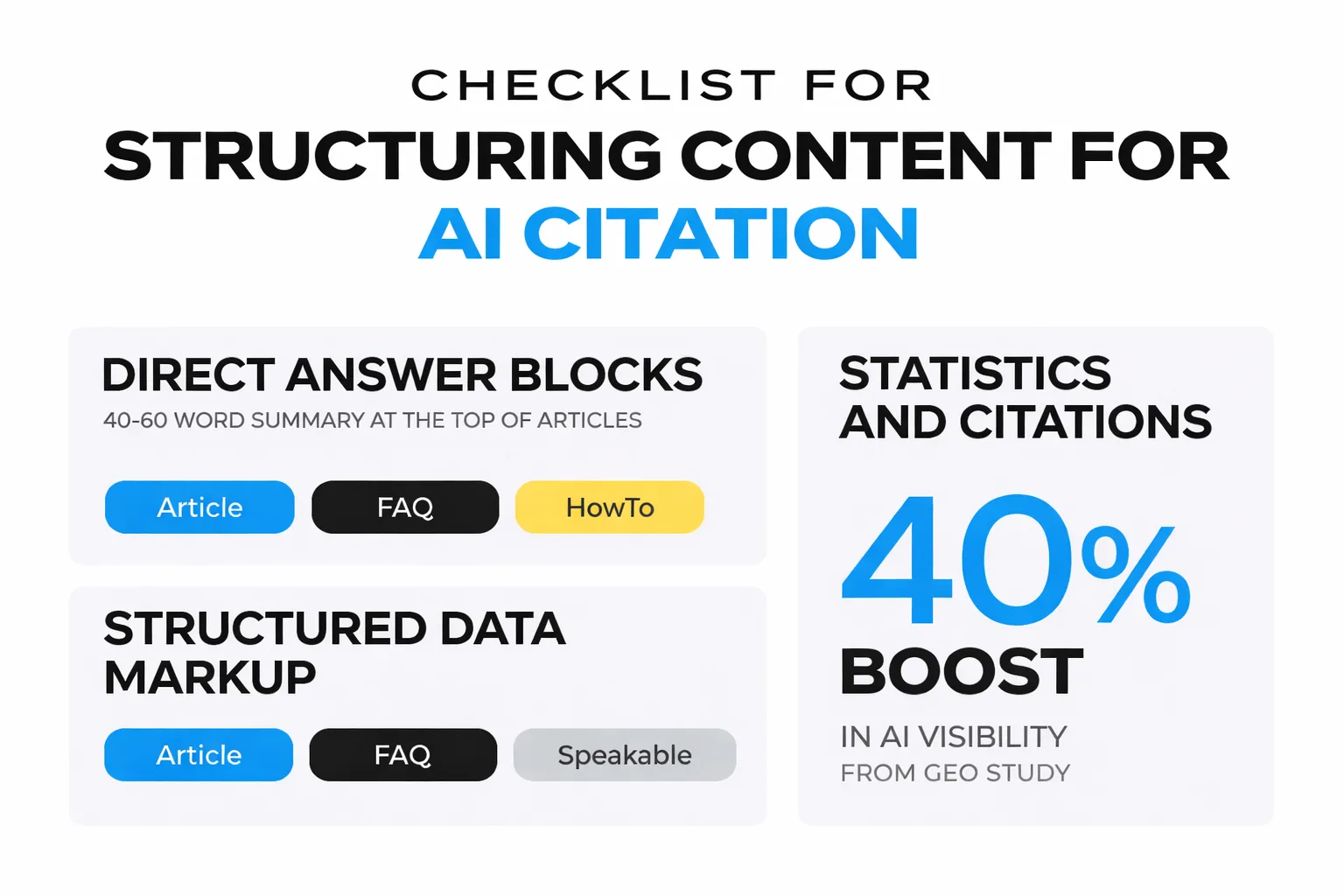
Several structural patterns consistently appear in AI-cited content. First, direct answer blocks at the top of articles. When an AI engine retrieves a page, it looks for a concise answer to the user's question. A 40-60 word summary near the top gives the model something to extract directly. This is why answer-dense openers matter.
Second, structured data markup. Schema.org types like Article, FAQ, HowTo, and Speakable help models parse content structure. Speakable schema specifically identifies sections suitable for text-to-speech and AI extraction. Content without structured data is harder for models to parse reliably.
Third, statistics and citations. The GEO study found a 40% boost in AI visibility from adding statistics and citations. AI engines prefer content that grounds claims in verifiable data. Every statistic should link to its primary source. Every claim should trace to an authoritative reference.
Fourth, entity-rich content. Naming specific people, companies, and concepts (with proper context) helps models build entity associations. When a brand's content consistently references industry entities in structured ways, models learn to associate the brand with those entities.
Fifth, question-shaped headings. AI engines extract from Q&A structures. H2s phrased as questions ("How does X work?", "Why does Y matter?") give models natural extraction points. Each question heading should open with a self-contained 40-60 word answer, then elaborate.
What Role Do AI SEO Agents Play?
The concept of an AI SEO agent goes beyond a writing tool. An agent orchestrates the full content lifecycle: research, strategy, writing, auditing, monitoring, and fixing. The distinction matters because most tools calling themselves "AI SEO agents" are actually AI writing wrappers with extra features bolted on.
According to Frase's analysis of AI SEO agents, real agents automate six pipeline stages: Research, Strategy, Write, Audit, Monitor, and Fix. Most competitors automate only three. The gap isn't in feature count. It's in automation depth. A tool that writes but doesn't monitor results is a writing assistant. A tool that monitors but doesn't fix identified gaps is a dashboard. A true agent closes the loop.
Agentic SEO represents the next evolution. Instead of a human deciding what to write, the agent identifies content opportunities based on AI visibility data. Instead of a human checking quality, the agent runs multi-dimensional verification. Instead of a human tracking rankings, the agent monitors AI citations across surfaces and adjusts strategy based on what's working.
The practical application for small teams is significant. A founder or marketer who can't afford a full content team can deploy an AI SEO agent that handles research, drafting, quality checks, publishing, and visibility tracking. The human's role shifts from execution to strategy and approval. They set the brand voice, define the knowledge base, and approve articles before they go live. The agent handles the rest.
This is where ai search optimization converges with content creation. The agent doesn't just produce content. It produces content specifically designed to fill citation gaps, targeting prompts where the brand is absent but competitors are present. Each article becomes a strategic intervention, not just a publishing event.
Is your brand being cited by AI engines, or are competitors filling the gap?
Tracking AI Citations and Visibility
You can't optimize what you don't measure. AI citation tracking is the measurement layer that makes everything else accountable.
Traditional SEO tracks keyword rankings. AI visibility tracking tracks brand mentions and citations across AI search surfaces. The metrics are different. Instead of "position 3 for keyword X," it's "cited in 12% of ChatGPT responses for topic Y" or "mentioned first in 45% of Perplexity answers about category Z."
Effective AI visibility reporting should capture several dimensions. Which AI engines cite the brand. Where in each answer the brand appears (first mention, in a list, last). Which sources those citations link to. What competitors are cited for the same prompts. How visibility trends change over time.
The cited-source leaderboard is particularly valuable. It shows which domains AI engines cite most frequently for a brand's topics. If a brand's own domain isn't on that list, the content strategy needs adjustment. If competitor domains dominate the list, the brand needs to understand why and close the gap.
Position tracking in AI answers is nuanced. A first mention in a ChatGPT response carries different weight than being listed fifth in a Perplexity answer. Brands need to track not just whether they're cited, but where and how. This data informs content strategy. If a brand consistently appears last in AI answers, it may need stronger entity grounding or more authoritative external mentions.
The Reddit Trap and Third-Party Mentions
Here's where the industry is getting it wrong.
Reddit claims to be the "#1 most cited domain across all AI/LLM platforms" and is monetizing this positioning through ad inventory. The implication is that buying Reddit ads buys AI visibility. This is misleading.
Paid display ads on Reddit do not grant access to LLM training data. They don't influence what Perplexity cites. They don't change what ChatGPT retrieves. Reddit's actual AI value comes from its $60M/year data licensing deal, which provides organic user-generated content to models for training. Paid ads and organic content are fundamentally different products.
A marketer who buys Reddit display ads expecting AI visibility is wasting budget. The ad placement never reaches the vector databases that train or inform these models. What does reach them is organic conversation: real users discussing a brand, product, or service in subreddit threads.
The broader lesson applies beyond Reddit. AI engines rely on third-party mentions because they provide independent validation. A brand saying "we're the best" carries no weight. A third-party publication saying "this brand is worth considering" carries significant weight. AI engines are designed to surface consensus, not marketing copy.
This means content strategy can't be purely owned-media. Brands need earned media, third-party reviews, industry forum mentions, and citations from authoritative domains. The AEO vs GEO distinction matters here. AEO optimizes owned content for answer extraction. GEO optimizes for the broader ecosystem of sources that generative engines synthesize.
Building this ecosystem requires active outreach. Finding the publishers AI engines cite for a topic, securing mentions in their content, and ensuring those mentions link back to the brand's entity. This is citation gap analysis applied to third-party domains, not just owned content.
Ecommerce GEO and Agentic Commerce
The intersection of AI content creation and ecommerce is accelerating fast. Generative engine optimization for ecommerce, or ecommerce GEO, applies the same principles of entity grounding and citation readiness to product and category pages.
Agentic commerce takes this further. AI agents are increasingly making purchasing decisions on behalf of users. When a user asks ChatGPT "what's the best CRM for a 5-person team," the agent synthesizes information from multiple sources and recommends specific products. If a brand's product isn't cited in the sources the agent retrieves, it doesn't get recommended. Period.
This makes ai and search engine optimization a revenue-critical function for ecommerce brands, not just a marketing channel. Product content needs to be structured for AI retrieval. Specifications, pricing, comparisons, and reviews need to be in formats that models can parse and cite. Entity grounding ensures the product is recognized as a distinct entity with attributes the model can reference.
The content creation pipeline for ecommerce differs from editorial content. Product descriptions need schema markup with specific attributes (price, availability, ratings). Comparison content needs structured tables that AI engines can extract. Category pages need entity relationships that connect products to broader taxonomies. An ai powered content platform that handles editorial content but not ecommerce-specific structures leaves a critical gap.
Challenges and Ethical Considerations
AI powered content creation services face real challenges that vendors often downplay. Understanding these limitations is essential for making informed decisions.
Factual accuracy remains the biggest risk. LLMs hallucinate. They generate plausible-sounding but incorrect information with confidence. Without fact verification that traces every claim to a source, published content can contain errors that damage brand credibility and trigger Google quality penalties. The quality firewall isn't a nice-to-have. It's a necessity.
Originality is the second challenge. AI models trained on similar data produce similar output. If multiple brands use the same AI tool with similar prompts, they risk publishing near-identical content. Cannibalization detection and duplicate content checks must run at both planning and writing stages. Without them, a brand can cannibalize its own rankings and dilute its entity authority.
Brand voice consistency is the third challenge. AI models default to a generic, helpful tone that sounds like every other AI-generated article. Custom brand voice training helps, but it requires ongoing tuning. The self-learning engines that analyze published article patterns monthly and refine future writing are a step toward solving this, but they need time and volume to calibrate effectively.
Ethical considerations extend beyond quality. Disclosure matters. The FTC has signaled interest in AI-generated content transparency. Brands should maintain editorial oversight and be prepared to disclose AI assistance where appropriate. Plagiarism risk is real even with originality checks, because AI models can reproduce training data patterns without directly copying. Human review remains the final ethical safeguard.
What This Actually Means
The brands that win in AI search won't be the ones publishing the most content. They'll be the ones publishing the most citable content. That distinction changes everything about how teams allocate resources.
Content strategy in 2026 requires three integrated capabilities. First, a creation engine that produces fact-verified, archetype-aware, entity-grounded content. Second, a visibility layer that tracks brand mentions across every major AI search surface and identifies citation gaps. Third, an outreach mechanism that closes those gaps by securing mentions from the publishers AI engines actually cite.
Most teams have none of these. Some have one. Almost no small team has all three integrated into a single workflow. That's the gap AI powered content creation services are designed to fill. Not by replacing human judgment, but by automating the mechanical work of research, drafting, verification, and tracking so that humans can focus on strategy and approval.
The data is clear. 40% visibility boost from statistics and citations. 25.8% of grounded responses name specific individuals. 70% of visibility potential from GEO. These numbers define the opportunity. The brands that act on them will be the sources AI engines choose to believe. The ones that don't will watch competitors fill the citation gaps they left open.
The question isn't whether to adopt AI powered content creation services. It's whether the service being adopted actually closes the loop from creation to citation to visibility. If it doesn't track AI mentions, it's a writing tool. If it doesn't verify facts, it's a risk. If it doesn't connect content to entity authority, it's invisible to the engines that matter. Choose accordingly.
FAQ
What are AI powered content creation services?
AI powered content creation services are platforms that combine large language models, retrieval-augmented generation, and quality verification to produce content designed for both human readers and AI search engines. Unlike simple AI writing tools, these services handle the full pipeline from topic discovery through publishing and visibility tracking, with fact verification and entity grounding built into the workflow.
How is AI content different from traditional content marketing?
Traditional content marketing optimizes for keyword rankings and organic traffic. AI content services optimize for citation by answer engines. The structural differences include answer-dense openers, entity-rich writing, question-shaped headings, statistics with primary source links, and schema markup. The goal shifts from ranking to being the source AI engines retrieve and cite.
Do free AI tools work for content creation?
Free AI tools like ChatGPT and Claude can draft content, but they lack the visibility tracking, quality verification, entity grounding, and publishing infrastructure that dedicated platforms provide. For testing and ideation, free tools have value. For a systematic content strategy targeting AI citations, a dedicated platform is necessary to close the loop between creation and measurement.
How do you track AI citations?
AI citation tracking monitors brand mentions across AI search surfaces including ChatGPT, Claude, Gemini, Perplexity, Grok, and Google AI Overviews. It tracks where in each answer the brand appears, which sources citations link to, and how visibility trends change over time. This data identifies citation gaps where competitors are mentioned but the brand isn't.
What is entity grounding and why does it matter?
Entity grounding connects unstructured content to structured knowledge graph entries, helping AI engines verify facts and attribute them correctly. Research shows grounded models name specific individuals in 25.8% of responses. Without entity grounding, brands risk being invisible to AI engines even when their content ranks well on Google.
Can AI content creation help with ecommerce?
Yes. Ecommerce GEO applies entity grounding and citation readiness to product and category pages. As AI agents increasingly make purchasing recommendations, product content structured for AI retrieval becomes revenue-critical. Schema markup, comparison tables, and entity relationships help models parse and cite product information accurately.
About the Author
Judy Zhou, Founder
Judy Zhou leads content strategy at Meev, where she oversees AI-driven content research and publishing for hundreds of brands. With a background in SEO and editorial operations, she focuses on building content systems that rank on Google, get cited by AI search engines, and drive measurable business results.
See exactly where your brand appears across every major AI search surface and get a content plan to close citation gaps.