
By Judy Zhou, Founder
Key Takeaways
- Semrush's 2025 study of 200,000 queries found AI Overviews appear on 12% of SERPs with weak overlap to classic organic results.
- Ahrefs' analysis of 11.8M search results shows only 9% of pages in AI Overviews come from the traditional Position 1 organic ranking.
- One B2B brand captured 56.67% of AI mentions in 90 days by shifting from Google rankings to LLM citation tracking and entity grounding.
- Enter any competitor domain into current AI audit tools to instantly map their answer engine footprint across ChatGPT, Gemini, and Perplexity.
What would you discover if you could type any competitor's domain into a tool and instantly see exactly where. And how often. AI models like ChatGPT, Gemini, and Perplexity are citing them instead of you? That capability isn't theoretical anymore. The best rated competitor analysis tools for ai search optimization now let you audit any site's answer engine footprint, LLM citation patterns, and entity grounding strength in minutes. Turning what used to be guesswork about AI visibility into a repeatable, data-backed process.
Most teams still treat a domain audit as a Google-only exercise. Semrush's 2025 AI Overviews study analyzed 200,000 queries and found that AI Overviews appear on roughly 12% of SERPs, and the overlap with classic organic results is weaker than people assume. Ahrefs' study of 11.8M search results found that only about 9% of pages ranking in AI Overviews come from the traditional Position 1 organic result. That gap between where you rank on Google and where AI engines cite you is the entire reason this audit process exists. If your tool only shows you Google rankings, you're auditing the wrong layer.
In my work leading content strategy at Meev, I've watched brands pour budget into traditional SEO audits that return clean technical reports while their competitors quietly capture AI citation share across ChatGPT, Perplexity, and Google AI Overviews. The audit looks great. The business outcome doesn't. A B2B brand captured 56.67% of AI mentions in 90 days by shifting focus from classic ranking signals to LLM citation tracking and entity grounding, according to a published case study. That number should stop you cold.
Here's the framework I use to audit any domain for both layers simultaneously.
What Happens When You Enter a Web Name Into an SEO Tool
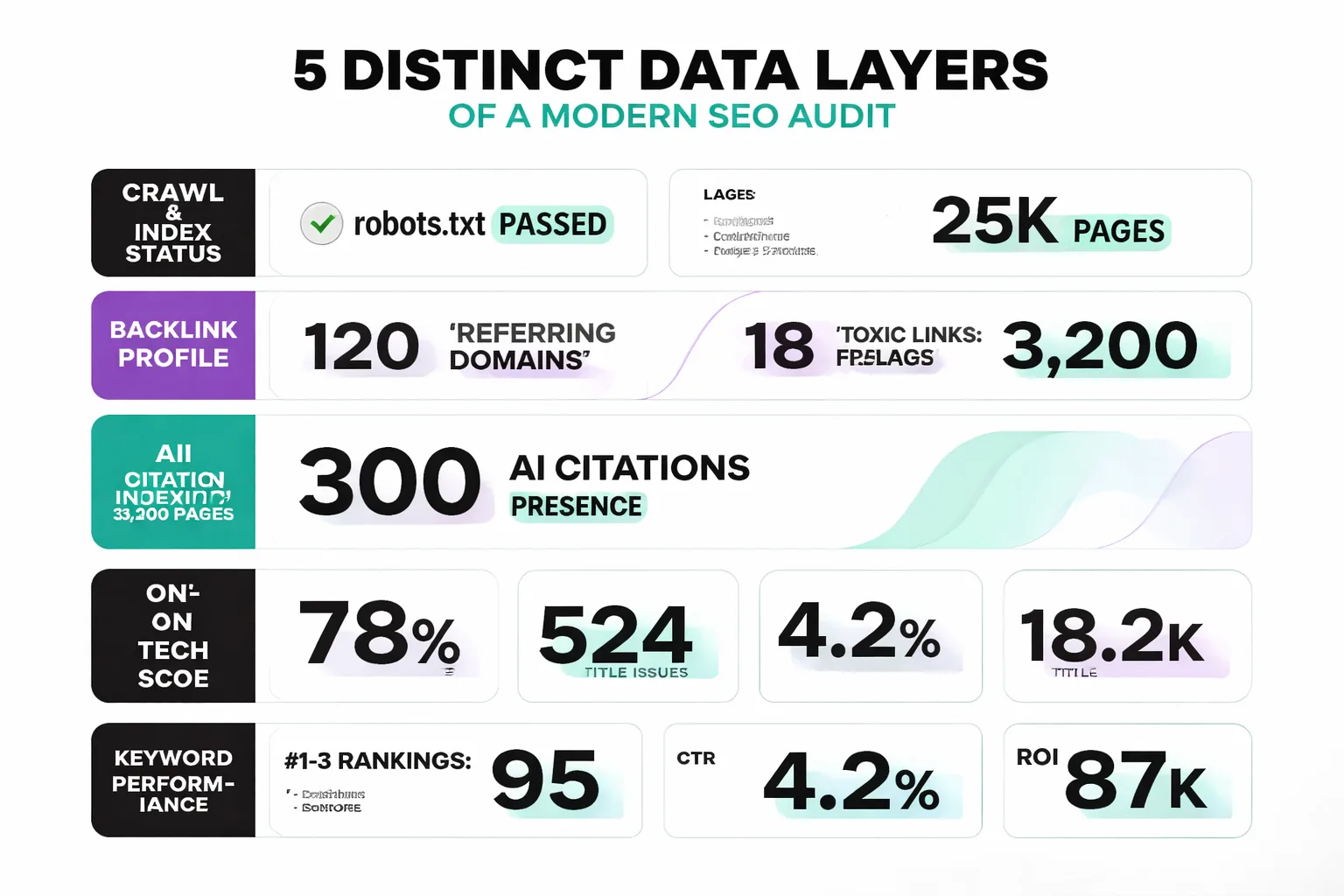
A domain-level audit is not a single report. It's five distinct data layers stacked together, and most tools only show you two of them. When you enter a web name into a modern audit platform, here's what actually gets pulled behind the scenes.
Layer 1 is crawl and index status. The tool fetches the site's robots.txt, checks sitemap health, and reports how many pages Google has indexed versus how many it has discovered but left in the dreaded "Crawled. Currently not indexed" state. I've seen pages sit in that limbo for months despite repeated manual submission. Google's indexing philosophy is quality-gated and discerning. Bing, by contrast, is far more reactive to direct submission and tends to index faster.
Layer 2 is the backlink profile. The tool surfaces referring domains, anchor text distribution, and toxic link flags. This is the layer every traditional SEO audit covers well.
Layer 3 is the one most audits miss entirely: AI citation presence. This is where the tool checks whether the domain appears as a cited source inside AI-generated answers across ChatGPT, Claude, Gemini, Perplexity, Grok, and Google AI Overviews. It tracks mention position (first, in a list, last), share-of-voice against competitors, and the specific prompts that trigger citations. Without this layer, your audit is incomplete for 2026.
Layer 4 is entity signals. The tool looks for structured data presence (schema markup), knowledge graph connections, and consistency across Wikidata, Wikipedia, LinkedIn, Crunchbase, and Google Business Profile. As Vikilinks notes, AI engines only recommend brands they recognize as real entities. If your competitor has a Wikidata entry and you don't, they have a structural advantage that no amount of blog content will close.
Layer 5 is content gap mapping. The tool identifies keywords and topics where competitors rank or get cited but you don't, cross-referencing both Google SERP data and AI answer coverage.
Most tools stop at Layer 2. That's the problem this article solves.
Step 1. Choose a Tool That Covers Both Layers
This is where most teams go wrong before they've even entered a domain. They pick a tool that excels at traditional SEO metrics but has zero capability to track AI citations, LLM mention patterns, or entity grounding. Then they wonder why their audit looks clean but their AI visibility is nonexistent.
The tool you choose must return data on both classic Google rankings and AI search visibility. If it can't tell you whether ChatGPT cites your competitor for the prompt "best CRM for startups," you're auditing with one eye closed.
Here's what to look for in a platform:
AI search surface coverage. The tool should track mentions across every major AI search surface: ChatGPT, Claude, Gemini, Perplexity, Grok, Google AI Overviews, and Google AI Mode. Not just one or two. The citation landscape shifts fast, and a tool that only checks Perplexity is giving you a fragment of the picture. At Meev, we built our AI visibility tracker specifically because existing tools treated AI citations as an afterthought.
Mention position tracking. Knowing you're cited is step one. Knowing where in the answer you appear is what actually matters. An AI that mentions your brand first in a list is driving traffic. An AI that mentions you last, after three competitors, is barely doing you a favor. I've seen brands celebrate a "mention" only to realize the framing positioned them as a "basic alternative" before recommending a more advanced competitor. Context matters more than volume.
Cited-source leaderboards. The tool should show which domains AI engines cite most often for your topics. This is your competitor's footprint laid bare. If a single publisher dominates citations for your keyword space, that's not a content gap. That's an outreach target.
Entity and knowledge graph signals. The tool should flag whether the domain has structured entity presence across Wikidata, Google Business Profile, and other knowledge graph sources. Entity grounding for AI search is not optional in 2026. It's the infrastructure that determines whether AI systems recognize your brand as a real, citable entity.
Traditional SEO coverage. Yes, you still need backlink analysis, keyword gap reports, site crawl diagnostics, and rank tracking. The AI layer doesn't replace classic SEO. It sits on top of it. Tools like Semrush and Ahrefs remain strong for Layers 1, 2, and 5. The gap is Layers 3 and 4, which is where specialized answer engine optimization platforms come in.
Don't try to force one tool to do everything if it can't. A common pattern I see is teams using Semrush for traditional SEO, then layering a dedicated AI visibility checker on top to cover the citation layer. That combination works. Using Semrush alone and assuming you've audited AI visibility does not.
Step 2. Enter the Domain and Read the Diagnosis
Once you've picked a tool (or a combination of tools) that covers all five layers, enter the domain you want to audit. What comes back will look overwhelming if you don't know how to triage it. Here's how I read these reports.
Start with the AI citation layer, not the Google ranking layer. This is a deliberate inversion of the traditional audit workflow. Most practitioners open the report, check organic rankings, review backlinks, and maybe glance at technical issues. I do the opposite. I look at AI citation presence first because it's the layer with the highest information density and the one most teams are blind to.
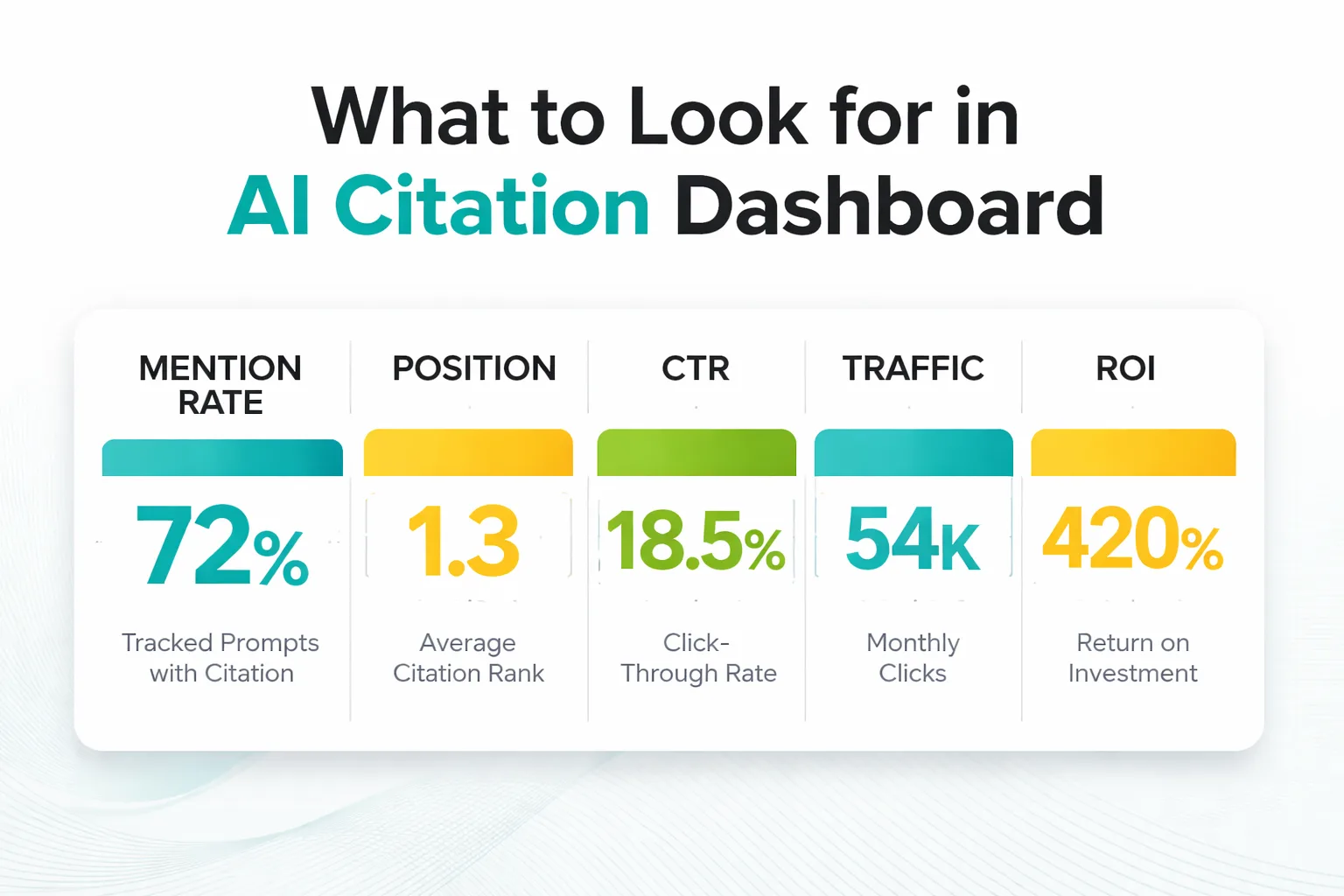
When I enter a domain and the AI citation dashboard loads, I'm looking for three things:
Mention rate across surfaces. How many of the tracked prompts return a citation for this domain? If the rate is low or zero, that's the most urgent gap. It means the brand is invisible to AI engines regardless of how well it ranks on Google. A site can rank Position 1 organically and still never appear in a ChatGPT answer. The Ahrefs study showing only 9% of AI Overview citations come from Position 1 confirms this disconnect is real and measurable.
Mention position and framing. Where in the answer does the brand appear, and how is it described? This is where raw numbers mislead you. A high mention rate means nothing if the framing is negative or positions the brand as secondary. I learned this the hard way early in my work with AI visibility tools. I optimized for raw mention count, only to discover the AI was citing our brand as a "good starting point" before recommending a more advanced competitor. That's not visibility. That's a referral to someone else.
Cited-source overlap. Which domains does the AI cite alongside this brand? If the same three publishers appear repeatedly as sources for this topic, those are the entities grounding the AI's knowledge. Getting cited by those publishers (or becoming one of them) is how you move the needle.
Next, I scan the traditional SEO layer for urgent technical issues. Robots.txt blocking critical pages. Broken internal links disrupting crawl paths. Missing schema markup on key content. These are quick fixes that can unblock both Google indexing and AI citation simultaneously. I've seen sites fix a single robots.txt directive and watch their AI citation rate climb within weeks because the AI crawlers could finally access the content.
Then I check entity signals. Does the domain have a Wikidata entry? Is the brand's Google Business Profile complete and consistent? Are there structured data markup gaps on key pages? Ryze AI reports that Shopify brands using their entity and GEO optimization platform began appearing in AI Overviews and ChatGPT answers within 8 weeks of implementation. That timeline is aggressive but directionally correct: entity grounding is a faster lever than content production for AI visibility.
Finally, I review the content gap map. Which keywords does this domain rank for or get cited on that the target site doesn't? This is where I cross-reference Google SERP data with AI answer coverage to find topics that drive both layers. A keyword where the competitor ranks on Google AND gets cited by Perplexity is worth more than a keyword where they only rank on Google.
The diagnosis should give you a clear picture of where the domain stands across all five layers. If it doesn't, your tool is incomplete.
How Does a Competitor Domain Comparison Work?
Running a competitor domain comparison is where the best rated competitor analysis tools for ai search optimization earn their keep. The process is straightforward but the interpretation requires nuance.
Enter your domain. Then enter your competitor's domain. The tool generates a side-by-side comparison across the same five layers. Here's what each comparison reveals.
AI citation rate comparison. This is the headline number. What percentage of tracked prompts cite your brand versus your competitor? If they're at 34% and you're at 8%, the gap is clear. But don't stop at the rate. Look at which surfaces show the biggest gap. If they dominate ChatGPT citations but you're roughly equal on Google AI Overviews, that tells you where to focus. Use a ChatGPT AI visibility checker or a Perplexity AI visibility checker to drill into specific surfaces.
Source coverage comparison. Which domains are AI engines citing as sources for your competitor's mentions? These are the publishers and reference sites that feed the AI's knowledge. If your competitor is cited and the source is a major industry publication, that publication is the leverage point. You don't necessarily need to out-publish your competitor. You need to get cited by the same sources the AI trusts. This is what I call the "citation path" and it's the most actionable insight a competitor comparison gives you.
Keyword overlap comparison. How many keywords do you both target, and where do they outrank you? More importantly, which of those keywords trigger AI Overviews or AI-generated answers? A keyword with no AI answer feature is a traditional SEO play. A keyword with an AI Overview is a dual-layer play where you need both Google ranking and AI citation. Prioritize the dual-layer keywords.
Entity presence comparison. Does your competitor have a Wikidata entry, a Wikipedia page, or a richer Google Business Profile? These are structural advantages. As Vikilinks explains, AI engines only recommend brands they recognize as real entities. If your competitor has entity infrastructure and you don't, no amount of content will close that gap until you fix the foundation.
Evan Bailyn, CEO of First Page Sage, notes that appearing in "two or three lists with superlative keywords like top or best" cements placement in AI responses. First Page Sage has built roughly 70 separate web pages customized to convince AI platforms of superiority across multiple industries. That's an aggressive play, but it illustrates how competitors are actively engineering their AI citation presence. Your competitor comparison should reveal whether they're doing this kind of entity engineering.
The output of this comparison should be a gap matrix: here's where they are, here's where you are, and here's the delta. That delta becomes your prioritized fix list.
Step 3. Benchmark Against Multiple Competitors
One competitor comparison gives you a snapshot. Multiple comparisons give you a pattern. I recommend running at least three competitor domains through the same audit process.
Why three? Because a single competitor might be an outlier. If one competitor dominates AI citations because they invested heavily in a single publisher relationship, that's a specific tactic you can replicate. But if three competitors all out-cite you across the same surfaces, that's a systemic gap in your AI visibility strategy. The pattern matters more than any individual data point.
When I run multiple comparisons, I look for convergence. Do all three competitors get cited by the same sources? Do they all have Wikidata entries? Do they all rank for the same set of dual-layer keywords? Convergence tells you what the baseline expectation is for your industry. If every competitor has entity infrastructure and you don't, that's not a nice-to-have. That's table stakes you're missing.
I also look for divergence. Does one competitor dominate ChatGPT while another dominates Google AI Overviews? That tells you different competitors are optimizing for different surfaces, which means the citation landscape is fragmented enough for you to find an entry point.
The tool you use should support multi-domain benchmarking. At Meev, our platform handles up to 15 domains on Agency tier, which lets you build a full competitive landscape view. If your tool only supports side-by-side comparisons one at a time, you'll need to export and manually consolidate, which is tedious but doable.
Want to see which AI surfaces cite your competitors instead of you?
Step 4. Turn Audit Findings Into a Prioritized Fix List
This is where the audit becomes action. Isaac Hammelburger, an SEO practitioner, put it bluntly on LinkedIn: "If that's all you're doing, you're not doing SEO. You're just dumping data." Raw audit exports without interpretation, context, and prioritization are useless. Here's how I translate audit findings into a ranked to-do list.
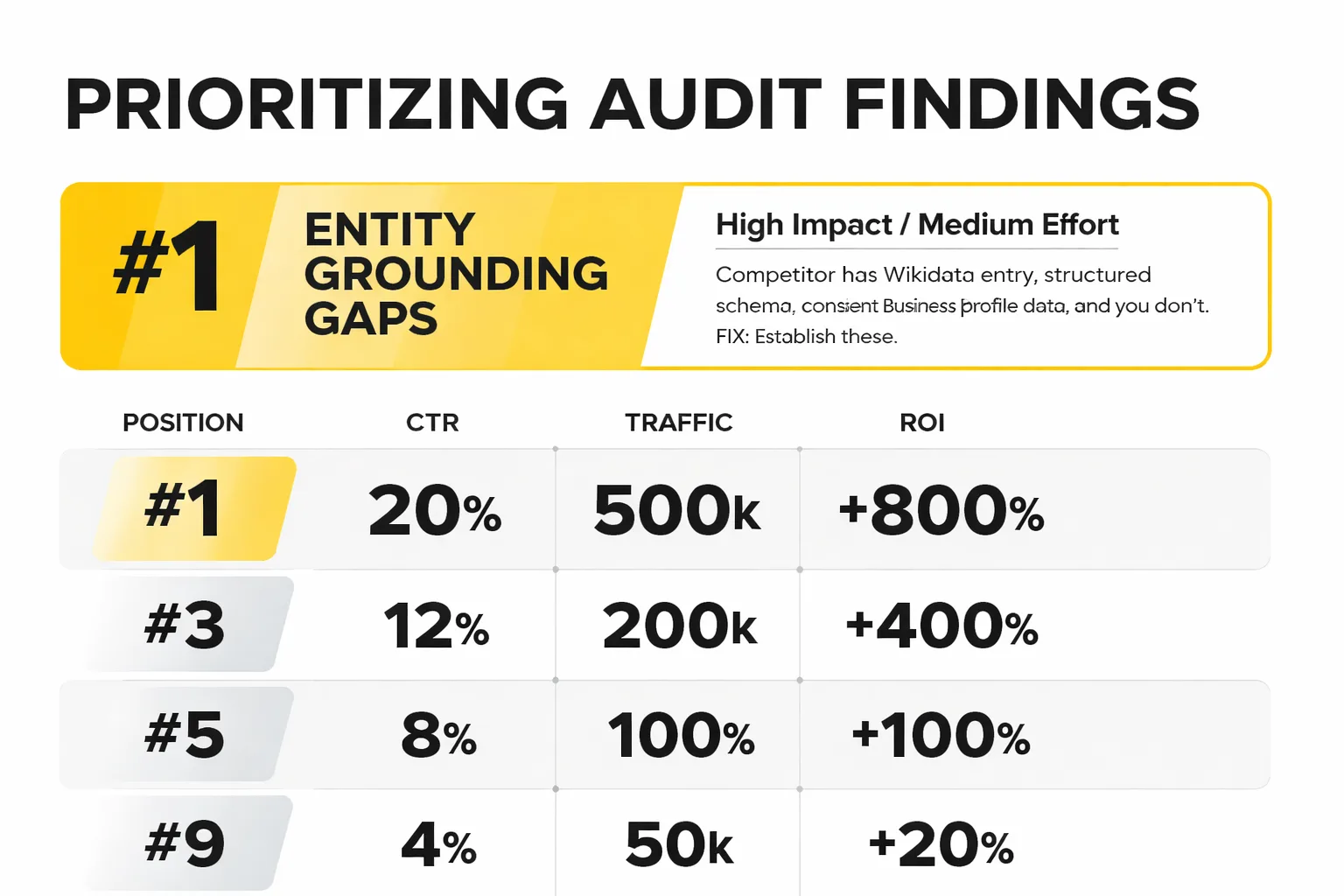
I sort every finding into one of four categories, ranked by impact and speed of execution.
Priority 1: Entity grounding gaps (high impact, medium effort). If the audit shows your competitor has a Wikidata entry, structured schema markup, and consistent Google Business Profile data, and you don't, this is your first fix. Entity grounding is the foundation that determines whether AI systems recognize your brand as a real, citable entity. Without it, you're invisible to AI regardless of your content quality. The fix involves creating or updating your Wikidata entry, ensuring schema markup is present on key pages, and verifying consistency across LinkedIn, Crunchbase, and Google Business Profile. Ryze AI's case study suggests this can produce results in 8 weeks. Even if that timeline is optimistic for your situation, the direction is correct.
Priority 2: AI citation gaps on high-intent prompts (high impact, high effort). If the audit reveals that competitors are cited for prompts where you're absent, and those prompts map to buying intent, this is your second fix. The solution is content creation targeted at answer engine optimization. Not traditional blog posts. Content structured specifically for AI extraction: clear definitions, direct answers, fact-verified claims, and authoritative outbound citations. This is where a tool like Meev's AI SEO platform can accelerate the process by generating archetype-aware, fact-verified articles designed for AI citation. The key is that the content must be structured for extraction, not just for human reading.
Priority 3: Technical SEO issues (medium impact, low effort). Robots.txt blocking AI crawlers. Broken internal links. Missing canonical tags. These are quick fixes that unblock both Google indexing and AI crawler access. I've seen a single robots.txt fix unlock AI citation within weeks. The effort is low, so even if the impact is moderate, the ROI is high. Run these fixes first while you're working on the longer-term entity and content fixes.
Priority 4: Content gap keywords (medium impact, medium effort). Keywords where competitors rank or get cited but you don't. Prioritize dual-layer keywords (those with both Google SERP presence and AI answer coverage) over Google-only keywords. Use the gap map from your audit to build a content calendar that targets these keywords with AI-optimized content.
The output should be a ranked list your team can act on this week. Not a 47-page PDF that sits in a shared drive. A one-page prioritized action plan with clear owners, timelines, and expected outcomes.
Why Most Teams Stop at Layer 2
Here's the honest tradeoff. Most teams stop at Layer 2 (backlink profile) because Layers 3 and 4 (AI citation presence and entity signals) require tools they don't have and expertise they haven't built. Traditional SEO tools are comfortable. They return familiar metrics. The reports look clean and professional. A backlink audit with 200 referring domains and zero toxic links feels like a win.
But that same audit tells you nothing about whether ChatGPT cites your brand. Nothing about whether Perplexity recommends you. Nothing about whether your entity is grounded in the knowledge graphs that AI engines use to decide what's real.
The reason teams skip the AI layers isn't laziness. It's that the tooling ecosystem for AI visibility is still maturing. Most established SEO platforms added AI tracking as a feature checkbox, not a core capability. The data is shallow. The surface coverage is incomplete. The mention position tracking is absent. So teams run the audit they can, not the audit they need.
This is also where agentic SEO enters the conversation. Search Atlas defines agentic SEO as autonomous agents executing in real-time across Google, AI Overviews, and LLMs. The argument is that manual audit workflows are insufficient for modern visibility because the citation landscape changes faster than any human can track. There's truth to this. AI citation patterns shift weekly. A prompt that cites you today may cite a competitor tomorrow. Real-time monitoring matters.
But agentic SEO also creates a failure mode I've seen firsthand. An ecommerce site runs a competitor's domain through an AI audit tool, identifies technical SEO issues, fixes them, and considers the audit done. Meanwhile, they never tracked how LLM citation systems were citing competitor content in agentic commerce recommendations. The competitors captured traffic through AI agent recommendations while the auditing site optimized for signals that don't drive agentic commerce traffic. The audit was technically correct. The business outcome was a loss.
The fix isn't to abandon traditional audits. It's to run them alongside AI visibility tracking and treat both layers as a single workflow. That's the entire premise of AEO vs SEO: they're not competing strategies. They're two layers of the same audit.
When This Audit Framework Fails
This framework assumes you have access to a tool that covers all five layers. If your tool only handles Layers 1 and 2, you'll get a false sense of completeness. The audit will look thorough because the report is long, but it's long about the wrong things. I've seen 40-page audit reports that contained zero AI citation data. Those reports are worse than no audit because they create the illusion of coverage.
This framework also fails when the competitive landscape is too fragmented to benchmark. If you're in a niche where no competitor has meaningful AI citation presence, the comparison gives you nothing to model against. In that case, you're not benchmarking. You're pioneering, which requires a different strategy: focus on entity grounding and content creation first, then monitor for citation emergence.
Finally, this framework fails when teams treat the audit as a one-time exercise. AI citation patterns are not static. A competitor who is invisible to ChatGPT today may dominate it next month after a single publisher relationship change. The audit needs to be recurring, not annual. Weekly monitoring of AI visibility changes is what separates teams that maintain citation share from teams that lose it and can't figure out why.
How Do You Know If Your Audit Actually Worked?
The measure of a successful audit isn't the report. It's the change in your AI citation rate over the following weeks. If you ran the audit, fixed the entity grounding gaps, published AI-optimized content, and your citation rate climbed, the audit worked. If your citation rate stayed flat, either the audit missed something or the fixes weren't executed properly.
I track this using a simple before-and-after comparison. Note your AI citation rate, mention position, and source coverage at the time of the audit. Re-check at 30 days, 60 days, and 90 days. If you see movement, double down on what's working. If you don't, re-run the audit to find what you missed.
The generative engine optimization landscape rewards speed. Teams that audit, act, and monitor on a weekly cycle outperform teams that audit annually and act quarterly. The citation window moves fast. Your audit cadence should match.
FAQ
Can I use a free SEO checker for AI visibility auditing?
Free seo checker tools handle basic technical audits like meta tags and page speed. None of them cover AI citation tracking or entity grounding. For AI visibility, you need a platform that specifically tracks LLM citations across ChatGPT, Perplexity, Claude, and Google AI Overviews. Free tools are a starting point, not a complete audit.
How often should I run a competitor domain audit for AI search?
I recommend weekly monitoring of AI citation changes and a full competitor comparison monthly. AI citation patterns shift faster than Google rankings. A competitor can go from zero citations to dominant in weeks if they land a single high-authority source. Monthly full audits catch this. Weekly monitoring catches it faster.
What's the difference between answer engine optimization and traditional SEO?
Traditional SEO optimizes for Google's organic ranking algorithm. Answer engine optimization optimizes for AI-generated answers that cite sources. The two overlap but require different content structures, entity signals, and monitoring. AEO focuses on being cited inside AI answers, not just ranking on SERPs.
Do I need a Wikidata entry to be cited by AI?
It's not strictly required, but it significantly increases your chances. AI engines use knowledge graphs to verify entity authenticity. A Wikidata entry signals to AI systems that your brand is a recognized entity. Without it, you rely entirely on content signals, which are weaker and slower to produce citation results.
Can I audit my own site or do I need an agency?
You can audit your own site if you have the right tool. The best rated competitor analysis tools for ai search optimization are designed for self-service. An ai search optimization agency adds value in interpretation and strategy, not in running the tool. If you can read the report and prioritize fixes, you don't need an agency for the audit itself.
The best rated competitor analysis tools for ai search optimization don't just give you data. They give you the specific gaps between where you rank and where AI engines cite you, then tell you which fixes close those gaps fastest. That's the audit that actually moves business outcomes in 2026.
About the Author
Judy Zhou, Founder
Judy Zhou leads content strategy at Meev, where she oversees AI-driven content research and publishing for hundreds of brands. With a background in SEO and editorial operations, she focuses on building content systems that rank on Google, get cited by AI search engines, and drive measurable business results.
Run your first AI visibility audit today and discover exactly where ChatGPT, Perplexity, and Google AI Overviews cite your competitors instead of your brand.