
By Judy Zhou, Founder
Key Takeaways
- 68% of US Google searches ended without a click in early 2026, rendering traditional rankability scores unreliable for predicting real visibility.
- 62% of AI citations are ghost citations that never mention the brand by name, so rankability alone no longer guarantees brand presence in AI summaries.
- The top organic result loses roughly 58% of its click-through rate when an AI Overview appears, shrinking the value of blue-link rankings.
- Separate rankability from AI citability in your model, because the gap between them is where most SEO strategies are failing.
In 2023, when Google began rolling out its Search Generative Experience to millions of users, a quiet but consequential shift began: for the first time, a page could rank on a traditional SERP and still be completely invisible to the AI layer answering the same query. SEO practitioners scrambling to understand why some brands appeared in AI-generated summaries and others did not started circling a new term. Rankability. To describe the set of signals, from entity grounding to knowledge graph presence, that determines eligibility in this new generation of search.
Rankability is the measurable probability that a specific page can reach page one for a target keyword, based on domain authority, content depth, backlink profile, and topical relevance. But here's what nobody is telling you: traditional rankability scores from SEO ranking software are becoming unreliable predictors of visibility because 68% of US Google searches ended without a click in early 2026, and 62% of AI citations are ghost citations that never mention the brand by name. The top organic result loses roughly 58% of its click-through rate when an AI Overview appears, per Ahrefs data. If your rankability model only accounts for where you rank on a blue-link SERP, you are optimizing for a surface that is shrinking.
I have spent the last three years building content systems at Meev that track brand visibility across both traditional SERPs and AI search surfaces. What I keep seeing is that teams with strong rankability scores are getting blindsided by AI search because they treat rankability and AI citability as the same thing. They are not. And the gap between them is where most SEO strategies are quietly failing.
What Rankability Means in Plain English
Rankability answers a simple question: can this page realistically reach page one for this keyword? It is not where you rank today. It is the probability of where you could rank if you executed well.
Think of it like a credit score for a web page. Your current ranking is your bank balance. Rankability is your credit score. A high bank balance does not guarantee loan approval if your credit score is weak. Similarly, a page that ranks #7 today might have low rankability because the domains above it have insurmountable authority advantages. No amount of on-page optimization will close that gap.
The core components of rankability have been stable for years. Domain authority (the aggregate trust signal your site has accumulated through backlinks). Content depth (how thoroughly your page covers the topic relative to competitors). Backlink profile (the quality and relevance of links pointing to the specific page). Topical relevance (how closely your domain's existing content cluster matches the target keyword). These four factors interact. A page on a domain with 90+ authority can rank for a keyword with thin content because the domain carries it. The same content on a DA 20 domain goes nowhere.
Here is where it gets interesting. General-AI search demand has roughly 3.6x'd since 2022 and is accelerating at +85% year-over-year, according to the Rankability 48-month panel report. Meanwhile, interest in traditional SEO peaked mid-2025 and has contracted about 30%. The concept of rankability was built for a world where Google's blue-link SERP was the only surface that mattered. That world is ending. ChatGPT alone handles over 2.5 billion questions every month, and experts predict AI-driven traffic will surpass traditional search by 2028. If your rankability model does not account for AI search surfaces, you are measuring yesterday's battlefield.
The distinction between rankings and rankability matters more now than ever because the cost of misallocation is higher. If you spend three months building content to rank for a keyword where you have low rankability, you lose time and budget. But if you spend three months building content that ranks well on Google but never gets cited by AI engines, you lose something worse: you become invisible in the answers that users actually read. The AEO vs SEO gap is not theoretical. It is happening right now on queries where AI Overviews have replaced the organic results users used to click.
How SEO Ranking Software Calculates Rankability
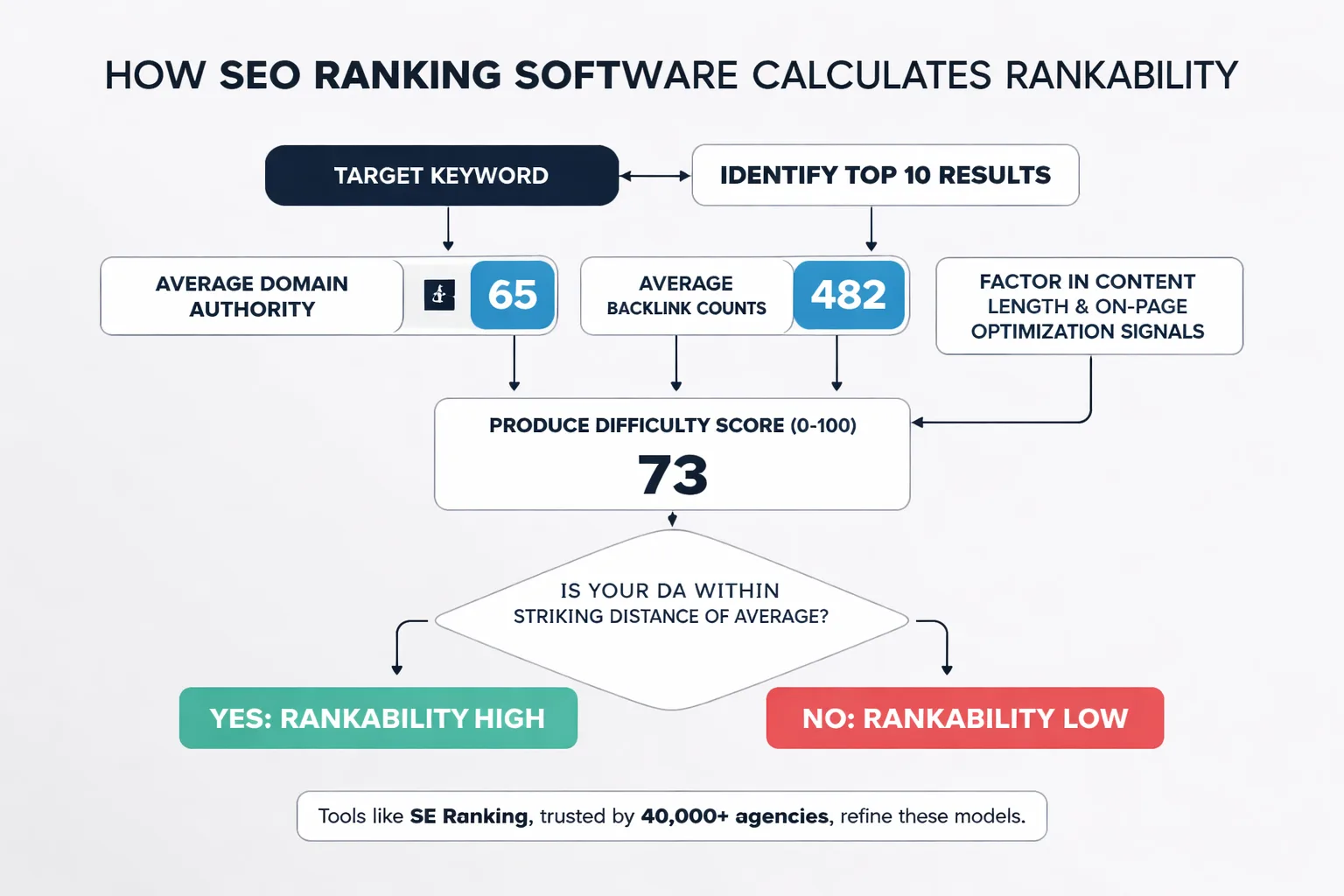
Most seo ranking software calculates rankability through a composite score that blends keyword difficulty, competing domain authority, and content gap analysis. The model is straightforward: take the top 10 results for a target keyword, average their domain authority and backlink counts, factor in content length and on-page optimization signals, and produce a difficulty score from 0 to 100. If your domain authority is within striking distance of the average, your rankability is high. If the top 10 are all DA 80+ sites with thousands of backlinks, your rankability is low.
This model works reasonably well for traditional Google rankings. I have used it for years, and when you are deciding whether to invest in a keyword or pick a different battle, the difficulty score gives you a honest signal. Tools like SE Ranking, trusted by 40,000+ agencies according to their site, have refined these models with increasingly granular data. The best seo ranking software on the market today does a solid job of predicting whether you can crack page one of Google.
But here is where the model breaks down. AI search surfaces do not use traditional ranking signals. ChatGPT does not care about your domain authority score. Perplexity does not rank results by backlink count. Google's AI Overviews pull from a different layer of signals, many of which are not captured by any seo ranking software on the market. The critical survey of generative engine optimization published on arXiv frames rankability as part of a "stochastic, partially observable pipeline" where topical relevance and context position are the most reproducible levers, not domain authority or backlink volume.
What this means in practice: you can have a page with excellent rankability on Google that never gets cited by a single AI engine. I have seen this pattern repeatedly. A client's page ranks #3 for a high-value keyword. Strong domain authority, solid backlinks, well-optimized content. But when you ask ChatGPT or Perplexity the same question, the page is nowhere in the answer. The AI engine cites a different source entirely, often one with lower traditional rankability but stronger entity signals.
The reverse also happens. A page on a low-authority domain gets cited by AI engines because it has clean structured data, clear entity definitions, and answer-friendly content blocks. This page would never rank on page one of Google. But it shows up in AI answers because the signals AI engines use are different from the signals Google's traditional ranking algorithm uses.
This is the fundamental limitation of seo ranking software today. The difficulty scores these tools produce are calibrated for a ranking system that is becoming less relevant. They do not measure AI citability. They do not account for entity grounding, knowledge graph presence, or structured data completeness. If you are using traditional rankability scores to decide where to invest your content budget in 2026, you are making decisions based on half the picture.
Rankability vs. AI Citability
This is the gap nobody talks about. Rankability and AI citability are parallel metrics that measure different things, and most teams do not even know the second one exists.
Rankability measures your ability to rank on a traditional SERP. AI citability measures your likelihood of being cited inside an AI-generated answer. They overlap but they are not the same. A page can be highly rankable on Google and never cited by ChatGPT. A page can be frequently cited by Perplexity and never crack page one of Google.
What moves AI citability? The signals are different from what moves traditional rankability. The Princeton-led GEO research (Aggarwal et al., KDD 2024) found that adding citations, quotations, and statistics lifts visibility in generative engine responses by up to 40%. Adding statistics to content improves AI visibility by 41%, per the peer-reviewed GEO study from Princeton and Georgia Tech. These are not traditional SEO signals. They are content structure and evidence signals.
Entity grounding is another factor that moves AI citability but barely registers in traditional rankability models. Jason Barnard at Kalicube advocates that securing accurate Wikidata entries educates AI systems and accelerates Google's confidence in entities, leading to more stable Knowledge Panels and accurate brand narratives. Wikidata is treated as a neutral, third-party source trusted by AI systems including Google's Knowledge Graph. If your brand entity is not properly defined in Wikidata, your AI citability drops, regardless of how strong your traditional rankability is.
I learned this the hard way. Last year, I leaned into Reddit for a quick AI visibility boost, assuming that the messy, real human language would be exactly what AI models craved. The results were underwhelming. While Google and OpenAI seem to have paid access to Reddit data, other engines like Perplexity and Claude face restrictions. My brand information was not being picked up evenly across AI tools. What actually moved the needle was building a comprehensive signal graph on owned first-party content, structured schema, and distributed reviews. That is what gave AI engines the confidence to cite my brand.
The measurement gap is real. Traditional rankability is measured by seo ranking software using keyword difficulty scores and SERP analysis. AI citability requires a different toolset entirely. You need LLM citation tracking across every major AI search surface to see which engines cite you, for which prompts, and from which source pages. Without this, you are flying blind on half the search landscape.
Here is the number that should stop you cold. 62% of AI citations are ghost citations, meaning the AI engine cites your URL but never mentions your brand name. Semrush's Ghost Citations Study found that the majority of AI citations are effectively invisible to brand monitoring tools. You might be getting cited and not even know it. Or worse, competitors might be getting cited for topics where you have stronger content, and you have no way to detect it without proper AI visibility reporting.
How Does AI Citability Differ from Traditional Rankability?
The simplest way to understand the difference: traditional rankability asks "can this page compete for this keyword?" AI citability asks "will an AI engine choose to reference this page when answering this question?" These are fundamentally different questions with different answers.
Traditional rankability is competitive. Ten results compete for ten blue-link positions. The strongest domain authority and best-optimized content wins. AI citability is selective. An AI engine synthesizes an answer from multiple sources, and it may cite three sources or zero sources. There is no fixed number of slots. The AI engine is not ranking you against competitors. It is deciding whether your content is worth including in its synthesis.
This means the optimization strategy is different. For traditional rankability, you focus on outperforming competitors on authority and relevance signals. For AI citability, you focus on making your content easy for AI engines to parse, cite, and verify. The Princeton GEO research found that citations, quotations, and statistics are the most impactful content elements for AI visibility. These are not the same signals that move traditional rankability.
The measurement infrastructure is also different. Traditional rankability is measured by tracking your position in SERPs over time. AI citability is measured by tracking whether and how your brand appears in AI-generated answers across ChatGPT, Perplexity, Claude, Gemini, Grok, Google AI Overviews, and AI Mode. Each engine has its own citation patterns, its own source preferences, and its own way of formatting answers. A comprehensive AI visibility tool needs to track all of them, because visibility on one engine does not guarantee visibility on another.
Why Does Entity Grounding Matter for Rankability?
Entity grounding is the process of defining who you are, what you do, and how you relate to other entities in a way that AI systems can verify and trust. It is the foundation of AI citability, and it barely registers in traditional rankability models.
Think of entity grounding as your brand's ID card in the AI world. If your entity is well-defined in Wikidata, Google's Knowledge Graph, and other trusted knowledge bases, AI engines can verify your identity and confidently cite you. If your entity is poorly defined or absent, AI engines either skip you entirely or hallucinate information about you.
The Kalicube methodology positions Wikidata entity grounding as part of the "Understandability phase" of their process. The idea is simple: before AI engines can cite you, they need to understand you. Wikidata serves as a neutral, third-party source that AI systems trust. Securing accurate Wikidata entries accelerates Google's confidence in your entity, which leads to more stable Knowledge Panels and accurate brand narratives across AI surfaces.
In my work auditing content operations, I have seen brands with excellent traditional SEO and zero entity grounding. They rank well on Google. They have strong backlink profiles. But when you search for their brand on ChatGPT, the AI engine either does not mention them or describes them incorrectly. The fix is not more content. The fix is entity grounding: Wikidata entries, consistent NAP information, structured data on the homepage, and a clear entity definition that AI engines can verify against multiple trusted sources.
The overlap between entity grounding and traditional rankability is small but growing. Google's AI Overviews do consider entity signals when deciding which sources to cite. A brand with strong entity grounding is more likely to appear in AI Overviews, which means entity grounding indirectly supports traditional rankability on queries where AI Overviews are present. But the primary impact of entity grounding is on AI citability, not traditional rankability.
Are you tracking your AI citations, or just hoping they happen?
Practical Steps to Improve Rankability
You do not need a full content overhaul to improve rankability. The highest-impact changes are structural, not volumetric. Here are the moves that lift both traditional rankability and AI citability simultaneously.
Tighten topical focus. If your site covers ten unrelated topics, your topical authority for each one is diluted. Pick the three topics where you have the strongest existing content and the clearest competitive advantage. Prune or consolidate content that does not serve those clusters. This raises your topical relevance score, which is a factor in both traditional rankability and AI citability. The arXiv survey on generative engine optimization found that topical relevance and context position are the most reproducible levers for AI visibility.
Fix entity gaps. Audit your brand's presence in Wikidata, Google's Knowledge Graph, and other trusted knowledge bases. If your entity is missing or incomplete, fix it. This is the single highest-ROI action for AI citability. It costs nothing but time, and it affects how every AI engine understands and cites your brand. The Kalicube methodology treats this as the foundational step. I agree. In my experience, brands that fix entity gaps see AI citation improvements within weeks, not months.
Add structured answer blocks. AI engines parse content differently than traditional crawlers. They look for clear, self-contained answer blocks that can be extracted and cited. If your content buries the answer in a wall of prose, AI engines will skip it. If your content leads with a direct answer and supports it with evidence, AI engines will cite it. The Princeton GEO research found that adding citations, quotations, and statistics lifts AI visibility by up to 40%. This is not a traditional SEO signal, but it improves traditional rankability too because Google's helpful content system rewards clarity and evidence.
Use schema markup. Structured data helps both traditional search engines and AI engines understand your content. Article schema, FAQ schema, and HowTo schema are all useful. But the schema that matters most for AI citability is Organization schema and the entity-level markup that connects your brand to its Wikidata entry. This is where answer engine optimization and traditional SEO diverge. Traditional SEO uses schema for rich results. AEO uses schema for entity grounding.
Build a citation graph. AI engines cite sources that are themselves cited by other authoritative sources. This means earned media matters more than ever. I have completely shifted my perspective on this. For the longest time, I was laser-focused on traditional SEO tactics. But the data is compelling: 84% to 89% of AI-generated answers come from earned media, meaning third-party coverage in credible publications. My focus for 2026 is on Machine Relations: pursuing mentions from high-authority external sources because that is what AI models actually cite.
When This Fails
The rankability framework I just described does not work in three specific scenarios, and I want to be honest about that.
First, it fails for brand-new domains with zero authority and zero entity presence. If you launched last month, tightening topical focus and adding schema will not move the needle. You need foundational authority first: backlinks, indexed content, and time. AI engines do not cite domains they have never seen. Traditional rankability models already account for this with domain age and authority thresholds, but teams often skip this reality check.
Second, it fails in hyper-competitive niches where the top results are dominated by domains with 90+ authority. If you are competing against Wikipedia, government sites, and major publications, no amount of entity grounding or structured answer blocks will get you cited over them. The AI engines will default to the sources they trust most, and those sources are the ones with decades of authority. Your rankability ceiling is real. Spend your budget on long-tail queries where the competition is weaker.
Third, it fails when your content is factually wrong or outdated. AI engines are increasingly good at detecting factual inconsistencies. If your content contradicts the consensus across other sources, AI engines will not cite you, no matter how well-structured your answer blocks are. This is not a rankability problem. It is an accuracy problem. Fix the content first, then optimize for citability.
Measuring Rankability Across AI Surfaces
If you cannot measure it, you cannot improve it. Traditional rankability is measured by seo ranking software using keyword difficulty scores and SERP position tracking. AI citability requires a different measurement infrastructure.
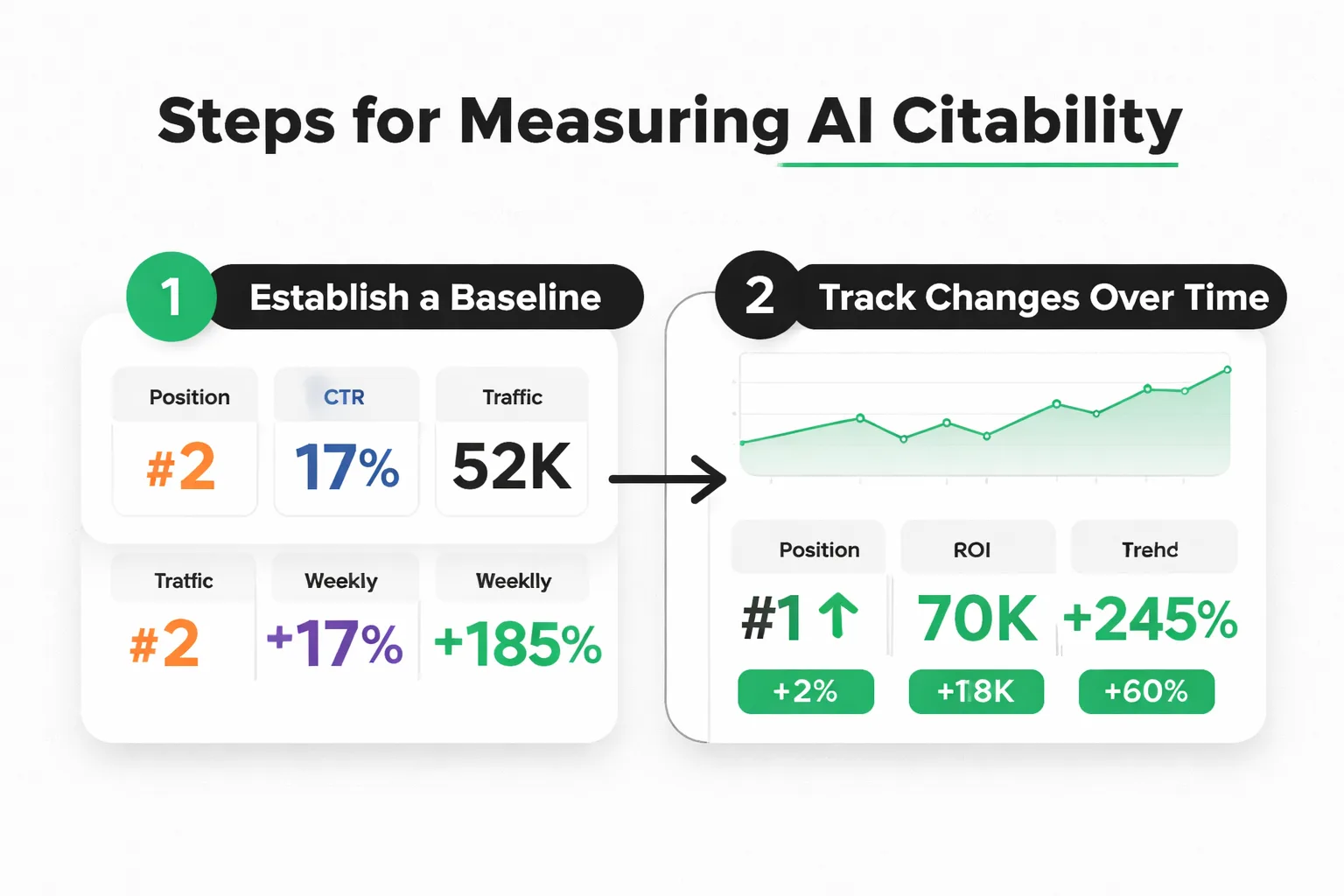
The first step is establishing a baseline. Where does your brand appear in AI answers today? Which engines cite you? Which prompts trigger citations? Which source pages do AI engines reference? This baseline tells you where you are starting from and where the gaps are. An AI visibility tracker that monitors every major AI search surface gives you this baseline.
The second step is tracking changes over time. AI citation patterns are volatile. A prompt that cites you today may not cite you tomorrow because the underlying model has been updated or the knowledge graph has shifted. You need ongoing monitoring, not one-time snapshots. Weekly trend data shows you whether your optimization efforts are moving the needle or whether you are treading water.
The third step is competitive benchmarking. Where are your competitors cited where you are not? What source pages are AI engines citing for your competitors? This information tells you exactly where to focus your optimization efforts. If a competitor is cited for a prompt where you have stronger content, the issue is likely entity grounding or content structure, not authority.
For ecommerce specifically, the stakes are higher. Traffic from AI sources to US retail sites grew 393% year-over-year in Q1 2026, and AI-referred traffic converted 42% better than non-AI sources by March 2026 (versus 38% worse a year prior). Revenue per visit from AI referrals ran 37% above non-AI traffic. If you are an ecommerce brand and you are not tracking AI citability, you are leaving revenue on the table. The Perplexity shopping experience and similar agentic commerce features mean AI engines are increasingly making purchase recommendations. If your products are not cited, you lose the sale.
The measurement challenge is that AI-referred traffic is hard to attribute. An AI engine might cite your product in an answer, but the user might visit your site directly rather than clicking the citation link. Without proper tracking, you cannot measure ROI on AI-driven traffic. This is where generative engine optimization tools that provide citation-level tracking become essential.
What This Actually Means
Rankability is not dead. Traditional Google rankings still drive significant traffic, and seo ranking software still provides valuable signal for where to invest your content budget. But rankability alone is no longer sufficient. The search landscape has fractured into two parallel surfaces: traditional SERPs and AI-generated answers. Each surface uses different signals. Each surface requires different optimization strategies. Each surface needs different measurement infrastructure.
The teams that win in 2026 and beyond will be the ones that optimize for both surfaces simultaneously. They will use traditional rankability scores to identify winnable keywords on Google. They will use AI citability tracking to identify where they are cited (or ghost-cited) across AI engines. They will fix entity gaps to improve AI citability. They will add structured answer blocks to improve both traditional rankability and AI citability. And they will measure both surfaces with the same rigor.
The teams that lose will keep doing what worked in 2023. They will optimize for traditional rankability, ignore AI citability, and wonder why their traffic is declining even though their rankings are stable. 68% of US Google searches ended without a click in early 2026. Users click a result only 8% of the time when an AI summary is present, versus 15% when it is not. If your entire SEO strategy is built on earning clicks from blue-link results, your addressable market is shrinking by the month.
Rankability is the foundation. AI citability is the future. You need both.
FAQ
What is rankability in SEO?
Rankability is the measurable probability that a specific page can reach page one for a target keyword, based on domain authority, content depth, backlink profile, and topical relevance. It is not where you rank today but where you could realistically rank if you executed well. Think of it as a credit score for your page. Traditional rankability is calculated by seo ranking software using keyword difficulty scores, competing domain authority, and content gap analysis.
Which SEO ranking software measures rankability best?
For traditional rankability, tools like SE Ranking (trusted by 40,000+ agencies) and other established platforms provide reliable keyword difficulty scores and SERP analysis. However, no traditional seo ranking software measures AI citability. For that, you need a dedicated AI visibility tool that tracks citations across ChatGPT, Perplexity, Claude, Gemini, Grok, and Google AI Overviews. The best approach is to use both: traditional tools for Google rankability and AI visibility tools for citation tracking.
Does rankability apply to AI search engines?
Traditional rankability does not directly apply to AI search engines because AI engines use different signals than Google's traditional ranking algorithm. AI engines prioritize entity grounding, structured data, and content that includes citations and statistics. The parallel concept for AI search is "AI citability," which measures the likelihood that an AI engine will cite your content in its answer. The two metrics overlap but are not identical. A page can be highly rankable on Google and never cited by AI engines.
How is AI citability different from traditional rankability?
Traditional rankability is competitive: ten results compete for ten positions on a SERP. AI citability is selective: an AI engine decides whether to include your content in its synthesized answer, with no fixed number of citation slots. Traditional rankability is driven by domain authority and backlinks. AI citability is driven by entity grounding, structured answer blocks, and the presence of citations and statistics in your content. The Princeton GEO research found that adding these elements lifts AI visibility by up to 40%.
Can you improve rankability without new content?
Yes. The highest-impact changes are structural, not volumetric. Tightening topical focus by pruning unrelated content raises your topical authority. Fixing entity gaps in Wikidata and Google's Knowledge Graph improves AI citability. Adding structured answer blocks and schema markup helps both traditional rankability and AI citability. These changes can be made to existing content without writing new articles.
What are ghost citations in AI search?
Ghost citations are AI citations that reference your URL without mentioning your brand name. Semrush's Ghost Citations Study found that 62% of AI citations are ghost citations. This means the AI engine cites your page as a source but the user never sees your brand. Ghost citations are a measurement blind spot because most brand monitoring tools track brand mentions, not URL citations. Without proper AI visibility tracking, you might be getting cited and not even know it.
About the Author
Judy Zhou, Founder
Judy Zhou leads content strategy at Meev, where she oversees AI-driven content research and publishing for hundreds of brands. With a background in SEO and editorial operations, she focuses on building content systems that rank on Google, get cited by AI search engines, and drive measurable business results.
Stop guessing at your AI visibility. See exactly where your brand is cited across every major AI search surface and close the gaps before competitors do.