
By Judy Zhou, Founder
Key Takeaways
- The overlap between top Google results and AI-cited sources has fallen from around 70% to under 20%, so traditional organic rankings no longer guarantee visibility in AI engines.
- Only 11% of domains are cited by both ChatGPT and Perplexity, requiring separate optimization for each AI platform rather than relying on Google overlap.
- Ecommerce brands that implemented structured GEO raised AI citation rates from below 5% to 20-40% within 60-90 days.
- Replace 2015-style audits that only crawl pages and count backlinks with checks for whether AI engines can parse your entities and cite your content.
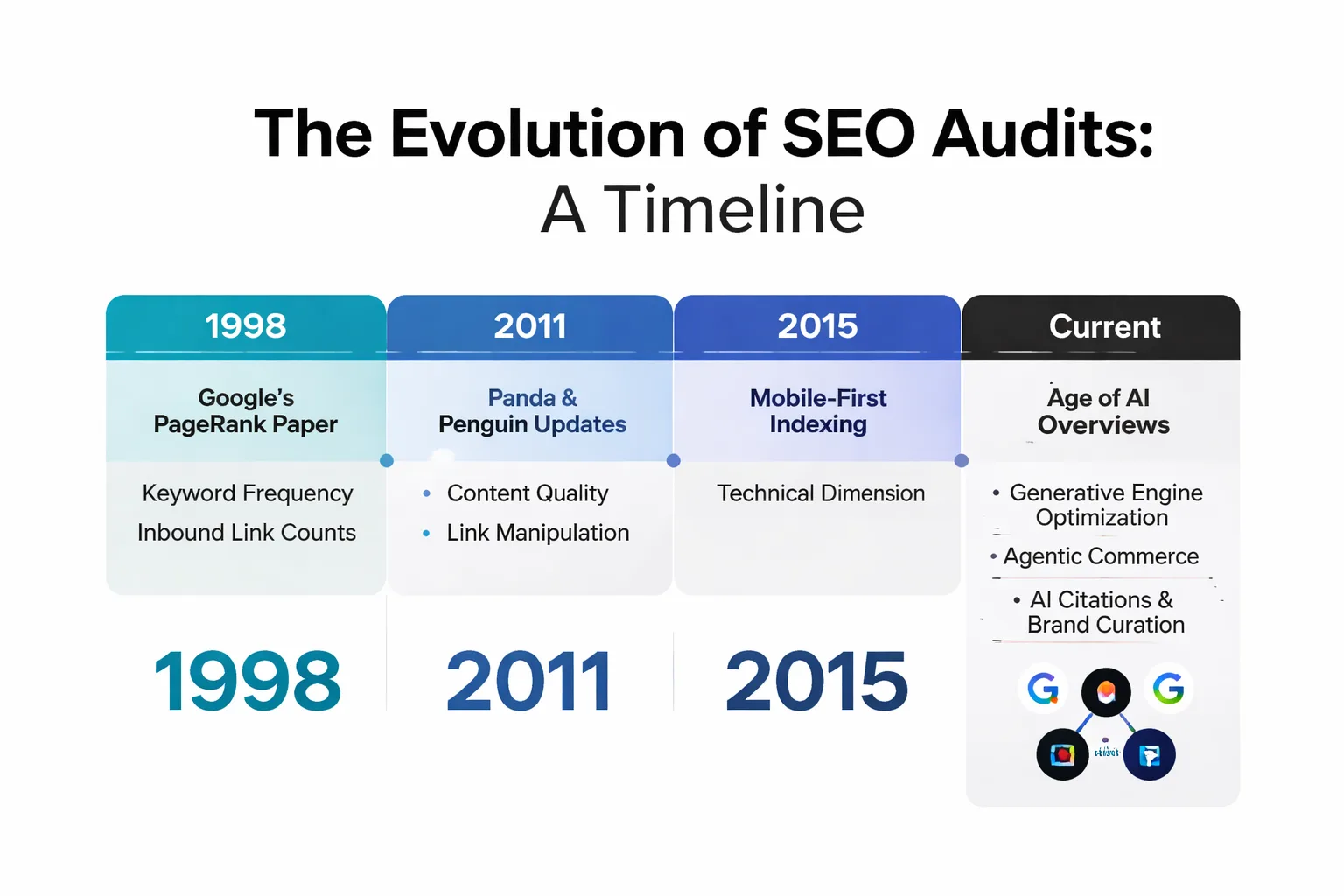
When Google published its original PageRank paper in 1998, an SEO audit meant little more than checking keyword frequency and inbound link counts. By 2011, Panda and Penguin forced auditors to confront content quality and link manipulation. By 2015, mobile-first indexing added an entirely new technical dimension. Each era redefined what SEO fundamentals actually meant. Now, in the age of AI Overviews, generative engine optimization, and agentic commerce, we're living through another definitional shift. And the five-step audit framework has to evolve again to keep pace.
The conventional SEO fundamentals audit is dead. Running a crawl, checking title tags, and counting backlinks is a 2015 checklist. In 2026, your audit has to measure whether AI search engines can parse your entities, cite your content, and recommend your brand. Ahrefs studied 75K+ brands and millions of AI citations across ChatGPT, Google AIO, Perplexity, and Gemini. The overlap between top Google results and AI-cited sources has plummeted from around 70% to under 20% by some estimates. Only 11% of domains are cited by both ChatGPT and Perplexity. That divergence means you can rank #1 organically and still be invisible to AI engines. Ecommerce brands implementing structured GEO saw citation rates jump from below 5% to 20-40% within 60-90 days, per Search Engine Journal. If your audit doesn't check for AI visibility, you're auditing for a world that no longer exists.
I run content strategy at Meev, where I oversee AI-driven content research and publishing for hundreds of brands. In my work auditing content operations, I see teams make the same mistake: they treat an audit as a compliance exercise instead of a diagnostic tool. They check boxes. They don't ask what those boxes actually measure in a world where AI search is reshaping traffic patterns.
This guide walks through the five steps I use to audit a site for both classic Google rankings and AI citation eligibility. It covers search engine optimization basics but extends them into entity grounding, structured data, and generative engine optimization. If you want to build a real seo audit checklist, this is the framework.
Step 1: Crawlability and Indexation Check
Nothing else matters if search engines cannot crawl and index your site. This is the foundation of all SEO fundamentals. Before you look at content or links, verify that Googlebot and AI crawlers can actually reach your pages.
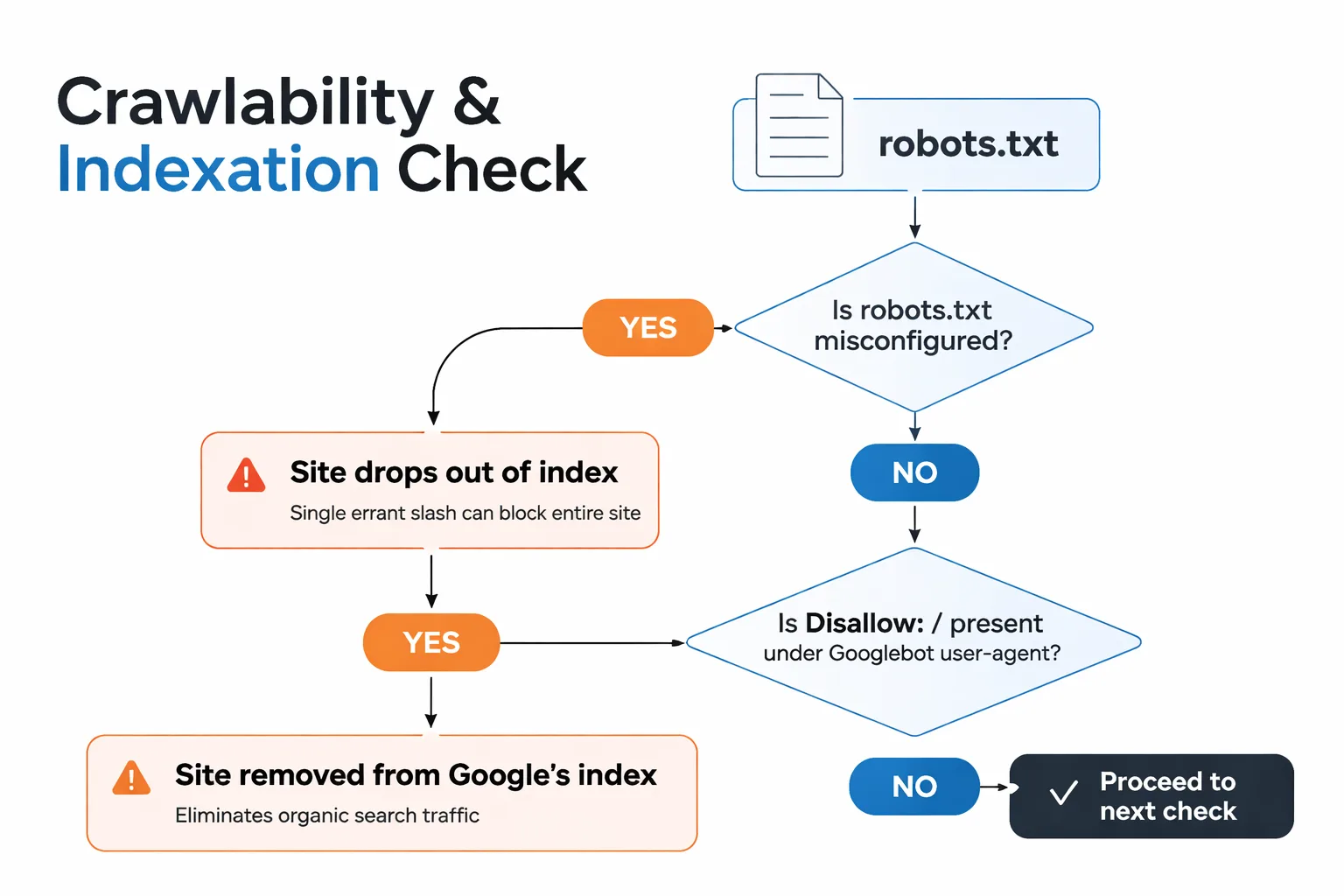
Start with robots.txt. This file sits at the root of your domain and tells crawlers which paths to follow and which to block. A misconfigured robots.txt file is the single most common reason a site drops out of the index. I have seen sites accidentally block their entire site with a single errant slash in the file.
Can you block Googlebot? Yes. You can block Googlebot by adding Disallow: / to your robots.txt file under the Googlebot user-agent directive. This prevents Google's crawler from accessing your entire site. You can also block specific directories using Disallow: /directory-name/. However, blocking Googlebot will remove your site from Google's index and eliminate all organic search traffic. Use it deliberately, never accidentally.
Next, check your XML sitemap. Submit it through Google Search Console. Your sitemap should list every canonical, indexable URL on your site. If your sitemap contains 500 URLs but Google has only indexed 50, you have a crawlability problem. Common causes include slow server response times, redirect chains, and canonical tag conflicts.
Verify server response times. Google expects your server to respond in under 200 milliseconds for HTML documents. If your Time to First Byte (TTFB) exceeds 600ms, Googlebot will throttle its crawl rate. You can check this in Google Search Console under the Crawl Stats report. A slow server does not just hurt rankings. It limits how many pages Google will discover and index.
Check for redirect chains. A single 301 redirect is fine. A chain of three or more redirects (301 to 301 to 301 to 200) wastes crawl budget and dilutes link equity. Use a crawler like Screaming Frog or Sitebulb to map redirect chains across your site. Fix them by updating the first redirect to point directly to the final destination URL.
Finally, confirm mobile-first indexing. Google indexes the mobile version of your site as the primary version. If your mobile site has different content, fewer links, or missing structured data compared to your desktop site, your mobile content is what Google will use. Check Google Search Console to confirm mobile-first indexing is active for your property.
Beyond Googlebot, you now need to think about AI crawlers. OpenAI's GPTBot, Anthropic's ClaudeBot, Google's Googlebot-Image (used for multimodal AI training), and Perplexity's PerplexityBot all respect robots.txt directives. If you blocked these crawlers during an AI-content-scraping panic in 2024 or 2025, you are actively preventing your site from being included in the training and retrieval data that powers AI search. Check your robots.txt for GPTBot, ClaudeBot, and PerplexityBot disallow rules. If you want AI engines to cite you, you must allow their crawlers access.
This is a fundamental shift in what crawlability means. In 2015, crawlability was about Googlebot reaching your pages. In 2026, crawlability is about every major AI search engine's crawler reaching your pages. Your robots.txt file is no longer just a gatekeeper for Google. It is the access control list for the entire AI search ecosystem.
How Does On-Page Signal Audit Work?
On-page signals are the elements you control directly on each page: title tags, meta descriptions, heading hierarchy, and internal links. These remain core SEO fundamentals, but the thresholds for what constitutes a problem have shifted as AI engines parse pages differently than classic crawlers.
Title tags should be 50-60 characters. Google typically displays the first 50-60 characters in search results. Titles longer than 60 characters get truncated. Titles shorter than 30 characters are usually too vague. Check every page for missing, duplicated, or overly long title tags. A duplicated title tag across 20 pages tells Google you have 20 pages about the same topic, which triggers keyword cannibalization.
Meta descriptions do not directly affect rankings. They do affect click-through rate, which correlates with rankings. Keep meta descriptions between 120-155 characters. Include the primary keyword for the page. Write them as ad copy, not as summaries. A good meta description answers the user's implicit question before they click.
Heading hierarchy matters more than most auditors admit. Every page should have exactly one H1 tag. Subsequent headings should follow a logical nesting order: H2, then H3, then H4. Skipping levels (H1 to H3) breaks the document outline. AI engines use heading hierarchy to understand the structure of your content. A clean heading structure makes it easier for LLMs to extract and cite specific sections.
Internal linking distributes link equity and establishes topical relationships between pages. Audit your internal links for three things: orphan pages (pages with zero internal links pointing to them), broken internal links (links pointing to 404 pages), and anchor text distribution. Orphan pages are invisible to crawlers unless they appear in your sitemap. Broken links waste crawl budget. Anchor text should be descriptive and varied, not keyword-stuffed.
I use a simple threshold for internal linking: every page should have at least two internal links pointing to it from other pages on the same domain. If a page has zero internal links, it is an orphan. If it has only one, it is fragile. Two or more internal links from contextually relevant pages ensure the page is discoverable and receives link equity.
Here is where on-page SEO diverges for AI engines. AI search engines do not just read your title tag and H1. They parse the full document structure to extract answer-worthy passages. I have found that 44% of AI citations come from the first third of a page. If your direct answer to a question is buried in the fourth paragraph under an H3, the AI engine may extract a competitor's answer instead. Front-load your direct answers. Put them under question-shaped H2s. Use comparison tables and structured lists where appropriate. This is not keyword density optimization. It is extraction optimization.
Meta tags also matter for AI extraction in ways they never did for classic SEO. The meta description, for instance, is sometimes used by AI engines as a summary of what a page is about when deciding whether to cite it. A vague meta description like "Learn about our services" tells an AI engine nothing. A specific meta description like "AI search visibility platform that tracks brand mentions across ChatGPT, Perplexity, and Google AI Overviews" gives the AI engine context about what your page covers and when to cite it.
Step 3: Content Gap and Topical Depth Review
Content gaps suppress site rank more than any technical issue. You can have perfect crawlability, flawless on-page signals, and a clean site architecture, but if your content does not cover the topics your audience searches for, you will not rank. This step maps your existing content against target topics and identifies thin pages and missing spoke articles.
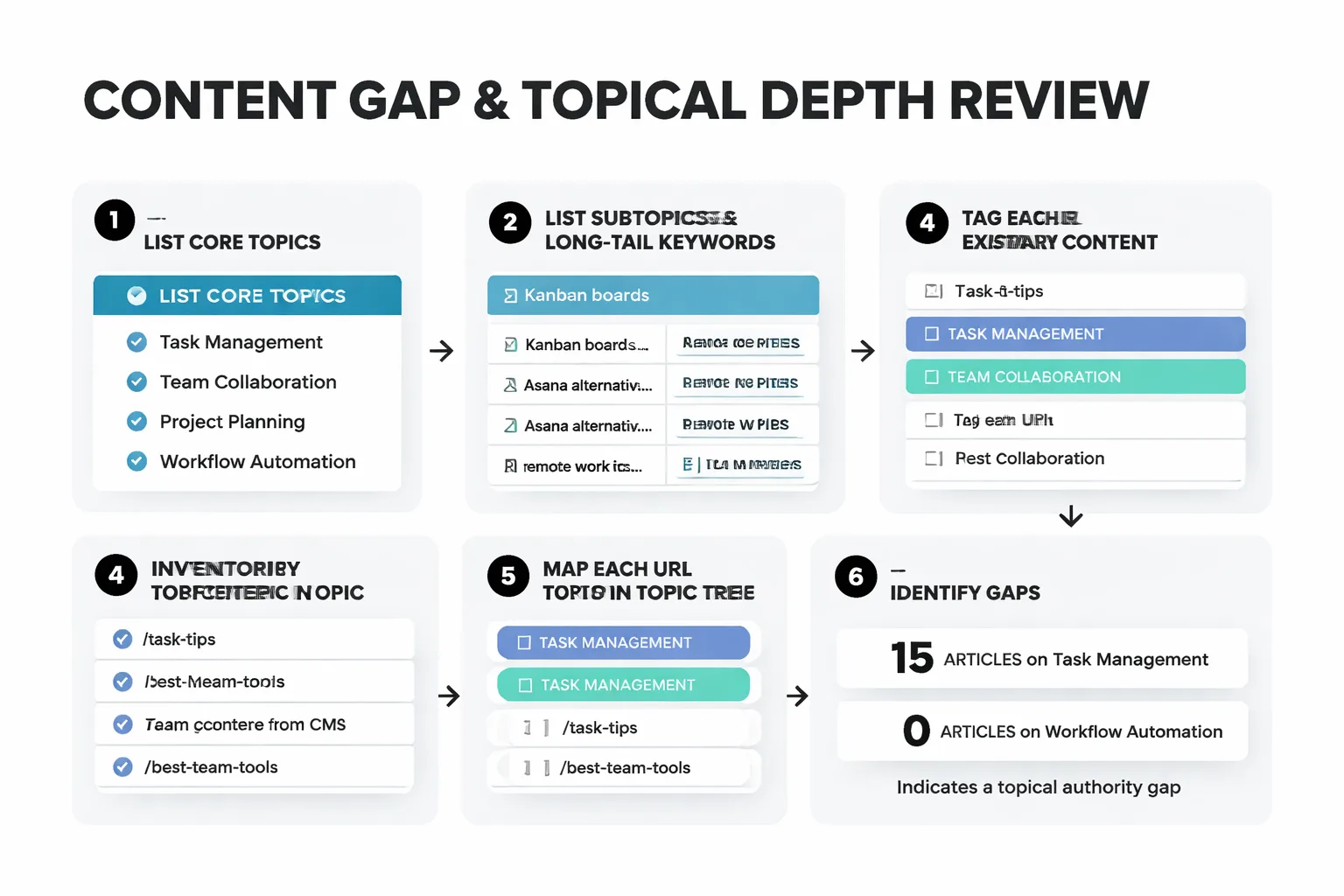
Start by listing your core topics. These are the broad categories your site should cover. If you sell project management software, your core topics might include task management, team collaboration, project planning, and workflow automation. Under each core topic, list the subtopics and long-tail keywords that branch from it.
Next, inventory your existing content. Export every URL from your sitemap or CMS. Tag each URL with its primary topic. Map each URL to a subtopic in your topic tree. The gaps become visible immediately. If you have 15 articles about task management but zero about workflow automation, you have a topical authority gap.
Thin content is the other side of this audit. A thin page is not just a short page. A thin page is one that fails to answer the user's question comprehensively. Google's Helpful Content System penalizes sites with thin content across the board. Check for pages under 300 words, pages with high bounce rates, and pages that target keywords but do not actually answer the search intent behind those keywords.
I have seen teams pour resources into outdated keyword optimization tactics and become nearly invisible to AI systems. My own experiments show that without a comprehensive content ecosystem and third-party mentions, even well-written articles struggle to gain traction in AI responses. The fix is not more content. The fix is deeper content that covers a topic exhaustively.
This is where generative engine optimization intersects with traditional SEO. AI engines look for topical depth. They want to see that your site covers a topic from multiple angles. If you have one article about a topic, you are a footnote. If you have ten articles that cover every facet of that topic, interlinked and structured for extraction, you are an authority.
Let me give you a concrete example. I worked with a B2B SaaS company that had 40 blog posts, each targeting a different long-tail keyword. None of the posts linked to each other. None covered the same topic cluster. The site had zero topical authority because it was 40 isolated pages, not 40 connected pages. We consolidated the posts into 8 topic clusters, each with a pillar page and 4-5 supporting spoke articles. Within 90 days, organic traffic to those pages increased 34% and the site started appearing in Google AI Overviews for three of the eight cluster topics. The content did not get better. The structure did.
The content gap review also needs to account for competitor coverage. Pull the top 10 ranking pages for each of your target topics. What subtopics do they cover that you do not? What questions do they answer that you ignore? If five of the top ten pages for "project management software" include a pricing comparison table and yours does not, that is a content gap. If seven of the top ten include a section on integrations and yours does not, that is a content gap. Document every gap. Prioritize them by search volume and business impact. Then fill them.
For AI-specific content gaps, the process is different. Instead of checking what ranks on Google, check what AI engines cite. Run your target queries through ChatGPT, Perplexity, and Google AI Overviews. Record which sources they cite. If they cite your competitors but not you, that is an AI citation gap. The fix is often not more content but better-structured content. Make sure your existing pages include direct, extractable answers to the questions AI engines are being asked.
Why Does Entity Grounding Matter for AI Search?
Entity grounding is the process of connecting your brand and content to recognized entities in knowledge graphs. This is where most SEO audits fail. They check schema markup but never verify whether the entities in that markup are recognized by Google's Knowledge Graph or Wikidata.
An entity is a discrete, well-defined thing: a person, a company, a product, a concept. Search engines use entities to understand what a page is about. AI engines use entities to determine whether to cite a page. If your brand is not recognized as an entity, AI engines will struggle to recommend you.
Start your entity audit with schema markup. Check for Organization schema on your homepage. Verify that it includes your brand name, logo, URL, sameAs links to your social profiles, and a description. Use Schema.org markup validated through Google's Rich Results Test.
Next, check for Wikidata presence. Wikidata is the structured data backbone of Wikipedia and many knowledge graphs. If your brand has a Wikidata entry, AI engines can verify your existence and attributes. If it does not, you are invisible to the knowledge graph layer that powers AI citations. Creating a Wikidata entry requires a notable source (a Wikipedia article, a major press mention, or an official registry listing). You cannot just add yourself.
Agentic SEO is the next evolution here. As Chris Long's guide on agentic SEO explains, optimizing for AI agents means ensuring your site can be parsed by automated systems that take action on behalf of users. This means your structured data, entity definitions, and content structure all need to be machine-readable. If an AI agent cannot parse your pricing page, it cannot recommend your product.
Check your knowledge panel signals. Search for your brand name on Google. If a knowledge panel appears on the right side of the results, Google recognizes your brand as an entity. If no panel appears, you have work to do. Build your entity presence through consistent NAP (Name, Address, Phone) data across directories, schema markup, and notable third-party mentions.
Finally, audit your structured data for errors. Use Google Search Console's Structured Data report to find markup errors. Common issues include missing required fields, invalid property values, and schema type mismatches. Fix every error. A schema markup error is worse than no schema at all because it sends conflicting signals to search engines.
Entity grounding goes beyond schema markup, though. It extends to how your brand is described across the web. AI engines build their understanding of your brand from multiple sources: your own site, Wikipedia, Wikidata, major press mentions, and community discussions on platforms like Reddit. If your brand is described inconsistently across these sources, the AI engine's confidence in its understanding of you drops. And when confidence drops, citation rates drop.
I recommend auditing your brand mentions across the open web as part of this step. Search for your brand name on Reddit, Hacker News, and major industry publications. What do people say about you? Is the description consistent with how you describe yourself on your own site? If your site says you are an "AI search visibility platform" but Reddit threads describe you as an "SEO tool," that inconsistency confuses AI engines. Align your messaging across all surfaces.
This is also where I check for what I call "entity competitors." These are brands that share your entity space in the knowledge graph. If you search for your category on Google and see a knowledge panel listing related brands, those are your entity competitors. AI engines use these relationships to determine which brands to recommend. If your competitors are listed in the knowledge graph and you are not, you are at a structural disadvantage that no amount of on-page optimization will fix.
Do you know which AI engines are citing your brand right now?
Step 5: Baseline Your AI Visibility Alongside Classic Rankings
This is the step most audits skip entirely. In 2026, a fundamentals audit that does not check AI visibility is incomplete. You need to know whether your brand is cited by AI search engines, and you need to track that alongside your classic Google rankings.
The overlap between top Google results and AI-cited sources has dropped below 20%. I can be #1 for a term on Google, but if ChatGPT, Perplexity, or Google AI Overviews does not cite my content, I am missing a growing share of search traffic. This is why I now treat AI visibility tracking as a mandatory part of every audit.
Start by running prompts related to your brand and topics across every major AI search surface. Ask ChatGPT, Claude, Gemini, Perplexity, and Google AI Overviews the same questions your customers would ask. Record whether your brand appears in the response, where it appears (first, in a list, last), and which sources the AI engine cites.
This is manual and slow. That is why I use an AI visibility tracker to automate the process. The tool runs daily checks across AI surfaces and shows me exactly where my brand is cited, where competitors are cited, and where gaps exist. It also surfaces the publishers AI engines cite most often for my topics, which tells me where to focus my outreach.
The data from this baseline is often surprising. I have seen brands with strong organic rankings get zero AI citations. I have seen brands with modest organic traffic get cited consistently by Perplexity and ChatGPT. The divergence is real and it is growing.
Once you have your baseline, compare it to your classic ranking data from Google Search Console. Look for two patterns: keywords where you rank well and get cited (your strengths), and keywords where you rank well but get zero citations (your gaps). The gaps are your priority. They represent topics where AI engines do not recognize your authority, even though Google does.
This is where answer engine optimization comes in. AEO is the practice of optimizing content specifically for AI search engines. It involves structuring content for extraction, building entity signals, and earning mentions from the sources AI engines cite. If your audit reveals citation gaps, AEO is the fix.
I also check the LLMs.txt file as part of this step. This file tells AI crawlers which content to prioritize. It is not a standard yet, but it is gaining traction. Validating it ensures AI engines can access your most important content.
For brands serious about closing the gap, I recommend tracking visibility across specific surfaces. A Perplexity AI visibility checker and a ChatGPT AI visibility checker give you surface-specific data. Different AI engines cite different sources, so you need per-surface visibility data to know where to focus.
The baseline should capture three metrics for each AI surface: mention rate (what percentage of relevant prompts mention your brand), citation rate (what percentage of responses cite your domain), and share of voice (what percentage of all brand mentions in your category are yours). These three metrics give you a complete picture of your AI search position. A high mention rate with a low citation rate means AI engines know about you but do not trust your content enough to cite it. A low mention rate means you are invisible. A high share of voice means you are dominating the category in AI search.
I track these metrics over time to spot trends. AI citation patterns shift faster than organic rankings. A change to Perplexity's Sonar model can dramatically alter which sources it cites. A Google AI Overviews rollout to new query categories can open up citation opportunities overnight. Weekly tracking is the minimum. Daily is better.
What Is Generative Engine Optimization in Practice?
Generative engine optimization (GEO) is the discipline of optimizing content for AI-generated search results. It builds on SEO fundamentals but adds a layer of optimization specifically for how AI engines select, synthesize, and cite content. If your audit in Steps 1 through 4 revealed strong traditional SEO but weak AI visibility (Step 5), GEO is the bridge.
GEO in practice means three things. First, it means structuring content so AI engines can extract answers from it. This includes using question-shaped headings, front-loading direct answers, and using comparison tables and structured lists. Second, it means building entity signals so AI engines recognize your brand as a credible source. This includes schema markup, Wikidata presence, and consistent brand descriptions across the web. Third, it means earning mentions from the sources AI engines already cite. This is the outreach component, and it is where most teams struggle.
The Search Engine Journal study found that ecommerce brands implementing GEO with structured content and entity-rich guides achieved citation rate increases from below 5% to 20-40% within 60-90 days. The highest-performing brand captured 35-55% category share of voice by publishing three or more deep structured guides first. This is not a gradual improvement. It is a step change.
The key insight from that study is that the brands that won did not publish more content. They published deeper content. Three structured guides outperformed thirty shallow blog posts. The AI engines cited the guides because they were comprehensive, well-structured, and entity-rich. Quality and structure beat quantity every time.
If you are looking for tools to help with this process, I have evaluated several GEO tools and the landscape is still maturing. Most tools track AI visibility but do not help you close the gap. The closed-loop approach is what matters: diagnose where you are absent, publish structured content to fill the gap, and track whether citations increase. That is the full GEO workflow.
When This Audit Framework Fails
This five-step framework breaks down in three specific scenarios.
First, it fails for brand-new sites with no indexed content. If Google has not indexed your site yet, Steps 2 through 5 are premature. Focus entirely on Step 1 (crawlability) and publishing your first 10-20 pages of content. Entity grounding and AI visibility are irrelevant until you have a content footprint.
Second, it fails for sites hit by a manual penalty. If you have a manual action in Google Search Console, no amount of on-page optimization or entity work will restore your rankings. You need to fix the penalty first. File a reconsideration request. Wait. Then run this audit.
Third, it fails for sites with fundamental business model problems. If your content is AI-generated slop that adds nothing to the internet, this audit will identify the symptoms (thin content, poor engagement, no AI citations) but cannot fix the root cause. I tried a basic AI SEO agent myself last quarter for a client's niche blog, and traffic dipped by 15% because the content just did not enrich the internet. No audit fixes bad content strategy.
What This Actually Means
SEO fundamentals in 2026 are not the same as SEO fundamentals in 2015. The core pillars (crawlability, on-page signals, content depth, structured data) still matter. But they now serve two masters: Google's classic algorithm and AI search engines that cite sources differently.
The teams winning right now are the ones who treat this audit as a diagnostic, not a checklist. They use it to find gaps and close them. They measure both classic rankings and AI citations. They build entity signals alongside content. They structure pages for extraction, not just for keywords.
If you run this five-step audit and find citation gaps, the next step is generative engine optimization. Start with the publishers AI engines already cite for your topics. Build relationships with them. Structure your own content for extraction. Verify your entity presence in Wikidata and Google's Knowledge Graph. Then track your AI visibility over time to see if the gap closes.
The brands that capture 35-55% category share of voice in AI search are not the ones with the most content. They are the ones with the most structured, entity-grounded, and citation-eligible content. Run this audit. Find your gaps. Close them. That is how you win in AI search.
Frequently Asked Questions
What is the difference between SEO and AEO?
SEO optimizes for Google's organic search results. AEO (Answer Engine Optimization) optimizes for AI search engines like ChatGPT, Perplexity, and Google AI Overviews. SEO focuses on rankings and click-through rates. AEO focuses on citations and mention position within AI-generated answers. Both require strong SEO fundamentals, but AEO adds entity grounding, structured data for extraction, and third-party mentions from sources AI engines trust. Learn more about the differences between AEO and SEO.
How long does an SEO fundamentals audit take?
A full five-step audit for a site with 500-1000 pages takes 4-6 hours if you use a crawler and automated tools. The crawlability and on-page steps take 1-2 hours with Screaming Frog. The content gap analysis takes 1-2 hours depending on how many topics you map. The entity and structured data check takes 30-60 minutes. The AI visibility baseline takes 30-60 minutes with an automated tool, or 2-3 hours manually.
What tools do I need for this audit?
You need a site crawler (Screaming Frog or Sitebulb), Google Search Console, Google's Rich Results Test for schema validation, and an AI visibility tracking tool. For keyword research and content gap analysis, you can use Ahrefs, Semrush, or similar platforms. For entity checks, use Wikidata and Google's Knowledge Graph search. For AI visibility, an LLM visibility tool automates the process across multiple AI surfaces.
How often should I run this audit?
Run the full five-step audit quarterly. Check crawlability and indexation monthly. Monitor AI visibility weekly or daily, since AI citation patterns shift faster than organic rankings. The content gap review should happen whenever you plan a new content batch.
Does traditional SEO still matter for AI citations?
Yes, but it is not sufficient. Traditional SEO provides the foundation (crawlability, structured content, topical authority) that AI engines need to parse your site. But AI citations also depend on factors traditional SEO does not cover: entity recognition, third-party mentions from cited sources, and content structured for extraction. The overlap between top Google results and AI-cited sources is under 20%, so you need both.
What is the most common mistake in an SEO fundamentals audit?
The most common mistake I see is stopping at technical SEO. Teams crawl their site, fix broken links, optimize title tags, and declare the audit complete. They never check content depth, entity presence, or AI visibility. The audit becomes a technical compliance exercise instead of a strategic diagnostic. The result is a technically perfect site that ranks poorly and gets zero AI citations because the content and entity layers were never examined.
About the Author
Judy Zhou, Founder
Judy Zhou leads content strategy at Meev, where she oversees AI-driven content research and publishing for hundreds of brands. With a background in SEO and editorial operations, she focuses on building content systems that rank on Google, get cited by AI search engines, and drive measurable business results.
Run your AI visibility baseline alongside your classic rankings in one platform. See exactly where you are cited, where you are absent, and which sources move the needle.