

By Judy Zhou, Founder
Key Takeaways
- Rankability measures the likelihood a page earns AI citations through entity grounding, structured formatting, and citation velocity rather than link authority alone.
- Reddit outranks financial experts 176% of the time in ChatGPT finance answers, proving traditional domain authority no longer dictates visibility.
- Google #1 pages earn zero AI citations when they lack answer-formatted clarity that LLMs can extract and verify.
- Add statistical citations, quotes, and fluency optimizations to measurably boost content visibility in generative engine responses per the Princeton GEO paper.
In 1998, when Sergey Brin and Larry Page published "The Anatomy of a Large-Scale Hypertextual Web Search Engine," the core challenge was simple: which pages are relevant, and which can be trusted? PageRank answered that with links. For twenty-five years, SEO teams have been engineering for that same signal. But in 2023, something structurally changed. Generative AI engines began answering questions directly, pulling from a different kind of trust graph entirely. One built on entity recognition, knowledge graph presence, and structured data. The old rankability rules no longer apply.
Rankability is the measurable likelihood that a page earns a top position or citation for a given query, determined by topical specificity, entity grounding, answer formatting, and citation velocity. In classic SEO, rankability was almost entirely a function of link authority and keyword relevance. In the AI search era, rankability is about whether a generative engine can verify your entity, extract a structured answer from your content, and trust you enough to cite you alongside (or instead of) a competitor. According to a Semrush study of AI search visibility, Reddit outranks financial experts 176% of the time in ChatGPT finance answers, which tells you the old authority hierarchies are already broken. The Princeton GEO paper formalized this shift under the framework of Generative Engine Optimization, proving that statistical citations, quotes, and fluency optimization measurably increase content visibility in AI-generated responses. In my work auditing content operations at Meev, I've found that pages ranking #1 on Google frequently earn zero AI citations because they lack the structured, answer-formatted clarity that LLMs need to extract and verify information.
What Does Rankability Actually Mean?
Rankability is not domain authority. It is not your link count. It is not your Moz score or your Ahrefs DR. Rankability is the probability that a specific page, for a specific query, earns a visible position in a search result or AI answer. That probability is calculated differently depending on the engine doing the ranking.
In classic Google search, rankability was relatively straightforward. You needed crawlability, keyword alignment, link authority, and technical hygiene. A page with a DR 70 domain, 200 referring domains, and a well-optimized title tag had high rankability for its target query. The formula was predictable enough that entire industries existed to reverse-engineer it.
AI search changes the formula. When ChatGPT, Perplexity, or Google AI Overviews generate an answer, they are not ranking ten blue links. They are retrieving information from a training corpus and a real-time retrieval index, synthesizing it into a natural language response, and citing the sources that provided the most extractable, verifiable information. Your rankability in this environment depends on whether your content can be parsed, verified, and cited by a language model. A page with massive link authority but dense, unstructured prose might get skipped entirely. A page on a DR 20 domain with clean entity markup, concise answer blocks, and authoritative outbound citations might get cited first.
Think of it like this. Classic rankability was a popularity contest. The page with the most votes (links) won. AI rankability is a comprehension test. The page that communicates its answer most clearly and verifiably gets cited. These are fundamentally different games.
Let me give you a concrete example from my own work. I was auditing a B2B SaaS company that ranked #1 on Google for "best CRM for startups." They had a DR of 68, 340 referring domains, and a well-optimized 2,500-word blog post. When I ran the same query through Perplexity, their brand was not mentioned at all. The AI answer cited three competitors and one industry roundup post on a DR 35 domain. The reason? The SaaS company's blog post was a narrative essay about their founding story, product features, and customer testimonials. It never directly answered the question "what is the best CRM for startups" in a format the AI could extract. The DR 35 roundup post had a comparison table, feature-by-feature breakdowns, and pricing data. The AI engine could extract and synthesize from it. The higher-authority page was invisible.
In my work building content systems at Meev, I see this gap every day. Teams obsess over their Google positions but have no idea whether AI engines even know they exist. They are winning a contest that fewer people are watching, while losing a comprehension test they do not even know they are taking. If you want to understand how your brand performs across these surfaces, an AI visibility checker can show you exactly where you stand.
How Rankability Signals Differ in AI Search vs. Classic Google
The signal architecture of AI search is fundamentally different from PageRank. Here is where the break happens.
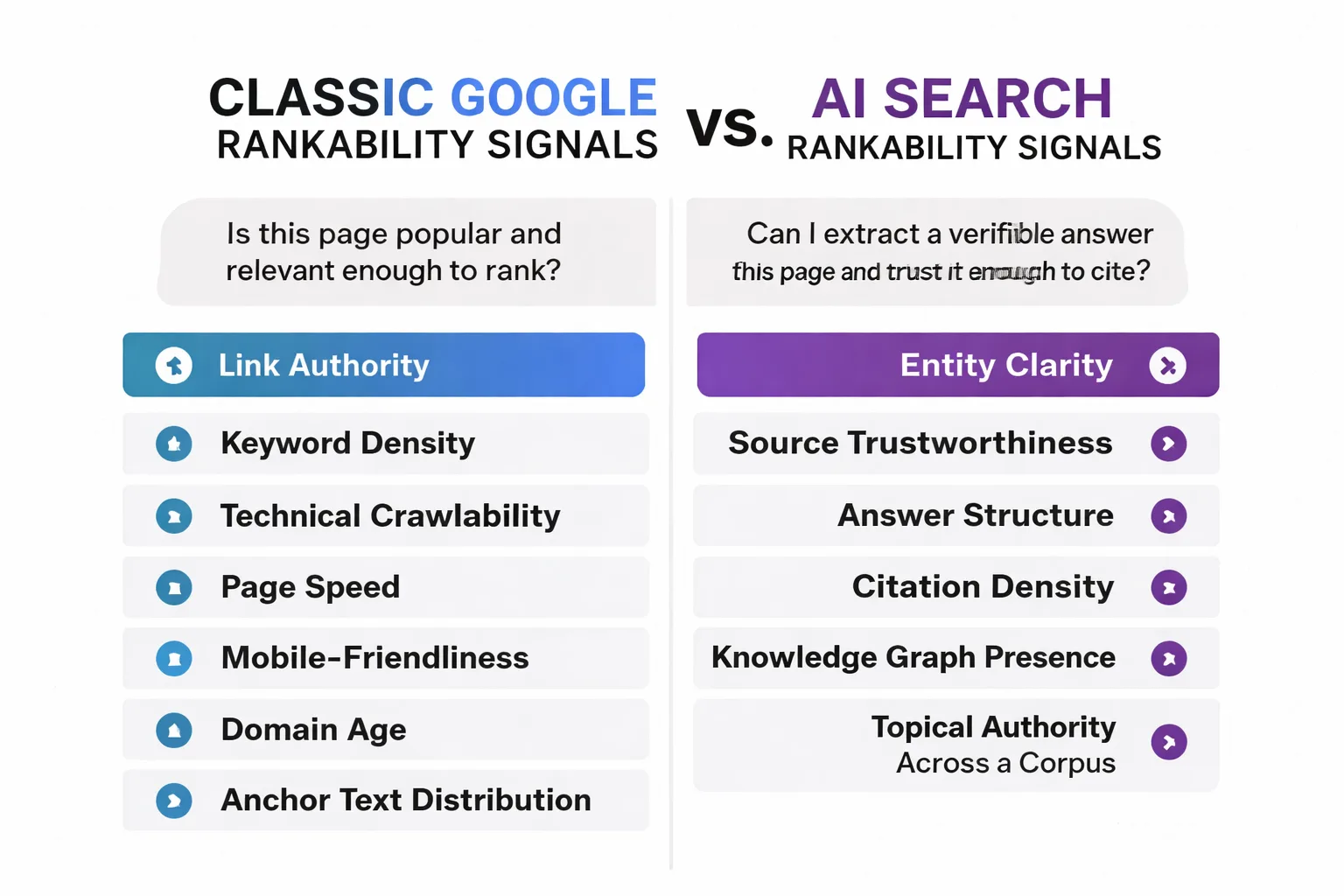
Classic Google rankability signals: link authority, keyword density, technical crawlability, page speed, mobile-friendliness, domain age, anchor text distribution. These signals answer one question: is this page popular and relevant enough to rank?
AI search rankability signals: entity clarity, source trustworthiness, answer structure, citation density, knowledge graph presence, topical authority across a corpus. These signals answer a different question: can I extract a verifiable answer from this page and trust it enough to cite?
The distinction matters because the tools that measure classic rankability will not help you with AI search. You can have a perfect PageSpeed score, 500 referring domains, and a #1 Google ranking, and still get zero citations in ChatGPT. I have seen this pattern repeatedly. A page ranks #1 for a high-volume query on Google, but when you run the same query through Perplexity or Claude, the answer cites a different source entirely. Why? Because the #1 page buried its answer in a 2,000-word block of prose with no headers, no schema markup, and no outbound citations. The AI engine could not extract a clean answer from it.
Meanwhile, a smaller site with a concise, well-structured answer block, proper schema markup, and citations to primary sources gets cited instead. The AI engine does not care that the smaller site has a DR of 22. It cares that the answer is extractable and verifiable.
Let me break down the mechanics of why this happens. When Perplexity or Google AI Overviews generates an answer, it uses a retrieval-augmented generation (RAG) pipeline. The retrieval component fetches the most semantically relevant passages from its index. The generation component synthesizes those passages into a coherent answer and attaches citations. If your page's key information is buried in a long narrative paragraph, the retrieval system may not select it as a relevant passage. Even if it does, the generation system may struggle to extract a clean, citable claim from dense prose. The result is that your page gets skipped, even if it ranks #1 on Google.
This is why answer engine optimization requires a completely different playbook from traditional SEO. You are not optimizing for a crawler that evaluates popularity. You are optimizing for a language model that evaluates extractability and trust.
The Princeton GEO research team formalized this in their Generative Engine Optimization paper, which demonstrated that specific content modifications (adding statistics, citations, and quotes) measurably increase visibility in AI-generated responses. The old signals are not dead. Links still matter for crawlability and indexation. But they are no longer sufficient for AI rankability.
The 4 Factors That Drive Rankability in 2026
After auditing hundreds of pages and tracking AI citations across every major AI search surface, I have identified four factors that consistently predict whether content earns AI citations. These are the levers you can actually pull.
Factor 1: Topical Specificity
AI engines reward pages that go deep on a single, well-defined topic. A page that tries to cover five related topics superficially will lose to a page that covers one topic with depth and precision. This is because AI retrieval systems use semantic similarity to match queries to content. The more topically specific your page is, the higher its semantic similarity score for that exact query.
Think about it from the retrieval system's perspective. When a user asks "how to reduce churn in B2B SaaS," the AI engine retrieves passages that semantically match that query. A page titled "SaaS Metrics Guide" that has one paragraph about churn buried in section four will have a low semantic similarity score. A page titled "How to Reduce Churn in B2B SaaS: 7 Proven Strategies" that is entirely dedicated to churn reduction will have a high semantic similarity score. The retrieval system will favor the second page even if the first page has higher link authority.
Action: Pick one primary topic per page. Cover it exhaustively. Do not dilute it with tangential content.
Factor 2: Entity Grounding
AI engines need to know what your page is about at the entity level. Entity grounding means your content clearly identifies the entities it discusses (people, places, organizations, concepts) and connects them to established knowledge graphs like Wikidata, Wikipedia, and Google's Knowledge Graph. This is how AI engines verify that your content is about a real thing, not just a string of keywords.
When a language model encounters your content, it maps every entity to its internal knowledge graph. If your content mentions a company and the model has a strong entity node for that company (connected to attributes like industry, founding date, headquarters, key products), the model can verify your content is about a real thing. It can cross-reference. It can trust. If your content mentions an entity the model does not recognize, the model has no way to verify your claims. It will deprioritize your content in favor of a source that uses recognized entities.
Action: Use schema markup to define entities. Link to Wikidata and Wikipedia entries for key concepts. Ensure your brand entity exists in major knowledge graphs. If you need to verify your entity markup is machine-readable, the LLMs.txt validator is a free tool that checks whether your content is properly structured for AI retrieval.
Factor 3: Answer-Formatted Content
This is the factor most teams miss. AI engines extract answers from content that is formatted as answers. If your page buries the key insight in paragraph three of a 1,500-word essay, the AI engine may not find it. If your page opens with a concise, direct answer to the implied question, and then elaborates with supporting evidence, the AI engine can extract that answer block and cite your page as the source.
The mechanics here are straightforward. RAG-based retrieval systems chunk content into passages of roughly 100-200 tokens. Each chunk is evaluated for semantic relevance to the query. If your key answer is a concise, self-contained sentence at the top of the page, it forms a clean chunk that scores high on semantic relevance. If your answer is spread across multiple paragraphs with transitions and context, it gets fragmented across chunks, each of which scores lower on relevance.
Action: Start every page with a direct answer to the query it targets. Use H2s and H3s that mirror how people ask questions. Format key claims as standalone, quotable sentences.
Factor 4: Citation Velocity from Authoritative Sources
AI engines trust pages that cite authoritative sources. This is not just about outbound links. It is about demonstrating that your content is built on a foundation of verifiable evidence. The Princeton GEO paper proved that adding citations and statistics to content measurably increases its visibility in AI-generated responses. Pages that cite primary sources, link to peer-reviewed research, and reference established authorities get cited more often by AI engines.
There is also an inbound dimension. When authoritative third-party sources cite your brand, AI engines encounter your entity more frequently in their training and retrieval corpora. According to Semrush's AI visibility research, 84% to 89% of AI-generated answers come from earned media, meaning third-party coverage in credible publications dramatically outperforms owned content for AI citations. This is why I have shifted my own strategy toward what I call Machine Relations: actively pursuing mentions from high-authority external sources because that is what AI models actually cite.
The inbound citation game is where most teams lose. They focus on building authoritative content on their own domain, but they neglect the earned media and third-party coverage that AI engines actually prefer. If your brand is only mentioned on your own website and your own blog, AI engines have limited exposure to your entity. If your brand is mentioned across 15 authoritative third-party publications, AI engines encounter your entity repeatedly in their training data and retrieval indices. That repetition builds trust at the model level.
Action: Cite primary sources in every article. Pursue earned media coverage. Track which sources AI engines cite most for your topics using a tool like Meev's Citation Path to find and pitch those publishers directly.
Do you know which queries AI engines cite your competitors for instead of you?
How to Diagnose Your Own Rankability Gap
Most teams have no idea how visible they are in AI search. They track their Google rankings religiously but never check whether ChatGPT, Perplexity, or Claude cites them. This is a blind spot that will cost you traffic in 2026 and beyond.
Here is a repeatable audit process to diagnose your rankability gap. I use this framework in my own work, and it works whether you have a 10-page site or a 10,000-page site.
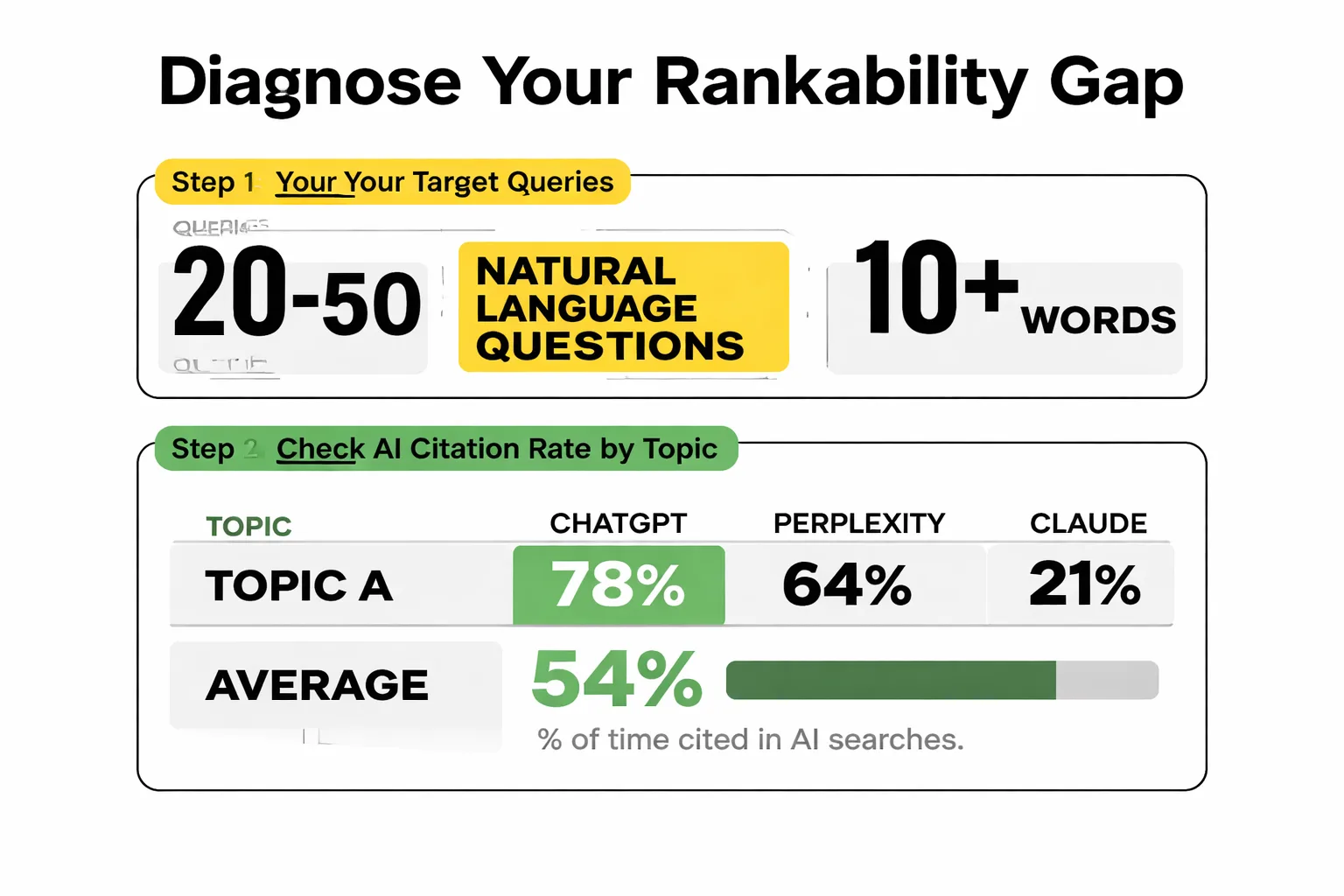
Step 1: Map Your Target Queries
List the 20-50 queries that matter most to your business. These are not just keyword targets. They are the natural language questions your customers type into ChatGPT or Perplexity. Think about how people actually ask these questions in conversation, not how they type into Google. A Google searcher types "email marketing software." A ChatGPT user asks "what is the best email marketing software for a 5-person e-commerce team?" The queries are longer, more conversational, and more specific.
Step 2: Check AI Citation Rate by Topic
Run each query through every major AI search surface (ChatGPT, Claude, Gemini, Perplexity, Grok, Google AI Overviews, AI Mode, DeepSeek). Record whether your brand is mentioned, where in the answer it appears (first, in a list, last), and which sources are cited instead of you. This is tedious to do manually, which is why platforms like Meev exist. Our enterprise AI rank tracker automates this across all major surfaces with daily refresh on SERP-driven surfaces and rolling refresh on LLM-driven surfaces.
The position of your mention matters enormously. Being cited first in an AI answer is the equivalent of ranking #1 on Google. Being cited last in a list of five sources is the equivalent of ranking #5. But there is a critical difference: AI answers synthesize information from multiple sources, so being cited at all means your content contributed to the answer. A last-place citation still drives brand awareness and referral traffic. A first-place citation establishes you as the primary authority.
Step 3: Identify Which Pages Are Sourced vs. Skipped
For each query where you are cited, identify which page on your site the AI engine is sourcing. For each query where you are not cited, identify which competitor page is being sourced instead. This tells you exactly which pages have high AI rankability and which ones need work.
I did this audit for a client last quarter. They had 80 blog posts but were only cited by AI engines for 6 queries. All 6 citations came from 3 specific pages. The other 77 pages were invisible. When I analyzed the 3 cited pages versus the 77 invisible pages, the pattern was clear. The cited pages had concise answer blocks at the top, schema markup, outbound citations to primary sources, and strong topical specificity. The invisible pages were long-form essays with no structure, no schema, and no citations. The fix was not to write more content. The fix was to restructure the existing content.
Step 4: Map Gaps to the Four Factors
For each page that is being skipped by AI engines, diagnose why. Is it lacking topical specificity? Is the entity not grounded in knowledge graphs? Is the content not answer-formatted? Is it missing citations to authoritative sources? Map each gap to one of the four factors and create a remediation plan.
This audit will give you a clear picture of your AI rankability gap. Most teams find that 60-80% of their pages are invisible to AI engines, even when those pages rank well on Google. That number should stop you cold.
Why Does Entity Grounding Matter So Much?
Entity grounding is the single most underrated factor in AI rankability, and I want to explain why it matters more than most SEO teams realize.
When a language model encounters your content, it does not just read the words. It tries to map every noun, every concept, and every entity in your content to its internal knowledge graph. If your content mentions "Klaviyo" and the model has a strong entity node for Klaviyo in its knowledge graph (connected to attributes like "email marketing platform," "founded in 2012," "headquartered in New York"), the model can verify your content is about a real thing. It can cross-reference. It can trust.
If your content mentions an entity the model does not recognize, the model has no way to verify your claims. It will deprioritize your content in favor of a source that uses recognized entities. This is why building your entity presence in Wikidata, Wikipedia, and Google's Knowledge Graph is not optional. It is the foundation of AI rankability.
Here is what entity grounding looks like in practice. Say you publish a page about "AI-powered customer support tools." If your page mentions specific tools like Intercom, Zendesk, and Drift, the AI engine can verify those entities because they exist in its knowledge graph. If your page also mentions your own product but your product does not have a Wikidata entry, a Wikipedia page, or structured schema markup identifying it as an entity, the AI engine cannot verify it. It will cite the page that mentions Intercom and Zendesk (verifiable entities) instead of your page that mentions your unverified product. Your own product is invisible to the AI engine because it does not exist as an entity.
I have seen pages jump from zero AI citations to consistent citations after the brand created a Wikidata entry and added structured entity markup to their site. The content did not change. The entity grounding did. If you want to go deeper on this, our AEO vs. SEO guide breaks down how entity signals work differently in answer engines versus traditional search.
When Should You Prioritize Rankability Over Traditional SEO?
This is the question I get from founders and marketing leaders more than any other. The answer depends on where your audience is searching.
If your audience still primarily uses Google (and for many B2B and enterprise audiences, they do), traditional SEO still matters. You need Google rankings. But here is the shift I am seeing in 2026: the teams winning search visibility are treating rankability as a dual-track problem. They optimize for Google's link-based authority signals AND for AI engines' entity and extraction signals. These are not mutually exclusive. Schema markup helps both. Authoritative citations help both. Answer-formatted content helps both.
The mistake is thinking you have to choose. You do not. But you do need to prioritize. If your analytics show that AI-referred traffic is growing while Google organic is flat or declining, it is time to shift resources toward AI rankability. If you are not tracking AI referrals yet, start. Google Analytics will show ChatGPT, Perplexity, and Claude as referral sources. If those numbers are growing, your rankability gap is costing you real traffic.
Let me give you a framework for deciding. Pull your last 90 days of Google Analytics 4 data. Filter your traffic sources for chatgpt.com, perplexity.ai, claude.ai, and gemini.google.com. If AI-referred traffic is less than 2% of your total organic traffic, you are in the early adoption phase. Keep optimizing for Google but start building entity presence and structured data. If AI-referred traffic is between 2% and 8%, you are in the acceleration phase. It is time to actively diagnose and close your rankability gap. If AI-referred traffic is above 8%, you are in the shift phase. AI search is a meaningful channel, and you need a dedicated AI visibility strategy, not just a side project.
For teams that want to track this systematically, an AI SEO tool that monitors both classic SERP positions and AI citation rates gives you the dual-track visibility you need without manual spot-checking.
The Reddit Trap: What Everyone Gets Wrong About AI Citations
Here is my contrarian take. Every SEO forum and marketing subreddit right now has someone claiming that Reddit is the secret to AI visibility. The advice is everywhere: get mentioned on Reddit, and AI engines will cite you. This was partially true in 2024. It is dangerously wrong in 2026.
Kevin Pike, a practitioner who monitors 100 AI prompts daily, published data showing that Reddit citations collapsed 80% in three months. In January 2026, Reddit appeared as a top-10 cited source with 622 citations across his tracked prompts. By the last 30 days of his tracking window, Reddit had dropped to 122 citations and was ranking 30th to 50th among cited sources. That is not a dip. That is a structural deprioritization.
The reason is manipulation. Agencies have been building 800+ Reddit profiles using foreign-based resold software to game AI citations. The LLMs caught on. As Pike observed, "LLMs still pull from Reddit when stronger sources are thin, but it's no longer a primary signal." I tried leaning into Reddit for a quick visibility boost last year, and the results were underwhelming. The visibility just was not translating across all the AI tools I track.
If you are building your 2026 AI visibility strategy on Reddit mentions, you are building on sand. The pattern I keep seeing is that a comprehensive signal graph built on owned first-party content, structured schema, and distributed authoritative coverage is the only reliable way to establish entity verification for AI engines. Reddit is a shortcut, and shortcuts get closed.
What This Won't Fix
I want to be honest about the boundaries of rankability optimization. Improving your rankability will not fix a product nobody wants. It will not generate demand for a category that does not exist. And it will not save you if your brand has a reputation problem that AI engines have already picked up in their training data.
Rankability optimization assumes you have something worth citing. If your content is factually wrong, outdated, or commercially biased without disclosure, no amount of schema markup or entity grounding will make AI engines trust you. In fact, AI engines are getting better at detecting commercial bias and deprioritizing content that reads like a sales pitch disguised as information. The AEO vs. GEO comparison breaks down how different optimization approaches handle this trust threshold.
Here is a specific scenario I see teams stumble on. They restructure their content for AI extractability, add schema markup, and build entity presence. Their AI citations increase. But the citations are for queries that do not drive business outcomes. They get cited for "what is [their industry]" but not for "best [their product category] for [their target audience]." Rankability optimization gets you cited. It does not get you cited for the right queries. You still need to choose your target queries strategically, map them to business intent, and ensure your content genuinely answers those queries better than any competitor.
Where Rankability Goes Next
The definition of rankability will keep evolving. As AI search engines become more agentic (capable of taking actions, not just generating text), the signals that drive rankability will shift again. Agentic SEO is the next frontier. When an AI agent can browse the web, compare options, and make a purchase recommendation, your rankability depends not just on being cited but on being the most actionable, verifiable source the agent encounters.
This means structured data will matter even more. Product schemas, FAQ schemas, HowTo schemas, and organization schemas will become the primary way AI agents understand what your page offers and whether it meets the user's intent. If you are not implementing schema markup today, you are already behind for what is coming.
I also expect citation tracking to become more sophisticated. Ahrefs has already studied 75,000+ brands and millions of AI citations across multiple AI search engines to understand how websites get cited in generative search results. As more data becomes available, the four factors I outlined above will get more precise. We will be able to quantify exactly how much each factor contributes to citation probability for specific queries and specific AI engines.
The other shift I am watching is the move from static retrieval to dynamic browsing. When an AI agent browses the web in real time (as ChatGPT's browsing mode and Perplexity's Sonar API already do), your content's freshness and update frequency become rankability signals. A page that was last updated in 2024 may get deprioritized in favor of a page updated last week, even if the older page has higher authority. This is because dynamic browsing systems can check modification dates and prefer recent information. If you are not updating your key pages regularly, you are losing rankability to competitors who do.
For now, the teams that win will be the ones that treat rankability as a measurable, improvable metric. Not a vibe. Not a checklist. A metric you track, diagnose, and optimize week over week. If you want to see how your brand performs across every major AI search surface, check your AI visibility and find out exactly where you stand.
FAQ
What is the difference between rankability and domain authority?
Rankability measures the probability a specific page earns a citation or position for a specific query, factoring in entity grounding, answer structure, and citation velocity. Domain authority measures the aggregate link-based strength of an entire domain. A high-DA site can have low rankability for AI search if its content is unstructured and lacks entity clarity.
How is rankability measured for AI search engines?
AI search rankability is measured by tracking citation frequency across major AI surfaces (ChatGPT, Perplexity, Claude, Gemini, Google AI Overviews), monitoring mention position within answers, and comparing your citation rate to competitors for the same queries. Tools like Meev automate this tracking with daily refresh on SERP-driven surfaces.
Does improving rankability also improve Google rankings?
Yes, partially. Several rankability factors (topical specificity, authoritative citations, structured data) also benefit Google rankings. However, AI-specific factors like answer-formatted content blocks and entity grounding in knowledge graphs have a stronger impact on AI citations than on traditional SERP positions.
How long does it take to see rankability improvements in AI search?
AI search engines update their retrieval indices differently than Google crawls the web. Some surfaces refresh weekly, others monthly. In my experience, structured content changes can produce citation improvements within 2-4 weeks on Perplexity and Google AI Overviews, while ChatGPT and Claude may take longer due to less frequent retrieval updates.
Can you improve rankability without creating new content?
Yes. Adding schema markup, restructuring existing content into answer-formatted blocks, adding outbound citations to primary sources, and building entity entries in Wikidata can all improve AI rankability without writing new articles. However, new content designed specifically for AI extraction will always outperform retrofitted content.
Is rankability relevant for local businesses or only for SaaS and enterprise?
Rankability matters for any business whose customers use AI search. As of 2026, that includes local queries. When someone asks ChatGPT for a restaurant recommendation or a local service provider, the AI engine cites sources it can verify. Local businesses with strong entity presence, structured data, and authoritative local citations will win those mentions.
About the Author
Judy Zhou, Founder
Judy Zhou leads content strategy at Meev, where she oversees AI-driven content research and publishing for hundreds of brands. With a background in SEO and editorial operations, she focuses on building content systems that rank on Google, get cited by AI search engines, and drive measurable business results.
Stop guessing about your AI visibility. See exactly where your brand is cited, where it is absent, and which content gaps are costing you citations across every major AI search surface.