

By Judy Zhou, Founder
Key Takeaways
- Semrush's 2025 study of 200,000 queries shows AI Overviews now dominate commercial-intent SERPs, so reports tracking only Google positions miss where buying decisions begin.
- 76.95% of URLs cited in AI answers fell outside the organic top 10, per OrganiKPI's analysis of 153,425 citations, proving strong rankings no longer guarantee visibility.
- Wikipedia supplies 22% of ChatGPT training data, making entity presence and structured data as critical as traditional page authority.
- Bloomfire increased AI referral traffic 30% by adopting agentic SEO optimization, a tactic absent from legacy rank trackers.
When Google published its original PageRank paper in 1998, search engine ranking reporting was almost laughably simple. Webmasters counted inbound links and watched their position on AltaVista shift. The sophistication of rank tracking evolved over the next twenty-five years into a discipline with hundreds of tools, billions in software revenue, and entire departments dedicated to it. Now, in a span of roughly thirty-six months, the emergence of AI-generated answers, LLM citations, and agentic search has forced that entire discipline to ask a question it hasn't faced since 1998: are we measuring the right thing at all?
The conventional wisdom about search engine ranking reporting is stuck in 2019. Semrush's 2025 AI Overviews study analyzed 200,000 queries and found that AI Overviews appear on a massive slice of commercial-intent SERPs, fundamentally changing what "position one" means. If your reports show Google positions but not AI citation rates, you are blind to where buying decisions actually start. 76.95% of cited URLs in AI answers fell outside the organic top 10, according to OrganiKPI's May 2026 analysis of 153,425 citations. Translation: you can rank well and still lose the AI answer. Wikipedia accounts for 22% of ChatGPT training data (ConvertMate, 2026), meaning entity presence matters as much as page authority. And Bloomfire grew AI referral traffic by 30% using agentic SEO optimization, a signal that does not exist in any traditional rank tracker.
Why Classic Ranking Reports Miss Half the Picture in 2026
A rank tracker tells you where you stand. It does not tell you where you are seen.
That distinction sounds semantic. It is not. When a buyer types a question into ChatGPT or Perplexity, they get a synthesized answer with citations. Your Google position three ranking might earn you a blue link click from someone who scrolls past the AI Overview. But if the AI engine cited your competitor as the primary recommendation, you lost the deal before the SERP even loaded.
In my work auditing content ops for founders, I see the same reporting blind spot repeatedly. Teams export a spreadsheet of keyword positions every Monday. They celebrate when "project management software" moves from position 7 to position 5. They never check whether ChatGPT mentions them when someone asks "best project management software for small teams." The rank tracker says they are winning. The AI engine says they are invisible.
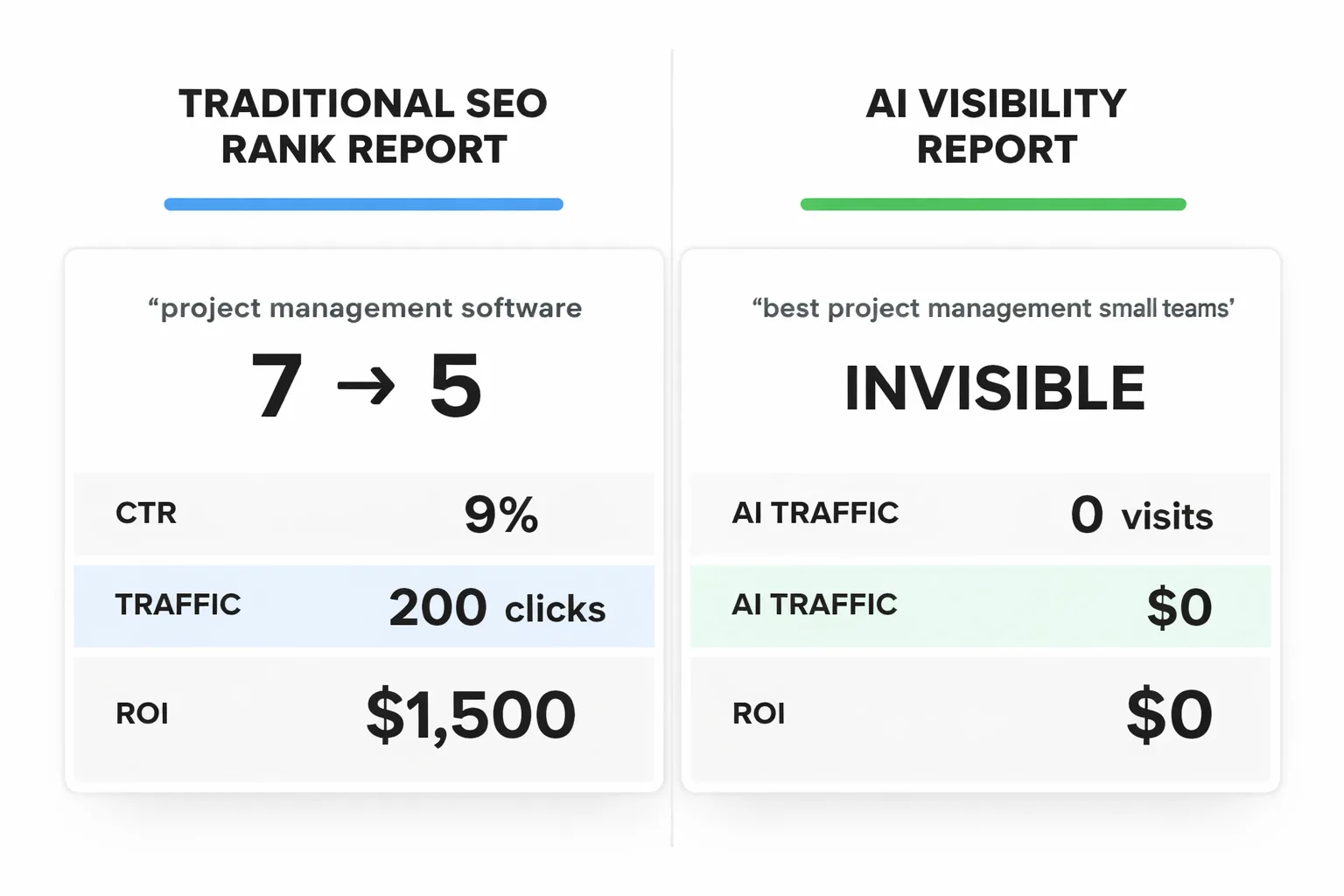
This is not a fringe problem. Seer Interactive monitored ChatGPT brand mentions for two years before testing an intervention. They changed their footer text from "Remote-First" to "130+ clients, 97% retention rate." ChatGPT adopted the new phrasing within 36 hours. That is a direct revenue-influencing change that produces zero movement in any traditional SEO ranking report. If Seer had been monitoring only Google positions, they would have missed the entire opportunity.
The gap is even wider for B2B founders. I initially thought AI visibility tools would give me a straightforward metric to optimize for: brand mention rate. More mentions equals more leads, right? Wrong. What I learned is that context matters more than volume. An AI can cite your brand as a "good starting point" before recommending a more advanced competitor. Your mention rate goes up. Your lead quality goes down. Traditional search engine ranking reporting has no column for "how the AI framed us."
Here is the core problem: a LinkedIn analysis argues AI visibility reports can give "false confidence" if they track raw mentions without context. You need both the classic position data and the AI citation data, plus the narrative framing, to understand your actual search visibility. Most founders have none of the three in a single report.
Let me make this concrete with a scenario I see weekly. A founder pulls up their Ahrefs dashboard. Position 4 for "best inventory management software." Position 6 for "cloud inventory tracking." They feel good. Then I ask them to type "what is the best inventory management software for a D2C brand doing $2M in revenue" into ChatGPT. The response recommends three competitors. Their brand is nowhere. The founder is stunned. "But we rank on page one of Google." Yes, for keywords. Not for prompts. And buyers are increasingly typing prompts, not keywords. That is the half of the picture your classic report misses.
What a Complete Search Engine Ranking Report Includes Today
The old reporting stack had three layers: keyword position, search volume, and estimated traffic. The new stack has six. Here is what belongs in a modern report.
Layer 1: Classic SERP positions. Still matters. Google drives real traffic. Track your top 50-100 keywords with weekly position data. Include SERP feature occupancy: featured snippets, People Also Ask, image pack, local pack. This is your baseline.
Layer 2: AI Overview presence. Does Google's AI Overview cite your domain for your target queries? This is separate from organic position. Semrush found that AI Overviews appear on a significant percentage of informational queries, and the citation does not always go to the position-one organic result. Track AI Overview citation rate as its own metric.
Layer 3: LLM citation rate by engine. This is where LLM citation tracking becomes essential. For each target prompt (not just keyword, but the actual question a user types into ChatGPT), track: does the engine mention your brand? Where in the response (first, in a list, last)? What source does it cite as evidence? OrganiKPI's study of 153,425 citations found 76.95% of cited URLs were outside the organic top 10, which means your AI citation profile can diverge wildly from your SERP profile.
Layer 4: Source-level attribution. When Perplexity cites a source for your topic, what domain does it link to? If it cites a competitor's blog post, you need to know. If it cites a third-party review site, you need to know that too. Ekamoira's LLM citation analysis shows that AI engines favor specific source types: authoritative databases, well-structured content, and pages with clear entity signals. Track which domains own the citations for your topics.
Layer 5: Entity and knowledge graph presence. Does your brand exist in Wikidata? Do your pages use sameAs schema linking to Wikipedia or Wikidata? WikiBusines notes that pages with sameAs schema links are "structurally advantaged for AI citation". No Wikipedia-level notability threshold is required to create a Wikidata entry. This is a fixable gap that most founders do not even know exists.
Layer 6: Share of voice across AI engines. What percentage of AI answers in your topic space cite you versus competitors? Riskonnect built 57% AI Share of Voice in a competitive market by combining SEO success with AI visibility strategies. That number is a north star metric for founder-led teams.
Here is what this looks like in practice. Imagine you run a project management SaaS. Your Layer 1 report shows you ranking position 3 for "task management software" with an estimated 2,400 monthly visits from that keyword. Layer 2 shows Google's AI Overview citing you for 3 of 10 tracked queries. Layer 3 shows ChatGPT mentioning you in 4 of 20 tracked prompts, but always third in a list of five. Layer 4 shows Perplexity citing G2.com and Capterra reviews as sources, not your blog. Layer 5 shows no Wikidata entry exists for your brand. Layer 6 shows your AI share of voice at 12% versus the market leader at 41%. That is a complete picture. Each layer tells you something different, and each demands a different response.
Without all six layers, you are optimizing blind. You might pour budget into climbing from position 3 to position 1 on Google while your AI share of voice stays flat at 12%. Or you might build backlinks while your entity grounding remains nonexistent, capping your AI citation potential regardless of how authoritative your domain becomes.
Do you know which AI engines cite your brand and which ones cite your competitors?
How Founders Should Read and Act on Ranking Reports
A report is only useful if it changes what you do next.
Most founders I work with get a ranking report, glance at the green arrows (up) and red arrows (down), and file it away. The report becomes a vanity document. Here is how to actually use it.
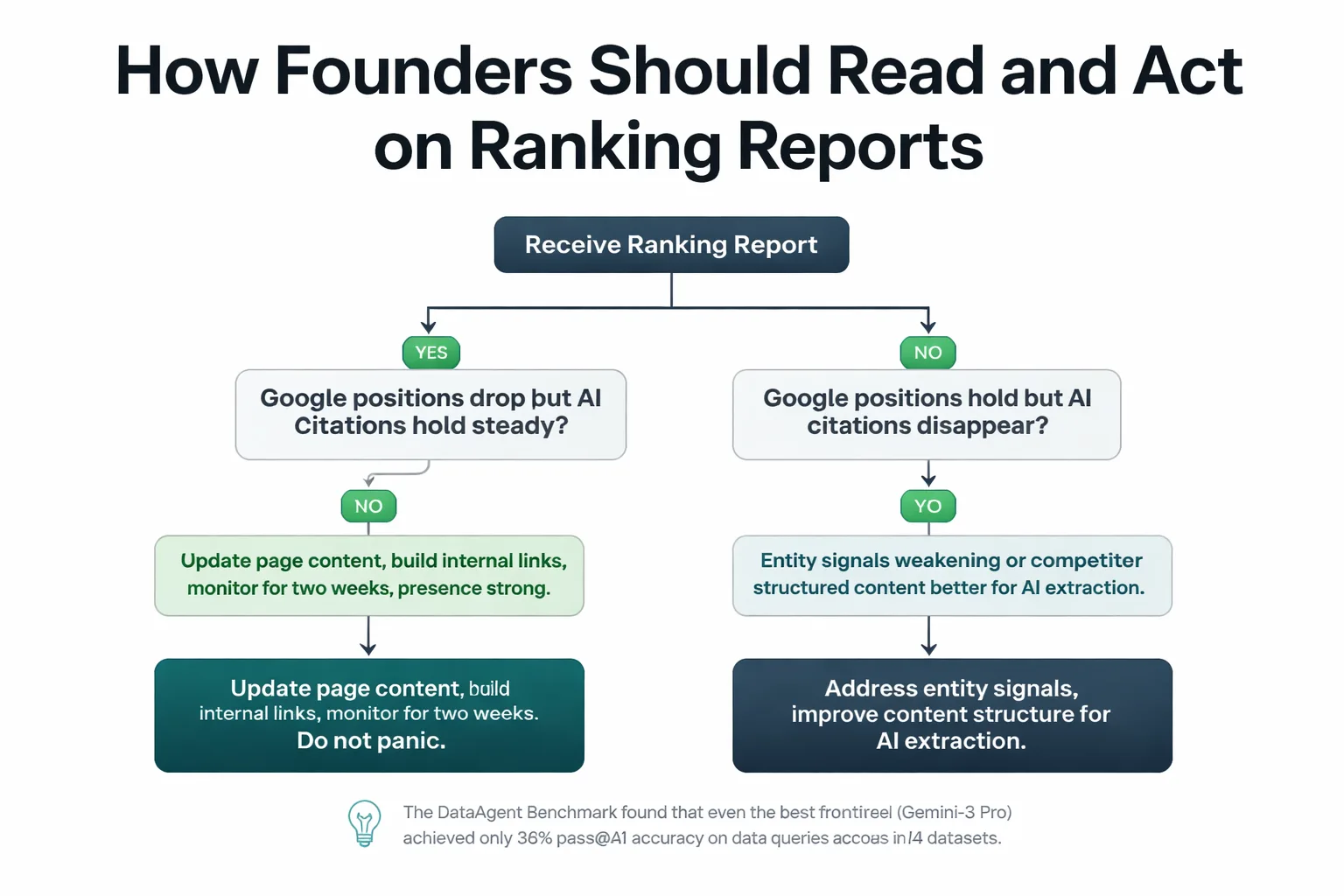
Scenario 1: Google position drops but AI citations hold steady. This usually means a competitor published fresher content or earned new backlinks. Your entity presence is strong enough that AI engines still cite you. Fix: update the page content, build internal links, and monitor for two weeks. Do not panic.
Scenario 2: Google positions hold but AI citations disappear. This is the scary one. It means your entity signals are weakening or a competitor has structured their content better for AI extraction. The Data Agent Benchmark found that even the best frontier model (Gemini-3-Pro) achieved only 38% pass@1 accuracy on data queries across 12 datasets, which tells you that AI engines are far from perfect at grounding. If your citations vanish, check: did you change your schema markup? Did a cited source go offline? Did a competitor publish a more comprehensive answer? Fix: audit your entity signals, update your knowledge graph presence, and ensure your content directly answers the prompts users type into AI engines.
Scenario 3: AI mentions you but frames you negatively. This is the hardest to detect and the most damaging. Seer Interactive's case study showed that AI engines pick up on specific phrasing from your site and repeat it verbatim. If your homepage says "affordable alternative to [competitor]," the AI will frame you as the budget option. Sometimes that is intentional. Often it is not. Fix: audit the language AI engines are extracting from your pages. Rewrite copy to control the narrative.
Scenario 4: Competitor is cited but you are absent. This is your content gap. The competitor has a page that directly answers a prompt AI engines receive. You do not. Fix: identify the prompt, write a better answer, and ensure it is structured for AI extraction. Use answer engine optimization principles: clear headings, concise answers, cited sources, and schema markup.
Prioritization for small teams. You cannot fix everything at once. Rank your issues by revenue impact: which AI citation gap costs you the most pipeline? If ChatGPT recommends a competitor for your highest-value query, fixing that is worth more than improving position 8 to position 6 for a low-volume keyword. Go Fish Digital achieved a 3X lead increase over three months using GEO strategy by focusing on prompt-level visibility rather than keyword-level ranking. That is the prioritization model founders should adopt.
Let me walk through a prioritization exercise I run with founders. List your top 10 revenue-driving prompts (the questions buyers ask AI engines that lead to evaluation). For each prompt, score three things on a 1-5 scale: citation presence (are you mentioned?), citation position (first, middle, last?), and framing (positive, neutral, negative). Multiply the three scores. Anything scoring below 30 is a priority fix. Anything above 75 can wait. This takes 20 minutes and tells you exactly where to spend your next sprint. No agency required. No complex tooling. Just a structured look at the data that matters.
The Tools That Cover Both Classic and AI Ranking
Most SEO tools were built for a world that no longer exists.
The market is split. On one side, you have classic rank trackers that do Google positions well but have no AI citation monitoring. On the other, you have AI visibility tools that track ChatGPT mentions but do not connect them to your SEO performance. Founders end up paying for two tools, exporting two reports, and manually stitching them together in a spreadsheet every week.
What you need is a unified reporting layer. Here is what to look for.
Google rank data with SERP feature tracking. Your tool should track not just positions but also SERP feature occupancy: featured snippets, People Also Ask, AI Overviews, local packs. Google Search Console integration is table stakes. You need CTR and impression data alongside position data to understand whether a ranking actually drives traffic.
AI citation monitoring across every major AI search surface. Not just ChatGPT. Not just Perplexity. You need Claude, Gemini, Grok, Google AI Overviews, AI Mode, and DeepSeek covered. Each engine has different citation patterns. Linkup's technical benchmark showed 2-3x higher source diversity versus competitors, which means the sources AI engines cite vary significantly depending on the retrieval system. Your tool needs to track all of them.
Mention position tracking. Where in the AI response does your brand appear? First mention matters. Last mention in a list of five is barely better than absent. Otterly AI's citation tracking guide emphasizes that position within the response is a stronger signal than raw mention count.
Source attribution. When an AI engine cites a source for your topic, your tool should tell you which domain got the citation. This is your link-building target list. If Perplexity consistently cites a specific industry blog for your topic, you need a relationship with that blog.
Entity and knowledge graph tracking. Your tool should flag whether your brand has Wikidata presence, whether your schema markup includes sameAs links, and whether your entity is recognized across AI engines. Alation's grounding guide emphasizes that "a capable model is not the same as a reliable one," and the same applies to your brand: being present in Google is not the same as being grounded in AI.
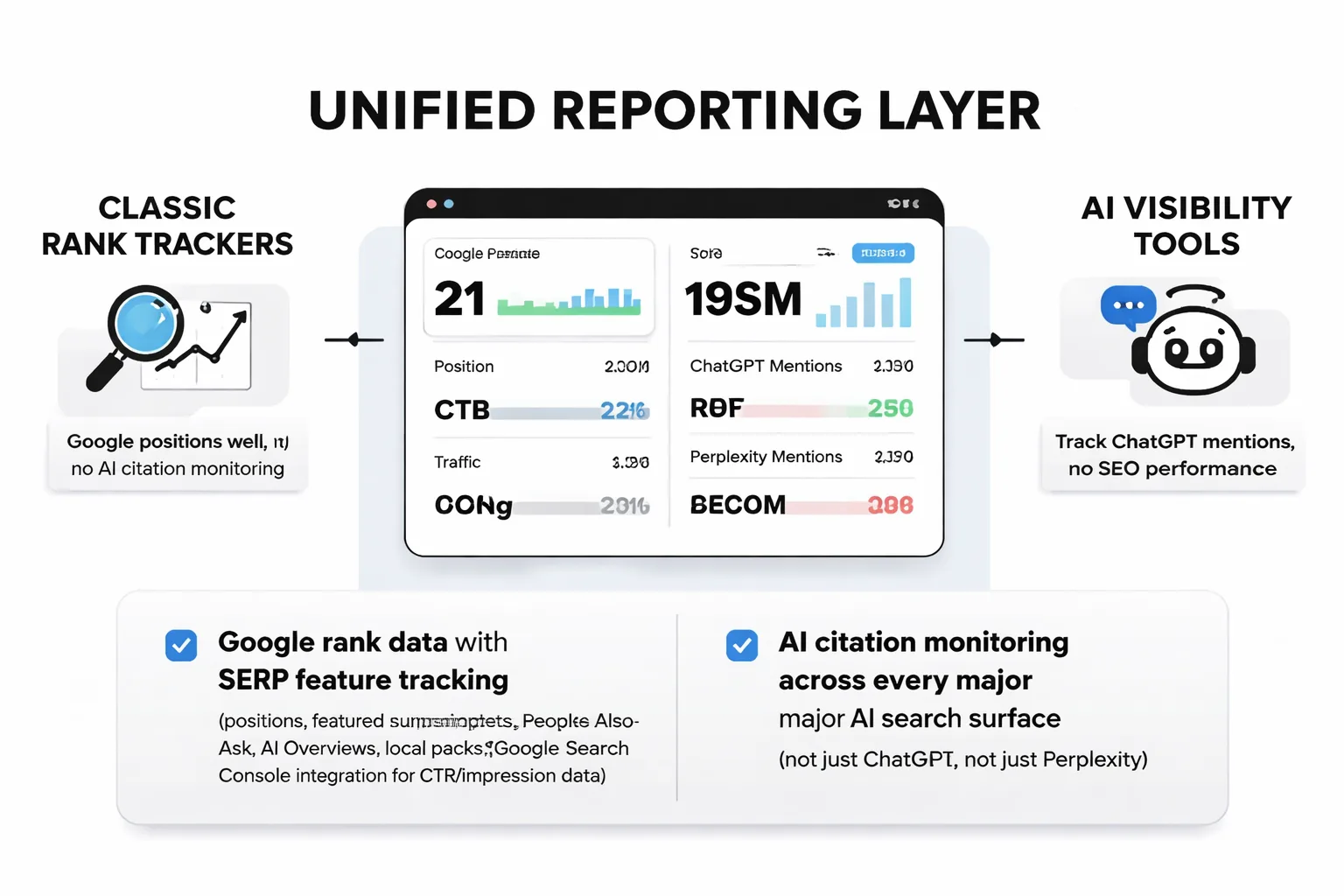
In my work at Meev, I have seen what happens when founders get both data sets in one view. The "aha" moment is always the same: they realize their Google rankings and their AI citations tell completely different stories. The keyword they rank position two for on Google has zero AI citations. The prompt where ChatGPT recommends them has no corresponding keyword they track. The unified report connects those dots.
Overdrive Interactive achieved 710% AI Overview growth using a combined SEO and AI visibility strategy. That kind of growth does not happen by tracking one surface. It happens when you see the full picture.
When evaluating tools, ask three questions. First, does it track both classic SERP positions and AI citations in the same dashboard? If you need two logins, it is not unified. Second, does it show you the actual AI response text behind each citation, not just a binary "mentioned / not mentioned"? The response text is where you spot framing problems. Third, does it connect citation gaps to content opportunities? A tool that tells you what is wrong but not what to do about it is half a tool. The value is in the closed loop: diagnose the gap, write the content, publish, and re-measure.
What Does Generative Engine Optimization Mean for Reporting?
Generative engine optimization (GEO) changes what you measure because it changes how users find you. In traditional SEO, the user types a keyword, scans the SERP, and clicks a result. In GEO, the user types a prompt, reads a synthesized answer, and may never click anything. Your success metric shifts from "did they click my link" to "did the AI cite me as the answer."
This means your reporting needs a new column: citation rate by prompt. Not by keyword. By prompt. The difference matters. A keyword like "CRM software" tells you what people search for. A prompt like "what is the best CRM for a 5-person startup" tells you what they actually ask AI engines. Search Engine Land's analysis of prompt-level visibility argues that prompt-level tracking is the missing layer in most SEO reporting stacks.
For founders, the practical implication is this: stop tracking only keywords. Start tracking prompts. Build a list of 20-50 prompts your buyers type into ChatGPT and Perplexity. Monitor citation rate, mention position, and framing for each. That is your AI search visibility report.
Here is how to build that prompt list without guesswork. Start with your sales calls. Every time a prospect says "I was looking for..." or "I asked ChatGPT about...", write down the exact phrasing. After 20 sales calls, you will have 15-30 real prompts. Supplement with your customer support tickets. What questions do users ask before they sign up? Those are prompts. Finally, check your Google Search Console queries. The long-tail, question-shaped queries ("how does X compare to Y", "what is the best X for Z") are your prompt candidates. Filter for queries with impressions but low CTR. Those are questions where Google showed your page but users did not click, likely because the AI Overview answered them directly. Those are your highest-priority prompts to track.
Why Does Entity Grounding Affect AI Citations?
Entity grounding is the mechanism AI engines use to verify that a brand is real, relevant, and authoritative. If your brand is not grounded in the knowledge graph, AI engines are less likely to cite you because they cannot verify your existence with high confidence.
Think of it this way. Google's ranking system evaluates pages. AI citation systems evaluate entities. A page can rank well without strong entity signals. But an AI engine is less likely to cite a brand it cannot ground in structured data.
WikiBusines positions Wikidata as foundational for AI entity recognition. The entry does not need Wikipedia-level notability. You can create a Wikidata entry for your brand, add sameAs schema links from your site, and ensure your entity is disambiguated from similarly named companies. Astiva AI's guide to Wikipedia and AI visibility notes that Wikipedia accounts for 22% of ChatGPT training data, which means Wikipedia presence (or absence) directly shapes how AI engines understand your brand.
For your ranking report, add an entity grounding section: Wikidata presence (yes/no), Wikipedia presence (yes/no), sameAs schema links (count), branded knowledge panel (yes/no). If any of these are missing, that is a structural disadvantage you can fix in a weekend.
The mechanics of entity grounding are simpler than most founders think. Step one: go to Wikidata.org and search for your brand. If it does not exist, create an entry. You need a few properties: your official website URL, your company type, your industry, and your founding date. Step two: add sameAs schema to your homepage. This is a single line of JSON-LD that tells search engines and AI models "this entity is the same as the one in Wikidata." Step three: ensure your About page contains structured information (founding date, location, leadership names) that matches your Wikidata entry. Consistency across sources is what builds entity confidence. Alation's grounding guide emphasizes that grounding is about creating verifiable, consistent signals, not gaming a system.
How Does Agentic SEO Change the Reporting Cadence?
Traditional SEO reporting runs on a weekly or monthly cycle. You pull positions, compare to last week, write a summary, send it to stakeholders. Agentic SEO does not wait for weekly cycles.
Siteimprove describes agentic SEO as operating "continuously and proactively", scanning for new search trends and aligning content with user intent in real time. This means your reporting needs to shift from periodic snapshots to continuous monitoring.
For founders, this is actually good news. You do not have time to build weekly reports manually. An agentic SEO system monitors your AI visibility daily, flags citation changes as they happen, and surfaces content opportunities automatically. BlazeHive ranked 500+ keywords in Google's top 3 within five months using an agentic approach. The reporting cadence for that kind of growth is not monthly. It is continuous.
The practical shift: your search engine ranking reporting should move from a document you produce to a dashboard you monitor. Stop exporting spreadsheets. Start watching trends.
Think about the difference between a weekly report and continuous monitoring in concrete terms. With a weekly report, you discover on Monday that your ChatGPT citation for "best CRM for startups" disappeared sometime in the last seven days. You do not know when. You do not know what changed. You do not know if a competitor published something new or if ChatGPT updated its model. With continuous monitoring, you get an alert the same day the citation drops. You can check what changed, respond with a content update, and potentially recover the citation within 48 hours. That is the difference between reactive reporting and proactive visibility management. For a founder where every lead matters, that 5-day head start can be the difference between winning and losing a quarter's worth of pipeline.
The Contrarian Take: Stop Tracking Keywords First
Here is what most founders get wrong about search engine ranking reporting in 2026: they start with keywords.
I know that sounds backwards. Keywords are the foundation of SEO. But in the AI search era, keywords are the wrong starting point because they describe search behavior, not answer behavior. When someone asks ChatGPT "how do I reduce churn for my SaaS," there is no keyword. There is a prompt. And the prompt maps to an answer, not a SERP.
Start with prompts. Build your reporting around the questions your buyers actually ask AI engines. Then map those prompts back to keywords for your traditional SEO tracking. The prompt list is your strategy. The keyword list is your execution. Most founders reverse this order and end up optimizing for a SERP that fewer people see.
The Data Agent Benchmark showed that even Gemini-3-Pro achieved only 38% accuracy on complex data queries, which means AI engines are still figuring out how to ground their answers. Your job is to make it easy for them. That starts with understanding what they are asked, not what ranks.
The pushback I hear from founders is predictable: "But my SEO agency tracks 500 keywords. Are you saying that is useless?" No. I am saying it is incomplete. Keyword tracking tells you where you stand on Google. Prompt tracking tells you where you stand in AI answers. You need both. But if you can only afford to do one well, start with prompts. The reason is simple: Google positions are a mature discipline with thousands of tools and agencies optimizing for them. AI citations are a frontier where most of your competitors are not even tracking yet. The arbitrage opportunity is in the gap between what everyone measures (keywords) and what almost no one measures (prompts). That gap will close over the next 18-24 months. While it is open, prompt-level reporting is your unfair advantage.
How Do AI Search Engine Optimization Tools Fit the Stack?
AI search engine optimization tools fill the gap between traditional SEO platforms and pure AI visibility trackers. They do not just track where you appear. They help you close the gap between where you are cited and where you are absent.
The category includes tools that monitor AI citations, track share of voice, and generate content designed to earn citations. Bloomfire grew AI referral traffic by 30% by making its content AI-ready through agentic SEO optimization. That is not a ranking change. It is a structural content change that made Bloomfire's existing content more extractable by AI engines.
When evaluating AI search engine optimization tools, look for three capabilities. First, diagnostic depth: can the tool tell you not just that you are absent from an AI answer, but why? Is it an entity problem, a content gap, or a source authority issue? Second, actionability: does the tool connect the diagnosis to a specific fix? "You are not cited for this prompt" is a diagnosis. "Write a 1,200-word explainer answering this prompt with these three sources cited" is an action. Third, closed-loop measurement: after you publish the fix, does the tool re-measure your citation rate for that prompt and confirm the improvement? Without the closed loop, you are guessing.
The biggest mistake founders make with these tools is treating them as dashboards. A dashboard is passive. It shows you data. What you need is a system that turns data into decisions, decisions into content, and content into measurable citation improvements. That is the difference between an AI visibility tool and an AI search engine optimization platform.
When Should You Hire a Generative Engine Optimization Agency?
Most founders do not need a generative engine optimization agency in the early days. You need a tool, a prompt list, and the discipline to check it weekly. But there is a tipping point.
If you are spending more than 10 hours per week manually tracking AI citations, building content to fill citation gaps, and monitoring competitor mentions across AI engines, you have outgrown the DIY approach. At that point, a generative engine optimization service can take over the execution while you focus on strategy.
The challenge is that most agencies claiming GEO expertise are traditional SEO shops that added an "AI" page to their website last month. The debate in the industry is real: some practitioners argue AI visibility reporting is "snake oil" because the metrics are noisy and the engines change constantly. Others point to documented wins like Seer Interactive and Go Fish Digital as proof that GEO works when done right.
My take: the skepticism is warranted for tools that sell raw mention counts without context. It is not warranted for the discipline itself. Go Fish Digital 3X'd leads using GEO strategy over three months. That is a measurable business outcome, not a vanity metric. The question is not whether GEO works. It is whether the specific agency or tool you hire can connect GEO activity to pipeline impact. Ask for case studies with revenue numbers, not just citation counts.
If you do hire an agency, make sure your reporting stack still runs in-house. You should own the data. The agency should execute against it. If the agency controls the dashboard, you have no way to verify their work when they claim "your AI visibility improved 40% this month." Use an independent AI visibility tracker to audit their results.
FAQ: Ranking Reporting Basics
Is paying someone to do SEO worth it?
Yes, if the person or agency tracks both SERP positions and AI citations. Paying for traditional SEO only (keyword tracking, backlink building, on-page optimization) is worth less in 2026 than it was in 2023 because it ignores where buying decisions increasingly start: AI answers. If your SEO provider cannot tell you your AI citation rate or share of voice across ChatGPT and Perplexity, you are paying for half a service. The ROI threshold is whether they can connect ranking changes to AI visibility changes to pipeline impact.
How much does SEO typically cost?
For small companies, SEO retainers range from $1,500 to $5,000 per month for a competent freelancer or small agency. Mid-market agencies charge $5,000 to $15,000 per month. AI visibility tracking and generative engine optimization services add $500 to $3,000 per month on top, depending on the number of prompts and engines tracked. For founders, the cost-effective path is a tool that combines both (like Meev's AI visibility platform) plus internal time for content creation, rather than outsourcing the entire function.
What is the 80/20 rule in SEO?
The 80/20 rule in SEO means 80% of your results come from 20% of your efforts. In traditional SEO, that 20% is usually: a handful of high-intent keywords, a few authoritative backlinks, and solid technical fundamentals. In AI-era SEO, the 80/20 shifts: 80% of your AI citation visibility comes from entity grounding (Wikidata, schema, sameAs links), direct answer content for your top 20 prompts, and being cited by the sources AI engines trust. Focus on those before anything else. A unified reporting tool that shows you which 20% is actually driving results saves months of wasted effort.
What This Actually Means for Founders
Search engine ranking reporting in 2026 is not an evolution of the 2019 version. It is a different discipline. The old version answered: where do I rank on Google? The new version answers: where am I seen, by whom, and in what context?
If your reporting stack cannot answer all three questions, you are flying blind. Not partially blind. Fully blind, because the half you cannot see is the half where your buyers are making decisions.
The founders who win the next three years of search visibility will not be the ones with the most keywords tracked or the most backlinks built. They will be the ones who saw the full picture: Google positions, AI citations, entity grounding, and narrative framing, all in one report, acted on weekly. That is the bar. Check your AI visibility across every major AI search surface and see what your current reports are missing.
About the Author
Judy Zhou, Founder
Judy Zhou leads content strategy at Meev, where she oversees AI-driven content research and publishing for hundreds of brands. With a background in SEO and editorial operations, she focuses on building content systems that rank on Google, get cited by AI search engines, and drive measurable business results.
Stop guessing at your AI search visibility. Run a full diagnostic across every major AI search surface and see exactly where you are cited, where you are absent, and what to fix first.