

By Judy Zhou, Founder
Key Takeaways
- Competitive intelligence tools miss the 58% of marketers who say AI-referred visitors convert at higher rates than organic traffic, per HubSpot's 2026 State of Marketing report.
- Brands tracking backlink profiles and SERP share-of-voice to six-figure precision still have zero data on how often ChatGPT cites competitors in buying-cycle prompts.
- LLMs maintain a 94% link validity frontier while producing daily citation shifts across ChatGPT, Perplexity, and Google AI Overviews that determine actual recommendations.
- Any competitive intelligence platform that skips LLM citation tracking is monitoring only half the board and ceding the highest-converting channel.
In 2003, when competitive intelligence tools began migrating from analyst spreadsheets to web-based dashboards, the core assumption was simple: visibility meant ranking on a search engine results page. For two decades, that assumption held well enough that an entire category of software was built on top of it. Then, between late 2022 and 2024, large language models rewired how millions of users find answers. And the foundational logic that competitive intelligence tools were built on quietly stopped being the whole story. The tools didn't break. They just stopped seeing a significant portion of the battlefield.
The conventional wisdom about competitive intelligence tools is wrong: they measure SERP rankings and backlink gaps but miss the 58% of marketers who say AI-referred visitors convert at higher rates than organic traffic, the 94% link validity frontier LLMs maintain, and the daily citation shifts across ChatGPT, Perplexity, and Google AI Overviews that determine who actually gets recommended. Competitive intelligence tools that don't track LLM citations are watching half the board.
In my work auditing content ops and building AI search visibility systems at Meev, I've watched brands pour six figures into traditional competitive tracking. They know their competitor's backlink profile down to the domain authority of every referring site. They can recite share-of-voice percentages on Google. But when I ask them how often ChatGPT cites their competitor in buying-cycle prompts, the room goes quiet. That's the gap. HubSpot's 2026 State of Marketing report found that 58% of marketers say visitors referred by AI tools convert at higher rates than traditional organic traffic. If you're not tracking who gets cited by those tools, you're ceding the highest-converting channel to competitors who are.
What Competitive Intelligence Tools Were Built to Track
Competitive intelligence tools were architected for a world where Google was the gatekeeper. The logic was clean: rank higher, get more clicks, win the market. Tools like Crayon, Klue, and Kompyte tracked competitor website changes, pricing pages, and press releases. SEO platforms like Semrush and Ahrefs monitored backlink profiles, keyword rankings, and SERP feature occupancy. AlphaSense tracked financial filings and earnings calls. Each tool carved out a slice of the competitive landscape and measured it with precision.
That precision mattered. If a competitor gained 200 referring domains in a quarter, you knew. If they launched a new pricing page, your CI tool flagged it within 48 hours. If they outranked you on a commercial keyword, you could trace it to a specific content update or link-building campaign. The entire system ran on a simple causal chain: visibility on Google led to traffic, traffic led to pipeline, pipeline led to revenue.
That chain still exists. But it's no longer the only chain, and for a growing segment of buyers, it's not even the primary one.
Here's what changed. When a buyer types "best CRM for B2B startups" into Google, they get ten blue links (well, fewer now) plus sponsored results plus AI Overviews. When that same buyer asks ChatGPT, Claude, or Perplexity the same question, they get a synthesized answer with citations to specific sources. No SERP. No ten blue links. No scrolling past position three. The AI picks a small set of brands to recommend and a small set of sources to cite. If you're not in that set, you're invisible to that buyer for that query. Your Google ranking doesn't help. Your backlink profile doesn't help. Your competitive intelligence tool, which was built to track Google rankings and backlink profiles, doesn't even know this channel exists.
The Fractl and Search Engine Land research on AI search confirms that AI visibility is increasingly tied to brand authority rather than traditional SEO metrics. The signals that get you cited by an LLM are not the same signals that get you ranked on Google. Knowledge graph presence, entity consistency across sources, and structured data matter more than title tag optimization or exact-match anchor text. Traditional competitive intelligence tools don't measure any of that.
What AI search gap do tools miss?
This is where it gets uncomfortable.
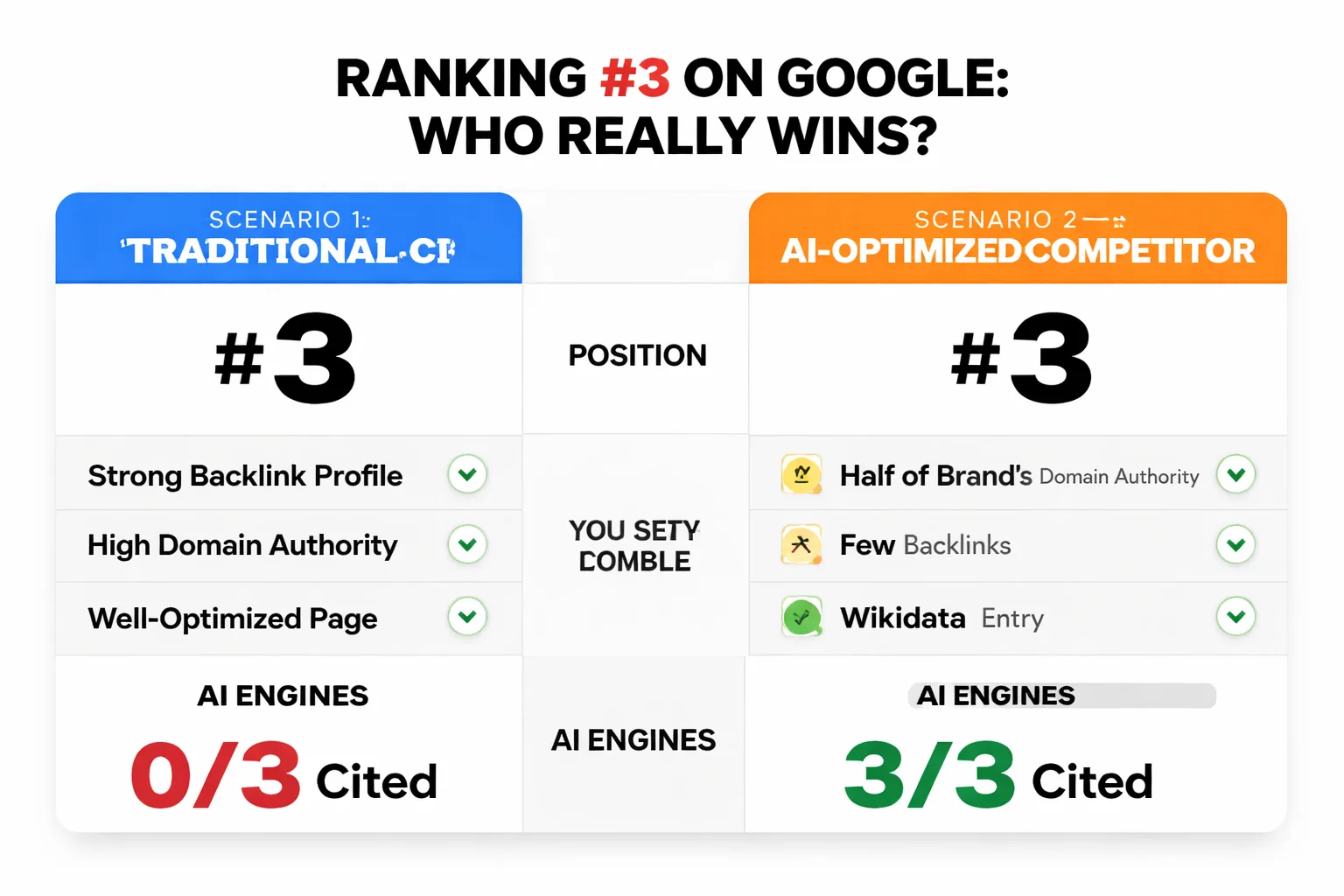
I've seen the pattern repeatedly: a brand ranks #3 on Google for a high-intent commercial keyword. They have a strong backlink profile, solid domain authority, and a well-optimized page. Their competitive intelligence tool shows them winning or competitive on every traditional metric. But when I run the same query through ChatGPT, Perplexity, and Google AI Overviews, their brand doesn't appear in a single answer. Not in the recommendations. Not in the citations. Not even as a comparison point.
Meanwhile, a competitor with half their domain authority and a fraction of their backlinks is cited by three out of four AI engines. Why? Because that competitor published a deeply researched comparison guide that AI engines treat as a canonical source. They have a Wikidata entry with consistent entity attributes. Their content is structured in a way that LLMs can parse, extract, and synthesize cleanly. None of this shows up in a traditional competitive intelligence dashboard.
The specific blind spot is this: competitive intelligence tools don't show which brands get cited by ChatGPT, Perplexity, Gemini, or Google AI Overviews, nor do they show which source pages those citations are built from. They track SERP positions. They track backlinks. They track share of voice on Google. They do not track LLM citation share, mention position within AI answers, or the source domains that AI engines reference when recommending products.
This matters because AI answers don't generate clicks the way SERP results do. A study on AI visibility measurement found that AI visibility rankings lack stability and are mostly statistical noise — a difference between your brand and a competitor could be genuine or just fluctuation between measurements. That instability makes it even more critical to track continuously, not snapshot-style. Traditional CI tools that check competitor positions weekly or monthly are operating on a cadence designed for Google's relatively stable SERPs. AI citation patterns shift faster and less predictably.
The gap cuts deeper than metrics. It's about the entire frame of reference. A traditional competitive intelligence tool answers: "Where does my competitor rank on Google?" An AI search visibility tool answers: "When a buyer asks an AI for recommendations in my category, who gets cited and why?" Those are fundamentally different questions. The first assumes a SERP-mediated discovery process. The second assumes a synthesis-mediated discovery process where the AI is the gatekeeper, not the search engine.
I'll give you a concrete scenario I've seen play out. A B2B SaaS company was tracking three competitors with a legacy CI platform. They monitored competitor blog posts, pricing changes, and feature announcements. They tracked SERP positions for 200 commercial keywords. Everything looked stable. But over six months, one competitor quietly published a series of entity-rich, structured comparison articles and built a presence on Wikidata. The competitor didn't move on Google. Their backlink count barely changed. But they started appearing in ChatGPT recommendations for category-defining queries. By the time the B2B company noticed (through a dip in demo requests from prospects who said they'd been comparing options), the competitor had established a citation moat that would take months to dislodge.
That's the danger of the AI search gap. It's not loud. It doesn't trigger alerts. It doesn't show up as a ranking drop. It shows up as a slow erosion of pipeline that you can't attribute to any single cause because your tools aren't measuring the channel where the erosion is happening.
What You Actually Need to See to Compete in AI Search
If traditional competitive intelligence tools are watching the wrong battlefield, what does the right battlefield look like? Here's the data layer that matters for ai search visibility in 2026.
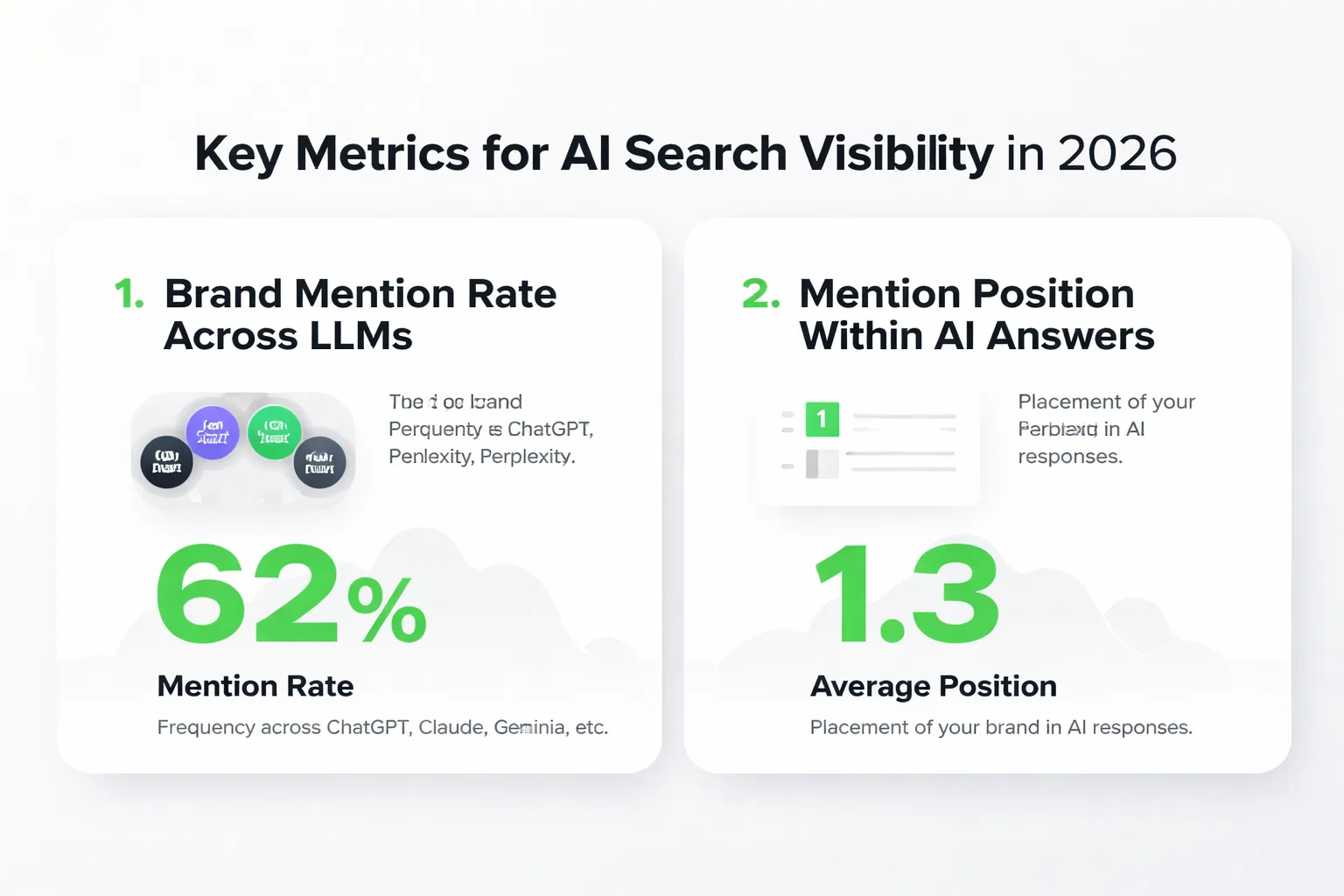
Brand mention rate across LLMs. This is the foundational metric. How often does ChatGPT, Claude, Gemini, Perplexity, or Grok mention your brand when a user asks a question related to your category? Not how often you rank. Not how often you get a click. How often the AI says your name. This needs to be tracked per engine because each LLM has different training data, different retrieval pipelines, and different citation patterns. A brand might dominate ChatGPT and be invisible on Perplexity. Without per-engine tracking, you're averaging away signal.
Mention position within AI answers. This is where my thinking evolved significantly. Early on, I focused on boosting raw mention rate, thinking more mentions equaled more leads. That was a misstep. An AI could recommend your brand as a "good starting point" before suggesting a more advanced competitor, effectively funneling users away. The context and framing of your citation matters more than the citation itself. Are you mentioned first? Are you positioned as the premium option or the budget alternative? Are you cited as a source, or merely listed as an option? Mention position and framing are the metrics that connect AI visibility to business outcomes. A PwC-led research team published the first source attribution evaluation framework for LLM deep research agents and found that frontier LLMs maintain link validity above 94% and relevance above 80%, yet achieve only 39-77% factual accuracy. The gap between high link validity and low factual accuracy means that being cited doesn't guarantee being represented accurately. You need to see the actual response text, not just a mention count.
Which competitor pages are being cited as sources. This is the competitive intelligence layer that traditional tools completely miss. When an AI engine cites a source, that source is a specific page on a specific domain. If you can see which pages your competitors are getting cited for, you can reverse-engineer their content strategy. You can see what topics they've earned citation authority on. You can identify the content gaps where they're present and you're not. This is the AI-era equivalent of backlink gap analysis, but instead of looking at who links to your competitor, you're looking at who AI engines cite when recommending your competitor.
Entity presence in knowledge graphs. AI engines don't just cite web pages. They ground responses in structured data from knowledge graphs like Wikidata, Google's Knowledge Graph, and proprietary entity databases. If your brand lacks a Wikidata entry or has inconsistent entity attributes across sources, AI engines have less structured data to ground their responses about you. This results in reduced citations and weaker competitive positioning. Traditional CI tools don't check knowledge graph presence at all. They don't know whether your competitor has a rich Wikidata entry with industry classifications, product attributes, and executive profiles. That's a gap that compounds over time.
Cited-source leaderboard. Which domains do AI engines cite most often for your topics? This tells you where you need to be cited or featured. If a specific publication or resource site shows up as a top cited source across multiple AI engines, that's a publication you should be targeting for coverage, guest posts, or product reviews. It's link-building reimagined for AI search. Instead of chasing domain authority, you're chasing citation authority.
Here's the contrast with a traditional competitive intelligence dashboard. Your CI tool shows: competitor A ranks #2 for "project management software," gained 45 backlinks this month, and updated their pricing page. Your AI visibility tracker shows: competitor A is cited by ChatGPT in 34% of category prompts (up from 18% last month), mentioned first in 22% of those answers, and their comparison guide on "best project management tools for enterprise" is the most-cited source page across all engines. Which set of insights would you rather have?
How to Pair Classic Competitive Intelligence with AI Citation Tracking
I'm not arguing you should abandon traditional competitive intelligence tools. That would be reckless. Google still drives significant traffic, backlinks still matter for domain authority, and SERP rankings still correlate with revenue for most B2B companies. The point is that traditional tools are necessary but no longer sufficient. You need to layer llm citation tracking on top of your existing CI stack.
Here's the practical workflow I use and recommend.
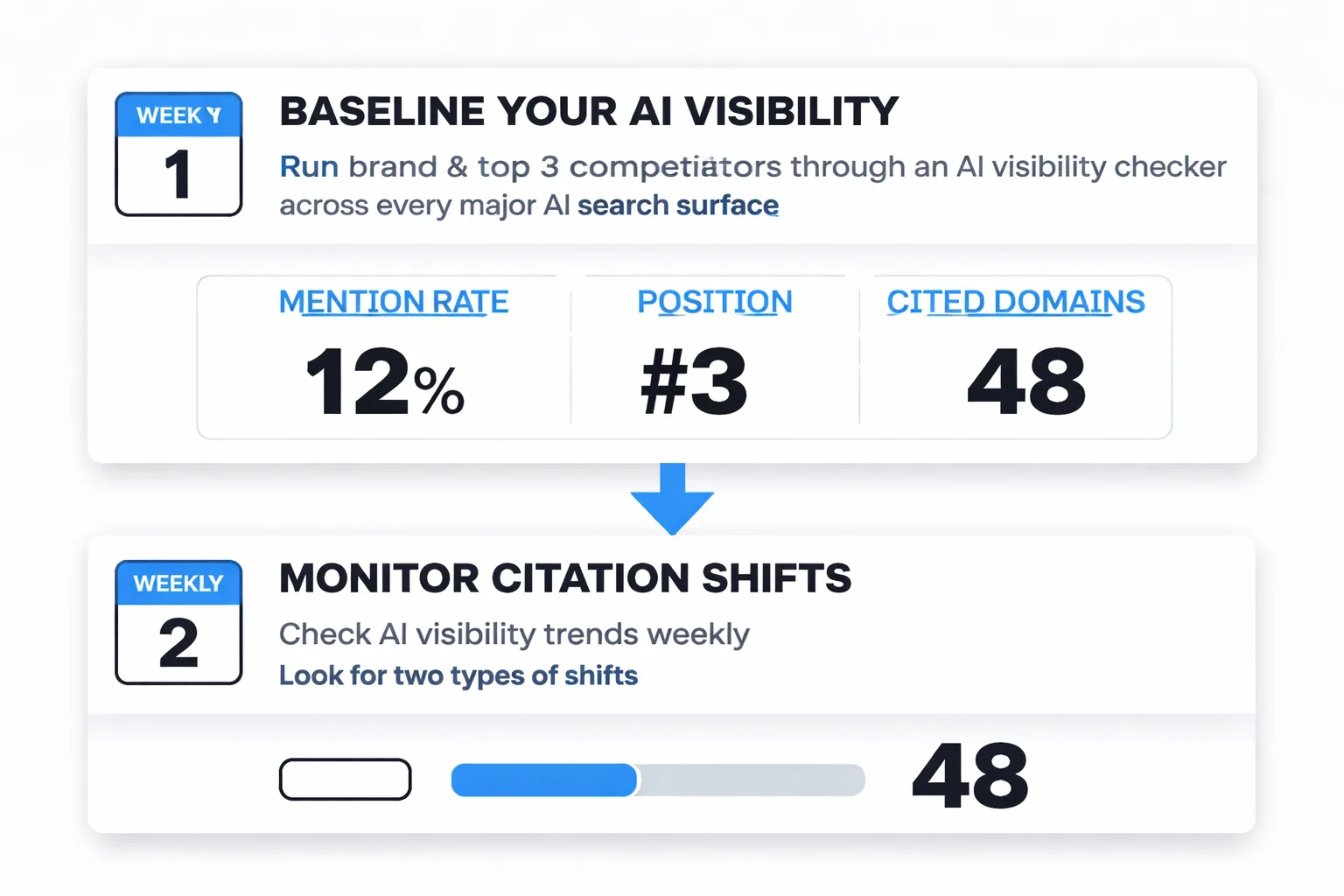
Week 1: Baseline your AI visibility. Run your brand and your top three competitors through an AI visibility checker across every major AI search surface. Capture your current mention rate, mention position, and cited-source domains per engine. This is your baseline. You can't improve what you don't measure, and most companies have never measured this.
Weekly: Monitor citation shifts. Check your AI visibility trends weekly. You're looking for two signals: (1) any competitor who shows a sudden increase in citation rate, which indicates they've published something that AI engines are picking up, and (2) any drop in your own citation rate, which could indicate a knowledge graph issue, a content freshness problem, or a competitor displacing you. The arxiv study on AI visibility measurement found that AI visibility rankings lack stability and are mostly statistical noise, so you need multiple data points before reacting. Don't panic over a single dip. Look for sustained trends over 2-3 weeks.
Biweekly: Run competitor citation gap analysis. Identify prompts where competitors are cited and you aren't. For each gap, trace the citation back to the source page. Ask: what did this page do that mine didn't? Is it more structured? Does it have better entity markup? Is it on a domain that AI engines cite frequently? This is your content roadmap for AI search. Instead of guessing what to write, you're letting the citation data tell you.
Monthly: Audit knowledge graph and entity presence. Check your Wikidata entry, Google Knowledge Panel, and structured data consistency. Ensure your brand entity has accurate industry classifications, product attributes, and relationships to other entities. Do the same for your competitors. If a competitor has a richer entity profile, that's a signal they're investing in structured data as a competitive moat.
Quarterly: Reassess your tool stack. Evaluate whether your traditional CI tools are adding AI-specific signals. Some are starting to. Semrush has an AI Toolkit. Ahrefs has Brand Radar. But ask whether these bolt-on features match the depth of dedicated AI search engine optimization tools. In most cases, the answer is no. The AI features on legacy platforms are surface-level. They give you a visibility score but don't show you the actual response text, the mention position, or the cited source pages. You need depth, not a score.
The workflow doesn't require adding headcount. It requires redirecting attention. If your SEO team currently spends 80% of its time on traditional SERP tracking and 0% on AI citation tracking, shift to 60/40 within a quarter. The shift doesn't mean abandoning SERP work. It means acknowledging that answer engine optimization is now a meaningful slice of the competitive landscape, and it deserves proportional attention.
Why Citation Framing Matters More Than Mention Count
This is the part where I disagree with most of the AI visibility discourse.
The dominant narrative is: get cited more, win. Track your mention rate, push it up, and you're doing AI search optimization. That's naive. In B2B especially, where buying decisions are heavily narrative-driven, the framing of your citation is what actually influences the pipeline.
I've seen a brand with a 40% mention rate across ChatGPT and Perplexity lose deals to a competitor with a 15% mention rate. How? Because the competitor's 15% of mentions were all in the "recommended" or "best overall" position, while the 40% brand was consistently mentioned as a "budget-friendly alternative" or "good for getting started." The AI was telling buyers: start with Brand A, then upgrade to Brand B. That's not visibility. That's a funnel away from your product.
This is why I push back on the idea that AI visibility is just a numbers game. It's a narrative game. The metric that matters isn't how often you're mentioned. It's how you're positioned when you are. That requires reading the actual AI response text, not just counting mentions. It requires tracking sentiment and framing, not just citation presence. Most competitive intelligence tools, even the ones adding AI features, don't go this deep. They give you a score. They don't give you the story.
The PwC/arXiv study on source attribution in LLM deep research agents reinforces this. They found that frontier LLMs maintain 94%+ link validity but only 39-77% factual accuracy. The AI cites a real URL, but what it says about that URL's content may be substantially wrong or misleadingly framed. If your competitive intelligence tool only tracks whether your URL is cited (link validity) and not how your brand is described (factual accuracy and framing), you're missing the metric that actually affects buyer perception.
What dark AI problem affects competitive intelligence?
There's a layer of competitive activity that neither traditional CI tools nor most AI visibility platforms capture. I call it dark AI: proprietary models, unannounced AI initiatives, and internal AI adoption that isn't publicly visible.
Your competitor might be fine-tuning a custom LLM on customer support transcripts to power an AI agent that handles pre-sales questions. That agent could be capturing buyers who would otherwise search Google or ask ChatGPT. It's a competitive move that doesn't show up in SERP tracking, backlink analysis, or even AI citation monitoring because it's happening inside the competitor's walled garden.
Or your competitor might be running agentic SEO experiments: deploying AI agents to continuously generate, test, and optimize content at a scale and speed that human teams can't match. You won't see the individual content pieces until they're indexed. By then, the agent has already iterated past them.
A Cornell Tech study found that user-generated content can manipulate AI research tool results, and ReachLLM reported getting posts cited by ChatGPT within a day of creation — though Reddit's crackdown on AI marketing slop has already resulted in post removals. This means competitors might be aggressively manipulating citation signals through user-generated content, and by the time you notice, the platform may have already cleaned it up. You're seeing the aftermath, not the maneuver.
I don't have a clean solution for dark AI. No tool fully solves it. But awareness matters. If you know that a competitor's sudden citation surge might be the result of aggressive UGC manipulation rather than genuine content quality, you can contextualize the data differently. You can watch for takedowns. You can focus on building durable citation authority through genuine entity presence and high-quality content rather than chasing short-term manipulation tactics that platforms are actively policing.
Which Tools Actually Track AI Visibility?
The tool landscape is shifting fast. Here's what I see across the platforms that matter.
Traditional SEO platforms are bolting on AI features. Semrush has an AI Toolkit that adds LLM brand-mention tracking and prompt research. Ahrefs has Brand Radar connecting AI mentions to backlink data. These are useful starting points if you're already on those platforms, but the AI features are surface layers on top of architectures built for SERP tracking. They'll tell you your AI visibility score. They typically won't show you the actual AI response text, the mention position, or the cited source pages that explain why your competitor is winning.
Dedicated AI visibility platforms go deeper. They track citations across every major AI search surface, show you the response text behind every mention, and map which source pages are driving citations. That depth matters because without the response text, you can't assess framing. Without cited source pages, you can't build a content roadmap to close citation gaps.
The comparison below covers six platforms that are actively competing in this space. I've included the traditional SEO giants adding AI layers, the dedicated AI visibility platforms, and the hybrid approaches that combine tracking with content generation.
| Tool | Best For | AI Citation Tracking | Response Text | Cited Source Pages | Pricing From |
| Meev | Teams wanting tracking + content engine | Every major AI search surface | Yes, full text | Yes, with Citation Path | $49/mo |
| Profound | Enterprise share-of-voice reporting | Up to 9 engines daily | Yes | Agent Analytics | $99/mo |
| AthenaHQ | Pre-interpreted action steps | 8 engines | Via Action Center | Competitive benchmarking | On request |
| Semrush AI Toolkit | Existing Semrush users | Via AI visibility score | Limited | Competitor gap analysis | $139.95/mo |
| Ahrefs Brand Radar | SEO-first teams | LLM mention tracking | Limited | Linked to backlink data | $129/mo |
| AIclicks | Agencies wanting fast onboarding | All major engines | Prompt-level | 2,288+ brand benchmark | $79/mo |
Best tool for AI citation tracking and content engine?
Best for: Teams that want AI citation tracking plus a content engine they can trust to publish. Not just a dashboard that surfaces problems.
Meev is an autonomous AI search visibility platform that tracks citations across every major AI search surface (ChatGPT, Claude, Gemini, Perplexity, Grok, DeepSeek, Google AI Overviews, AI Mode), writes quality-gated content that earns them, and proves which placements drove the lift. What separates it from the other tools on this list is the 12-dimension Quality Matrix and Helpful Content Risk score that gate every article before it ships.
Key features: - Citation tracking across ChatGPT, Claude, Gemini, Perplexity, and Grok on a rolling cadence; Google AI Overviews and AI Mode refresh daily. 12-dimension Quality Matrix plus Helpful Content Risk score. 70/100 publish gate on both. Knowledge Base enforcement. Articles grounded in your approved claims, not AI hallucination. Closed-loop Citation Path (roadmap) — each article mapped to the citation-rate delta it drove. Autopilot topic pool with gap detection from competitor citation patterns
Pricing: 7-day free trial. After the trial, services pause unless you subscribe. Your account stays open and your data stays readable. Lite $49/mo, Starter $99/mo, Pro $269/mo, Agency $599/mo. 20% annual discount. Cancel anytime; hard-cap quotas with no overage fees.
The honest assessment is that Meev is built for small teams that need to be found and cited by AI answers without running a full content operation. If you're an enterprise with a dedicated content team and a separate AI visibility analyst, you might find the content generation layer redundant. But if you're a founder or marketer who needs both the diagnosis (where you're cited, where you're not) and the treatment (content that closes the gap), Meev combines both in one workflow. The quality firewall is the differentiator that matters most to me: it blocks weak drafts before they reach your CMS, which prevents the AI slop problem that Google's Helpful Content System penalizes.
2. Profound — Best for enterprise share-of-voice reporting
Best for: Enterprise marketing and growth teams that need boardroom-ready AI share-of-voice reporting and agentic content workflows in one platform.
Profound is an agentic marketing platform that tracks AI visibility across up to nine answer engines daily and pairs analytics with agent-driven content workflows to improve LLM citation share. The platform is built around prompt volumes derived from 1.9 billion real user prompts segmented by intent, age, income, and region.
Key features: - Prompt Volumes built on 1.9B+ real user prompts segmented by intent, age, income, and region. Answer Engine Insights tracking citation share, accuracy, and sentiment across every engine and competitor. Agent Analytics tying AI crawler activity to traffic and conversions. Query Fanouts showing how an engine expands a single user prompt into sub-queries
Pricing: Starter $99/mo (ChatGPT only, 50 prompts); Growth $399/mo (3 engines, 100 prompts, 400 credits); Enterprise custom pricing (up to 9 engines, SSO/SAML, SOC 2).
Profound is the strongest option if you need to walk into a board meeting with AI share-of-voice charts that hold up under scrutiny. The query fanout feature is genuinely useful for understanding how AI engines decompose complex prompts. The limitation is that the Starter tier covers ChatGPT only, which means you're paying $399/mo before you get multi-engine visibility. If your buyers use Perplexity or Claude as heavily as ChatGPT (and many B2B buyers do), that's a meaningful gap at the entry level.
Do you know how often AI engines cite your competitors instead of you?
3. AthenaHQ — Best for pre-interpreted action steps
Best for: Growth and content teams that want AI visibility data pre-interpreted into clear next steps rather than raw dashboards requiring manual analysis.
AthenaHQ is a GEO platform that tracks AI visibility across eight engines and converts raw data into prescriptive recommendations through its Action Center, reducing the gap between insight and execution.
Key features: - Visibility, sentiment, and citation tracking across eight major AI engines. Action Center that turns monitoring data into step-by-step optimization tasks. AI content creation and content-refresh capabilities on premium tiers. Competitive benchmarking across brands and categories in AI-generated answers
Pricing: Pricing available on request; AI content and refresh features unlocked on higher tiers.
The Action Center concept is what makes AthenaHQ interesting. Most AI visibility tools dump data on you and expect you to figure out what to do with it. AthenaHQ attempts to close the insight-to-execution gap by translating monitoring data into specific tasks. The trade-off is that pricing isn't publicly listed, which creates friction for teams trying to compare options on a budget. If you're the type of team that wants someone to tell you what to do next rather than presenting you with a dashboard to interpret, AthenaHQ's approach is worth evaluating.
4. Semrush AI Toolkit — Best for existing Semrush users
Best for: Mid-market companies and agencies already on Semrush that want to layer AI search visibility tracking onto their existing SEO workflow without adopting a new platform.
Semrush's native AI visibility layer adds LLM brand-mention tracking, prompt research, and competitor gap analysis directly inside the established Semrush SEO ecosystem.
Key features: - AI visibility score quantifying brand presence across answer engines relative to competitors. Prompt research to discover and prioritize AI search topics by volume and intent. Competitor gap analysis highlighting prompts where rivals appear but your brand does not. Unified dashboard combining traditional keyword research with AI visibility data
Pricing: Semrush Pro starts at $139.95/mo and includes AI Toolkit features; Semrush One Starter begins at approximately $199/mo (50 prompts).
If you're already paying for Semrush, the AI Toolkit is a no-brainer to turn on. It's included in your plan, and it gives you a baseline AI visibility score alongside your existing SEO metrics. The limitation is depth. The AI visibility score is a summary metric, not a diagnostic tool. It tells you whether you're visible, but not why. You won't see the actual AI response text or the specific source pages driving competitor citations. For teams that need to understand the mechanics of AI citation (not just the score), a dedicated platform will be more useful.
5. Ahrefs Brand Radar — Best for SEO-first teams
Best for: SEO-first teams and agencies that want AI visibility data contextualized within backlink authority and organic performance rather than as a standalone metric.
Ahrefs' AI visibility module connects LLM brand-mention data to its industry-leading backlink index and organic search performance metrics for a unified competitive intelligence view.
Key features: - AI brand mention tracking linked directly to backlink and organic search data. Competitive AI share-of-voice benchmarking across major LLM platforms. Citation source analysis connecting which pages earn AI references to their link authority. Integrated view of traditional SEO signals alongside generative engine visibility
Pricing: Included within Ahrefs subscription plans; Ahrefs Lite starts at $129/mo, with AI search features available on Standard and above.
Ahrefs' advantage is its backlink index. No one has a deeper or more accurate link database. If your theory of AI search is that citation authority correlates with link authority (and there's evidence it does, at least partially), Ahrefs lets you test that theory in one dashboard. The limitation is that AI visibility features are less deep than dedicated GEO platforms. If your primary need is LLM citation tracking with response-level detail, Ahrefs gives you the overview but not the granular diagnostic. Full AI search features also require higher-tier plans.
6. AIclicks — Best for agencies wanting fast onboarding
Best for: Agencies and in-house SEO teams that want fast onboarding, agentic workflow compatibility, and broad competitive benchmarking at a mid-market price point.
AIclicks is an AEO tracking and AI search visibility platform with a free 60-second AI SEO scan, MCP-ready agent skills, and competitive gap analysis across 2,000+ brands.
Key features: - Free 60-second AI SEO scan for instant brand visibility snapshot. Prompt-level visibility tracking across all major AI engines. Competitive gap analysis benchmarked against 2,288+ brands. MCP-ready agent skills enabling agentic SEO workflow integrations
Pricing: Basic $79/mo (50 prompts, 250 responses, 1 seat, weekly refresh); Pro $199/mo (500 prompts, 5,000 responses, unlimited seats, email writer, daily refresh).
AIclicks wins on speed. The free 60-second scan is a genuine differentiator for agencies that need to show prospects a snapshot of their AI visibility before pitching services. The MCP-ready agent skills are forward-looking and position the platform well for an agentic SEO future. The trade-off is that the Basic tier's weekly refresh cadence may be too slow for brands in fast-moving categories where citation patterns shift daily. The prompt and response caps at Basic also limit coverage for large keyword universes.
Making the Right Choice
The competitive intelligence tools you choose should match where your buyers actually research. If your buyers still start on Google, traditional CI tools remain essential. If your buyers are asking ChatGPT or Perplexity for recommendations (and in 2026, a growing segment are), you need ai search visibility tracking layered on top.
Here's my decision framework. If you're an enterprise team that needs board-level AI share-of-voice reporting, Profound is the strongest option. If you're already on Semrush or Ahrefs and want a baseline AI visibility score without adopting a new platform, their respective AI toolkits are worth turning on. If you're an agency that needs fast onboarding and competitive benchmarking, AIclicks is worth evaluating. And if you're a small team that needs both the diagnosis (where you're cited, where you're not) and the treatment (content that closes the gap), Meev combines both in one workflow with a quality gate that prevents the AI slop problem.
The key is to not wait. Every month you delay adding AI citation tracking to your competitive intelligence stack is a month your competitors are building citation authority that compounds. AI engines reward entities that are consistently cited across sources. The longer a competitor is cited and you're not, the harder it becomes to displace them. This is a moat that forms quietly, and traditional competitive intelligence tools won't even show you it's forming.
FAQ
What are competitive intelligence tools missing about AI search?
Competitive intelligence tools miss LLM citation tracking across AI search surfaces like ChatGPT, Perplexity, and Google AI Overviews. They track SERP rankings and backlinks but don't show which brands AI engines cite, what position they appear in within AI answers, or which source pages drive those citations. This means teams are blind to a growing channel where 58% of marketers report higher conversion rates than traditional organic traffic.
How is AI visibility different from SERP visibility?
SERP visibility measures where you rank on Google's search results page. AI visibility measures how often and in what context AI engines like ChatGPT, Claude, and Perplexity mention your brand when users ask category-related questions. AI visibility depends on knowledge graph presence, entity consistency, and citation authority rather than traditional SEO signals like backlinks and title tags.
Can traditional SEO tools track AI citations?
Some traditional SEO tools are adding AI visibility features. Semrush has an AI Toolkit and Ahrefs has Brand Radar. However, these features are typically surface-level, providing an AI visibility score without showing the actual AI response text, mention position, or cited source pages. Dedicated AI visibility platforms offer deeper diagnostic data for teams that need to understand citation mechanics.
How often should I check my AI visibility?
Weekly monitoring is the minimum for brands in active categories. AI citation patterns shift faster and less predictably than SERP rankings. The arxiv study on AI visibility measurement found that rankings are mostly statistical noise, so you need multiple data points over 2-3 weeks to distinguish genuine trends from random fluctuation. Daily refresh is ideal for fast-moving categories.
What is citation framing and why does it matter?
Citation framing is the context and narrative position of your brand mention within an AI answer. Being mentioned as "best overall" versus "budget-friendly alternative" dramatically affects buyer perception and conversion. A brand with a lower mention rate but favorable framing can outperform a brand with a higher mention rate but unfavorable framing. Tracking framing requires reading the actual AI response text, not just counting mentions.
Do I need a separate tool for AI visibility if I already use Semrush or Ahrefs?
It depends on your goals. If you need a baseline AI visibility score alongside your existing SEO metrics, the AI features in Semrush or Ahrefs may suffice. If you need to see actual AI response text, cited source pages, mention position, and citation framing, a dedicated AI visibility platform provides depth that legacy SEO tools don't offer. Many teams use both: the legacy tool for SERP tracking and the dedicated platform for AI citation diagnostics.
Competitive intelligence tools that don't track AI citations are watching half the board. The question isn't whether to add AI visibility tracking. It's how much pipeline you can afford to lose before you do.
About the Author
Judy Zhou, Founder
Judy Zhou leads content strategy at Meev, where she oversees AI-driven content research and publishing for hundreds of brands. With a background in SEO and editorial operations, she focuses on building content systems that rank on Google, get cited by AI search engines, and drive measurable business results.
Stop guessing about your AI visibility. See exactly where you're cited, where competitors are winning, and what to do about it.