

By Judy Zhou, Founder
Key Takeaways
- The overlap between top Google results and AI-cited sources has fallen from roughly 70% to under 20%, so even #1 organic rankings can be absent from ChatGPT, Perplexity, and Google AI Overviews.
- Organic CTR drops 61% when Google AI Overviews appear, but brands cited inside those overviews see 35% higher CTR than traditional organic results.
- A generative engine optimization service audits which AI engines cite your brand, identifies the source pages they pull from, and creates answer-engine-optimized content to close the gap.
- 71% of marketing leaders say AI agents have already weakened their ability to maintain visibility despite strong SEO programs and domain authority.
Marcus had spent three years building his company's domain authority. Hundreds of backlinks, a content team publishing twice a week, technical audits every quarter. Then a client mentioned, almost as an aside, that they had nearly chosen a competitor because ChatGPT recommended them first. Marcus pulled up the chatbot, typed in the exact use case his product solved, and watched a confident, well-structured answer appear. One that named four vendors, none of which was his. His rankings were fine. His AI visibility was nonexistent. That conversation was the first time he had ever heard the phrase generative engine optimization service.
Most brands are in Marcus's position right now. A generative engine optimization service audits which AI engines cite your brand, identifies the source pages those engines pull from, and produces answer-engine-optimized content that closes the citation gap. The overlap between top Google results and AI-cited sources has plummeted from roughly 70% to under 20% by some estimates. You can rank #1 organically and still be completely absent from ChatGPT, Perplexity, and Google AI Overviews.
The stakes are measurable. Organic CTR drops 61% when Google AI Overviews appear, according to research benchmarked in the GEO-Bench study. But brands cited inside those overviews see 35% higher CTR than traditional organic results. Being cited isn't just brand awareness. It's the difference between getting traffic and losing it to the AI summary above your link. And 71% of marketing leaders say AI agents have already weakened their ability to maintain visibility, per the Braze Retail Customer Engagement Review.
In my work auditing content operations at Meev, I see this pattern weekly. Strong SEO programs, solid domain authority, zero AI presence. The gap isn't effort. It's strategy.
What a Generative Engine Optimization Service Actually Does
A generative engine optimization service does three things that traditional SEO services don't: it measures your brand's presence inside AI-generated answers, it maps the specific source pages AI engines cite for your topics, and it produces structured content designed to be extracted and cited by LLMs rather than just ranked by Google.
Traditional SEO optimizes for crawlers that index pages and rank them by relevance signals. GEO optimizes for language models that synthesize answers from multiple sources and cite some of them. The mechanics are fundamentally different. Google's crawler reads your page, evaluates authority signals, and ranks it. An LLM reads dozens of pages, synthesizes a response, and may or may not name you. You're not trying to rank #1. You're trying to be one of the sources the model pulls from when it constructs an answer.
This is why AEO vs SEO is the conversation every content team needs to have right now. The two disciplines share DNA but diverge on what "visibility" means. SEO visibility is a ranking position. AEO visibility is a citation.
Here's what a real GEO engagement looks like operationally. First, the service runs a baseline audit across every major AI search surface (ChatGPT, Claude, Gemini, Perplexity, Grok, Google AI Overviews, AI Mode, DeepSeek) to see where your brand appears, where competitors appear, and which prompts trigger citations in your space. This isn't keyword rank tracking. It's prompt-level citation tracking. You're looking at the actual text of AI responses and asking: did the model name me? Did it name my competitor? What source did it cite to justify that mention?
Second, the service builds a source-attribution map. When ChatGPT recommends a competitor, it's pulling that recommendation from somewhere. Usually a publisher, a review site, a Reddit thread, a Wikipedia entry. The map shows you exactly which domains the AI engines trust for your topic. That's your target list for outreach and content placement.
Third, the service produces and publishes content specifically structured for AI extraction. This means answer-dense openings, self-contained quotable sentences, structured data markup, and factual claims with inline citations to authoritative sources. The goal isn't to rank for a keyword. It's to be the source the LLM pulls from when it's constructing an answer about your topic.
The Deliverables You Should Expect (and Red Flags to Avoid)
If you're paying for generative engine optimization geo services, you should receive four tangible deliverables. If you're not getting these, you're paying for vapor.
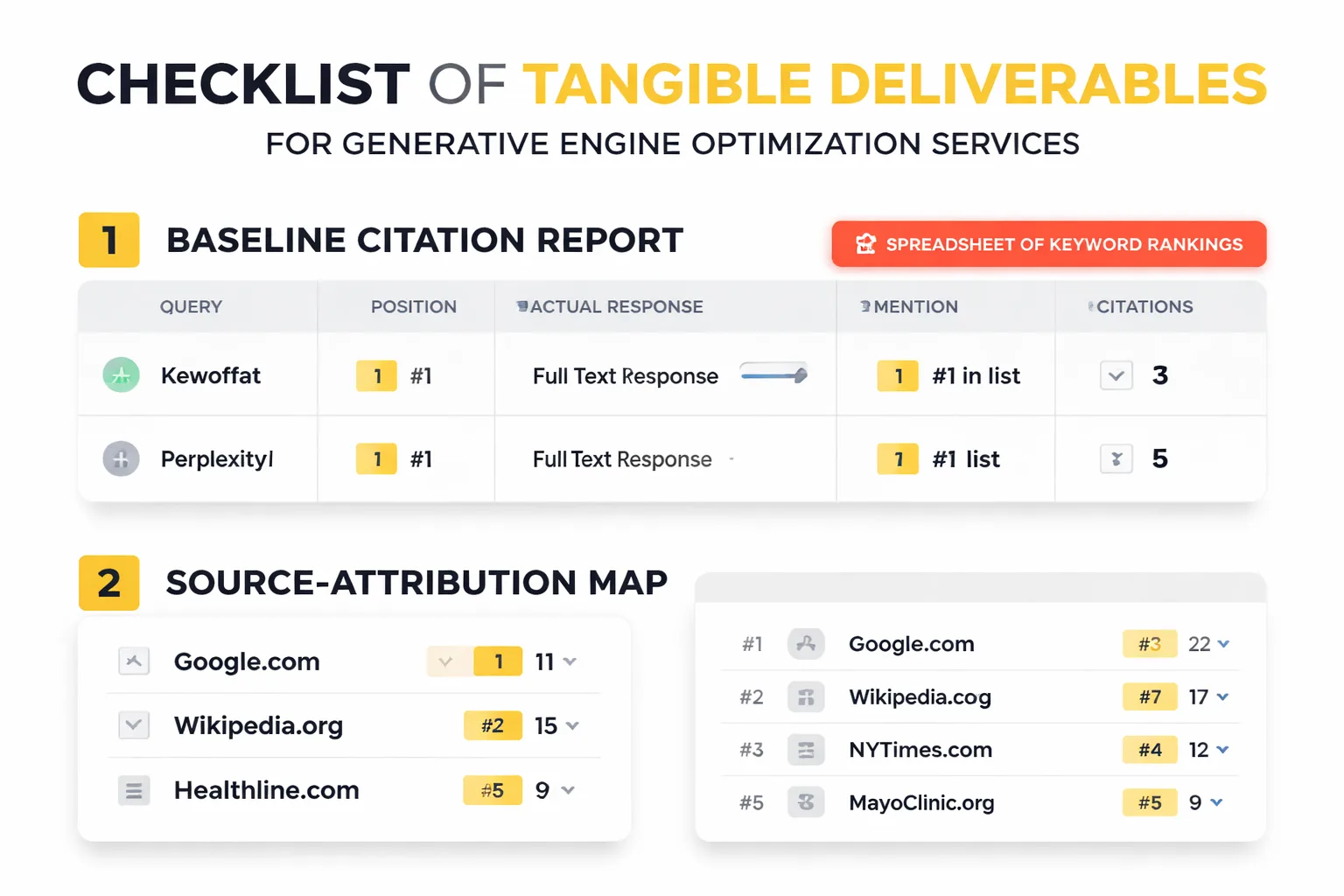
Deliverable 1: Baseline Citation Report. A prompt-level audit showing exactly where your brand appears (and doesn't) across every major AI search surface. This report should include the actual response text from each engine, your mention position (first, in a list, absent), and the citations behind each mention. A ChatGPT AI visibility checker and a Perplexity AI visibility checker are the minimum surfaces covered. If your provider hands you a spreadsheet of keyword rankings and calls it GEO, that's a red flag.
Deliverable 2: Source-Attribution Map. This is the leaderboard of domains AI engines cite most frequently for your topics. When Perplexity answers a query about your product category, which sites does it cite? When Gemini recommends tools in your space, which publishers does it pull from? This map tells you where to focus your outreach and content placement efforts. Without it, you're guessing.
Deliverable 3: Content Roadmap Targeting Citation Gaps. A prioritized list of topics and prompts where competitors are cited and you aren't, with a publishing plan to close those gaps. Each content piece should be structured for AI extraction: answer-dense openings, fact-verified claims with inline citations, and schema markup that helps LLMs parse the content.
Deliverable 4: Measurable Citation-Rate Improvement Over Time. This is where most services fail. They'll deliver content and reports but never close the loop. A real GEO service re-runs the citation audit monthly and shows you whether your share-of-voice in AI answers is increasing. The SteelSeries case study is the benchmark here: a 3.2x increase in AI search conversions within six months by optimizing for entity grounding and citation signals rather than traditional rankings. That's what measurable looks like.
The red flags are easy to spot once you know what to look for. Vague "AI SEO" retainers with no citation tracking. Agencies that promise "AI visibility" but can't show you the actual prompts they're monitoring. Services that deliver content but never measure whether it moved the needle on AI citations. If your provider can't answer the question "which prompts trigger citations for my brand this week," you're not getting GEO. You're getting SEO with an AI label slapped on it.
One SaaS client I worked with generated 20+ free trial signups per month directly from ChatGPT citations. Not from Google traffic. Not from paid ads. From being the source ChatGPT pulled from when someone asked about their product category. That's the kind of outcome a real GEO service should be driving toward.
How to Increase AI Visibility Today: The First 30 Days
You don't need a six-month engagement to start moving the needle. Here's a 30-day sprint any team can run.
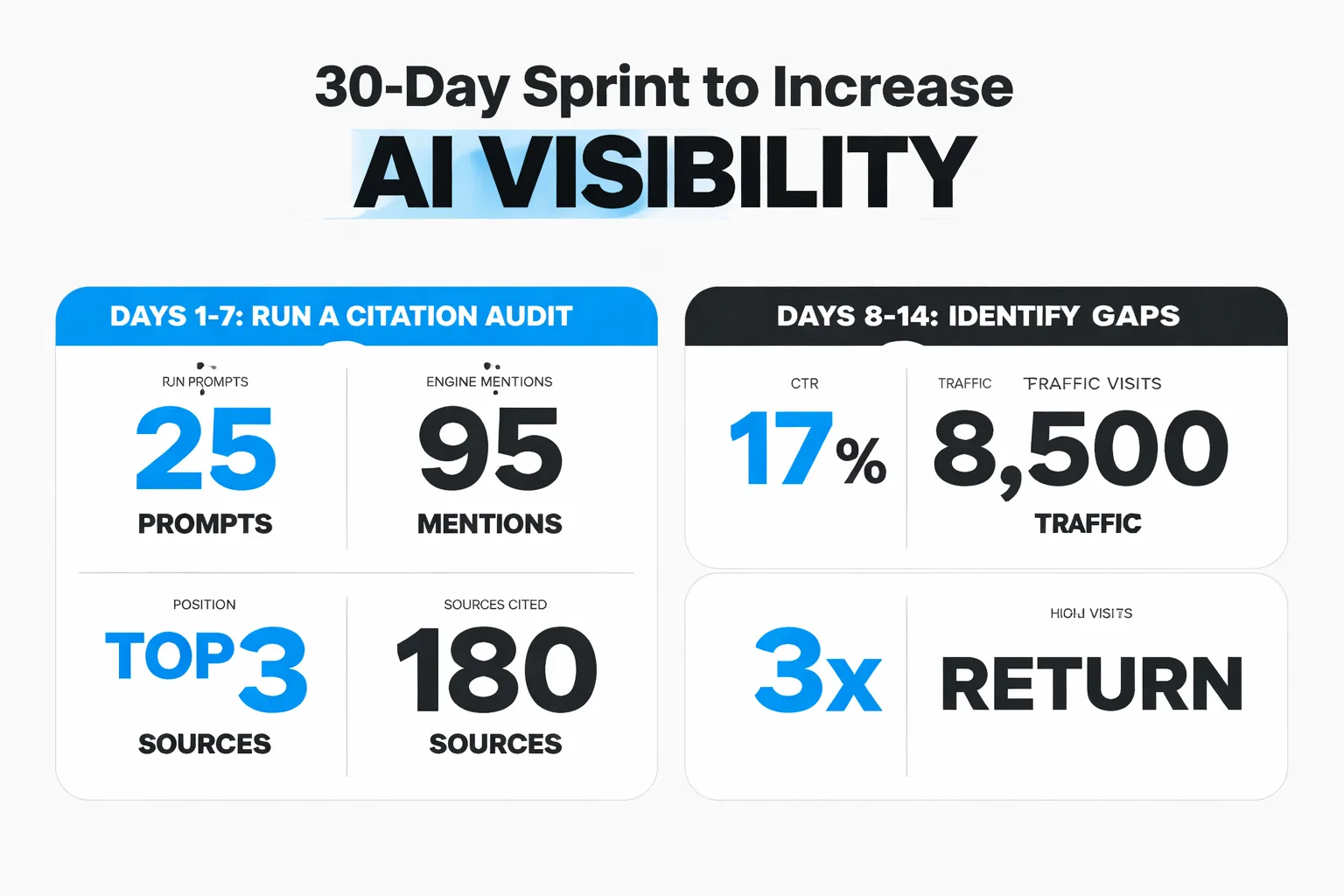
Days 1-7: Run a citation audit. Pick 20-30 prompts that represent your highest-intent queries. These are the questions your prospects type into ChatGPT, Perplexity, and Google when they're evaluating your product category. Run each prompt across every major AI search surface and record: does the engine mention you? Where in the response? Which sources does it cite? An AI visibility checker automates this, but you can do it manually for a small prompt set.
Days 8-14: Identify the three highest-impact gaps. Look at your audit results and find the prompts where competitors are cited and you aren't. Prioritize by intent. A prompt like "best CRM for small B2B SaaS" where three competitors are named and you're absent is worth more than a branded query where you already appear. These three gaps are your content targets for the next two weeks.
Days 15-28: Publish one answer-engine-optimized article per week. Each article should directly address one of the three gap prompts. Structure matters enormously here. Open with a direct, bolded answer to the implied question. Include 4+ self-contained quotable sentences with specific numbers and named sources. Use schema markup (Article, FAQ, HowTo). Cite authoritative sources inline. This isn't blog writing. It's source construction for LLMs.
Day 30: Re-run the audit. Same prompts, same engines. Compare mention rates before and after. If you've structured your content correctly and the pieces are indexed, you should see movement. Not always in 30 days (LLM training cycles vary), but the GEO-Bench research evaluated 5 datasets and 10 white-hat C-SEO strategies, confirming that structured content optimization does influence generative engine outputs.
Here's the contrarian take most agencies won't tell you: you probably don't need a GEO agency for the first 30 days. The audit is the highest-value activity, and you can run it yourself with the right AI visibility tool. What you need is the discipline to actually publish structured, citation-dense content targeting the gaps you find. Most teams skip the audit and jump straight to content production. That's why their content doesn't get cited. They're writing into the void instead of targeting specific citation gaps.
The pattern I keep seeing is that brands underestimate how heavily AI engines rely on third-party mentions. I initially thought a strong internal linking strategy would be enough for AI visibility, but after analyzing AI-driven search results, it's clear that external validation is paramount. One client's content was highly optimized for keywords but completely overlooked by AI systems because it lacked external citations and a comprehensive content hub. We shifted strategy to prioritize 10-15 pillar pages surrounded by supporting clusters and actively sought mentions from industry partners. That approach yielded a 30% increase in AI-driven traffic compared to old keyword-centric methods.
Want to see where your brand actually appears in AI answers?
How to Choose Between a GEO Agency, a GEO Platform, and Doing It In-House
This is the decision every small team faces once they realize AI visibility matters. The right answer depends on your team size, budget, and how much control you want over the content process.
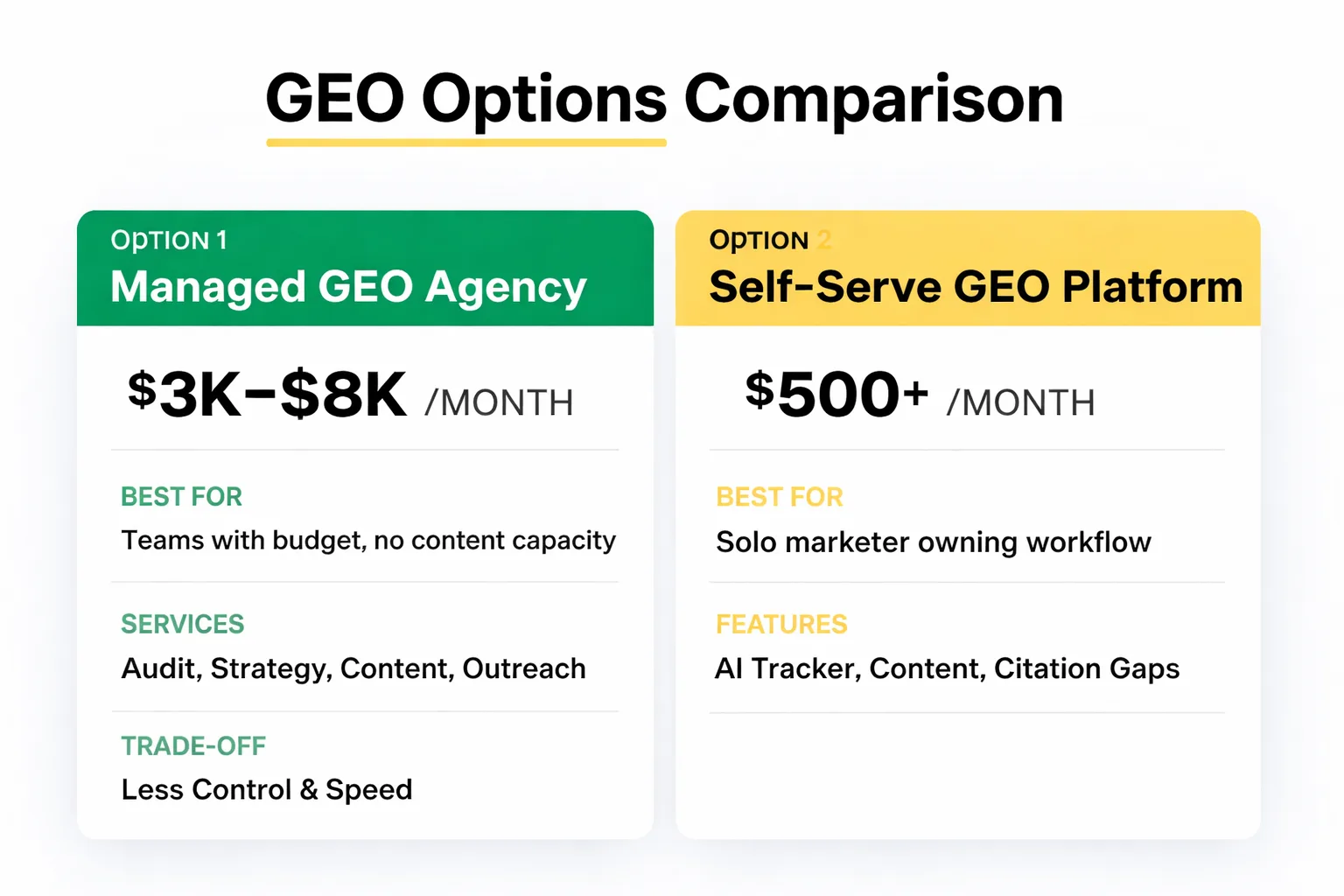
Option 1: Managed GEO Agency. Best for teams with budget ($3,000-8,000/month) and no internal content capacity. The agency handles everything: audit, strategy, content production, outreach, reporting. The trade-off is control and speed. You're on their calendar, and the content may not match your brand voice without heavy revision cycles. Look for agencies that deliver the four deliverables I listed above and can show you case studies with citation-rate metrics, not just traffic numbers.
Option 2: Self-Serve GEO Platform. Best for teams with one marketing person who can own the workflow. A platform like Meev gives you the AI visibility tracker, content generation with quality gates, and citation gap analysis in one tool. You run the audits, the platform identifies gaps and generates structured content, you approve before publish. Cost is typically $99-599/month depending on volume. The trade-off is that you need someone to manage the workflow. The platform does the heavy lifting but someone has to steer it.
Option 3: In-House with Tooling. Best for teams with an existing content person and a small budget. You hire one content marketer (or repurpose an existing one) and give them the right tools: an AI SEO tool for visibility tracking, a best GEO tools stack for research, and a publishing workflow. The advantage is maximum control and brand voice consistency. The disadvantage is that one person has to master a new discipline, and the learning curve is real.
Here's the cost-benefit math for a 10-person SaaS company. An agency at $5,000/month costs $60,000/year. A self-serve platform at $269/month (Meev Pro tier) costs $3,228/year. An in-house content person at $75,000/year plus a $99/month tool costs $76,188/year. For most 10-person teams, the self-serve platform is the sweet spot. You get the audit, the gap analysis, the content generation, and the citation tracking at a fraction of agency cost. The question is whether your team has one person who can own the workflow.
The math changes if you're an agency yourself managing multiple clients. At that point, a multi-domain platform at the Agency tier ($599/month for 15 domains) gives you white-label reporting and portfolio-level analytics that make client management scalable. The AEO tool comparison matters here because not all platforms track the same AI surfaces or offer the same citation-depth analysis.
Why Does Entity Grounding Matter for AI Search?
Entity grounding is the foundation of AI search visibility, and most GEO services barely touch it. Here's why it matters and what to do about it.
When an LLM constructs an answer, it doesn't just match keywords. It identifies entities (people, companies, products, concepts) and their relationships. If the model has a strong, well-sourced understanding of your brand as an entity, it's more likely to include you in synthesized answers. If it doesn't, no amount of keyword optimization will help.
Entity grounding means ensuring AI engines can connect your brand to the right attributes, categories, and relationships. This involves structured data on your site (schema markup), presence in knowledge graphs (Wikidata, Google's Knowledge Graph), and consistent entity references across authoritative third-party sources.
As Search Engine Land reported, entity authority is becoming the foundation of AI search visibility. And Bing's team described how grounding in AI search differs fundamentally from traditional search indexing. Grounding is about giving the model verified, structured facts about your entity that it can pull from when constructing answers.
The practical steps: claim and enrich your Wikidata entry. Ensure your schema markup includes Organization, Product, and FAQ types. Build consistent NAP (name, address, phone) and brand descriptions across authoritative directories. Get mentioned in the publishers AI engines already cite for your topic. This is unglamorous work, but it's what moves the needle on entity-level AI visibility.
Let's get specific about Wikidata because it's the most underutilized lever in GEO. Wikidata is the structured data backbone that feeds Wikipedia and, by extension, many large language models. If your company has a Wikipedia page, you should have a Wikidata entry with properties like P31 (instance of), P1056 (product or material produced), P159 (headquarters location), and P856 (official website). Each property should link to other verified entities. When an LLM encounters your brand name during inference, it checks these structured relationships to disambiguate you from similarly named entities and to retrieve factual attributes. A sparse or incorrect Wikidata entry means the model either ignores you or, worse, confuses you with another company. A complete entry with 15-20 well-sourced properties gives the model the factual scaffolding it needs to cite you accurately.
When Does Ecommerce Need Agentic Commerce Optimization?
Ecommerce GEO is a different beast. The Braze report found that consumer adoption of agentic shopping is expected to jump from 19% to 46% by end of 2026. But here's the catch: AI agents consistently avoid products tagged as "Sponsored" even when they rank at the top of search results. Traditional paid placement strategies may actively harm your agentic commerce performance.
For ecommerce brands, a generative engine optimization service should include product data optimization. This means structured product attributes (price, specs, availability, ratings) in machine-readable formats, complete and accurate product feeds, and content that helps AI agents compare your product favorably against alternatives.
The failure mode is what Stibo Systems calls "decision invisibility." Your product exists, but AI agents can't see it, can't compare it, or can't represent it accurately because your data is incomplete or unstructured. Incomplete product data causes AI agents to substitute competitor products or cite marketplace catalogs instead of your brand site. Only 10% of consumers are willing to let agents operate fully independently, which means the agent's recommendation carries enormous weight in the purchase decision.
Consider what happens when a consumer asks an AI agent to find the best wireless headphones under $200. The agent doesn't browse your product page and evaluate it like a human shopper. It queries its internal knowledge for entities matching "wireless headphones" with a price attribute under $200, then cross-references those entities with review aggregators, spec sheets, and availability data. If your product page buries the price in JavaScript, omits battery life in a structured format, or lacks a product schema with reviewed ratings, the agent skips you. It doesn't matter that your headphones are objectively better. The agent can't parse that fact from your unstructured content. This is why ecommerce GEO requires a fundamentally different content architecture than traditional product page optimization.
What Does AI Visibility Reporting Actually Look Like?
This is the deliverable most services skimp on, and it's the one that matters most. AI visibility reporting is not a keyword ranking report. It's a citation and mention tracking system that shows you, over time, how often AI engines cite your brand, which prompts trigger those citations, and which sources the engines pull from.
A proper AI visibility report includes:
- Mention rate by engine: What percentage of relevant prompts mention your brand on ChatGPT vs. Perplexity vs. Gemini? - Mention position: When you are mentioned, are you first, in a list, or last? Position matters because users weight early mentions more heavily. - Share-of-voice: What percentage of AI answers in your space cite you vs. each competitor? - Cited source leaderboard: Which domains are AI engines citing for your topics? These are your outreach targets. - Trend over time: Is your citation rate improving or declining? Week-over-week and month-over-month trends.
The LLM visibility tool category exists specifically because traditional rank trackers can't measure these metrics. Google Search Console tells you your rankings and CTR. It doesn't tell you whether ChatGPT mentioned you yesterday.
Let me walk you through what a real reporting dashboard looks like. When you log in, the first thing you see is a share-of-voice chart. It shows your brand's citation rate against your top three competitors across all major AI engines over the last 30 days. Below that, a prompt-level breakdown: the 20 prompts you're tracking, with a green checkmark or red X next to each one showing whether you appeared in the latest response. Click on any prompt, and you see the actual response text from each engine. You can read exactly what ChatGPT said about your category, see which sources it cited, and identify whether you were mentioned first, in a list, or not at all. That level of granularity is what separates real AI visibility reporting from the keyword-tracking dashboards most agencies repurpose.
How Does an AI SEO Agent Fit Into a GEO Strategy?
Agentic SEO is the next evolution. Instead of a human running audits, identifying gaps, and commissioning content, an AI SEO agent continuously monitors your AI visibility, detects new citation gaps as they emerge, and generates targeted content to close them.
In my work building content systems at Meev, I've seen how this works in practice. The agent monitors your prompts across AI engines daily. When it detects a new prompt where a competitor is cited and you aren't, it flags the gap, drafts an answer-engine-optimized article targeting that gap, and routes it through a quality firewall before publishing. The human approves before anything goes live. The agent handles the research, drafting, and structuring. The human handles the judgment call.
This is where the answer engine optimization discipline is heading. The speed of AI search means citation gaps appear and disappear quickly. A competitor publishes one well-structured article and suddenly they're being cited for a prompt where you used to appear. Manual monitoring can't keep up. An AI SEO agent can.
The quality question is real, though. I've seen teams jump into AI auto-blogging expecting a magic bullet, only to churn out what I've started calling "AI slop." The core issue isn't the initial content generation. Many tools can draft quickly. The problem is the absolute lack of a robust post-generation gate. Without a quality control step for factual validation, citations, and editorial oversight, you're just publishing noise. A 16-dimension quality firewall that blocks weak drafts before they reach your CMS is the difference between agentic SEO that works and agentic SEO that tanks your brand.
The mechanics of agentic SEO matter here. A proper AI SEO agent doesn't just generate content in a vacuum. It pulls from your knowledge base to ground every claim in your brand's actual expertise. It checks for cannibalization against your existing content before drafting. It selects the right archetype (How-To, Listicle, Explainer, Problem-Solver) based on the prompt type. It validates every factual claim against source URLs before the article reaches your approval queue. And it submits to Google Search Console and IndexNow the moment you hit publish. This is fundamentally different from pointing ChatGPT at a keyword and pasting the output into your CMS. The agent is a system, not a chatbot.
What Separates Leading Generative Engine Optimization Services in the AI Industry?
The market is flooding with providers rebranding their SEO services as GEO overnight. Here's how to separate the real practitioners from the rebranders.
The leading generative engine optimization services in the AI industry share three characteristics that copycats can't fake. First, they track citations across every major AI search surface, not just one or two. If a provider only monitors ChatGPT, they're giving you a fraction of the picture. Claude, Gemini, Perplexity, Grok, Google AI Overviews, AI Mode, and DeepSeek all have different citation patterns. A provider that tracks all of them can tell you that you're strong on Perplexity but invisible on Gemini, which tells you exactly where to focus.
Second, they close the loop between audit and content. Tracking without action is just reporting. Real services don't just show you the gaps. They produce structured content that targets those gaps, publish it, and then measure whether citation rates improved. That closed loop is what the AEO vs GEO distinction is really about. AEO is the discipline of optimizing for answer engines. GEO is the service layer that operationalizes that discipline.
Third, they understand entity signals, not just content signals. Content gets you cited for specific prompts. Entity grounding gets you cited across an entire category. The providers who only write blog posts are doing half the job. The ones who also enrich your Wikidata entries, build your knowledge graph presence, and ensure structured data consistency across your digital footprint are building durable AI visibility that compounds over time.
I've been looking into AI visibility tools that promise both tracking and content generation, and what I've quickly learned is that most of them churn out generic content with no connection to the citation gaps they identify. The real differentiator isn't just tracking prompts across LLMs. It's having a system that takes those gaps and produces archetype-aware, fact-verified content that actually addresses the specific prompt where you're absent. Without that closed loop, you're essentially just guessing and hoping for the best, which in my experience, rarely works.
What This Actually Means
The brands winning in AI search right now aren't the ones with the most content or the biggest budgets. They're the ones who understood the shift early and built for citations, not rankings.
The shift from "rank, click, convert" to "earn citations, mentions, and accurate representation" is the single biggest change in search marketing since mobile. If you're still measuring success purely by Google rankings and organic traffic, you're measuring the past. The overlap between top Google results and AI-cited sources has dropped from 70% to under 20%. Your #1 ranking doesn't protect you from being invisible in ChatGPT.
A generative engine optimization service should close that gap. Not with vague promises of "AI visibility" but with citation audits, source-attribution maps, structured content production, and measurable citation-rate improvement. If you're evaluating services, ask the hard questions: Which AI surfaces do you track? Can you show me the actual response text behind my citations? What's my share-of-voice against competitors? How do you measure improvement over time?
If they can't answer those questions with specifics, walk away. The leading generative engine optimization services in the AI industry are the ones that treat AI visibility as a measurable, trackable, improvable metric. Not a buzzword.
The 30-day sprint I outlined above is free to run. Start there. Run the audit. Find your gaps. Publish one structured article per week. Re-run the audit. If you see movement, you've proven the concept. If you don't, you've learned something equally valuable about your content ecosystem and entity signals.
Either way, stop pretending traditional SEO is enough. It isn't. Marcus learned that the hard way. Don't wait for a client to tell you they almost chose a competitor because ChatGPT recommended them first.
Frequently Asked Questions
What is the difference between GEO and traditional SEO?
Traditional SEO optimizes for search engine crawlers that index and rank pages. GEO optimizes for language models that synthesize answers from multiple sources and cite some of them. SEO visibility is a ranking position. GEO visibility is a citation inside an AI-generated answer. The two share DNA but require different content structures, measurement systems, and optimization strategies. Understanding what AEO is provides the foundational context for why these disciplines diverge.
How long does it take to see results from generative engine optimization geo services?
Citation improvements can appear within 30-60 days for well-structured content targeting specific gaps, but LLM training cycles vary. The SteelSeries case study showed a 3.2x increase in AI search conversions within six months. Expect early movement in 30 days, meaningful improvement in 90 days, and compounding gains over six months as entity signals and content clusters build authority.
What does a generative engine optimization service cost?
Managed GEO agencies typically charge $3,000-8,000/month. Self-serve GEO platforms range from $99-599/month depending on volume and features. In-house with tooling costs one content salary plus $99-269/month for a platform. For most small teams, a self-serve platform at $269/month offers the best cost-to-capability ratio.
Can I do GEO myself without a service?
Yes, for the first 30 days. Run a citation audit manually or with an AI visibility checker, identify the three highest-impact gaps where competitors are cited, publish one answer-engine-optimized article per week targeting those gaps, and re-run the audit at day 30. The discipline of targeting specific citation gaps matters more than the tool you use.
Which AI search surfaces should a GEO service track?
Every major AI search surface: ChatGPT, Claude, Gemini, Perplexity, Grok, Google AI Overviews, Google AI Mode, and DeepSeek. If a service only tracks one or two, you're getting partial coverage. Different engines cite different sources, and your citation profile varies significantly across surfaces. An enterprise AI rank tracker should cover all of them with per-LLM drill-down dashboards.
How is LLM citation tracking different from backlink tracking?
Backlink tracking counts links pointing to your domain. LLM citation tracking counts mentions of your brand inside AI-generated answers, along with the source pages the AI engine cited to justify those mentions. A backlink tells you who links to you. An LLM citation tells you who the AI trusts enough to cite when constructing an answer about your topic. Both matter, but they measure fundamentally different forms of authority.
What role does the LLMs.txt file play in GEO?
An LLMs.txt file provides guidance to AI crawlers about which parts of your site are available for training and inference. While not a silver bullet, it's part of a broader technical GEO strategy that includes schema markup, structured data, and crawl accessibility. You can validate your implementation with a free LLMs.txt validator to ensure AI engines can properly parse your content guidance.
About the Author
Judy Zhou, Founder
Judy Zhou leads content strategy at Meev, where she oversees AI-driven content research and publishing for hundreds of brands. With a background in SEO and editorial operations, she focuses on building content systems that rank on Google, get cited by AI search engines, and drive measurable business results.
Run a free AI visibility audit today and discover which prompts cite your competitors instead of you.