
By Judy Zhou, Founder
Key Takeaways
- The overlap between top Google results and AI-cited sources has fallen from roughly 70% to under 20%, so organic rank #1 no longer ensures visibility in AI answers.
- AI search engines systematically favor earned media from third-party sources over brand-owned content, unlike Google's more balanced mix.
- Topical authority, not domain authority alone, drives AI citations according to Ahrefs' study of 75,000+ brands across millions of mentions.
- Replace "optimize for AI" tactics with entity grounding: resolve who your company is, what it does, and why it is credible before expecting citations.
Most of what the SEO industry is telling B2B SaaS founders about AI search visibility is wrong. Publishing more content won't fix it. Chasing higher domain authority won't fix it. Even the phrase "optimize for AI" is misleading. Because the real problem isn't optimization, it's entity grounding. Until large language models can reliably resolve who your company is, what it does, and why it's credible, no amount of keyword-rich content will earn you a citation inside an AI-generated answer that your buyers actually trust.
The overlap between top Google results and AI-cited sources has plummeted from roughly 70% to under 20%, meaning you can rank #1 organically and still be invisible in AI answers. According to HubSpot's AI search visibility playbook, visibility now measures how often a brand is mentioned, how owned content is cited, and how mentions are framed in model responses. Research from GEO analysis on arXiv shows AI search systematically favors earned media (third-party authoritative sources) over brand-owned content, contrasting sharply with Google's more balanced mix. And Ahrefs' study of 75,000+ brands across millions of AI citations confirmed that topical authority, not domain authority alone, drives whether you get cited. If you're a B2B SaaS founder trying to find the best generative engine optimization tools, this playbook is for you.
Why B2B SaaS Founders Face a Different AI Visibility Problem
B2B SaaS companies occupy a brutal spot in the AI search ecosystem. You're not a household name. Buyers don't search for your brand. They search for your category: "best project management tool," "CRM for startups," "AI content platform." When they ask ChatGPT or Perplexity to recommend a tool, your brand competes against companies with ten times your marketing budget and a Wikipedia page you don't have.
This is the core problem. AI engines don't cite you because you published a good blog post. They cite you because their training data and retrieval pipelines have enough third-party signals to confidently resolve your entity. In my work auditing content ops for SaaS companies, I see the same pattern repeatedly: founders invest in content production, watch their Google rankings climb, and then discover their brand is completely absent from AI answers. The AEO vs SEO gap isn't theoretical anymore. It's costing pipeline.
Here's what makes B2B SaaS uniquely vulnerable. First, category-level queries dominate buyer research. Nobody asks ChatGPT "what does Meev do." They ask "what's the best AI search visibility tool." If the AI's knowledge graph doesn't connect your brand to that category, you lose. Second, buyers use AI for comparison shopping before they ever visit your site. A buyer asks "compare Meev vs Profound" and the AI constructs a narrative from whatever sources it can find. If those sources are thin, outdated, or wrong, your brand gets misframed. Third, the earned media problem. That arXiv research found AI engines disproportionately favor third-party authoritative sources over brand-owned content. For B2B SaaS companies with limited press coverage, this is a structural disadvantage.
The conventional advice — "just publish more content" — fails because it ignores entity grounding. You can publish 100 blog posts about your category. If no independent source corroborates who you are, AI models treat your claims as self-serving marketing, not citable facts. The fix isn't more content. The fix is building the entity signals and third-party corroboration that make AI engines confident enough to cite you.
The 3 Prompts Your Buyers Are Asking AI Right Now
Your AI visibility strategy starts with knowing exactly what your buyers type into AI engines. Not what you think they ask. Not what your keyword research tool says they search on Google. What they actually type into ChatGPT, Perplexity, and Claude when they're evaluating a purchase.
There are three prompt archetypes that dominate B2B SaaS buying journeys. I want you to go test each one tonight.
Prompt 1: "Recommend a tool for [use case]." This is the discovery prompt. A buyer has a problem and wants a shortlist. Example: "recommend a tool for tracking AI search visibility." The AI returns a list of 3-7 brands. If you're not on that list, you're not in the consideration set. Full stop. What determines who makes the list? Entity grounding and category association. The AI needs to resolve your brand as a credible entity within that category, supported by enough third-party signals (reviews, directory listings, press mentions, community discussions) that it feels confident recommending you.
Prompt 2: "Compare [Your Brand] vs [Competitor]." This is the evaluation prompt. The buyer knows you exist and is weighing you against an alternative. Example: "compare Meev vs Profound for AI visibility tracking." What happens here is critical. The AI constructs a comparison narrative from its training data and retrieval sources. If your competitor has more third-party coverage, the comparison tilts in their favor. I've seen cases where the AI accurately describes a competitor's features but hallucinates or omits the subject brand's capabilities entirely. The fix isn't writing a comparison page on your own site (though that helps with answer engine optimization). The fix is ensuring enough independent sources describe your features accurately.
Prompt 3: "What's the best platform for [specific scenario]?" This is the decision prompt. The buyer has context and wants a definitive recommendation. Example: "what's the best AI visibility platform for a two-person team with a $300/month budget?" These prompts are highly specific and they're where smaller SaaS companies can win. The AI can't rely on generic brand awareness alone. It needs to match specific criteria to specific features. If your content and entity signals clearly communicate your positioning, use cases, and pricing context, you become the answer to niche prompts that bigger competitors ignore.
To find your own prompts, start by running these three archetypes with your category and brand name across ChatGPT, Perplexity, and Claude. Log the responses. Note where you appear, where you don't, and how you're framed. This is your AI visibility baseline. The AI visibility checker can automate this across surfaces, but you can start manually with three prompts and twenty minutes.
Want to see where your brand appears across ChatGPT, Perplexity, and Claude right now?
Which GEO Tools Actually Fit a Founder's Budget and Workflow
Let's talk about the best generative engine optimization tools on the market. I'm going to be blunt about what each does well, what it costs, and whether it fits a founder's actual workflow. I've spent enough time evaluating these platforms to have opinions.
The tool landscape splits into three categories: tracking-only platforms, content-generation platforms, and hybrid platforms that do both. Most founders need a hybrid because the gap between tracking and fixing is where progress dies. You see you're not cited. Then what? If your tool doesn't help you close that gap, you're paying for a dashboard that generates anxiety instead of citations.
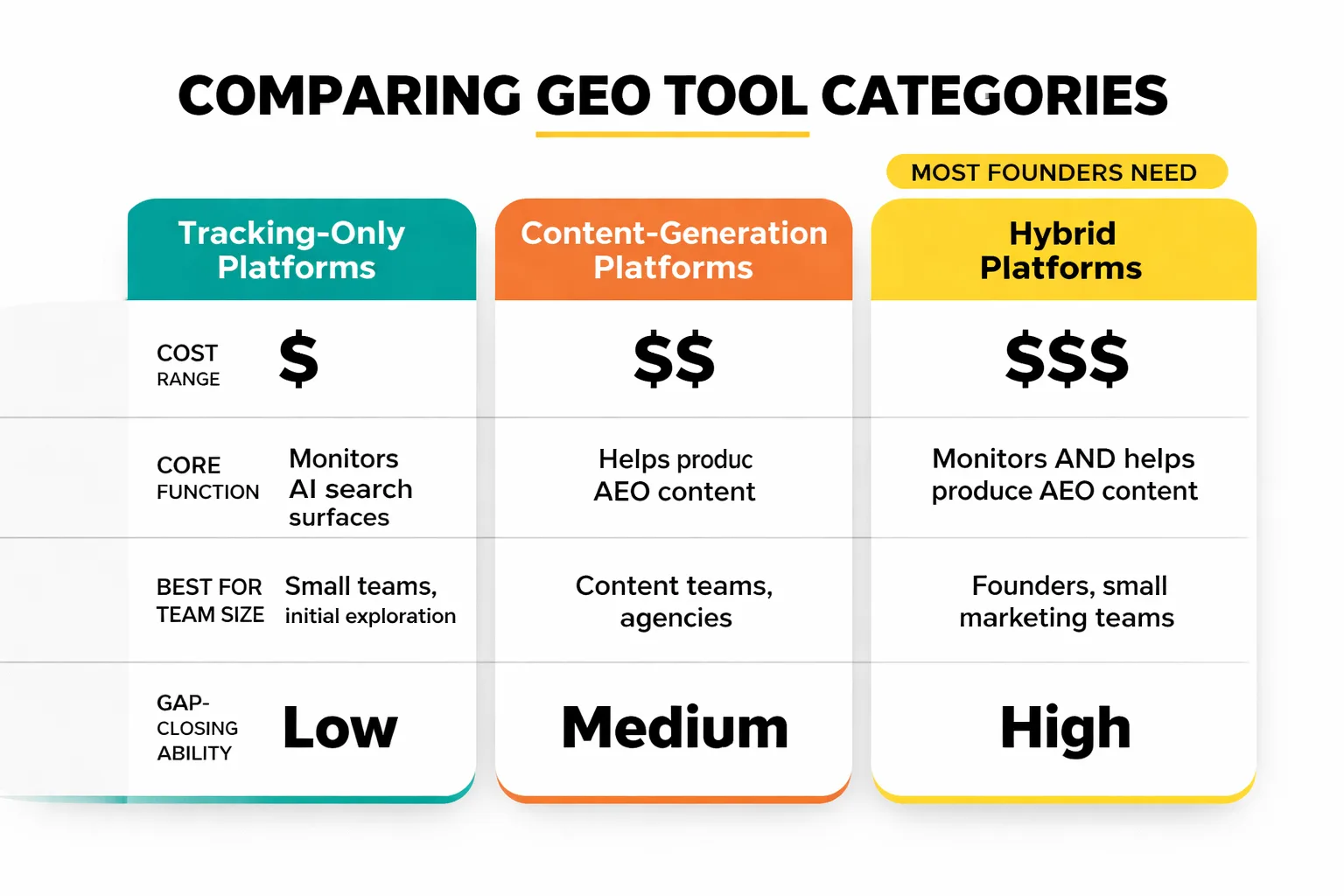
For tracking, you want a platform that monitors every major AI search surface (ChatGPT, Claude, Gemini, Perplexity, Grok, Google AI Overviews, AI Mode, DeepSeek) and shows you where your brand appears, where it doesn't, and what position it holds in the answer. Mention position matters enormously. Being first in an AI answer is worth exponentially more than being seventh in a list. The Perplexity AI visibility checker and ChatGPT AI visibility checker are examples of surface-specific tracking that gives you per-LLM drill-down.
For content generation, the bar is quality control. I've tested AI content tools extensively, and most produce what I can only call AI slop. They generate text that reads fine but fails the extractability test. AI engines don't cite content because it's well-written. They cite content because it's structured for extraction: direct answers under question headings, fact-verified claims with source links, and schema markup that signals authority. The AI SEO tool category has evolved significantly, but the best tools for generative engine optimization are the ones that combine archetype-aware writing with a quality firewall that blocks weak drafts before they reach your CMS.
For entity signal building, most GEO tools are weak. This is the gap. Tracking tells you you're invisible. Content gets you indexed. But entity grounding. Getting into Wikidata, building knowledge graph presence, earning third-party mentions on authoritative domains. Most platforms treat this as an afterthought. In my experience, this is where the actual citation lift comes from. The arXiv research confirms it: AI search favors earned media over brand-owned content. If your GEO strategy doesn't include a systematic way to earn third-party mentions on the domains AI engines cite most, you're doing half the work.
A cited-source leaderboard — knowing which domains AI engines actually cite for your topics. Is the missing piece. Once you know that, say, G2 and Capterra and three niche blogs are the sources Perplexity pulls from for your category, you can focus your outreach there instead of spraying pitches across 50 domains.
How Does Entity Grounding Actually Work?
Entity grounding is the process by which an AI model builds a reliable internal representation of who you are, what you do, and why you're credible. It's not a single action. It's a network of signals that converge to give the model confidence.
Think of it like a credit score. No single data point determines your creditworthiness. It's the aggregate pattern: payment history, credit utilization, length of history, types of credit. AI entity grounding works the same way. The model looks at your website, your structured data, your presence in knowledge bases like Wikidata, your mentions across the web, and the consistency of how those sources describe you. When enough signals align, the model "resolves" your entity with confidence and can cite you in answers.
For B2B SaaS founders, the entity grounding gap usually looks like this: your website exists, your structured data is incomplete or wrong, you have no Wikidata entry, your G2 profile is thin, and the only third-party mentions about you are a few directory listings. The AI model has insufficient signal to resolve you as a credible entity within your category. So when a buyer asks "recommend a tool for X," the AI skips you entirely. Not because your product is bad, but because the model isn't confident enough to recommend you.
The fix is systematic. First, audit your entity signals: does your site have proper Organization schema, are you in Wikidata, do G2 and Capterra profiles exist and accurately describe your category, are there at least 5-10 independent domains mentioning your brand in context? Second, close the gaps: claim or create your Wikidata entry, enrich your G2 profile, pursue mentions on the domains your AI visibility tool identifies as top cited sources for your topic. Third, ensure consistency: every source should describe your brand the same way (same category, same positioning, same core feature set). Inconsistency makes the model less confident, not more.
I used to think a robust knowledge graph and perfectly structured content were the silver bullet. My team spent months building out our internal knowledge base with schema markup, expecting a direct correlation to AI visibility. What I found is that structured data is foundational but insufficient. The real lift comes from third-party editorial mentions and community discussion. The model needs external corroboration to trust your self-description. That's why the arXiv finding about earned media dominance is so important for founders to internalize.
The Minimum Viable AI Visibility Stack for a Two-Person Team
You don't need a five-tool stack and a $2,000/month budget. Here's the minimum viable stack I'd build if I were a two-person founder team starting today.
One tracking tool. You need a platform that monitors your brand across all major AI search surfaces and shows you mention position, not just presence. The LLM visibility tool category covers this. What matters: daily or weekly refresh rates, per-LLM drill-down so you can see the actual response text behind each mention, and competitor share-of-voice tracking so you know whether you're gaining or losing ground. A tool that only tracks Google AI Overviews isn't enough. Your buyers use ChatGPT and Perplexity too. You need cross-surface visibility or you're optimizing blind.
One content workflow. You need a systematic way to produce answer-engine-optimized content that AI models can extract from. This means articles structured with question-shaped headings, direct answers in the first paragraph, fact-verified claims with inline source links, and schema markup. The content generation tool you pick must have archetype-aware writing (listicles, how-tos, and explainers each need different structures) and a quality gate that blocks weak drafts. I've seen what happens without a quality firewall: a 60% failure rate where articles either don't rank or get flagged as low-quality. Your content workflow should also handle internal linking, schema generation, and indexing (Google Search Console + IndexNow) automatically. If you're manually publishing, formatting schema, and pinging IndexNow for every article, you'll publish three articles and quit.
One entity signal. Pick the highest-impact entity signal you can build in a week. For most B2B SaaS founders, that's a Wikidata entry combined with a complete G2 profile. Wikidata is the structured knowledge base that many AI models reference for entity resolution. A properly constructed Wikidata entry with your company name, description, category, and official website creates a machine-readable entity record. G2 profiles matter because they're frequently cited by AI engines for software recommendations. A thin G2 profile with three reviews and no feature descriptions won't get you cited. A complete profile with 20+ reviews, detailed feature descriptions, and accurate category tags will.
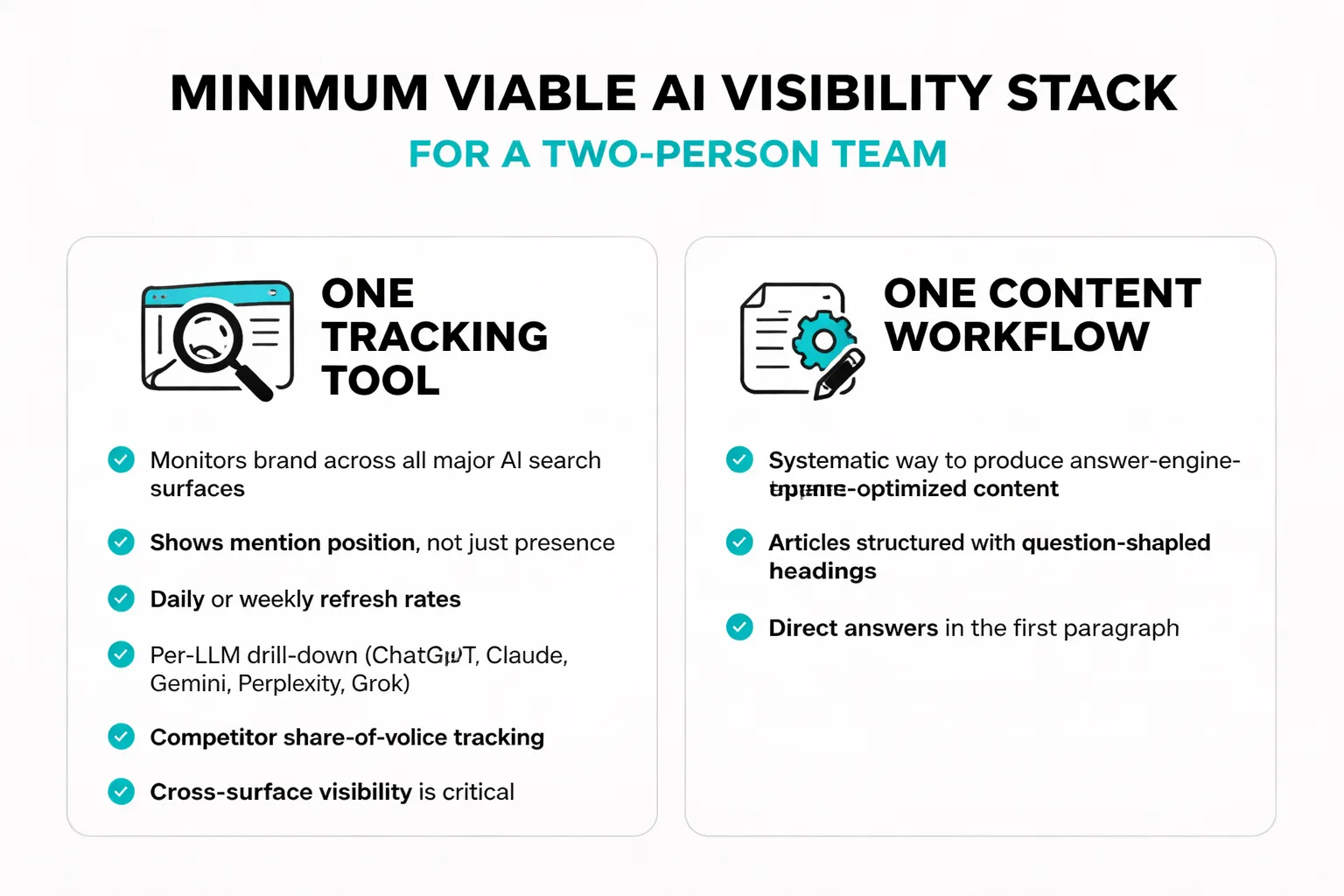
This stack costs under $300/month if you pick the right tools. The AI visibility tracker handles tracking. A content platform with a quality firewall handles generation. Wikidata and G2 are free (your time is the cost). The total investment is small. The discipline of running it weekly is what produces results.
How to Measure Progress Without a Full Analytics Team
The biggest mistake I see founders make with AI visibility is treating it as unmeasurable. They run a few prompts, see their brand mentioned (or not), and then either celebrate or despair without any systematic tracking. You need a methodology.
Here's the system I recommend. It requires no analytics team and takes 30 minutes per week.
Build a prompt set of 15-25 prompts. These are the actual questions your buyers ask AI engines. Use the three prompt archetypes from earlier (recommend, compare, best platform) and build 5-8 variants of each. Include category-level prompts ("best AI visibility tool"), comparison prompts ("Meev vs [competitor]"), and scenario-specific prompts ("AI visibility tool for small teams"). These prompts become your tracking instrument. They don't change week to week. You run the same prompts and measure movement.
Run your prompt set on a fixed cadence. Weekly is ideal. Daily is noisy because LLM responses have natural variation. Monthly is too slow to catch trends. Run your 15-25 prompts across ChatGPT, Perplexity, and Claude (or use a tool that automates this). Log whether your brand appears, what position it holds (first, in a list, last, not present), and how it's framed (positive, neutral, negative, misframed).
Track two metrics. The first is citation rate: what percentage of your prompt set cites your brand? If you run 20 prompts and your brand appears in 4, your citation rate is 20%. This is your headline metric. The second is share of voice: when the AI cites brands in your category, what percentage of mentions are yours vs. competitors? If the AI mentions 5 brands across your prompt set and 1 is you, your share of voice is 20%. These two metrics tell you whether your GEO work is compounding.
The framing metric matters too. I learned this the hard way. An AI can recommend your brand as a "good starting point" before suggesting a "more advanced" competitor, funneling users away from you. Track not just whether you're mentioned, but how. Are you positioned as the leader, the budget option, the beginner-friendly choice, or the also-ran? Framing determines whether AI visibility converts to pipeline.
A note on methodology. LLM responses are non-deterministic. The same prompt can return different answers on different days. This is why you track trends, not individual data points. A single week where your citation rate drops from 25% to 20% is noise. A four-week trend from 25% to 15% is a signal. Don't panic over weekly fluctuations. Panic over monthly trends.
The AEO vs GEO distinction matters here. Traditional SEO ranking reports show position changes that correlate directly with traffic. AI visibility metrics don't have that direct line. A citation rate increase from 15% to 30% won't immediately double your demo requests. But it means more buyers are seeing your brand in AI-generated shortlists, which compounds over time as those buyers research further, visit your site, and enter your funnel. The relationship between AI visibility and pipeline is real but indirect. Track it as a leading indicator, not a conversion metric.
What About AI SEO Agents and Agentic SEO?
The term "agentic SEO" gets thrown around a lot in 2026. Let me be clear about what it means and what it doesn't.
An AI SEO agent isn't a chatbot that writes meta descriptions. It's a system that operates with autonomy across the content lifecycle: discovering topics, researching content, writing drafts, checking quality, publishing, and monitoring performance. The key word is autonomy. Traditional SEO tools are instruments you operate. An AI SEO agent is a worker you supervise.
For B2B SaaS founders, the appeal is obvious. You don't have a content team. You don't have time to research 50 keyword variants, write a 2,000-word article, format schema, add internal links, submit to IndexNow, and track rankings. An AI SEO agent handles the operational work while you focus on strategy and quality control.
But here's the contrarian take. Most agentic SEO implementations I've seen are dangerous for B2B SaaS brands. They prioritize volume over quality. They publish content without a quality firewall. They don't check for cannibalization, duplicate content, or fact accuracy. For a B2B SaaS company where every piece of content shapes how AI engines understand your entity, publishing 30 low-quality articles per month is worse than publishing 5 excellent ones. The low-quality content dilutes your entity signal. It teaches the AI model that your brand produces generic content, which makes the model less likely to cite you as an authoritative source.
The What is AEO question is relevant here. Answer engine optimization isn't about volume. It's about producing content that AI engines can extract from, cite confidently, and attribute accurately. An AI SEO agent that doesn't understand archetype-aware writing, fact verification, and quality gating will produce content that ranks on Google but gets ignored by AI engines. That's the worst outcome: you spend money on content that wins the old game and loses the new one.
If you're evaluating an AI SEO agent, ask three questions. Does it have a quality firewall that blocks weak drafts before publishing? Does it support archetype-aware writing (different structures for listicles, how-tos, explainers)? Does it handle entity signals (schema markup, author entities, fact verification with source links)? If the answer to any of these is no, you're buying an article factory, not a GEO system.
When Should You Invest in Paid GEO Tools?
Free manual tracking works for baseline measurement. Run your prompts, log the responses, track citation rate in a spreadsheet. But at some point, manual tracking breaks down.
The threshold is prompt volume. If you're tracking 15 prompts across 3 AI engines weekly, that's 45 manual queries. Manageable. If you expand to 50 prompts across 7 surfaces, that's 350 weekly queries. Not manageable for a founder who's also building a product.
Paid GEO tools earn their cost when you need scale, consistency, and depth that manual tracking can't provide. Scale means more prompts, more surfaces, more frequent refreshes. Consistency means the same prompt run the same way every time, eliminating the human error that plagues manual tracking. Depth means seeing not just whether you're mentioned, but the full response text, the citations behind each mention, and the competitor analysis that tells you where to focus.
The enterprise AI rank tracker tier exists for teams that need all of the above plus multi-domain management, team collaboration, and white-label reporting. Most B2B SaaS founders don't need this on day one. Start with a mid-tier tool that covers your core surfaces and gives you per-LLM drill-down. Upgrade when your prompt set grows beyond what you can manage manually or when you're tracking multiple competitors across multiple product lines.
The Framing Problem Nobody Talks About
I want to end on something most GEO playbooks ignore. Getting cited by AI engines is necessary but insufficient. How you're cited matters more than whether you're cited.
I discovered this working with a B2B SaaS client. We spent three months optimizing for positioning accuracy, getting the brand to appear more frequently in AI answers. The brand did appear more often. But the conversion rate from AI-driven impressions didn't show the expected lift. When I dug into the response text, I found the problem. The AI was recommending the client as a "good starting point for small teams" before suggesting a "more advanced" competitor for growing companies. The AI was citing the brand, but framing it as training wheels. Every mention was a funnel away from the product.
This is the framing problem. An AI citation that positions you as the budget option, the beginner tool, or the stepping stone to a "real" solution is worse than no citation at all. It actively trains buyers to start with you and leave.
The fix is narrative control. You need to shape not just whether AI engines mention you, but what narrative they attach to that mention. This means your content, entity signals, and third-party mentions all need to consistently communicate your actual positioning. If you're the premium option, your signals should say that. If you're the specialist for a niche, your signals should say that. Inconsistency between how you describe yourself and how third parties describe you creates framing drift, and the AI fills the gap with whatever narrative it can construct from available signals.
The most effective AI visibility tools with generative engine optimization don't just track mentions. They track framing. They show you the actual response text behind every citation, so you can see whether the AI is positioning you as the leader or the warmup act. If your tool only shows a binary "mentioned / not mentioned," you're flying blind on the thing that matters most.
FAQ
What is Generative Engine Optimization (GEO) and why does it matter for B2B SaaS?
Generative engine optimization is the practice of optimizing your brand's presence so AI search engines (ChatGPT, Perplexity, Claude, Google AI Overviews) cite your company in their answers. For B2B SaaS, it matters because buyers increasingly use AI for vendor research and comparison before visiting your site. If AI engines don't cite you, you're invisible during the consideration phase. GEO focuses on entity grounding, third-party signals, and content structured for AI extractability rather than traditional keyword optimization.
How is GEO different from traditional SEO?
Traditional SEO optimizes for Google's ranking algorithm: keywords, backlinks, domain authority. GEO optimizes for AI model retrieval and citation: entity grounding, third-party corroboration, content extractability, and framing. The AEO vs SEO distinction is that SEO wins organic traffic while AEO/GEO wins AI citations. The overlap between top Google results and AI-cited sources has dropped below 20%, meaning the two disciplines require different strategies.
What is the best website ranking tool for AI search?
The best tool depends on your needs. For tracking-only, look for platforms that monitor all major AI surfaces with per-LLM drill-down and mention position tracking. For hybrid tracking-plus-content, look for platforms with a quality firewall and archetype-aware writing. For entity signal building, look for tools that surface cited-source leaderboards so you know which domains to target for outreach. The AEO tool category covers the spectrum.
How long does it take to see AI visibility improvement?
Expect 8-12 weeks before seeing measurable citation rate improvement from GEO work. Entity grounding is cumulative. Wikidata entries, third-party mentions, and structured content need to be indexed and incorporated into model updates. Content published today might not affect AI citations for weeks. Track weekly, evaluate trends monthly, and expect compounding gains rather than overnight results.
Can I do GEO without paid tools?
Yes. Start by running 15-25 buyer-intent prompts manually across ChatGPT, Perplexity, and Claude weekly. Track citation rate and share of voice in a spreadsheet. Build your Wikidata entry, complete your G2 profile, and ensure your site has proper Organization schema. Publish answer-engine-optimized content with question-shaped headings and inline source links. Paid tools become worth it when your prompt volume exceeds manual capacity or when you need competitor benchmarking and cited-source analysis.
What's the biggest mistake B2B SaaS founders make with AI visibility?
The biggest mistake is treating AI visibility as a volume problem. Publishing more content without building entity signals, third-party corroboration, and proper framing doesn't move the needle. AI engines don't cite you because you published a lot. They cite you because they're confident in your entity and have enough independent sources to corroborate your claims. Focus on signal quality, not content quantity.
The bottom line for B2B SaaS founders is this. AI search visibility isn't about publishing more content or chasing domain authority. It's about building entity signals that make AI models confident enough to cite you, tracking your citation rate and framing across all major AI surfaces, and closing gaps with a systematic content and outreach workflow. The best generative engine optimization tools are the ones that connect diagnosis to action: they show you where you're invisible, why you're invisible, and what to do about it. Start with your 15 prompts tonight. The data will tell you everything you need to know about where you stand and what to fix first.
About the Author
Judy Zhou, Founder
Judy Zhou leads content strategy at Meev, where she oversees AI-driven content research and publishing for hundreds of brands. With a background in SEO and editorial operations, she focuses on building content systems that rank on Google, get cited by AI search engines, and drive measurable business results.
Stop guessing whether AI engines cite your brand. Run a free AI visibility audit today and get your citation rate, framing analysis, and competitor share-of-voice in minutes.