

How to Be Recommended by AI: What Actually Drives Citations
By Judy Zhou, Founder
Key Takeaways
- Between 84% and 89% of AI-generated answers come from earned media in credible third-party publications rather than owned content.
- Build entity signals, secure citations from the right sources, and structure content for retrieval instead of publishing more site content to earn AI recommendations.
- Measure your own citation rates because no benchmark data yet compares GEO performance against traditional SEO across ChatGPT, Perplexity, or Gemini.
- The Princeton GEO paper with 22 Scopus citations proves the framework works in principle but leaves exact citation lifts unquantified.
Ranking on page one of Google no longer means you exist in the answers that matter most. As ChatGPT, Perplexity, and Google's AI Overviews absorb more of the questions your customers are asking, traditional SEO signals. Backlinks, keyword density, even domain authority. Are becoming largely irrelevant to whether an AI recommends your brand. The engines that now shape buying decisions operate on entirely different logic, and most of what you've been optimizing for simply doesn't translate.
The conventional wisdom about AI visibility is wrong. Most teams think publishing more content on their own site will eventually get them cited by ChatGPT or Perplexity. In my work auditing content ops, I've found that owned content alone rarely drives AI recommendations. Between 84% and 89% of AI-generated answers come from earned media, meaning third-party coverage in credible publications is what actually moves the needle. The teams getting recommended aren't the ones publishing the most. They're the ones building entity signals, getting cited by the right sources, and structuring content for retrieval. That's the gap between having content and getting cited.
The Princeton GEO research paper, which has already accumulated 22 Scopus citations, establishes Generative Engine Optimization as a distinct framework from traditional SEO. But here's what nobody is telling you: no benchmark comparison data exists showing citation rate percentages for GEO versus traditional SEO. The original GEO paper on arXiv proves the framework works in principle, yet nobody has quantified the exact citation lift across specific tools like ChatGPT, Perplexity, or Gemini. You're operating in a space where the academic foundation exists but the empirical benchmarks don't. That means you need to measure your own baseline rather than relying on industry averages that haven't been established yet.
Why AI Engines Recommend Some Brands and Ignore Others
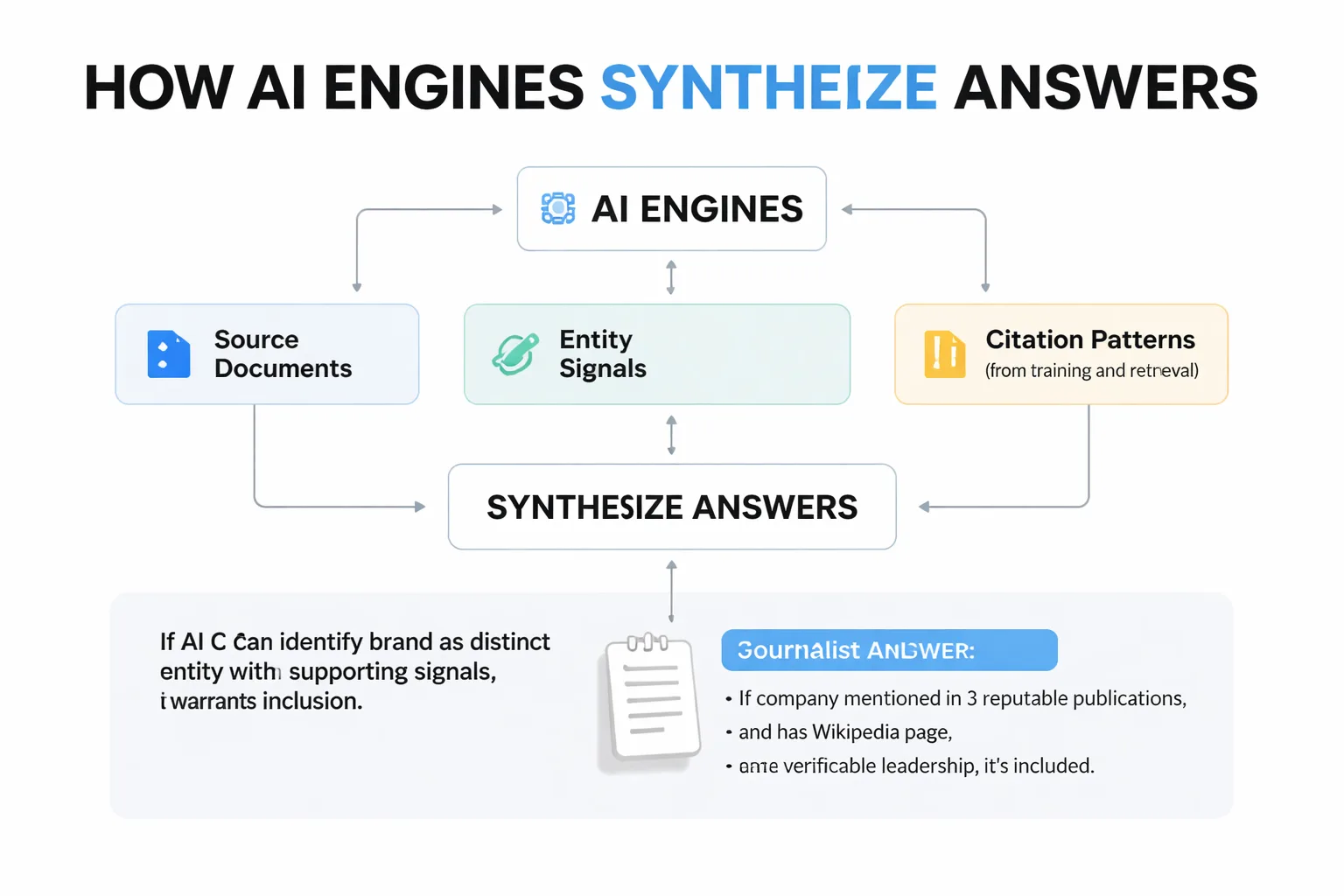
AI engines don't rank pages. They synthesize answers from source documents, entity signals, and citation patterns they've encountered during training and retrieval. The gap between having content and getting cited comes down to whether AI systems can identify your brand as a distinct entity with enough supporting signals to warrant inclusion in a generated answer.
Think of it like a journalist writing a story. If you've never heard of a company, you won't quote them. But if you've seen them mentioned in three reputable publications, they have a Wikipedia page, and their leadership team is verifiable, you'll include them without hesitation. AI works the same way. The model needs to encounter your brand in contexts it trusts before it will recommend you.
In my work at Meev, I've seen this pattern repeat across hundreds of brands. The ones that get cited have structured entity data, consistent mentions across high-authority sources, and content that directly answers the prompts users actually type. The ones that don't get cited are usually sitting on a pile of blog posts that were optimized for keyword density but never structured for retrieval. The Department of Energy's SEO best practices documentation even acknowledges this shift, noting that having pages cited in AI answers is now as important as ranking in search results.
Here's the uncomfortable part. Most teams are spending their budget on content production when they should be spending it on entity grounding and source diversification. You can publish 100 blog posts and still not appear in a single AI answer if no third-party source has ever mentioned you. The mechanics of AI recommendation favor brands that exist as recognized entities across the web, not brands that simply produce a high volume of content on their own domain.
The deeper issue is about how LLMs construct their world model. During training, the model ingests enormous amounts of text and builds internal representations of entities and their relationships. If your brand appears frequently alongside specific topics in the training data, the model forms a strong associative link. If it doesn't, your brand is effectively invisible to the model's internal knowledge. Retrieval-augmented generation can bridge this gap by pulling in live web results, but even then, the model needs to recognize your brand name as a meaningful entity to include it in the synthesized answer rather than discarding it as noise.
What Does Being Recommended by AI Actually Mean?
Being recommended by AI isn't a single state. There are three distinct types of AI visibility, and they carry different weight depending on what your customer is doing.
The first is appearing in a list. When someone asks ChatGPT for the best project management tools, and your brand shows up alongside five competitors, that's list inclusion. It's valuable for awareness but doesn't differentiate you. The second is being cited as a source. When Perplexity generates an answer about a topic and links to your page as evidence, that's a citation. It drives direct traffic and signals authority. The third is being named as a recommended tool. When Gemini tells a user, "Based on your needs, I'd recommend [your brand] because...", that's a recommendation. This is the most valuable form of AI visibility because it directly influences a buying decision.
I track these distinctions because they require different strategies. List inclusion responds to entity signals and category presence. Citations respond to content structure and source authority. Recommendations respond to sentiment, feature differentiation, and what I call citation velocity (the rate at which new sources are mentioning you over time). If you don't know which type you're optimizing for, you're throwing darts blindfolded.
The practical implication is that you need different content for different citation types. For list inclusion, you need category pages and structured data that clearly position your brand within a product category. For citations, you need deep, fact-dense content that answers specific questions with verifiable claims. For recommendations, you need review coverage, comparison content, and feature-specific mentions that give the AI enough context to differentiate you from competitors.
Let me make this concrete with an example I've seen play out repeatedly. A SaaS tool in the project management space was invisible in ChatGPT responses despite ranking on page one of Google for their primary keyword. The problem wasn't their content quality. It was that no comparison articles, no listicles, and no review sites mentioned them. ChatGPT's model had no training data associating their brand with the project management category. Once they secured mentions in three high-authority comparison articles and got listed in two industry roundups, they started appearing in ChatGPT list responses within six weeks. The content on their own site hadn't changed at all. What changed was the external citation graph.
Contrast that with a brand that was getting cited as a source by Perplexity but never appeared in ChatGPT recommendations. Their content was deep and fact-rich, which Perplexity's retrieval system loved. But they had no review coverage and no comparison content, so ChatGPT's model didn't have enough context to recommend them as a solution. They needed a completely different intervention: earned media that explicitly compared their features to competitors and framed them as a top choice.
The 4 Signals That Move AI Recommendation Rate
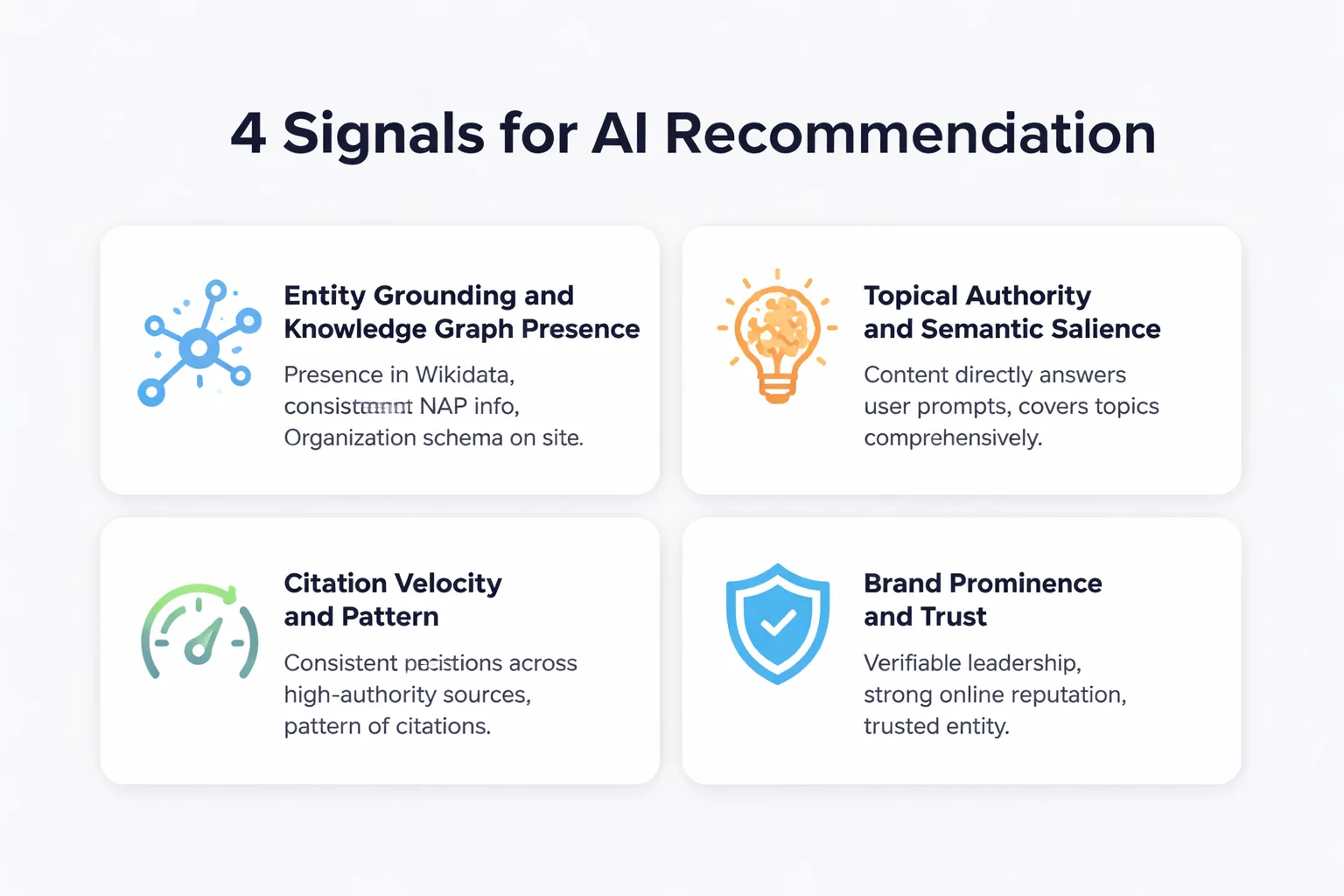
After months of testing and observation, I've identified four signals that consistently correlate with higher AI recommendation rates. These aren't theoretical. They're the patterns I see in brands that show up in AI answers versus those that don't.
Signal 1: Entity Grounding and Knowledge Graph Presence
AI engines need to recognize your brand as a distinct entity before they'll recommend it. This means having a presence in structured knowledge bases like Wikidata, consistent NAP (name, address, phone) information across the web, and clear entity definitions on your own site using schema markup.
The practical action here is straightforward but tedious. Claim your Wikidata entry. Implement Organization schema on your homepage. Make sure your brand name, description, and category are consistent across every platform where you appear. I've seen brands go from invisible to cited in AI answers within weeks of fixing their entity data, simply because the AI could finally recognize them as a distinct, verifiable entity rather than an ambiguous string of text.
Entity grounding goes beyond schema markup. It includes your presence in knowledge panels, your association with specific categories and topics in structured data, and the consistency of your brand information across the web. If your Wikidata entry says you're a "software company" but your website says you're a "platform for marketing automation," that inconsistency weakens your entity signal. AI engines resolve entities by matching structured data across sources, and inconsistencies force them to guess. Guessing is bad for you because the model may merge your entity with a different company or fail to recognize you entirely.
The most overlooked entity signal is founder and leadership presence. AI models associate brands with their leaders. If your CEO has a verified Wikidata entry, a LinkedIn profile with consistent company information, and mentions in authoritative publications, that strengthens your brand's entity graph. I've seen companies break into AI recommendations after securing Wikipedia pages for their founders, even when their product pages hadn't changed.
Signal 2: Source Authority of Pages That Mention You
Not all mentions are equal. A mention in a high-authority publication carries far more weight than a mention in a low-quality directory. AI engines weight their sources, and the authority of the page that mentions you directly affects your likelihood of being recommended.
This is where AI search engine optimization tools that track cited-source leaderboards become essential. You need to know which domains AI engines are actually citing for your topics, then focus your outreach on getting mentioned there. In my experience, the top 10 cited domains for any given topic account for the majority of AI answer sources. If you're not mentioned in any of them, you're invisible.
The pattern I keep seeing is that brands chase quantity of mentions when they should be chasing quality. One mention in a top-cited publication is worth more than fifty mentions in sites that AI engines never reference. I've watched brands spend months building directory listings on low-authority sites only to see zero movement in their AI visibility. Then a single mention in a top-tier publication moves the needle within weeks.
The reason is mathematical, not mysterious. Retrieval systems rank sources by authority and relevance. When they retrieve documents to construct an answer, they pull from the top of the ranked list. If your brand is only mentioned in low-authority sources, those sources rank below the retrieval threshold and never make it into the answer. You need mentions in sources that rank above the threshold for your topic, and those sources are surprisingly few.
Signal 3: Answer-Engine-Optimized Content Structure
Content that gets cited by AI engines has a specific structure. It leads with direct answers to questions. It uses clear headings that match how users phrase prompts. It includes verifiable facts with named sources. And it avoids the fluff that AI engines filter out during retrieval.
This is exactly what we focus on at Meev with our answer engine optimization framework. Every article goes through a 16-dimension quality firewall that checks whether the content is structured for retrieval, not just for keyword ranking. The articles that pass are the ones that lead with extractable answers, cite authoritative sources inline, and use schema markup to signal their relevance to specific question types.
The structural elements that matter most for AEO are different from traditional SEO. H1 and H2 headings should mirror natural language prompts, not keyword strings. "How much does CRM software cost" is a better heading than "CRM Software Pricing Guide." Paragraphs should be self-contained and answer-scoped, meaning each paragraph should make a complete point that could be extracted independently. Lists and tables should be used for structured data because AI engines parse them more reliably than prose. And every factual claim should have a named source because AI engines prioritize content with verifiable citations over unsourced assertions.
Signal 4: Citation Velocity
Citation velocity is the rate at which new sources are mentioning your brand over time. AI engines favor brands that are actively being discussed, not brands that had a burst of coverage two years ago and went quiet.
This is where earned media comes back into play. The 84-89% figure I mentioned earlier means that your PR strategy is now your AI visibility strategy. Every new mention in a credible source signals to AI engines that your brand is current and relevant. Brands that maintain steady citation velocity outperform brands that spike and fade, even if the spiking brand gets more total mentions in a given month.
Citation velocity matters because AI models are continuously updated with new training data and because retrieval-augmented systems pull from recent web content. A brand that was heavily mentioned in 2024 but hasn't had new coverage since will gradually lose recommendation share as the model's training data shifts and newer sources dominate the retrieval results. I've tracked brands that were top recommendations in early 2025 and have since dropped out of AI answers entirely because they stopped earning new mentions. The half-life of AI visibility is shorter than most teams realize.
Want to see which AI engines are citing your brand today?
How Answer Engine Optimization Services Close the Gap
Understanding the signals is one thing. Acting on them systematically is another. This is where the best answer engine optimization services earn their keep. A real AEO service workflow isn't about publishing more content. It's about diagnosing where you stand, identifying what's missing, and closing specific gaps with measurable actions.
The workflow I use at Meev follows four phases. First, diagnosis: we track where your brand appears across every major AI search surface, including ChatGPT, Claude, Gemini, Perplexity, Grok, Google AI Overviews, AI Mode, and DeepSeek. We measure your mention position, your share of voice versus competitors, and which prompts trigger your brand versus which don't. This gives you a baseline. Without a baseline, you're optimizing blind.
Second, gap identification. We find prompts where competitors are cited but you aren't. We identify the sources AI engines are citing for those prompts. We surface the specific publishers you need to get mentioned by. This is where tools like our Perplexity AI visibility checker and ChatGPT AI visibility checker become essential for understanding engine-specific citation patterns.
Third, content publishing. This is where the approve-before-publish model matters. Unlike black-box autoblogging tools that ship whatever the model produces, a real AEO service gives you control over what goes live. Every article should be archetype-aware (structured for the question type it answers), fact-verified (every claim source-traced before publish), and gated by quality checks that block weak drafts. The 16-dimension quality firewall we use at Meev blocks articles scoring below 70 out of 100 from auto-publishing. No competitor in the auto-blog space has an equivalent gate.
Fourth, measurement. You track whether your citation rate actually improved. You monitor which new sources mentioned you. You adjust based on what's working. This is the loop that most teams skip, and it's why most AEO efforts fail. You can't improve what you don't measure.
The reason most answer engine optimization aeo services fail is that they focus on content production without diagnosis. They publish articles and hope. A real service starts with the diagnosis, identifies specific gaps, and closes them with targeted content and outreach. The content is the output of the strategy, not the strategy itself.
Let me walk through what this looks like in practice. A B2B SaaS company came to us with zero AI visibility. They ranked well on Google for their category but weren't mentioned by any AI engine. The diagnosis phase revealed that competitors were being cited in responses to prompts like "best tools for [their category]" and "how to [core use case]." The cited sources were three specific comparison sites and two industry publications. Gap identification showed that our client wasn't mentioned on any of them.
We then executed a two-track strategy. Track one was content: we published answer-engine-optimized articles targeting the specific prompts where they were absent, structured with extractable answers and schema markup. Track two was outreach: we used Meev's Citation Path feature to find verified contacts at the cited publications and sent personalized pitches grounded in the client's knowledge base. Within 60 days, they appeared in their first ChatGPT response. Within 90 days, they were cited by Perplexity. The combination of owned content structure and earned media coverage was what moved the needle. Neither track alone would have been sufficient.
How to Measure Whether You're Actually Getting Recommended
This is the question that separates serious practitioners from people playing with AI tools. Measurement in AEO is fundamentally different from traditional SEO because the inputs are non-deterministic. Ask ChatGPT the same question twice and you may get different answers. That makes tracking harder but not impossible.
Prompt-Based Monitoring
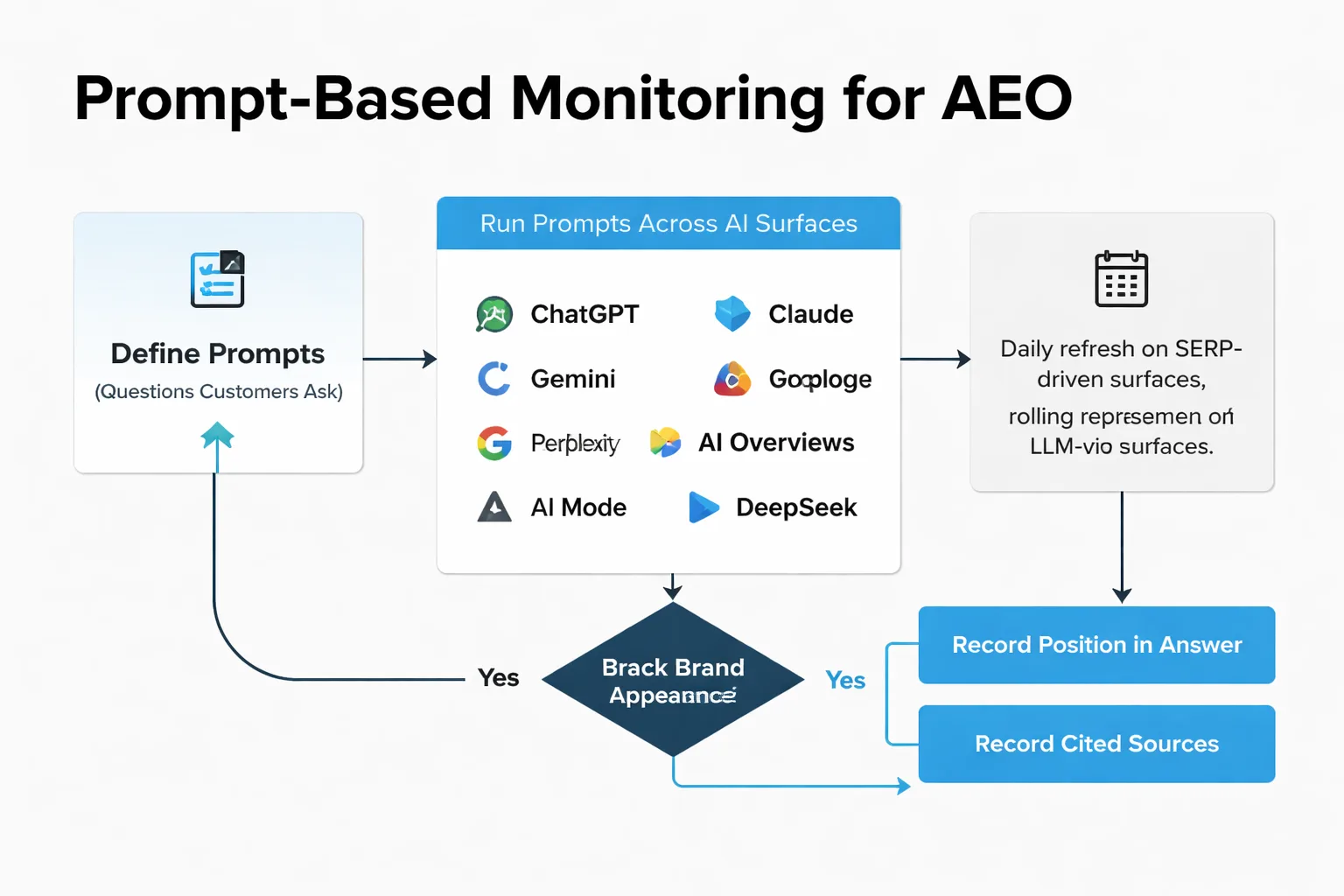
The core method is prompt-based monitoring. You define a set of prompts that represent the questions your customers ask when researching your category. You run those prompts across every major AI search surface on a regular schedule. You track whether your brand appears, where in the answer it appears, and what sources are cited.
This is exactly what our AI visibility tracker does. It runs your prompts across ChatGPT, Claude, Gemini, Perplexity, Grok, Google AI Overviews, AI Mode, and DeepSeek with daily refresh on SERP-driven surfaces and rolling refresh on LLM-driven surfaces. You see the actual response text and the citations behind every mention. You track trends over time. You know whether you're gaining or losing visibility.
Brand Mention Rate Metrics
Brand mention rate is the percentage of prompts where your brand appears in the AI's response. It's the AEO equivalent of keyword ranking position. But it's more nuanced than a single number because it varies by engine, by prompt type, and by mention type (list inclusion vs. citation vs. recommendation).
I recommend tracking three metrics: raw mention rate (how often you appear at all), citation rate (how often an AI links to your content as a source), and recommendation rate (how often an AI names you as a top choice). These three metrics tell you different things about your AI visibility health.
Setting Your Baseline
Before you optimize anything, run your prompt set across all engines and record your current state. This is your baseline. Every optimization should be measured against it. If you publish ten answer-engine-optimized articles and your mention rate doesn't move after 30 days, something isn't working. If you get mentioned in a top-cited publication and your citation rate jumps on Perplexity but not on ChatGPT, that tells you something about how different engines weight sources.
Here's the critical finding from recent research that affects how you interpret your measurements. A study on LLM deep research agents found that while these models maintain link validity above 94% and relevance above 80%, they achieve only 39-77% factual accuracy when citations are evaluated against actual source content. Fewer than half of AI citations achieve full factual accuracy, which means a citation tracking tool can report your brand as cited while the cited source doesn't actually support the claim the AI made. This is a gap that most citation tracking tools completely ignore.
The implication is that you need a secondary verification layer. Don't just track whether you're cited. Verify that the citation is accurate. A citation that misrepresents your brand is worse than no citation at all.
How Do AI Engines Actually Choose Sources?
AI engines choose sources through a combination of retrieval-augmented generation (RAG) and training data weighting. When you ask Perplexity a question, it doesn't search the live web the way Google does. It retrieves relevant documents from its index, ranks them by relevance and authority signals, and synthesizes an answer from the top results. The sources it cites are the documents it used to construct the answer.
This means being cited requires being in the retrieval set for a given prompt. And being in the retrieval set requires having content that matches the prompt semantically, carries sufficient authority signals, and is structured in a way the retrieval system can parse. This is why content structure matters as much as content quality. A brilliantly written article that isn't structured for retrieval will never be cited because the retrieval system won't select it.
The difference between AEO and SEO comes down to what you're optimizing for. SEO optimizes for ranking position on a search results page. AEO optimizes for inclusion in a synthesized answer. The former rewards pages that satisfy search intent. The latter rewards pages that provide extractable, citable information that an AI can use to construct a response.
Understanding the retrieval mechanism changes how you approach content. Traditional SEO rewards depth and comprehensiveness because Google ranks pages that thoroughly cover a topic. AEO rewards extractability because AI engines pull specific passages, not entire pages. An article that covers ten topics superficially will be cited less than an article that deeply answers one specific question with verifiable data, even if the former ranks higher on Google. The unit of retrieval is the passage, not the page. This is why I structure articles with self-contained paragraphs that each make a complete, citable point.
When Should You Invest in AEO?
The answer is now, and the reason is simple. Every month you wait, your competitors are building entity signals, earning citations, and establishing themselves as the sources AI engines trust. AI recommendation patterns are sticky. Once an engine starts citing a brand for a given topic, it tends to continue citing that brand because the citation reinforces the entity association.
I've seen this with brands that got early coverage in 2024 and 2025. They're now the default recommendations for their categories across multiple AI engines, and competitors who are technically better products can't break in because the AI has already formed its citation patterns. The window to establish your brand as a cited source is open now, but it won't stay open forever.
The investment question really comes down to whether your customers are using AI engines to research purchases. If they are (and they are, in increasing numbers), then AEO isn't optional. It's the new SEO. The difference is that AEO is harder to game and slower to show results, which means the brands that start now will have a durable advantage.
If you're evaluating generative engine optimization services, the criteria are straightforward. Does the service diagnose before it prescribes? Does it track across every major AI surface? Does it verify citation accuracy, not just citation presence? Does it give you control over what gets published? If the answer to any of these is no, you're looking at a content production service dressed up as an AEO service.
What About Ecommerce and Agentic Commerce?
AEO for ecommerce operates on different mechanics than B2B SaaS. When a user asks an AI engine to recommend a product, the AI doesn't just cite sources. It often pulls from structured product data, review aggregations, and comparison content. This is what the industry calls agentic SEO: optimizing for AI agents that make purchasing recommendations, sometimes even executing transactions directly.
For ecommerce brands, the entity signals that matter include product schema, review structured data, and presence on platforms that AI engines use as product data sources. If your product feeds are inconsistent across Google Shopping, Amazon, and your own site, the AI can't confidently recommend your product because it can't verify the specifications. Consistency across product data sources is the ecommerce equivalent of entity grounding for B2B brands.
The rise of agentic commerce means AI engines are increasingly making purchasing decisions on behalf of users. A user might ask an AI to "find the best standing desk under $500 and order it." The AI needs to compare options, verify specifications, check reviews, and execute the purchase. If your brand isn't in the AI's recommendation set for that prompt, you lose the sale entirely. This makes AEO for ecommerce a direct revenue driver, not just a visibility metric.
What About Ethical Implications and AI Bias?
AI recommendations aren't neutral. They reflect the biases in training data, the weighting of sources, and the retrieval system's design. Brands that are overrepresented in high-authority sources get recommended more often, creating a rich-get-richer effect. Brands in emerging categories or serving underserved markets may struggle to get cited because the training data doesn't yet associate their category with any brands strongly enough.
The ethical implication for AEO is that you can't optimize your way out of systemic bias. If AI engines don't cite sources from your industry or region, no amount of content optimization will fix that. What you can do is ensure your brand is represented in the sources that AI engines do cite. This means pursuing earned media in the publications that AI engines trust, even if those publications have historically overlooked your category.
I've seen this play out with brands serving non-English markets. AI engines trained primarily on English content have weaker entity graphs for non-English brands, making it harder to get recommended even when the brand is well-known in its local market. The mitigation strategy is to build English-language entity signals (Wikidata, English Wikipedia, English-language press coverage) while maintaining strong local presence. It's not ideal, but it reflects the current reality of how AI models are trained.
What This Actually Means
The shift from SEO to AEO isn't a tactic change. It's a fundamental reorientation of how brands earn visibility. You're no longer optimizing for an algorithm that ranks pages. You're optimizing for a model that synthesizes answers from the sources it trusts. The brands that win will be the ones that build entity signals, earn citations from authoritative sources, structure content for retrieval, and maintain citation velocity over time.
The teams that fail will be the ones who keep publishing keyword-optimized blog posts on their own site while wondering why ChatGPT never mentions them. The data is clear: 84-89% of AI answers come from earned media, not owned content. If your AEO strategy doesn't include source diversification and entity grounding, you're invisible to the engines that matter.
If you want to know where you stand right now, start with a diagnostic. Run your prompts across every major AI search surface. See where you're cited and where you're absent. Then close the gaps with targeted content, structured data, and outreach to the publishers AI engines actually trust. That's what the best answer engine optimization services do, and it's the only approach that produces measurable results.
FAQ
What is the difference between AEO and traditional SEO?
AEO optimizes for inclusion in AI-synthesized answers, while SEO optimizes for ranking position on search engine results pages. AEO focuses on entity signals, source authority, content structure for retrieval, and citation velocity. SEO focuses on backlinks, keyword density, and domain authority. The AEO vs SEO comparison breaks down how the two approaches differ in practice and why both are still necessary.
How long does it take to see results from AEO?
In my experience, you should expect 60-90 days before seeing measurable changes in your AI citation rate. Entity grounding and schema markup can show results faster (2-4 weeks), but earned media and citation velocity take longer to compound. The key is to set a baseline before you start so you can measure progress accurately.
Can I do AEO without an agency or service?
Yes, but it requires significant manual effort. You need to track your prompts across multiple AI engines, identify citation gaps, structure content for retrieval, and pursue earned media. Tools like our LLMs.txt validator and AI visibility tool can help with diagnosis. But the content production and outreach components are time-intensive without automation.
Which AI engines should I track for visibility?
Track every major AI search surface: ChatGPT, Claude, Gemini, Perplexity, Grok, Google AI Overviews, AI Mode, and DeepSeek. Each engine has different citation patterns and source preferences. Perplexity is particularly important for commerce-related queries because it cites sources more aggressively than other engines.
How accurate are AI citations?
Recent research found that LLM deep research agents achieve only 39-77% factual accuracy when citations are evaluated against actual source content. This means nearly a quarter to more than half of AI citations may not accurately represent the source they reference. You need a verification layer beyond simple citation tracking to ensure your brand is being represented accurately.
What should I look for when choosing an AEO service?
Look for a service that diagnoses before prescribing, tracks across every major AI surface (not just one or two), verifies citation accuracy rather than just tracking presence, and gives you control over what gets published. If the service can't show you the specific prompts where competitors are cited and you aren't, it's not doing real AEO work. It's just producing content and hoping something sticks.
About the Author
Judy Zhou, Founder
Judy Zhou leads content strategy at Meev, where she oversees AI-driven content research and publishing for hundreds of brands. With a background in SEO and editorial operations, she focuses on building content systems that rank on Google, get cited by AI search engines, and drive measurable business results.
Stop guessing about your AI visibility. Run a diagnostic across every major AI search surface and get a clear picture of where you're cited, where you're absent, and what to do next.