
What Is an Answer Engine Optimization Agency?
By Judy Zhou, Founder
Key Takeaways
- An answer engine optimization agency diagnoses your brand's absence from AI answers on ChatGPT, Perplexity, Gemini, and Google AI Overviews, then publishes content structured for LLM citations instead of blue-link rankings.
- AI Overviews cut organic CTR by 58% (from 7.3% to 1.6%) on affected keywords, with Seer Interactive reporting a 61% drop on informational queries.
- Brands that launch structured AEO content capture 20-40% citation rates in AI answers within 60-90 days, while traditional SEO agencies track rankings in a channel Gartner predicts will shrink 25% by 2026.
- Track weekly changes in what ChatGPT and similar models say about your brand, then close citation gaps through entity grounding in Wikidata and knowledge graphs rather than rank dashboards alone.
An answer engine optimization agency gets your brand cited by AI. Not just ranked by Google.
An answer engine optimization agency diagnoses where your brand is absent from AI-generated answers across ChatGPT, Perplexity, Gemini, and Google AI Overviews, then builds and publishes content structured to win citations. Unlike a traditional SEO agency that optimizes for blue-link rankings, an AEO agency focuses on becoming the source that language models quote when users ask questions in your category. The work spans AI citation tracking, entity grounding for AI search, knowledge graph presence in Wikidata, and content written specifically for how LLMs extract and cite information.
The shift is not subtle. Ahrefs found that AI Overviews reduce organic click-through rates by 58% (from 7.3% to 1.6%) on keywords where they appear. Seer Interactive reported a 61% organic CTR drop on informational queries. Gartner predicted a 25% decline in traditional search volume by 2026, and that prediction has held. If your agency is still handing you rank-tracking dashboards as the primary deliverable, they are optimizing for a world that is shrinking. The agencies that matter now are the ones that can show you what ChatGPT says about your brand on Tuesday and what it says on Friday, then explain the delta.
I lead content strategy at Meev, where I oversee AI-driven content research and publishing for hundreds of brands. In my work auditing content operations and AI visibility, I have seen the same pattern repeat: brands pour budget into traditional SEO while their competitors quietly capture 20-40% citation rates in AI answers within 60-90 days of launching structured content. The gap between brands that have an AEO strategy and brands that do not is widening fast.
What Does an Answer Engine Optimization Agency Actually Do?
An answer engine optimization agency performs three core functions: diagnosis, content engineering, and citation gap closure. Each one maps to a specific failure mode I see when brands try to handle AI search in-house.
First, diagnosis. The agency runs AI visibility reporting across every major AI search surface to establish a baseline. Where is your brand mentioned? Where is it absent? Which competitors are being cited, and what sources are the LLMs pulling from to build those answers? This is not a one-time audit. AI engines refresh their responses on different cadences. Google AI Overviews and AI Mode refresh daily. LLM-driven surfaces like ChatGPT and Claude refresh on a rolling basis. An agency that hands you a single snapshot is handing you a screenshot of a moving target.
Second, content engineering. This is where most agencies fail. They write generic blog posts and slap "AI-optimized" on the invoice. A real AEO agency writes content structured for how LLMs extract information. That means archetype-aware writing: listicles, how-tos, explainers, and problem-solvers each have different retrieval weights, different structures, and different quality criteria. The agency should be grounding every article in your approved knowledge base, not in AI hallucination. Every claim should be source-traced before publish. Every article should cite authoritative sources inline, prioritized by domain authority. If the agency cannot explain their quality gating process, they are shipping whatever the model produces.
Third, citation gap closure. The agency finds the publishers that AI engines actually cite for your topics, resolves verified contacts, and drafts personalized outreach pitches grounded in your knowledge base. This is the closed-loop work that separates a diagnostic dashboard from a business outcome. An agency that only tracks problems without closing them is selling you a mirror, not a solution.
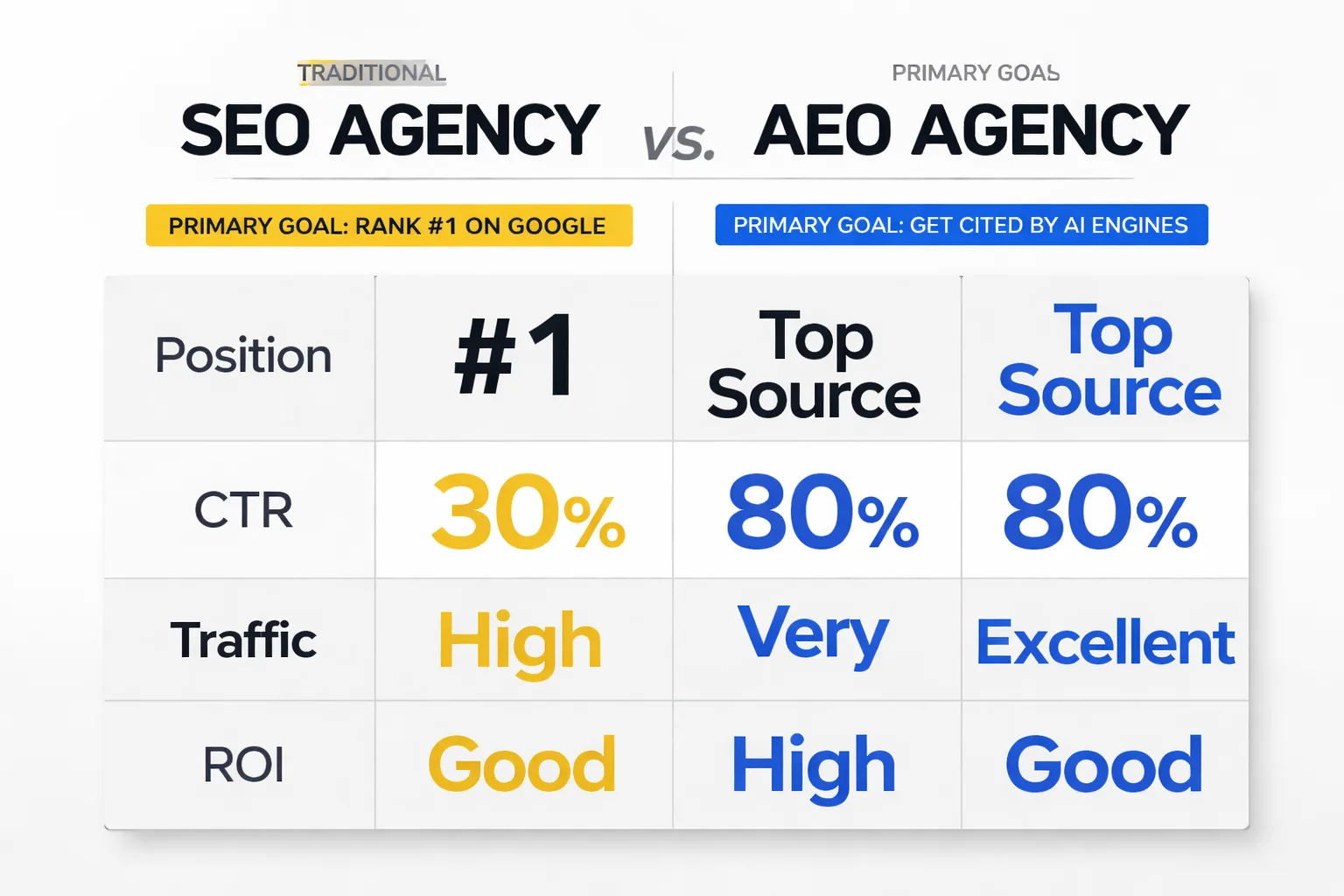
The contrast with a traditional SEO agency is stark. A traditional agency optimizes title tags, builds backlinks, and tracks keyword positions. An AEO agency does all of that, but also tracks LLM citation tracking across ChatGPT, Claude, Gemini, Perplexity, Grok, and Google AI surfaces. They monitor where in each AI answer your brand appears (first, in a list, last). They track industry share-of-voice across AI engines. They find content opportunities where competitors are cited but you are not. The deliverable is not a rank tracker. It is a citation strategy.
Here is the contrarian take that most agencies will not tell you: traditional SEO rankings still matter enormously for AI search inclusion. Chris Long and Tomek Rudzki's analysis of 25,000+ queries found that first-position Google rankings have a 25% chance of inclusion in AI Overviews, with second and third positions maintaining 20%+ inclusion rates. The assumption that AI search eliminates ranking importance is wrong. What changes is the goal: you are no longer ranking to get clicks. You are ranking to get cited. The agency that understands this distinction is the one worth hiring.
When You Need an Agency vs. a Tool
This is the question I get most from founders and marketing leads. The answer depends on four factors: team size, content volume, budget, and how much of the work is diagnosis versus execution.
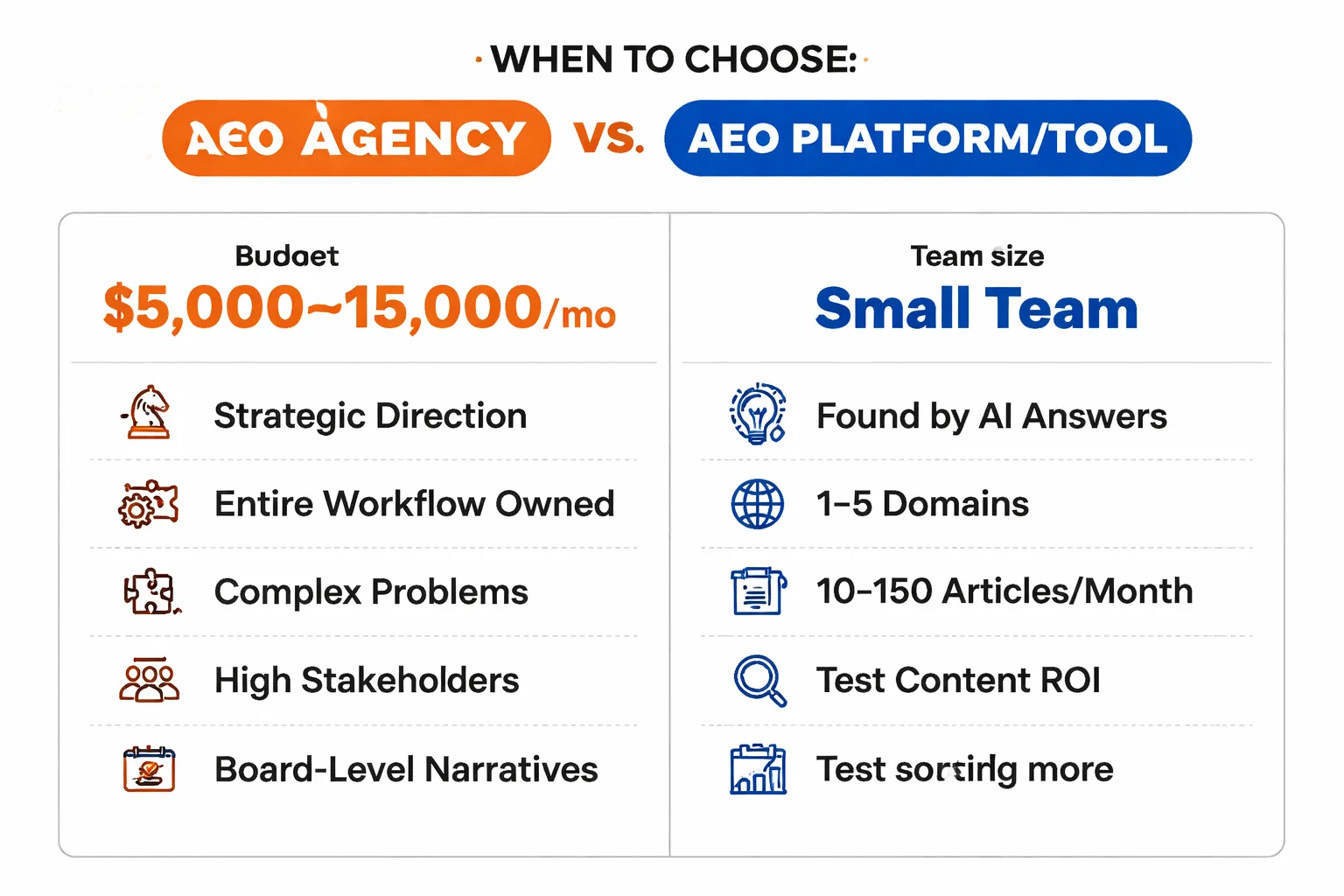
A full-service AEO agency makes sense when you have the budget to sustain $5,000-15,000/month in retainer fees, when you need strategic direction that your in-house team cannot provide, and when you want someone else to own the entire workflow from audit to publish to outreach. Agencies shine when the problem is complex, the stakeholder count is high, and you need a partner who can translate AI search data into board-level narratives.
A platform makes sense when you are a small team that needs to be found and cited by AI answers without running a full content operation. This is the gap I built Meev to fill. If you have one to five domains, need 10-150 articles per month, and want to see what is already working before investing in more content, a tool gives you the same diagnostic and execution capabilities without the agency overhead. You get AI visibility tracking across every major surface, a content engine gated by a quality firewall, and citation gap discovery. The difference is that you own the workflow instead of outsourcing it.
The hybrid approach is what I see most mature teams adopt. They use a platform for the operational work (AI visibility tracking, content generation, citation monitoring) and bring in an agency or consultant for strategic direction, competitive analysis, and quarterly planning. This splits the cost structure: you pay software pricing for execution and consulting pricing for strategy. It works well when your in-house team has the bandwidth to manage the platform but lacks the expertise to set the AEO direction.
Here is where budget reality bites. An agency retainer for serious AEO work starts at $5,000/month and scales fast. A platform like Meev starts at $49/month for Lite and runs $269/month for Pro, which includes 80 articles, 100 prompts, five domains, three seats, premium LLM tracking, and citation path discovery. The math is straightforward: if your team can execute, the platform delivers agency-grade output at a fraction of the cost. If your team cannot execute and you need the human layer, the agency earns its keep.
The mistake I see most often is brands buying a tool, getting overwhelmed by the data, and then assuming they need an agency to interpret it. The data is not the problem. The problem is that most teams have not internalized what AI visibility metrics mean. A high brand mention rate is a red herring if the framing of that mention positions your brand as a secondary option. An AI could cite your brand as a good starting point before suggesting a more advanced competitor, funneling users away. The metric that matters is not mention volume. It is favorable framing in the context of a buying decision. Whether you use an agency or a tool, make sure someone on your team is thinking about narrative control, not just citation counts.
What to Look for Before You Hire One
The AEO agency market is filling up fast with providers who rebranded overnight from "SEO agency" to "AI SEO agency" without changing their methodology. Here is the checklist I use when evaluating whether an agency can actually do this work.
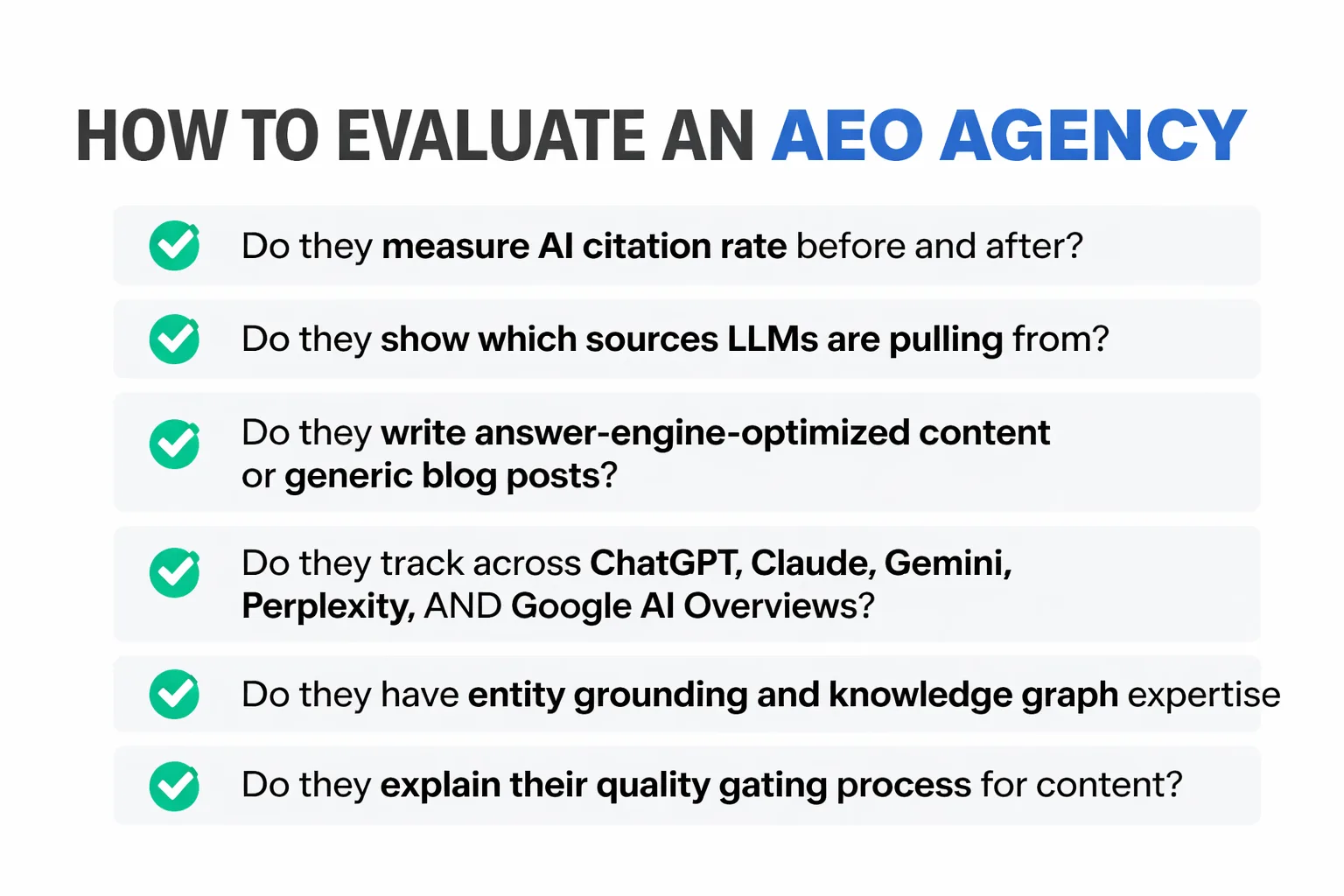
Do they measure AI citation rate before and after? This is the most basic test. If the agency cannot show you a baseline citation rate and a post-engagement citation rate, they are not doing AEO. They are doing content marketing with an AI label. The baseline should cover every major AI search surface, not just one. Citation rates move from below 5% to 20-40% within 60-90 days when structured content is implemented correctly, according to RankScope's GEO case studies. If the agency cannot reference this kind of trajectory, they have not done the work.
Do they show which sources LLMs are pulling from? When ChatGPT cites your competitor, it is pulling that citation from somewhere. A real AEO agency surfaces the cited-source leaderboard for your topics. They can tell you which domains AI engines cite most often, and they build a strategy to get your brand onto those domains. This is the Citation Path work. If the agency only tracks whether your brand is mentioned but not where the mention comes from, they are missing the leverage point.
Do they write answer-engine-optimized content or generic blog posts? Ask to see samples. Answer-engine-optimized content has specific structural characteristics: it uses clear question-shaped headings, provides self-contained answers at the top of sections, cites authoritative sources inline, and follows archetype-specific structures (listicle, how-to, explainer, problem-solver). Generic blog posts do none of this. If the agency hands you a 2,000-word essay with no headings, no citations, and no structural optimization, they are writing for 2015 Google, not 2026 ChatGPT.
Do they track across every major AI search surface? ChatGPT alone is not enough. As of 2026, ChatGPT has 910 million weekly active users and Google AI Overviews reaches 2 billion monthly users across 200+ countries. An agency that only monitors one or two surfaces is giving you a partial picture. The minimum bar is tracking across ChatGPT, Claude, Gemini, Perplexity, Grok, Google AI Overviews, and AI Mode. If they cannot list these surfaces and show you per-LLM drill-down dashboards, walk away.
Do they have entity grounding and knowledge graph expertise? This is the technical differentiator. Entity grounding for AI search means ensuring that AI systems can correctly identify your brand, disambiguate it from competitors or unrelated entities, and connect it to the right topics. Without it, AI systems might confuse your brand with a competitor's product or something entirely unrelated, as Siteimprove notes. The agency should be able to discuss Wikidata presence, knowledge graph optimization, and structured data markup (Article, FAQ, HowTo, Speakable) as part of their methodology. If they glaze over when you mention entity grounding, they are not the right partner.
Red flags to watch for. Any agency that promises specific citation rates within 30 days is lying to you. The IQRush research paper found that AI visibility rankings are unstable and mostly statistical noise in the short term. Brands that measure within one week underestimate results by 40-60% compared to measurement at four weeks. The lag is real. A trustworthy agency will tell you that AEO takes 60-90 days to show measurable movement, and they will set expectations accordingly.
Another red flag: the agency that dismisses traditional SEO entirely. The Writer.com guide on GEO notes that generative engine optimization is 80% strategic and only 20% technical. The strategic layer includes positioning, ecosystem presence, and brand authority, all of which are built on a foundation of traditional SEO work. An agency that tells you to abandon keyword research, backlink building, and technical SEO in favor of "AI optimization" is selling you a bridge. The best AEO agencies layer AI citation strategy on top of a solid SEO foundation. They do not replace it.
How to Measure Whether It Is Working
The metrics that matter for AEO are different from what you are used to tracking. Here is the framework I use, broken into three tiers.
Tier 1: AI visibility metrics. The foundational numbers are brand mention rate across AI engines, mention position (where in the answer your brand appears), and industry share-of-voice. Brand mention rate tells you how often your brand appears in AI-generated answers for your target prompts. Mention position matters because being cited first in an AI answer is worth more than being cited last in a list of ten. Industry share-of-voice tells you what percentage of answers cite you versus each competitor. These three metrics together give you the visibility picture.
But visibility alone is not enough. I learned this the hard way. My early attempts to optimize AI visibility were focused on boosting raw recommendation rate, thinking more mentions equaled more leads. This was a significant misstep. The context and framing of an AI's citation is paramount. An AI could recommend my brand as a good starting point before suggesting a more advanced competitor, effectively funneling users away. The metric I now prioritize is favorable framing: is the AI positioning my brand as the recommended solution, or as a secondary option? This is harder to track, but it is the metric that connects to business outcomes.
Tier 2: Citation source attribution. When an AI engine cites your brand, it is pulling from a source. That source might be your own website, a publisher that mentioned you, a review site, a Wikipedia page, or a knowledge graph entry. Citation source attribution tells you which sources are driving your AI visibility. This matters because it tells you where to invest. If 60% of your AI citations come from a single publisher, you are dangerously concentrated. If your own website is rarely the source, your content is not structured for AI extraction. The agency should be tracking this and adjusting the content strategy accordingly.
Tier 3: Classic rank and traffic movement. This is where the AEO and SEO worlds overlap. Traditional rankings still feed AI Overviews inclusion. The ZipTie.dev study of 25,000+ queries confirmed that first-position rankings have a 25% chance of AI Overview inclusion. Your Google rankings, organic traffic, and Search Console data are still relevant signals. The difference is that they are now inputs to a larger system, not the final output. The agency should be connecting rank movement to AI citation movement, showing you how improvements in traditional SEO translate into AI visibility gains.
Here is how to track all of this without a full analytics team. You need three things: an AI visibility tracker that monitors your brand across every major AI surface on a rolling cadence, a content platform that publishes answer-engine-optimized articles gated by a quality firewall, and a weekly digest that surfaces the delta. The digest should tell you what changed: new citations, lost citations, new content published, AI visibility movements, and top opportunities. If you are reviewing a dashboard more than once a week, you are doing it wrong. The data should come to you.
The measurement lag is the thing that trips up most teams. Brands that measure within one week of launching an AEO campaign underestimate results by 40-60% compared to measurement at four weeks. This is because AI engines do not update their responses instantly. There is a 2-4 week lag before structured content shows up in AI citation data. The ecommerce site that neglects this lag and measures too early will conclude that AEO does not work, while competitors who wait and measure at four weeks see the real trajectory. Set the expectation internally: no judgment for 30 days, first read at 4 weeks, real signal at 8-12 weeks.
Seth Besmertnik argues that AI visibility scores are misleading without focus on specific dimensions: persona, customer journey stage, topic, and brand versus non-branded. He is right. A single aggregate score tells you nothing. You need to break it down by surface (ChatGPT versus Perplexity versus Gemini), by prompt type (branded versus category versus comparison), and by journey stage (awareness versus consideration versus decision). An agency or platform that gives you a single number is giving you a vanity metric. Demand the breakdown.
Want to see where your brand stands in AI answers before hiring an agency?
The Technical Layer: Entity Grounding and Knowledge Graphs
This is where AEO gets technical, and it is the section where most agencies reveal whether they actually know what they are doing. Entity grounding for AI search is the process of ensuring that language models can correctly identify, disambiguate, and connect your brand to the right topics and categories. It is the foundation that makes everything else work.
Think of it this way. When you tell a human "I work at Apple," they use context to disambiguate: the conversation, your location, your industry. An LLM does the same thing, but it relies on structured data and knowledge graph connections to make that disambiguation. If your brand is not properly grounded in the knowledge graphs that LLMs reference (Wikidata, Google's Knowledge Graph, schema markup on your site), the LLM might confuse your brand with a competitor, or fail to connect it to the topics where you want to be cited.
The work involves several layers. Schema markup (Article, FAQ, HowTo, Speakable) on your site helps AI systems parse your content. Wikidata entries ensure your brand exists as a recognized entity in the knowledge graphs that LLMs reference. Internal linking structures define the relationships between your content pieces, helping AI systems understand what your brand is about. Author entity profiles establish E-E-A-T signals that make your content more likely to be cited as a trustworthy source.
An AEO agency that skips this layer is building a house on sand. You can publish all the answer-engine-optimized content you want, but if the AI systems cannot correctly identify and disambiguate your brand, your citations will be inconsistent. The IQRush research paper found that AI visibility rankings are unstable and mostly statistical noise. Part of that instability comes from poor entity grounding. When the LLM is unsure about your brand identity, it cites you sometimes and not other times. Fix the grounding, and the stability improves.
How AEO Integrates With Your Other Marketing
An answer engine optimization agency does not replace your PR, content marketing, or traditional SEO functions. It integrates with them. Here is how the pieces fit together.
Your PR team builds brand authority through earned media. AEO amplifies this by ensuring that the publications your PR team lands are the ones AI engines cite. The agency identifies which publishers are most cited for your topics and feeds that intelligence to your PR team. Your PR team then prioritizes outreach to those publishers, creating a feedback loop where PR drives AI visibility and AI visibility data informs PR strategy.
Your content marketing team produces blog posts, guides, and resources. AEO ensures that this content is structured for AI extraction. The agency or platform applies archetype-aware writing, quality gating, and knowledge base grounding to transform generic content into answer-engine-optimized content. The content marketing team owns the topics and the brand voice. The AEO layer owns the structure and the optimization for AI citation.
Your traditional SEO function handles keyword research, technical SEO, and backlink building. AEO layers on top of this by connecting rank movements to AI citation movements. The AEO vs. SEO distinction is not about replacement. It is about extension. You still need keyword research to understand what people are asking. You still need technical SEO to ensure your site is crawlable. You still need backlinks to build authority. AEO adds the layer that ensures all of this work also earns you citations in AI-generated answers.
For ecommerce brands, the integration extends to what is now called agentic commerce. Profound's Shopping Insights and similar tools track product visibility in ChatGPT Shopping, which is becoming a significant surface for ecommerce brands. An AEO agency with ecommerce GEO expertise can track how your products appear in AI-generated shopping recommendations, identify where competitors are capturing share, and build content that improves your product visibility. This is the ecommerce GEO and agentic commerce layer that goes beyond traditional product page optimization.
Making the Right Choice
The decision between hiring an agency, using a platform, or running a hybrid approach comes down to one question: who is going to do the work? If the answer is "the agency, fully," make sure they can show you the checklist items above. If the answer is "my team, with a tool," make sure your team has the bandwidth and the platform has the depth. If the answer is "my team for execution, agency for strategy," make sure the two sides can communicate effectively.
The brands winning in AI search right now are not the ones with the biggest budgets. They are the ones that started earliest, measured correctly, and waited for the lag. The ecommerce sites that implemented structured content and entity-rich guides achieved 20-40% citation rates within 60-90 days, while those that neglected AI visibility reporting experienced zero GEO results. First-mover brands with three or more deep structured guides captured 35-55% category share of voice. The window for first-mover advantage is still open, but it is closing.
Whether you hire an agency or use a platform, the worst decision is to do nothing. AI search is not a future trend. It is the current reality. ChatGPT has 910 million weekly active users. Google AI Overviews reaches 2 billion monthly users. Every day you wait is a day your competitors are publishing the structured guides that will capture the citations you should be winning.
An answer engine optimization agency is not a luxury for enterprise brands anymore. It is a necessity for any brand that wants to be found in the answers that matter. The question is not whether you need one. The question is whether you need an agency, a platform, or both. I built Meev because I believe small teams deserve the same AI visibility capabilities as enterprise brands, without the agency overhead. But if your situation calls for an agency, use the checklist above and do not settle for a provider that cannot answer every question with specifics.
FAQ
What is answer engine optimization?
Answer engine optimization (AEO) is the practice of optimizing your brand's presence in AI-generated answers across surfaces like ChatGPT, Perplexity, Gemini, and Google AI Overviews. It involves tracking where your brand is cited, structuring content for how LLMs extract information, grounding your brand entity in knowledge graphs, and closing citation gaps through outreach and content engineering. Unlike traditional SEO, which targets blue-link rankings, AEO targets citations in AI-generated responses.
How is an AEO agency different from an SEO agency?
A traditional SEO agency optimizes for Google rankings: keyword positions, backlinks, technical SEO. An AEO agency does this plus tracks AI citation rates across every major AI search surface, monitors brand mention position and framing, identifies which sources LLMs pull from, and writes content structured for AI extraction. The deliverable shifts from a rank tracker to a citation strategy with per-LLM dashboards and source attribution.
How long does it take to see results from AEO?
Expect 60-90 days for measurable citation rate movement. Brands that measure within one week underestimate results by 40-60% compared to measurement at four weeks. There is a 2-4 week lag before structured content appears in AI citation data. Citation rates typically move from below 5% to 20-40% within 60-90 days when structured content is implemented correctly. Set internal expectations: no judgment for 30 days, first read at 4 weeks, real signal at 8-12 weeks.
What should an AEO agency deliver?
An AEO agency should deliver: a baseline AI visibility audit across every major AI surface, per-LLM citation tracking with trend data, a cited-source leaderboard showing which domains AI engines cite most for your topics, answer-engine-optimized content gated by a quality firewall, entity grounding and knowledge graph optimization, and citation gap closure through outreach. If they cannot deliver all six, they are not a full-service AEO agency.
Can a platform replace an AEO agency?
For small teams that can execute in-house, yes. A platform like Meev provides AI visibility tracking, content generation with quality gating, and citation gap discovery at a fraction of agency cost. The tradeoff is that you own the workflow instead of outsourcing it. For teams that need strategic direction or lack execution bandwidth, an agency or hybrid approach is better. The decision depends on team size, content volume, budget, and whether you need external strategy.
What does agentic SEO mean for AEO?
Agentic SEO refers to AI-driven automation of SEO and AEO workflows: content auditing, optimization, generation, and publishing at scale. For an AEO agency, agentic SEO means using AI agents to audit content for AI extractability, refresh outdated content, generate new answer-engine-optimized articles, and manage entity grounding across knowledge graphs. It is the execution layer that makes AEO scalable for brands with large content footprints.
About the Author
Judy Zhou, Founder
Judy Zhou leads content strategy at Meev, where she oversees AI-driven content research and publishing for hundreds of brands. With a background in SEO and editorial operations, she focuses on building content systems that rank on Google, get cited by AI search engines, and drive measurable business results.
Start your 7-day free trial and get a full AI visibility audit across every major AI search surface. No agency retainer required.