

By Judy Zhou, Founder
Key Takeaways
- A search visibility tool in 2026 must track both classic SERP positions and AI engine citations because Google users run roughly 200 searches per month while Perplexity users run about 15 prompts monthly and Perplexity grew 42% year-over-year.
- Semrush's analysis of 150,000 ChatGPT citations found that Reddit, Wikipedia, and YouTube dominate LLM sourcing.
- Treat citation share movements of 3 percentage points (such as 8% to 11%) as statistically indistinguishable from random noise before reporting progress.
- Require full methodological disclosure including prompt repetition counts, confidence ranges, and baseline stability before accepting visibility lift claims like 3.2% to 22.2%.
Maya had spent three months rebuilding her ecommerce client's entity presence. Structured data, Wikidata entries, knowledge panel corrections, the works. Rankings held steady. Then one afternoon she queried Perplexity about the best products in the category and watched a rival brand get cited four times in a single response. Her client's name did not appear once. She had no tool that tracked this, no baseline to compare against, and no clear answer for why the gap existed. That afternoon changed how she thought about search visibility entirely.
A search visibility tool in 2026 must track both classic SERP positions and AI engine citations, because Datos/Sonata Insights research shows Google users conduct roughly 200 searches per month while Perplexity users run about 15 prompts monthly, and Perplexity grew 42% year-over-year. Semrush analyzed 150,000 ChatGPT citations and found Reddit, Wikipedia, and YouTube dominate LLM sourcing. Citation share movements of 3 percentage points (8% to 11%) are statistically indistinguishable from random noise, meaning most dashboards report false progress. Todd Paris publicly critiqued a Profound AI case study claiming a 7x visibility lift (3.2% to 22.2%) for lacking methodological disclosure including prompt repetition counts, confidence ranges, and baseline stability. The category is messy, the metrics are noisy, and small teams need to know what actually matters before spending a dollar.
What a Search Visibility Tool Actually Measures in 2026
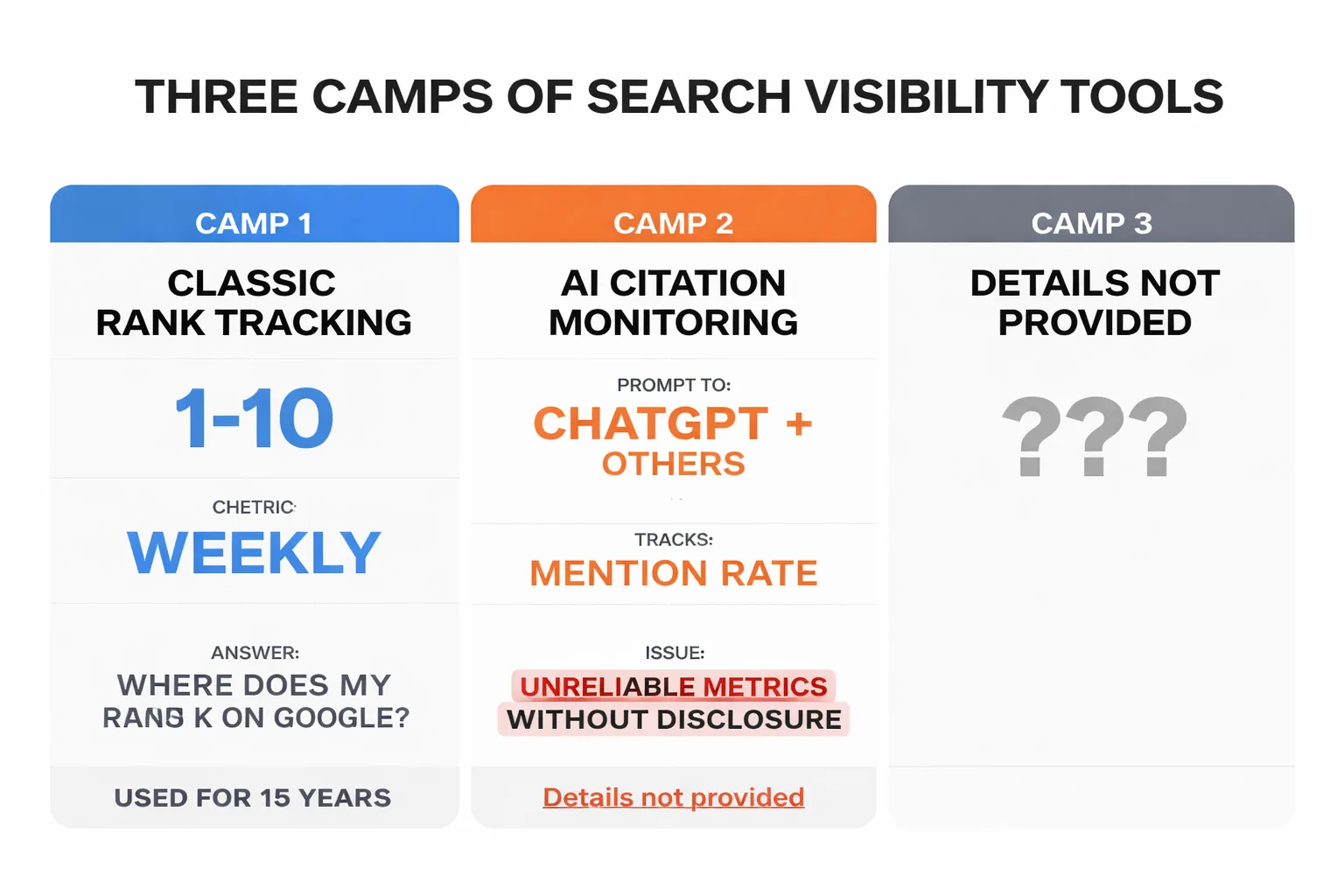
The category has split into three distinct camps, and confusing them wastes budget.
The first camp is classic rank tracking. Position 1 through 10, weekly SERP snapshots, maybe a keyword difficulty score. This is what SEO teams have used for fifteen years. It answers one question: where does my page rank on Google? It tells you nothing about whether ChatGPT mentions your brand when someone asks "what's the best CRM for a 12-person team." For a lot of small businesses, this is still the only visibility tracking they do. It is insufficient in 2026.
The second camp is AI citation monitoring. These tools send prompts to ChatGPT, Perplexity, Gemini, and other LLMs, then parse the responses for brand mentions. They track mention rate, citation frequency, and sometimes sentiment. The problem: AI visibility metrics are unreliable without disclosure. John Shehata warned on LinkedIn that some platforms may be complicit in metric gaming without disclosure. Repeated runs of the same prompt return different brands and different sources. Purchase-intent questions show the least stability. Most dashboards report a single number to one decimal place without confidence intervals, masking noise as signal.
The third camp, where the category is heading, combines both. It tracks classic rankings alongside AI citations, shows which sources those citations are built from, and ideally closes the gap by helping you create content that gets cited. This is what a modern search visibility tool should do: diagnose where you are absent, identify which publishers AI engines cite for your topics, and give you a path to fix it.
The distinction matters because ai search visibility is not an extension of traditional SEO. It is a different measurement problem entirely. Classic rank tracking asks "does my page appear for this query." AI visibility tracking asks "does my brand appear in the answer this model generates, in what context, and from what source." Those are fundamentally different questions requiring different instrumentation.
The Features That Matter for Small Teams
Enterprise teams have dedicated analysts who can stare at dashboards all day. Small teams do not. A solo marketer or a three-person growth team needs tools that turn data into action, not tools that generate more data to interpret.
Here is what actually matters.
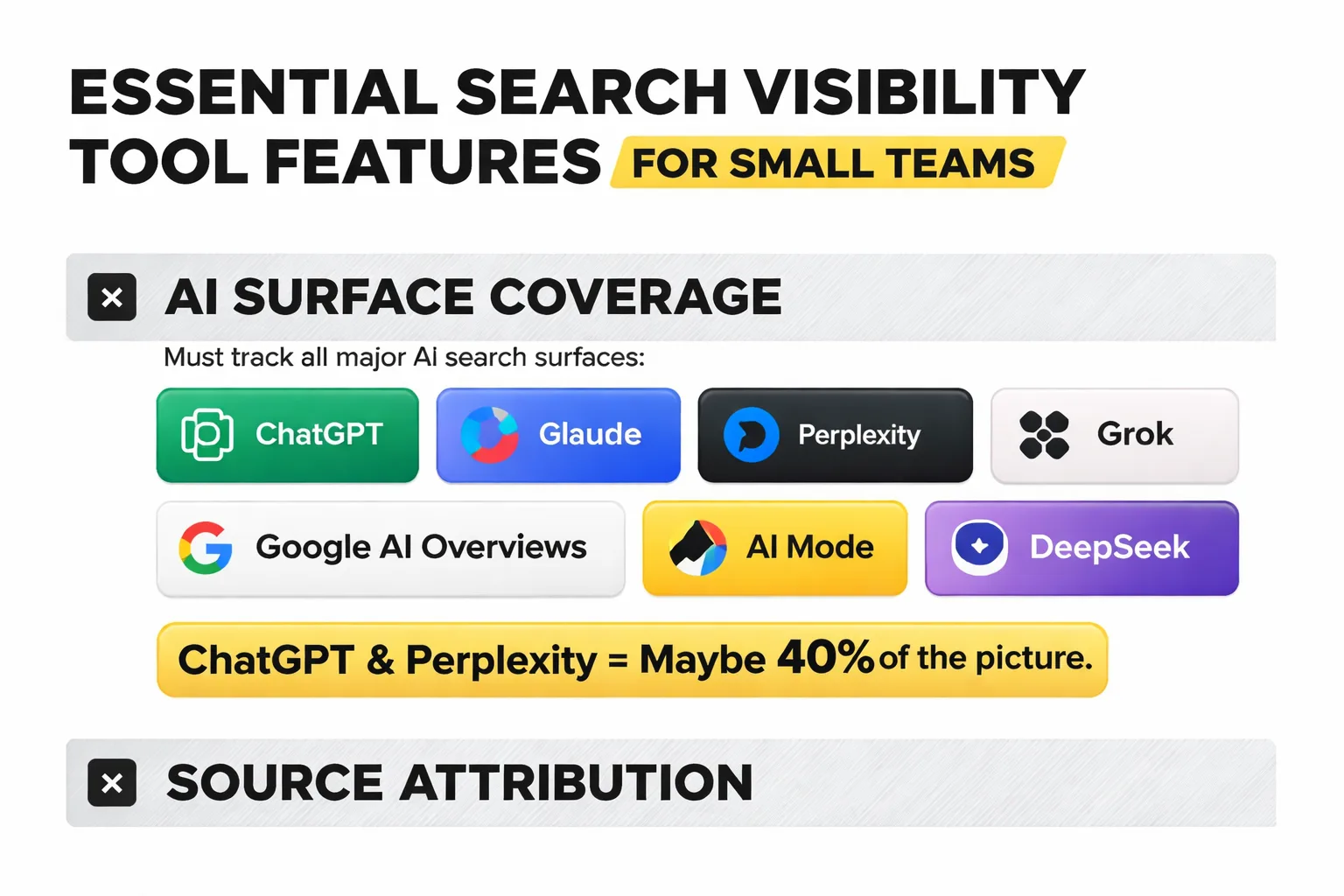
AI surface coverage. The tool needs to track every major AI search surface: ChatGPT, Claude, Gemini, Perplexity, Grok, Google AI Overviews, AI Mode, and DeepSeek. Not a subset. A tool that only tracks ChatGPT and Perplexity is giving you maybe 40% of the picture. The set of AI surfaces changes frequently, so the tool should add new engines as they emerge without requiring a plan upgrade. Checking your Perplexity visibility separately from your ChatGPT visibility is table stakes. If a tool treats "AI visibility" as synonymous with "ChatGPT visibility," it is not serious.
Source attribution. This is the feature most teams overlook and the one that matters most. When an AI engine cites your brand, where did it pull that information from? Was it your homepage, a Reddit thread, a Wikipedia article, a competitor's comparison page? Semrush's analysis of 150,000 ChatGPT citations found that Reddit, Wikipedia, and YouTube are dominant LLM citation sources. If your brand is cited but the citation traces back to a Reddit post complaining about your pricing, your "mention rate" looks great while your reputation is actively degrading. Source attribution lets you see the actual text behind every mention and the URL the LLM used to build its answer.
Content gap identification. Tracking mentions tells you where you are. Finding prompts where competitors are cited and you are not tells you where the opportunity is. This is the difference between a monitoring tool and an optimization tool. Generative engine optimization requires knowing which prompts you are absent from, not just which ones you appear in. A tool that surfaces "your competitor was cited in 12 prompts where you received zero mentions" is worth ten times more than a tool that says "your mention rate is 7.3%."
Publishing workflow. This is where most visibility tools stop and where small teams get stuck. You find a gap. You know you need content. Then you open a separate document, write a draft, edit it, format it, publish it, submit it to Google Search Console, ping IndexNow, and hope it gets indexed. That workflow kills momentum. Tools that combine visibility tracking with content generation and publishing close the loop. The answer engine optimization workflow should be: find gap, generate content, approve, publish, index, measure. Not: find gap, switch tools, write, switch tools, publish, switch tools, submit.
What small teams do not need. They do not need API access for custom integrations. They do not need white-label reporting for client portfolios (unless they are an agency). They do not need sentiment scoring across 14 languages. They do not need a dedicated account manager. They need accurate data, clear gaps, and a way to act.
How to Evaluate a Search Visibility Tool Before Buying
The evaluation checklist is shorter than most vendors want you to believe. Four criteria separate useful tools from expensive dashboards.
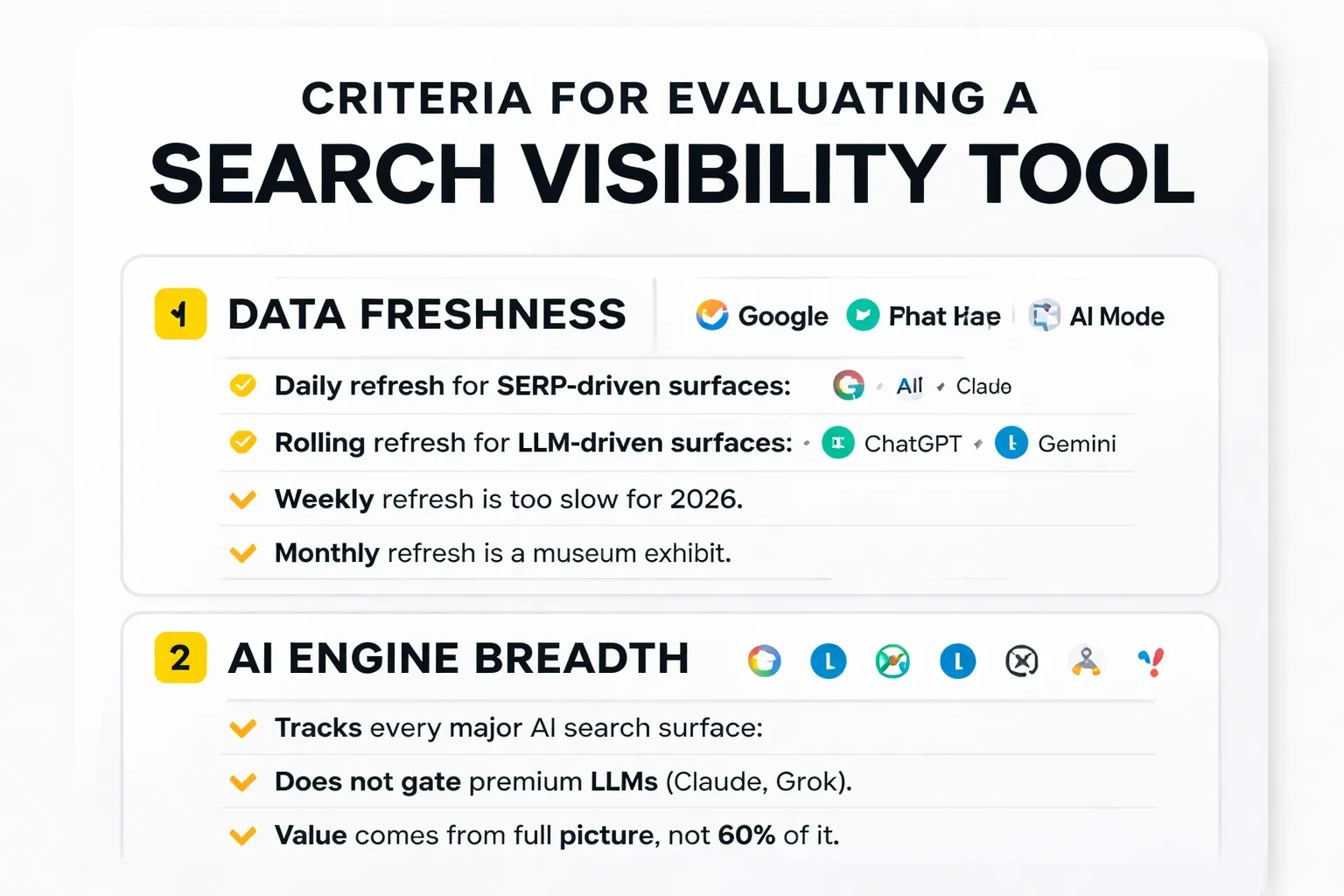
1. Data freshness. How often does the tool refresh its data? Daily refresh on SERP-driven surfaces (Google AI Overviews, AI Mode) is the minimum. LLM-driven surfaces (ChatGPT, Claude, Gemini) can operate on rolling refresh because LLM responses change less frequently than SERP results. A tool that refreshes weekly across all surfaces is too slow for 2026. A tool that refreshes monthly is a museum exhibit.
2. AI engine breadth. Does the tool track every major AI search surface or just a few? Does it gate premium LLMs behind higher tiers? A tool that charges extra to track Claude or Grok is nickel-and-diming on the metric that matters most. The value of ai visibility tracking comes from seeing the full picture, not 60% of it. Check whether the tool uses direct API integrations or simulated prompts. Direct integrations (like Perplexity's Sonar API) preserve measurement validity. Simulated prompts through a web interface are less reliable and more prone to variance.
3. Citation source transparency. Does the tool show you the actual response text behind every mention? Does it show you which URL the LLM cited? Does it surface a cited-source leaderboard showing which domains AI engines cite most often for your topics? If the answer to any of these is no, the tool is a black box. You are paying for a number you cannot verify against the source material. Todd Paris's critique of the Profound case study is instructive here. A 7x visibility lift (3.2% to 22.2%) sounds impressive until you realize the vendor did not disclose prompt repetition counts, confidence ranges, baseline stability, or whether the prompt set was consistent across measurements. Without methodological transparency, the number is a marketing claim, not a measurement.
4. Gap closure vs. reporting only. This is the single most important criterion. Does the tool help you close the gap or just report it? Most tools stop at "you are cited in 12% of prompts, your competitor is cited in 31%." That is a diagnosis without a prescription. The tools worth paying for go further: they identify which publishers AI engines cite for your topics, surface verified contact information for those publishers, draft personalized outreach pitches, and help you create and publish content designed to earn citations. The AEO vs. SEO distinction is not academic. It determines whether your tool investment produces a dashboard or a result.
Jason Goldberg, writing in Forbes, put it bluntly: build the practice regardless of metric accuracy. Not because the number is accurate, but because a shared methodology, a common vocabulary, and a team that can reason about probabilistic measurement are worth more right now than the metric itself. That is the right frame. The metrics are noisy. The practice is not. Choose a tool that supports the practice, not one that pretends the metrics are precise.
Do you know which AI engines cite your brand and which ones do not?
Why Does AI Visibility Matter for B2B?
The question sounds obvious until you look at the data. Mention rate is the metric most teams optimize for, and it is the wrong one.
In B2B, decisions are narrative-driven. A buying committee does not impulse-purchase a CRM or a content platform. They research, compare, and deliberate. When an AI engine recommends a brand, the framing of that recommendation matters more than the mention itself. An AI could cite a brand as "a good starting point" before suggesting a "more advanced" competitor. The mention rate looks great. The business outcome is terrible. The user was funneled away.
This is why raw mention tracking is a red herring. The metric that actually matters is favorable framing. Is the AI recommending the brand as the best option, or as the budget option? Is it citing the brand's strengths, or its limitations? Is it positioning the brand as a leader, or as an also-ran?
The problem: no tool currently measures framing well. Most track binary mentions (cited or not cited) and maybe sentiment (positive, negative, neutral). Neither captures the nuance of "cited positively but positioned as inferior to a competitor." Small teams need to evaluate tools with this limitation in mind. A tool that tracks mention rate and sentiment is better than nothing. A tool that also shows the full response text so a human can assess framing is better still. A tool that helps you create content designed to shape the narrative is the goal.
What is AEO is not just about being cited. It is about being cited in the right context. The brands that win in AI search are not the ones with the most mentions. They are the ones with the most favorable mentions. Content strategy needs to focus on narrative control, not just presence.
Which AI Engines Should You Track?
All of them. That is the short answer and the only honest one.
The longer answer involves understanding that different engines serve different purposes and cite different sources. ChatGPT and Claude are general-purpose LLMs that synthesize information from their training data and web search. Perplexity is a search-native engine that cites sources inline. Gemini integrates with Google's knowledge graph and search index. Grok pulls from X (formerly Twitter) in real time. Google AI Overviews and AI Mode sit atop the traditional SERP and summarize results. DeepSeek is a lower-cost model gaining traction, particularly in technical and international markets.
Each engine has different sourcing patterns. A Semrush analysis of 150,000 ChatGPT citations found Reddit, Wikipedia, and YouTube as dominant sources. Perplexity tends to cite higher-authority domains and news sites. Gemini leans on Google's own knowledge graph and top-ranking pages. A brand that is cited on Perplexity but absent from ChatGPT is not "partially visible." It is visible to one audience and invisible to another.
SparkToro's 2024 research (via Datos/Sonata Insights) found Google had 290 times more search users than Perplexity in May 2024, and Google users conducted roughly 200 searches per month compared to Perplexity users at about 15 prompts per month. Perplexity grew 42% year-over-year while Google grew 1.4%. The volume gap is massive. The growth differential is significant. Both matter.
A tool that only tracks one or two engines is giving a partial picture. The best GEO tools cover the full surface area. Small teams should not have to choose between tracking ChatGPT and tracking Perplexity because of pricing tiers. The value comes from seeing the whole board, not one corner of it.
What About Entity Grounding and Knowledge Graphs?
This is the topic most visibility tools ignore entirely, and it is one of the most important.
AI engines do not just cite web pages. They cite entities. An entity is a discrete, identifiable thing: a company, a person, a product, a concept. When ChatGPT generates an answer about "the best project management tools," it is not just matching keywords. It is retrieving entities from its training data and from real-time search, then synthesizing a response. If the AI does not recognize a brand as an entity with clear attributes (what it does, who uses it, how it differs from competitors), the brand will not appear in the answer regardless of how many blog posts it publishes.
Entity grounding is the process of ensuring AI engines recognize a brand as a distinct entity with accurate attributes. This involves structured data on the brand's website, Wikidata entries, knowledge panel accuracy, consistent NAP (name, address, phone) information across the web, and internal linking structures that clearly define relationships between content.
The mechanism: LLMs build their internal representations from training data that includes Wikipedia, Wikidata, schema.org markup, and high-authority web content. When an LLM encounters a brand name in a prompt, it retrieves its internal entity representation. If that representation is sparse, incomplete, or inaccurate, the LLM either omits the brand or generates a vague, unhelpful mention. If the representation is rich and well-sourced, the LLM can generate specific, favorable citations.
Most visibility tools do not address entity grounding. They track whether a brand is mentioned, not whether the LLM has a robust internal representation of that brand. This is a gap. A tool that helps you identify entity weaknesses (missing Wikidata entry, inconsistent structured data, thin knowledge panel) and guides you through fixing them is more valuable than a tool that just reports mention rate.
For ecommerce specifically, entity grounding matters enormously. Product entities need to be recognized by AI engines for the brand to appear in product recommendation answers. Ecommerce GEO and agentic commerce depend on the AI understanding not just the brand but the brand's products, their attributes, and their positioning relative to competitors.
How to Act on Visibility Data
Finding a gap is easy. Acting on it is where small teams stall.
The workflow should be: identify the gap, determine what content would close it, create that content, publish it, ensure it gets indexed, and measure whether the gap closes. Most teams get stuck between "determine what content would close it" and "create that content" because they lack the resources to produce answer-engine-optimized content at the volume needed.
Here is a practical approach for small teams.
First, use the visibility tool to find prompts where competitors are cited and you are not. Prioritize prompts by commercial intent. A prompt like "best CRM for startups" is higher priority than "what is a CRM." Sort by the gap between your presence and the competitor's presence. A prompt where a competitor appears three times and you appear zero times is a bigger opportunity than one where a competitor appears once and you appear zero times.
Second, look at the sources the AI engine cited for that prompt. If it cited a Reddit thread, consider whether you need a Reddit presence. If it cited a comparison article on a high-authority site, consider whether you need to be featured in that article. If it cited the competitor's own content, consider what content you need to create that the AI would cite instead.
Third, use the cited-source leaderboard to identify which publishers AI engines cite most often for your topics. These are your outreach targets. A tool that provides verified contact information for these publishers and drafts personalized outreach pitches grounded in your knowledge base turns a multi-day research project into a one-hour task.
Fourth, create content designed to be cited. This means answer-engine-optimized content: clear, factual, well-structured, with authoritative outbound citations and schema markup. Content that an LLM can parse, trust, and synthesize. Not keyword-stuffed blog posts designed for 2015-era Google.
Fifth, publish and index. Submit to Google Search Console and ping IndexNow. Ensure internal linking is strong. Ensure mobile-first design. Bing is more responsive to direct submission than Google, so submit there too.
Sixth, measure. Did the gap close? Did the AI engine start citing your brand for that prompt? If not, iterate. Visibility optimization is not a one-and-done activity. It is a continuous loop of finding gaps, creating content, and measuring results.
The Metric Reliability Problem
Every claim about AI visibility metrics needs an asterisk.
Jason Goldberg's Forbes analysis laid out the core problem: citation share movements of 3 percentage points (from 8% to 11%) are statistically indistinguishable from random noise. Repeated runs of the same prompt return different brands and different sources. Purchase-intent questions are the least stable query type. Most dashboards report a single number to one decimal place without confidence intervals.
This means a tool that shows "your visibility went from 7.3% to 9.1%" may be showing noise, not progress. The 1.8 percentage point increase is within the margin of error for most AI citation measurements. The team celebrates. The client gets a report. The number means nothing.
The solution is not to abandon measurement. It is to measure differently. Run the same prompt multiple times and look at the distribution of results, not just the average. Track trends over weeks, not single data points. Segment branded vs. non-branded queries (branded queries where the user includes the brand name in the prompt will always return the brand, inflating visibility numbers). Control for prompt variance by using a consistent prompt set.
Todd Paris's critique of the Profound case study highlights what happens when vendors do not disclose methodology. A 7x lift sounds impressive. Without knowing how many times the prompt was run, what the confidence interval was, whether the baseline was stable, and whether the prompt set was consistent, the claim cannot be validated. Small teams should demand the same transparency from their tools that they would demand from any research vendor.
The LLM visibility tool market is young. The metrics are imperfect. But the practice of tracking, measuring, and optimizing for AI visibility is not optional. It is the future of search marketing. The teams that build the practice now, while the metrics are noisy and the tools are immature, will have a compounding advantage as the technology matures.
Stop Treating AI Visibility as a Dashboard Problem
Here is the contrarian take: most teams buying AI visibility tools are buying the wrong thing.
They are buying dashboards. They want a number that goes up. They want a chart they can show their boss. They want to feel like they are measuring something. And the market is happy to sell them dashboards. Beautiful, real-time, multi-surface dashboards with sparklines and trend graphs and competitive benchmarks.
Dashboards do not close citation gaps. Content does. Outreach does. Entity grounding does. A dashboard that shows you are absent from 60% of relevant prompts is useful information. A dashboard that shows the same thing next month is a expensive confirmation that nothing changed.
The tools worth investing in are the ones that move from diagnosis to treatment. The ones that identify the gap, show you what content would close it, help you create that content, help you get it indexed, and measure whether it worked. Everything else is a thermometer. You need a thermometer. But if that is all you have, you are not treating the patient.
Small teams have limited budget and limited time. Every dollar spent on a dashboard that does not lead to action is a dollar not spent on content, outreach, or entity optimization. The AI SEO tool market will consolidate around platforms that close the loop. The dashboard-only tools will either add action features or become irrelevant.
The brands that win in AI search are not the ones with the best dashboards. They are the ones with the best content, the strongest entity presence, and the most cited sources. A search visibility tool is a means to that end, not the end itself.
FAQ
What is a search visibility tool?
A search visibility tool tracks how often and in what context a brand appears in search results across both traditional search engines (Google, Bing) and AI search surfaces (ChatGPT, Perplexity, Gemini, Claude, Grok, Google AI Overviews). Unlike a pure rank tracker, it measures citations, mentions, and source attribution in AI-generated answers, not just URL positions on a SERP. The best tools also identify content gaps where competitors are cited and the brand is absent.
How is it different from a rank tracker?
A rank tracker measures where a specific URL ranks for a specific keyword on a traditional search engine results page. A search visibility tool measures whether a brand is mentioned and cited in AI-generated answers across multiple LLMs and AI search surfaces. Rank tracking asks "does my page appear?" Visibility tracking asks "does my brand appear in the answer?" The latter requires sending prompts to AI engines, parsing responses, and attributing sources, which rank trackers do not do.
Which is the best keyword planner tool?
For AI search specifically, the best keyword planning approach combines traditional tools (Google Keyword Planner, Ahrefs, Semrush) with AI-specific prompt research. Traditional tools surface search volume. AI visibility tools surface which prompts trigger citations and which sources those citations come from. The combination gives both volume data and AI citation opportunity data. For small teams, a platform that integrates both is more efficient than stitching together separate tools.
How to use a keyword tool for free?
Google Keyword Planner is free with a Google Ads account and provides search volume, competition level, and keyword ideas. For AI-specific keyword research, use free AI engines directly: type prompts into ChatGPT, Perplexity, and Gemini to see which brands and sources get cited. This manual approach is slow but free. Some visibility tools offer free trials or limited free tiers that let you test a handful of prompts before committing to a paid plan.
Can AI visibility metrics be gamed?
Yes. John Shehata warned on LinkedIn that some platforms may be complicit in metric gaming without disclosure. Branded prompt loading (including the brand name in the prompt set to inflate mention rate) is one tactic. Reporting single numbers without confidence intervals masks noise as progress. Repeated runs of the same prompt return different results, meaning small changes may be random variance. Demand methodological transparency: prompt repetition counts, confidence ranges, and baseline stability.
What is the difference between AEO and GEO?
Answer Engine Optimization (AEO) focuses on optimizing content so AI engines cite it in answers. Generative Engine Optimization (GEO) is the broader practice of optimizing for generative AI surfaces, including content creation, entity grounding, and citation earning. AEO is a subset of GEO. The distinction matters because a tool that only tracks AEO (citation monitoring) is narrower than a tool that supports GEO (citation monitoring plus content generation, entity optimization, and outreach).
About the Author
Judy Zhou, Founder
Judy Zhou leads content strategy at Meev, where she oversees AI-driven content research and publishing for hundreds of brands. With a background in SEO and editorial operations, she focuses on building content systems that rank on Google, get cited by AI search engines, and drive measurable business results.
Stop guessing about your AI search presence. See exactly where your brand is cited, where competitors are winning, and which content gaps to close first.