

By Judy Zhou, Founder
Key Takeaways
- The overlap between top Google results and AI-cited sources has dropped from roughly 70% to under 20%, rendering traditional rankings insufficient.
- Measure citation rates across ChatGPT, Claude, Gemini, Perplexity, Grok, and Google AI Overviews or the agent is only a blog factory.
- Teams publishing 60 articles per month track organic impressions but lack dashboards for LLM recommendations on buyer queries.
- AI answers now satisfy queries before clicks occur, so citation tracking—not publishing volume—determines visibility.
The marketing team's Slack thread is full of wins. Sixty new articles published this month, organic impressions up, content velocity at an all-time high. Then someone screenshots a ChatGPT conversation where a competitor. Not their brand. Is confidently recommended to a buyer asking exactly the question their product solves. Nobody on the team has a dashboard that tracks that. Nobody has an AI SEO agent watching for LLM citations or entity grounding failures. The auto-blogging workflow is humming, but the answer engines have already made their choice.
An AI SEO agent that only publishes content without tracking whether AI engines cite that content is operating blind. In my work auditing content operations, I see teams conflate publishing volume with answer visibility. The overlap between top Google results and AI-cited sources has dropped from roughly 70% to under 20% by some estimates. Meanwhile, Semrush's analysis confirms that traditional SEO metrics like rankings and organic traffic are now insufficient for AI search reporting because AI answers satisfy queries before clicks occur. If your agent isn't measuring citation rate across ChatGPT, Claude, Gemini, Perplexity, Grok, and Google AI Overviews, it's not an AI SEO agent. It's a blog factory.
The distinction I'm drawing here isn't semantic. It's the difference between a tool that diagnoses why your competitor keeps winning AI recommendations and a tool that generates 30 articles in 30 seconds with no quality gate. Both get marketed under the same umbrella. Only one actually moves the needle for AI-era visibility.
Why Buyers Keep Conflating Two Very Different Problems
A founder types into ChatGPT: "recommend a tool that monitors AI visibility and auto-publishes blogs." The results are a mess. Some tools track citations across a few LLMs but can't produce content. Others generate content at scale but have no idea whether any of it actually gets cited by AI engines. A few claim to do both but do neither well. The buyer walks away confused, picks a tool based on whichever landing page had better screenshots, and six months later wonders why their AI visibility hasn't improved.
I get why the confusion exists. The terminology is still settling. "AI SEO agent" sounds like it should handle everything AI-related, from tracking to publishing. "Auto-blogging" sounds like it should be part of an SEO strategy. And vendors deliberately blur the lines because the intersection of these two capabilities is where the market is heading.
But here's the reality: AI visibility tracking and auto-blogging solve fundamentally different problems. Visibility tracking is diagnostic. It tells you where your brand appears (and doesn't) in AI-generated answers across every major AI search surface. Auto-blogging is productive. It generates content. The first answers "are we being cited?" The second answers "are we publishing?" These are not the same question, and a high score on one does not imply a high score on the other.
For small teams, the conflation is expensive. You might spend $200/month on an auto-blogging tool, publish 80 articles, and see zero improvement in AI citations because none of those articles were structured for answer engine optimization. Or you might invest in a visibility tracker that shows you exactly where you're losing but provides no mechanism to close the gap. The ideal system does both: diagnoses the citation gap and then helps you close it with content specifically designed to be cited.
That ideal system is what an actual ai seo agent should be. Not a fire-and-forget content pump. A closed-loop system that measures, diagnoses, produces, and verifies.
What AI Visibility Tracking Actually Measures
AI visibility tracking is the measurement layer. It answers a specific set of questions: When someone asks ChatGPT, Perplexity, Claude, Gemini, or Grok about your product category, does your brand appear in the response? Where in the response (first mention, middle of a list, last)? What sources does the AI cite to justify that response? Is the sentiment positive, neutral, or negative?
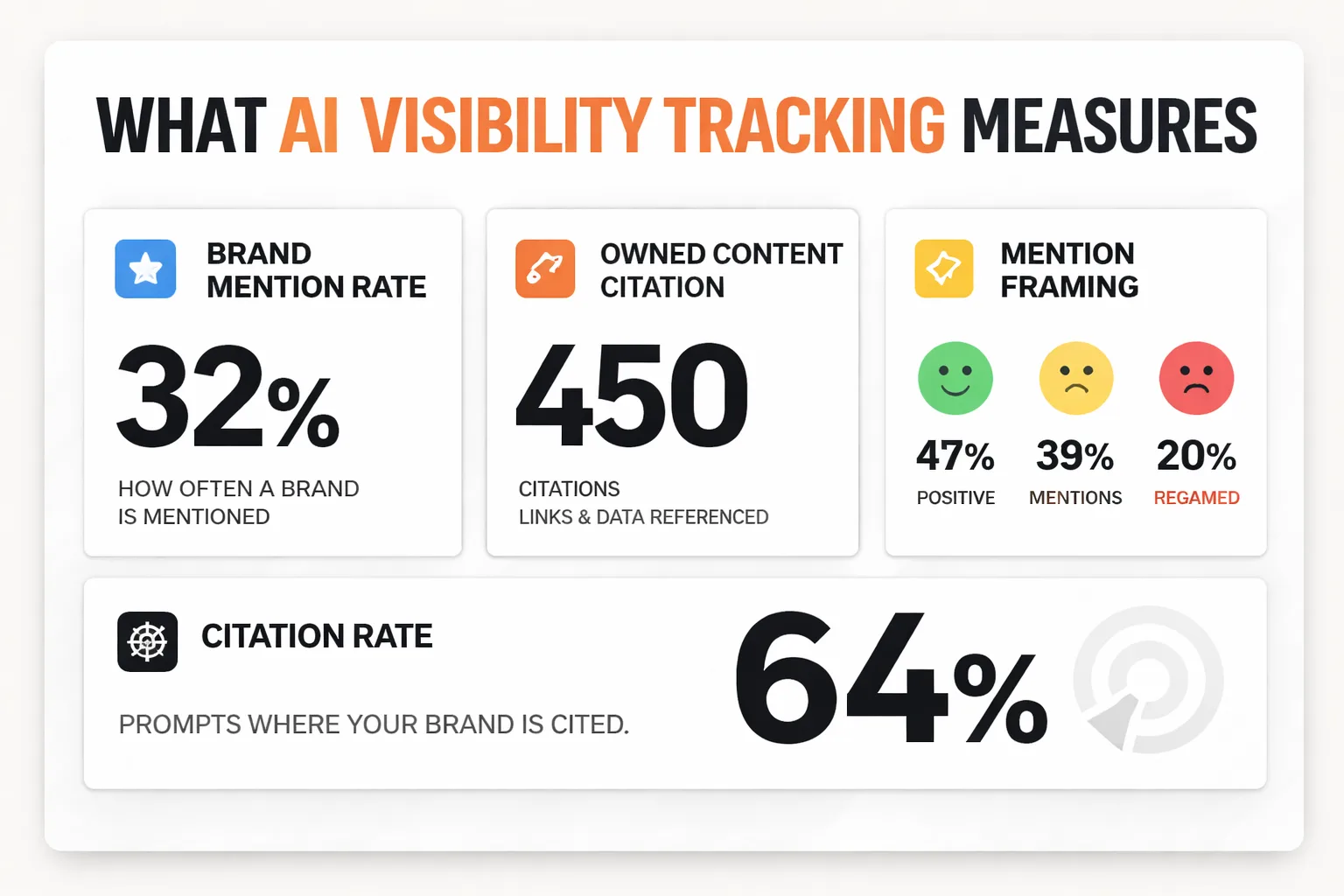
According to HubSpot's AI search visibility playbook, AI search visibility measures three things: how often a brand is mentioned, how owned content is cited, and how mentions are framed in model responses. These are distinct from traditional SEO ranking metrics, which only measure where your blue link sits on a SERP.
Here's what a proper visibility tracking system measures:
Citation rate: The percentage of relevant prompts where your brand is mentioned at all. If you track 100 prompts related to your product category and your brand appears in 12, your citation rate is 12%.
Mention position: Where in the AI answer your brand shows up. First mention carries different weight than being the seventh item in a list. In my experience, the first two mentions in an AI response get disproportionately more mindshare from the reader.
Source-level attribution: When an AI engine cites sources, which domains does it cite? This tells you which publishers are feeding the AI's understanding of your category. If Wired, G2, and Reddit threads keep showing up as cited sources for your topic, those are the domains you need to be present on.
Entity grounding signals: Whether AI models associate your brand with the right entities. If someone asks about "CRM software" and the AI thinks of Salesforce, HubSpot, and Pipedrive but not your product, you have an entity grounding problem. This is about knowledge graph presence, not keyword rankings.
Share of voice: What percentage of AI answers in your category cite you versus each competitor. This is the AI-era equivalent of market share, and it's the metric I'd argue matters most for brand visibility in 2026.
Traditional rank tracking, by contrast, tells you that you're position 4 for "best project management tool." That's useful information. But it doesn't tell you whether ChatGPT recommends you when someone asks "what's the best project management tool for a 5-person startup." The gap between those two answers is where most brands are bleeding visibility right now.
If you want to see what this looks like in practice, you can use an ai search visibility checker to test your brand's presence across AI surfaces. The results are often sobering. Brands that rank organically on page one of Google are frequently absent from AI-generated answers for the same queries.
What Auto-Blogging Really Means, and Where It Fails
Auto-blogging is the content production layer. At its best, it means AI-assisted content generation with human oversight: research topics, draft articles, route for approval, publish. At its worst, it means pushing AI-generated content directly to a CMS with zero review, zero fact-checking, and zero quality control.
I've seen the worst version far more often than the best.
The promise is seductive. Platforms advertise things like "0 to 5,800 traffic in 30 days" or "plagiarism-free articles in 30 seconds." The speed is real. The quality is not. I've personally experimented with AI agents for content generation over the past six months, and the output consistently required significant human oversight and editing to meet even basic quality standards. Factual errors, choppy sentences, and an unmistakable machine voice that tanked engagement.
The deeper problem is that unreviewed auto-published content actively harms your AI citation rates. Here's why: AI engines learn from patterns. If your site publishes thin, generic, factually loose content, AI models learn to associate your domain with low-quality information. When they later generate answers and need to cite sources, they skip domains they've learned to distrust. You're not just wasting content budget. You're training the AI to ignore you.
This is especially dangerous for YMYL (Your Money, Your Life) topics. Google's E-E-A-T guidelines and helpful content system demand expertise, authoritativeness, and trustworthiness. AI engines apply similar quality filters when deciding which sources to cite. Auto-blogged content that lacks author entities, verified claims, and authoritative outbound citations gets filtered out before it ever has a chance to be cited.
The critical missing piece in most auto-blogging workflows is a quality gate. Content goes from model to CMS with nothing in between. No check for factual accuracy. No check for keyword cannibalization. No check for whether the article actually answers the question in a way that an AI engine would find citable. I've started calling this the "slop pipeline": content goes in, content comes out, nobody checks if it's any good.
A quality gate doesn't have to mean a human reads every word. It can be automated, but it needs to be rigorous. At minimum, it should check: Does every claim have a source? Is the article structurally sound for its archetype (listicle, how-to, explainer)? Does it cannibalize existing content? Does it cite authoritative domains? Is the author entity established? If any of these checks fail, the article should be blocked from publishing, not pushed live and fixed later.
This is where content velocity and content quality directly conflict. I've found that adding a proper quality gate slows the publishing loop by at least 50% compared to unedited AI drafts. That's not a bug. That's the cost of producing content that AI engines will actually cite.
Do you know which AI engines cite your brand, and which don't?
What an AI SEO Agent Should Do Instead
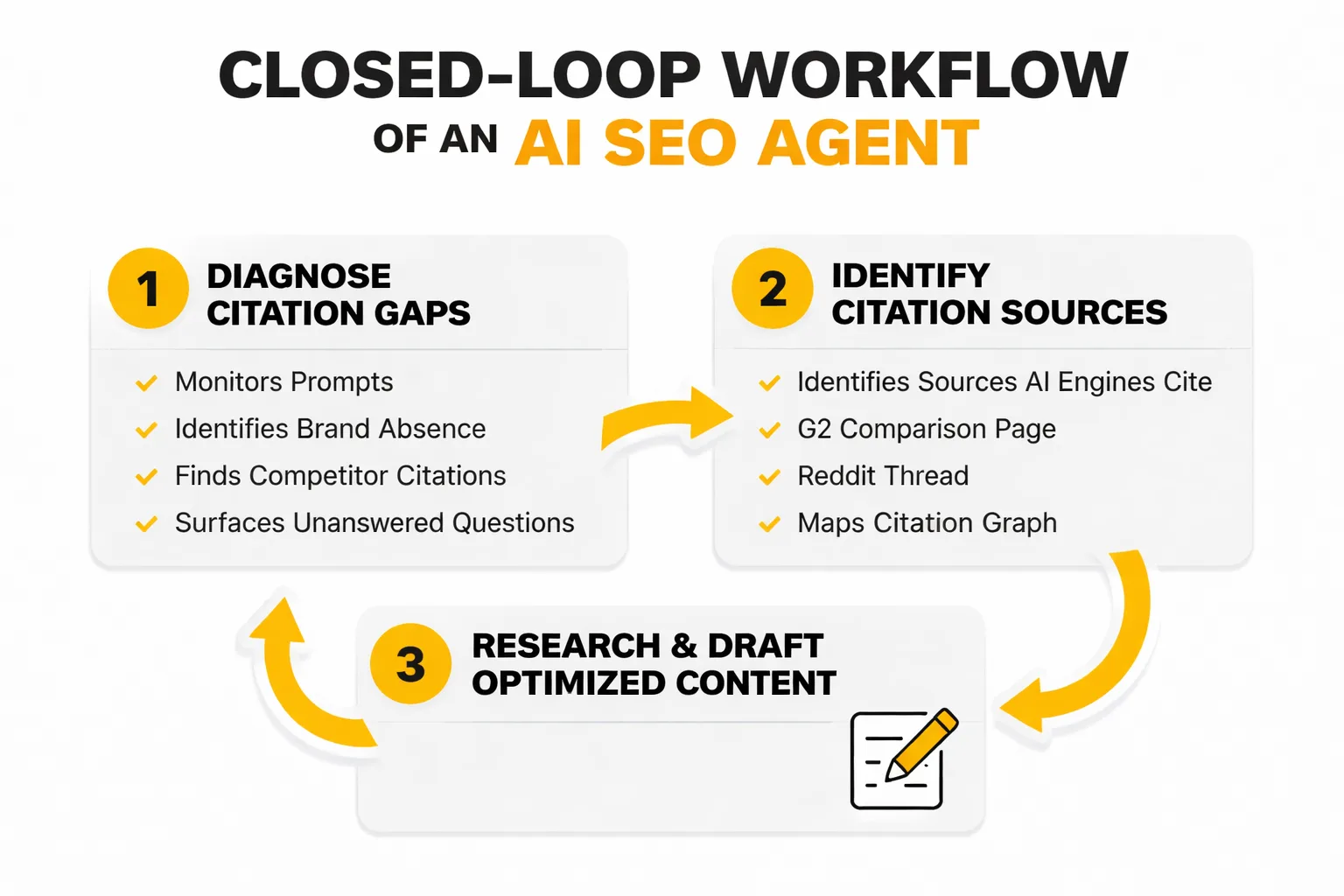
The right model isn't tracking-only or publishing-only. It's a closed loop. An AI SEO agent should diagnose, produce, and verify, all in one workflow.
Here's what that looks like in practice:
Step 1: Diagnose citation gaps. The agent monitors prompts across every major AI search surface and identifies where your brand is absent. It finds the prompts where competitors are cited but you aren't. It surfaces the specific questions buyers are asking that your content doesn't answer (or answers poorly enough that AI engines skip you).
Step 2: Identify citation sources. For each gap, the agent identifies which sources AI engines are actually citing. If Perplexity keeps citing a G2 comparison page when someone asks about tools in your category, that's a source you need to be present on. If ChatGPT cites a specific Reddit thread, that's a signal about where buyer conversations are happening. The agent maps the citation graph for your topic.
Step 3: Research and draft answer-engine optimized articles. This is where content generation comes in, but it's not random blog production. The agent drafts articles specifically structured to be cited by AI engines. That means clear, extractable answers to common questions. Authoritative outbound citations. Schema markup that helps AI models parse the content. Entity-rich writing that strengthens knowledge graph associations.
Step 4: Route for human approval. Nothing publishes without a human reviewing and approving it. This is non-negotiable. The agent can draft, research, and structure, but a human confirms the content is accurate, on-brand, and genuinely useful before it goes live. The quality firewall runs its checks, the human makes the final call.
Step 5: Publish and verify. After publishing, the agent monitors whether the new content actually moved the needle. Did citation rates improve for the target prompts? Did the AI engines start citing the new article? If not, the agent flags the gap and the loop restarts with a revised approach.
This is what answer engine optimization actually looks like. It's not a one-time content push. It's a continuous cycle of diagnosis, production, and verification. The agent learns from each iteration, refining its understanding of what content earns citations for your specific brand and topic.
Yoast's work on agentic AI for SEO points in this direction. They describe a shift from traditional visibility and ranking to being trusted and understood by AI systems, including monitoring custom brand questions and citation analysis across ChatGPT, Gemini, and Perplexity. That's the right framing. The goal isn't to produce more content. The goal is to be the source AI engines trust and cite.
How to Evaluate Platforms That Claim to Do Both
The market is filling up with tools that claim to be AI SEO agents. Most are either rebranded auto-bloggers or repackaged rank trackers. Here's the checklist I use to separate real agents from marketing theater.
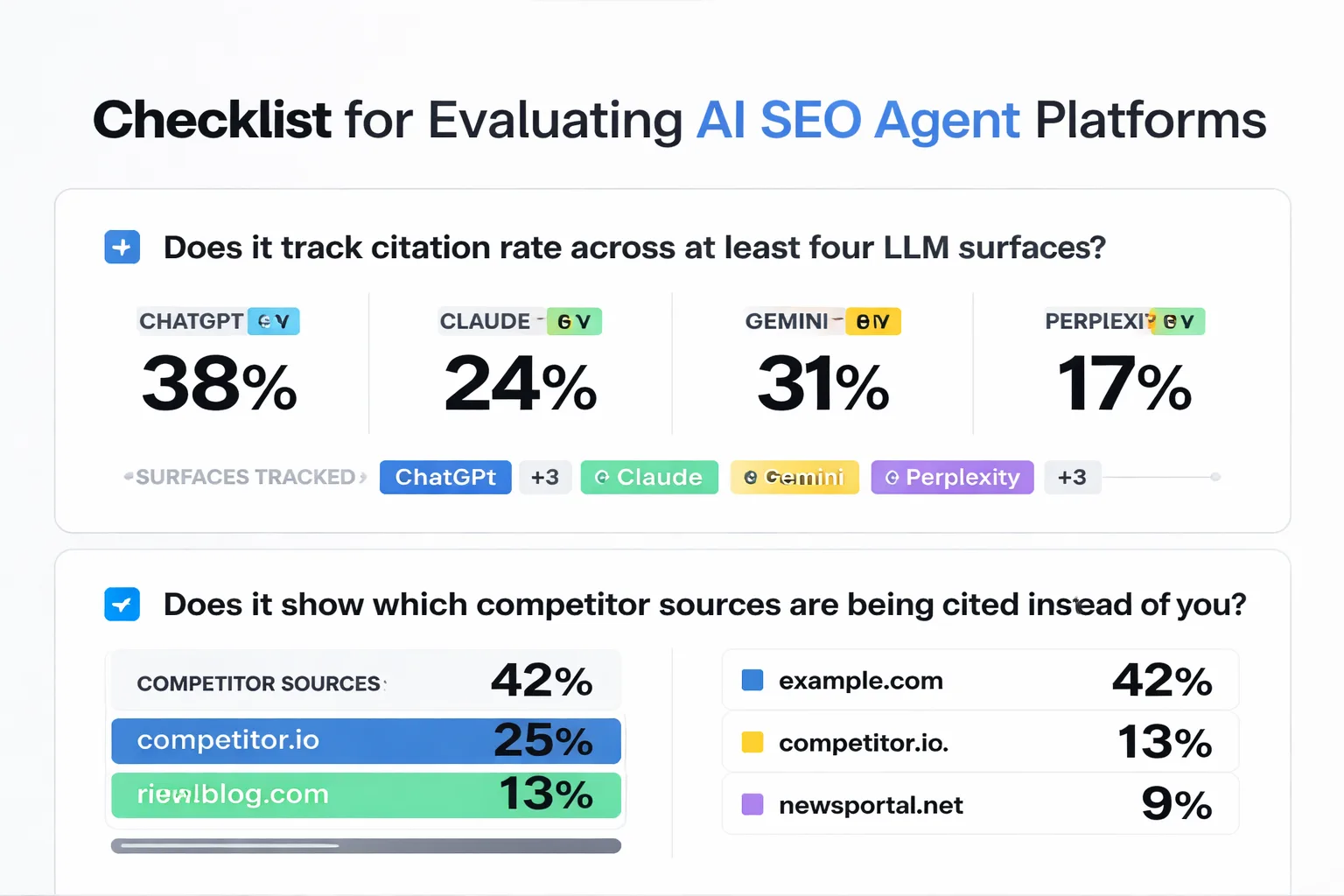
Does it track citation rate across at least four LLM surfaces? ChatGPT alone isn't enough. A real visibility tracker covers ChatGPT, Claude, Gemini, Perplexity, Grok, and Google AI Overviews at minimum. If a tool only tracks one or two surfaces, you're getting a partial picture. You can verify specific surface coverage with tools like our ChatGPT visibility checker or Perplexity visibility checker to understand what surface-specific tracking looks like.
Does it show which competitor sources are being cited instead of you? Tracking your own mentions is table stakes. The valuable insight is knowing which domains AI engines cite for your topics when they don't cite you. That tells you exactly where to focus your outreach and content efforts. A cited-source leaderboard that ranks domains by citation frequency for your topic is one of the most actionable features you can have.
Does content go through human approval before publishing? If the answer is no, walk away. Any tool that auto-publishes AI-generated content to your CMS without a human review gate is a liability. The quality gate can be automated (and should be), but the final publish decision must involve a human.
Does it measure entity grounding, not just keyword rankings? Ask the vendor how they track knowledge graph presence. Do they monitor whether your brand is associated with the right entities in AI responses? Do they surface entity grounding failures where your brand is miscategorized or absent from relevant entity clusters? If they can't answer this question clearly, they're not tracking AI visibility. They're tracking traditional SEO with an AI label slapped on.
Does it close the loop between tracking and content production? This is the hardest test. Most tools either track or produce. A real AI SEO agent does both. It identifies a citation gap, researches the content that could close it, drafts an answer-engine optimized article, routes it for approval, publishes it, and then verifies whether citation rates improved. If the tool can't show you this closed loop, it's not an agent. It's a point solution.
Does it offer LLM citation tracking with source attribution? When an AI engine cites your brand, can the tool show you the exact response text and the sources behind it? Can it tell you whether the citation came from your website, a third-party review, a Reddit thread, or a news article? This level of granularity is what separates real visibility tracking from vanity metrics. Our LLM visibility tool provides this drill-down, and I consider it essential for any team serious about AI visibility.
The Metric That Actually Matters in 2026
Here's my contrarian take: most SEO teams are measuring the wrong thing in 2026. They're still obsessed with keyword rankings and organic traffic. Those metrics haven't become irrelevant, but they've become insufficient. The metric that actually matters now is AI citation share: the percentage of AI-generated answers in your category that mention your brand.
Why? Because AI answers are increasingly satisfying user queries without a click. When someone asks ChatGPT "what's the best CRM for a startup" and gets a confident answer citing three tools, they may never visit Google. They may never click a blue link. Your position-1 ranking for "best CRM for startups" is irrelevant if ChatGPT doesn't mention you. And as Semrush notes, this zero-click dynamic makes traditional SEO metrics fundamentally inadequate for AI search reporting.
The teams that win in this environment are the ones that treat AI citations as the primary metric and traditional rankings as a secondary signal. They run an ai seo agent that continuously monitors citation share, identifies gaps, produces content to close them, and verifies the results. They're not publishing 60 articles a month and hoping. They're diagnosing, targeting, and measuring.
This shift requires a mental model change. For years, we've equated visibility with ranking. Now visibility means being cited. Being cited means being trusted by AI models. Being trusted means having authoritative content, strong entity associations, and presence on the sources AI engines actually reference. None of that comes from auto-blogging without oversight.
What This Actually Means for Small Teams
If you're a founder or marketer at a small company, you don't have the budget to buy five tools and stitch them together. You need one system that handles the full loop: track visibility across AI surfaces, diagnose where you're losing, produce content that closes the gap, and verify the results. That's what an AI SEO agent should be.
The distinction between visibility tracking and auto-blogging isn't academic. It's the difference between knowing you have a problem and having the tools to fix it. Visibility tracking without content production tells you you're losing but gives you no way to win. Auto-blogging without visibility tracking publishes content into a void, hoping something sticks. Neither is sufficient.
The teams I see succeeding are the ones that demand both capabilities from a single platform and refuse to settle for tools that do one or the other badly. They want diagnosis and treatment in the same workflow. They want to know not just that they're absent from AI answers, but exactly which content will change that, and whether it worked.
That's the bar. If your current tool can't clear it, it's time to look for one that can.
FAQ
What is the difference between AI visibility tracking and auto-blogging?
AI visibility tracking is diagnostic: it measures how often your brand appears in AI-generated answers across surfaces like ChatGPT, Perplexity, and Google AI Overviews. Auto-blogging is productive: it generates and publishes content. Tracking tells you where you're losing. Auto-blogging produces content but doesn't measure whether that content actually earns AI citations. A real AI SEO agent does both in a closed loop.
Can auto-blogging improve my AI citations?
Only if the content is high quality, fact-verified, and structured for answer engine optimization. Unreviewed auto-published content often harms citation rates because AI models learn to associate your domain with low-quality output. Content needs a quality gate (automated or human) before publishing to ensure it meets the standards AI engines use when deciding which sources to cite.
How many AI surfaces should a visibility tracker cover?
At minimum, it should track ChatGPT, Claude, Gemini, Perplexity, Grok, and Google AI Overviews. Tracking only one or two surfaces gives you a partial picture. Different AI engines cite different sources, so coverage across all major surfaces is essential for understanding your full citation landscape.
What is entity grounding and why does it matter for AI visibility?
Entity grounding is whether AI models correctly associate your brand with the right product categories and concepts. If someone asks about "best email marketing tools" and the AI doesn't think of your brand, you have an entity grounding problem. This is about knowledge graph presence and brand associations, not keyword rankings. Strengthening entity grounding requires authoritative content, consistent brand mentions across trusted sources, and structured data.
Should I use an AI SEO agent or hire a content team?
It's not either-or. An AI SEO agent handles the repetitive work of monitoring citations, identifying gaps, researching topics, and drafting articles. A human (whether in-house or freelance) reviews, edits, and approves before anything publishes. The agent scales your content operation without scaling your quality risk. For small teams, this hybrid model is the most cost-effective way to compete for AI citations without a full editorial staff.
How often should I check my AI visibility?
Daily for SERP-driven surfaces (like Google AI Overviews) and weekly for LLM-driven surfaces (like ChatGPT and Claude). AI citations can shift quickly as models update and new content gets indexed. Monthly checks are too infrequent to catch meaningful changes. A tool that offers daily or weekly refresh ensures you're working with current data when making content decisions.
About the Author
Judy Zhou, Founder
Judy Zhou leads content strategy at Meev, where she oversees AI-driven content research and publishing for hundreds of brands. With a background in SEO and editorial operations, she focuses on building content systems that rank on Google, get cited by AI search engines, and drive measurable business results.
Stop guessing about your AI visibility. Run a free citation audit across every major AI search surface and see exactly where you're winning and losing.