By Judy Zhou, Founder
Key Takeaways
- API-based tracking tools reproduce only 26.2% of the specific pages ChatGPT actually cites, according to a National University of Singapore preprint.
- Brand web mentions correlate 3x more strongly with AI visibility than backlinks (0.664 vs 0.218), yet most SEO suites still prioritize links.
- AI-cited content runs 25.7% fresher than organic top-10 results, rendering static content audits stale by default.
- SE Ranking's AI Visibility Tracker works as an affordable add-on for agencies already inside its suite but measures only a sliver of real LLM citation drivers.
SE Ranking's AI Visibility Tracker solves yesterday's problem elegantly.
The tool is clean, affordable, and built for agencies that already live inside SE Ranking's SEO suite. If you're tracking 40,000+ agencies' worth of client keywords and need a bolt-on AI visibility widget, it does the job. But the se ranking ai visibility tracker captures only a fraction of what actually drives AI citations, and the gaps matter more than the dashboard.
Here's what I've found after auditing AI visibility tooling for the past year. A National University of Singapore preprint found that API-based tracking tools reproduce only 26.2% of specific pages ChatGPT actually cited. That's the core problem. You can't fix what you can't measure, and most tools (SE Ranking included) are measuring a sliver of reality. Brand web mentions correlate 3x more strongly with AI visibility than backlinks (0.664 vs 0.218), yet most SEO suites still optimize for links. And AI-cited content runs 25.7% fresher than organic top-10 results, which means your static content audit is already stale.
The conventional wisdom about AI visibility tracking is wrong. Most teams think adding an AI tracker to their existing SEO stack is enough. It's not. The measurement methodology, the surfaces covered, and the gap between what tools report and what LLMs actually cite can differ by orders of magnitude.
What the SE Ranking AI Visibility Tracker Actually Does
SE Ranking launched its AI visibility features as an extension of its classic SEO platform. The suite includes an AI Visibility Tracker, AI Overviews Tracker, ChatGPT Tracker, and AI Mode Tracker. If you're already using SE Ranking for rank tracking and site audits, the AI visibility module feels like a natural add-on. You can benchmark competitors across AI search engines and see where your brand appears in AI-generated answers.
The tool is designed for agencies managing multiple clients. SE Ranking is trusted by 40,000+ agencies, and the AI visibility features reflect that agency-first design philosophy. You get dashboards, competitor benchmarking, and reporting that fits neatly into client deliverables. For teams that need to show clients 'we're tracking your AI presence,' it checks the box.
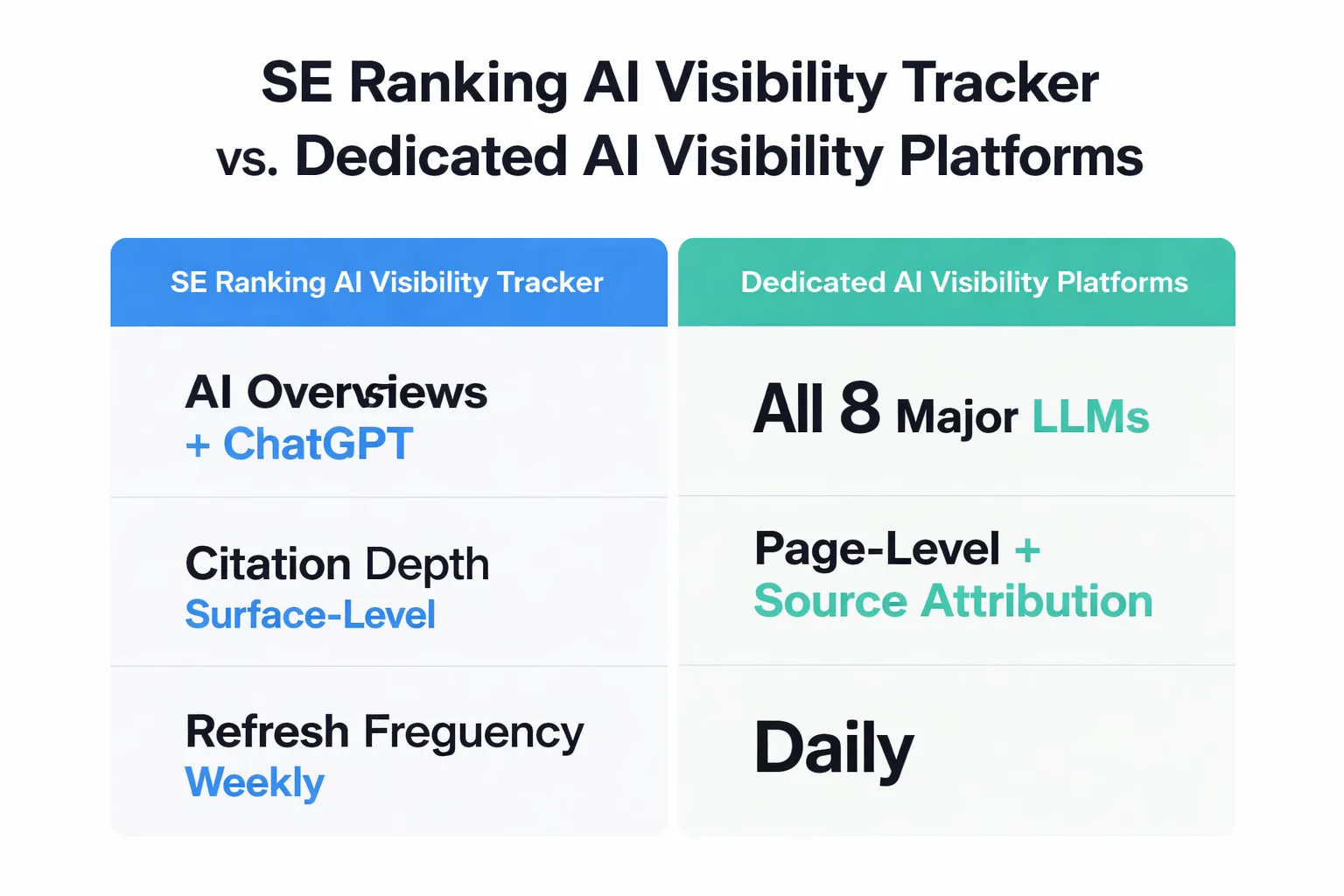
But here's where I push back. The feature set is wide but not deep. SE Ranking tracks AI Overviews and ChatGPT, which are the most visible AI surfaces, but it misses Claude, Grok, and DeepSeek entirely. Perplexity gets partial coverage. If your audience includes developers (who live in Claude), early adopters (who use Grok), or research-driven buyers (who rely on Perplexity's citation-heavy answers), you're flying blind on three of the most influential AI search surfaces. The broader data is stark: only 11% of domains are cited by both major LLMs. If your tool only tracks one or two of those LLMs, you're not seeing 89% of the picture.
This is where answer engine optimization diverges from traditional SEO. Classic rank tracking covers one surface (Google) with deep precision. AI visibility tracking needs to cover every major surface with enough depth to be actionable. SE Ranking chose width over depth. That trade-off works if you're producing client reports. It fails if you're making strategic decisions about where to invest content resources.
Where SE Ranking's AI Tracker Falls Short
Let me be specific about the gaps, because vague criticism helps nobody.
Missing surfaces. SE Ranking doesn't track Claude, Grok, DeepSeek, or Perplexity's deep citation data. These aren't fringe tools. Claude has become the default AI assistant for developers and technical buyers. Grok is embedded in X (formerly Twitter) and reaches a politically engaged audience. DeepSeek is the fastest-growing AI model in Asia. If your AI visibility tool doesn't cover these surfaces, you're missing entire audience segments.
Shallow citation attribution. When SE Ranking shows you that your brand appeared in a ChatGPT answer, it doesn't always show you which source page ChatGPT pulled that mention from. That's a critical gap. In my work auditing content ops, I've found that knowing which source page drove the citation is the single most actionable data point in AI visibility. Without it, you can't double down on what's working. You just know you got mentioned. That's the difference between a vanity metric and a strategic one.
No content gap diagnosis. SE Ranking tells you where you appear. It doesn't tell you where you should appear but don't. Dedicated AI visibility tools surface prompts where competitors are cited but you aren't, which is where the real opportunity lives. If your competitor shows up in 15 AI answers for prompts you care about and you show up in 2, you need to know that gap exists before you can close it.
Single-snapshot unreliability. This is the most technical gap, and it's the one that frustrates me most. The NUS preprint found that 44.5% of unique pages appeared in only 1 of 20 repeated runs of the same prompt. That means nearly half of AI citations are one-time anomalies, not reliable visibility. If your tool takes a single snapshot and reports it as your 'AI visibility score,' you're getting noise dressed up as signal. SE Ranking doesn't run repeated measurements to filter out these anomalies. You could see your brand cited on Monday, feel great about it, and never see it again because it was a fluke.
False negatives. Richard Michie (a practitioner I follow) reported that a client's AI visibility tool showed zero presence in ChatGPT, but Google Search Console showed massive AI impressions. The tool was pulling random searches and 'effectively made stuff up.' If your AI visibility tracker uses API-based or SERP-based methods rather than actual user prompts, you're vulnerable to the same false negatives. SE Ranking's methodology isn't fully transparent on this point, which makes me cautious.
No entity grounding or knowledge graph visibility. This is a gap that almost no SEO suite addresses, and it's arguably the most important for long-term AI visibility. LLMs don't just cite pages. They reference entities. If your brand isn't recognized as a distinct entity in the knowledge graphs that feed AI models (Wikidata, Google's Knowledge Graph, schema.org typed entities), you're invisible regardless of how many pages you publish. SE Ranking doesn't surface your entity status. It doesn't tell you whether your brand has a Wikidata entry, whether your organization schema is recognized, or whether AI models can disambiguate you from similarly named companies. In my experience, this is the single biggest blind spot for companies investing in AI search optimization services. They publish content, earn mentions, and still don't get cited because the LLM doesn't know who they are as an entity.
No agentic commerce tracking. Here's where the market is heading and where SE Ranking's feature set looks most dated. AI agents are increasingly making purchasing decisions on behalf of users. Gela Fridman's analysis of agentic commerce highlights a critical problem: ChatGPT rewrites 67-70% of Chinese-language queries into English before processing them. If you're an e-commerce brand selling to international markets, your product citations may be getting lost in translation. SE Ranking has no mechanism to detect query rewriting, no agentic commerce tracking, and no way to measure how AI agents represent your products in multi-step shopping flows. For ecommerce GEO strategies, this is table stakes.
How to Check Your AI Ranking Beyond a Single Tool
If you're asking 'how can I check my AI ranking,' the answer is: don't rely on one tool. Here's the audit process I use.
Step 1: Run manual prompts across every major AI search surface. Open ChatGPT, Claude, Gemini, Perplexity, and Grok. Type 10-15 prompts that your customers would actually use. Not keyword-stuffed queries. Real questions like 'what's the best AI visibility tool for a small marketing team' or 'how do I track my brand in AI search results.' Screenshot every answer. Note whether your brand appears, where it appears (first mention, in a list, last), and which source the AI cites.
This sounds tedious because it is. But it's the only way to ground-truth what your tools are telling you. I've seen tools report strong AI visibility when manual checks show nothing, and vice versa. The ChatGPT AI visibility checker approach works because it mirrors what actual users see, not what an API reconstructs.
Step 2: Cross-reference with Google Search Console. GSC now shows AI-driven impressions in Search Console. If you see a spike in impressions from AI surfaces but your visibility tracker shows flat or declining citations, that's a red flag. The tool is likely using methodology that misses real citations. This is exactly what happened with Richard Michie's client. GSC is ground truth. Your AI visibility tool is an interpretation.
Step 3: Run each prompt 5-10 times across multiple sessions. Remember that 44.5% anomaly rate. If your brand appears once and disappears on the next run, that's not visibility. It's noise. You need repeated measurements to distinguish reliable citations from one-time flukes. Any AI visibility tracker worth using should do this automatically, but if yours doesn't, you need to do it manually.
Step 4: Track which source pages drive your citations. When an AI cites your brand, which of your pages did it pull from? Was it your homepage, a blog post, a product page, or a third-party review? This tells you where to invest. If your blog posts drive 80% of AI citations but you're spending 80% of your content budget on product pages, you've got a misallocation problem.
Step 5: Monitor competitor citations on the same prompts. Run the same prompts and note which competitors appear. Track this over time. If a competitor was absent 3 months ago and now appears consistently, figure out what changed. Did they publish new content? Earn a high-authority mention? Get added to a Wikipedia article? Reverse-engineer their moves.
Step 6: Audit your entity presence across knowledge graphs. This step is invisible to most teams, and it's where I see the biggest quick wins. Check whether your brand has a Wikidata entry. Search for your company name on Wikidata. If you're not there, that's a gap. Check whether your homepage uses Organization schema markup that AI models can parse. Verify that your entity is disambiguated from similarly named companies. I've seen brands with strong organic rankings and solid content that still don't get cited by LLMs because the model can't confidently identify them as a distinct entity. Fixing your Wikidata presence and schema markup is often the highest-ROI move for ai search engine optimization.
Step 7: Test for query rewriting and language drift. If you serve international markets, run your prompts in multiple languages and check whether the AI rewrites them before answering. ChatGPT rewrites 67-70% of Chinese queries to English. This means your Chinese-language content may never surface in AI answers because the model converts the query before retrieval. If you're investing in multilingual content, you need to know whether the LLM even processes it in the original language.
What to Look for When Comparing AI Visibility Trackers
If you're evaluating AI visibility tools (whether SE Ranking, Meev, or anything else), here are the criteria that actually matter. I've developed this framework through trial and error, and it's the checklist I wish I'd had a year ago.
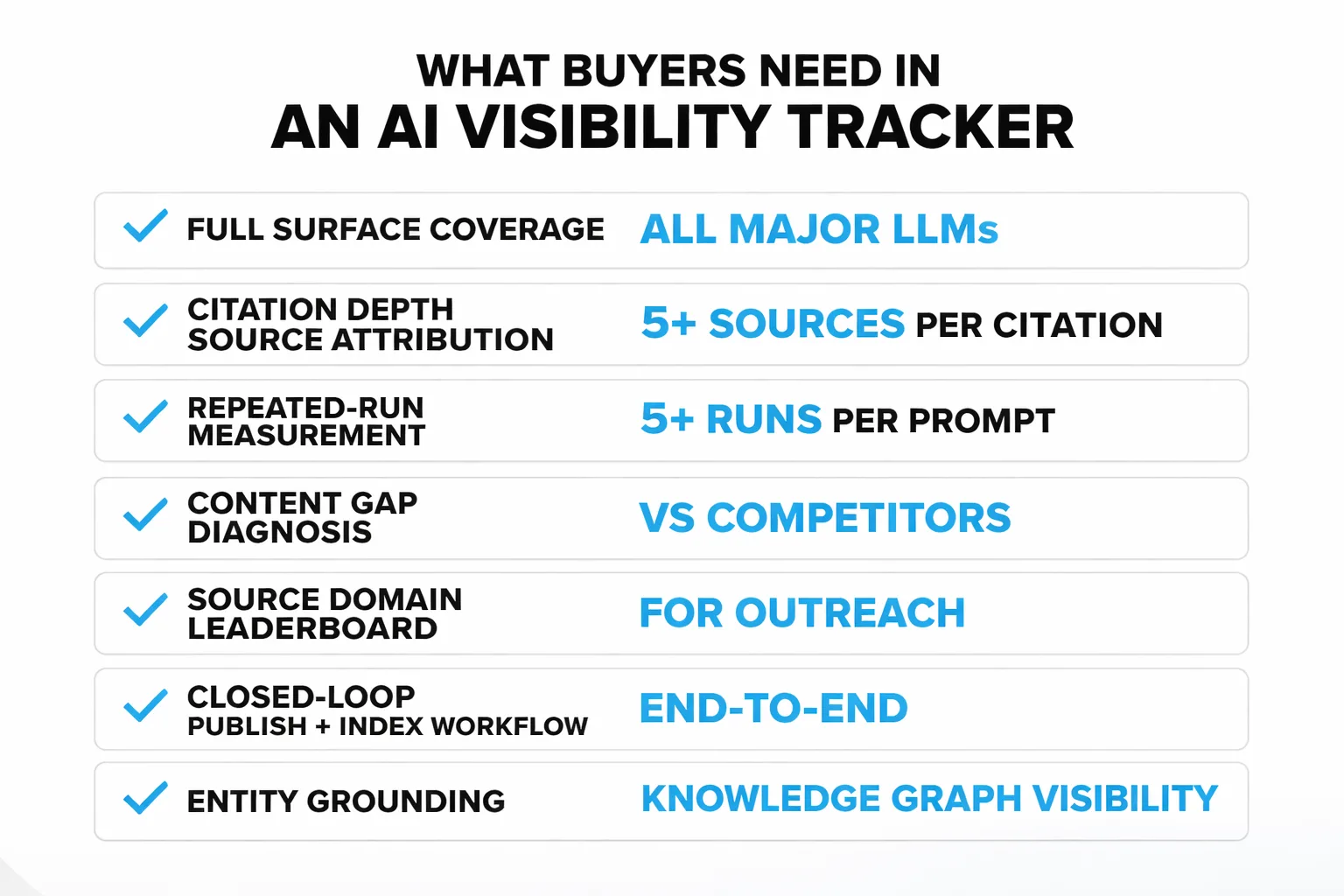
Surface coverage. Does the tool track every major AI search surface? ChatGPT, Claude, Gemini, Perplexity, Grok, Google AI Overviews, AI Mode, and DeepSeek. Not a subset. The AI search space is fragmented, and different surfaces serve different audiences. A tool that covers 2 surfaces is not an AI visibility tool. It's a ChatGPT rank tracker with extra steps.
Citation depth. Does the tool show you the full AI response text, or just a binary 'mentioned / not mentioned' flag? Does it attribute citations to specific source pages? Does it track your position within the answer (first mention, in a list, last)? Binary mention tracking is the bare minimum. You need the full response context to understand how the AI is positioning your brand.
Measurement reliability. Does the tool run repeated measurements to filter out one-time anomalies? This is non-negotiable. With a 44.5% anomaly rate, single-snapshot readings are worse than no data because they create false confidence. Ask the vendor how many times they run each prompt. If they can't answer, walk away.
Content gap diagnosis. Does the tool surface prompts where competitors are cited but you aren't? This is where strategy lives. Knowing your current visibility is descriptive. Knowing where you're invisible is prescriptive. The AEO vs SEO distinction matters here: traditional SEO tools tell you where you rank. AI visibility tools should tell you where you're absent.
Source attribution. Does the tool show which domains and pages AI engines cite most often for your topics? This is your link-building roadmap for AI search. If AI engines consistently cite a specific industry publication for your topic, that's where you need to earn a mention. SE Ranking doesn't offer this. Dedicated AI visibility platforms do.
Publish workflow. Here's the thing that most comparison posts miss. Tracking AI visibility without closing the gaps is academic. You need a tool that not only diagnoses where you're invisible but also helps you fix it. Can the tool generate and publish answer-engine-optimized content that targets the specific prompts where you're absent? Can it submit that content for indexing automatically? Can it track whether the new content actually moved your AI visibility needle?
SE Ranking is a tracking tool. It tracks well within its coverage area. It doesn't publish content, doesn't close citation gaps, and doesn't submit to IndexNow. If you want a closed-loop system, you need either a dedicated AI visibility platform or a stack of tools stitched together.
Methodology transparency. This is my personal hill. I've been burned by tools that claim massive AI visibility gains without disclosing their methodology. The Profound/Ramp case study claiming a 7x increase from 3.2% to 22.2% is the poster child. Without knowing prompt consistency, baseline establishment, or confidence ranges, those numbers are marketing fluff. When evaluating any AI visibility tool, ask: How do you construct prompts? How many times do you run each one? What's your confidence interval? If the vendor can't answer, the data is suspect.
The Freshness Factor and Brand Mentions
Let me circle back to the two findings that changed how I think about AI visibility.
AI-cited content runs 25.7% fresher than organic top-10 results. This is across nearly 17 million citations. If your content strategy is 'publish evergreen content and forget it,' you're at a structural disadvantage in AI search. LLMs weight freshness more heavily than Google's classic algorithm. This doesn't mean you need to churn out daily blog posts. It means you need to update existing content regularly and publish on current topics. The generative engine optimization playbook is different from the SEO playbook.
Brand mentions correlate 3x more strongly with AI visibility than backlinks (0.664 vs 0.218). This finding fundamentally changed my content strategy. I used to spend 70% of my content budget on link-building and 30% on brand awareness. I've flipped that ratio. If you want AI engines to cite you, you need people talking about you on the open web. Reddit threads, LinkedIn posts, industry forum discussions, podcast appearances. These signals matter more to LLMs than a DA-70 backlink from a guest post nobody read.
This is also why traditional AI search engine optimization approaches often fail. Teams apply SEO logic to AI search. They build links, optimize meta tags, and stuff keywords. But LLMs don't care about your meta tags. They care about whether real people discuss your brand, whether authoritative sources reference your work, and whether your content is fresh enough to be relevant.
The 25.7% freshness gap also explains why static content audits are insufficient. If you audited your content 6 months ago and haven't updated since, your AI visibility has likely declined. Not because your content got worse, but because the AI citation pool got fresher around you.
Let me add a nuance here that I don't see discussed enough. The freshness finding doesn't mean every piece of content needs a date stamp from this week. It means the information in the content needs to reflect current reality. I've seen articles from 2024 that still rank in AI citations because they were updated with current data, even though the publish date stayed the same. The LLM is evaluating semantic freshness, not URL freshness. Your update strategy should focus on data accuracy, current examples, and reflecting the latest state of your industry. If your article references 'recent research' from two years ago, the LLM can tell. It's pulling from a corpus that includes more recent sources, and your stale references signal that your content is outdated relative to alternatives.
The brand mention finding (0.664 correlation vs 0.218 for backlinks) deserves deeper unpacking. This isn't just about volume of mentions. It's about the context of those mentions. A brand mentioned in a Reddit thread asking 'what tool do you use for X' carries more weight than a brand mentioned in a generic listicle. LLMs are trained on conversational data, and they weight community discussion heavily. I've shifted my outreach strategy to prioritize getting into real conversations (Reddit, Hacker News, industry Slack communities, LinkedIn comment threads) over earning traditional editorial mentions. The correlation data backs this up. Community discussion signals carry 3x the predictive weight of backlinks for AI citation likelihood.
What Drives AI Citations Beyond Traditional Ranking
Here's a finding that challenges the foundational assumption of most SEO strategies. 55.2% of top-10 AI citations did not rank in the traditional top 10. Over half of the pages that AI engines cite aren't even on page one of Google.
This is the single most important data point for anyone investing in AI search optimization. It means your Google rankings are not a reliable proxy for your AI visibility. You could be ranking position 2 for a high-value keyword and still get zero AI citations. I've seen this firsthand. We ran an experiment with 5 articles that hit top 3 organic rankings. Over a 3-month period, those articles received zero AI citations across ChatGPT, Claude, and Perplexity. The content was optimized for Google's algorithm. It wasn't optimized for how LLMs select and cite sources.
What does optimize for LLM citation? The same research found that thorough topic coverage nearly doubled the top-10 AI citation rate: 27.6% vs 14.5%. LLMs favor comprehensive treatment of a topic over shallow, keyword-targeted content. This aligns with how LLMs work technically. They retrieve passages that semantically cover the query space, not pages that keyword-match. If your content answers the specific question but doesn't address adjacent topics, sub-questions, and context, the LLM is less likely to cite you.
Traditional positions 1-3 had a 98.9% chance of being cited by AI. This seems contradictory to the 55.2% finding, but it's not. If you rank top 3, you're almost certainly cited. But 55.2% of AI citations go to pages outside the top 10. This means there's a massive pool of AI citations going to content that doesn't rank organically. The implication: if you can't crack the top 3 on Google, you can still earn AI citations through content depth, brand mentions, and freshness. The LLM visibility tool approach is about optimizing for the citation selection mechanism, not the ranking algorithm.
Are you tracking AI visibility across all major LLMs, or just the ones your SEO tool happens to cover?
Why AI SEO Agents Change the Workflow
The search demand for AI-agent topics grew 22x in three years. That's not a gradual trend. It's a structural shift in how people search for and discover information.
AI SEO agents represent a fundamentally different workflow from traditional SEO tools. A traditional SEO tool tells you what to optimize. An AI SEO agent executes the optimization. The difference matters because the gap between diagnosis and execution is where most AI visibility strategies fail. You know you need to publish fresh, comprehensive, fact-verified content targeting specific prompts where you're invisible. But doing that manually at scale is impossible for small teams.
Here's where I've seen teams get burned. They deploy an AI SEO agent that churns out content quickly, but the agent doesn't model search intent deeply. It clusters keywords without semantic understanding and produces content that's technically 'optimized' but misses the user's underlying 'why.' I tried a basic AI SEO agent for a client's niche blog last quarter. Traffic dipped 15% because the content didn't enrich the internet. It just added to the noise.
The lesson: an AI SEO agent is only as good as its intent modeling and quality gates. If the agent doesn't understand why someone is asking a question, it can't produce content that earns AI citations. The 27.6% vs 14.5% thoroughness gap proves this. LLMs cite comprehensive content because it serves the user's intent better. An agent that produces shallow content optimized for keyword density will never capture that lift.
This is why the AEO tool category matters. The right tool doesn't just generate content. It researches the topic space, retrieves relevant knowledge base context, structures the content for AI citation (clear claims, sourced data, comprehensive sub-topic coverage), and gates quality before publish. SE Ranking doesn't offer any of this. It's not trying to. But if you're comparing SE Ranking against a platform that does, this is the gap that matters most for actual business outcomes.
When SE Ranking Makes Sense (and When It Doesn't)
I want to be fair here. SE Ranking isn't a bad tool. It's a good tool solving a narrow problem.
SE Ranking makes sense if: - You're already an SE Ranking customer and want a quick AI visibility widget added to your existing dashboard. Your clients primarily care about Google AI Overviews and ChatGPT visibility. You need agency-grade reporting with competitor benchmarking across a few surfaces. You're budget-constrained and need an all-in-one SEO + AI visibility solution. Your team doesn't have the bandwidth to act on deep citation data even if you had it
SE Ranking falls short if: - You need coverage across Claude, Grok, DeepSeek, and Perplexity (not just ChatGPT and AI Overviews) - You need to know which source pages drive your AI citations (not just whether you were mentioned) - You need repeated-run measurement to filter out the 44.5% of citations that are one-time anomalies. You need content gap diagnosis that tells you where competitors are cited but you aren't. You need a closed-loop system that diagnoses gaps AND publishes content to close them. You need entity grounding visibility (Wikidata, knowledge graph status, schema disambiguation) - You serve international markets and need to detect query rewriting and language drift. You're an ecommerce brand investing in agentic commerce and need to track how AI agents represent your products
The honest answer is that SE Ranking's AI Visibility Tracker is a feature, not a product. It's an add-on to a classic SEO suite. If you need a feature, it's fine. If you need a product, you need a dedicated AI visibility platform.
Here's the analogy I use with my team. SE Ranking's AI tracker is like the camera on your phone. It's convenient, it's always there, and it's good enough for quick snapshots. But if you're shooting a commercial, you need a dedicated camera with manual controls, interchangeable lenses, and raw output. The phone camera and the DSLR aren't competitors. They're tools for different jobs. The problem is when teams treat the phone camera as if it's a DSLR.
The Model Migration Problem Nobody Is Talking About
There's one more gap that affects every AI visibility tool, not just SE Ranking. But it compounds the limitations I've already described.
When OpenAI migrated from GPT-4 to GPT-5.5, German-language citations saw a 47% variance compared to the normal 1-2% variance between runs. That's not a minor fluctuation. It's a structural reshuffling of which sources the model cites. Nearly half of the citation landscape changed overnight.
This means your AI visibility data has a shelf life. If your tool captured your visibility before a model migration and you're comparing it to post-migration data, you're comparing apples to oranges. The variance is so high that trend lines become meaningless. You could see a 40% drop in AI visibility and conclude your strategy is failing, when in reality the model just reshuffled its citation preferences.
SE Ranking doesn't account for model migrations. It doesn't flag when a model update has occurred or annotate your trend data with migration events. Without this context, you're making strategic decisions based on data that may reflect model behavior changes rather than your own performance. Any enterprise AI rank tracker worth the name should annotate model updates on your timeline. If yours doesn't, you're flying blind through every migration.
The model migration problem also affects competitive benchmarking. If your competitor's AI visibility spiked after a model migration, that doesn't mean they did something smart. It means the model changed its preferences. Without migration annotations, you might reverse-engineer their 'strategy' and waste resources replicating a move they never made.
What This Actually Means for Your AI Search Strategy
Here's my synthesis after a year of working with AI visibility data.
Stop treating AI visibility as a checkbox on your SEO dashboard. It's a fundamentally different discipline that requires different measurement, different content strategies, and different success metrics. The AEO vs GEO distinction isn't academic. It changes what you publish, how you publish it, and how you measure success.
The tools you choose matter less than the methodology you apply. A team running manual prompts across 5 AI surfaces with disciplined repeated measurements will outperform a team relying on a single-snapshot tool that covers 2 surfaces. The data gap between tools (26.2% capture rate for API-based methods) means your methodology is more important than your tool budget.
If I were building an AI search strategy from scratch today, I'd start with three things. First, manual prompt testing across every major AI surface to establish ground truth. Second, a dedicated AI visibility platform that covers all surfaces with repeated-run measurement and source attribution. Third, a content engine that publishes fresh, fact-verified content targeting the specific prompts where I'm invisible.
The se ranking ai visibility tracker can be part of that stack if your needs are narrow. But don't mistake it for the whole solution. The gap between what it shows and what's actually happening in AI search is wider than most teams realize. With 55.2% of AI citations going to pages outside the traditional top 10, with brand mentions carrying 3x the weight of backlinks, and with 44.5% of citations being one-time anomalies, you need a measurement system that's built for the reality of AI search. Not a bolt-on to a tool built for Google's 2018 algorithm.
FAQ
Can SE Ranking's AI Visibility Tracker monitor Claude and Grok?
No. SE Ranking's AI visibility features focus on Google AI Overviews, AI Mode, and ChatGPT. Claude, Grok, DeepSeek, and Perplexity's deep citation data are not covered. If your audience uses these surfaces, you'll need a dedicated AI visibility platform that tracks every major LLM.
How accurate are API-based AI visibility tools?
According to a National University of Singapore preprint, API-based tracking tools reproduce only 26.2% of specific pages that ChatGPT actually cited. Additionally, 44.5% of unique pages appeared in only 1 of 20 repeated runs, meaning nearly half of AI citations are one-time anomalies. Tools that rely on single snapshots are unreliable.
What's the difference between AI visibility tracking and traditional rank tracking?
Traditional rank tracking monitors your position in Google's organic results for specific keywords. AI visibility tracking monitors whether and how your brand appears in AI-generated answers across surfaces like ChatGPT, Claude, and Perplexity. The methodologies, metrics, and strategies are fundamentally different. AEO vs SEO is not a minor distinction. It changes your entire content approach.
Should I use SE Ranking or a dedicated AI visibility platform?
If you're already on SE Ranking and need basic AI Overviews and ChatGPT tracking for client reports, SE Ranking's built-in features are sufficient. If you need full-surface coverage, source attribution, content gap diagnosis, repeated-run measurement, or a closed-loop content publishing workflow, you need a dedicated platform. Evaluate based on your specific AI search strategy, not on which tool you already pay for.
How often should I check my AI visibility?
Daily for SERP-driven surfaces (AI Overviews, AI Mode) and weekly for LLM-driven surfaces (ChatGPT, Claude, Perplexity). More importantly, run each prompt multiple times to filter out the 44.5% of citations that are one-time anomalies. A single snapshot is worse than no data because it creates false confidence in visibility that may not be reliable.
What drives AI citations more: backlinks or brand mentions?
Research analyzing nearly 17 million citations found that brand web mentions correlate 3x more strongly with AI visibility than backlinks (0.664 vs 0.218). This means Reddit discussions, LinkedIn mentions, podcast appearances, and industry forum threads matter more to LLMs than traditional link-building. Shift your content budget accordingly.
Does SE Ranking track entity presence in knowledge graphs?
No. SE Ranking does not surface your brand's entity status in Wikidata, Google's Knowledge Graph, or schema.org typed entities. This is a critical gap because LLMs reference entities, not just pages. If your brand isn't recognized as a distinct entity, you may be invisible in AI answers regardless of your content quality. Check your Wikidata presence and Organization schema markup manually if your tool doesn't surface it.
How do model migrations affect AI visibility data?
Model migrations (like GPT-4 to GPT-5.5) can cause massive variance in citation data. The German-language citation variance after the GPT-5.5 migration was 47%, compared to a normal 1-2% variance between runs. Without migration annotations on your trend data, you may interpret model behavior changes as your own performance changes. Any AI visibility tool should flag model updates on your timeline.
About the Author
Judy Zhou, Founder
Judy Zhou leads content strategy at Meev, where she oversees AI-driven content research and publishing for hundreds of brands. With a background in SEO and editorial operations, she focuses on building content systems that rank on Google, get cited by AI search engines, and drive measurable business results.
Stop guessing at your AI search visibility. See exactly where your brand is cited, where it's invisible, and which content closes the gap.