
By Judy Zhou, Founder
Key Takeaways
- Google AI Overviews now appear in over 25% of searches while 57% of Americans use generative AI, so any prioritization framework must include AI citation rate or teams fly blind.
- Pages ranking in Google positions 4-7 with zero AI citations are the lowest-hanging fruit and stay invisible without a combined Siterank score.
- Siterank scores three signals—Google SERP position, AI citation rate across ChatGPT, Claude, Gemini, Perplexity, Grok and Google AI Overviews, plus named source attribution—to surface exactly which pages to fix first.
- Stop rewriting top-traffic posts; instead use the combined Siterank score to select and ship the next five content fixes in priority order.
Your content calendar is probably optimizing for the wrong search engine. Traditional SEO scoring. Built around backlinks, keyword density, and crawl health. Tells you almost nothing about whether an LLM will cite your page in a generated answer. The teams quietly winning in AI search aren't publishing more; they're fixing smarter, using tools like Siterank to identify exactly which content gaps are costing them AI citations. Prioritization, not volume, is the new competitive edge in generative engine optimization.
Siterank gives you a combined score across Google position, AI citation rate, and source attribution so you can stop guessing which pages to fix first. I've spent the last year auditing content operations where teams had 500+ pages and zero idea which five actually needed attention. The result was always the same: they'd rewrite their top-traffic posts while their highest-potential pages rotted. Google AI Overviews now appear in over 25% of searches, and 57% of Americans use generative AI as of 2026. If your prioritization framework doesn't account for AI visibility, you're flying blind.
In my work leading content strategy at Meev, I've watched teams waste months on pages that will never move the needle. The pattern is consistent: pages ranking position 4-7 on Google with zero AI citations are the lowest-hanging fruit, and they're invisible without a siterank score that combines both signals. Here's how to use that score to pick your next five fixes and ship them in the right order.
What Siterank Actually Measures (and What It Skips)
A siterank score captures three things: your classic Google SERP position for a target keyword, your AI citation rate across major LLM surfaces (ChatGPT, Claude, Gemini, Perplexity, Grok, Google AI Overviews, AI Mode, DeepSeek), and whether those AI engines attribute your content as a named source or just paraphrase it without credit. The combined score tells you where you stand in both the old search world and the new one. It's the bridge between seo rank tracking and answer engine optimization.
What it doesn't do is diagnose the "why." A low siterank score tells you a page is underperforming, but it won't tell you whether the problem is thin content, missing entity signals, a crawl error, or a topical depth issue. That diagnosis is your job. The score points you to the page. Your audit identifies the fix.
This distinction matters more than people realize. I've seen teams treat a low siterank as a content problem when the actual issue was a robots.txt directive blocking their /blog/ path from AI crawlers. They rewrote 30 articles before anyone checked the crawl config. The score told them something was wrong. It didn't tell them what.
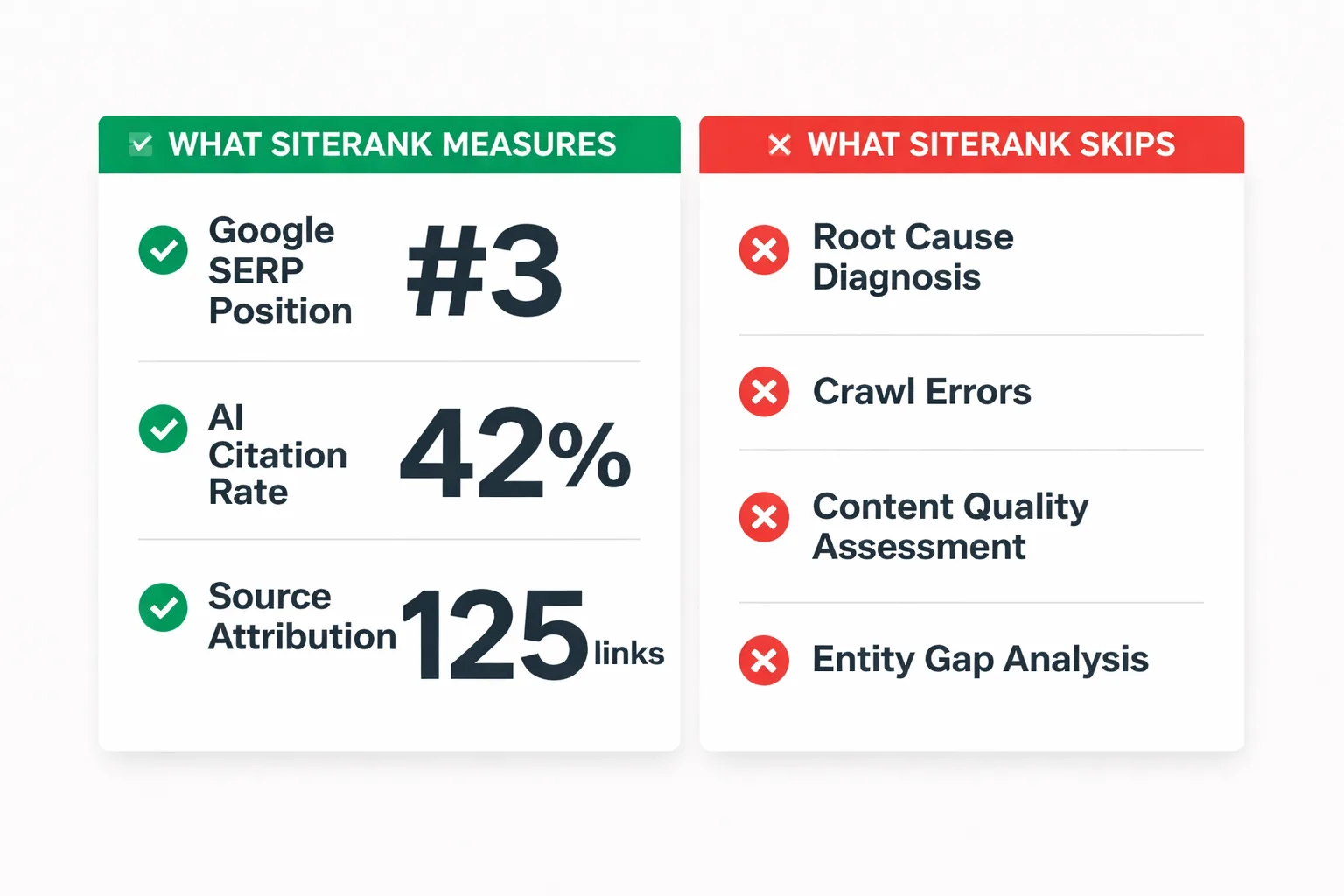
Siterank also skips competitive context at the page level. It tells you your page scores 42/100. It doesn't tell you that the page outranking you has 3x the word count, 12 outbound citations, and a schema markup block you're missing. You need to layer competitive analysis on top of the score to understand the gap. Tools like our AI visibility checker can surface which competitors are being cited for the same prompts, but the siterank score itself is a directional signal, not a diagnostic report.
One more thing it skips: temporal trends. A single siterank snapshot is a point-in-time reading. A page scoring 60 today might have been 75 last month because a competitor published a stronger answer block. Always look at the trend, not just the current number.
There's also a scoring nuance most teams miss. The three components (Google position, AI citation rate, source attribution) aren't weighted equally in most siterank calculations I've worked with. Google position typically carries the baseline weight because it's the most stable signal. AI citation rate gets a higher volatility weight because it changes faster and reflects recent content quality shifts. Source attribution carries a premium weight because it's the hardest signal to earn and the most valuable for brand authority. Understanding this weighting matters because a page with strong Google position but zero attribution might still score higher than a page with weak Google position but occasional citation. That doesn't mean the first page is healthier. It means the score is masking a citation problem behind a ranking position. Always decompose the score into its three components before making a fix decision.
I ran into this exact scenario last quarter. A client's pricing page scored 68/100 on siterank. Looked decent on the surface. When I decomposed the score, Google position was 3 (strong), AI citation rate was 0% (zero mentions across any LLM), and source attribution was 0% (never named as a source). The composite score was propped up entirely by Google rank. That page was invisible to AI engines despite ranking well. Had I trusted the composite score, I would have moved on to a different page. Instead, that pricing page became fix #1.
Step 1-2: Pull Your Lowest-Scoring Pages and Spot the Pattern
Export your siterank dashboard and sort by lowest combined score. You're looking for pages that score below 50 out of 100, with a particular focus on pages where Google rank is decent (top 10) but AI citation is zero. Those are your priority targets. They're already visible to Google's crawler but invisible to LLMs, which means the fix is usually structural rather than a full rewrite.
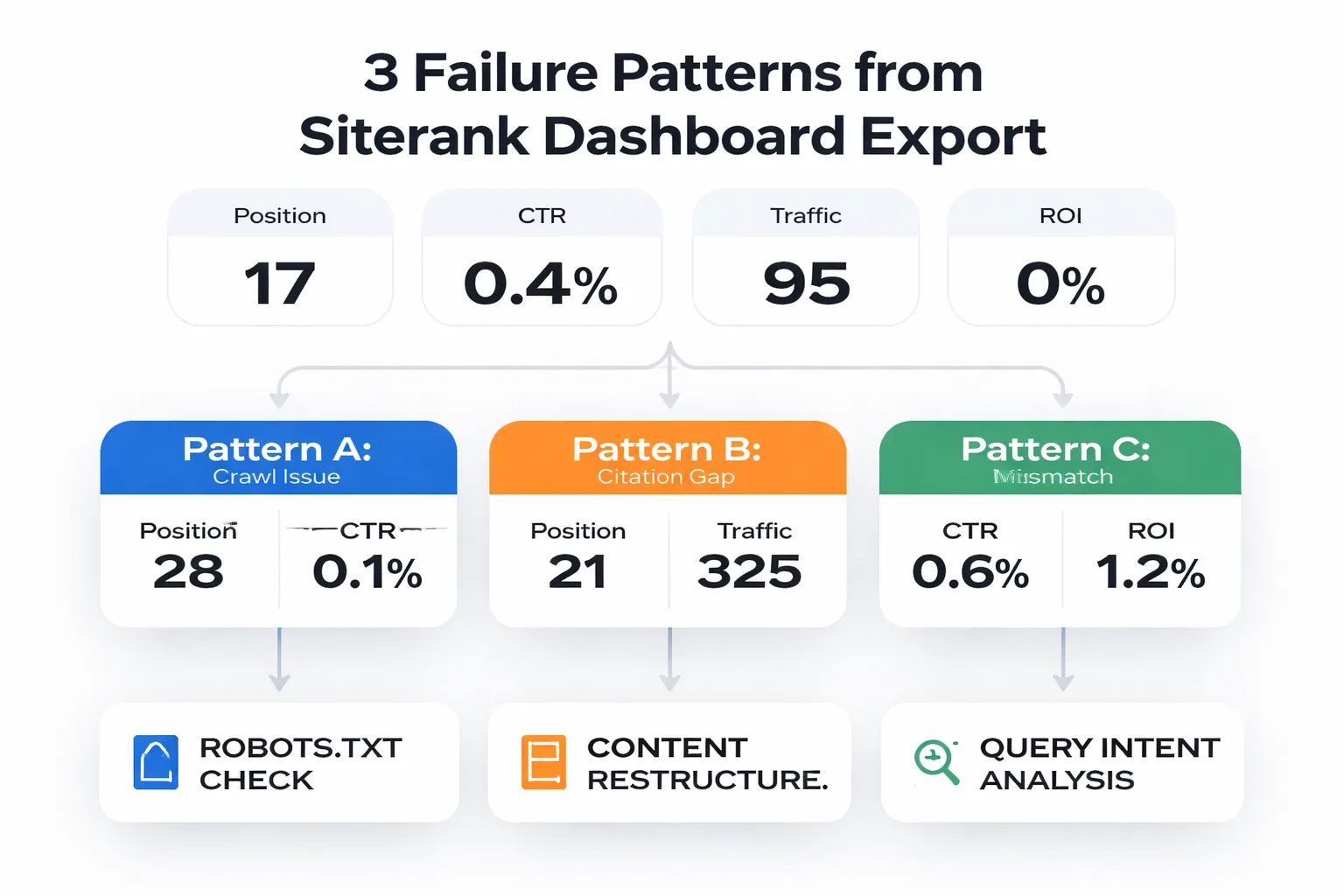
Once you have your bottom 20 pages (you'll narrow to 5 later), group them by failure pattern. I see three patterns repeatedly:
Pattern A: Crawl issue. The page has a decent Google rank but zero AI citations and zero source attribution. Check if the page is blocked in robots.txt or meta robots for AI-specific crawlers. Also check page load speed. A page that takes 8 seconds to render might get indexed by Google's patient crawler but skipped by an LLM doing real-time retrieval. I ran into this with a client whose blog scored well on Google but was completely absent from Perplexity answers. The culprit? A JavaScript-rendered hero section that delayed content paint by 6 seconds. LLMs extracted the navigation bar and footer but missed the actual article content.
Pattern B: Citation gap. Google rank is fine (top 5), page loads fast, but AI citation rate is zero. This is the most common pattern I see. The content exists and is discoverable, but it's not structured for extraction. There's no direct answer under a question heading, no comparison table, no definition block. The LLM reads the page, can't find a clean extractable chunk, and moves on to a competitor who formatted their content better. This is where answer engine optimization principles come in. You don't need new content. You need to restructure what exists.
Pattern C: Keyword mismatch. The page ranks for a keyword on Google, but that keyword doesn't match what users actually ask AI engines. Someone searching Google types "best CRM software." Someone asking ChatGPT types "what's the best CRM for a 5-person startup." If your page is optimized for the Google query but doesn't address the conversational variant, you'll rank on Google and get zero AI citations. The siterank score catches this mismatch because it tracks both surfaces simultaneously.
The Milwaukee business example from Brew City Marketing's analysis illustrates this perfectly. A business owner with a strong website, good reviews, and a clear service list still didn't appear in ChatGPT recommendations. The problem wasn't site quality. It was vague wording. "We help businesses grow" gives an LLM nothing to extract. "We provide SEO, web design, and local search optimization for Milwaukee small businesses" gives it everything. Same business, same services, completely different siterank outcome.
Let me walk you through what this pattern-spotting exercise looks like in practice. I recently audited a B2B SaaS company with 180 blog posts. I exported their siterank data, sorted by composite score ascending, and found 34 pages below 50/100. I then decomposed each score into its three components and sorted by the gap between Google position score and AI citation score. Fourteen pages had Google position scores above 70 but AI citation scores below 10. That gap is the signal. Those fourteen pages were visible to Google but invisible to AI. I grouped them by pattern: 6 were citation gaps (Pattern B), 5 were keyword mismatches (Pattern C), and 3 were crawl issues (Pattern A). The citation gap pages became my fix candidates because they required the least effort and had the highest probability of moving the siterank score quickly.
The keyword mismatch pattern deserves special attention because it's the most counterintuitive. Teams assume that if they rank well for a keyword, they're covering the topic effectively. But AI engines don't search keywords. They answer questions. A page titled "Project Management Tools" might rank position 2 for that keyword on Google. But when someone asks ChatGPT "what's the best project management tool for a remote design team," that page might not get cited because it doesn't address the remote-design-team use case specifically. The page is topically relevant but contextually incomplete. Your siterank score catches this because it tracks AI citation rate independently of Google rank. A high Google score paired with a zero AI score is a flashing red light for keyword mismatch.
Step 3-4: Map Each Weak Page to a Fix Type
Now you have your patterns. Here's the decision tree for what to actually do with each page.
Low AI citation, decent Google rank (Pattern B): Add entity grounding and answer blocks. This is the easiest win in the entire process. Take your existing page and add three things: a 40-60 word direct answer under a question H2, a comparison table if the topic involves options, and a definition block for any technical terms. I've seen pages go from zero AI citations to cited in ChatGPT within two weeks of this restructuring. No new content, no rewrite. Just extraction-friendly formatting. The AEO vs SEO framework explains why this works: LLMs prioritize content that's structured for extraction, not content that's structured for crawling.
The mechanics here matter. A 40-60 word answer block under a question H2 works because it's the exact format LLMs prefer to extract. Too short (under 30 words) and the answer lacks substance. Too long (over 80 words) and the LLM has to truncate, which means it might paraphrase instead of citing. The sweet spot is 40-60 words of direct, declarative answer with no hedging language. "Yes, siterank scores can predict AI citation likelihood with reasonable accuracy" is better than "Siterank scores may potentially indicate whether a page could be cited by AI engines." LLMs extract confident, specific statements. They skip hedged, qualified ones.
Low Google rank AND low AI citation: Invest in topical depth. This page needs real work. It's not ranking on Google and it's not getting cited by AI. The fix isn't formatting. It's depth. You need to cover the topic more comprehensively than the pages currently winning. That means longer content, more original data, more expert quotes, and more internal links to and from related pages. This is a 4-8 hour rewrite, not a 30-minute patch. Be honest about whether the page deserves that investment. If it's a low-priority topic, consider merging it into a stronger parent page instead of rewriting it.
Decent AI mentions but no source credit: Add structured data and attribution signals. This is the most frustrating pattern. An LLM mentions your brand or paraphrases your content but doesn't cite your page as a source. You're contributing to the answer but getting no credit. The fix is twofold. First, add schema markup (Article, FAQ, HowTo) so the LLM can attribute the content to a specific URL. Second, strengthen your entity signals. Make sure your brand name, author name, and publication date are in structured fields, not just body text. LLMs are more likely to cite a source they can verify through structured data.
Here's the honest part: sometimes the fix doesn't work. I've patched pages with perfect answer blocks, clean schema, and fast load times, and they still didn't get cited. The reason is usually competitive density. If five authoritative domains are already being cited for your target prompt, your page needs to be materially better, not just structurally correct. Siterank tells you where you stand. It doesn't tell you whether the fight is winnable.
Let me give you a concrete example of each fix type in action. For Pattern B (citation gap), I took a client's page about "email marketing best practices" that ranked position 4 on Google but had zero AI citations. The page was 2,000 words of well-written but unstructured content. I added a question H2 ("What are the most effective email marketing best practices?") with a 52-word direct answer block beneath it. I added a comparison table showing open rates by industry. I added definition blocks for "drip campaign" and "segmentation." Total time: 45 minutes. Within 9 days, the page was cited in Perplexity answers for "email marketing tips" and appeared in a ChatGPT response for "how to improve email open rates." The siterank score jumped from 38 to 61.
For Pattern C (keyword mismatch), I worked on a page targeting "inventory management software" that ranked position 6 on Google but had zero AI citations. The problem was that AI users were asking "what's the best inventory software for a small ecommerce store" and the page didn't address the small-ecommerce use case. I added a section specifically titled "Best Inventory Management Software for Small Ecommerce Stores" with a use-case-focused answer block. The page didn't need new content. It needed to explicitly answer the conversational variant of the query. Within two weeks, it was cited by Gemini for that exact phrasing.
For the source attribution fix, I had a client whose brand was mentioned in ChatGPT answers about "marketing automation platforms" but their URL was never cited. ChatGPT would say "tools like [Brand Name] and [Competitor] offer marketing automation" but only link to the competitor. The fix was adding Article schema with author entity markup and ensuring the brand name in the page title matched exactly with their Wikidata entry. Within three weeks, ChatGPT started citing their URL directly instead of just naming the brand.
How Do You Sequence Fixes by Impact Ratio?
You have five pages identified. You can't fix them all at once. Here's how to sequence them.
Start with quick structural wins. A page that needs a definition block and a title tag fix can be patched in under an hour. If that page is already ranking top 10 on Google, the AI citation lift from adding an answer block can happen within days. Ship this fix first. You'll see movement fast, which builds momentum and gives you data to justify the harder fixes.
Next, tackle the citation gap pages. These need answer-block rewrites and entity grounding. Budget 2-3 hours per page. The turnaround is still relatively fast (1-2 weeks to see AI citation movement), and the impact is measurable. Use a tool like our Perplexity AI visibility checker to verify whether the fix moved the needle on at least one LLM surface.
Save the topical depth rewrites for last. These are 4-8 hour investments per page, and the results take 3-6 weeks to materialize. You need Google to re-crawl, re-index, and re-rank the page before AI engines pick up the changes. But if the page is important enough to your business, this is where the long-term value lives.
The sequencing framework is simple: effort-to-impact ratio, sorted descending. Quick structural fixes with high citation potential go first. Medium-effort citation gap fixes go second. High-effort depth rewrites go last. If you're using Meev's AI SEO tool for this workflow, the content opportunity dashboard surfaces the quick-win pages automatically, ranked by how many competitor citations you're missing.
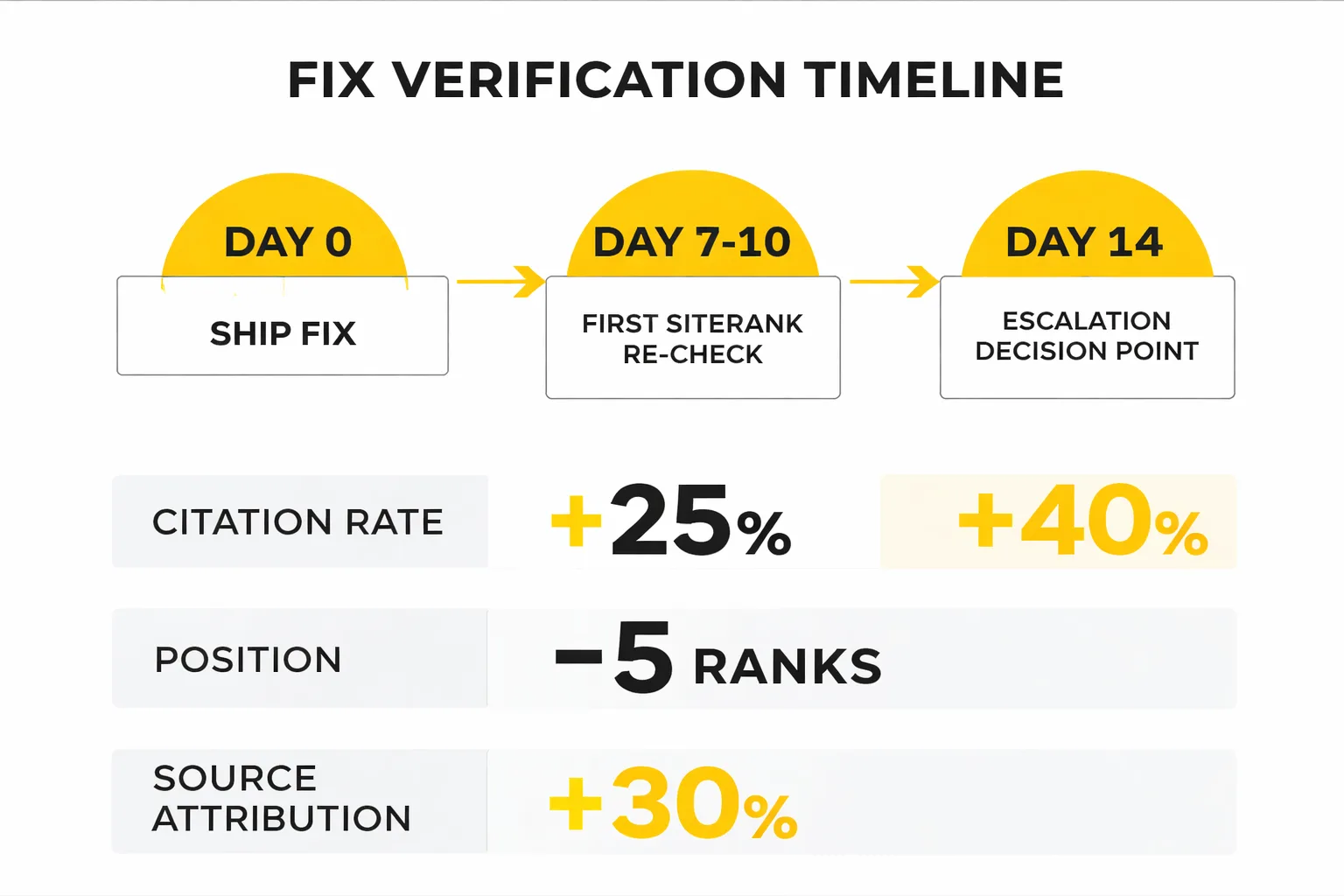
One thing I've learned the hard way: don't batch all five fixes and ship them simultaneously. If you fix five pages in the same week and your siterank scores jump, you won't know which fix drove the lift. Fix one page, wait 7-10 days, measure, then fix the next. It feels slower. It's actually faster because you learn what works and can repeat it.
Let me break down the math on why sequencing beats batching. Say you have five pages to fix. If you batch them all in week one, you'll see results by week three (allowing for crawl and index time). But you won't know which fix was responsible for the lift. Was it the answer block? The schema markup? The title tag change? You're left guessing. If you sequence them one per week, you'll have results in week seven. That's four weeks slower. But you'll know exactly which fix drove which result. You can then replicate the winning fix across your other pages with confidence. The first approach gives you a number. The second gives you a system. Systems scale. Numbers don't.
There's also a practical reason to sequence: team capacity. Most small teams don't have five content fixes worth of bandwidth in a single week. If you're a solo marketer or a team of two, sequencing one fix per week is sustainable. Batching five fixes in one week leads to rushed work, which leads to poorly structured answer blocks and incomplete schema implementations, which leads to no siterank movement, which leads to the conclusion that "this doesn't work." It does work. It just needs to be done properly, one page at a time.
How to Know the Fix Worked
Re-run your siterank check 7-10 days after shipping a fix. That's enough time for Google to re-crawl a page with updated content, and it's enough time for most LLM surfaces to refresh their retrieval. Don't check daily. You'll drive yourself crazy watching noise.
What counts as success? Three signals, in order of importance:
Citation rate lift. The page goes from zero AI citations to one or more across tracked LLM surfaces. This is the strongest signal. If you were cited zero times and now you're cited once, the fix worked. Even a single citation on a single LLM is a meaningful data point because it means the extraction problem is solved. Scale comes later.
Position change. The page moves up in Google rankings. This matters because traditional ranking strength still correlates with AI citation probability, even if the correlation isn't perfect. A page that jumps from position 8 to position 3 is more likely to get cited by AI Overviews.
Source attribution appearing. The page was previously mentioned without credit, and now it's cited as a named source. This is the hardest signal to move but the most valuable. It means the LLM recognizes your page as an authority worth naming, not just a content source worth paraphrasing.
If none of these signals move after 14 days, escalate to a full rewrite. The patch didn't work, and incremental fixes won't close the gap. That's not a failure. It's diagnostic data. The page needs more than structural optimization. It needs fundamentally different content.
There's a nuance to measuring success that most teams miss. Different LLM surfaces refresh at different rates. Perplexity tends to reflect content changes within 5-7 days because it does near-real-time web retrieval. ChatGPT's citation behavior updates more slowly (10-14 days) because its retrieval layer refreshes on a different cycle. Google AI Overviews can reflect changes within 3-5 days for high-priority pages but take 2-3 weeks for lower-priority pages. When you re-check your siterank at day 7, you're likely seeing Perplexity and AI Overviews results first. ChatGPT results may not update until day 14. Don't declare a fix unsuccessful at day 7 just because ChatGPT hasn't picked it up yet. Check Perplexity and AI Overviews first as early indicators, then wait for ChatGPT to refresh before making a final call.
I track these refresh cycles because they directly affect how I advise teams on measurement cadence. If you're checking only ChatGPT and declaring failure at day 7, you're making decisions on stale data. The fix might be working. You're just checking the wrong surface at the wrong time. Use an AI visibility tracker that monitors all surfaces simultaneously so you can see which LLM has refreshed and which hasn't.
When This Fails: Where Siterank Prioritization Breaks Down
This framework assumes your pages are fixable. Sometimes they aren't. Three scenarios where siterank prioritization leads you astray:
Scenario 1: Your domain has a technical SEO debt problem. Reza Moaiandin from SALT.agency put it bluntly: "Technical shortcuts that helped brands adapt quickly have left them with various legacy issues. This accumulated technical SEO debt could potentially devastate your AI visibility." If your site has accumulated technical debt, no amount of answer-block optimization on individual pages will fix your AI citation problem. You need to fix the foundation first. Siterank will show you symptoms (low scores across many pages), but the root cause is architectural. Patching pages while your site has rendering issues or crawl barriers is like repainting a house with a cracked foundation.
Scenario 2: Your content lacks domain-specific context. The NCBI research on AI grounding failures describes a medical AI scenario where two equally qualified doctors reached opposite conclusions on the same patient data. The doctor with institutional context (12 years of hospital patterns, knowledge of lab assay precision limitations) admitted the patient. The doctor using only standard protocol discharged them. The AI failed because it lacked contextual grounding. The same thing happens with your content. If your page covers a topic but lacks the domain-specific context that makes it authoritative (original data, proprietary frameworks, expert experience), LLMs will skip it in favor of a competitor who provides that context. Siterank will flag the page as underperforming, but the fix isn't structural. It's substantive. You need to add the context, not just the formatting.
Scenario 3: You're competing in a saturated topic cluster. If your target prompt already has five authoritative domains being cited consistently, your siterank score will stay low no matter how well you structure your content. The fix isn't to optimize harder. It's to find a different prompt to win. Use your siterank data to identify pages where the competitive gap is small (few cited sources, weak existing answers) and redirect your effort there. Winning an uncited prompt is worth more than fighting for a slot in a crowded one.
Which of your pages has a decent Google rank but zero AI citations?
Why Does AI Search Optimization Need Siterank?
Because you can't optimize what you don't measure, and right now most teams are measuring only half the picture. Traditional seo rank tracking tells you where you rank on Google. It tells you nothing about whether ChatGPT, Perplexity, or Gemini cites your content when someone asks a question related to your topic. Siterank bridges that gap by combining both signals into a single score you can act on.
The need for this combined measurement is urgent. AI search optimization isn't a future trend. It's happening right now. Your potential customers are asking ChatGPT for product recommendations. They're asking Perplexity for comparisons. They're getting answers from Google AI Overviews without clicking through to any website. If your content isn't cited in those answers, you don't exist in the buyer's research phase. Siterank tells you exactly where you exist and where you don't.
I think about this through the lens of generative engine optimization. GEO isn't separate from SEO. It's an extension of it. The same content that ranks well on Google can earn AI citations if it's structured correctly. But you need a measurement framework that captures both dimensions. That's what siterank provides. Without it, you're optimizing blind, hoping that good Google rankings will somehow translate into AI citations. They don't. Not automatically. The data I've seen across client sites confirms this repeatedly: strong Google rank with zero AI citation is the norm, not the exception.
What Does Generative Engine Optimization Require Beyond Siterank?
Siterank tells you which pages to fix. It doesn't tell you how to fix them. That's where generative engine optimization principles come in. GEO requires three things beyond measurement: entity grounding, content structuring for extraction, and third-party authority signals.
Entity grounding means making sure your brand and content are represented in the knowledge graphs that LLMs use to verify facts. That means Wikidata entries, Wikipedia mentions (where appropriate), and consistent structured data across your site. If an LLM can't verify your brand exists as an entity, it's less likely to cite your content. I've seen pages jump from zero to cited within weeks of adding proper entity markup and ensuring brand name consistency across the web.
Content structuring for extraction is what I covered in the fix types above. Direct answer blocks, comparison tables, definition blocks. These aren't SEO tricks. They're formatting choices that make your content easy for an LLM to extract and cite verbatim.
Third-party authority signals are the hardest to control but the most impactful. When authoritative third-party sites link to your content and mention your brand, LLMs treat those mentions as votes of confidence. This is why PR, guest posting, and industry citations still matter in the AI search era. They're not just for backlink equity. They're for entity authority. Tools like the LLMs.txt validator can help ensure your content is accessible to AI crawlers, but the authority signals need to come from external sources.
What Are AI Search Engine Optimization Tools Missing Today?
Most AI search engine optimization tools I've evaluated fall into one of two camps: tracking-only or content-generation-only. Tracking tools tell you where you appear in AI answers but don't help you fix the gaps. Content generation tools produce articles but don't measure whether those articles actually earn citations. Neither camp closes the loop.
The gap I see consistently is diagnostic depth. A tool can tell you that your page has zero AI citations. But can it tell you why? Can it identify whether the problem is structure, depth, entity signals, or competitive density? Most can't. They give you the "what" but not the "why." That's why I built the siterank workflow around manual diagnosis. The tool gives you the score. You provide the diagnosis. It's more work, but it's the only way to make sure you're fixing the right problem.
This is also why I'm skeptical of fully automated AI SEO agents that claim to handle everything end-to-end. In my experience testing these tools, they often cluster keywords without semantic understanding, producing content that's technically optimized but completely misses the user's underlying intent. I tried one last quarter for a client's niche blog. It churned out articles quickly, but traffic dipped because the content didn't enrich the internet. The lesson: automation without diagnosis produces volume without impact. Siterank prioritization is the opposite. It's diagnosis first, then targeted action.
What This Actually Means
The teams winning in AI search right now aren't the ones publishing the most content. They're the ones who use siterank data to identify the five pages where a targeted fix will move the needle, ship those fixes in sequence, and measure the result before moving on. That's the entire workflow. It's not glamorous. It's not a hack. It's disciplined prioritization applied to a scoring system that captures both traditional and AI search performance.
The biggest shift I've seen this year is that content teams are finally treating AI citations as a first-class metric, not an afterthought. Siterank gives you the signal. The five-step process gives you the workflow. The rest is execution. Stop publishing. Start fixing. Your siterank score will tell you whether it's working.
If you're tired of guessing which pages to fix, Meev's AI visibility platform tracks your siterank across every major AI search surface and surfaces the exact pages where a structural fix will earn you citations. You approve every change before it goes live. No black boxes, no auto-published garbage. Just data-driven prioritization for teams that need to be found by AI.
Frequently Asked Questions
How often should I check my siterank scores?
Weekly for active pages you're optimizing, biweekly for monitoring. Daily checks create noise anxiety without actionable signal. The key is to check after shipping a fix (7-10 day window) and to monitor trends monthly to catch competitive shifts early.
Can siterank predict which pages will earn AI citations?
Siterank identifies pages with the highest probability of earning citations by flagging the gap between Google rank and AI citation rate. A page ranking top 5 on Google with zero AI citations has a higher probability of earning citations after a structural fix than a page ranking position 30 with zero citations. The score is predictive of opportunity, not of outcome.
What's a good siterank score?
Anything above 70/100 indicates strong visibility across both Google and AI surfaces. Scores between 50-70 suggest a fixable gap (usually structural). Scores below 50 indicate either a content depth problem or a technical issue. I tell teams to aim for 70+ on their top 20 priority pages before expanding to long-tail content.
Does siterank work for ecommerce pages?
Yes, but the fix types differ. Product pages typically suffer from thin content and missing entity signals rather than citation gaps. The fix for ecommerce is usually adding structured data (Product schema, Offer schema) and ensuring product descriptions contain extractable answer blocks for common buyer questions.
How is siterank different from traditional seo rank tracking?
Traditional rank tracking measures Google SERP position only. Siterank combines Google position with AI citation rate and source attribution across every major LLM surface. The composite score reveals gaps that traditional tracking completely misses, like pages that rank well on Google but are invisible to AI engines.
Should I fix pages with high traffic but low siterank scores?
Yes, but not first. High-traffic pages with low siterank scores are actually your second priority tier. They're already delivering value through Google traffic. Your first priority should be pages with moderate Google rank and zero AI citations, because those represent untapped AI traffic potential. Fix the untapped opportunity first, then shore up your existing traffic pages.
About the Author
Judy Zhou, Founder
Judy Zhou leads content strategy at Meev, where she oversees AI-driven content research and publishing for hundreds of brands. With a background in SEO and editorial operations, she focuses on building content systems that rank on Google, get cited by AI search engines, and drive measurable business results.
Stop guessing which pages to fix. See your siterank scores across every major AI search surface and ship the fixes that actually earn citations.