

By Judy Zhou, Founder
Key Takeaways
- Organic search drives 53.3% of website visits and 23.6% of ecommerce orders, so rank tracking must expand beyond Google to capture AI visibility.
- AI Overviews appear in at least 16% of searches, with 62% of citations being ghost citations that name domains without mentioning brands.
- The decisive 2026 metric is whether AI engines cite your brand favorably in answers, not your average position like 4.2 or first-page count.
- Add ChatGPT, Perplexity, Google AI Overviews, and Claude to every rank tracking dashboard to close the gap between perfect rankings and zero AI mentions.
Maya pulled up the rank tracking dashboard on a Tuesday morning and saw exactly what she wanted: seventeen first-page rankings, three featured snippets, a stable average position of 4.2. Then her VP forwarded a screenshot. A customer had asked ChatGPT which project management tool to buy. The AI named four competitors, cited their documentation, and explained their pricing in confident, flowing prose. Maya's company. The category leader by search volume. Was not mentioned once. Her rankings were perfect. Her AI visibility was zero. That gap is what modern SEO rank tracking exists to close.
SEO rank tracking is the practice of monitoring where your web pages appear in search engine results for specific keywords over time. In 2026, this practice has expanded beyond traditional blue-link positions on Google to include visibility in AI-generated answers from ChatGPT, Perplexity, Google AI Overviews, and Claude. Organic search still drives 53.3% of total website visits and 23.6% of ecommerce orders. Meanwhile, AI Overviews appear in at least 16% of all searches, and 62% of AI citations are "ghost citations" where a domain is cited without the brand being named. Rank tracking that ignores AI visibility misses where decisions are actually being made.
The conventional wisdom about rank tracking is wrong. Or more precisely, it is incomplete to the point of being dangerous for B2B teams. The industry treats position tracking as the finish line. The real metric that matters is not where a page ranks, but whether an AI engine cites it favorably when a buyer asks a question. A number-one ranking means nothing if ChatGPT skips your brand entirely and recommends three competitors.
The Core Mechanics of Position Monitoring
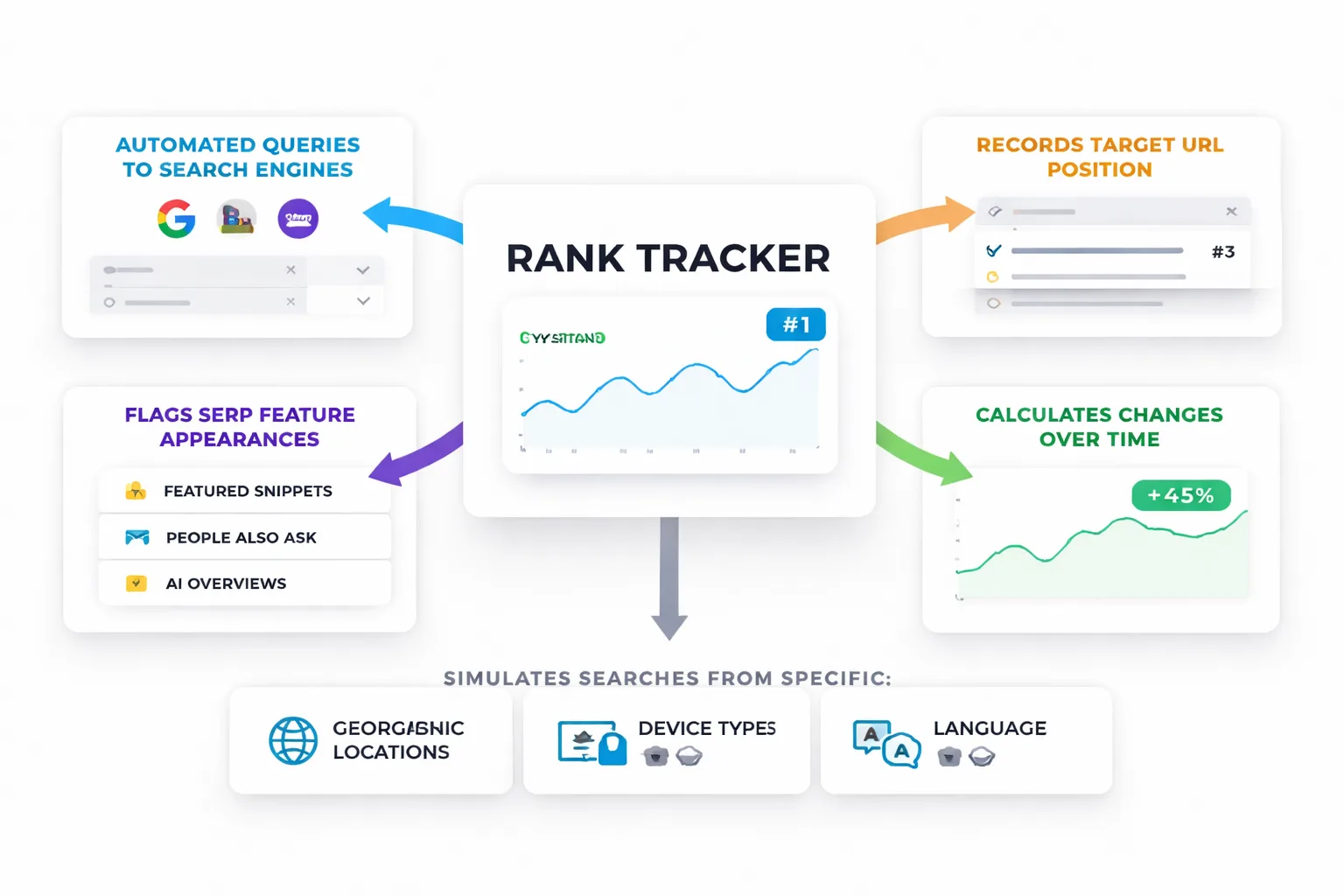
SEO rank tracking works by sending automated queries to search engines at regular intervals and recording where a target URL appears in the results. A rank tracker uses proxy networks to simulate searches from specific geographic locations, device types (desktop or mobile), and languages. The tracker stores each position, calculates changes over time, and flags SERP feature appearances like featured snippets, People Also Ask boxes, and AI Overviews.
The process sounds simple. The execution is messy. Google personalizes results based on search history, location, and behavioral signals, meaning the same query can return different rankings to different users. Bill Sebald of Greenlane argues that rank tracking as a primary SEO metric "stopped being fully valid years ago" because daily fluctuations make individual positions a moving target. He recommends looking at aggregate organic traffic instead.
The nuance matters. Aggregate traffic tells you what happened. Rank tracking tells you why it happened. If organic traffic drops 30%, you need to know whether a core keyword slipped from position 2 to position 7, or whether a competitor outranked you for a featured snippet. Traffic data is the outcome. Rank data is the diagnostic. Both are needed.
Modern trackers have adapted to the personalization problem by aggregating data across multiple geographies and reporting a normalized average. They also track SERP feature occupancy separately from organic blue-link positions, because appearing in an AI Overview or a featured snippet often matters more than your traditional rank. A page ranking in position 5 that also occupies the AI Overview will capture more clicks than a page ranking in position 2 with no SERP feature.
The technical architecture of a rank tracker involves several components working in concert. The keyword database stores the target queries, associated URLs, search intent classifications, and priority weights. The scheduling engine determines when each keyword is checked, balancing API costs against freshness requirements. The proxy network routes queries through IP addresses in target geographies, simulating local search conditions without triggering bot detection. The SERP parser extracts position data, identifies SERP features, and maps URLs to domains. The storage layer records each data point with a timestamp, enabling trend analysis. The reporting interface visualizes the data, flags anomalies, and exports to formats stakeholders can consume.
Each component introduces potential failure points. Proxy IPs get flagged and blocked by search engines, producing incomplete data. SERP parsers break when Google changes its HTML structure, which happens frequently without warning. Scheduling conflicts cause keywords to be checked at different times of day, introducing volatility that is not real. A good rank tracker handles these failures gracefully, retrying failed checks, updating parsers rapidly, and maintaining data integrity. A bad rank tracker silently reports stale or incorrect data, leading to wrong decisions.
Why Rank Tracking Still Matters in an AI Search World
Google processes billions of searches daily. Organic search remains the largest single driver of website traffic and ecommerce revenue. The data shows that organic search drives over half of all website visits and nearly a quarter of ecommerce orders. Rank tracking on Google is not obsolete. It is the foundation.
But the foundation has a new floor. AI search engines like ChatGPT (with over 800 million weekly users) and Google's Gemini app (surpassing 750 million monthly users) are building answers on top of the traditional SERP. When ChatGPT recommends a product, it is often grounding its answer in web pages that rank well for relevant queries. Ranking well on Google increases the probability that an AI engine will discover, trust, and cite your content. The two systems are linked, not separate.
The challenge is that AI citation is not a clean function of ranking. A page can rank number one organically and still be absent from the AI answer. This happens because AI engines prioritize different signals: entity clarity, structured data, source authority, and the way information is framed. A page that clearly defines a concept, uses schema markup, and is connected to a recognized entity in the knowledge graph is more likely to be cited than a page that simply ranks well for a keyword.
This is why rank tracking in 2026 must measure two things: traditional SERP position and AI visibility. The first tells you where you stand in the indexing system. The second tells you whether you are actually being surfaced in the answers buyers see. Tracking only the first is like tracking your inventory but never checking the storefront display.
Teams that adopt answer engine optimization alongside traditional rank tracking see a clearer picture of their actual market presence. They know their Google positions. They also know whether ChatGPT, Perplexity, and Google AI Overviews are citing their brand when buyers ask questions.
Consider a concrete example. A B2B SaaS company ranks in position 1 for "best project management software for remote teams." Their rank tracker reports this as a win. But when a potential customer asks ChatGPT the same question, the AI recommends three competitors, cites their pricing pages, and explains their feature differences. The company's rank tracker shows green. The AI answer shows red. Without AI visibility tracking, the team celebrates a position that is not generating recommendations. The gap between ranking and being recommended is where deals are won and lost.
The connection between ranking and citation is real but imperfect. Pages that rank in the top 3 are more likely to be retrieved by AI engines during their search-augmented generation process. But the AI engine also evaluates the content's clarity, structure, and entity definition. A page that ranks well but uses vague language, lacks structured data, and does not clearly define the product entity may be passed over in favor of a page ranking in position 6 that uses schema markup and explicitly defines its product features. Ranking gets you into the candidate pool. Entity clarity and content structure get you cited.
How Does SEO Rank Tracking Actually Work?
A rank tracker queries search engines at scheduled intervals using proxy-based crawlers, records the position of target URLs, detects SERP features, and normalizes the data across locations and devices to produce trend reports. The system replaces manual "incognito window" searches with automated, scalable, and geographically accurate data collection.
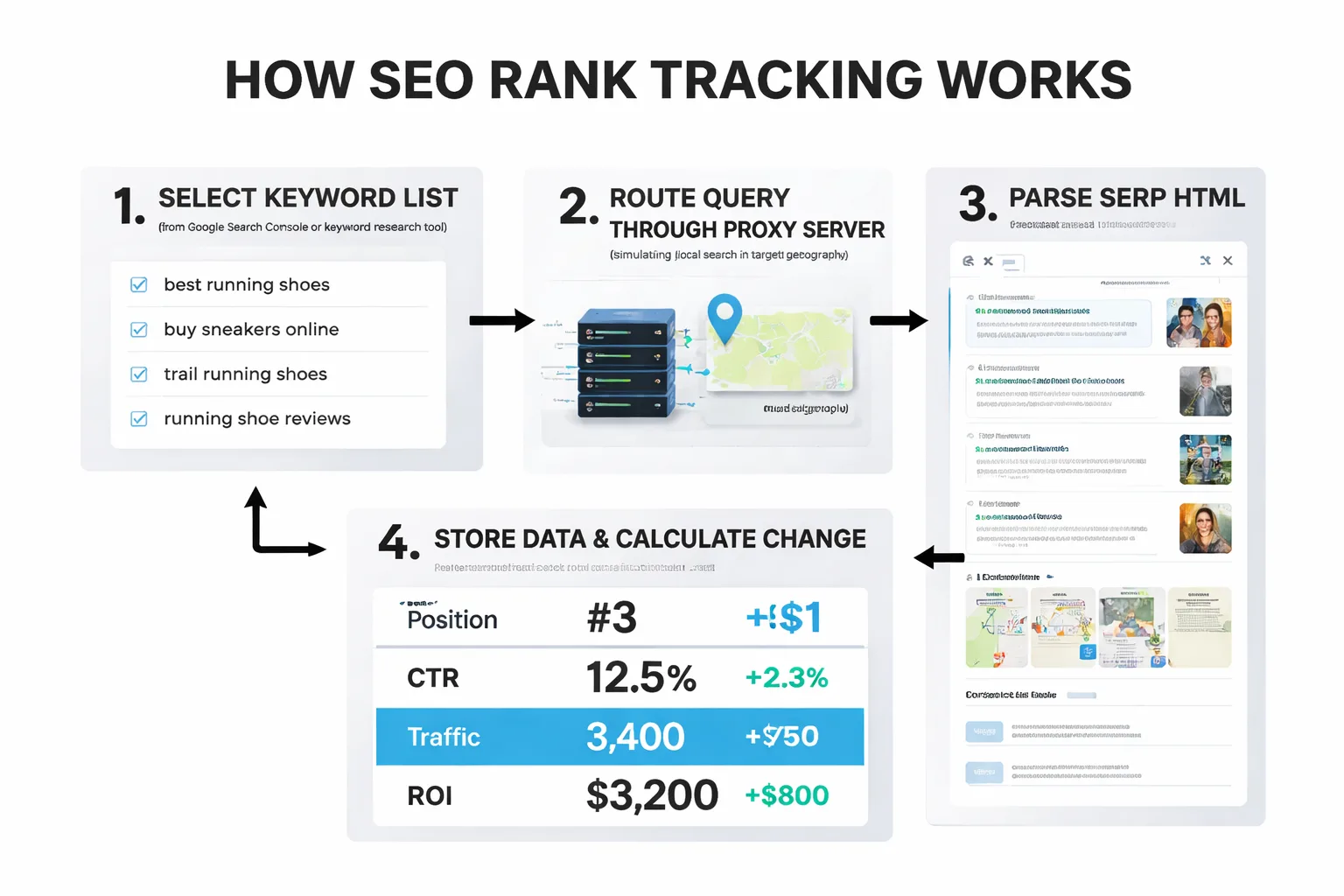
The mechanics break down into four stages. First, the tracker selects a keyword list (often pulled from Google Search Console or a keyword research tool). Second, it routes each query through a proxy server located in the target geography, simulating a local search. Third, it parses the SERP HTML to identify where the target domain appears, what SERP features are present (AI Overviews, featured snippets, People Also Ask, image packs, local packs), and which competitors occupy those features. Fourth, it stores the data point and calculates the change from the previous check.
The parsing stage is where modern trackers earn their keep. A good keyword rank tracker does not just report "position 4." It reports that you are in position 4 organically, that a competitor holds the featured snippet above you, that an AI Overview is present and does not cite your domain, and that a People Also Ask box occupies screen space below position 1. This layered data is what separates a useful tracker from a toy.
Geo-targeting adds another layer. A business in Chicago tracking "plumber near me" needs to see Chicago results, not results from a data center in Virginia. Trackers use city-level proxies to simulate local searches. Device simulation matters too: mobile results often differ from desktop results, and mobile-first indexing means the mobile SERP is the one Google actually uses to rank pages.
The frequency of checks matters. Daily tracking catches volatility. Weekly tracking smooths the noise. For most small teams, weekly is sufficient. For high-value commercial keywords where a single position change means real revenue, daily is justified. The key is consistency: tracking at the same interval, from the same location, on the same device type, produces comparable data over time.
SERP feature detection deserves deeper explanation because it is the area where most trackers fall short. A modern SERP for a commercial query is not ten blue links. It is a composite surface that may include an AI Overview at the top, a row of shopping ads, a featured snippet, a People Also Ask block with four expandable questions, a local pack with three businesses and a map, a video carousel, an image pack, and then the organic results below all of that. A tracker that reports "position 3" without telling you that an AI Overview, a featured snippet, and a local pack all sit above position 3 is giving you a number stripped of context. The actual click-through rate for position 3 in that scenario is closer to what position 8 used to be, because the user has to scroll past three SERP features to reach the organic results.
This is why SERP feature tracking is not a premium add-on. It is the core metric. When a tracker reports that a keyword has an AI Overview present, it should also report whether your domain is cited within that overview, whether competitors are cited, and what the overview says about your category. Without this layer, the tracker is measuring a SERP that no longer exists.
What Good Tracking Data Looks Like
Good rank tracking data tells a story. Bad data tells you nothing. The difference comes down to three things: what you track, how you read it, and what you ignore.
Track the 20% that drives 80% of value. Most SEO practitioners know the 80/20 rule applies to keywords. A site might rank for thousands of queries, but a small subset (typically commercial and transactional keywords with high intent) drives the majority of organic conversions. Tracking 500 keywords is useless if 400 of them are informational long-tails that never convert. Track the 100 that matter. Focus budget and attention on the keywords that map to revenue.
Separate branded from non-branded keywords. Branded keywords (your company name, product names) almost always rank number one if your site is functioning. They are vanity metrics. Non-branded keywords are where growth happens. A site that ranks well for branded terms but poorly for non-branded commercial terms is not growing. It is coasting on existing awareness. Good tracking data splits these two categories and prioritizes the non-branded set for optimization.
Read trends, not daily positions. Daily rank fluctuations are noise. Google's algorithm produces natural volatility. A keyword that drops from position 3 to position 6 on Tuesday and returns to position 3 on Thursday is not a problem. A keyword that trends downward over four weeks, losing one position every few days, is a problem. The trend line reveals the signal. The daily data point is a distraction.
Ignore vanity metrics. Average position across all tracked keywords is a number that sounds impressive in a report and means nothing. A site with an average position of 4.2 across 200 keywords is not winning if the 20 commercial keywords that drive revenue average position 12. Report on the keywords that matter, not the aggregate.
Monitor SERP feature occupancy. In 2026, the organic blue-link position is one of several ways to appear on the SERP. AI Overviews, featured snippets, People Also Ask, and local packs all capture clicks. A good tracker reports which features are present for each keyword and whether your domain occupies them. Losing a featured snippet to a competitor can cut traffic by 30% even if your organic position does not change.
The relationship between AI and search engine optimization means that tracking SERP features is no longer optional. AI Overviews are a SERP feature. If your tracker does not detect and report them, you are blind to one of the most consequential changes in search behavior.
A practical framework for reading rank data uses a four-week rolling average as the primary signal and daily positions as secondary context. If the four-week average for a keyword is trending upward, the daily positions do not matter. If the four-week average is flat but daily positions swing wildly, the keyword is in a volatile SERP where Google is testing different results. If the four-week average is declining, investigate immediately: check whether a competitor published new content, whether a SERP feature appeared that pushed organic results down, or whether an algorithm update affected the query category.
Tag keywords by intent category (informational, navigational, commercial, transactional) and track each category separately. A site might have strong informational rankings (driving traffic but not revenue) and weak commercial rankings (driving revenue but losing ground). Without intent tagging, the aggregate data hides this split. With intent tagging, the report immediately shows where to focus: the commercial set that is slipping.
Are you tracking where AI engines cite your competitors?
Rank Tracking vs. AI Visibility Tracking: Do You Need Both?
Yes. Traditional rank tracking measures where you appear in search results. AI visibility tracking measures whether AI engines cite your brand in generated answers. You need both because they measure different things.
A Semrush multi-platform study analyzed over 230,000 prompts and 100 million citations across ChatGPT, Google AI Mode, and Perplexity. The study found that a small set of domains dominate AI citations, but these domains differ from traditional SEO powerhouses. The sites that rank well on Google are not always the sites that AI engines cite. The correlation is positive but imperfect.
The study also found that 62% of AI citations are "ghost citations" where a site is cited without the brand being mentioned. This means a domain can be present in the AI answer without the user ever knowing it. For B2B teams, this is a critical gap. Being cited as a source is not the same as being recommended as a solution. A ghost citation provides zero brand awareness. It is the AI equivalent of a hidden link in the footer of a search result.
This is where the concept of framing becomes essential. An AI engine might cite a brand but frame it as a "good starting point" before recommending a more advanced competitor. The mention exists, but the narrative steers the user away. For B2B decisions, which are heavily narrative-driven, favorable framing matters more than raw mention count. A brand cited three times in positive context outperforms a brand cited ten times as an afterthought.
Traditional rank tracking cannot detect framing. It cannot detect ghost citations. It cannot tell you whether ChatGPT recommends your product or merely references your blog post as background reading. This is why AI visibility tracking is the necessary next layer.
Platforms like Meev layer both signals into one view. The system tracks traditional Google rankings alongside AI visibility across every major AI search surface. It shows where in each AI answer a brand appears (first mention, in a list, or last), what the actual response text says, and which sources the AI cited. This gives small teams the diagnostic power of rank tracking and the answer-engine intelligence of AI citation monitoring without running a full content operation.
For teams evaluating ai search engine optimization tools, the question is not whether to replace rank tracking with AI visibility tracking. The question is whether the tool provides both in an integrated view. Tracking one without the other gives a partial picture. Tracking both in separate tools creates context-switching overhead that small teams cannot afford.
The distinction between the two measurement systems comes down to what they observe. Traditional rank tracking observes a static SERP at a point in time. It tells you where your URL appears in a list of results. AI visibility tracking observes a generated response that is dynamic, conversational, and context-dependent. The same prompt can produce different answers depending on conversation history, follow-up questions, and the specific LLM version running. This makes AI visibility tracking inherently more variable than rank tracking, which adds complexity to measurement but also reflects the reality of how buyers research in 2026.
The AEO vs SEO framework clarifies the relationship. SEO optimizes for being found in search results. AEO optimizes for being cited in AI answers. Rank tracking measures the first. AI visibility tracking measures the second. A complete measurement strategy tracks both because a buyer's journey now spans both surfaces, often in the same session.
How to Choose an SEO Rank Tracker
Choosing a rank tracker in 2026 requires evaluating features that did not exist two years ago. The market has split. Traditional rank trackers report SERP positions. AI visibility platforms report LLM citations. A few tools attempt both. The evaluation criteria below apply to both categories.
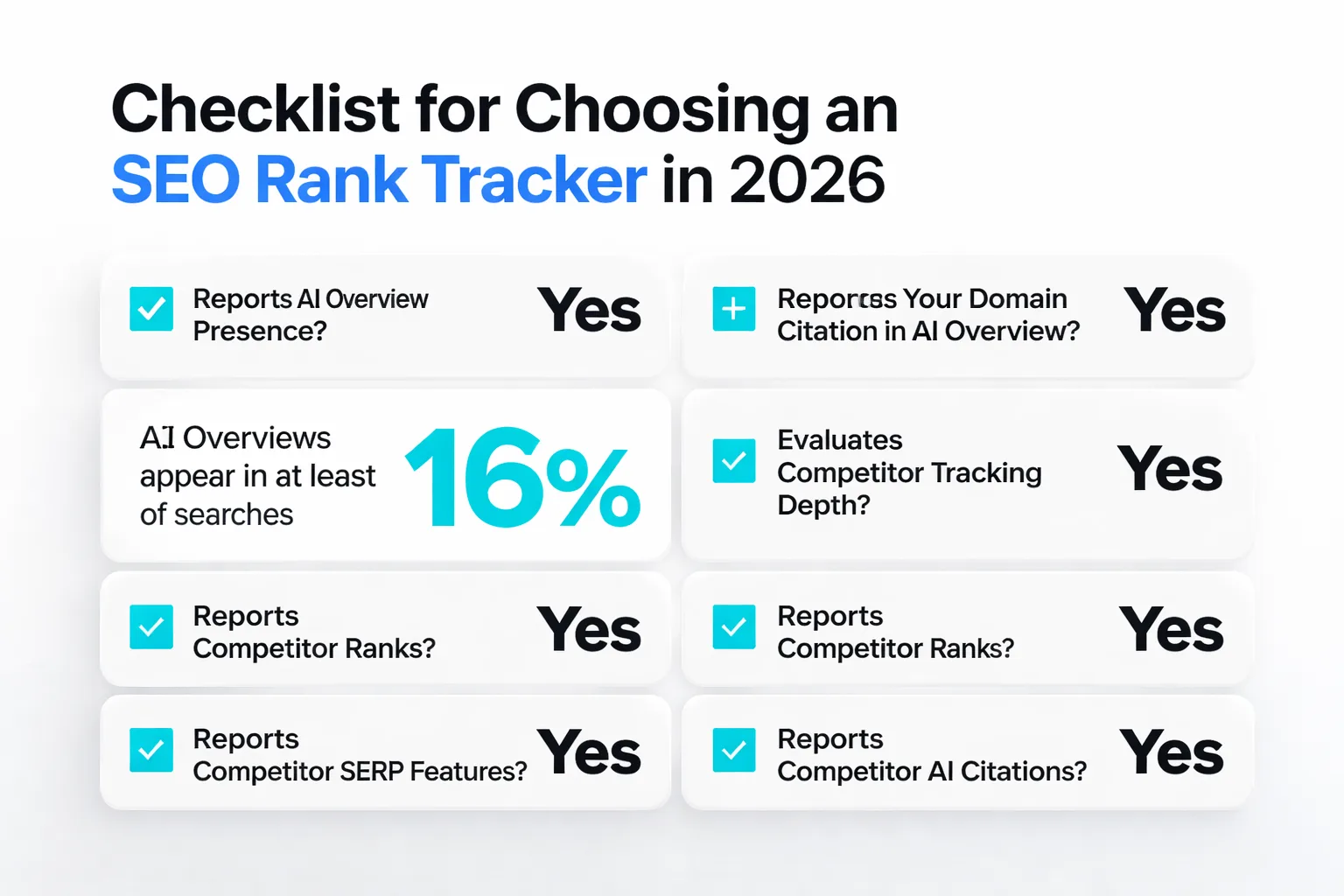
Check for AI Overview detection. If the tracker does not report whether an AI Overview is present for a tracked keyword and whether your domain is cited within it, the tool is incomplete for 2026 search. AI Overviews are a persistent SERP feature appearing in at least 16% of searches. A tracker that ignores them is like a weather app that does not show precipitation.
Evaluate competitor tracking depth. Knowing your own position is step one. Knowing where competitors rank, which SERP features they occupy, and whether AI engines cite them in the same prompts is step two. Competitor benchmarking reveals where you are losing and to whom. The best tools show share-of-voice across AI engines, not just Google positions.
Assess reporting and integrations. A tracker that produces data you cannot share is a tracker no one uses. Look for automated reporting (weekly digest emails, PDF exports), white-label options for agencies, and integrations with Google Search Console. The GSC integration is non-negotiable because GSC provides click and impression data that no rank tracker can replicate. The combination of rank position (from the tracker) and click-through rate (from GSC) is what reveals whether a position is actually driving traffic.
Consider the AI citation layer. For B2B teams, this is the differentiator. A platform that tracks AI visibility alongside traditional rankings provides a unified view of search and answer presence. Look for per-LLM drill-down dashboards, the ability to see the actual response text behind each mention, and sentiment or framing analysis. Without these, you are tracking the "what" but not the "so what."
A practical evaluation checklist for any rank tracking tool in 2026 should include these criteria. Does the tool track traditional organic positions with daily or weekly refresh? Does it detect SERP features including AI Overviews, featured snippets, People Also Ask, and local packs? Does it track AI citations across major LLMs including ChatGPT, Perplexity, Google AI Overviews, and Claude? Does it report competitor share-of-voice in AI answers, not just in Google positions? Does it offer geo-targeted tracking at the city or region level? Does it support device-specific tracking (mobile and desktop)? Does it integrate with Google Search Console for click and impression data? Does it provide reporting that stakeholders can consume without training? If the answer to any of these is no, the tool has a gap that will cost visibility in 2026.
The pricing model matters too. Some trackers charge per keyword, which penalizes teams for tracking more data. Others charge a flat fee with keyword limits. For small teams, a flat-fee model with generous keyword limits is preferable because it encourages tracking the full keyword set rather than rationing slots. For agencies managing multiple clients, per-domain pricing with multi-domain dashboards is more cost-effective than per-keyword pricing that scales unpredictably.
When Should You Track AI Citations?
Start tracking AI citations the moment your customers begin their buying journey with a question to ChatGPT or Perplexity. For most B2B SaaS companies, that moment is now.
The data is unambiguous. ChatGPT has become the number one referral source for Tally, a form builder that bootstrapped to $3M ARR. This is not a hypothetical future scenario. AI search is driving real business today. Companies that wait for the market to mature before tracking AI visibility will find that competitors have already established citation patterns that are difficult to displace.
The right time to start was six months ago. The second best time is now. Start with a baseline. Run prompts across ChatGPT, Perplexity, and Google AI Overviews for your top 20 commercial keywords. Record whether your brand is mentioned, where in the answer it appears, and what the framing says. This baseline becomes the benchmark against which all future content and optimization is measured.
For teams that already track rankings, adding AI citation monitoring is an extension, not a replacement. The keyword list is the same. The intent is the same. The surface is different. A good AI visibility tool uses the same keyword set to query AI engines and reports the results alongside traditional rank data.
The cadence of AI citation tracking differs from traditional rank tracking. Google SERPs change daily, so daily or weekly rank tracking makes sense. AI answers are generated fresh each time, but the underlying training data and retrieval sources change less frequently. Weekly or biweekly AI visibility checks are sufficient for most teams. The key is to track consistently over time, because AI citation patterns establish slowly and shifts are meaningful when they occur. A brand that goes from unmentioned to mentioned in ChatGPT responses for a commercial keyword has crossed a threshold that content investment should be evaluated against.
The Role of Entity Grounding and Knowledge Graphs
Entity grounding is the mechanism AI engines use to verify that a brand, concept, or product mentioned in an answer corresponds to a real, recognized entity. When ChatGPT writes about a company, it checks whether that company exists as an entity in its training data, in Wikidata, or in the live web sources it retrieves. If the entity is weakly defined, the AI is less likely to cite it confidently.
This means rank tracking in 2026 is not just about keyword positions. It is about entity presence. A brand that is well-defined in the knowledge graph, has a Wikidata entry with accurate attributes, and is consistently referenced across authoritative sources is more likely to be cited by AI engines. Entity grounding is the bridge between traditional SEO (ranking for keywords) and AI visibility (being cited in answers).
The practical implication is that rank tracking should expand to include entity monitoring. Does your brand appear as a recognized entity in Google's Knowledge Graph? Does Wikidata have a complete entry? Are your product attributes (pricing, features, integrations) consistently described across the sources AI engines retrieve? These are the new ranking factors.
Google's indexing philosophy reinforces this. Content-driven entity recognition is paramount. Pages that clearly define entities through structured data, internal linking, and consistent terminology are more likely to be indexed, ranked, and cited. A page that uses schema markup to declare "this is a software product with these features and this pricing" is more machine-readable than a page that describes the same information in prose.
Entity monitoring involves several concrete checks. First, search for your brand name on Google and see whether a Knowledge Panel appears on the right side of the SERP. If it does, Google recognizes your brand as an entity. If it does not, your entity presence is weak and needs strengthening through structured data, consistent NAP (name, address, phone) information across the web, and authoritative third-party references. Second, check Wikidata for a complete entry with accurate attributes (founding date, industry, product type, key people). Third, search for your brand in ChatGPT and Claude to see whether the AI recognizes your brand as an entity and can describe it accurately. If the AI describes your brand incorrectly or vaguely, the entity definition is weak and needs reinforcement through content and structured data.
The relationship between entity grounding and AI citation is causal. AI engines use entity recognition to disambiguate brands (is "Asana" the project management tool or the philosophical concept?). They use entity attributes to populate answers (what are Asana's key features, pricing tiers, and integrations?). A brand with a strong entity definition provides the AI with accurate, structured information it can cite confidently. A brand with a weak entity definition forces the AI to rely on whatever it can retrieve, which may be incomplete, outdated, or sourced from a competitor's comparison page.
Agentic SEO and the Future of Rank Tracking
The next frontier is agentic commerce. AI agents are beginning to make autonomous purchasing decisions on behalf of users. An AI agent tasked with "find the best CRM for a 50-person startup, compare pricing, and sign up for a trial" does not browse the SERP the way a human does. It queries multiple sources, evaluates entities, and makes a decision based on structured data and cited sources.
Traditional rank tracking breaks in this scenario. The agent does not click through to a page ranked in position 3. It retrieves information from cited sources, evaluates entity attributes, and acts. Rank position is irrelevant if the agent never visits the SERP. What matters is whether the brand is cited favorably in the sources the agent retrieves, whether the entity is well-defined, and whether the structured data supports a positive evaluation.
This is why AI visibility tracking is not a nice-to-have. It is the precursor to agentic SEO. Brands that are cited favorably by AI engines today are building the entity recognition and citation patterns that agentic commerce will rely on tomorrow. The Perplexity AI visibility checker and similar tools are not just measuring current performance. They are measuring readiness for a future where AI agents, not humans, are the ones evaluating your product.
The shift from human search to agentic search means rank tracking must evolve from measuring human-clickable positions to measuring machine-citable presence. The metrics change. The intent does not. The goal is still to be found and chosen. The path to that goal now runs through AI engines, knowledge graphs, and entity definitions.
Agentic commerce introduces a measurement problem that traditional rank tracking cannot solve. When an AI agent makes a purchasing decision, there is no human search session to attribute the conversion to. The agent retrieves information from multiple sources, synthesizes it, and acts. The conversion path is algorithmic, not human-driven. Rank trackers that scrape SERP results cannot capture this path because the agent never visits the SERP. The measurement gap is real, and it means that AI visibility reporting becomes the primary diagnostic tool for understanding how AI agents evaluate and select products.
For ecommerce teams, this shift is urgent. Ecommerce GEO and agentic commerce will reshape how products are discovered and purchased. An AI agent shopping for office furniture will retrieve product information, compare specifications, evaluate reviews, and place an order without a human ever visiting a search results page. The brands that win in this scenario are the ones whose product data is structured, complete, and consistently cited across the sources the agent retrieves. Rank tracking tells you whether your product page appears on Google. AI visibility tracking tells you whether an agent will find, evaluate, and choose your product.
Generative Engine Optimization and the New Ranking Surface
Generative engine optimization (GEO) is the practice of optimizing content to be cited by AI-generated answers rather than (or in addition to) ranking in traditional SERPs. The concept is distinct from traditional SEO because the optimization target is different. SEO optimizes for Google's ranking algorithm. GEO optimizes for the retrieval and citation mechanisms of LLMs.
The retrieval mechanisms that LLMs use are related to but distinct from Google's ranking algorithm. When Perplexity generates an answer, it retrieves web pages using its own search index, evaluates them for relevance and authority, and cites the most useful sources. The factors that influence retrieval include traditional SEO signals (domain authority, page relevance, link equity) but also include content structure, factual precision, and the presence of clearly attributable claims with sources. A page that makes specific, sourced claims is more likely to be cited than a page that makes vague general statements.
This means that generative engine optimization is not a replacement for SEO. It is a parallel optimization track that targets a different retrieval system. The content that ranks well on Google may not be the content that gets cited by AI engines, and vice versa. A comprehensive measurement strategy tracks performance on both surfaces.
For small teams, the practical implication is that content should be written to serve both retrieval systems. This means using clear headings, structured data, and sourced claims (which help AI engines cite the content) while also maintaining keyword relevance, internal linking, and mobile optimization (which help Google rank the content). The two systems reward overlapping but not identical signals, and content that satisfies both is more valuable than content that satisfies only one.
What This Actually Means
Rank tracking is not dead. It is being absorbed into a larger measurement framework. The teams that win in 2026 and beyond are the ones who track both the SERP and the AI answer, who understand that ranking well is the input and being cited favorably is the output, and who build content that serves both human readers and machine retrievers.
The practical path forward is straightforward. Keep tracking your Google rankings. Add AI visibility monitoring for the same keyword set. Monitor entity presence in the knowledge graph. Track competitor share-of-voice in AI answers. And write content that is fact-verified, clearly structured, and connected to recognized entities. The teams that do this will not just rank well. They will be the brands that AI engines recommend.
The transition from rank tracking to integrated search and answer visibility tracking is not a future prediction. It is a present requirement. Organic search drives over half of all website visits. AI Overviews appear in at least 16% of searches. ChatGPT has 800 million weekly users. Sixty-two percent of AI citations do not name the brand. These numbers describe a market where traditional rank tracking is necessary but insufficient. The teams that recognize this gap and close it will capture the attention of buyers who are increasingly starting their journey with a question to an AI, not a query to Google. SEO rank tracking, redefined to include AI visibility, is how that gap gets measured and closed.
FAQ
What is SEO rank tracking?
SEO rank tracking is the practice of monitoring where your web pages appear in search engine results for specific keywords over time. In 2026, this practice has expanded beyond traditional blue-link positions on Google to include visibility in AI-generated answers from ChatGPT, Perplexity, Google AI Overviews, and Claude. It now focuses on closing gaps between search rankings and actual brand mentions in AI responses.Why is traditional position tracking insufficient for modern SEO?
The conventional approach treats rankings as the finish line, but the real metric is whether an AI engine cites a brand favorably when a buyer asks a question. A number-one ranking means nothing if tools like ChatGPT skip the brand entirely and recommend competitors instead. This gap is especially dangerous for B2B teams where decisions increasingly happen in AI answers.How do AI Overviews and ghost citations affect rank tracking?
AI Overviews appear in at least 16% of all searches, and 62% of AI citations are ghost citations where a domain is cited without naming the brand. Rank tracking that ignores these elements misses where many purchasing decisions are now made. Modern tools must monitor both traditional positions and AI visibility to capture full performance.What role does organic search still play in 2026?
Organic search drives 53.3% of total website visits and 23.6% of ecommerce orders, keeping it central to traffic and revenue. However, strong rankings alone cannot protect against zero AI visibility, as shown in cases where category leaders are overlooked by tools like ChatGPT. Effective rank tracking combines both to reflect actual buyer influence.About the Author
Judy Zhou, Founder
Judy Zhou leads content strategy at Meev, where she oversees AI-driven content research and publishing for hundreds of brands. With a background in SEO and editorial operations, she focuses on building content systems that rank on Google, get cited by AI search engines, and drive measurable business results.
See exactly where your brand appears across every major AI search surface and close the citation gaps costing you customers.