

By Judy Zhou, Founder
Key Takeaways
- The lack of a standard term for AI search optimization forces buyers to cross-reference GEO, AEO, LLMO, and AIO tools from vendors selling identical features.
- Perplexity cites brand sites 47.4% of the time and Wikipedia 12.5% of the time, so the term you optimize for directly determines your citation sources.
- GEO targets generative engines like Perplexity while AEO targets answer engines and LLMO targets models that may not be search engines at all.
- Choose one label and stick to it when evaluating ai search optimization services, or you will miss comparable tools hidden under different acronyms.
Nobody agrees on what to call AI search optimization. And that confusion is costing brands citations.
What is AI search optimization called? The field goes by several names: GEO (Generative Engine Optimization), AEO (Answer Engine Optimization), AIO (AI Optimization), LLMO (Large Language Model Optimization), and AI search optimization itself. Each term emerged from a different community, targets slightly different surfaces, and carries different assumptions about what "optimization" even means in an AI-mediated search environment.
I've spent the last two years watching these terms multiply. In my work leading content strategy at Meev, where I oversee AI-driven content research across hundreds of brands, I've seen marketers and founders cycle through at least four labels for the same underlying practice. The result is a vendor landscape where two tools with identical features sell themselves under different terminology, and buyers can't comparison-shop because the category doesn't have a stable name.
Here's what the terminology confusion actually costs you. When you search for an ai search optimization agency or evaluate ai search optimization services, you're forced to cross-reference GEO, AEO, LLMO, and AIO tools because no two vendors use the same label. A Semrush study analyzing AI citation patterns found that Perplexity cites brand sites 47.4% of the time and Wikipedia 12.5% of the time, which means the source of your AI citations depends heavily on which engine's mechanics you're optimizing for. The term you choose implicitly selects which engine's mechanics you're optimizing for.
The deeper problem is that each term carries assumptions. GEO assumes the target is a generative engine (Perplexity, AI Overviews). AEO assumes the target is an answer engine that synthesizes multiple sources. LLMO assumes the target is a large language model that may or may not be a search engine at all. These aren't synonyms. They're different mental models for different AI surfaces, and choosing the wrong one means optimizing for the wrong citation mechanics.
What are the four dominant terms?
The taxonomy of AI search optimization terms breaks into four dominant labels, each with a distinct origin, target surface, and practitioner community. Understanding what each one actually means (not what vendors claim it means) is the first step to cutting through the noise.
Generative Engine Optimization (GEO) emerged from academic research, specifically the 2024 paper "GEO: Generative Engine Optimization" published on ArXiv. The term targets generative AI engines like Perplexity and Google AI Overviews that synthesize multiple sources into a single answer. GEO's practitioners focus on citation inclusion, content structure, and factual density. The academic origin matters because GEO carries an assumption that the target engine generates new text from multiple sources, which means optimization is about being one of those sources.
Answer Engine Optimization (AEO) predates GEO by several years. It originated in the SEO community around 2017-2018 as voice search and featured snippets became prominent. AEO's focus is broader than GEO: it targets any system that provides a direct answer rather than a list of links, including featured snippets, voice assistants, and AI-powered search results. The aeo vs seo distinction matters here because AEO assumes the practitioner is still working within a search engine's results page, even if the format has changed.
Large Language Model Optimization (LLMO) is the newest term and the most technically precise. It targets LLMs directly, meaning systems like ChatGPT, Claude, and Gemini that may or may not be connected to live search. LLMO's practitioners focus on training data presence, entity recognition, and knowledge graph inclusion. The term acknowledges that some AI systems cite sources (Perplexity, AI Overviews) while others generate answers from training data alone (ChatGPT without search, Claude without web access). What is AEO becomes a different question from "what is LLMO" because the latter assumes no live search retrieval at all.
AI Optimization (AIO) is the broadest and most commercially flexible label. It's used by vendors who want to avoid committing to any specific engine or retrieval mechanism. AIO covers everything from content optimization to brand mention tracking to entity grounding. The vagueness is both its strength and its weakness: it's inclusive enough to cover the full scope of AI search visibility work, but it's too imprecise to tell you what a tool actually does.
AI search optimization itself is the term I use most often because it's the most descriptive for practitioners. It tells you what you're doing (optimizing) and what you're doing it for (AI search). It doesn't carry the academic baggage of GEO, the legacy assumptions of AEO, or the vendor-flexibility of AIO. But it also doesn't tell you which AI surface you're targeting, which is why every practitioner eventually needs to get more specific.
How GEO, AEO, and LLMO Actually Differ
The three dominant terms aren't interchangeable. They target different AI surfaces, optimize for different citation mechanics, and require different content strategies. Here's how they actually differ.
What Does Each Term Optimize For?
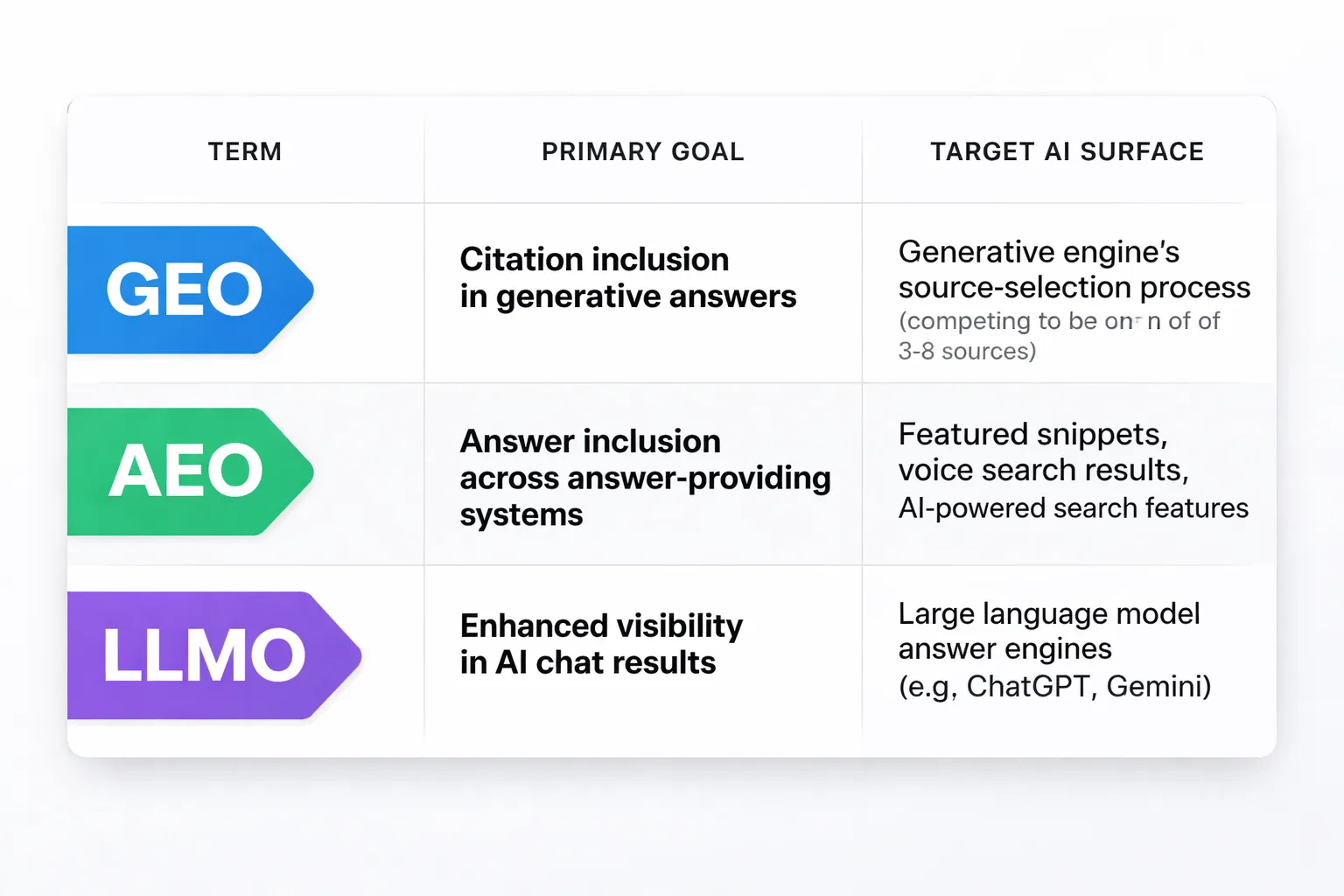
GEO optimizes for citation inclusion in generative answers. If you're working on GEO, your primary question is: "When Perplexity or Google AI Overviews generates an answer about my topic, does it cite my content as a source?" The optimization targets retrieval and ranking within the generative engine's source-selection process. You're competing to be one of the 3-8 sources a generative engine synthesizes.
AEO optimizes for answer inclusion across answer-providing systems. If you're working on AEO, your primary question is broader: "When any system provides a direct answer to a question about my topic, is my brand or content part of that answer?" This includes featured snippets, voice search results, and AI-powered search features. Answer engine optimization work targets the answer format itself, not just citation.
LLMO optimizes for model-level presence. If you're working on LLMO, your primary question is: "When an LLM generates text about my topic, does it reference my brand, products, or content?" This is about training data presence, entity recognition, and knowledge graph inclusion. The model may or may not cite a source at all. Perplexity's citation breakdown shows 47.4% of citations come from brand sites and 12.5% from Wikipedia, which means LLMO and GEO overlap significantly when a generative engine draws from both training data and live retrieval.
The distinction matters because each term implies a different measurement framework. GEO success looks like citation rate in generative answers. AEO success looks like answer inclusion across multiple answer formats. LLMO success looks like brand mention frequency and sentiment in model outputs, regardless of whether a citation is attached.
Which AI Surfaces Does Each Term Target?
GEO targets generative engines that synthesize multiple sources: Perplexity, Google AI Overviews, Google AI Mode. These engines retrieve content, rank it, and generate an answer that cites specific sources. The optimization is for the retrieval and ranking layer.
AEO targets a broader set of surfaces: Google featured snippets, voice assistants (Siri, Alexa), Google AI Overviews, and any system that provides a direct answer. The aeo vs geo distinction is that AEO includes non-generative answer surfaces (like featured snippets) while GEO is specific to generative synthesis.
LLMO targets LLMs regardless of whether they're connected to search: ChatGPT (with and without search), Claude, Gemini, and open-source models. The llm visibility tool category exists because LLMO practitioners need to track brand mentions across models that don't provide citation lists.
When Should You Use Each Term?
Use GEO when your primary target is Perplexity or Google AI Overviews and your success metric is citation rate in generative answers. This is the most common scenario for B2B brands and content publishers.
Use AEO when you need a broader umbrella that includes featured snippets, voice search, and AI-powered search results. This is the right term if you're reporting to leadership who still thinks in terms of "search results" rather than "AI answers."
Use LLMO when your primary target is LLMs that may not provide citations (ChatGPT without search, Claude without web access). This is the right term if your brand visibility depends on training data presence and entity recognition rather than live retrieval.
Use AI search optimization when you need a general-purpose term that covers all of the above. This is the right term for vendor evaluation, internal documentation, and cross-functional communication.
The Mechanics Behind AI Citations
Understanding the terminology is only useful if you understand what the terms are trying to influence. AI citations aren't magic. They're the output of specific retrieval and generation mechanisms that you can understand and, to some extent, optimize for.
How Do AI Search Engines Actually Cite Sources?
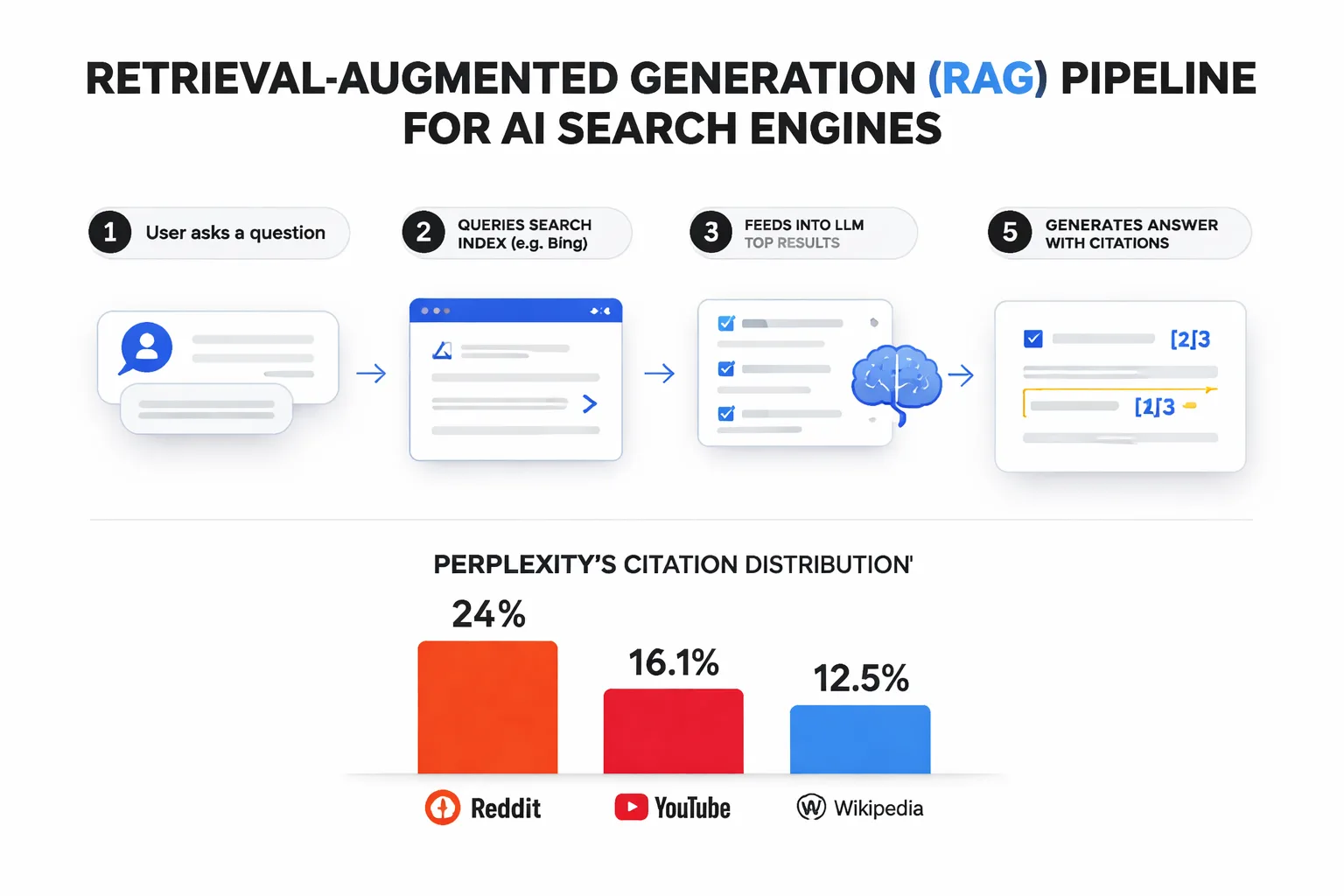
AI search engines like Perplexity and Google AI Overviews use a retrieval-augmented generation (RAG) pipeline. When a user asks a question, the engine queries a search index (often Bing or a proprietary index), retrieves top results, and feeds those results into an LLM that generates an answer with inline citations.
The citation you see in a Perplexity answer isn't the LLM choosing to cite you. It's the retrieval layer surfacing your content as a relevant source, and the generation layer deciding to include information from your content in its synthesis. Perplexity's citation distribution shows 24% of citations go to Reddit, 16.1% to YouTube, and 12.5% to Wikipedia, which means the retrieval layer's source preferences heavily influence which brands get cited.
This is why GEO and AEO work differently from traditional SEO. In traditional SEO, you optimize for a ranking algorithm that evaluates relevance, authority, and user experience. In GEO, you optimize for a retrieval layer that selects sources and a generation layer that synthesizes them. The retrieval layer behaves more like traditional search (it uses ranking signals), but the generation layer adds a second filter: it only cites sources whose content is actually useful for synthesizing an answer.
What Is Entity Grounding for AI Search?
Entity grounding is the process of ensuring AI systems can correctly identify and reference your brand, products, and key entities. It's the foundation that makes all the other optimization terms possible.
When AI systems lack entity grounding, they operate with what researchers call "misplaced confidence." According to entity resolution research from Senzing, when AI systems get entities wrong, every downstream step is corrupted: data ingestion merges or fragments identities, model training learns inaccurate patterns, and decision automation takes wrong actions. The outputs look smart but are fundamentally untrustworthy.
I've seen this firsthand. An AI agent might confidently write a query against the wrong product table because it confused SKU identifiers. A chatbot might reference the wrong past order because customer IDs were mismatched. A risk model might flag unrelated transactions because two similar customer names were merged into one entity. These aren't hypothetical edge cases. They're the predictable failure mode when entity grounding is neglected.
Starburst's research on agent grounding notes that enterprise teams building AI agents hit "the same wall at the same moment": prototypes work beautifully until entity confusion emerges. The discipline of deliberate entity-grounding architecture is new, and it's required to operate agents materially more accurately than competitors.
For AI search optimization specifically, entity grounding means ensuring your brand is correctly identified in knowledge graphs, structured data, and authoritative sources. This is where Wikidata and knowledge graph presence become critical.
Why Does Wikidata and Knowledge Graph Presence Matter?
Wikidata is the structured data backbone of Wikipedia and, by extension, a primary entity source for many AI systems. Wikimedia statistics show Wikidata contains approximately 120 million entries with 2.4 billion edits, and Wikipedia receives 25 billion monthly views across 300 languages. When an LLM needs to identify an entity (a company, a person, a product), Wikidata is often the first place it looks.
The IBM and Wikimedia partnership to make Wikipedia's knowledge base accessible to LLMs through Astra DB underscores this point. IBM's documentation notes that this integration unlocks Wikipedia's knowledge base for LLMs and AI developers, which means Wikidata presence directly influences how LLMs identify and reference your brand.
This is why entity grounding isn't optional. If your brand isn't correctly represented in Wikidata, knowledge graphs, and structured data sources, AI systems will either omit you, confuse you with another entity, or generate incorrect information about you. No amount of content optimization fixes an entity recognition problem.
Why the Terminology Matters for Tool Selection
The terminology confusion isn't just academic. It directly impacts how you evaluate and select ai search engine optimization tools. Vendors use different labels for the same capability, and the same label for different capabilities. Here's what to look for regardless of what a tool calls itself.
What to Look for in AI Search Optimization Software
The first thing to check is which AI surfaces a tool actually tracks. A vendor selling "GEO" should track Perplexity and Google AI Overviews at minimum. A vendor selling "AEO" should track a broader set including featured snippets and voice search. A vendor selling "LLMO" should track LLM outputs across ChatGPT, Claude, and Gemini. If a tool's marketing pages don't specify which surfaces it tracks, assume it tracks fewer than it implies.
The second thing to check is whether the tool tracks citation position, not just mention frequency. In my experience auditing content ops, I've found that an AI can cite your brand as a "good starting point" before suggesting a more "advanced" competitor, effectively funneling users away from you. A high mention rate with unfavorable framing is worse than no mention at all. This is why I no longer treat raw mention frequency as a reliable metric for B2B outcomes.
The third thing to check is whether the tool provides source attribution. When an AI cites your brand, can the tool tell you which page or content piece drove that citation? If not, you can't optimize because you don't know what's working. The ai visibility tracker category exists specifically to solve this problem.
The Vendor Label Problem
Vendors choose labels strategically. A vendor selling "AEO" might be positioning against SEO agencies who haven't updated their offerings. A vendor selling "GEO" might be positioning as more technically sophisticated than AEO tools. A vendor selling "AI Optimization" might be avoiding commitment to any specific surface because their tool only tracks one or two.
This is why the term doesn't matter as much as the capability. When evaluating an answer engine optimization tool, ask three questions: which AI surfaces does it track, does it track citation position and framing (not just mention frequency), and does it provide source attribution so you know what drove each citation? If the answer to all three is yes, the label doesn't matter.
The Real Cost of Choosing the Wrong Term
Choosing the wrong term doesn't just mean buying the wrong tool. It means optimizing for the wrong citation mechanics. If you choose "AEO" and optimize for featured snippets, you're not optimizing for Perplexity citations. If you choose "LLMO" and optimize for training data presence, you're not optimizing for live retrieval in AI Overviews.
The terminology matters because it determines your optimization strategy. And the strategy determines whether you get cited.
The Metrics That Define Success in AI Search Optimization
Regardless of which term you use, the metrics that define success are remarkably consistent across all naming conventions. Here are the KPIs that actually matter.
Citation Rate vs Mention Frequency
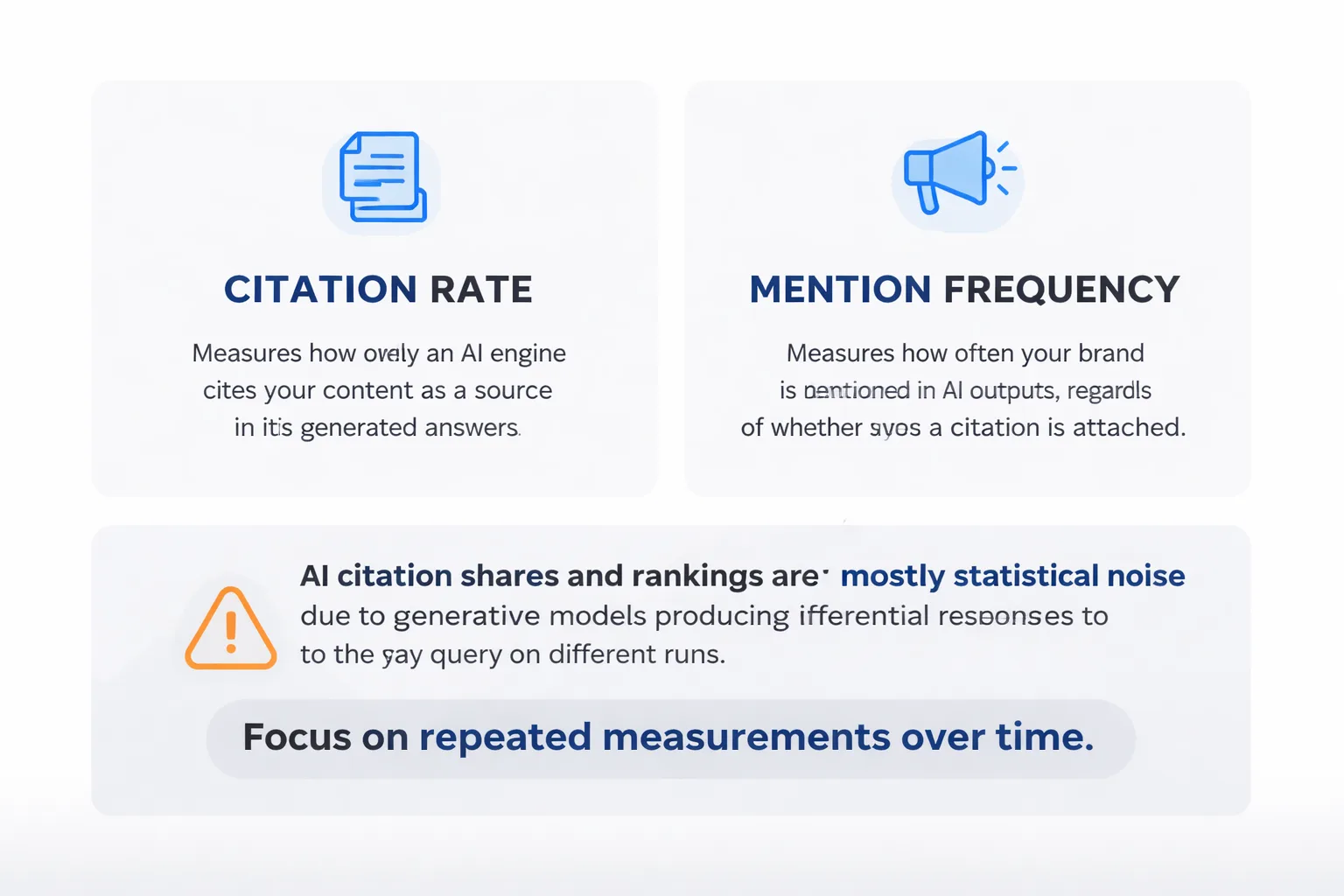
Citation rate measures how often an AI engine cites your content as a source in its generated answers. Mention frequency measures how often your brand is mentioned in AI outputs, regardless of whether a citation is attached. Both matter, but they measure different things.
Research from IQRush on AI visibility ranking stability found that AI citation shares and rankings are "mostly statistical noise" due to generative models producing different responses to the same query on different runs. This means a single measurement of citation rate is unreliable. You need repeated measurements over time to distinguish genuine competitive differences from measurement fluctuation.
This finding has practical implications. If you're comparing your AI visibility against a competitor on two different days and see a 15-point difference, that gap could be statistical noise rather than a real competitive disadvantage. Search Engine Journal's coverage of this research notes that no fixed amount of data can definitively settle AI visibility comparisons, which means benchmark dashboards can be misleading if you don't account for variance.
The solution is to track citation rate over time with enough sample volume to filter noise. A single prompt isn't a data point. It's an anecdote. You need dozens of prompts across multiple sessions to build a reliable picture of your AI citation performance.
Source Attribution and Citation Position
Source attribution tells you which of your pages or content pieces drove a citation. Citation position tells you where in the AI answer your brand appears (first mention, in a list, last mention). Both metrics are more actionable than raw citation rate because they tell you what to optimize.
I've seen brands celebrate a high citation rate only to discover that 80% of their citations come from a single blog post that's becoming outdated. Without source attribution, they wouldn't know which content to update, repurpose, or promote. The chatgpt ai visibility checker and similar tools exist to provide this granularity.
Citation position matters because of framing. As I noted earlier, an AI can cite your brand in position one with favorable framing, or cite you in position three as a "budget alternative" to a premium competitor. The position doesn't tell you the framing, but it's a leading indicator. If your citation position is dropping across multiple prompts, your framing is likely degrading too.
AI Overview Inclusion and Share of Voice
AI Overview inclusion measures whether your brand appears in Google's AI-generated search results. Share of voice measures what percentage of AI answers cite you versus competitors. Both are aggregate metrics that help you understand your competitive position.
Semrush's research on traditional SEO vs AI SEO notes that traditional metrics like rankings and organic traffic are insufficient for AI search reporting, which is why AI-specific metrics like share of voice and AI Overview inclusion are necessary. The perplexity ai visibility checker and similar tools focus on these aggregate metrics because they're more stable than individual citation measurements.
The Citation Collapse Problem
Here's where AI visibility reporting gets dangerous. Citation patterns can change overnight, and if you're not monitoring continuously, you lose visibility without knowing why.
Reddit's share of ChatGPT Search citations collapsed 86% in a single week, falling from 3.83% to 0.52% following ChatGPT's algorithm change on August 8, 2026. This wasn't a gradual decline. It was a sudden, platform-specific collapse that caught brands relying on Reddit for ChatGPT visibility completely off guard.
The mechanism was a shift in ChatGPT's search methodology. Promptwatch's analysis shows ChatGPT's use of the site: search operator jumped from approximately 0.4% to 17% of fanout queries on August 8, 2026, which fundamentally changed which sources ChatGPT retrieved and cited. Google AI Overviews and Google AI Mode showed only gradual declines in Reddit citations (11% and 30% respectively) over the same window, proving that citation collapse isn't universal across AI systems.
This is why continuous AI visibility reporting matters. A brand that checked its ChatGPT visibility on August 7 and didn't check again until August 15 would have missed an 86% citation collapse. Research on citation failure in LLMs from ArXiv documents how HTTP errors (404, 403, 5xx) prevent AI agents from accessing and citing content, directly reducing brand visibility in AI-generated responses. If your pages return errors when AI agents crawl them, you're invisible to AI search regardless of how well your content is optimized.
The lesson is that AI visibility isn't a set-it-and-forget-it metric. It requires continuous monitoring with daily or weekly refreshes, and it requires the ability to drill into individual AI surfaces because citation patterns don't move in lockstep across platforms.
Which AI surfaces are citing your brand right now — and which ones are citing your competitors instead?
Agentic SEO and the Evolution Toward Autonomous Optimization
The terminology conversation is evolving again. "Agentic SEO" and "agentic commerce" are emerging as the next frame for AI search optimization, and they carry different assumptions than GEO, AEO, or LLMO.
What Is Agentic SEO?
Agentic SEO refers to the use of AI agents that autonomously perform search optimization tasks: keyword research, content creation, technical auditing, and performance monitoring. The term shifts the focus from "optimizing for AI search" to "using AI agents to do SEO." It's a subtle but important distinction.
Research published on ArXiv describes AgenticGEO as a "self-evolving agentic system for generative engine optimization" that autonomously adapts to changes in AI search algorithms. The concept is promising but, notably, the research contains no conversion rate benchmarks or quantified business impact data. This is emerging thinking, not validated practice.
The practitioner community is still figuring out what agentic SEO means in practice. Shawn Basey, writing on LinkedIn about the evolution from SEO to GEO and AIO in e-commerce, acknowledges that "one day, we will all agree on definitions" but frames the current state as transitional. The terminology hasn't stabilized because the practice hasn't stabilized.
How Does Agentic Commerce Relate to AI Search Optimization?
Agentic commerce extends agentic SEO into transactional AI: AI agents that not only find products but purchase them on behalf of users. This is where ecommerce GEO and agentic commerce intersect with AI search optimization.
The connection is that agentic commerce requires the same entity grounding and knowledge graph presence as AI search optimization. If an AI agent can't correctly identify your product, it can't recommend or purchase it. Siteimprove's analysis of schema and AI search visibility notes that schema markup alone doesn't guarantee AI search visibility, which means entity grounding is necessary but insufficient without proper implementation across all the surfaces AI agents use to discover and evaluate products.
For ecommerce brands, this means AI search optimization isn't just about citations. It's about ensuring AI agents can correctly identify your products, match them to customer queries, and execute transactions without entity confusion. The stakes are higher because the failure mode isn't just "not cited" but "cited incorrectly" or "confused with a competitor's product."
Which Term Will Dominate by 2026?
Here's my contrarian take. None of these terms will dominate. The terminology will fragment further before it consolidates, and that's actually a good thing.
The reason is that AI search is not a single surface. It's a constellation of surfaces with different retrieval mechanisms, different citation patterns, and different user intents. Perplexity is a generative answer engine that cites sources. ChatGPT is an LLM that may or may not use search. Google AI Overviews is a search feature that synthesizes web results. Claude is an LLM with optional web access. Each of these requires a different optimization approach, and no single term captures all of them.
The IQRush research on AI visibility ranking stability reinforces this fragmentation. If citation patterns are "mostly statistical noise" across AI engines, then a single optimization framework (and by extension, a single term) can't capture the full picture. The metrics themselves are surface-specific, which means the terminology has to be surface-specific too.
What I expect to happen by late 2026 is that the terminology settles along surface lines rather than discipline lines. Instead of "GEO" or "AEO," practitioners will say "Perplexity optimization" or "AI Overviews optimization" or "ChatGPT visibility." This is more precise, more honest, and more useful for practitioners who need to communicate exactly what they're optimizing for.
The vendor landscape will resist this because surface-specific terminology makes it harder to sell broad-platform tools. But the practitioner community will adopt it because it matches the reality of how AI search actually works.
What This Actually Means for Your Strategy
The terminology debate is a distraction from the work that actually matters. Here's what to do regardless of what you call it.
First, track your AI visibility across every major AI search surface. Not just one. Not just the one your vendor of choice happens to support. All of them. Citation patterns diverge across platforms, and optimizing for one surface while ignoring others leaves you exposed to citation collapses like the one Reddit experienced.
Second, focus on entity grounding before content optimization. If your brand isn't correctly identified in Wikidata, knowledge graphs, and structured data sources, no amount of content will fix your AI visibility. Entity grounding is the foundation. Content optimization is the superstructure.
Third, track citation position and framing, not just mention frequency. A high mention rate with unfavorable framing is actively harmful. You need to know not just whether you're cited, but how.
Fourth, monitor continuously. Citation patterns can collapse overnight. A weekly check isn't enough for brands whose AI visibility directly impacts pipeline. You need daily refresh on SERP-driven surfaces and rolling refresh on LLM-driven surfaces.
Fifth, don't wait for the terminology to settle. The practice is real even if the name isn't. Semrush reports that 10 million marketing professionals use their platform for SEO and AI visibility tracking, which means the practice has already outpaced the terminology. The brands that win in AI search won't be the ones who picked the right term. They'll be the ones who did the work while everyone else was arguing about what to call it.
In my work at Meev, I've stopped worrying about which term wins. What I track is whether brands get cited across the AI surfaces their buyers actually use, whether the framing is favorable, and whether the entity grounding is solid. The term for that work is less important than the work itself. But if you need a label for the budget line, "AI search optimization" is the most honest, most descriptive, and most resistant to vendor rebranding. Use it until something better comes along. And something better will come along, because that's what always happens in this field.
FAQ
Is GEO the same as AI search optimization?
GEO (Generative Engine Optimization) is a subset of AI search optimization that specifically targets generative AI engines like Perplexity and Google AI Overviews. AI search optimization is the broader practice of optimizing for all AI-mediated search, including LLMs that may not generate answers from live retrieval. GEO is to AI search optimization what local SEO is to SEO: a specialized sub-discipline within a broader field.
Do I need different tools for AEO and GEO?
Not necessarily. The capability matters more than the label. If a tool tracks citation rate across Perplexity, Google AI Overviews, and ChatGPT, it covers both AEO and GEO use cases regardless of what it calls itself. The key question is whether the tool tracks the specific AI surfaces your buyers use, not whether the vendor labels it AEO or GEO.
How is AI search optimization different from traditional SEO?
Traditional SEO optimizes for ranking in a list of links. AI search optimization optimizes for citation inclusion and brand mention in AI-generated answers. The mechanics are different: traditional SEO targets ranking algorithms, while AI search optimization targets retrieval layers and generation layers that synthesize answers from multiple sources. The metrics are different too: traditional SEO tracks rankings and organic traffic, while AI search optimization tracks citation rate, mention frequency, and share of voice in AI answers.
What is the best term to use when reporting to leadership?
Use "AI search optimization" for leadership reporting because it's the most descriptive and resistant to vendor rebranding. If leadership needs more specificity, use surface-specific language: "Perplexity visibility" or "Google AI Overviews inclusion." Avoid acronyms (GEO, AEO, LLMO) in executive reporting because they require explanation and create confusion.
Will the terminology consolidate by 2026?
No. The terminology will fragment further before it consolidates because AI search is not a single surface. Each AI engine has different retrieval mechanisms and citation patterns, which means surface-specific terminology ("Perplexity optimization," "AI Overviews optimization") will become more common than discipline-specific terminology (GEO, AEO). The practice will outpace the terminology, and brands that focus on the work rather than the label will be ahead.
How often should I check my AI visibility?
At minimum weekly for brands where AI visibility directly impacts pipeline. For high-stakes B2B brands, daily refresh on SERP-driven surfaces (Google AI Overviews, Perplexity) and rolling refresh on LLM-driven surfaces (ChatGPT, Claude, Gemini) is ideal. Citation patterns can collapse overnight, as Reddit's 86% citation drop in ChatGPT Search demonstrated. Monthly checks are insufficient for any brand that treats AI visibility as a business-critical metric.
About the Author
Judy Zhou, Founder
Judy Zhou leads content strategy at Meev, where she oversees AI-driven content research and publishing for hundreds of brands. With a background in SEO and editorial operations, she focuses on building content systems that rank on Google, get cited by AI search engines, and drive measurable business results.
Stop guessing about your AI visibility. See exactly where your brand is cited, how it's framed, and what's closing the gap — across every major AI search surface.