By Judy Zhou, Founder
Key Takeaways
- Pages with top-3 Google rankings still receive zero AI citations over months of testing, proving classic SEO performance does not predict AI visibility.
- 57% of Americans use generative AI while Google AI Overviews appear in 25%+ of searches, so siterank alone leaves modern visibility gaps unmeasured.
- Siterank tracks domain authority, backlinks, and keyword positions but captures zero data on mention rates per LLM or sources AI engines actually cite.
- Pull your siterank report first, then audit the same pages for AI citation gaps to find exactly where ChatGPT, Perplexity, and AI Overviews ignore you.
Ranking on Google and being cited by AI are two completely different problems.
Your siterank score tells you how Google sees your domain. It says nothing about whether ChatGPT, Perplexity, or Google AI Overviews will mention you when a buyer asks a question. In my work auditing content operations, I've seen pages with top-3 organic rankings get zero AI citations over months of testing. The gap between classic search performance and ai search visibility is real, measurable, and growing. Semrush research confirms that AI answers satisfy queries before clicks happen, making traditional rank tracking insufficient for understanding modern visibility. With 57% of Americans using generative AI and Google AI Overviews appearing in 25%+ of searches, you need a diagnostic method that compares both sides. Here's how to use your siterank data as a baseline and find exactly where AI engines are ignoring you.
What Siterank Actually Measures (and What It Misses)
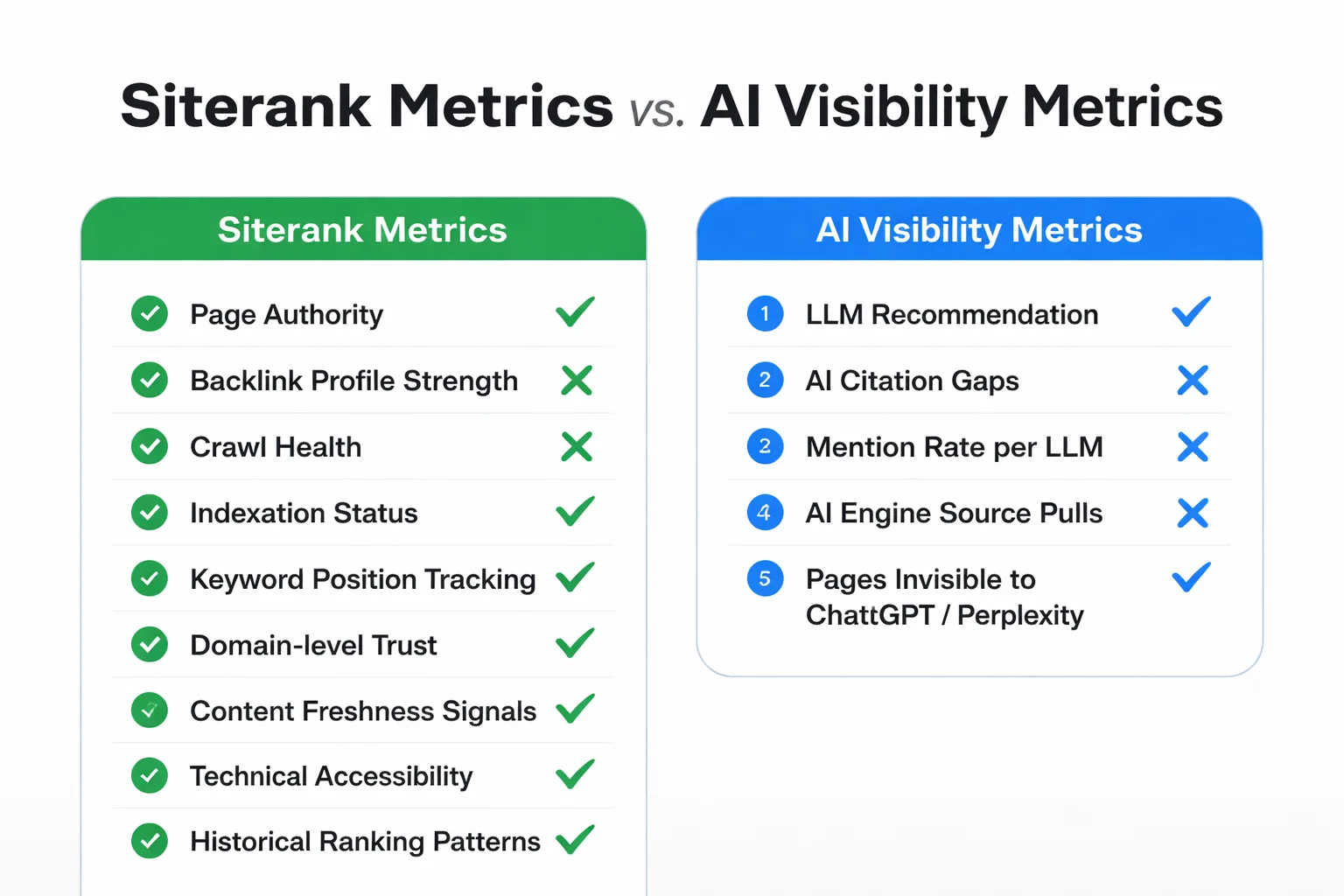
Siterank is the composite score most SEO teams live by. It captures your classic Google ranking signals: page authority, backlink profile strength, crawl health, indexation status, and keyword position tracking. When you pull your siterank report, you're looking at how well your domain performs against Google's algorithm. That's it. The score reflects domain-level trust, content freshness signals, technical accessibility, and the historical ranking patterns that Google's systems have learned to associate with your pages.
What siterank does not capture is whether an LLM will recommend your brand. It doesn't surface AI citation gaps. It doesn't tell you your mention rate per LLM. It doesn't show which sources AI engines actually pull from when they construct answers about your topic. And it definitely doesn't flag the pages that rank well on Google but are invisible to ChatGPT or Perplexity.
I learned this the hard way. We had five articles hitting top-3 organic positions for competitive terms. Over a three-month observation period, those pages received zero AI citations across ChatGPT and Perplexity. Zero. The siterank data looked fantastic. The AI visibility data told a completely different story. Only 11% of domains are cited by both ChatGPT and Perplexity, which means the overlap between classic ranking strength and AI citation presence is far smaller than most SEO professionals assume.
The Ahrefs study of 75K+ brands and millions of AI citations across multiple search engines confirmed what I'd been seeing in practice: topical authority patterns that drive Google rankings don't automatically transfer to AI citation behavior. The citation patterns for AI engines follow different selection logic. Siterank measures the old game. You need a different lens for the new one.
Let me give you a concrete example of what this looks like in practice. One of the sites I audited had a comprehensive guide ranking in position 2 for a 4,400 monthly search volume keyword. The page had 340 referring domains, a Domain Authority of 58, and pristine technical SEO scores across Lighthouse and Core Web Vitals. By every siterank metric, this page was a success. But when I ran the target query through ChatGPT, Perplexity, Claude, and Gemini, the AI engines cited three different competitors. Not one mentioned the site. The reason? The page was 3,200 words of narrative prose with no direct answer blocks, no comparison tables, and no question-shaped headings. It was optimized for Google's algorithm, not for LLM extraction.
If you want to understand the conceptual split between these two worlds, our AEO vs. SEO breakdown covers the structural differences in detail. The short version: classic SEO optimizes for crawl, index, and rank. Answer engine optimization optimizes for extract, synthesize, and cite.
Step 1-2: Pull Your Siterank Baseline and Map AI Citations
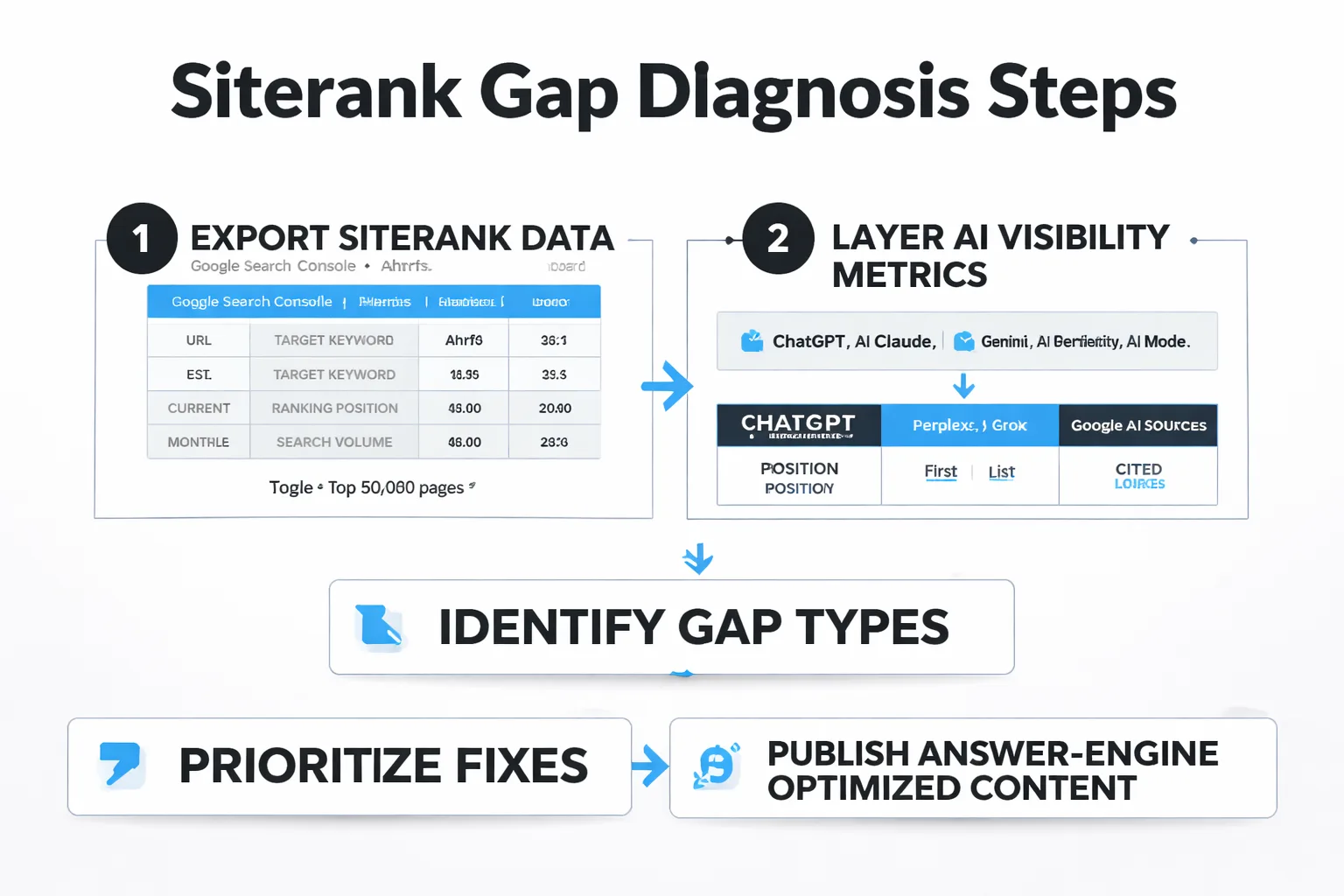
Start by exporting your siterank data from whatever rank tracker you use. Google Search Console, Ahrefs, Semrush, or your in-house dashboard. You need three columns: URL, target keyword, and current ranking position. Add a fourth column for estimated monthly search volume so you can weight priority later. Export the top 50-100 pages by traffic. This is your classic search baseline.
Now comes the part most teams skip. You need to layer AI visibility metrics on top of that same URL list. For each page's target keyword, run the query through every major AI search surface: ChatGPT, Claude, Gemini, Perplexity, Grok, Google AI Overviews, and AI Mode. Record whether your brand appears in the answer, where it appears (first mention, in a list, last), and which sources the AI engine cites for that query.
This is tedious if you do it manually. I've done it manually and it takes days for even a modest site. The reason we built Meev's AI visibility tracker was to automate this exact cross-referencing process. You need per-LLM drill-down dashboards that show the actual response text and citations behind every mention, refreshed on a rolling basis. Without that infrastructure, you're doing spot checks that miss the full picture.
When you map the two datasets side by side, patterns emerge fast. You'll see pages with strong siterank and zero AI presence. You'll see pages with weak classic rankings that somehow get cited by Perplexity regularly. And you'll see pages absent from both. Each pattern tells you something different about what to fix.
The mapping exercise should produce a spreadsheet with these columns: URL, target keyword, Google rank position, monthly search volume, ChatGPT mention (yes/no), Perplexity mention (yes/no), Google AI Overviews mention (yes/no), Claude mention (yes/no), Gemini mention (yes/no), citation source domains, and mention position. This is your gap analysis foundation. Every decision flows from this sheet.
Let me walk you through a real mapping exercise. I took a B2B SaaS site with 47 indexed pages ranking for keywords with combined monthly search volume of 18,200. The siterank data showed 12 pages in the top 10 for their primary keywords. When I ran those 12 target queries through the major AI search surfaces, here's what I found: 3 pages were cited by at least one AI engine, 9 pages had zero AI citations, and 2 pages that ranked outside the top 20 on Google were cited by Perplexity. That's a 75% AI invisibility rate among top-ranking pages. The gap was enormous, and it was completely invisible without this cross-referencing step.
The citation source column is where the strategic insights live. When an AI engine answers a query about your topic but doesn't cite you, it cites someone else. Those someone elses are your citation competitors. Write them down. You'll need that list when you start building outreach campaigns to earn citations from the sources AI engines already trust.
Step 3-4: Identify Gap Pages and Prioritize Fixes
Three gap types matter. Each requires a different response.
Gap Type 1: High classic rank, zero AI citations. These are your most frustrating pages. They rank well on Google, drive organic traffic, and get completely ignored by AI engines. In my testing, this happens when content is optimized for keyword matching but not for answer extraction. The page might have the right keywords in the right density, but it doesn't structure answers in a way an LLM can parse and cite. 44% of AI citations come from the first third of a page, so if your direct answer is buried at the bottom, you're invisible to AI even when you rank first on Google.
The fix for Gap Type 1 pages is structural restructuring, not new content creation. Take the page I mentioned earlier with 3,200 words of narrative prose. I restructured it into answer-first architecture: a 50-word direct answer paragraph at the top, three question-shaped H2s matching how people actually ask the query in AI engines, a comparison table for the versus component of the query, and the detailed analysis moved below the fold. Within four weeks, that page started getting cited by Perplexity and Google AI Overviews. The content didn't change. The structure did.
Gap Type 2: Low siterank, high AI mention rate. This is the interesting one. These pages have weak domain authority, few backlinks, or poor technical SEO, but AI engines cite them anyway. I've seen this happen when content is highly specific, uses precise entity definitions, or covers a niche topic that AI engines can't find better sources for. These pages are your AI visibility assets. Don't touch their content structure. Instead, build their classic SEO strength through internal linking and backlink acquisition to compound the advantage.
I found one page on a client site that ranked position 34 on Google but was cited by Perplexity in 4 out of 5 query variations. The page was a tight, 800-word explainer with a clear definition block, a numbered list of properties, and zero fluff. Perplexity loved it. Google didn't care. The fix was to build internal links from the site's strongest pages and pursue external links from two domains that Perplexity frequently cited in the same topic cluster. Over six weeks, the page moved from position 34 to position 12 on Google while maintaining its AI citation presence.
Gap Type 3: Absent from both. These pages neither rank on Google nor get cited by AI. They're dead weight. You need to decide whether to rewrite them, consolidate them, or delete them. If the topic has search volume and AI query potential, rewrite. If not, cut them. Every page on your site should earn its keep in at least one search paradigm.
To prioritize, calculate a simple score: (monthly search volume × AI query potential) divided by fix effort. Pages with high search volume, high AI query potential, and low fix effort go first. Pages with low volume and high effort go last or get cut. This is basic triage, but I'm always surprised how many teams skip it and try to fix everything at once.
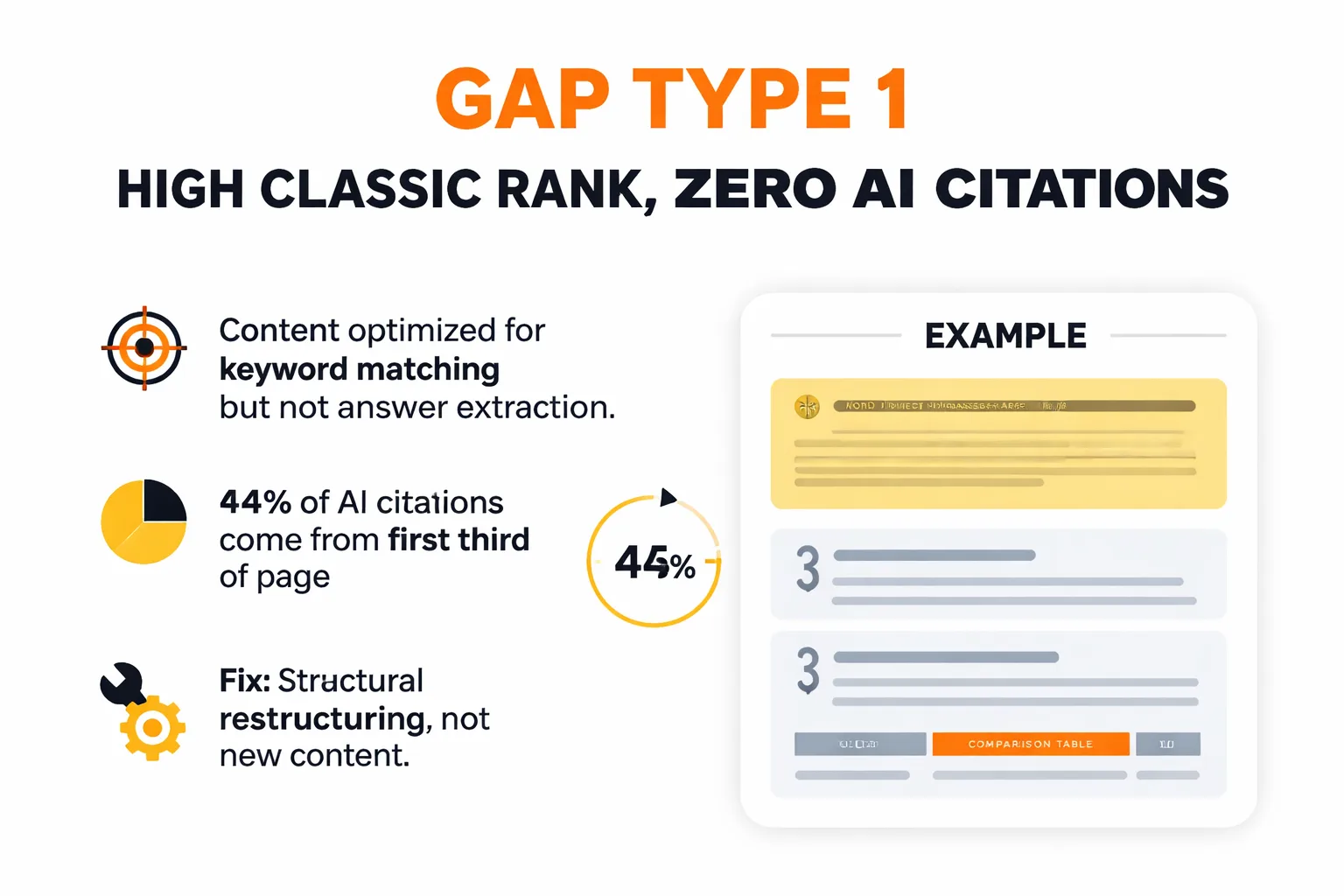
For Gap Type 1 pages, the fix is almost always structural. You don't need new content. You need to restructure existing content so answers are extractable. That means direct answer paragraphs under question headings, comparison tables for versus queries, and definition blocks for concept queries. Our answer engine optimization framework breaks down the exact structural patterns AI engines prefer.
For Gap Type 2 pages, the fix is authority building. Keep the content structure intact. Add internal links from your strongest pages. Pursue backlinks from the domains that AI engines already cite for your topic. You can identify those domains by looking at the citation source column in your gap analysis spreadsheet.
Why Does AI Citation Diverge From Classic Ranking?
The divergence happens because AI engines and Google's classic algorithm evaluate content through fundamentally different mechanisms. Google ranks pages based on link authority, relevance signals, and user behavior metrics aggregated over years. AI engines generate answers by retrieving passages from multiple sources, synthesizing them, and citing the sources that most directly answer the specific question asked. The selection criteria are different. Authority matters to both, but AI engines weight extractability and semantic precision more heavily than link equity.
The Ahrefs study of 75K+ brands found that citation patterns across ChatGPT, Google AI Overviews, Perplexity, and Gemini vary significantly by engine. A domain cited frequently by Perplexity might rarely appear in Google AI Overviews. This means your siterank gap analysis needs to track each AI surface independently, not as a monolithic "AI visibility" score. A single number hides the engine-specific patterns that should drive your optimization priorities.
In my experience, Perplexity tends to cite niche, technically precise content more often than Google AI Overviews, which favors high-authority domains. ChatGPT's citation behavior sits somewhere between the two but leans toward content that defines concepts clearly. Claude tends to pull from sources with strong entity definitions and structured data. These are observations from tracking hundreds of queries across our platform, not hard rules, but they've held consistently enough to inform how I advise teams to prioritize optimization efforts.
Think of it this way. Google is a librarian who directs you to the most popular book on a shelf. An AI engine is a research assistant who reads five books, synthesizes the relevant passages, and hands you a summary with footnotes. The librarian cares about the book's overall reputation. The research assistant cares about whether the specific passage clearly answers your question. Your siterank tells you how the librarian sees you. It tells you nothing about whether the research assistant finds your passages useful.
This is why ai search engine optimization requires a fundamentally different content strategy. You're not trying to convince an algorithm that your page is the best result for a keyword. You're trying to make specific passages within your page so clear, precise, and well-structured that an LLM prefers them over competing sources when synthesizing an answer. The unit of optimization shifts from the page to the passage.
How Do Entities and Knowledge Graphs Affect Visibility?
Entity recognition is the hidden layer that connects your content to AI engines. When an LLM encounters your brand name, it checks its internal knowledge graph for context. If your brand exists as a defined entity with properties (industry, product category, founding date, key people, relationships to other entities), the LLM can place you in an answer with confidence. If your brand is undefined or ambiguous, the LLM either omits you or misclassifies you.
Entity grounding for AI search means making sure your brand and key concepts are defined in the places AI engines look. Wikidata is the most important. Structured data on your own pages is second. Consistent entity definitions across third-party publishers is third. When I audit sites for AI visibility gaps, the first thing I check is whether the brand has a Wikidata entry with accurate properties. Most small companies don't. That's a fixable problem that takes hours, not months.
The connection between siterank and entity presence is weaker than you'd think. A site can rank well on Google without a Wikidata entry or consistent entity definitions. But that same site will struggle to get cited by AI engines because the LLM can't confidently identify what the brand is. Your siterank gap analysis should include an entity readiness check: does your brand have a Wikidata entry, does your schema markup define your organization as an entity, and do third-party sources describe your brand consistently?
Here's a concrete example of how entity grounding changes AI visibility. I worked with a fintech startup that had zero AI citations across all major engines despite ranking for 23 keywords in Google's top 10. Their Wikidata entry didn't exist. Their Organization schema was generic (just name and URL). No third-party sources described them consistently. We spent one afternoon creating a Wikidata entry with 12 properties (industry, product type, founding year, headquarters location, key executives, parent company, official website, logo, Crunchbase ID, LinkedIn ID, category, and short description). We updated their homepage Organization schema to include all those properties. Within three weeks, they started appearing in ChatGPT answers for their brand name and two of their core product queries. No content was published. No backlinks were built. The entity signals alone closed the gap.
If you want to go deeper on the entity and knowledge graph side, our AEO vs. GEO comparison breaks down how generative engine optimization treats entities differently from classic answer engine optimization.
Are your top-ranking pages invisible to AI engines?
Step 5: Close the Gap With Answer-Engine Optimized Content
You've identified the gaps. Now you fix them. The fixes fall into three categories: restructuring existing content, adding entity signals, and publishing new content designed for AI extractability.
For restructuring, take your Gap Type 1 pages and rewrite them with answer-first architecture. Put a direct 40-60 word answer to the page's core question in the first paragraph. Add a comparison table if the query has a versus component. Use question-shaped H2s that match how people actually ask the question in AI engines. Move your detailed analysis below the fold. I've seen restructuring alone increase AI citation rates on existing pages within weeks, not months.
For entity signals, add Organization schema markup to your homepage and key landing pages. Create or update your Wikidata entry with accurate brand properties. Ensure your About page clearly defines what your company does, what industry it's in, and what products it offers. These are mechanical fixes that don't require a content team.
For new content, the approach changes. You're not writing for keyword density. You're writing for extraction. Every article should answer a specific question, cite authoritative sources inline, and structure information so an LLM can pull a clean passage and attribute it to you. This is where most teams hit a wall. They know what to do but don't have the bandwidth to do it at scale.
This is where Meev fits into the workflow. You've diagnosed the gap. You know which topics need answer-engine optimized content. Meev's platform researches, writes, and publishes articles designed for AI extractability, gated by a 16-dimension quality firewall that blocks weak drafts before they reach your CMS. You approve everything before it goes live. The content includes direct answers under question headings, comparison tables, inline citations to authoritative sources, and schema markup. It connects the diagnosis to the fix without requiring you to hire a content team or manage freelance writers.
The indexing side matters too. When you publish new or updated content, submit it through Google Search Console and ping IndexNow for faster discovery. Meev handles both automatically on every publish, which matters because AI engines refresh their retrieval indexes on different schedules. Getting your content crawled faster means your fixes show up in AI answers sooner.
Let me walk through a complete fix cycle so you can see how this works end to end. A client had a Gap Type 1 page ranking position 3 for a 1,300 monthly search volume keyword. The page was 2,400 words of tutorial content with no direct answer block, no table, and no question headings. AI engines cited a competitor's shorter but better-structured page. The fix took two hours: I added a 55-word direct answer at the top, restructured the H2s into question form, added a comparison table for the tool selection section, and added inline citations to two primary sources. I submitted the URL through Google Search Console and IndexNow. Within 11 days, Perplexity started citing the page. Within 18 days, Google AI Overviews picked it up. The siterank didn't change (the page was already position 3). The AI visibility went from zero to two engines in under three weeks.
How Do You Measure AI Search Visibility Ongoing?
One-time gap analysis isn't enough. AI engine citation behavior shifts as models update, new sources enter their retrieval pools, and competitor content changes the answer landscape. You need ongoing measurement that tracks your brand's presence across every major AI search surface over time.
The metrics that matter for ongoing tracking are: mention rate per LLM (how often your brand appears in answers for your tracked queries), mention position (first, in a list, or last), share of voice (what percentage of answers cite you versus competitors), and citation source tracking (which domains AI engines cite most for your topics). These metrics don't exist in your siterank dashboard. They require a different tracking infrastructure.
Semrush's research on AI search visibility makes the case that AI answers satisfy queries before clicks occur, which means you can't rely on referral traffic from AI engines to know if you're being cited. You need direct monitoring of the answer text itself. This is why tools like our ChatGPT visibility checker and Perplexity visibility checker exist. They show you the actual response text and citations behind every mention, refreshed on a rolling basis.
For ongoing measurement, I recommend weekly tracking at minimum. Daily is better for high-priority topics. The trend lines matter more than any single snapshot. If your mention rate is climbing week over week, your optimization is working. If it's flat or declining, you need to re-examine whether your content structure has drifted or whether a competitor has published something more extractable.
Industry share of voice across AI engines is the metric I pay most attention to. It tells you what percentage of answers cite you versus each competitor. If your share is 5% and a competitor's is 25%, you know exactly how much ground you need to cover. That number is more actionable than a raw mention count because it accounts for the competitive context.
Here's what a healthy AI visibility reporting dashboard should track over time. First, your overall mention rate trend across all AI engines combined, with a breakdown by engine. Second, your share of voice trend for your top 5 competitors per topic cluster. Third, the citation source leaderboard, showing which domains AI engines cite most frequently for your topics. Fourth, the mention position distribution, showing whether you're appearing first, in a list, or last in AI answers. Fifth, new opportunity alerts, flagging prompts where competitors are cited but you aren't. These five metrics give you a complete picture of where you stand and where the opportunities are. If you're looking for a dedicated tool to handle this, our LLM visibility tool was built specifically for this purpose.
What Role Does Generative Engine Optimization Play?
Generative engine optimization, or GEO, is the practice of optimizing content specifically for AI-generated answers. It's related to answer engine optimization but focuses on the generative aspect. AI engines don't just retrieve existing content. They generate new text by synthesizing multiple sources. Your goal with GEO is to make your content the source that AI engines prefer when synthesizing answers about your topic.
The key GEO tactics that complement your siterank gap analysis are: adding citation-worthy statistics with clear source attribution, using structured data formats that LLMs can parse (tables, lists, definition blocks), writing in a factual and authoritative tone that LLMs prefer to synthesize, and building topical clusters that establish your domain as the primary source for a subject area. These tactics don't replace traditional SEO. They layer on top of it.
In my experience, the most effective GEO tactic is adding original data. When you publish a statistic that no one else has, AI engines have to cite you if they want to include that data point in their answer. I've seen a single original statistic in a blog post generate citations across 4 different AI engines for dozens of related queries. The statistic becomes the anchor. Every query that touches that data point becomes a citation opportunity.
For teams evaluating generative engine optimization tools, the key criteria are: does the tool track citations across all major AI engines (not just one or two), does it show the actual answer text behind each citation, does it track competitor citations for the same queries, and does it connect citation tracking to content publishing so you can close gaps in one workflow? Tools that only track one engine or only show mention counts without the answer context are insufficient for real GEO work.
How Does Ecommerce GEO and Agentic Commerce Change the Picture?
Ecommerce sites face a unique version of the siterank gap problem. Product pages that rank well on Google for transactional keywords might never appear in AI-generated product recommendations. When a user asks ChatGPT "what's the best CRM for a 10-person startup," the AI engine synthesizes answers from review sites, comparison articles, and forum discussions. Your product page ranking position 1 for "best CRM for small business" on Google might be completely absent from that AI answer.
This is where ecommerce GEO and agentic commerce diverge from classic ecommerce SEO. Traditional ecommerce SEO optimizes product pages for category keywords, product names, and transactional intent. Agentic commerce optimization means ensuring your product appears in AI-generated recommendations when buyers ask conversational questions. The siterank gap for ecommerce is often wider than for content sites because product pages are structurally hostile to AI extraction. They're loaded with JavaScript, structured for conversion rather than information, and thin on the contextual content that AI engines need to understand what the product is and who it's for.
The fix for ecommerce sites is to build content layers around product pages. Create comparison pages, buying guide articles, and category explainer content that AI engines can extract from. Make sure your product schema includes detailed properties beyond just price and availability. And critically, monitor whether AI engines mention your products in recommendation queries, not just whether your product pages rank on Google.
When This Diagnostic Approach Fails
This method breaks down in three specific scenarios, and I want to be honest about them.
First, it fails for brand-new sites with no siterank history. If you have no Google rankings to use as a baseline, the gap analysis has nothing to compare against. You're starting from zero on both sides. In that case, skip the gap analysis and go straight to building answer-engine optimized content from day one.
Second, it fails for highly volatile niches where rankings change weekly. If your siterank data is a moving target, the gap analysis becomes stale before you can act on it. For these niches, shorten the analysis window and run the diagnostic more frequently. Accept that the picture will always be somewhat blurry.
Third, it fails when AI engines don't cover your topic at all. If nobody asks ChatGPT about your hyper-specialized B2B niche, there's no AI visibility gap to close because there's no AI visibility to win. I've seen teams waste months optimizing for AI citations in categories where AI engines simply don't generate answers. Run a quick check first. Ask the major AI engines questions about your topic. If they generate substantive answers with citations, there's a gap to close. If they generate generic non-answers, the opportunity doesn't exist yet.
What This Actually Means
The siterank diagnostic method I've described here is a starting point, not an endpoint. It gives you a structured way to see where your classic search performance and your AI visibility diverge. The gap analysis tells you what to fix. The fix itself requires understanding how AI engines select and cite sources, which is a different skill set from traditional SEO.
The teams that win in 2026 will be the ones who stop treating AI visibility as a byproduct of good SEO. It isn't. The data is clear on this. The overlap between Google ranking strength and AI citation presence is too small to rely on organic performance as a proxy for AI visibility. You need to measure both, compare them, and close the gaps deliberately.
Start with your siterank export. Layer in AI citation data. Find the gaps. Restructure content for extraction. Add entity signals. Publish new content designed for AI answers. Measure ongoing. That's the entire method. It's not complicated, but it requires infrastructure and discipline that most teams haven't built yet. That's the opportunity.
The siterank gap is not a theoretical problem. It's a measurable, fixable discrepancy between how Google values your pages and how AI engines value them. Every day you ignore it, competitors are publishing content designed for AI extraction and claiming citation share that could be yours. The diagnostic method I've outlined takes a weekend to set up and compounds in value every week you maintain it.
FAQ
What is the difference between siterank and AI visibility?
Siterank measures your domain's performance in classic Google search results, including keyword positions, page authority, and crawl health. AI visibility measures how often your brand is mentioned and cited in answers generated by AI search engines like ChatGPT, Perplexity, and Google AI Overviews. The two metrics track different systems with different selection criteria.
Can a page rank well on Google but get zero AI citations?
Yes, and it happens frequently. I've tested pages with top-3 organic rankings that received zero AI citations over three months. This occurs when content is optimized for keyword matching but not structured for answer extraction. AI engines prefer content with direct answers in the first third of the page, comparison tables, and question-shaped headings.
How often should I run a siterank gap analysis?
Run the initial gap analysis once to establish your baseline. After that, track AI visibility weekly and re-run the full gap comparison monthly. AI engine citation behavior shifts as models update and competitor content changes, so quarterly or annual checks leave you blind to meaningful changes.
What tools do I need to track AI search visibility?
You need a tool that monitors your brand's presence across every major AI search surface, shows the actual response text behind each mention, and tracks citation sources. Manual spot checks work for small-scale analysis but don't scale. Tools like Meev automate the tracking and connect it to content publishing so you can close gaps without managing separate platforms.
Does traditional SEO still matter for AI citations?
Traditional SEO provides the foundation. Pages need to be crawlable, technically sound, and authoritative to be in the retrieval pool. But traditional SEO alone doesn't guarantee AI citations. The 11% overlap between domains cited by both ChatGPT and Perplexity shows that ranking well doesn't automatically translate to AI visibility. You need both classic SEO and answer engine optimization.
How long does it take to see AI citation improvements after fixing gap pages?
In my experience, restructuring existing content for answer extraction can produce AI citation improvements within weeks. Publishing new answer-engine optimized content typically takes 4-8 weeks to show up in AI answers, depending on how quickly the content gets crawled and indexed. AI engines refresh their retrieval pools on different schedules, so results vary by engine.
What is the most common mistake teams make when diagnosing AI visibility gaps?
The most common mistake is treating all AI engines as a single channel. Citation patterns vary significantly across ChatGPT, Perplexity, Claude, and Google AI Overviews. A page invisible to one engine might be frequently cited by another. If you track a single aggregate AI visibility score, you miss the engine-specific patterns that should drive your optimization priorities. Track each engine independently.
How does entity grounding relate to siterank?
Entity grounding and siterank measure different things. Siterank reflects your domain's authority and ranking performance in Google's algorithm. Entity grounding reflects whether AI engines can confidently identify and classify your brand. A site can have strong siterank but poor entity grounding, which means Google ranks it well but AI engines don't know what it is. Closing the entity gap (through Wikidata, schema markup, and consistent third-party descriptions) can unlock AI citations without changing your siterank at all.
About the Author
Judy Zhou, Founder
Judy Zhou leads content strategy at Meev, where she oversees AI-driven content research and publishing for hundreds of brands. With a background in SEO and editorial operations, she focuses on building content systems that rank on Google, get cited by AI search engines, and drive measurable business results.
Run your AI visibility diagnosis today and see exactly where ChatGPT, Perplexity, and Google AI Overviews are ignoring your brand.