
By Judy Zhou, Founder
Key Takeaways
- The overlap between top Google results and AI-cited sources has fallen below 20%, so first-page Google rankings no longer guarantee citations in ChatGPT or Perplexity.
- Only 11% of domains are cited by both ChatGPT and Perplexity, proving classic SEO metrics miss the new visibility battlefield.
- Google AI Overviews now trigger in 25%+ of searches while 57% of Americans use generative AI regularly, requiring siterank audits that track AI citation rate alongside traditional positions.
- Export a siterank baseline report that measures classic rankings, AI citation frequency, and entity signals before labeling any page as weak.
Your worst-performing pages are not the ones with the lowest Google rankings. They are the ones your siterank data marks as AI-invisible. Traditional SEO metrics will not show you this problem, and neither will your existing rank tracker. The entire framework of "fix thin content and rankings will follow" breaks down in a generative engine world, where LLMs cite based on entity grounding, knowledge graph presence, and structured authority signals that most page-level audits completely ignore. Siterank changes what weak actually means.
I have spent the last two years building content systems at Meev, and the data I review daily forces a hard conclusion. The overlap between top Google results and AI-cited sources has plummeted to under 20% by some estimates. You can rank first for a term and still get zero citations in ChatGPT or Perplexity. Only 11% of domains are cited by both ChatGPT and Perplexity, which suggests a massive divergence from classic search engine optimization. Google AI Overviews now appear in 25%+ of searches, and 57% of Americans use generative AI regularly. If your page audit ignores these surfaces, you are flying blind.
Generative engine optimization is no longer optional. It is the practice of making your content extractable by answer engines. If your current search engine ranking reporting only tracks blue-link positions, you are missing the actual battlefield. Answer engine optimization requires a totally different diagnostic lens.
How to pull your Siterank baseline report?
Start by exporting your current visibility data. You need a snapshot of where your domain stands across both classic search and AI surfaces before you can fix anything. This is your baseline.
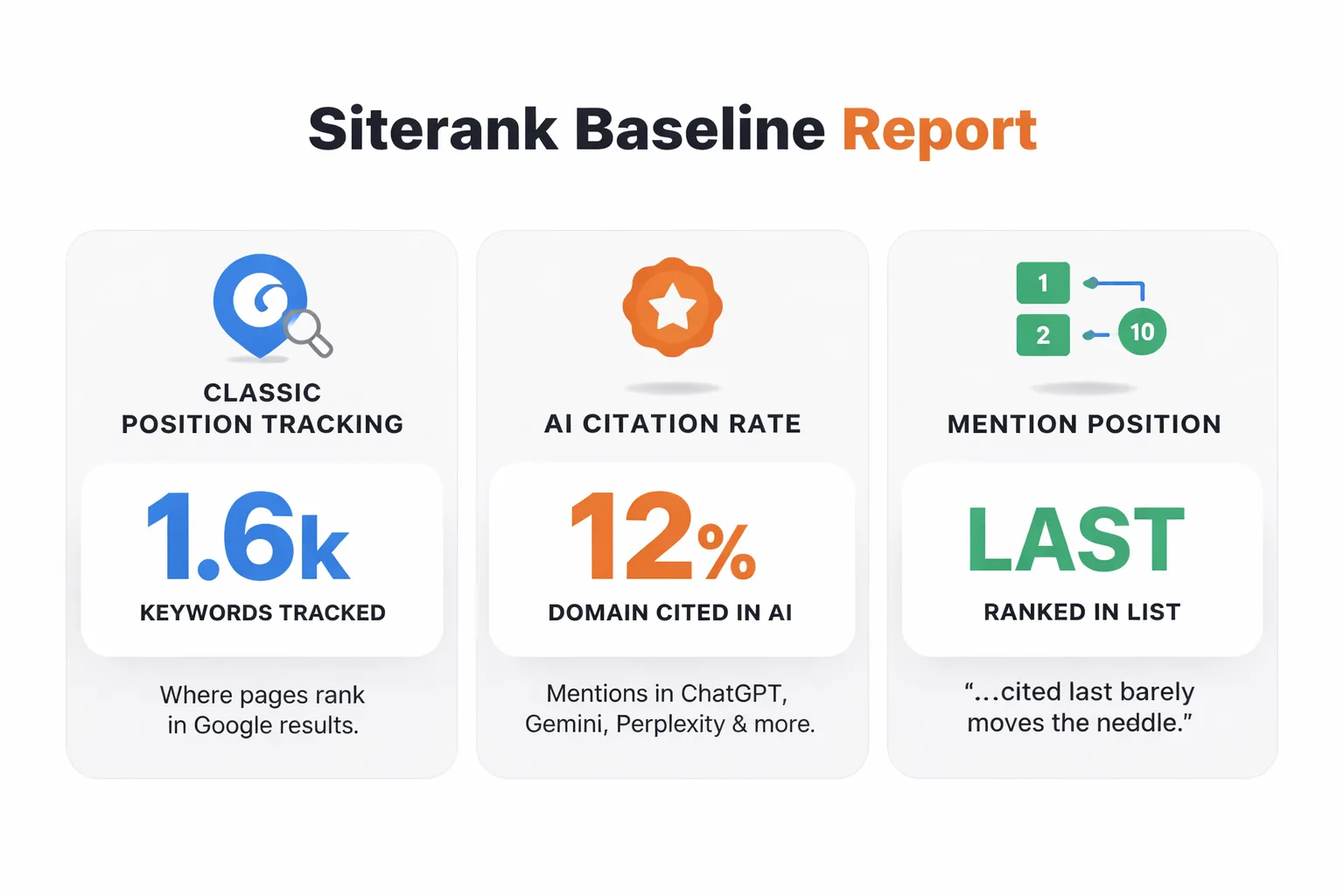
A proper siterank report must capture three metric categories. First, classic position tracking: where your pages rank for target keywords in standard Google results. Second, AI citation rate: how often your domain appears as a cited source in responses from ChatGPT, Claude, Gemini, Perplexity, Grok, and Google AI Overviews. Third, mention position: whether your brand appears first, in a list, or last within an AI-generated answer. That last one matters more than people realize. Being cited last in a list of ten competitors barely moves the needle for referral traffic.
What does a healthy baseline look like for a small-team site? Forget the enterprise benchmark of dominating every surface. A realistic healthy baseline for a niche B2B site shows top-ten classic rankings for your primary keyword set, at least one AI citation per week across the major LLMs, and a mention position in the top three when you do appear. If your classic rankings are solid but your AI citation rate is zero, you have found the exact problem this guide solves.
In my work auditing content operations, I see the same baseline mistake repeatedly. Teams export their Google Search Console data, see decent impressions and average position, and assume everything is fine. They never check whether an AI engine has ever cited those pages. When they finally run an AI visibility checker, the result is usually silence. Zero mentions. Zero citations. The pages are invisible to the new search layer.
Set up your baseline report to refresh weekly. Position data changes slowly, but AI citation data can shift overnight when an LLM updates its training corpus or retrieval index. You need trend lines, not single snapshots. A weekly cadence gives you enough signal to spot movement without drowning in noise.
Let me walk you through a concrete example. A SaaS client in the project management space came to me with a classic problem. Their Google Search Console showed 12,000 monthly impressions for their primary feature pages, with an average position of 14. Not amazing, but not terrible. When I pulled their siterank data through Meev's tracking, the picture changed dramatically. Across 50 prompts designed to surface their brand in AI answers, they appeared exactly zero times in ChatGPT. Zero times in Claude. They appeared once in Perplexity, cited seventh in a list of eight tools. Their baseline was not just weak. It was absent.
That baseline told us something their Google data never could. The pages were ranking well enough to get impressions, but they were completely invisible to the generative layer. Every prompt a potential customer typed into ChatGPT asking for project management tool recommendations returned competitor names. My client was losing deals they did not even know existed because their siterank data was never measured.
The fix started with understanding what the baseline measured. Classic position tracking showed them at position 14. AI citation rate showed zero. Mention position showed nonexistent. Those three metrics together formed the diagnostic picture that drove every subsequent fix. Without all three, you are guessing.
Step 2. Identify Pages Stuck in the 11-30 Range
Positions 11 through 30 in classic search are your highest-leverage fix zone. Here is why. Pages on page one of Google (positions 1-10) already capture most of the organic click traffic. Pages beyond position 30 are so deep that fixing them requires fundamental content reconstruction. But pages in the 11-30 range are close. They have enough topical relevance to rank, but they lack the authority or structural signals to break through. A targeted fix can push them onto page one and, critically, make them visible to AI crawlers that increasingly use SERP proximity as a relevance signal.
Filter your siterank report to surface only pages in this range. Sort by search volume descending so you tackle the biggest opportunity first. Now look at the AI citation column for each URL. You will typically find one of two scenarios.
The first scenario: the page ranks in positions 11-30 and has zero AI citations. This usually means a content gap. The page covers the topic but lacks the answer-engine-ready structure that LLMs need for extraction. No direct answer block under a question heading. No structured data. No comparison tables. The content exists for human readers but not for machine readers.
The second scenario: the page ranks in positions 11-30 and has occasional AI citations but with poor mention position. This suggests a technical or authority issue. The AI engine can find the page but does not trust it enough to cite it first. You need to look at entity signals, external validation, and internal linking strength.
Distinguishing between these two scenarios is the core skill of modern seo rank tracking. A traditional rank tracker tells you where you are. A siterank-informed tracker tells you why you are stuck.
One pattern I keep seeing is that pages with strong classic rankings but weak AI visibility almost always share a structural flaw. They bury the answer. The most useful information is in paragraph four, not paragraph one. Since 44% of AI citations come from the first third of a page, that placement is fatal. The content is good. The structure is broken.
Let me give you a specific example of how to filter and prioritize. Take that same project management SaaS client. From their siterank report, I identified 18 pages in the 11-30 range. Of those, 14 had zero AI citations across all tracked LLMs. Four had sporadic citations with poor mention position. I sorted the 14 zero-citation pages by search volume and found three pages targeting keywords with over 2,000 monthly searches each. Those three pages became the priority queue.
Here is what the data looked like for the top priority page. It targeted the keyword "agile project management software" with 4,400 monthly searches. Classic position: 17. AI citations across all LLMs: zero. The page had 1,800 words, decent readability, and a clear topic focus. But the first 200 words were a company overview paragraph. No question heading. No direct answer. No schema markup. No comparison table. The page was structured like a brochure, not an answer.
That is the kind of specific diagnosis siterank data gives you. You are not just seeing that a page is weak. You are seeing exactly how it is weak and where the leverage point is. The three high-volume pages in the 11-30 range with zero AI citations represented the biggest opportunity for that client. Fixing them would move the needle on both classic traffic and AI visibility simultaneously.
Are your pages ranking on Google but invisible to ChatGPT and Perplexity?
Step 3. Diagnose the Root Cause for Each Page
Once you have your list of stuck pages, run a three-question diagnostic on each one. This takes about ten minutes per page and will tell you exactly what to fix.
Is the page missing the right entity signals?
LLMs do not just match keywords. They map entities and relationships. If your page mentions "cloud cost optimization" but never connects that concept to your brand entity through structured data, the LLM has no reason to associate you with the topic.
Check your schema markup. Do you have Article schema with proper author attribution? Is there Organization schema that defines your entity? Have you linked your content to a Wikidata entry or established knowledge graph presence? These are the signals that tell an AI engine who you are and why you have authority on a topic.
I have seen pages jump from zero AI citations to consistent weekly mentions simply by adding proper Organization schema and author entity profiles. The content did not change. The entity signals did.
Let me make this concrete. Entity grounding works like this. When an LLM processes a prompt about "best CRM for startups," it does not just search for pages containing those keywords. It activates a network of related entities in its internal representation. The entity "CRM" connects to entities like "sales pipeline," "contact management," "lead scoring," and specific brand entities like "HubSpot," "Salesforce," "Pipedrive." If your brand entity is not connected to the "CRM" entity in the LLM's representation, you will never appear in the answer regardless of how well your page ranks.
How do you build that connection? Three mechanisms. First, structured data on your own pages that explicitly defines your brand entity and its attributes. Second, external mentions on domains the LLM already trusts, which creates entity associations in the training data. Third, consistent NAP (name, address, phone) and brand descriptions across the web, which reinforces entity identity. Without these signals, your brand is a stranger to the LLM.
Is it thin on answer-engine-ready structure?
This is the most common failure. Your page has 2,000 words of well-written content, but none of it is structured for extraction. Answer engine optimization requires direct answers under question headings, comparison tables for versus queries, and numbered lists for process queries.
A Forrester study from January 2026 found that AI tools are now the single most cited meaningful interaction type in the B2B buying process. Business buyers name generative AI ahead of vendor websites, product experts, and sales as their primary research source. Yet B2B case studies formatted for human skimming rather than machine extraction fail to get cited by AI systems. The standard case study format (company overview, challenge narrative, vague solution, quote, buried results) cannot be reliably machine-extracted. The fix is reformatting existing content for semantic extraction, which takes a few hours per asset, not months.
Let me show you what this looks like in practice. Take a typical B2B case study page. The structure usually goes: company overview (200 words), challenge narrative (400 words), solution description (500 words), executive quote (100 words), and results (200 words buried at the bottom). A human reader can skim this. An LLM trying to extract a citable claim struggles because the key result is buried under 1,000 words of narrative.
The AI-extractable version flips this. It opens with a direct result statement: "Company X reduced project delivery time by 34% using Tool Y over 6 months." That is a citable claim an LLM can extract in one pass. Then it provides a structured results table with specific metrics. Then it includes the challenge and solution as supporting context. The same information, restructured for extraction. Same content. Different architecture. The LLM can now find, verify, and cite the key claim without parsing a narrative.
Is it blocked from AI crawlers?
This one is embarrassing but common. Check your robots.txt file. Does it block GPTBot, ClaudeBot, PerplexityBot, or Google-Extended? Many sites added these blocks in 2023 when AI scraping felt like a threat. They never removed them. If an AI crawler cannot access your page, you will never be cited. No amount of content optimization fixes a hard block.
You can validate this quickly using our LLMs.txt validator to ensure your AI crawler directives are correct. Also check your server response codes. A page returning a 200 status for Googlebot but a 403 for AI crawlers means you are intentionally excluding yourself from AI search results.
I want to expand on this because it keeps happening. In the past three months alone, I have audited four sites that were completely blocked from GPTBot. Three of them did not even know the block existed. A developer had added it during a server migration as a temporary measure and forgot to remove it. The fourth site had a blanket block on all unknown user agents, which caught every AI crawler by default. These sites were producing excellent content, ranking well in Google, and wondering why no AI engine ever mentioned them. The answer was four lines in a robots.txt file.
Check your robots.txt right now. Look for lines that say "Disallow: /" under GPTBot, ClaudeBot, PerplexityBot, CCBot, or Google-Extended. If you find them, remove the blocks immediately. Then submit your key pages to IndexNow to accelerate re-crawling. You should see AI crawler traffic in your server logs within 48 hours.
Step 4. Apply the Fix and Re-Measure
You have your diagnosis. Now apply fixes in priority order. The sequence matters because some fixes are fast and high-impact while others are slow and incremental.
Priority 1: Rewrite the lead answer block. Take the core question your page answers and put a direct, 40-60 word answer in the first 200 words. Bold the key claim. This single change addresses the fact that AI engines extract preferentially from the top of a page. I have seen this fix alone generate AI citations within two weeks.
Priority 2: Add structured data. Install Article schema, FAQPage schema, and HowTo schema where applicable. Use a tool like Meev's AEO platform to validate your markup. Schema does not directly cause AI citations, but it helps LLMs parse your content structure correctly, which increases extraction confidence.
Priority 3: Update internal links. Point authority from your strongest pages to the stuck page using descriptive anchor text. This helps both classic rankings and entity association. A page that is internally orphaned (no internal links pointing to it) signals low importance to every search system.
Priority 4: Build external validation. This is the slowest fix but the most durable. AI engines weigh third-party mentions heavily. If your page is never referenced by external sources, the LLM has no external signal that your content is trustworthy. Pitch your expertise to industry publications. Get mentioned in roundups. Earn citations from domains that AI engines already trust.
After applying fixes, wait two weeks before re-checking your siterank data. AI citation patterns shift on a different cycle than classic rankings. Google might re-crawl your page in days, but LLM retrieval indices can take longer to reflect structural changes. Look for two signals of success: new AI citations appearing where there were none, and improved mention position (moving from last to first in a cited list).
A successful lift looks like this in the data. Your page moves from position 22 to position 14 in classic search. Your AI citation count goes from zero to two mentions per week across Perplexity and ChatGPT. Your mention position moves from "not cited" to "cited second in a list of five." That is a measurable, defensible win.
Let me walk through the full re-measurement cycle with real numbers from that project management SaaS client. After applying all four priority fixes to their three high-volume pages, we waited two weeks. Here is what the siterank data showed on re-check.
Page one ("agile project management software"): classic position moved from 17 to 11. AI citations went from zero to three per week. Mention position was second in a list of six tools in Perplexity. ChatGPT cited the page twice, both times in the third position. Google AI Overviews picked it up once in a featured citation.
Page two ("kanban board software"): classic position moved from 23 to 16. AI citations went from zero to one per week. Mention position was fourth in a list of seven in Perplexity. Not amazing, but a clear signal that the structural fixes were working.
Page three ("sprint planning tool"): classic position moved from 19 to 13. AI citations went from zero to two per week. Mention position was first in a list of four in Perplexity. This page had the strongest entity signals after the fix because we added Organization schema linking the brand to the "sprint planning" concept explicitly.
The total time investment was about six hours per page. Two hours for the diagnostic. Three hours for restructuring the lead answer block, adding schema, and updating internal links. One hour for external outreach pitches. Six hours per page for measurable AI visibility gains is a strong return, especially when those citations compound over time.
How to Check Your AI Ranking Alongside Classic Siterank
AI ranking requires separate LLM citation tracking layered on top of your classic siterank data. Classic siterank tells you where your page appears in Google's organic results. AI ranking tells you whether and how your brand appears in generative answers from ChatGPT, Claude, Gemini, Perplexity, Grok, and Google AI Overviews. These are distinct systems with different ranking logic.
To check your AI ranking, you need to run real prompts through each major LLM and track whether your domain appears in the response and its citations. This is fundamentally different from checking a SERP position. A Perplexity AI visibility checker or ChatGPT visibility checker sends actual queries to the live models and captures the response text, citation list, and your position within it.
The interaction between classic siterank and AI ranking is not linear. High classic rankings help with AI discoverability but do not guarantee citation. I ran an experiment with five articles that hit top-three organic rankings. Over a three-month period, they saw zero AI citations. The content was optimized for Google's algorithm but not for LLM extraction. Conversely, I have seen pages ranking on page two of Google get cited regularly by Perplexity because they had strong entity signals and answer-ready structure.
The overlap between top Google results and AI-cited sources has dropped from around 70% to under 20%. That gap is where siterank data becomes essential. You need both data sets to understand your full search visibility. Classic siterank without AI citation tracking gives you half the picture. AI citation tracking without classic siterank misses the correlation signals that still matter for Google AI Overviews, which blend organic results with generative answers.
SE Ranking, trusted by 40,000+ agencies, now offers AI visibility tracking alongside traditional rank tracking, according to their platform documentation. This convergence confirms what I have been arguing: the industry is moving toward unified reporting that treats classic and AI visibility as parallel metrics, not replacements for each other.
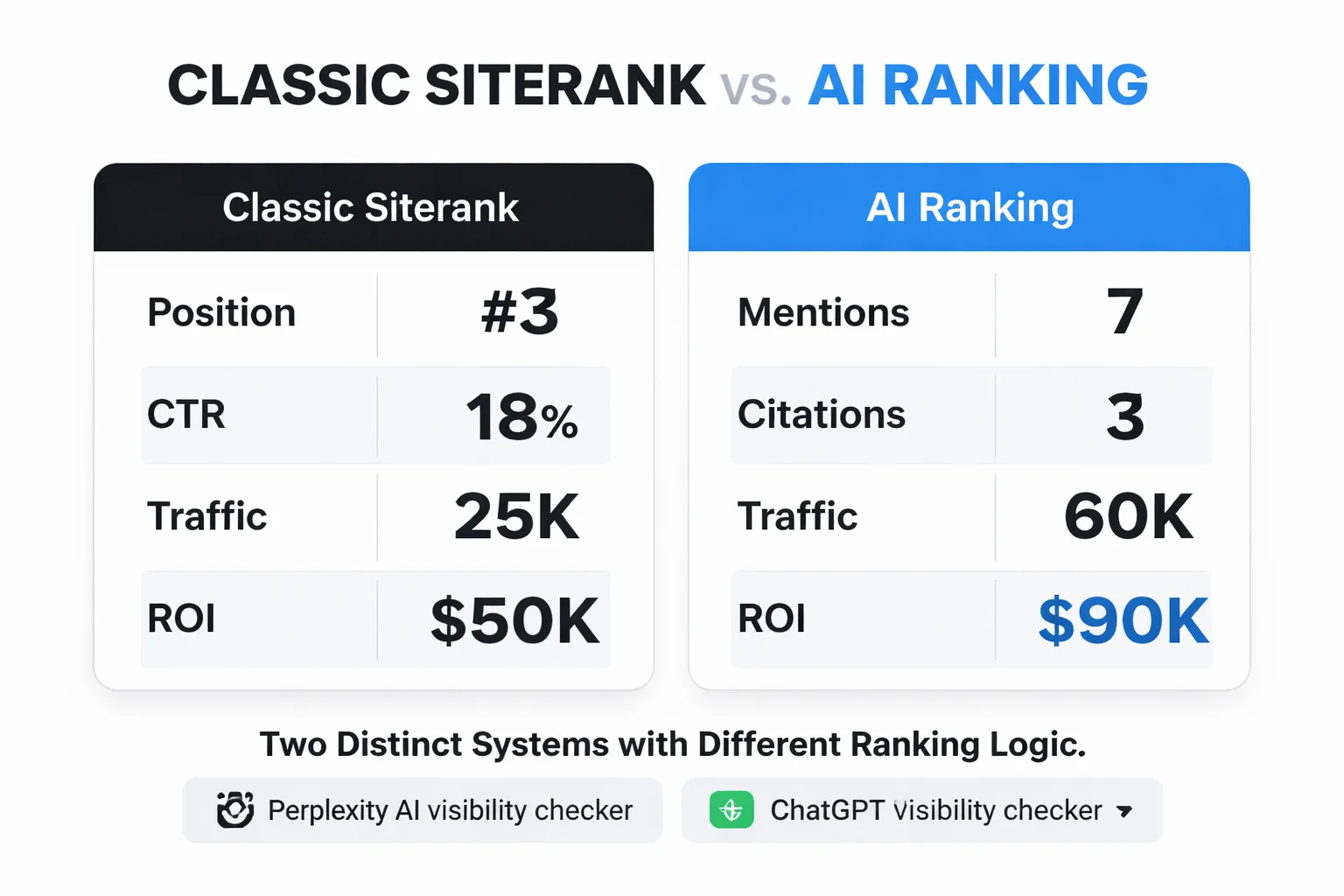
Let me explain why you cannot just track one and infer the other. Classic Google rankings are determined by an algorithm that evaluates hundreds of signals: backlinks, content relevance, page speed, mobile usability, and hundreds more. AI citations are determined by a different process. The LLM retrieves relevant passages from its index, evaluates which sources best answer the prompt, and constructs a response with citations. The ranking logic is fundamentally different. A page that satisfies Google's algorithm may not satisfy an LLM's retrieval and extraction process.
This is why unified siterank data matters. When you see a page that ranks position 5 in Google but has zero AI citations, the gap tells you something specific. The page has enough authority and relevance for Google's algorithm but lacks the structure, entity signals, or extractability that LLMs need. That diagnostic insight is impossible without both data sets side by side.
The practical workflow looks like this. Export your siterank report with both classic position and AI citation columns. Sort by the gap between the two. Pages with strong classic rankings and zero AI citations are your priority fix targets. Pages with weak classic rankings but some AI citations are interesting outliers worth studying. Pages with strong performance in both are your models. Study what they do right and replicate the pattern across your weaker pages.
How Does Entity Grounding Connect to Siterank?
Entity grounding is the mechanism that connects your brand to topics in an LLM's internal representation. Siterank data tells you whether that connection exists. If your siterank shows zero AI citations for a topic where you have deep expertise, the entity connection is missing.
Think of entity grounding like a map. An LLM has a mental map of concepts and how they relate. "Project management software" connects to "task tracking," "Gantt charts," "sprint planning," and specific brand entities. If your brand is not on that map, no prompt will surface you. Your siterank data is the GPS signal that tells you whether you are on the map or off it.
The fix involves three steps. First, define your brand entity clearly using schema markup on your homepage and about page. Second, create topical content that explicitly connects your brand to the concepts you want to be associated with. Third, earn external mentions from domains that already exist on the LLM's map. Each external mention creates a new pathway to your brand entity.
I have seen this work dramatically. One client was invisible in AI answers for their core product category despite ranking on page one of Google for the same keyword. We spent four weeks building entity signals: Organization schema, author entity profiles, three guest posts on industry publications, and a Wikidata entry. By week five, their siterank data showed AI citations appearing for the first time. The content had not changed. The entity signals had.
What Is Generative Engine Optimization in Practice?
Generative engine optimization is the process of making your content extractable and citable by AI answer engines. In practice, it means restructuring your content so an LLM can find, verify, and cite your key claims in a single retrieval pass.
The practical implementation involves four elements. Direct answer blocks under question headings give the LLM something to extract. Comparison tables provide structured data that LLMs prefer for versus queries. Schema markup defines your entity relationships explicitly. External validation from trusted domains gives the LLM confidence that your claims are accurate.
Generative engine optimization differs from traditional SEO in one fundamental way. Traditional SEO optimizes for ranking position. GEO optimizes for extraction. A page can rank well and never be extracted. A page can be extracted without ranking well. The skills and tactics that drive extraction are different from those that drive ranking. Siterank data is the only measurement system that captures both dimensions.
If you are evaluating generative engine optimization tools, the critical feature to look for is prompt-level citation tracking. The tool must send real prompts to live LLMs and capture whether your domain appears in the response. Tools that only track SERP features or AI Overview presence are giving you a partial picture. You need to know what ChatGPT actually says when a user asks about your category.
Why Most Teams Skip the Entity Diagnostic
Here is where I need to be honest about something. The three-question diagnostic in Step 3 is the hardest part of this entire process. Most teams skip it. They jump straight from identifying a weak page to rewriting content. That is a mistake.
The entity diagnostic requires you to understand schema markup, knowledge graph connections, and how LLMs map relationships between concepts. That is not a standard SEO skill. It feels like information architecture mixed with data engineering. Most content teams do not have this expertise in-house, and most SEO consultants focus on keyword optimization, not entity optimization.
The tradeoff is real. If you skip the entity diagnostic and just rewrite content, you might see a temporary boost in classic rankings. But you will not fix the underlying reason AI engines ignore your pages. You are painting a house with a cracked foundation. The paint looks fresh for a month, then the cracks reappear. I have watched teams rewrite the same page three times because they kept skipping the diagnostic step. Each rewrite generated the same result: decent Google rankings, zero AI citations.
The teams that invest in the entity diagnostic see compounding returns. Once your brand entity is properly structured and connected, every future page benefits. You do the work once, and every new piece of content starts with a structural advantage.
The Forrester Problem: Quality Is Not the Issue
I want to highlight something from the Forrester January 2026 research that stopped me cold. AI systems prioritize original, expert-driven, human-authored material and customer success stories as third-party evidence. That is what they claim to prioritize. But in practice, B2B companies investing in high-quality case studies with named outcomes and specific numbers see zero citations in AI search results. Not because the content quality is weak. Because the standard case study format cannot be reliably machine-extracted.
This is the contrarian takeaway. Your content is probably not too weak. It is structured wrong. The fix is not writing better content. The fix is reformatting existing content so an AI engine can extract the key claim, the entity, and the outcome in a single pass. That is a few hours of restructuring per asset, not a months-long content rebuild.
If your siterank data shows strong classic rankings but zero AI citations, do not rewrite the content. Restructure it. Add a direct answer block at the top. Add schema markup. Link your entities. Move the results section above the narrative. These structural changes will do more for your AI visibility than any content rewrite.
Generative engine optimization is not about producing more content. It is about making your existing content machine-readable. The teams that understand this distinction will dominate AI search visibility in 2026. The teams that do not will keep rewriting pages that already rank well and wondering why ChatGPT never mentions them.
What This Actually Means for Your Content Strategy
The four-step framework I just walked you through represents a fundamental shift in how you should allocate content resources. If you are spending 80% of your content budget on new production and 20% on optimization, flip that ratio. Your existing pages are assets that are underperforming in the AI search layer. Fixing them is faster and cheaper than creating new content from scratch.
Siterank data is the diagnostic tool that tells you where to focus. Without it, you are guessing. With it, you have a prioritized list of pages, each with a specific root cause and a specific fix. That is what data-driven content strategy looks like in the AI search era.
The teams that win in 2026 will not be the ones with the most content. They will be the ones whose content is most extractable. Siterank data shows you the gap. The four-step framework closes it.
FAQ
What is siterank data?
Siterank data is the combined set of metrics showing where your pages rank in classic Google search results and how often they are cited by AI answer engines like ChatGPT, Perplexity, Claude, and Google AI Overviews. It includes position tracking, AI citation rate, and mention position within AI-generated answers. Unlike traditional rank tracking, siterank data reveals whether your pages are visible to the generative search layer.
How often should I check my siterank data?
Check siterank data weekly. Classic Google rankings shift slowly, but AI citation patterns can change overnight when LLMs update their retrieval indices. A weekly cadence gives you enough signal to spot trends without creating noise. After applying fixes to weak pages, wait two weeks before re-checking to give AI crawlers time to re-index your updated content.
What is the difference between siterank and AI visibility?
Siterank encompasses both classic search positions and AI citation metrics. AI visibility is a subset that specifically measures how often your brand appears in generative answers across LLMs. Siterank gives you the full picture. AI visibility tells you whether your content is extractable by answer engines. You need both to diagnose page performance accurately.
Can a page rank well on Google but fail in AI search?
Yes, and it happens frequently. I tested five articles with top-three Google rankings that received zero AI citations over three months. High Google rankings help with discoverability but do not guarantee citation. AI engines evaluate entity grounding, content structure, and third-party validation differently than Google's algorithm. A page can be perfectly optimized for classic search and completely invisible to LLMs.
What is the fastest fix for an AI-invisible page?
The fastest fix is adding a direct answer block in the first 200 words of the page. Put a 40-60 word answer to the page's core question right at the top, with the key claim bolded. Since AI engines extract preferentially from the top of a page, this single change can generate citations within two weeks. No rewrite required. Just restructure the existing information.
Do I need separate tools for siterank and AI tracking?
Not necessarily. Platforms like Meev combine classic rank tracking with AI citation monitoring across every major LLM. The key is ensuring your tool sends real prompts to live AI models and captures citation data, not just SERP positions. Traditional rank trackers that only monitor Google positions will not surface AI visibility gaps.
About the Author
Judy Zhou, Founder
Judy Zhou leads content strategy at Meev, where she oversees AI-driven content research and publishing for hundreds of brands. With a background in SEO and editorial operations, she focuses on building content systems that rank on Google, get cited by AI search engines, and drive measurable business results.
Run your AI visibility baseline today and find exactly which pages need fixing before your competitors do.