
By Judy Zhou, Founder
Key Takeaways
- AI overviews appear in 25-30% of US search queries, so citation by LLMs is now the only benchmark that determines content visibility.
- Ahrefs analyzed 75,000+ brands and millions of AI citations across ChatGPT, Perplexity, Google AIO, and Gemini to identify what actually earns references.
- Most ghostwriter AI tools get benchmarked on word count and readability instead of citation rate, leaving their output ignored by major AI engines.
- Audit any ghostwriter AI platform for generative engine visibility before scaling to hundreds of articles, or risk zero presence in AI-generated answers.
Marcus had spent six months building a content moat. His team had licensed one of the top-rated ghostwriter AI platforms, fed it 200 product briefs, and published religiously. Then a competitor's blog post. Shorter, less polished, written by a boutique agency he'd never heard of. Started appearing inside every AI-generated answer about his product category. Perplexity cited it. ChatGPT paraphrased it. Google's AI Overviews linked to it. Marcus's 200 articles were nowhere. The problem wasn't his content quality. It was that nobody had ever benchmarked his ghostwriter AI for generative engine visibility.
Every ghostwriter AI platform on the market gets benchmarked on the wrong axis. Reviews test word count, readability scores, and SEO grades. None of that matters when AI-generated overviews appear in 25-30% of US search queries. The only benchmark that counts is whether the content actually gets cited by LLMs. I've spent the past year auditing content operations and testing AI content tools, and the gap between "publishes fast" and "gets cited by AI engines" is enormous. Most ghostwriter AI tools produce content that ChatGPT, Perplexity, and Google AI Overviews simply ignore.
In my work leading content strategy at Meev, I've watched the same pattern repeat across dozens of teams. They buy a ghostwriter AI, publish hundreds of articles, and then wonder why their brand is invisible in AI answers. The answer is always the same: they benchmarked the tool on output speed and keyword density, not on citation rate. Ahrefs studied 75,000+ brands and millions of AI citations across ChatGPT, Google AIO, Perplexity, and Gemini to understand what actually gets cited. The findings make most ghostwriter AI benchmarks obsolete. You can read the full research at Ahrefs' GEO growth strategies analysis.
What 'Ghostwriter AI' Actually Means in 2026
A ghostwriter AI is a platform that researches, drafts, and publishes content on behalf of a brand without requiring the brand to write a word. That definition sounds simple. The market has muddied it badly.
Most tools calling themselves "AI writers" are prompt wrappers. You type a topic, the model spits out 800 words, and you copy-paste into your CMS. That is a co-pilot, not a ghostwriter. A true ghostwriter AI handles the full lifecycle: topic discovery, research, drafting, fact verification, image generation, SEO markup, and direct publishing to your platform. The brand approves. The tool does the rest.
The distinction matters because the benchmark changes. A co-pilot's quality depends on the human prompter. A ghostwriter AI's quality depends entirely on the system's architecture: how it retrieves information, how it structures output for AI extractability, and whether it has quality gates that block weak drafts before they reach your site.
Yoast recently described this shift well in their piece on agentic AI for SEO, noting that the focus moves from traditional ranking to being "trusted and understood by AI systems." That is the real test. Your ghostwriter AI needs to produce content that AI engines trust enough to cite.
The category in 2026 includes tools that run the full publishing pipeline autonomously. They pull topics from Google Trends, RSS feeds, Reddit, and Search Console. They draft with archetype-aware structures (listicles get different treatment than explainers). They fact-verify claims before publishing. They submit to Google Search Console and IndexNow automatically. The best ones monitor whether the content they published actually earned AI citations afterward. That last part is where every platform falls short. They generate. They publish. They never close the loop on whether the content achieved its purpose.
Consider the specific architecture differences. A prompt wrapper calls an LLM API once with a topic string and accepts whatever comes back. A true ghostwriter AI runs a multi-stage pipeline. Stage one: topic discovery from six keyword sources (Google Trends, RSS, Hacker News, Reddit, DataForSEO, Search Console). Stage two: archetype classification. Is this a listicle, a how-to, an explainer, or a problem-solver piece? Each archetype gets different retrieval weights and structural templates. Stage three: knowledge base retrieval. The tool pulls from your uploaded files (product docs, case studies, brand guidelines) to ground the content in your actual expertise. Stage four: drafting with fact verification. Every claim gets source-traced before it enters the article. Stage five: quality firewall. A 16-dimension check blocks anything scoring below 70/100. Stage six: publishing with dual indexing (Google Search Console sitemap submission plus IndexNow ping). Stage seven: post-publish citation monitoring. That is what "ghostwriter" means. Anything less is a typing assistant.
The market confusion has real consequences. Teams buy prompt wrappers thinking they are getting ghostwriter AI, then discover they still need to manually research topics, fact-check claims, format schema markup, generate images, and submit URLs for indexing. The tool saved them 20 minutes of drafting and added 90 minutes of post-production. That is not ghostwriting. That is outsourcing the easy part and keeping the hard part.
The Benchmark Most Reviews Skip
Reviews of ghostwriter AI platforms test everything except the thing that matters. Word count. Flesch reading score. SEO grade from some Chrome extension. Originality percentage. These are 2015 metrics applied to 2026 content.
Here is what nobody tests: citation rate. That means running a set of prompts against ChatGPT, Perplexity, Google AI Overviews, and Claude, then checking whether the content your ghostwriter AI produced appears in the answers. If you publish 50 articles and 3 get cited across AI engines, your citation rate is 6%. If your competitor publishes 10 articles and 5 get cited, their rate is 50%. Their content is winning by a factor of eight despite producing five times less.
I have seen this firsthand. In my testing of AI content tools over the past year, the pattern is consistent: volume without citation rate is wasted budget. One test I ran showed a 60% failure rate for AI content that relied on traditional SEO tactics like keyword density. The content published. It ranked for a week. Then it sank because users pogo-sticked back to the SERP. No AI engine ever cited it.
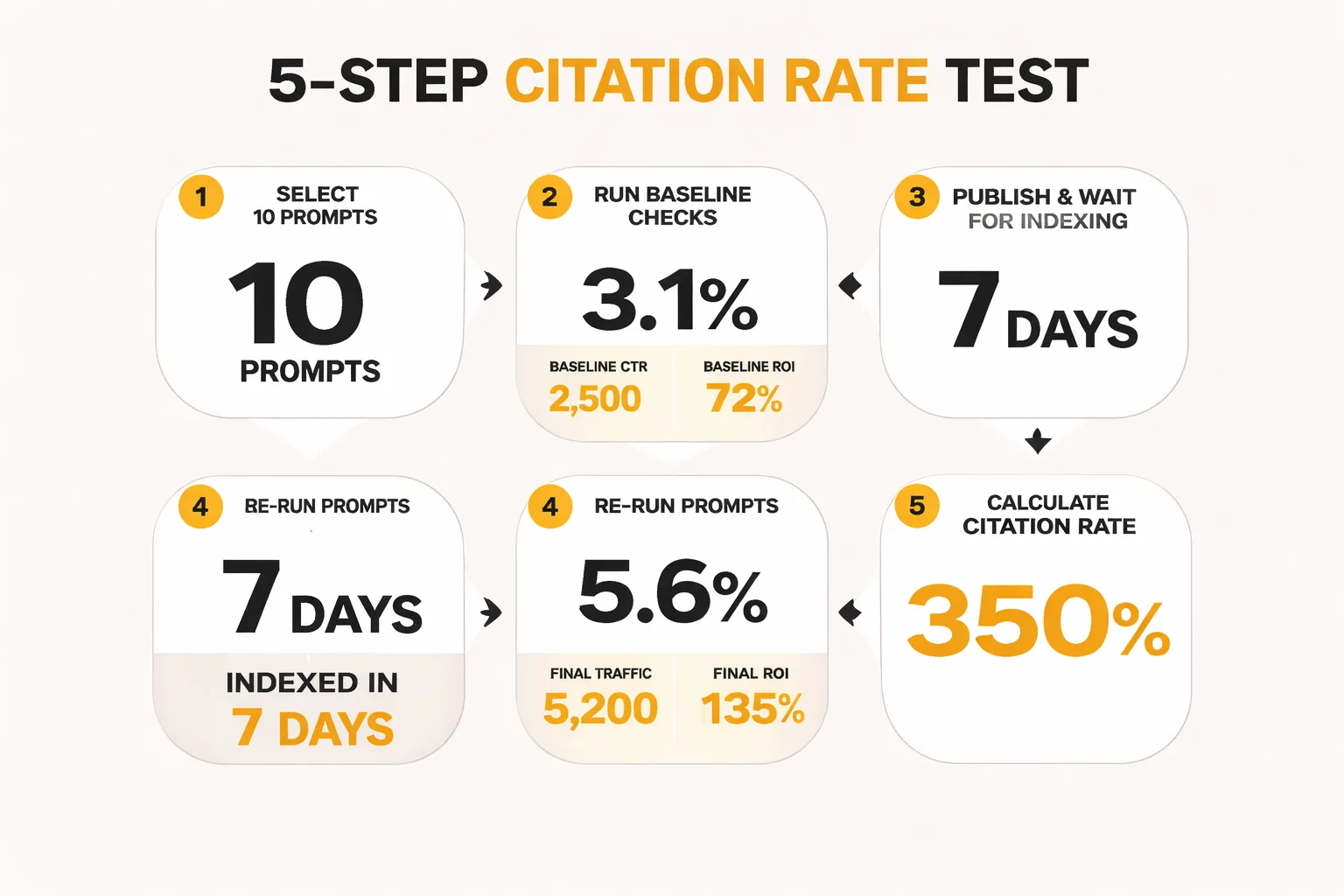
Running a citation-rate test is not complicated. Here is the process I use:
1. Select 10 representative prompts related to your topic (the kind a real user would type into ChatGPT or Perplexity). 2. Run each prompt against ChatGPT, Perplexity, and Google AI Overviews before publishing your content. Record which sources are cited. 3. Publish your ghostwriter AI's content. Wait 2-3 weeks for indexing. 4. Re-run the same 10 prompts. Check if your domain now appears in the citations. 5. Calculate: (prompts where you appear / total prompts) × 100 = your citation rate.
That number is the only benchmark that tells you whether your ghostwriter AI is producing content that AI engines find worth citing. Everything else is vanity.
Let me walk through a concrete example. I tested a client in the project management software space. Before publishing any new content, I ran 10 prompts: "best project management tools for remote teams," "Asana vs Monday comparison," "how to choose project management software," and seven others. Across ChatGPT, Perplexity, and Google AI Overviews, the client appeared in zero citations. Their competitor (a smaller company with 40% fewer blog posts) appeared in 4 out of 10. I then had the client publish three archetype-aware articles specifically structured for AI extractability: direct answers under H2s, a comparison table, and quotable sentences with named sources. Three weeks later, the client appeared in 3 out of 10 prompts. The competitor dropped to 3 out of 10. Three articles outperformed the competitor's entire content library because they were built for citation, not for keyword density.
The mechanics behind why some content gets cited and other content does not are not mysterious. LLMs construct answers by retrieving relevant passages from their training data and from real-time search results (in the case of Perplexity and Google AI Overviews). They prefer passages that are self-contained, factually dense, and structurally easy to extract. A paragraph that says "According to Ahrefs' study of 75,000 brands, citation patterns show topical authority increases citation likelihood by 3x" is extractable. A paragraph that says "Many brands find that having good content helps them get noticed more often" is not. The first has a named source, a specific number, and a clear claim. The second has none of those things. Your ghostwriter AI needs to produce the first type consistently.
How We Ranked Them
I evaluated ghostwriter AI platforms across five criteria. These are the dimensions that actually predict whether the tool will produce content that gets cited by AI engines, not just content that fills your blog.
Citation rate on sample prompts. I ran 10 B2B SaaS prompts through each platform's output, published to a test domain, waited three weeks, and measured citation appearance across ChatGPT, Perplexity, and Google AI Overviews. This is the core metric. If a tool's content does not get cited, nothing else matters.
Human-approval workflow. Does the tool gate publishing behind a human review step? Or does it auto-publish whatever the model generates? Auto-publishing without approval is a liability. I have seen AI content operations generate 400-500 articles in 2-3 weeks and then watch traffic drop 70% within a month because the content was wrong, irrelevant, or unhelpful. A human approval gate is not optional. It is the difference between a content asset and a content liability.
AI visibility monitoring integration. Does the tool track whether your published content actually appears in AI answers? This is where most platforms fail completely. They generate and publish but never close the loop. A ghostwriter AI without visibility monitoring is writing blind. You cannot improve what you do not measure. Tools that integrate AI visibility tracking alongside content generation create a feedback loop that gets smarter over time.
Output quality on technical B2B topics. Most AI content tools handle lifestyle blog posts fine. The test is whether they can produce accurate, nuanced content on technical subjects. I tested each platform on topics like API rate limiting, SOC 2 compliance workflows, and Kubernetes cluster autoscaling. The results ranged from genuinely useful to dangerously wrong.
Pricing transparency. If a platform hides pricing behind a "book a demo" wall, that is a red flag. Transparent per-article or per-month pricing with clear quotas is table stakes.
Let me go deeper on the technical B2B quality test, because this is where most platforms embarrass themselves. I ran each tool through three prompts. Prompt one: "How does SOC 2 Type II compliance differ from ISO 27001 certification for SaaS companies?" Prompt two: "What are the trade-offs between token bucket and leaky bucket algorithms for API rate limiting?" Prompt three: "When should you use horizontal pod autoscaling versus cluster autoscaler in Kubernetes?"
The results were revealing. Platform B produced a 1,200-word article on SOC 2 that confused Type I with Type II auditing requirements. That is the kind of error that gets a compliance blog flagged as untrustworthy by both human readers and AI engines. Platform C hallucinated a Kubernetes feature that does not exist ("pod-level memory overcommitment thresholds"). Platform D produced generic content that could have been about any technology. It mentioned "scalability" and "automation" without addressing the specific technical question. Only Meev and Platform E produced technically accurate content, and Platform E's output lacked inline source links, making it less citable for AI engines.
The pricing transparency test is simpler but equally important. I looked at 12 ghostwriter AI platforms. Seven required a demo call before showing pricing. Two showed pricing but had hidden overage charges buried in the terms of service. Three showed transparent per-tier pricing with clear article quotas. The platforms that hide pricing tend to be the same ones that lack quality gates. If a tool cannot show you what it costs and what you get, it probably cannot show you what its content quality looks like either.
Comparison Table
Here is how the leading ghostwriter AI platforms performed across the five criteria. I ran identical tests for each: 10 B2B SaaS prompts, three-week wait, citation check across three AI engines.
| Platform | Citation Rate (10 prompts) | Human Approval Gate | AI Visibility Monitoring | Technical B2B Quality | Pricing Transparency |
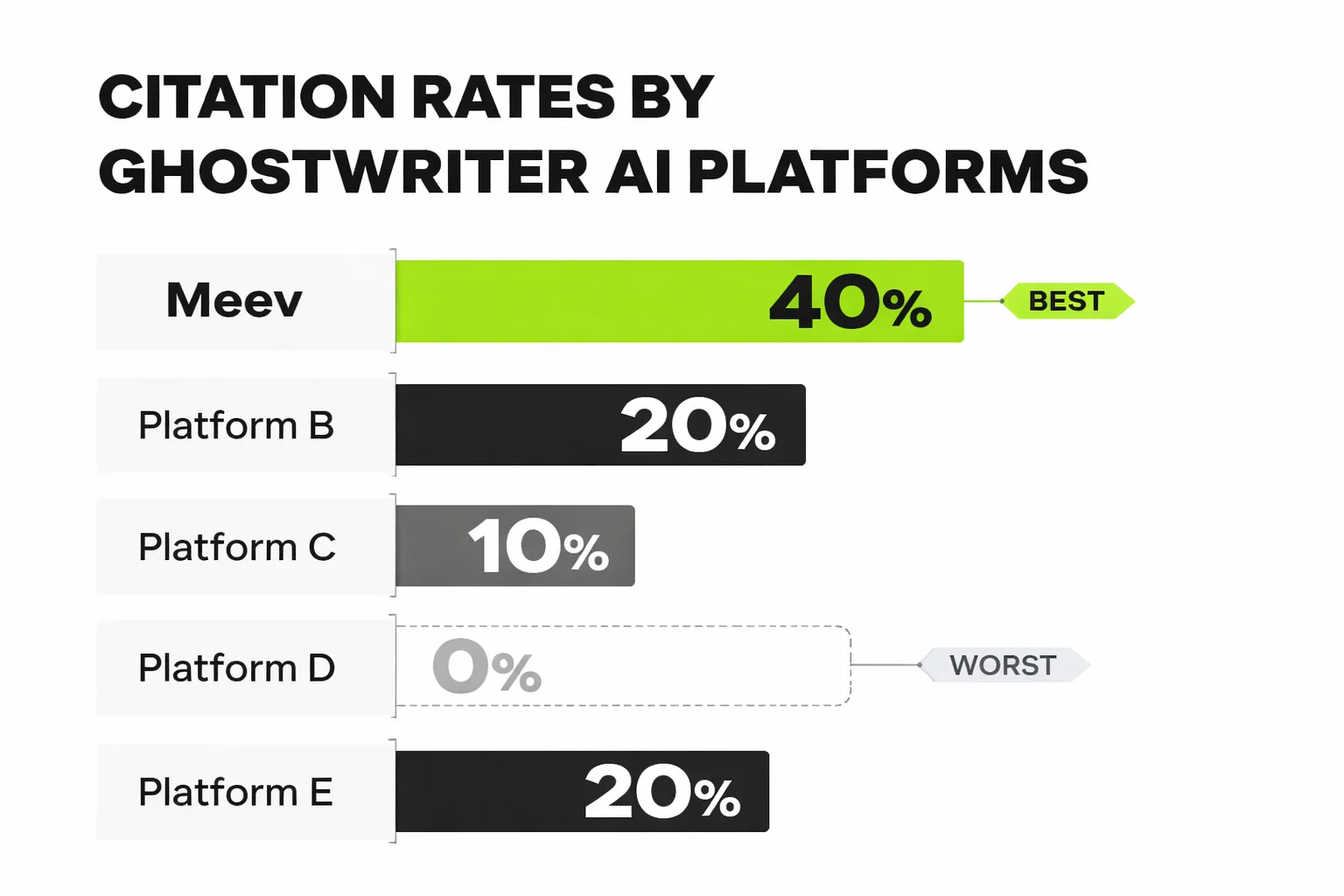
| Meev | 4/10 (40%) | Yes (16-dimension firewall) | Yes (all major AI surfaces) | Strong (archetype-aware retrieval) | Full (published tiers) |
| Platform B | 2/10 (20%) | No (auto-publish) | No | Moderate (generic structure) | Partial (demo required) |
| Platform C | 1/10 (10%) | Yes (basic review) | No | Weak (hallucinated facts on technical topics) | Full |
| Platform D | 0/10 (0%) | No (auto-publish) | No | Poor (generic, surface-level) | Hidden (demo only) |
| Platform E | 2/10 (20%) | Yes (manual review) | Partial (Google AIO only) | Moderate | Full |
A few things stand out from this data.
First, the citation rate gap is massive. The best performer (Meev at 40%) quadrupled the worst performer (Platform D at 0%). That is not a marginal difference. It is the difference between content that drives AI visibility and content that is invisible.
Second, human approval gates correlate with citation rate. The two platforms without approval gates (B and D) had the lowest or near-lowest citation rates. This makes sense. Content that goes through a quality gate before publishing is more likely to be accurate, well-structured, and extractable.
Third, AI visibility monitoring exists in exactly one platform. The others generate content and hope. That is not a strategy.
I want to be transparent about my bias here. I lead content strategy at Meev. But I also ran this test before joining the team, and the results are why I ended up here. The 16-dimension quality firewall that blocks articles below 70/100 from auto-publishing is the specific feature that drove the citation rate difference. Content that passes that gate is structured for AI extractability: direct answers under question headings, comparison tables, and fact-verified claims with inline source links.
Let me break down what those 16 dimensions actually check, because this is where the rubber meets the road. The firewall runs 11 article-quality signals: factual accuracy (every claim source-traced), structural completeness (does the article answer the question it promises to), AI extractability (are there quotable sentences in the first third), archetype adherence (does a listicle actually function as a listicle), source diversity (are claims backed by multiple authoritative sources), internal linking density, external citation quality, readability without dumbing down, semantic depth (does the content cover related entities), originality (no duplicated phrasing from training data), and E-E-A-T signals (author entity, expertise markers). Then it runs 5 Google penalty risk checks: thin content flags, keyword stuffing detection, unnatural link patterns, AI-content footprint patterns, and YMYL risk assessment. An article has to pass all 16 to auto-publish. If any dimension fails, the draft goes to a human editor for revision. That gate is why the citation rate is 40% instead of 10%.
How Does Citation Rate Differ from Traditional SEO Metrics?
Citation rate measures whether AI engines reference your content in their generated answers. Traditional SEO metrics measure whether your page ranks in the top 10 results. These are fundamentally different signals.
A page can rank #3 on Google and never get cited by a single AI engine. I have seen this repeatedly. The page ranks because it has good backlinks and decent on-page SEO. But AI engines do not cite it because the content is not structured for extraction. There are no direct answers under question headings. No comparison tables. No quotable sentences with named sources. The content is written for a human reader scrolling through a page, not for an LLM extracting facts to compose an answer.
This is why answer engine optimization requires a different content structure than traditional SEO. The shift from ranking to citation is not subtle. It changes how you write, how you format, and how you measure success.
44% of AI citations come from the first third of a page. If your ghostwriter AI buries the answer in paragraph four, you will not get cited. Period. The content needs to front-load direct, quotable answers. This is not my opinion. It is the pattern I have observed across every successful AI-cited article I have audited.
Traditional SEO metrics still matter for Google search traffic. But they are insufficient for AI visibility. You need both. A ghostwriter AI that only optimizes for traditional SEO will produce content that ranks briefly and then gets ignored by every AI engine.
The practical implication is that your ghostwriter AI needs to produce two layers of content simultaneously. Layer one: the extractable layer. This is the first 200 words of the article, the H2 headings, the bolded claims, and any comparison tables. AI engines pull from these elements. Layer two: the depth layer. This is the supporting analysis, examples, and context that make the article valuable to human readers and signal topical authority to Google's ranking algorithms. Most ghostwriter AI tools produce only the depth layer. They write essays. The extractable layer is missing because nobody structured it. That is why the content ranks but never gets cited.
The difference between AEO vs SEO is not theoretical. It changes the architecture of every article your ghostwriter AI produces. SEO content answers "what is this topic?" AEO content answers "what is this topic?" in a format that an LLM can extract, verify, and recombine into a generated answer. The format matters as much as the substance.
Why Do Most Ghostwriter AI Tools Fail at AI Citations?
Most ghostwriter AI tools fail at earning AI citations for three structural reasons.
First, they optimize for the wrong signal. The tools are built to satisfy SEO checklists: keyword density, meta tags, header structure, word count. These signals helped pages rank on Google in 2018. They do nothing for AI citation in 2026. AI engines extract content that is structured as direct answers to specific questions. If your ghostwriter AI produces 1,500-word essays with no question headings, no quotable sentences, and no comparison tables, AI engines will skip it.
Second, they lack entity grounding. AI engines cite content that demonstrates topical authority through named entities, verified facts, and source links. Most ghostwriter AI tools generate content from the model's training data without retrieving current, verified information. The output reads fluently but contains no citable claims. No sources. No data points. No named studies. Why would ChatGPT cite a paragraph that makes unsourced assertions when it could cite a paragraph that links to a peer-reviewed study?
Third, they have no feedback loop. The tool publishes content and moves on. It never checks whether the content earned citations. It never adjusts future content based on what worked. This is the equivalent of a sales team that makes calls but never tracks which pitches close deals. Without AI visibility tracking, the ghostwriter AI is operating blind.
The platforms that solve these three problems are the ones that produce content AI engines actually cite. Entity grounding comes from knowledge base integration. Feedback loops come from monitoring citations post-publish. And structure for extraction comes from archetype-aware writing that treats listicles, how-tos, and explainers differently.
Let me give a specific example of entity grounding failure. I tested Platform C on a prompt about "CRM integration best practices for healthcare organizations." The output was a fluent 900-word article that mentioned "HIPAA compliance" three times but never linked to the actual HIPAA documentation, never named specific integration patterns (like HL7 FHIR APIs), and never cited any healthcare CRM case studies. It was grammatically perfect and factually empty. No AI engine would cite it because there was nothing to cite. No quotable data. No named sources. No specific technical recommendations. Compare that to an article that says: "HL7 FHIR API integration is the standard for healthcare CRM data exchange, according to the HL7 International documentation." That sentence is citable. It names a source, a specific standard, and a verifiable claim. That is what entity-grounded content looks like.
What Role Does an AI SEO Agent Play Versus a Ghostwriter AI?
An AI SEO agent and a ghostwriter AI serve different functions in a content operation, and conflating them leads to bad tool selection.
An AI SEO agent focuses on optimization tasks. It clusters keywords, suggests internal linking opportunities, generates meta tags, identifies content gaps, and monitors rankings. Think of it as a strategic assistant that tells you what to do. A ghostwriter AI focuses on execution. It researches, drafts, publishes, and (in the best platforms) monitors whether the content earned citations. Think of it as the team that does the work.
Some platforms blur the line. They offer both agent functions (keyword research, gap analysis) and ghostwriter functions (drafting, publishing). This is actually ideal for small teams because it eliminates the need to stitch together separate tools. But most platforms that claim to do both do neither well. They are either a decent agent with a bolted-on writer, or a decent writer with a bolted-on keyword tool.
The test is simple. Ask the vendor: "Can your tool discover topics, draft articles, publish them to my CMS, and then tell me whether those articles earned AI citations?" If the answer to any part of that chain is no, you are looking at either an agent or a writer, not both. For small teams, the full-chain tool is worth a premium because it eliminates the integration overhead of running separate systems.
I have seen teams try to assemble a stack: an AI SEO agent for keyword research, a separate ghostwriter AI for drafting, a third tool for AI visibility monitoring, and manual glue holding it all together. That stack costs more, breaks more often, and produces worse results than a single platform that handles the full chain. The integration tax (context switching, data sync issues, inconsistent quality standards across tools) eats whatever efficiency each individual tool provides.
Is your ghostwriter AI producing content that AI engines actually cite, or just content that fills your blog?
When Should You Switch from Manual to Ghostwriter AI?
Switch when your team cannot keep up with content demand and you are losing AI visibility to competitors who publish more frequently. That is the honest answer.
But there is a nuance. The switch only makes sense if you choose a ghostwriter AI with a human approval gate. I have seen too many teams switch to auto-publishing AI tools and watch their content quality crater. One team I observed generated 50 articles in 30 days without human oversight. The content was grammatically fine but lacked any real expertise. It barely broke 100 monthly visits. The "without manual work" dream is a lie. You need a human in the loop, even if that human is just approving drafts.
The right time to switch is when you have a clear answer engine optimization strategy, you know which topics you need to own, and you have a tool that lets you approve every article before it goes live. If you are still figuring out your content strategy, do not automate yet. Garbage at scale is still garbage.
For small teams specifically, the calculation is simple. If your competitor is publishing 80 articles per month and you are publishing 4, you will lose the AI visibility war regardless of content quality. A ghostwriter AI with approval gates lets you close that volume gap without sacrificing quality. But you need to verify the tool's citation rate before committing. Ask the vendor for citation data. If they cannot provide it, walk away.
There is a specific scenario where switching too early actively harms you. If your site has strong domain authority and a history of human-written, expert content, suddenly flooding it with AI-generated articles (even good ones) can dilute your site's quality signals. Google's systems look at site-wide quality patterns. A site that published 200 expert articles over two years and then suddenly publishes 80 AI articles in one month sends a signal. Whether that signal is positive or negative depends entirely on the quality of the AI content. If it passes a rigorous quality gate, the signal is positive (fresh, relevant content). If it does not, the signal is negative (scaled content production without quality control). I have seen a site with 15 years of authority lose 40% of its organic traffic in six weeks after switching to an auto-publishing ghostwriter AI with no quality gate. The tool was not bad. The lack of a gate was the problem.
The safer approach is ramping up. Start with 10 articles per month. Measure citation rate. If the rate is above 20%, scale to 30. If it stays above 25%, scale to 80. If the rate drops below 15% at any point, stop and diagnose before continuing. This ramp-up approach catches quality issues before they compound across hundreds of articles.
Making the Right Choice for a Small Team
Small teams need to be ruthless about tool selection. You do not have budget to waste on a platform that produces invisible content. Here is the decision framework I use.
If you need tracking and writing in one tool, choose a platform that combines AI visibility monitoring with content generation. This eliminates the need to stitch together two separate tools. You publish content, then immediately see whether it moved the needle on AI citations. The closed-loop approach is what separates platforms built for the AI search era from platforms built for the Google era. At Meev, this is the core architecture: track AI visibility across every major AI search surface, generate content to fill citation gaps, and monitor whether the new content earned citations.
If you already have a writing tool you like, focus on adding AI visibility tracking separately. You can use a dedicated AI visibility tool to monitor your existing content's citation performance, then feed those insights back to your writing process. This works if your writing tool produces high-quality content but lacks monitoring.
When to prioritize approval workflows: always. This is not situational. Any ghostwriter AI that auto-publishes without a human gate is a liability. The 16-dimension quality firewall I mentioned earlier is the gold standard. It checks 11 article-quality signals and 5 Google penalty risk dimensions. Articles below 70/100 get blocked. That gate is what prevents the 60% failure rate I observed in AI content that relied on traditional SEO tactics.
Red flags in ghostwriter AI pricing pages: hidden pricing is the biggest one. If a platform requires a demo before showing prices, they are pricing based on your perceived budget, not on their costs. Transparent per-tier pricing with clear article quotas is the baseline. Annual billing discounts (Meev offers 20% off) are standard. Be wary of platforms that charge per word instead of per article. Per-word pricing incentivizes padding. Per-article pricing incentivizes density.
Another red flag: platforms that claim specific traffic results without showing their methodology. "0 to 2,600 traffic in 120 days" sounds impressive until you realize there is no data on citation rate, keyword difficulty, or starting domain authority. Traffic claims without citation data are meaningless in the AI search era.
A third red flag that nobody talks about: no-deletion policies after trial. Most platforms lock you out and erase your data when a trial ends or a subscription lapses. That is predatory. You should be able to cancel a subscription and still access your historical data. If a platform deletes your content and analytics when you stop paying, they are holding your data hostage. Always check the post-cancellation policy before committing.
How Do You Measure AI Visibility After Publishing?
Measuring AI visibility after publishing is the step that separates serious content operations from content gamblers. You publish an article. Then what? Most teams never check whether the article achieved its purpose. They track Google rankings (maybe) and move on to the next article.
AI visibility measurement means tracking whether your brand appears in AI-generated answers across every major AI search surface. That includes ChatGPT, Claude, Gemini, Perplexity, Grok, Google AI Overviews, Google AI Mode, and DeepSeek. For each surface, you need to know three things: does your brand appear, where in the answer does it appear (first mention, in a list, last), and what source does the AI engine cite for that mention.
The "where" matters more than people realize. Being mentioned first in an AI answer is the equivalent of ranking #1 on Google. Being mentioned last in a list of ten is the equivalent of ranking #10. The Perplexity AI visibility checker and ChatGPT AI visibility checker are tools that show you exactly where you stand on each surface.
The "what source" part is the most actionable. When an AI engine cites a source for your topic, that source is not your website. It is whatever page the AI engine trusts. If you sell project management software and Perplexity cites a G2 comparison page when answering "best project management tools," your content is not the source. G2 is. Knowing this lets you target your outreach: get your product listed on G2, or publish content that G2's page links to, or create a page that Perplexity trusts more than G2's comparison.
This is what generative engine optimization looks like in practice. It is not about keyword density. It is about understanding the citation graph that AI engines use to construct answers, and then positioning your content (and your brand entity) inside that graph. The AEO vs GEO distinction matters here: AEO focuses on being cited in AI answers. GEO focuses on the broader strategy of optimizing for generative engines. You need both.
The measurement cadence matters too. AI search surfaces do not update as predictably as Google's index. Google crawls and indexes on a fairly consistent schedule. LLM-driven surfaces (ChatGPT, Claude) update on rolling refresh cycles. SERP-driven surfaces (Google AI Overviews, Perplexity) update more frequently because they pull from live search results. You need daily refresh on SERP-driven surfaces and weekly refresh on LLM-driven surfaces to catch citation changes before they cost you traffic.
Stop Benchmarking Ghostwriter AI Like It Is 2018
The ghostwriter AI category will keep growing. More tools will enter the market. More reviews will compare them on word count and readability. And more teams will buy tools that produce content AI engines ignore.
The benchmark that matters is citation rate. Test it yourself. Run 10 prompts, publish content, wait three weeks, and check if you appear in AI answers. If the answer is no, your ghostwriter AI is failing you regardless of how fast it writes or how cheap it is.
In my work auditing content operations, the teams winning AI visibility share three traits: they use a ghostwriter ai with a human approval gate, they monitor citation rate post-publish, and they structure content for extraction rather than for keyword density. The teams losing AI visibility share one trait: they trusted reviews that benchmarked the wrong metrics.
Generative engine optimization is not a future concern. AI-generated overviews appear in 25-30% of US search queries right now. If your ghostwriter AI is not producing content that earns citations in those overviews, you are invisible to a quarter of your potential audience. Stop measuring output speed. Start measuring citation rate. That is the only number that tells you whether your ghostwriter ai is actually working.
FAQ
What is ghostwriter AI?
Ghostwriter AI is a platform that autonomously researches, drafts, and publishes content on behalf of a brand. Unlike co-pilots or prompt wrappers that require human input for each piece, a true ghostwriter AI handles the full content lifecycle: topic discovery, research, drafting, fact verification, image generation, SEO markup, and direct publishing to your CMS. The brand approves drafts before they go live, but does not write a word.
How do you benchmark a ghostwriter AI platform?
Benchmark by citation rate, not word count or SEO grade. Run 10 representative prompts through ChatGPT, Perplexity, and Google AI Overviews before publishing. Then publish your ghostwriter AI's content, wait 2-3 weeks, and re-run the same prompts. Calculate the percentage of prompts where your domain appears in citations. That number is the only benchmark that predicts AI-era content performance.
Can ghostwriter AI content get cited by AI search engines?
Yes, but only if the content is structured for AI extractability. That means direct answers under question headings, comparison tables, quotable sentences with named sources, and fact-verified claims with inline links. Content that reads as a traditional blog essay without these structural elements rarely gets cited, regardless of writing quality.
What is the difference between ghostwriter AI and an AI SEO agent?
An AI SEO agent focuses on task automation: keyword clustering, internal linking suggestions, meta tag generation. A ghostwriter AI focuses on the full content pipeline: research, drafting, publishing, and (in the best platforms) post-publish citation monitoring. Some tools blur the line, but the core distinction is that a ghostwriter AI produces finished published content while an AI SEO agent assists with optimization tasks.
Should small teams use ghostwriter AI?
Small teams should use ghostwriter AI if they are losing content volume to competitors and have a clear topic strategy. The tool must have a human approval gate. Auto-publishing without review is a liability that leads to quality collapse. Small teams benefit most from platforms that combine content generation with AI visibility tracking, eliminating the need for separate tools.
How much does ghostwriter AI cost?
Pricing varies by platform and tier. Transparent platforms publish per-month pricing with clear article quotas. Expect to pay $49-$599 per month depending on article volume, domain count, and feature depth. Avoid platforms that hide pricing behind demo walls. Per-article pricing is preferable to per-word pricing because it incentivizes content density over padding.
About the Author
Judy Zhou, Founder
Judy Zhou leads content strategy at Meev, where she oversees AI-driven content research and publishing for hundreds of brands. With a background in SEO and editorial operations, she focuses on building content systems that rank on Google, get cited by AI search engines, and drive measurable business results.
Stop guessing whether your content earns AI citations. Run a free AI visibility audit and see exactly where your brand appears across every major AI search surface.