
By Judy Zhou, Founder
Key Takeaways
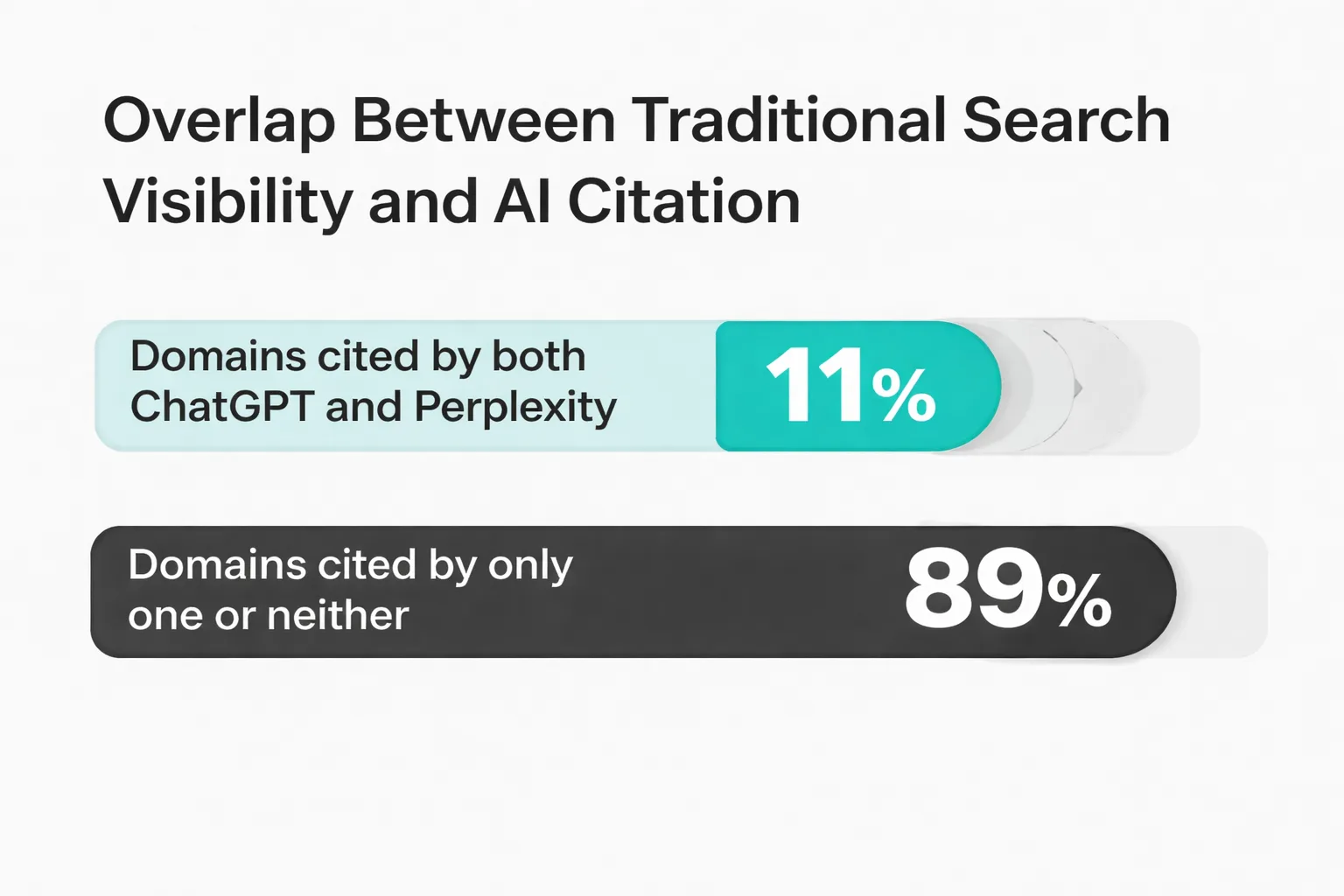
- Only 11% of domains appear in both ChatGPT and Perplexity citations, according to Semrush's 2025 study of 200,000 queries.
- Ecommerce brands using generative engine optimization raised AI citation rates from under 5% to 20-40% within 60-90 days.
- Track both Google rankings and AI answer citations across ChatGPT, Perplexity, Claude, and Google AI Overviews or risk missing the $1 trillion US B2C agentic commerce market by 2030.
- Audit your stack for zero AI visibility if it contains 4-6 tools that all measure only the same Google SERP.
The head of SEO at a mid-market ecommerce brand pulled up her tool dashboard on a Tuesday morning and saw exactly what she expected: rankings holding, crawl errors down, domain authority ticking upward. Everything looked fine. What the dashboard could not show her was that her three top product categories had vanished entirely from Perplexity's buying recommendations and that a competitor with weaker backlinks was being cited by name in ChatGPT responses twelve times a day. Her SEO tools stack was working perfectly. It was just answering questions nobody was asking anymore.
The right seo tools stack in 2026 tracks two surfaces at once: classic Google rankings and AI answer citations across ChatGPT, Perplexity, Claude, and Google AI Overviews. Only 11% of domains appear in both ChatGPT and Perplexity citations, according to Semrush's 2025 AI Overviews study, which analyzed 200,000 queries. Ecommerce brands implementing generative engine optimization with structured content saw citation rates jump from under 5% to 20-40% within 60-90 days, per data from Search Engine Journal. McKinsey forecasts the US B2C agentic commerce market will hit $1 trillion by 2030, as cited in SAP's agentic commerce resource. If your stack only covers Google, you are invisible to that market.
In my work auditing content ops and building AI search visibility systems at Meev, I see the same pattern every week: teams have 4-6 search engine optimization tools that all measure the same Google SERP, and zero visibility into whether AI engines even know they exist. The five decisions below are the framework I use to fix that.
Decision 1: Rank Tracking, AI Citations, or Both?
The first fork in building your stack is the one most teams get wrong. They either double down on classic rank tracking (because that is what their boss asks about) or they chase AI visibility tools without maintaining their Google foundation. Neither approach works in isolation.
Here is the reality: Google still drives the majority of search traffic for most businesses. But AI search surfaces are growing fast, and they do not reward the same signals. A page can rank #1 on Google and never appear in a ChatGPT response. A competitor with weaker backlinks can get cited by name in Perplexity because they have stronger entity grounding and third-party editorial mentions.
Only 11% of domains are cited by both ChatGPT and Perplexity, which means the overlap between traditional search visibility and AI citation is far smaller than most SEO professionals assume. I have tried doubling down on classic SEO tactics for newer content, hoping to boost AI citations, and the results were underwhelming. The two surfaces require different optimization strategies, and your tool stack needs to reflect that.
The "both" answer requires two distinct tracking layers. First, a classic rank tracker that monitors Google positions, SERP features, and keyword trends. Google Search Console covers the basics for free. A paid tool like Semrush or Ahrefs adds competitor tracking and keyword gap analysis. Second, an AI visibility tracker that monitors brand mentions and citation positions across every major AI search surface. This is where most stacks have a gaping hole.
The mechanics matter. AI citation tracking is not the same as rank tracking. When you track a Google rank, you get a position number that updates weekly and moves predictably. When you track an AI citation, you are dealing with a non-deterministic system. Ask ChatGPT the same question twice and you may get different sources cited each time. Your tool needs to run prompts at scale, capture the actual response text, log which sources are cited, and track your position within each answer (first mention, in a list, last, or absent entirely). A tool that just says "you were mentioned 3 times this week" is useless without the context of which prompts, which competitors, and what the full response said.
Let me walk through a concrete example. A B2B SaaS company in the project management space tracked their target keyword "best project management software" and held position 4 on Google for 18 months. Solid. Their Semrush dashboard showed steady traffic. But when they ran an AI citation audit using a dedicated tracking tool, they discovered that across 50 high-intent prompts ("best project management software for remote teams," "cheapest project management tool for startups," "Asana alternatives"), their brand appeared in zero ChatGPT responses and was mentioned once in Perplexity, in the last position of a list of seven tools. Their competitor, a brand with half their domain authority and a third of their organic traffic, was cited first in 23 of those 50 prompts. The competitor was winning the AI surface entirely.
The reason was not backlinks or keyword optimization. The competitor had invested in three things the B2B SaaS company had not: consistent entity references across Wikidata and third-party review sites, a cluster of comparison pages structured as direct-answer tables (which AI engines extract preferentially), and a set of deep product guides that AI models used as reference material. The B2B SaaS company's content was optimized for Google's ranking factors. The competitor's content was optimized for AI extractability. Same topic, same intent, different tooling required to measure the gap.
My recommendation: if you are a team under 5 people, start with Google Search Console (free) for classic tracking and add a dedicated AI visibility layer. Do not try to use a traditional SEO suite's "AI features" bolted onto a Google-first tool. The measurement architecture is fundamentally different, and the bolt-on approach produces unreliable data. I have seen too many teams trust AI citation counts from traditional SEO tools that do not actually query the LLMs directly.
If you want to check your current AI visibility before committing to a paid tool, try a free AI visibility checker to see where you stand across the major surfaces. The results are often surprising. Brands that feel dominant in Google search are frequently absent from AI answers, and the gap is invisible until you measure it.
For teams that need deeper drill-down, a dedicated Perplexity AI visibility checker can isolate one surface and show you exactly which prompts trigger competitor citations while you are absent. This surface-specific data is what turns a vague "we need to improve AI visibility" into a prioritized content roadmap.
Decision 2: When Do You Need GEO-Aware Content Research?
Keyword research tools have been the entry point to SEO for 15 years. You type in a seed keyword, get a list of related terms with search volumes and difficulty scores, and build content around them. That model still works for Google. But it is incomplete for AI search.
Here is the difference. Traditional keyword research tells you what people type into a search box. AI search optimization requires understanding what people ask in natural language, what entities AI models associate with your topic, and which sources they already trust enough to cite. A keyword tool gives you volume. A GEO-aware content research layer gives you citation opportunities.
Let me be concrete about what "GEO-aware" means. A traditional keyword tool might tell you that "best project management software" gets 22,000 monthly searches. Useful. But it does not tell you that when someone asks ChatGPT "what is the best project management software for small teams," the model cites three specific domains, your brand is not one of them, and the gap is traceable to a lack of entity grounding on Wikidata and insufficient third-party editorial mentions. That second layer of intelligence is what GEO-aware content research provides.
In my own experiments, I have seen content structured for AI extractability dramatically outperform traditionally optimized content. 44% of AI citations come from the first third of a page, which means front-loading direct answers under question headings and using comparison tables is not a styling choice. It is a citation strategy. A content research tool that only gives you keyword volumes cannot tell you this. It cannot tell you which archetypes (listicle, how-to, explainer) are most likely to get cited for your topic. It cannot tell you which publishers AI engines trust for your category.
The question is when a keyword tool is enough and when you need the full layer. My rule: if you are publishing 2-4 articles per month on a single domain, a keyword tool plus manual SERP analysis is fine. You can look at what ranks, study the AI Overviews for your target queries, and structure your content accordingly. But if you are publishing at scale (20+ articles per month across multiple domains), you need a content research layer that automates opportunity discovery, archetype selection, and citation gap analysis. At that volume, manual research becomes the bottleneck.
This is also where the concept of answer engine optimization becomes practical rather than theoretical. AEO is not a separate discipline from SEO. It is an extension of content strategy that accounts for how AI engines select, structure, and cite information. Your content research tool needs to surface AEO opportunities alongside traditional keyword opportunities, not in a separate workflow.
The tool I keep recommending for this layer is one that combines topic discovery with citation gap analysis. You want a tool that can show you: prompts where competitors are cited but you are not, which domains AI engines cite most for your topics, and what content archetypes are earning citations in your space. Without those three data points, your content calendar is flying blind on the AI side.
For teams evaluating this layer, the best GEO tools roundup covers the current options. The key evaluation criterion is simple: does the tool actually query AI engines and return citation data, or does it just repurpose Google SERP data and call it "AI optimized"? If it does the latter, skip it.
A practical workflow for evaluating a GEO-aware content research tool: run the same set of 20 target prompts through the tool and through manual ChatGPT/Perplexity queries. Compare the citation data. If the tool's citation data does not match what you see when you manually query the AI engines, the tool is estimating, not measuring. Estimation is worse than no data because it creates false confidence.
I also look for tools that integrate with Google Trends, RSS feeds, and community platforms like Reddit and Hacker News. AI engines pull from community discussion heavily. If your content research tool only looks at search volume data, it is missing the signals that actually drive AI citations. The pattern I keep seeing is that content grounded in real community questions and third-party editorial mentions gets cited far more often than content built purely from keyword volume data.
Decision 3: What Technical Audit Coverage Do Small Teams Need?
Technical SEO audit tools are where small teams overspend most often. The enterprise suites sell you on 300+ checks across crawlability, indexability, structured data, Core Web Vitals, internal linking, canonical chains, hreflang, and a dozen other dimensions. Most of those checks produce noise for a 50-page site.
Here is what small teams actually need from a technical audit tool.
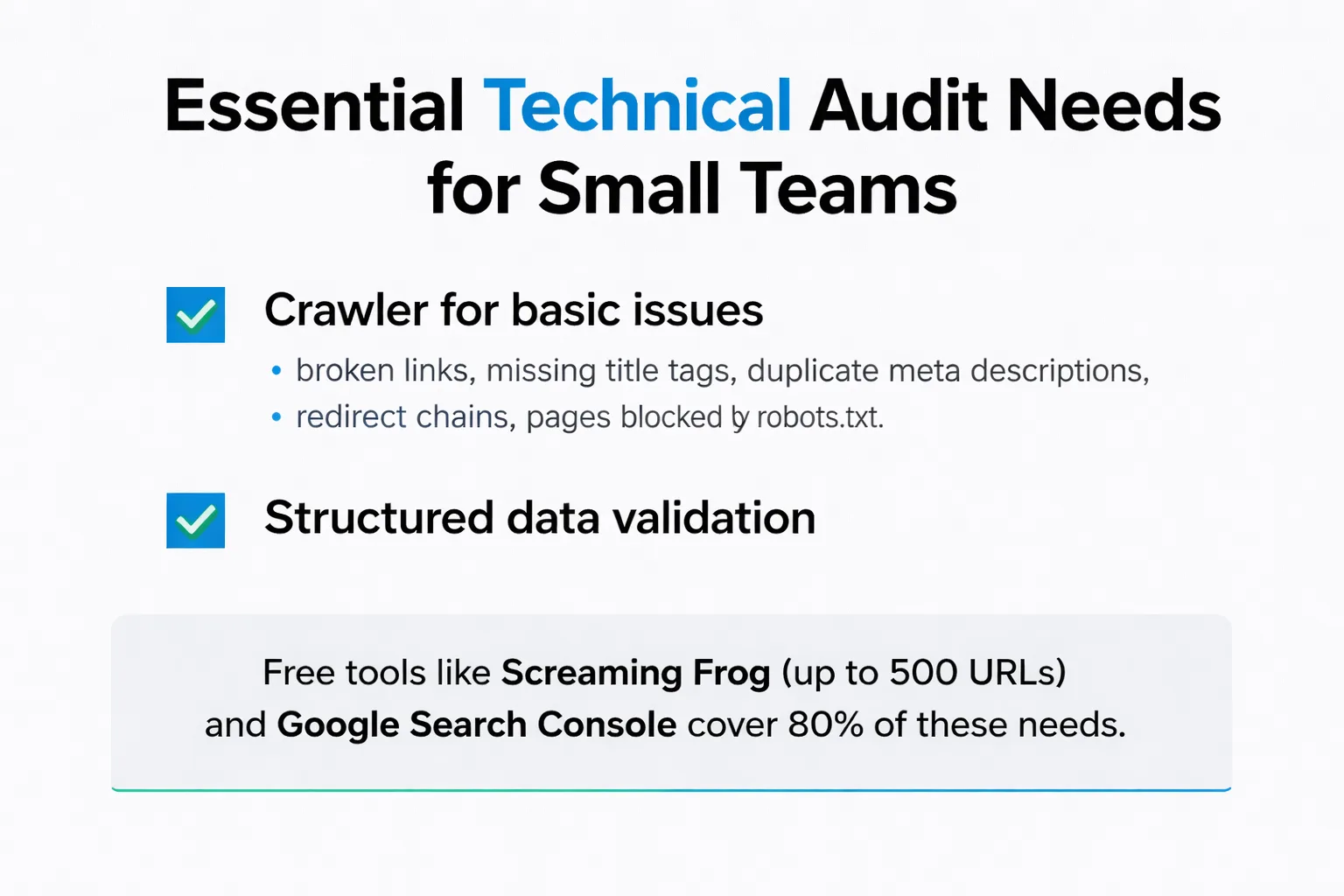
First, a crawler that can identify basic issues: broken links, missing title tags, duplicate meta descriptions, redirect chains, and pages blocked by robots.txt. Screaming Frog does this well and the free version covers up to 500 URLs, which is enough for most small sites. Google Search Console covers indexation status and core errors for free. Between those two, you have 80% of what a small team needs.
Second, structured data validation. This matters more in 2026 than ever because AI engines use schema markup to understand entity relationships. If your product pages lack Product schema, your articles lack Article schema, and your FAQs lack FAQPage schema, you are making it harder for AI models to parse and cite your content. Google's Rich Results Test is free and covers validation. You do not need a paid tool for this unless you are managing schema across hundreds of templates.
Third, Core Web Vitals monitoring. Google Search Console gives you field data for free. If you need lab data for debugging, PageSpeed Insights is free. A paid tool like Semrush or Ahrefs adds trend tracking, but the underlying data comes from the same CrUX dataset.
What small teams do not need: enterprise crawl depth analysis, log file analysis (unless you have a massive site with crawl budget issues), international SEO auditing (unless you operate in multiple markets), and automated schema generation at scale (unless you have thousands of pages).
The one area where I see teams under-invest is entity grounding for AI search. This is not a traditional technical SEO task, but it is becoming one. AI engines build their understanding of your brand from structured data, knowledge graph entries, and consistent entity references across the web. If your brand is not on Wikidata, your schema does not include Organization entity references, and your internal linking does not reinforce topical clusters, AI models will struggle to associate your content with your brand.
Grounding means you have more control over what AI says about you than most people assume, according to MQL Magnet's B2B guide to search grounding. Without it, ecommerce sites lose control over AI-generated product descriptions, pricing claims, and search visibility. The failure mode is what Saket Saurabh describes as "accurate data interpreted through the wrong context". AI models can cite your pricing correctly but apply it to the wrong product, or describe your features accurately but in the context of a competitor's value proposition.
Lee Boonstra from Google/Kaggle emphasizes that "examples help guide the model toward intended structure" and that you should "be specific about output." Both of these are grounding techniques that are entirely absent when entity context is skipped. In practice, this means your technical audit needs to check for more than missing H1 tags. It needs to verify that your Organization schema includes the same name, same URL, and same logo that appears on your Wikidata entry. It needs to confirm that your product schema includes accurate offers, availability, and price data that matches what is on the page. Inconsistency between structured data and visible content is a grounding failure that AI models will resolve by picking one version (usually not yours).
For technical audit coverage, my recommendation for teams under 5 people: Google Search Console (free) + Screaming Frog free tier + Google Rich Results Test (free). Add a paid crawler only when your site exceeds 500 pages or you need scheduled crawl comparisons. Spend the saved budget on AI visibility tracking instead.
One more technical audit dimension that matters specifically for AI search: the llms.txt file. This is a relatively new standard that tells AI crawlers which parts of your site they should and should not access. If you have not validated your llms.txt file, you may be unintentionally blocking AI engines from crawling your best content, or you may be allowing them to crawl thin pages that dilute your entity signal. A free validator takes 30 seconds and can surface issues you did not know existed.
Decision 4: How Should Reporting Cover Both Search and AI?
Reporting is where the two-track reality of 2026 SEO hits the wall of stakeholder expectations. Your CEO wants to know "are we ranking?" Your board wants to know "are we visible in AI?" Your content team wants to know "what should we write next?" A reporting layer that only answers one of those questions is incomplete.
The problem is that most reporting tools are built for one world. Google Search Console reports on Google. Semrush reports on Google with some SERP feature data. AI visibility tools report on AI citations. Nobody combines them into a single view that a non-technical stakeholder can understand in 30 seconds.
This is where I see teams make the mistake of doubling their stack. They keep their Google reporting tool and add a separate AI visibility dashboard, then spend hours each month manually combining the data into a slide deck. That is not a stack. That is a workflow held together with hope and spreadsheet formulas.
The reporting layer you need should answer three questions in one view. First, where does the brand appear in Google search? This means rank positions, SERP feature occupancy, and organic traffic trends. Second, where does the brand appear in AI answers? This means mention count, citation position, share of voice versus competitors, and trend over time across every major AI search surface. Third, what should we do next? This means prioritized opportunities: keywords where you rank but are not cited, prompts where competitors are cited but you are absent, and content gaps that would move both metrics.
Ecommerce brands implementing GEO with structured content achieved citation rate increases from below 5% to 20-40% within 60-90 days, according to Search Engine Journal's analysis. The highest-performing brand captured 35-55% category share of voice by publishing three or more deep structured guides first. That is the kind of data point that belongs in a stakeholder report. Not "we published 12 articles this month." Rather, "we moved from 5% to 22% citation rate on target prompts in 90 days, capturing 40% category share of voice."
For teams that need to report on AI visibility specifically, a dedicated LLM visibility tool can provide the drill-down data: which prompts trigger citations, which competitors appear when you do not, and how your share of voice trends week over week. The key is making sure this data feeds into the same reporting cadence as your Google rank tracking, not a separate report that gets ignored.
Let me describe what a good combined report looks like in practice. The top section shows Google performance: top 10 keywords by movement, organic traffic trend, and SERP feature occupancy. The middle section shows AI visibility: citation rate across target prompts, share of voice versus top 3 competitors, and trend over the last 30 days broken down by AI surface (ChatGPT, Perplexity, Claude, Google AI Overviews). The bottom section shows prioritized actions: the top 5 prompts where you are absent but a competitor is cited, the top 5 keywords where you rank on Google but are not cited in AI Overviews, and the top 3 content opportunities ranked by estimated citation impact.
That report takes 30 seconds to read and tells a stakeholder exactly where you stand and what you are doing about it. If your current reporting tool cannot produce that view, you have a reporting gap. The question is whether to replace your existing tool or add a layer on top. For most small teams, adding a dedicated AI visibility tool that exports data you can combine with your Google Search Console export is faster and cheaper than replacing your entire stack.
The reporting decision comes down to this: do not buy two tools and manually merge their outputs. Either find a platform that covers both surfaces, or accept that your reporting will have a blind spot. In my experience, the blind spot is always on the AI side because that is the newer, less understood surface. Teams default to what they know (Google rankings) and treat AI visibility as a "nice to have" until a competitor starts getting cited in every ChatGPT response in their category.
For agencies specifically, white-label reporting that covers both surfaces is critical. Your clients do not want two dashboards. They want one report that shows their search performance holistically. If your reporting layer only covers Google, your clients will eventually notice the gap when they ask ChatGPT about their own brand and do not see themselves cited.
Do you know how often AI engines cite your brand versus competitors?
Decision 5: Where Should You Allocate Budget?
Budget allocation is the decision that forces all the previous ones into reality. Most small teams I work with have between $200 and $800 per month to spend on tools. That is not enough for enterprise suites, and it is too much to waste on redundant tools that overlap.
Here is the framework I use for teams under 5 people.
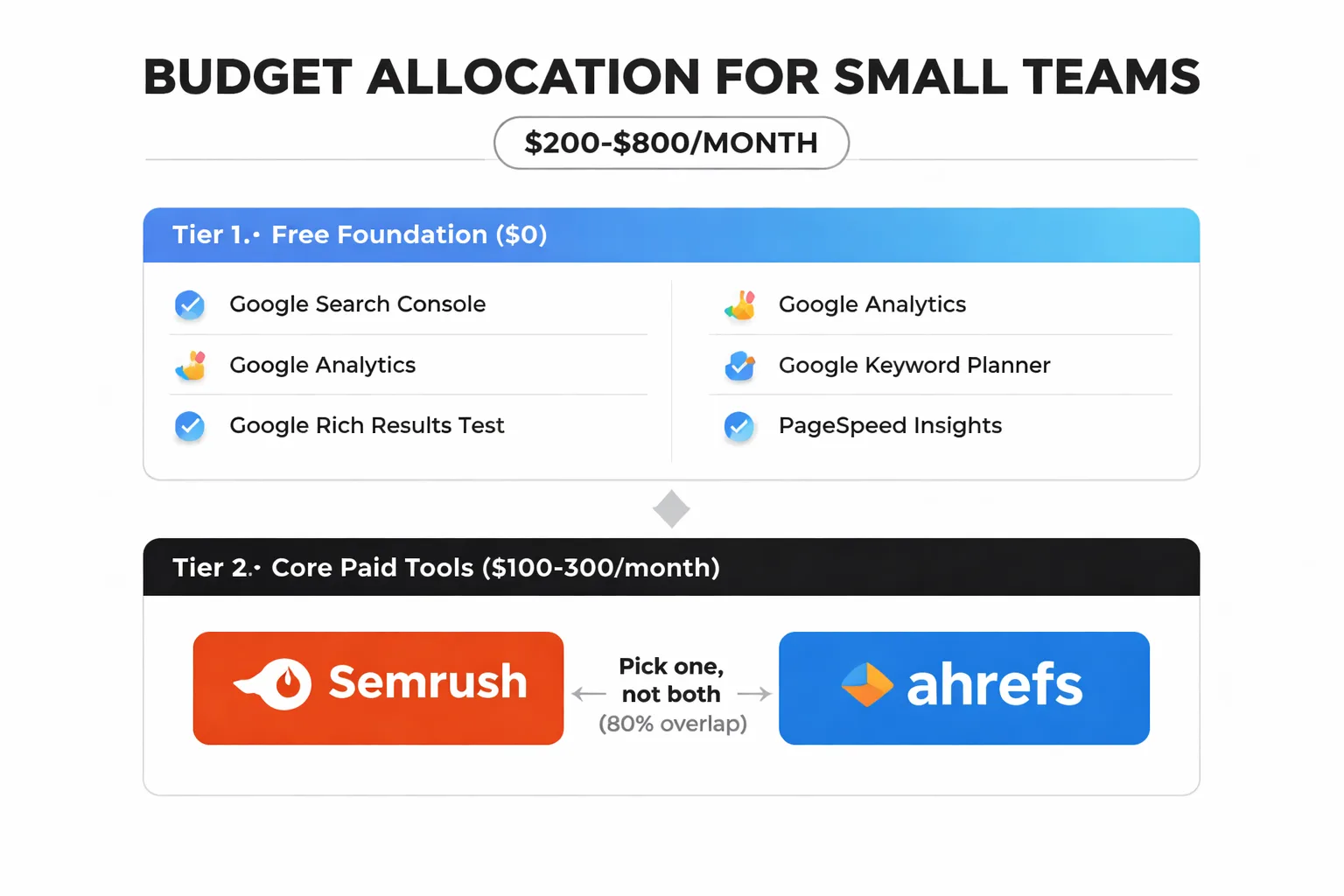
Tier 1: Free foundation (always start here). Google Search Console, Google Analytics, Google Keyword Planner, Google Rich Results Test, PageSpeed Insights. These cover rank tracking basics, traffic analysis, keyword volume data, schema validation, and Core Web Vitals. Total cost: $0. This is non-negotiable. If you are not using all five of these, you are leaving data on the table.
Tier 2: Core paid tools ($100-300/month). This is where you pick one keyword research and rank tracking tool. Semrush and Ahrefs are the two dominant options. Both cost roughly $100-130/month for entry tiers. Pick one, not both. They overlap by 80% in functionality. The deciding factor should be which one has better data for your specific market (Semrush tends to be stronger for PPC-heavy markets, Ahrefs for content-driven markets). This tier also includes a technical crawler if your site exceeds the free Screaming Frog limit ($200/year for a license).
Tier 3: AI visibility layer ($50-270/month). This is the tier most teams skip, and it is the one that matters most for 2026. You need a tool that tracks brand mentions and citations across AI search surfaces. Entry-level options start around $50/month. More comprehensive platforms that include citation gap analysis, competitor share of voice, and content opportunity discovery run $200-270/month. If you are evaluating this tier, the key question is whether the tool queries AI engines directly or estimates visibility from SERP data. Direct querying is the only reliable method.
The budget split I recommend for a team of 3-5 people with $500-800/month total: 40% on core paid tools (keyword research + rank tracking), 35% on AI visibility tracking, 15% on technical audit, 10% reserved for experimentation. The AI visibility allocation is the one that feels too high to most teams until they see the data. Once you realize your brand is absent from 80% of AI answers in your category, that 35% starts to look like the most important line item.
For larger teams or agencies managing multiple domains, the calculus changes. You need multi-domain dashboards, white-label reporting, and higher query volumes. In that case, a platform like Meev that combines AI visibility tracking with content generation and publishing in one workflow can replace 2-3 separate tools, which actually reduces total spend while increasing coverage. But for small teams, the key is resisting the urge to buy enterprise suites that bundle everything poorly.
A common mistake I see: teams buy Semrush at $130/month, then add Ahrefs at $130/month because they want "both perspectives." They are paying $260/month for tools that overlap 80% in functionality. That $130 could fund an entire AI visibility tracking layer. Pick one keyword tool and redirect the savings to AI citation tracking. The marginal value of a second keyword research tool is near zero compared to the marginal value of knowing whether AI engines cite your brand.
Another mistake: teams buy enterprise SEO suites ($300-500/month) that include "AI features" as a line item, then skip dedicated AI visibility tools because they think the suite covers it. The suite's AI features are almost always bolted-on estimations, not direct LLM queries. You end up paying enterprise prices for unreliable data. Better to buy a mid-tier keyword tool ($100/month) and a dedicated AI visibility tracker ($150/month) for $250 total than to spend $400 on a suite that does both poorly.
When This Framework Breaks Down
This five-decision framework assumes you are a small team with a single domain and a content strategy you control. It breaks down in three specific scenarios.
First, if you are an agency managing 10+ client domains, the per-domain cost of separate tools becomes unsustainable. You need a multi-domain platform, and the tradeoff is less depth per domain in exchange for breadth across the portfolio. The framework above will overcount your tool needs.
Second, if you operate in a YMYL (Your Money Your Life) niche, the content quality bar is higher and AI-generated content carries real risk. I have seen AI agents produce content for niche YMYL topics that required significant human editing to meet basic quality standards. The tool stack matters less than the editorial process in this case. No tool compensates for publishing inaccurate health or financial advice.
Third, if your primary channel is not search. If you are a brand that grows through community, social, or partnerships, investing heavily in an SEO tools stack is a misallocation. Track your AI visibility so you know what is being said about you, but do not build a content engine around it.
What This Actually Means
The shift happening in 2026 is not that SEO is dying. It is that SEO is splitting into two disciplines that share a foundation but require different tools. The foundation is the same: clean technical SEO, structured data, authoritative content, and a fast crawlable site. What changes is the measurement layer and the optimization target.
Google rewards relevance and authority. AI engines reward extractability and entity grounding. Your tool stack needs to measure both, report on both, and guide content decisions for both. The teams that figure this out in 2026 will capture AI citation share while their competitors are still arguing about whether AI search is real.
The five decisions are straightforward once you accept the two-surface reality. Track both Google and AI. Research content for both keyword volume and citation opportunity. Audit for both crawlability and entity grounding. Report on both rank and citation share. Budget for both layers without redundancy. The teams that do this well are not spending more. They are spending differently.
If you want to see where you stand right now before making any tool decisions, start with a free visibility check across the major AI surfaces. The data will tell you which of these five decisions is most urgent for your team. In my experience, it is usually Decision 1. Most teams have no idea how invisible they are in AI answers until they measure it.
FAQ
What are SEO tools and why are they important?
SEO tools are software platforms that help you research keywords, track rankings, audit technical issues, analyze competitors, and measure content performance. In 2026, the category has expanded to include AI citation tracking and generative engine optimization. They matter because search now happens across Google and AI answer engines, and you cannot optimize what you cannot measure across both surfaces.
What is the difference between SEO tools and GEO tools?
SEO tools focus on Google search rankings, keyword volumes, and technical crawlability. GEO (generative engine optimization) tools focus on AI answer citations, entity grounding, and content extractability for LLMs. The best stacks in 2026 include both, because the two surfaces require different optimization strategies despite sharing a content foundation.
How much should a small team spend on SEO tools?
For teams under 5 people, I recommend $200-500/month total: free Google tools as a foundation, one paid keyword/rank tracking tool ($100-130/month), and an AI visibility tracking layer ($50-270/month). Do not buy enterprise suites. The key is covering both Google and AI surfaces without redundant tools.
Can Google Search Console track AI citations?
No. Google Search Console tracks Google search performance only: impressions, clicks, positions, and indexation status. It does not track brand mentions or citations in ChatGPT, Perplexity, Claude, or other AI search surfaces. You need a dedicated AI visibility tool for that data.
Do I need separate tools for Google SEO and AI search optimization?
In most cases, yes. Traditional SEO suites (Semrush, Ahrefs, Moz) are built around Google SERP data and do not query AI engines directly. AI visibility tools query LLMs and track citation patterns. Some platforms combine both, but if you are using a traditional SEO suite, you likely need a separate AI visibility layer.
What is entity grounding and why does it matter for tool selection?
Entity grounding is the process of ensuring AI models can correctly identify and associate your brand, products, and content with the right context. It involves structured data, knowledge graph presence, and consistent entity references. It matters for tool selection because your stack needs to audit entity grounding, not just traditional SEO factors. Without it, AI models may cite your data in the wrong context.
How do I know if my AI visibility tool is actually querying LLMs?
Run the same 20 prompts through the tool and through manual ChatGPT and Perplexity queries. Compare the citation data. If the tool's data does not match what you see manually, it is estimating from SERP data, not querying the LLMs directly. Estimation creates false confidence and is worse than no data at all.
About the Author
Judy Zhou, Founder
Judy Zhou leads content strategy at Meev, where she oversees AI-driven content research and publishing for hundreds of brands. With a background in SEO and editorial operations, she focuses on building content systems that rank on Google, get cited by AI search engines, and drive measurable business results.
Stop guessing about your AI search visibility. Run a free check across every major AI surface and see exactly where you stand before you spend another dollar on tools.