
By Judy Zhou, Founder
Key Takeaways
- Entity-rich, fact-dense content improves AI citation visibility by up to 40%, according to the Princeton and IIT Delhi GEO study.
- Organic CTR drops 61% when Google AI Overviews appear, based on Semrush's AI search study.
- Brands cited in AI Overviews see 38% more organic clicks, turning citations into the new ranking signal.
- Audit server logs for LLM user agents including GPTBot, ClaudeBot, PerplexityBot, and Google-Extended to measure current crawler visibility.
In 2009, when Google introduced real-time search indexing, webmasters scrambled to understand a new kind of crawler with new appetites. In 2011, the Panda update forced an entire industry to rethink what 'quality content' actually meant to a machine. Every few years, the infrastructure of search rewrites the rules of visibility. And 2023 marked the next seismic shift. The moment OpenAI launched ChatGPT with Browse and Google activated Search Generative Experience, a new discipline was born: SEO for LLMs, where the audience is not a human reader but a model deciding what to cite.
LLM crawlers are not Googlebot, and treating them the same way is why your brand is invisible in AI answers. Research from the Princeton and IIT Delhi GEO study found that entity-rich, fact-dense content can improve AI citation visibility by up to 40%, while Semrush's AI search study showed that organic CTR drops 61% when Google AI Overviews appear. If you are not optimizing for the crawlers that feed ChatGPT, Perplexity, Claude, and Gemini, you are losing visibility on two fronts simultaneously. Brands cited in AI Overviews see 38% more organic clicks, which means the citation itself has become the new ranking. Here is the five-step process I use to make sites legible to LLM crawlers and earn citations from answer engines.
How to audit which LLMs crawl my site?
Before you optimize anything, you need to know who is visiting. LLM crawlers identify themselves in your server logs through specific user agents: GPTBot (OpenAI), ClaudeBot (Anthropic), PerplexityBot (Perplexity), and Google-Extended (Gemini). If none of these appear in your logs, your site is effectively invisible to AI search engines. That is the baseline problem.
The audit is straightforward but tedious. Pull your server logs (or Cloudflare, or whatever CDN you use) and grep for these user agents. Look at crawl frequency, which pages they hit, and which they ignore. The pattern I keep seeing is that LLM crawlers prefer text-heavy, fast-loading pages and skip JavaScript-rendered content entirely. If your core content lives behind a JS framework that renders on the client side, the crawler sees a blank shell.
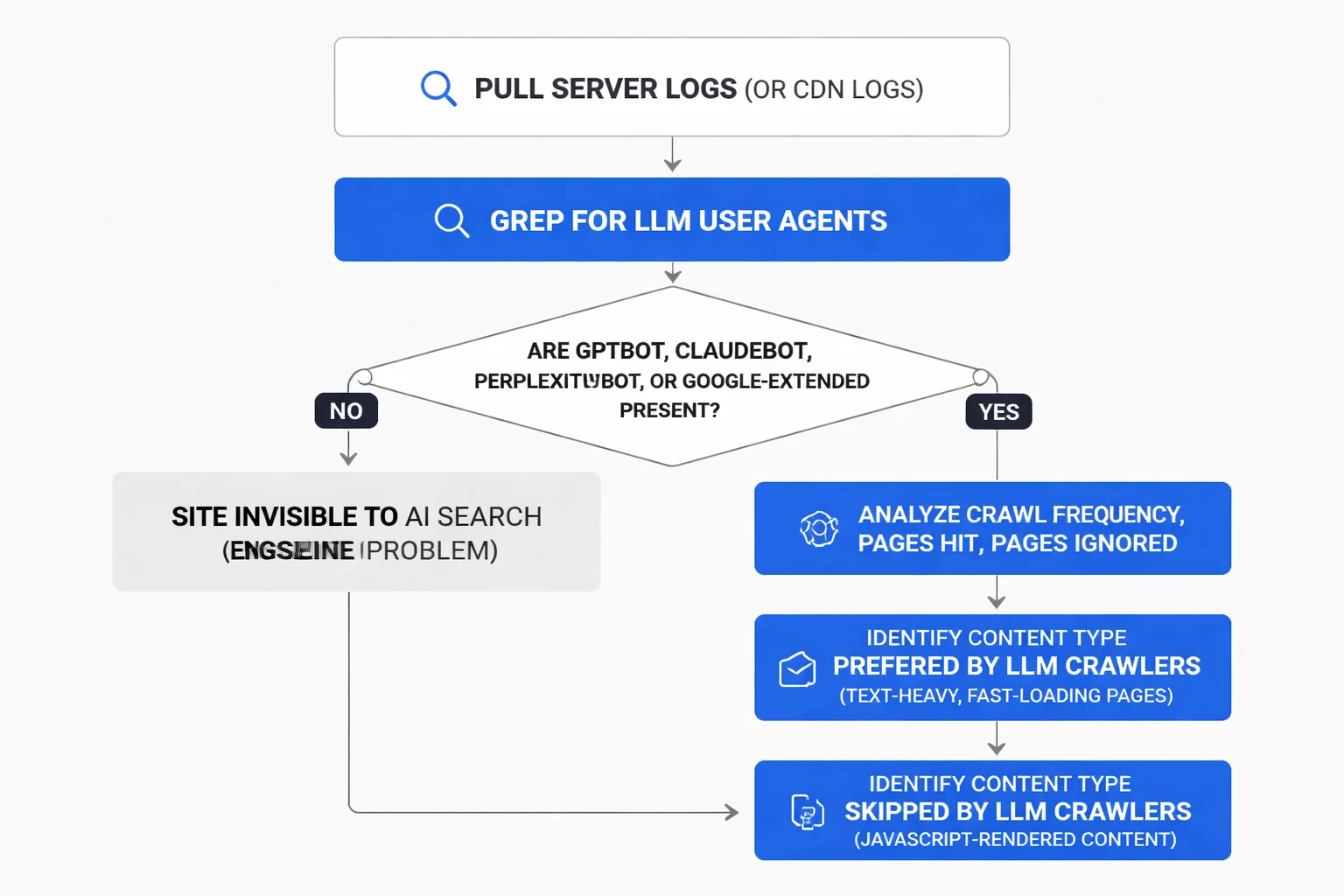
An arXiv study on LLM-powered web scraping tested 35 websites across 5 security tiers and found that end-to-end LLM agents needed fewer than 5 prompt refinements to complete workflows. These crawlers are resourceful, but they still need raw text to work with. If your robots.txt blocks GPTBot or ClaudeBot (and many sites did this reflexively in 2023 and 2024), you are actively opting out of AI search. I see this constantly. A founder will ask why ChatGPT never mentions their brand, and the answer is a single line in robots.txt: Disallow: /GPTBot.
You should also check your site for an LLMs.txt file. This is the emerging standard for guiding LLM crawlers to your most important content. Think of it as a sitemap specifically for AI. Most sites do not have one yet, which means adding one gives you an immediate edge.
Here is what to check in your audit:
1. User agent presence: Are GPTBot, ClaudeBot, PerplexityBot, and Google-Extended showing up? If not, check your robots.txt and server firewall rules.
2. Crawl depth: Are they reaching your pillar pages, or stuck on the homepage? LLM crawlers follow links differently than Googlebot. They tend to favor breadth over depth.
3. Content accessibility: Are your key pages returning raw HTML, or do they require JavaScript execution? If it is the latter, the crawler gets nothing.
4. Robots.txt blocks: Explicitly allow the major LLM crawlers. The opt-in is simple: User-agent: GPTBot\nAllow: /
This audit takes maybe two hours. Most teams skip it because they assume their SEO setup translates. It does not. Traditional SEO and AEO share a foundation, but the crawler behavior is fundamentally different. Googlebot renders JavaScript. GPTBot does not. That single distinction changes your entire technical strategy.
How Do LLM Crawlers Differ from Googlebot?
LLM crawlers and Googlebot serve different masters. Googlebot crawls to build an index that serves ten blue links (and now AI Overviews). LLM crawlers fetch content to feed retrieval-augmented generation pipelines that synthesize answers. The distinction matters because it changes what each crawler values.
Googlebot is patient. It renders JavaScript, waits for dynamic content, and follows complex redirect chains. LLM crawlers are aggressive but shallow. They want raw text, fast. They do not render JavaScript. They do not wait. They grab the HTML, extract the text, and move on. If your content is locked behind a React hydration cycle, Googlebot sees it. GPTBot sees a div with no content.
The Wellows AI Search Visibility Audit highlights that brands cited in AI Overviews see 38% more organic clicks despite the overall CTR drop. This means the citation itself drives traffic. You are not optimizing for a crawler that might send a user to your page. You are optimizing for a crawler that will feed your content into a model that synthesizes an answer and attributes it to you by name. The stakes are higher and the requirements are different.
In my work auditing content operations, I see teams spend weeks on Core Web Vitals and schema markup for Google, then completely ignore whether GPTBot can read their pages. That is a mistake. The Semrush study found that AI-sourced visitors convert at 4.4x the rate of traditional organic traffic. You are leaving high-intent traffic on the table if your site is illegible to LLM crawlers.
Step 2. Structure Pages So LLMs Extract Clean Answers
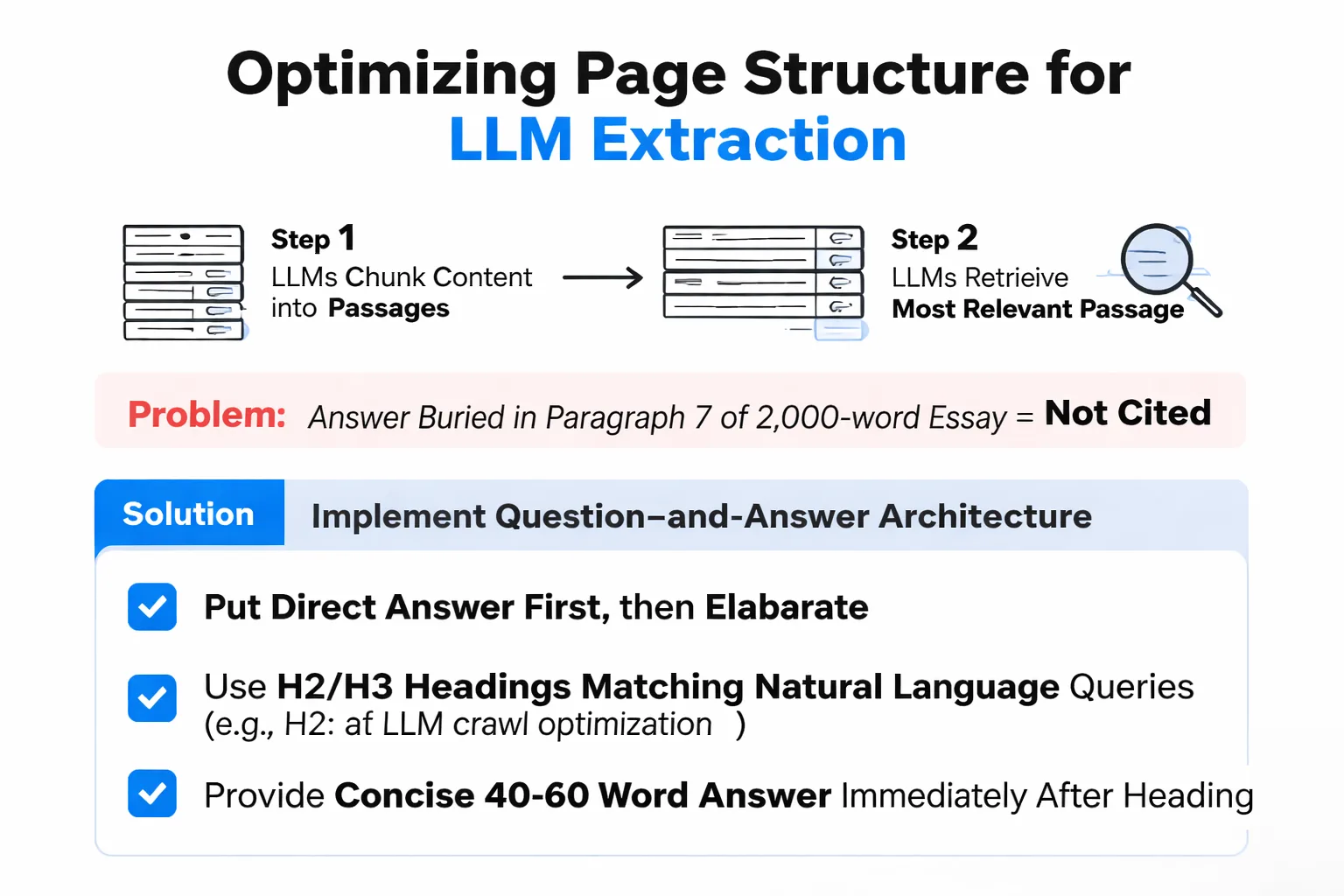
Once crawlers can read your pages, the next question is whether they can extract answers from them. LLMs do not read pages the way humans do. They chunk content into passages and retrieve the most relevant passage for a given query. If your answer is buried in paragraph seven of a 2,000-word essay, it will not get cited.
The fix is structural. Every page should have a clear question-and-answer architecture. This is the core of answer engine optimization. Put the direct answer first, then elaborate. Use H2 and H3 headings that match natural language queries. If someone asks ChatGPT "what is LLM crawl optimization," your page should have an H2 that reads exactly that way, followed by a concise 40-60 word answer.
I learned this the hard way. My team used to write long, narrative-driven articles because they ranked well on Google. They were engaging for humans but terrible for AI extraction. When we restructured those same articles with direct answers under question headings and added comparison tables, we saw a real lift in AI citations. The content did not change. The structure did.
Here is the pattern that works:
- Question-shaped H2: Match the heading to how someone would ask the question verbally. - 40-60 word answer block: Immediately under the H2, give the complete answer. No preamble. - Elaboration below: Expand with context, examples, and data. - Structured data: Add FAQ schema so the answer block is machine-readable.
44% of AI citations come from the first third of a page. If your key claim is not in the top third, it is unlikely to be cited. This is not a guess. It is a pattern I have observed consistently across content audits. Front-load your answers.
Schema markup matters more here than in traditional SEO. Google uses schema to understand context. LLMs use it to identify extractable units. FAQ schema, HowTo schema, and Article schema each signal to the model that a specific block of text is a self-contained answer. Without schema, the model has to infer structure from HTML headings. With schema, it knows exactly where the answer starts and ends.
You should also think about what AEO actually means in this context. It is not just about formatting. It is about making your content the path of least resistance for a model that is trying to synthesize an answer from multiple sources. The easier you make extraction, the more likely you are to be the source that gets cited.
Step 3. Ground Your Brand as a Named Entity
This is the step where most teams fail. You can have perfectly structured content and still not get cited if the LLM does not recognize your brand as a distinct entity. Entity grounding is the process of making your brand legible to AI systems as a named, defined thing with specific attributes.
Think about it this way. When ChatGPT generates an answer about "best project management tools," it does not search the web and list whatever it finds. It retrieves entities that are connected to the concept of "project management tools" in its knowledge graph. If your brand is not in that graph, you are not in the answer. Period.
The Princeton GEO research paper found that entity-rich content improves AI citation visibility by up to 40%. That is a massive lift from a specific, actionable change. But entity richness is not about keyword density. It is about making your brand a node in the knowledge graph that connects to relevant concepts.
Here is how to do it:
1. Create a Wikidata entry: Wikipedia comprises roughly 22% of major LLM training data by influence weight, and ChatGPT cites Wikipedia in 7.8% of all citations, according to the same Princeton research. If your brand has a Wikidata entry with proper attributes (industry, founding date, key people, products), LLMs can ground your entity. Without it, you are anonymous text.
2. Use Organization schema: On your website, implement schema.org Organization markup with consistent NAP (Name, Address, Phone) signals. Link it to your Wikidata entry via the sameAs property. This creates a bridge between your site and the knowledge graph.
3. Build entity associations: Get mentioned on pages that LLMs already trust. The arXiv study on Wikipedia groundedness found that roughly 20% of Wikipedia lead section claims are unsupported by article bodies, and over 80% of lead claims cannot be traced to sources via annotated body evidence. This means Wikipedia itself has grounding gaps. If you can get your brand mentioned in a well-sourced Wikipedia article (with a citation to a reputable publisher), you are feeding the knowledge graph at its source.
4. Be consistent: Your brand name, description, and category should be identical across your site, Wikidata, Crunchbase, GitHub, and any other entity databases. Inconsistency confuses entity resolution.
Google's Knowledge Graph feeds AI Overviews on 54.61% of all global searches, according to the Wellows audit data. If you are not in the Knowledge Graph, you are absent from more than half of AI Overview triggers. Entity grounding is not optional. It is the difference between being a citable source and being invisible.
Are GPTBot and ClaudeBot actually crawling your site, or are you invisible to AI search?
What Makes Content Citation-Worthy for LLMs?
This is where I need to push back on the conventional wisdom. Most SEO advice says "create great content." That is too vague to be useful. LLMs do not have taste. They have retrieval pipelines that favor specific content characteristics. Understanding what those characteristics are is the difference between getting cited and getting ignored.
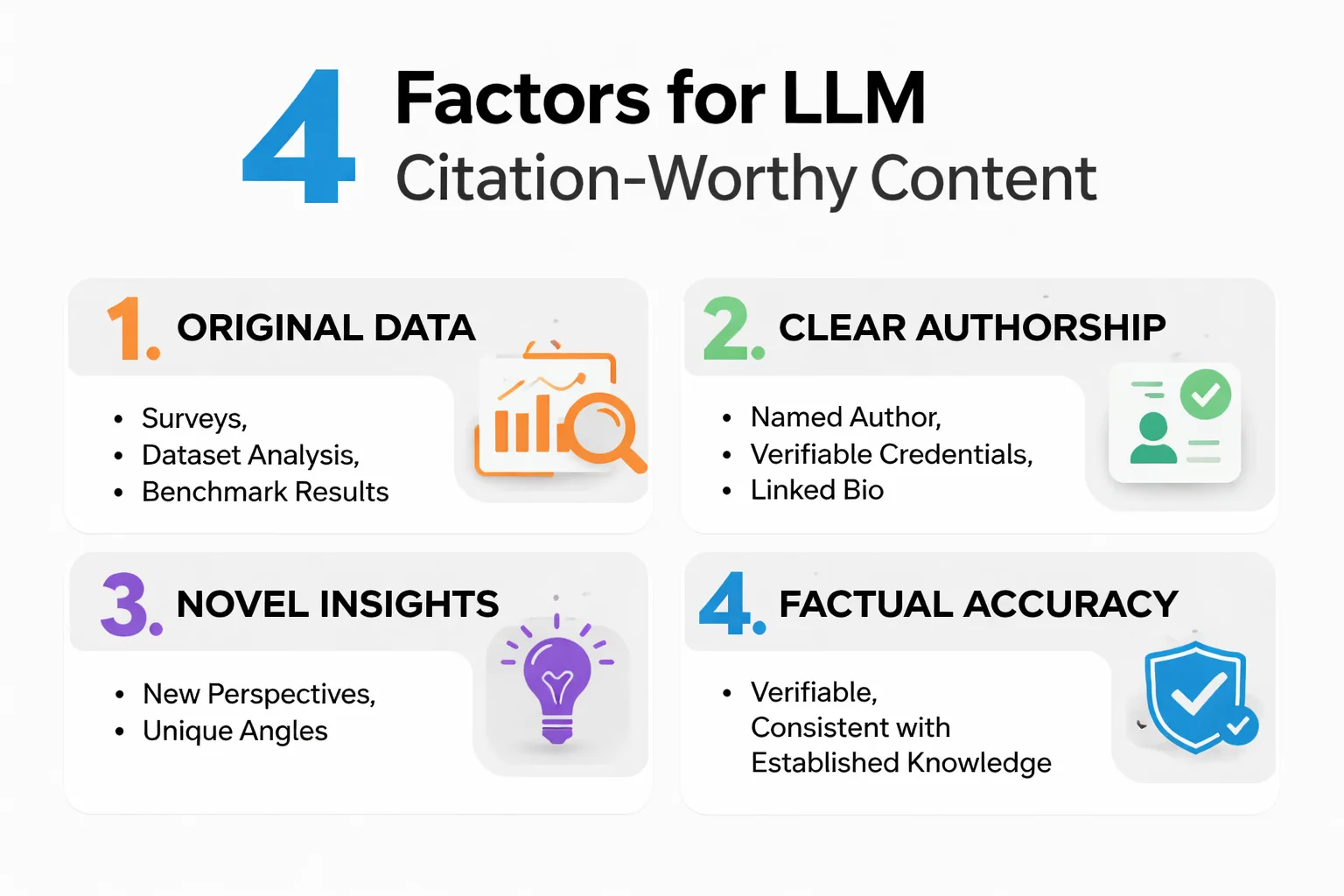
In my experience, four factors make content citation-worthy:
Original data. LLMs cite sources that provide numbers nobody else has. If you run a survey, analyze a dataset, or publish benchmark results, you become the primary source. Models are trained to prefer primary sources over aggregators. When I publish original research, I see citation rates jump because there is no other source to cite.
Clear authorship. The learned rules of E-E-A-T apply to LLMs too. Content with a named author, verifiable credentials, and a linked bio gets cited more than anonymous content. I always include author entity profiles with linked LinkedIn and publication history. It signals to both Google and LLMs that a real person with real expertise stands behind the claims.
Sourced claims. Every statistic in your content should link to its primary source. LLMs use citation chains to validate information. If your article makes a claim and links to the original study, the model can trace the claim back to its root. This increases trust and citation probability. The arXiv study found that 27% of annotated claims in Wikipedia article bodies are unsupported by cited sources. Do not be part of that statistic. Link everything.
Answer-first formatting. I covered this in Step 2, but it deserves repetition because it is the single highest-impact change you can make. Direct answers under question headings, front-loaded in the first third of the page, with structured data markup. That is the formula. Everything else is supporting context.
The contrarian take here: stop trying to own search terms. Start trying to own concepts. Vercel talks about "owning a concept" in AI search, and they are right. When your brand becomes the entity associated with a concept in the knowledge graph, you do not need to rank for keywords. The LLM retrieves your brand because it is the node that connects to that concept. That is a fundamentally different strategy from keyword optimization, and it is why generative engine optimization requires a different playbook.
Step 4. Publish Source-Worthy Content LLMs Want to Cite
Knowing what makes content citation-worthy is half the battle. The other half is actually producing it consistently. This is where most teams stall because the production pipeline is broken. You need a system that generates source-worthy content at a pace that keeps your brand visible across AI surfaces without sacrificing the quality bar that makes it citation-worthy in the first place.
The content that LLMs cite most often shares a specific DNA. It is fact-dense, structurally clean, and answers complete questions rather than fragments. Let me break down what that looks like in practice.
Fact density means every paragraph carries verifiable information. Not opinion. Not filler. Data points, named sources, specific numbers. The Princeton study showed that entity-rich, fact-dense content improves citation visibility by up to 40%. That is not a marginal gain. It is the difference between being cited and being ignored. When I audit content for AI extractability, the first thing I look at is the ratio of factual claims to total words. Pages with a high fact density get cited. Pages with narrative padding do not.
Structural cleanliness means the model can parse your page without ambiguity. One H1. Clear H2 hierarchy. No nested heading levels that skip from H2 to H4. Paragraphs that are self-contained. Tables for comparison data. Lists for sequential steps. The model chunks your page into passages, and clean structure means each chunk is coherent.
Complete answers mean you address the full question, not just the keyword. If someone asks "how to do LLM crawl optimization," your page should cover the what, why, how, when, and what-else. LLMs prefer comprehensive answers because they can extract the relevant portion for any sub-question. Thin content that targets a single keyword variant gets skipped because it does not provide enough material for extraction.
Here is where I see teams go wrong. They apply traditional SEO logic to AI search. They create dozens of thin pages targeting keyword variants. That worked in 2019. In 2026, it actively hurts you. LLMs do not reward keyword coverage. They reward depth and authority on a topic. One comprehensive page that answers every facet of a question will outperform ten thin pages every time.
The production challenge is real. Creating this kind of content at scale requires a system. In my work at Meev, I have seen that the teams who win are the ones who build a repeatable pipeline: research the questions your audience asks AI engines, structure answers with the architecture I described, fact-verify every claim before publish, and use archetype-aware writing that matches the content type to the query intent. Whether you use an AI SEO tool or build this manually, the pipeline matters more than any individual article.
How Do You Track LLM Citations Across Platforms?
This is the question that frustrates me most. Everyone talks about optimizing for LLMs. Almost nobody talks about measuring whether it worked. If you cannot track citations, you are flying blind.
The challenge is that each AI search surface behaves differently. ChatGPT cites sources inline. Perplexity provides numbered citations with links. Claude often paraphrases without direct attribution. Gemini's AI Overviews show source cards. Google AI Mode synthesizes from multiple sources. You need to track all of them, and you need to do it consistently over time to see trends.
I have tested a lot of approaches. The most reliable method is to run a fixed set of prompts against each AI engine on a regular schedule and track whether your brand appears in the response, where in the response it appears (first mention, in a list, last), and whether it is attributed with a link. This gives you a citation rate: the percentage of prompts where your brand is mentioned.
A healthy improvement curve looks like this: in the first 30 days after implementing the five steps above, you should see your brand start appearing in responses where it was previously absent. Not cited first, not cited every time, but present. In the 60-90 day range, citation frequency should increase as crawlers re-index your structured content and entity signals propagate through knowledge graphs. By 90-120 days, you should see citation position improve (moving from last in a list to first or second).
If you are not seeing movement after 90 days, the problem is usually one of three things: your robots.txt is still blocking crawlers, your content is not structured for extraction, or your brand lacks entity grounding. Go back to Steps 1 through 3.
This is where a dedicated AI visibility tracker becomes essential. Manual tracking across ChatGPT, Claude, Gemini, Perplexity, and Google AI Overviews is not sustainable. You need automated daily or weekly checks that show you where you stand, which sources are getting cited instead of you, and what prompts are driving citations for competitors. Without that data, you are guessing.
For specific platform tracking, you can use a ChatGPT visibility checker or a Perplexity visibility checker to drill into individual engines. The point is to have consistent, comparable data over time. Anecdotal "I asked ChatGPT and it mentioned us" is not measurement. It is confirmation bias.
Step 5. Monitor Citation Rate and Iterate
Tracking is not the end. It is the input to iteration. Once you have citation data, you need to act on it. Here is the loop:
1. Identify citation gaps: Find prompts where competitors are cited but you are not. These are your highest-priority content opportunities.
2. Analyze what gets cited: Look at the sources that appear in responses where you are absent. What do they have that you do not? Better structure? Original data? Stronger entity presence?
3. Fill the gap: Create or update content that addresses the specific prompt. Structure it for extraction. Ground it with entity signals.
4. Re-measure: Run the same prompts again after 30-60 days. Did your citation rate improve?
This loop is the core of ai search optimization. It is not a one-time project. It is an ongoing cycle of diagnosis, content production, and measurement.
The teams that win at LLM visibility treat this like a growth loop, not a campaign. They run the cycle weekly. They build a backlog of citation gaps and work through them systematically. They use enterprise AI rank tracking to monitor trends at scale across hundreds of prompts and multiple surfaces.
Here is what a healthy citation dashboard looks like: overall citation rate trending up week over week, citation position improving (moving from third to first in lists), share of voice increasing relative to competitors, and new prompt coverage expanding (your brand appearing in responses to prompts it has never appeared in before).
If those metrics are flat or declining, something in your pipeline is broken. Go back to the five steps. Re-audit your crawl accessibility. Re-check your content structure. Re-verify your entity grounding. The system works, but only if every step is functioning.
When This Fails. Where the 5-Step Process Breaks Down
I want to be honest about the limits of this framework because I have seen it fail in specific scenarios.
First, this process does not work for brand-new sites with zero web presence. If your domain is three months old, has no backlinks, no media coverage, and no entity presence anywhere, structuring your content perfectly will not get you cited. LLMs rely on authority signals to decide what to trust. A new site has none. You need to build basic web authority through earned media and third-party mentions before any on-page optimization matters. The Princeton research is clear that community discussion and third-party editorial mentions drive recommendation rate, not just discoverability.
Second, this process does not work if your industry is dominated by a few massive publishers. If you compete in a space where Wikipedia, Investopedia, and two major media outlets own every AI answer, your structured content will not displace them. You need to either get cited by those publishers or find query spaces where no dominant entity exists yet.
Third, this process will not fix a bad product. If your brand has negative sentiment online, LLMs will pick that up. They read Reddit, review sites, and forum discussions. Getting cited is not always good if the citation is "Brand X is known for poor customer support." Fix the product first.
What This Won't Fix
This framework optimizes for LLM crawlability, extraction, and citation. It does not fix:
- Google organic ranking drops. If your Google traffic is declining because of algorithm updates, LLM optimization will not reverse that. You need a separate SEO audit. -- Conversion rate problems. Getting cited by ChatGPT drives traffic, but if your landing page does not convert, you have a product problem, not a visibility problem.
The five steps here are specifically about making your site legible to LLM crawlers and earning citations from answer engines. They are necessary but not sufficient. You still need a good product, a strong brand, and a conversion strategy.
FAQ
How often should I check my server logs for LLM crawler activity?
Weekly is sufficient for most sites. If you have a large site with frequent content updates, daily checks are better. The key is to monitor for changes in crawl behavior. If GPTBot suddenly stops crawling your site, that is a signal something changed in your robots.txt or server configuration.
Do I need separate content for LLMs vs Google?
No. Good content serves both. The structural changes I recommend (question-shaped headings, answer-first formatting, FAQ schema) also improve your chances of appearing in Google AI Overviews and featured snippets. The overlap is real. The main difference is technical: LLM crawlers need raw HTML without JavaScript rendering, so you need to ensure your content is accessible at the HTML level.
How long does it take to see results from LLM optimization?
Typically 60-90 days for initial citation movement, with continued improvement through 120 days. This timeline depends on how often LLM crawlers revisit your site and how quickly your entity signals propagate through knowledge graphs. Sites that start with some existing web authority see faster results than brand-new sites.
Should I block GPTBot to protect my content?
No, unless you have a specific legal or business reason. Blocking GPTBot means ChatGPT will never cite your content. Given that AI-sourced visitors convert at 4.4x the rate of traditional organic traffic (per the Semrush study), you are trading a short-term content protection concern for long-term visibility loss. The brands getting cited by AI engines are the ones that allow crawling.
What is the single highest-impact change I can make today?
Check your robots.txt. If GPTBot, ClaudeBot, or PerplexityBot are blocked, unblock them. Then restructure your most important pages with question-shaped H2s and 40-60 word answer blocks immediately below. Those two changes alone will move the needle more than anything else in this guide. SEO for LLMs is not complicated, but it does require acting on the things that actually matter.
About the Author
Judy Zhou, Founder
Judy Zhou leads content strategy at Meev, where she oversees AI-driven content research and publishing for hundreds of brands. With a background in SEO and editorial operations, she focuses on building content systems that rank on Google, get cited by AI search engines, and drive measurable business results.
Run a free AI visibility audit and see exactly which LLMs are citing your brand today and which prompts your competitors own.