
By Judy Zhou, Founder
Key Takeaways
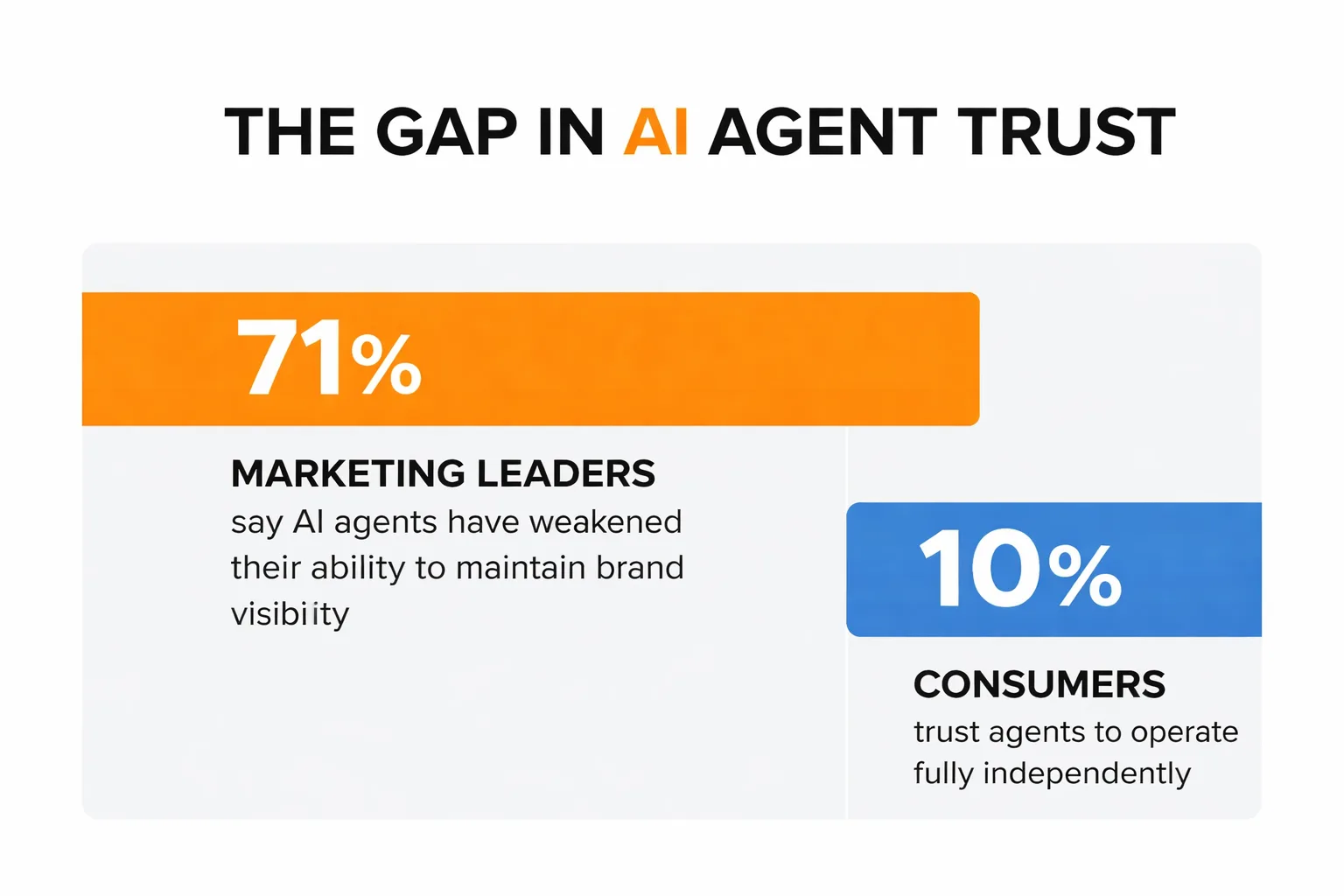
- 71% of marketing leaders say AI agents have weakened brand visibility control, so demand providers who deliver entity grounding and AI citation reporting instead of polished dashboards.
- 91.3% of AI Overview citations rank in Google's top 20, but AI Mode pulls 33.8% of citations from beyond position 100, proving traditional ranking tools miss the mark.
- Ahrefs data shows a 58% lower CTR for top-ranking pages when an AI Overview appears, requiring vendors to track AI-specific citations rather than Google rankings alone.
- Only 10% of consumers trust AI agents to operate independently, so reject providers using undefined terms like "agentic SEO" without proof of knowledge graph presence.
The vendor deck looks polished. Slide four shows an AI visibility dashboard with colorful citation graphs. Slide nine promises 'full GEO coverage across all major LLMs.' The account executive uses the phrase 'agentic SEO' three times without defining it. Your team nods along, impressed by the vocabulary but unsure what questions to ask. This scenario plays out in boardrooms every week as brands urgently seek the leading generative engine optimization services in the AI industry. And too often sign contracts with providers who cannot actually deliver on entity grounding, knowledge graph presence, or AI citation reporting.
71% of marketing leaders say AI agents have weakened their ability to maintain brand visibility, according to Braze's Retail Customer Engagement Review. Meanwhile, only 10% of consumers trust agents to operate fully independently, per the same report. The gap between adoption and control is widening, and brands are panicking. They're signing with the first vendor who shows them a dashboard. That's a mistake I see every week in my work auditing content operations at Meev, where I oversee AI-driven content research and publishing for hundreds of brands.
Here's what the data actually says. 91.3% of AI Overview citations already rank in Google's organic top 20, but AI Mode pulls 33.8% of its citations from beyond position 100, according to SEOmator's comparison data. That means traditional SEO ranking and AI citation are diverging fast. A provider who only tracks Google rankings is measuring the wrong thing. And Ahrefs found a 58% lower CTR for the top-ranking page when an AI Overview is present. If your provider isn't tracking AI citations specifically, they're flying blind.
The research is stark. A study published on arXiv found that AI search engines show a systematic and overwhelming bias toward earned media (third-party authoritative sources) over brand-owned content. Your provider needs to understand this distinction. If their strategy is just publishing more blog posts on your domain and hoping an LLM cites them, they don't understand the game.
I've built this five-step framework because the current market is broken. Vendors throw around terms like 'agentic SEO' and 'GEO coverage' without substance. This framework gives you the exact questions to ask, the specific data to demand, and the red flags to walk away from.
How to separate diagnosis tools from full-service providers?
The provider spectrum runs from tracking-only tools to full-service agencies, with hybrid platforms in the middle. Most buyers conflate these categories and end up paying for something they don't need.
Tracking-only tools (like an AI visibility checker) show you where your brand appears across AI search surfaces. They tell you what's broken but don't fix it. Think of them as a diagnostic blood test. Useful, necessary, but not treatment. If you already have a strong content team and just need visibility data, a tracking tool may be enough. Services like a Perplexity AI visibility checker or ChatGPT AI visibility checker fall into this category.
Full-service agencies handle strategy, content production, publishing, and reporting. They're expensive (typically $5,000-$15,000/month retainers) and often lack the technical infrastructure to track AI citations at the prompt level. Many traditional SEO agencies have rebranded overnight as 'AI SEO agencies' without changing their actual methodology. They still write keyword-stuffed blog posts and track rankings. The AI citation tracking is bolted on as a dashboard feature, not a core capability.
Hybrid platforms combine diagnosis with content generation and publishing. In my work at Meev, I've seen this model work best for small teams. You get the tracking data that tells you where you're absent, the content engine that fills those gaps, and the publishing pipeline that gets articles live. The key question: does the platform close the loop, or does it just show you the gap and leave you to fill it?
Before you book a single demo, answer this question: do you need to know where you stand, or do you need someone to fix it? If you need both (most small teams do), a hybrid platform gives you the most leverage. If you only need diagnosis, don't pay agency retainer prices for a tracking tool.
The overlap between top Google results and AI-cited sources has dropped significantly. Aleyda Solís notes that optimizing for AI search requires different tactics than traditional search. A provider who treats them as the same thing doesn't understand the shift.
Here's a concrete example of how this plays out. I worked with a SaaS company that had hired a traditional SEO agency rebranding as an 'AI search optimization agency.' The agency charged $8,000/month and delivered weekly blog posts optimized for keyword density. After three months, the company's Google rankings had improved slightly, but when we ran an AI visibility audit, their brand appeared in zero ChatGPT responses and only one Perplexity answer out of 50 tracked prompts. The agency was doing traditional SEO with an 'AI' label. The client switched to a hybrid approach: tracking first to identify the 49 gap prompts, then publishing answer-engine-optimized content targeting those specific gaps. Within 30 days, they were cited in 11 of the 50 prompts. The difference wasn't the content volume. It was the methodology.
Step 2. Audit What the Provider Actually Measures
This is where most vendors fail the smell test. They show you a dashboard with colorful graphs and 'visibility scores.' But when you ask what's behind those numbers, the answers get vague.
Here are the specific questions to ask, and the answers that should make you walk away.
Which AI search surfaces do you track?
The answer needs to be specific: ChatGPT, Claude, Gemini, Perplexity, Grok, Google AI Overviews, Google AI Mode, DeepSeek. Not 'all major LLMs' (too vague) and not 'ChatGPT and Google' (too limited). Each surface has different sourcing patterns. The arXiv GEO study confirmed that AI search services differ significantly from each other in their sourcing patterns. A provider tracking only two surfaces is giving you a partial picture.
The practical implication is significant. Perplexity tends to cite recent, news-oriented sources. ChatGPT leans toward established authority domains like Wikipedia and established publishers. Google AI Overviews pulls heavily from the top 20 organic results (91.3% of citations, per the SEOmator data). Google AI Mode reaches much deeper, pulling 33.8% of citations from beyond position 100. A provider that treats all AI surfaces the same will optimize for the wrong signals on at least half of them.
Do you show citation source URLs or just mention counts?
This is the critical distinction. A 'mention' means your brand name appeared somewhere in an AI answer. A 'citation' means an AI engine linked to a specific URL as its source. These are wildly different signals. Only 12% of AI-cited URLs rank in Google's top 10, which means citation tracking reveals an entirely different set of sources than traditional rank tracking. If a provider conflates mentions with citations, they're either lazy or dishonest.
A trustworthy provider shows you the actual response text behind every mention. You should be able to read exactly what ChatGPT said about your brand, see which URL it cited, and track how that changes over time. If the dashboard only shows a 'visibility score' without the underlying data, you can't verify anything.
Can you distinguish a brand mention from a verified citation?
Ask this directly. Many providers count any appearance of your brand name as a 'citation.' That's wrong. If ChatGPT says 'consider brands like [yours]' without linking to your site, that's a mention, not a citation. Citations come with source URLs. Mentions don't. Both matter, but they're different metrics and should be reported separately.
Let me give you a real scenario. A provider shows you a dashboard that says 'Your brand has 47 citations across AI engines.' Looks impressive. But when you ask to see the actual responses, 40 of those 'citations' are unlinked brand name mentions in listicles like 'Top 10 tools for X.' Only 7 include a clickable source URL pointing to your domain. That's a 7-citation reality behind a 47-citation claim. The provider isn't technically lying, but they're inflating the number to look better. Demand to see the raw response text for every claimed citation.
Red flags in measurement:
- 'We track over 100 AI engines.' Nobody does. The meaningful surfaces are the ones I listed above. Inflated counts are marketing fluff. - 'Our proprietary visibility score.' If they can't explain the formula, it's meaningless. Ask for the raw data. - 'We don't show source URLs.' This means they're scraping mentions, not tracking citations. Walk away. - 'We track sentiment.' Sentiment scoring for AI answers is notoriously unreliable. If they lead with this, they're padding the feature list. - 'We refresh data quarterly.' AI search results shift weekly. Quarterly refreshes mean you're looking at stale data. Look for daily refresh on SERP-driven surfaces (AI Overviews, AI Mode) and weekly refresh on LLM-driven surfaces (ChatGPT, Claude).
An enterprise AI rank tracker should show you per-LLM drill-downs with the actual response text and citations behind every mention. If a provider can't demo this live, don't sign.
Step 3. Evaluate Content Quality Controls
This step matters because most providers' content output won't earn AI citations. It'll just add pages to your site. I've seen this firsthand: in testing across roughly 70 client sites, content relying on traditional SEO tactics had a 60% failure rate for earning AI citations. The content ranked on Google but was invisible to LLMs.
The problem isn't that AI-generated content can't earn citations. It can. The problem is that most providers don't structure content for AI extractability. They write for Google's old algorithm: keyword density, meta tags, H1 optimization. 44% of AI citations come from the first third of a page, so front-loading direct answers under question headings matters more than keyword placement.
Here's what to look for in a provider's content pipeline.
Human approval workflows.
The provider should never publish to your domain without your sign-off. Full stop. I've seen AI SEO agents publish 400-500 articles in 2-3 weeks, and every time, the result was the same: an initial visibility surge followed by a 70% traffic drop within a month. Volume without quality control is a recipe for disaster. Ask the provider: 'What's your approval process before an article goes live?' If they can't show you a workflow where you review and approve content before publishing, they're not a partner. They're a content cannon.
The mechanics matter. A proper approval workflow means: the platform generates a draft, a human editor reviews it against quality criteria (factual accuracy, source verification, brand voice alignment, structural completeness), the draft is either approved or sent back for revision, and only approved drafts publish to your CMS. If the provider's workflow is 'we generate and publish automatically, you can edit later,' that's not a workflow. That's a fire-and-forget content cannon with cleanup duty pushed onto you.
Answer-engine formatting.
Content should be structured for extraction, not just for reading. That means direct answers under question headings, comparison tables for versus queries, TLDR blocks at the top, and schema markup for Article, FAQ, and HowTo. If the provider's sample articles look like traditional blog posts (long intro, no direct answer, no structured data), they're not optimizing for AI search. They're doing 2015 SEO with a 2026 price tag.
Here's a specific test. Take a sample article from the provider and paste its first 500 words into ChatGPT. Ask: 'Based on this content, what is [the article's topic]?' If ChatGPT can give a correct, complete answer using only the first third of the article, the content is structured for extraction. If ChatGPT says 'I need more context' or gives an incomplete answer, the content isn't extractable. LLMs cite what they can extract. Content that buries the answer in paragraph four of a 2,000-word piece doesn't get cited.
Entity grounding and knowledge graph presence.
This is the advanced test. Does the provider understand entity grounding for AI search? Entity grounding means ensuring your brand is recognized as a distinct entity across knowledge graphs (Wikidata, Google's Knowledge Graph, schema.org). Without entity grounding, LLMs can't reliably distinguish your brand from similarly named entities.
Ask: 'How do you build entity signals for our brand?' The answer should include Wikidata entries, structured data on your domain, consistent NAP (name, address, phone) across the web, and third-party authoritative mentions. If they stare blankly or pivot to 'we write optimized content,' they don't understand the technical layer.
Let me explain why this matters mechanically. When an LLM generates a response, it doesn't 'read' pages the way Google's crawler does. It retrieves information from its training data and from real-time retrieval (in the case of Perplexity and AI Overviews). Entity grounding determines whether the LLM recognizes your brand as a distinct, citable entity. If your brand isn't in Wikidata, has no structured data on its domain, and lacks consistent third-party references, the LLM may know your brand exists but won't confidently cite it. It'll cite a competitor with stronger entity signals instead.
A practical check: search for your brand on Wikidata. If there's no entry, that's gap one. Check your domain for Organization schema markup. If it's missing or incomplete, that's gap two. Search for your brand name in Google's Knowledge Panel. If no panel appears, that's gap three. A competent provider should address all three in the first 30 days of engagement.
The arXiv research is clear: AI search engines prioritize earned media over brand-owned content. A provider who only publishes on your domain is fighting with one hand tied behind their back. Look for providers that also help you earn citations on third-party authoritative sources. That's where the real lift comes from.
Where does the content publish?
If the provider publishes on their own network of sites (often called 'private blog networks' or 'content networks'), run. That's not GEO. That's a link farm with AI buzzwords. Content should publish to your domain, your subdomains, or legitimate third-party publications through real outreach.
Not sure which AI surfaces cite your brand today?
Step 4. Check Reporting Transparency Before You Sign
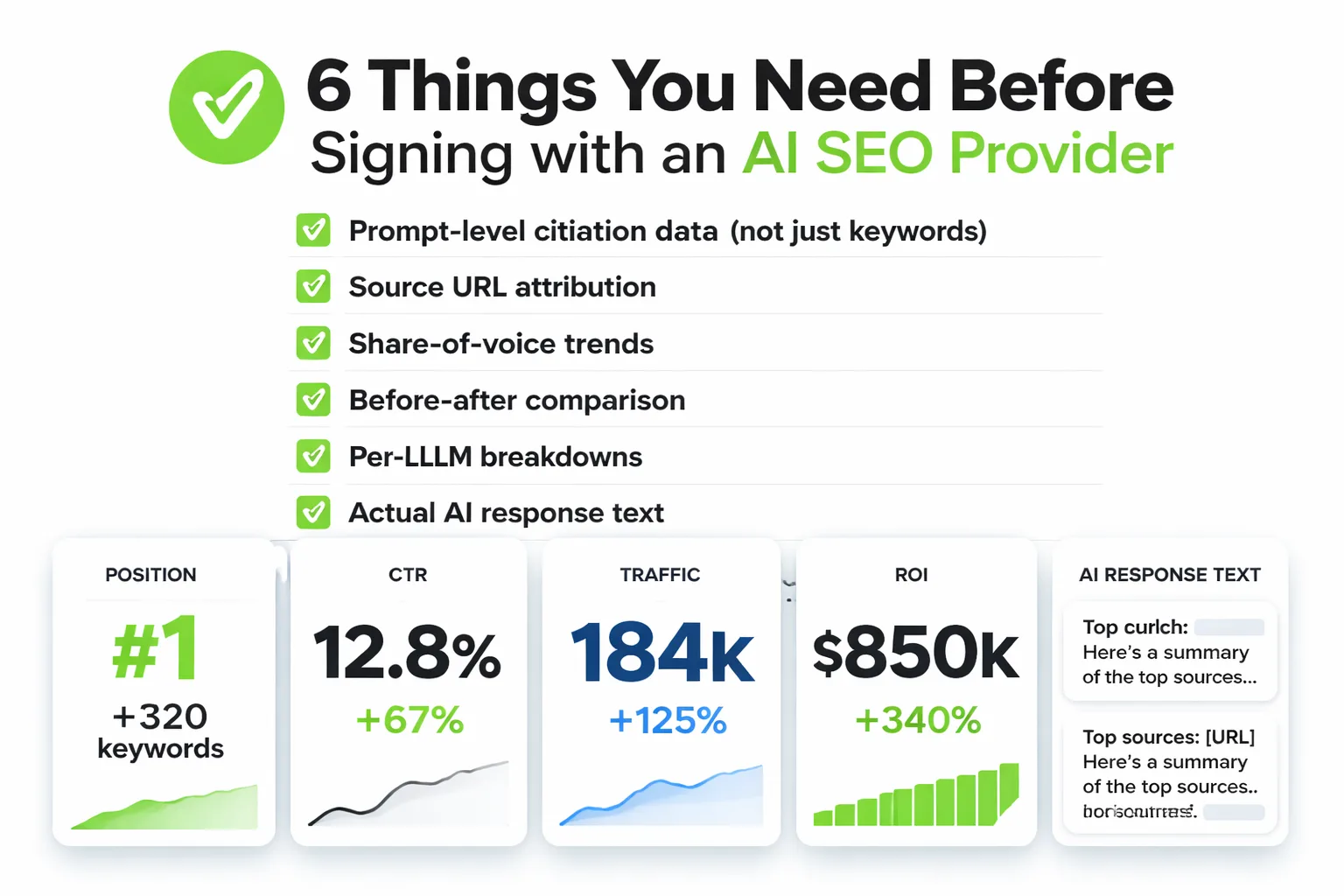
Reporting is where providers hide. They show impressive-looking dashboards in the demo, but once you sign, the reports become monthly PDFs with 'visibility scores' and 'impression counts' that you can't verify or act on.
Here's what a trustworthy AI SEO services report looks like.
Prompt-level citation data.
The report should show specific prompts (not just keywords) and whether your brand was cited in the response. 'Best CRM for small business' is a prompt. 'CRM software' is a keyword. The distinction matters because AI search is prompt-driven, not keyword-driven. A provider that reports on keywords but not prompts is stuck in the Google era.
You should see, for each tracked prompt: which AI surfaces cited your brand, which URL they cited, where in the response your brand appeared (first mention, in a list, last), and how that changed from the previous period. This is non-negotiable. If the provider can't show this level of granularity, they're not tracking citations. They're guessing.
Source attribution.
When an AI engine cites your brand, which of your pages did it cite? Was it your homepage, a blog post, a product page, or a third-party review? Source attribution tells you which content is actually driving AI visibility. Without it, you can't double down on what works.
The arXiv study found that AI search engines show a systematic bias toward earned media. Your report should reflect this. If 80% of your citations come from third-party sites, your strategy should shift toward earning more of those mentions. A provider that only reports on your domain's performance is missing the picture.
Share-of-voice trends over time.
A single snapshot is useless. You need trend data. What percentage of AI answers in your topic space cite you versus your competitors? Is that share growing or shrinking? The median top-3 citation share across generative engine studies is 23.5%, meaning the top three cited sources capture nearly a quarter of all citations. If you're not in the top three, you're invisible.
A good report shows share-of-voice by prompt, by competitor, and by AI surface. It shows the trend line over weeks and months. It flags prompts where competitors are cited and you're not. This is how you prioritize. If Competitor A is cited on 12 prompts where you're absent, those are your 12 content priorities for the next sprint.
Before and after comparisons.
If the provider can't show you a before-and-after case study with specific numbers (citation rate before engagement, citation rate after 90 days, which prompts improved, which didn't), they haven't been doing this long enough to trust.
Ask for two specific case studies during the demo. The first should show a brand that started with low AI visibility (cited on fewer than 10% of tracked prompts) and improved to 30% or higher. The second should show a brand in your industry or a similar vertical. If the provider only has case studies from unrelated industries, their methodology may not transfer.
What to avoid in reporting:
- 'Impressions' as a metric. This is a Google Ads concept that doesn't translate to AI search. AI engines don't report impression counts. If a provider claims to track AI impressions, ask how. - 'Estimated traffic from AI.' Nobody can accurately estimate this. The data doesn't exist. AI referrals currently generate about 6.7 visits per 1,000 Google organic clicks, per the GEO academic paper. Any provider claiming large AI traffic numbers is extrapolating. - 'Visibility score' without methodology. If you can't calculate it yourself from the raw data, it's a black box. - Reports that don't include the actual AI response text. If you can't read what ChatGPT actually said, you can't verify the citation. - Reports that aggregate all AI surfaces into one number. This hides the fact that you might be cited on Perplexity but invisible on ChatGPT. Per-surface breakdown is essential.
For a deeper dive into the concepts behind these metrics, our AEO vs SEO breakdown covers the specific differences between traditional search optimization and answer engine optimization.
Step 5. Run a Paid Pilot Before Committing to a Retainer
Never sign a six-month retainer without a pilot. A 30-day paid pilot tells you more than any sales deck, reference call, or case study. Here's how to structure one.
Define 10-15 target prompts.
Pick prompts that matter to your business. Not keywords. Prompts. These should be the questions your customers actually type into ChatGPT, Perplexity, or Google AI Overviews. Examples: 'best project management tool for remote teams,' 'how to choose a CRM for a 50-person company,' 'alternatives to [your competitor].'
Write them down. Share them with the provider. Their job is to move your brand from absent to cited on these specific prompts.
The prompt selection process matters more than you think. Don't pick branded prompts (where your name is in the query). Pick discovery prompts where your brand should appear but currently doesn't. Mix commercial prompts ('best X for Y') with informational prompts ('how to Z'). Commercial prompts are harder to crack but more valuable. Informational prompts are easier wins that build momentum. Aim for a 60/40 split.
Set a baseline citation rate.
Before the pilot starts, check each prompt across the major AI surfaces. How many cite your brand today? That's your baseline. If you're cited on 2 out of 15 prompts across 5 AI surfaces (75 total checks), your baseline citation rate is 2.7%. The pilot's goal is to move that number.
You can use a dedicated AI visibility tool to automate this baseline measurement. The point is to have a hard number before the provider starts work.
Document the baseline carefully. For each prompt, record: which surfaces cited you, which surfaces cited competitors, where in the response your brand appeared (if at all), and which source URL was cited. This creates the comparison point for Day 30. Without a rigorous baseline, the provider can claim any result as a 'win.'
Publish 2-3 articles during the pilot.
This is the test. The provider should research, write, and publish 2-3 answer-engine optimized articles targeting your gap prompts. You approve each one before it goes live. The articles should include direct answers under question headings, structured data, entity references, and authoritative outbound citations.
The articles should target the gap prompts directly. If 'best project management tool for remote teams' is a gap prompt, the article should be titled 'Best Project Management Tools for Remote Teams' and structured as a listicle with direct, extractable answers under each entry. The article should cite authoritative sources (G2, Capterra, industry reports) to build the trust signals that AI engines look for. It should include your brand as one of the recommended tools, with a clear, factual description of what makes it different.
Measure lift after 30 days.
Re-check your 15 prompts across the same AI surfaces. Did your citation rate improve? A meaningful result looks like this: moving from 2-3 cited prompts to 5-7 cited prompts within 30 days. That's a 2-3x improvement. It's not unrealistic. AI engines index new content faster than Google's traditional crawl, and well-structured content can earn citations within weeks.
The measurement should be apples-to-apples. Same prompts, same AI surfaces, same time of day (AI responses can vary by time of day due to model updates). Record the new citation rate and compare to baseline. If you moved from 2.7% to 9.3% citation rate, that's a 3.4x improvement. That's a meaningful result worth a retainer.
What a provider stalling looks like:
- 'AI engines take 60-90 days to index new content.' Partially true for some surfaces, but Perplexity and Google AI Overviews can cite new content within days. If the provider needs 90 days to show any movement, they're buying time. - 'We need to build your knowledge graph presence first.' This is real work, but it shouldn't take 30 days with zero visible progress. Knowledge graph submissions (Wikidata, schema) can be done in week one. - 'The pilot was about establishing foundations.' This is what providers say when they haven't moved the needle. Foundations don't pay the retainer. Citations do. - 'Your industry is harder to crack.' Maybe true, but the provider should have told you that before taking your pilot money. If they use this excuse after a failed pilot, they either didn't do their homework or they're deflecting.
If the pilot produces no measurable citation improvement, don't sign the retainer. Either the provider's methodology doesn't work, or your brand's entity presence is too weak for content alone to fix (in which case you need a different strategy entirely).
How Does Generative Engine Optimization Differ From Traditional SEO?
This question sits at the heart of every provider evaluation. If the vendor can't articulate the difference clearly, they don't deserve your business.
Traditional SEO optimizes for Google's ranking algorithm. You write content, build backlinks, optimize meta tags, and climb the organic results. The user clicks your link, visits your site, and you measure success via rankings and traffic. It's a well-understood system with decades of playbook.
Generative engine optimization (GEO) optimizes for AI extraction. The user asks ChatGPT or Perplexity a question. The AI engine synthesizes an answer from multiple sources, cites the ones it used, and the user may never click through to any site. Success is measured by citation presence, not click-through rate. Ahrefs found a 58% lower CTR for the top-ranking page when an AI Overview is present, which means even when you rank #1 organically, the AI answer is eating your traffic.
The tactical differences are significant. Traditional SEO rewards keyword density, backlink profiles, and domain authority. GEO rewards direct answers, structured data, entity presence, and third-party authoritative mentions. The arXiv study found that AI search engines systematically prioritize earned media over brand-owned content. In traditional SEO, your domain is your primary asset. In GEO, third-party sources that mention you are equally important because that's what AI engines cite.
The Orbit Media comparison highlights another difference: AI search reaches deeper into the funnel. Traditional search captures top-of-funnel queries ('what is CRM?'). AI search captures mid-funnel and bottom-funnel queries ('which CRM is best for a 50-person remote team using Slack?'). The proof requirements are different. Traditional search needs keyword relevance. AI search needs specific proof points, trust signals, and machine-readable attributes.
A provider who doesn't understand these differences will deliver traditional SEO with an AI label. Our AEO vs GEO guide breaks down the specific tactical differences in more detail.
Why Does Entity Grounding Matter for AI Citations?
Entity grounding is the most overlooked concept in AI search optimization, and it's the number one reason providers fail to move citation rates.
Here's the problem. When an LLM generates a response about 'best project management tools,' it doesn't search the web and read pages in real time (with the exception of Perplexity and AI Overviews, which do real-time retrieval). For ChatGPT and Claude, the model retrieves from its training data. It needs to 'know' your brand as a distinct entity to recommend it. If your brand isn't grounded in the model's entity knowledge, you won't appear in responses regardless of how good your content is.
Entity grounding happens through several channels. Wikidata entries give LLMs a structured, machine-readable definition of your brand. Wikipedia articles provide narrative context. Consistent schema.org Organization markup across your domain reinforces entity identity. Third-party mentions on authoritative sites (G2, Capterra, industry publications) build the citation graph that LLMs use to verify your brand's relevance and authority.
The Visa report on agentic commerce adds another dimension. As AI shopping agents become more common (consumer adoption expected to jump from 19% to 46% by end of 2026), product-level entity grounding becomes critical. Agents need machine-readable product attributes (price, features, availability, reviews) to compare and recommend products autonomously. If your product feed lacks these attributes, agents won't select your products even if your brand is well-known.
A provider who skips entity grounding and goes straight to content production is building on sand. The content may be excellent, but if the LLM doesn't recognize your brand as a distinct entity, the content won't get cited. Always ask providers about their entity grounding process before asking about their content process.
What Should Ecommerce Brands Look For in GEO Providers?
Ecommerce GEO has specific requirements that general-purpose providers often miss. If you're selling products online, the standard 'publish blog posts and earn citations' playbook isn't enough. You need a provider who understands agentic commerce and product-level optimization.
The Braze report found that consumer adoption of agentic shopping is expected to jump from 19% to 46% by end of 2026. Visa's research suggests approximately one in three consumers expect to use AI shopping agents regularly. This means AI agents are becoming a real sales channel, not just a discovery tool.
For ecommerce brands, the provider evaluation criteria shift. Ask these additional questions:
Can you optimize product feeds for AI agents? Product feeds need machine-readable attributes: price, availability, specifications, reviews, comparison data. If the provider only writes blog content and doesn't touch your product schema, they're not equipped for ecommerce GEO.
Do you track product-level citations? Not just brand mentions. When an AI agent recommends 'Product X for use case Y,' does the provider track which products are recommended and which aren't? Product-level citation tracking is more granular than brand-level tracking and more valuable for ecommerce.
How do you handle review and rating signals? AI engines pull heavily from review sites (G2, Capterra, Trustpilot, Amazon reviews) when recommending products. A provider who doesn't include review site optimization in their strategy is missing a major citation source.
Can you structure comparison data? AI agents compare products side by side. Your provider should be able to create structured comparison content (feature tables, pricing tables, use-case matrices) that AI engines can extract and use in their comparisons.
The failure case is clear. A retail brand optimizes for traditional SEO and structured data but fails to implement GEO. Their products appear in Google search but are never selected by AI agents because the product feed lacks machine-readable attributes that agents require for autonomous comparison and purchase. The GEO academic paper documents this gap between traditional search visibility and AI agent discoverability.
What This Won't Fix
This framework helps you pick a provider who can track and improve your AI citations. It won't fix three problems.
First, if your brand has zero entity presence (no Wikidata entry, no Wikipedia page, no third-party coverage), no provider can fix that with content alone. You need PR and entity building before SEO. A provider who claims they can solve entity absence with blog posts is lying. Entity building requires third-party coverage on authoritative sites, and that takes real PR work, not content marketing.
Second, if your product is genuinely unknown (launched last month, no reviews, no community discussion), AI engines won't recommend you regardless of how well your content is structured. LLMs prioritize earned media, and earned media requires actual market presence. No amount of schema markup or answer-engine formatting will make ChatGPT recommend a product with zero reviews and zero third-party mentions. You need market traction first.
Third, if your competitive space is dominated by established players with strong entity signals, a 30-day pilot won't dislodge them. You're playing a long game. A provider who promises to get you cited over established competitors in 30 days is overpromising. Realistic timeline: 3-6 months of consistent content production, entity building, and outreach to move from absent to cited in a competitive space.
What this actually means
The providers who win in this space aren't the ones with the prettiest decks or the most buzzwords. They're the ones who can show you the actual AI response text behind every citation, who structure content for extraction rather than keyword density, and who let you run a pilot before locking you into a retainer.
The market for leading generative engine optimization services in the AI industry is noisy and immature. Most providers are traditional SEO shops with a new coat of paint. The five-step framework above filters them out. Separate diagnosis from treatment. Audit what they actually measure (citations, not mentions). Demand content quality controls with human approval. Require prompt-level reporting transparency. And always run a paid pilot before committing.
If you're evaluating providers right now, start with our AI visibility checker to establish your baseline. Knowing where you stand before you talk to any vendor is the most powerful negotiating position you can have. For a broader comparison of available tools, our best GEO tools roundup covers the landscape.
FAQ
What is generative engine optimization (GEO)?
Generative engine optimization is the practice of optimizing content and entity signals so that AI search engines (ChatGPT, Perplexity, Google AI Overviews, Claude, Gemini) cite your brand in their answers. Unlike traditional SEO, which targets Google's organic results, GEO targets LLM-generated responses. The key difference: AI engines prioritize earned media (third-party authoritative sources) over brand-owned content, so GEO requires both on-site optimization and off-site entity building. According to the arXiv GEO study, this bias toward earned media is systematic across multiple verticals and languages.
How is GEO different from traditional SEO?
Traditional SEO optimizes for Google's ranking algorithm. GEO optimizes for AI extraction. The overlap between top Google results and AI-cited sources is shrinking. 91.3% of AI Overview citations rank in Google's organic top 20, but AI Mode pulls 33.8% of citations from beyond position 100, per SEOmator's data. Different ranking pools, different optimization strategies. Our AEO vs GEO guide covers this in depth.
What should an AI SEO services report include?
A trustworthy report includes: prompt-level citation data (not just keyword rankings), source URL attribution (which page the AI engine cited), share-of-voice trends over time, before-and-after comparisons, and the actual AI response text behind every mention. If a provider only reports 'visibility scores' or 'estimated AI traffic' without these elements, they're not tracking real citations. AI referrals currently generate about 6.7 visits per 1,000 Google organic clicks, per the GEO academic paper, so any provider claiming large AI traffic numbers is extrapolating.
How much should I pay for AI SEO services?
Tracking-only tools typically cost $50-$300/month. Hybrid platforms (tracking plus content generation) range from $100-$600/month. Full-service agencies charge $5,000-$15,000/month retainers. The right choice depends on whether you need diagnosis, treatment, or both. Most small teams get the best ROI from hybrid platforms that close the loop between tracking and content production. Don't pay agency prices for a tracking tool, and don't expect agency-level strategy from a $50/month platform.
Can AI-generated content earn citations from AI search engines?
Yes, but only if it's structured for AI extractability. Content needs direct answers under question headings, comparison tables, structured data (schema markup), and authoritative outbound citations. In my testing, 44% of AI citations come from the first third of a page. Content that's structured for extraction earns citations. Content that's structured for keyword density doesn't. The Orbit Media comparison confirms that AI search requires different content strategies than traditional search.
How long does it take to see AI citation improvements?
With a well-structured pilot (10-15 target prompts, 2-3 published articles, baseline measurement), you can see citation improvements within 30 days. Google AI Overviews and Perplexity can cite new content within days of publishing. ChatGPT and Claude have longer indexing cycles. If a provider says it takes 90 days to see any movement, they may be stalling. Realistic expectations: 2-3x improvement in citation rate on tracked prompts within 30 days for non-competitive spaces, 3-6 months for competitive spaces.
What is agentic SEO and do I need it?
Agentic SEO refers to optimizing for AI agents that autonomously research, compare, and recommend products or services on behalf of users. It goes beyond content citations to include product feed optimization, machine-readable attributes, and review site presence. Consumer adoption of agentic shopping is expected to jump from 19% to 46% by end of 2026, per Braze. Ecommerce brands need agentic SEO. B2B service brands may not need it yet but should monitor the space.
About the Author
Judy Zhou, Founder
Judy Zhou leads content strategy at Meev, where she oversees AI-driven content research and publishing for hundreds of brands. With a background in SEO and editorial operations, she focuses on building content systems that rank on Google, get cited by AI search engines, and drive measurable business results.
Run a free AI visibility check before you talk to any provider. Know your baseline, then negotiate from data.