
By Judy Zhou, Founder
Key Takeaways
- 68% of US Google searches ended without a click in early 2026, and AI Overviews cut the top organic result's CTR by 58%.
- Adding citations, quotations, and statistics lifts visibility in generative engine responses by up to 40%, per the Princeton-led GEO paper.
- AI-referred traffic to US retail sites grew 393% year over year and converts 42% better than paid search.
- Audit your AI SEO service by verifying whether your brand's citation rate improved, since 50-90% of LLM citations fail to support their attached claims.
In 2022, SEO audits were still a straightforward discipline: crawl the site, review backlinks, check Core Web Vitals, compare rankings. Then large language models went mainstream, and within eighteen months the entire premise of search visibility fractured. By late 2024, generative engines were answering millions of queries without sending a single click to a source. And the AI SEO services that emerged to address this shift created an urgent new problem: how do you audit something most marketers don't yet have the tools or vocabulary to measure?
68% of US Google searches ended without a click in early 2026, and when AI Overviews appear, the top organic result loses roughly 58% of its click-through rate. Meanwhile, traffic from AI sources to US retail sites grew 393% year over year, and AI-referred traffic now converts 42% better than paid search. The Princeton-led GEO paper (Aggarwal et al., KDD 2024) found that adding citations, quotations, and statistics can lift visibility in generative engine responses by up to 40%. Yet between 50% and 90% of LLM-generated citations don't fully support the claims they're attached to, according to research published in Nature Communications. If you hired an AI SEO service and can't answer whether your brand's citation rate actually improved, you're flying blind. This five-step audit framework is how I'd diagnose whether your investment is producing real AI visibility or just vanity dashboards.
I lead content strategy at Meev, where I oversee AI-driven content research and publishing for hundreds of brands. In my work auditing content ops, I've seen too many teams pay for generative engine optimization services and then have no methodology to evaluate the results. The best tools for generative engine optimization give you data, but they don't hand you an audit framework. That's what this article is.
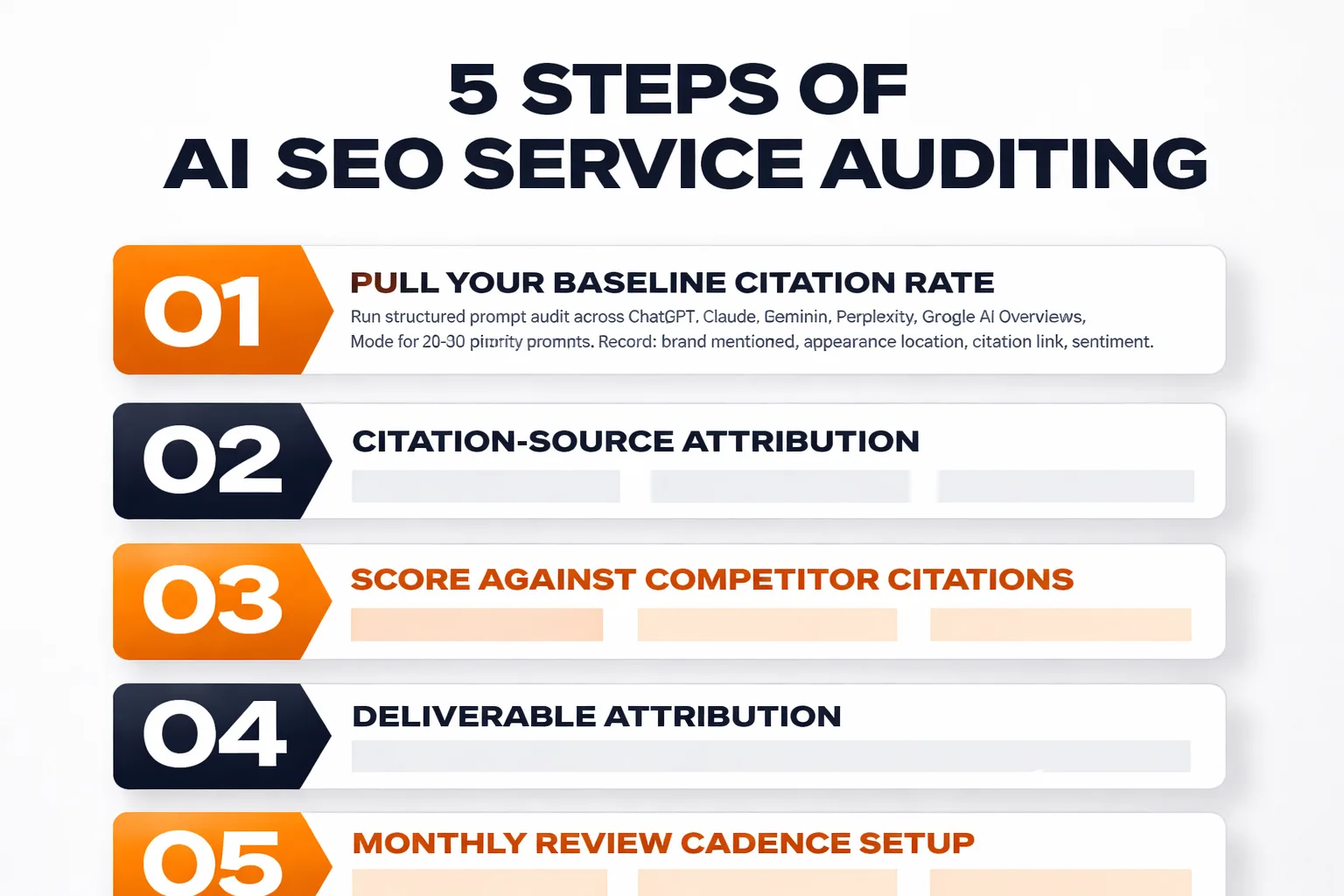
Step 1. Pull Your Baseline Citation Rate
Before you can measure improvement, you need to know where you stand today. That means running a structured prompt audit across every major AI search surface: ChatGPT, Claude, Gemini, Perplexity, Grok, Google AI Overviews, and AI Mode.
Here's what a baseline audit actually looks like. You take your top 20 to 50 priority prompts (the questions your customers type into AI engines when evaluating your category) and you run each one through each surface. For every response, you record four things: whether your brand is mentioned, where in the response it appears (first, in a list, last), whether the mention includes a citation link, and what the sentiment is. That grid of prompts times engines is your baseline.
What does a healthy baseline look like? It depends entirely on your category. A brand in a niche B2B SaaS vertical might get cited on 15% of relevant prompts and that's fine because the total prompt universe is small. A consumer ecommerce brand should expect higher volume but faces more competition. The point isn't to hit a benchmark. The point is to establish a number you can compare against in 60 and 90 days.
Let me give you a concrete example of how this works in practice. Say you run an ai search optimization agency for a project management SaaS brand. Your priority prompts might include "best project management tools for remote teams," "Asana vs Monday alternatives," and "project management software for startups." You run each of these through ChatGPT, Claude, Gemini, Perplexity, and Grok. For "best project management tools for remote teams," ChatGPT mentions your brand third in a list of five with a positive sentiment but no citation link. Claude doesn't mention you at all. Perplexity cites you with a link in second position. Gemini mentions a competitor but not you. Grok includes you in a list without a link. That's one row in your grid. Now multiply that across 30 prompts and 5 engines. You end up with 150 data points that form your baseline.
The specific numbers matter less than the methodology. What matters is that you have a repeatable process. The same prompts, run the same way, across the same engines, recorded in the same format. When you run the audit again in 30 days, you're comparing apples to apples.
In my experience, most brands have never done this. They hired an AI SEO service, got a monthly report with some visibility charts, and assumed progress. When I ask them what their citation rate was before the engagement started, they don't know. That's the first red flag. Any ai search engine optimization engagement that can't show you a before-and-after comparison is asking you to trust them blindly. In a discipline this new, blind trust is malpractice.
If you're using a tool like Meev, this baseline is automated. The platform tracks where your brand appears across every major AI search surface with daily refresh on SERP-driven surfaces and rolling refresh on LLM-driven surfaces. You can see per-LLM drill-down dashboards with the actual response text and citations behind every mention. But even if you're doing this manually in a spreadsheet, the methodology is the same. You need the grid.
One critical thing I've learned: don't average across engines. ChatGPT and Perplexity have only an 11% overlap in citations, according to the Orbit Media study tracking 13,184 citations across four LLMs. Your brand might dominate Perplexity and be invisible in Claude. Averaging masks that. Track each engine separately.
This non-determinism is also why you need multiple runs per prompt. I recommend running each prompt three times per engine and recording the best, worst, and median result. If your brand appears in two of three runs on ChatGPT for a given prompt, your citation rate for that prompt-engine pair is 67%, not 100%. This gives you a more honest picture and reduces the chance that a single anomalous response skews your baseline.
How Do You Know Which Pages AI Engines Actually Cite?
This is the step most audits skip entirely. You know whether your brand gets cited. But do you know which of your pages the citation came from?
Citation-source attribution is the process of mapping each AI citation back to the specific page on your site (or third-party page about you) that the LLM pulled from. This matters because it tells you which content is actually doing the work. I've seen brands publish 80 articles through an AI SEO service and discover that 90% of their citations come from three pages that existed before the engagement. The new content contributed nothing.
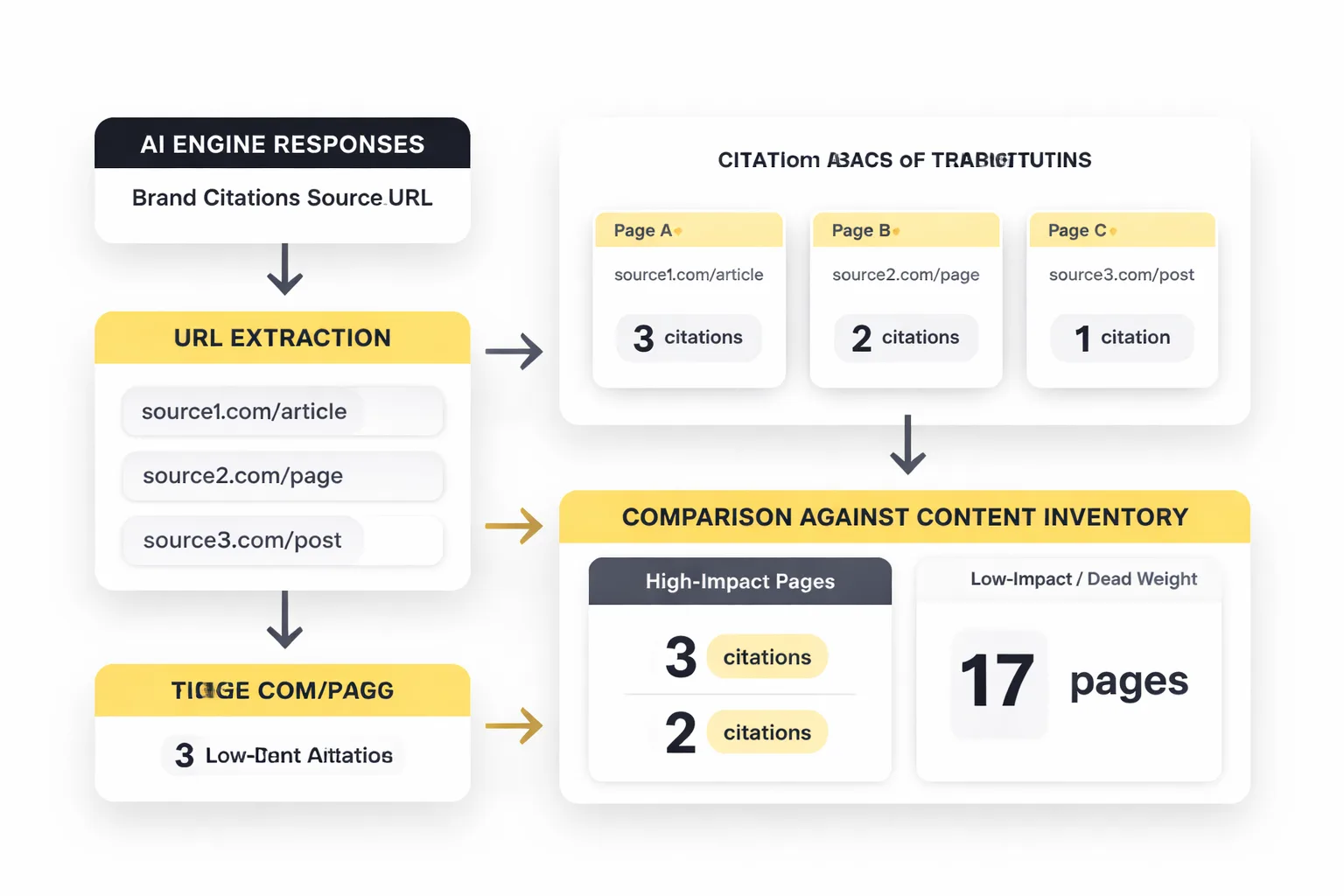
Here's how to do it. When an AI engine cites your brand, it often includes a source URL. Capture those URLs. Group them by page. Then compare against your full content inventory. The pages that exist but are never cited are your dead weight. The pages that get cited repeatedly are your citation engines.
Let me walk through the mechanics more precisely. Perplexity and Google AI Overviews typically include inline source links in their responses. You click the link, record the URL, and note which claim it supports. ChatGPT (especially with browsing enabled) sometimes includes source URLs but often paraphrases without linking. Claude rarely includes direct links but sometimes names the source domain. Grok varies depending on whether it's pulling from X data or web search. For engines that don't provide direct links, you can search for exact phrases from the AI response in quotes to find which of your pages contains that language. It's detective work, but it's the only way to know which content is earning citations.
Once you've mapped citations to pages, categorize each cited page by archetype. Is it a product page? A blog post? A comparison page? An FAQ? A case study? This categorization reveals patterns. In my audits, I consistently find that comparison pages and FAQ pages earn disproportionate citations relative to their volume in the content inventory. That tells you something. AI engines want to cite pages that directly answer questions and compare options. If your AI SEO service is publishing listicles and thought leadership pieces instead of comparison pages and structured FAQs, they're producing content that AI engines don't find useful.
This is also where you check whether your AI SEO service is producing the right kind of content. The Princeton GEO paper found that adding citations, quotations, and statistics to content can lift visibility by up to 40%. If your service is publishing articles without inline citations, without statistics, without quotations from named sources, they're ignoring the single most effective GEO tactic documented in peer-reviewed research.
I'll be blunt about something I keep seeing. Many ai search engine optimization tools and services treat content generation as a volume play. They publish 30 articles a month and hope some stick. But Cloudflare's research found that AI crawlers consume content at rates 38,000 times higher than they refer traffic back to sources. The crawlers are reading everything. They're citing almost nothing. Volume without citation-friendly structure is wasted effort.
The 38,065:1 crawl-to-refer ratio from Cloudflare's data is one of the most important numbers in this entire discipline. It means that for every 38,000 pages AI crawlers read on your site, they refer traffic back once. This doesn't mean you should stop publishing. It means you should stop publishing content that isn't designed for citation. Every page should be structured so that an AI engine can extract a direct answer, cite a specific statistic, and link back to your domain. If a page can't serve that function, it's consuming crawl budget without producing citation value.
The pages that earn citations share specific traits: they answer questions directly under question-shaped headings, they include comparison tables, they cite authoritative sources inline, and they front-load the answer in the first third of the page. 44% of AI citations come from the first third of a page, which means if your service is burying the answer below 500 words of preamble, the content is structured wrong for AI extraction.
This is also where structured data enters the picture. Schema markup (Article, FAQ, HowTo, Speakable) helps AI engines understand what your page is about and which sections are directly citable. If your AI SEO service isn't implementing structured data on every published page, that's a gap. The LLMs.txt validator is one tool that can help you check whether your site is signaling correctly to AI crawlers. It's not a silver bullet, but it's a diagnostic that takes five minutes and catches problems that would otherwise go unnoticed for months.
Step 3. Score Against Competitor Citations
Knowing your own citation rate is necessary but insufficient. You need to know your share of voice relative to competitors for the same prompts.
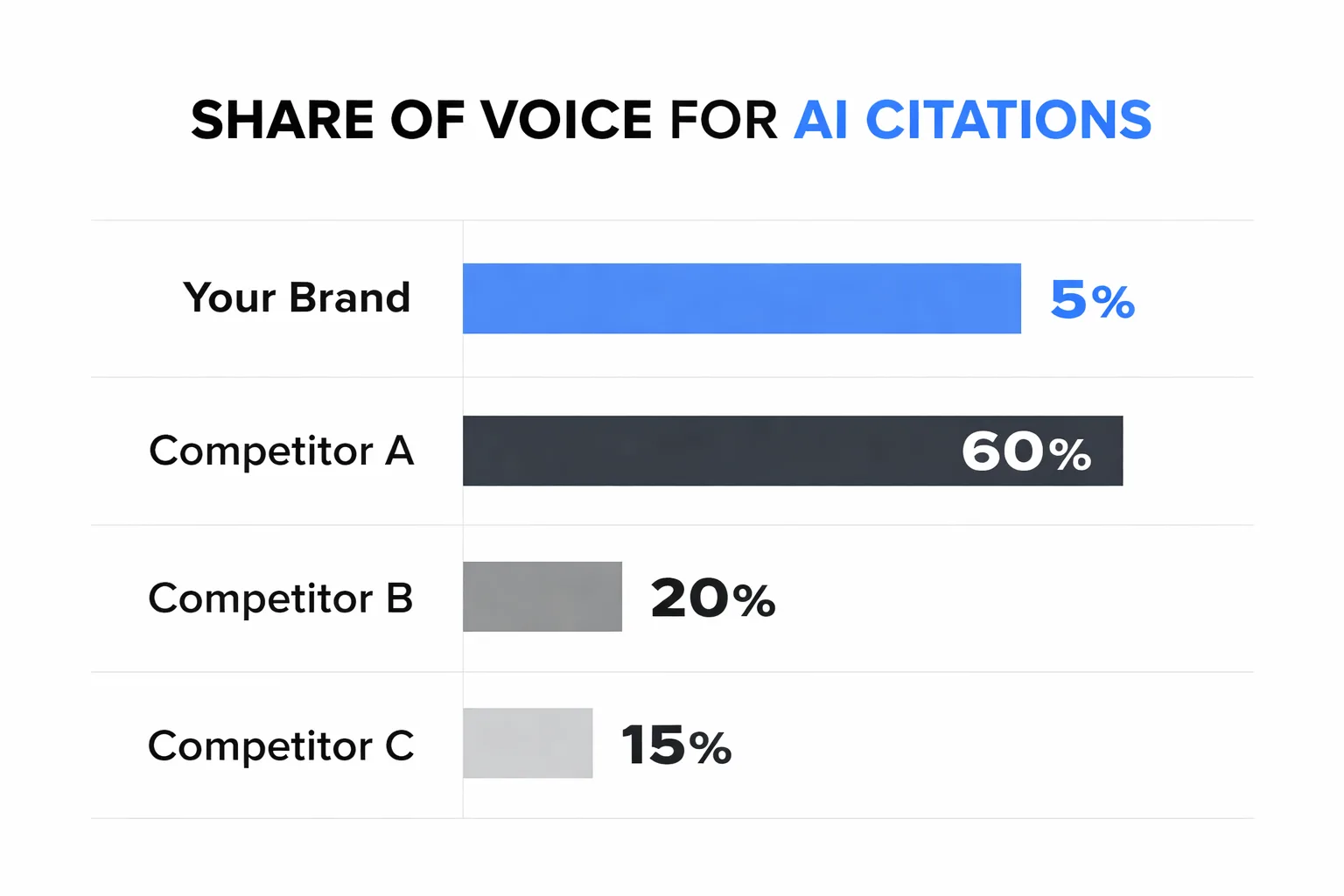
Run the same prompt set from Step 1, but this time record every brand mentioned in each response. If you're mentioned alongside three competitors, your share of voice for that prompt is 25%. Do this across all prompts and all engines, and you get a competitive citation map.
The gap size tells you what kind of problem you have. If competitors are cited on 60% of prompts and you're at 5%, that's not a content problem. That's an entity and authority problem. No amount of blog posts will fix it. You need entity grounding: Wikidata entries, knowledge graph presence, third-party editorial mentions on the sites AI engines trust. I've spent months building schema markup and internal knowledge bases expecting a direct correlation to AI visibility. What I found is that while semantic SEO is foundational, the real lift comes from factors like community discussion and third-party editorial mentions.
Let me break down the difference between a content problem and an entity problem with a real scenario. Suppose you audit 40 prompts across 5 engines (200 total prompt-engine pairs). Your brand appears in 30 of 200 (15%). Your top competitor appears in 120 of 200 (60%). Now look at where you appear. If you appear almost exclusively on brand-name prompts ("is [your brand] worth it?") but never on category prompts ("best [product category] for [use case]"), your entity presence is weak. The LLM knows who you are when asked directly but doesn't associate you with the category. That's an entity grounding problem. Publishing more articles won't fix it. You need Wikidata entries, knowledge graph connections, and mentions on the third-party sites that AI engines use to build their understanding of your category.
If the gap is smaller (competitors at 30%, you at 18%), that's a content problem. You need more answer-engine optimized articles targeting the specific prompts where you're absent. This is where a tool like Meev's content opportunity finder helps. It identifies prompts where competitors are cited but you aren't, so you can prioritize the highest-gap topics.
Here's a specific way to think about it. The Ahrefs study of 75,000+ brands and millions of AI citations found that topical authority drives citation patterns. Brands that publish deep, focused content clusters get cited more often than brands with shallow coverage across many topics. If your competitor has 20 well-structured articles on a topic and you have 3, the citation gap reflects that depth differential. The fix isn't more articles. It's more depth on the topics that matter.
One more thing on competitor analysis. Look at which domains AI engines cite as sources for your topics. Meev calls this the cited-source leaderboard. If the same five domains keep appearing as citation sources in your category, those are the publishers you need to be mentioned on. This is where outreach becomes part of your GEO strategy. You find the publishers AI trusts, you get mentioned there, and your entity authority rises.
This is what I mean by citation path. It's not enough to publish on your own site. You need to understand which third-party domains AI engines cite for your topics, then get your brand mentioned on those domains. Meev's Citation Path feature does this by finding publishers AI engines cite for your topic, resolving verified contacts, and drafting personalized outreach pitches grounded in your knowledge base. Whether you use Meev or do this manually, the principle is the same. Your AI visibility is a function of both your own content and the third-party content that mentions you.
The competitive analysis also reveals a pattern I see repeatedly. Brands that invest in community discussion (Reddit threads, Hacker News posts, industry forums) tend to get cited more often by AI engines. This aligns with what I've observed about recommendation rate. It's not enough for an LLM to find your content. It needs to recommend it. And LLMs appear to weight community signals heavily when deciding what to recommend. If your competitors have active Reddit threads discussing their product and you don't, that's a gap no amount of on-site content will close.
Which Deliverables Actually Moved Metrics?
This is the step where you hold your AI SEO service accountable. You've got your baseline from Step 1 and your competitive map from Step 3. Now you need to tie specific deliverables to citation rate changes.
Here's the method. Plot your citation rate over time (weekly data points, not daily). Mark the publication date of each article your service delivered. Then look for inflection points. Did the citation rate change after a specific article went live? Did a particular topic cluster move the needle?
Wil Reynolds and Nick Haigler at Seer Interactive demonstrated that AI systems actively monitor and cite website content. In their test, simply adding structured footer data ("130+ clients, 97% retention rate") influenced ChatGPT output within 36 hours. That's a powerful data point because it means you can test causality. Change something specific, wait 36 to 72 hours, and measure the response.
Let me walk through what this looks like operationally. Your AI SEO service delivered Article A on March 1, Article B on March 8, and Article C on March 15. Your citation rate on March 1 was 12%. By March 8, it's 13%. By March 15, it's 12.5%. By March 22, it jumps to 16%. Which article caused the jump? Not Article A or B (the rate didn't move meaningfully after they published). Article C published on March 15, and the jump appeared 7 days later. That's your signal. Article C targeted a prompt cluster that was previously uncited, and it worked.
Now flip the scenario. Your service delivered 20 articles over 60 days. Your citation rate went from 12% to 12.5%. That 0.5% increase is within natural variance (remember, LLMs are non-deterministic). The service produced volume but no measurable citation lift. This is where you need to ask hard questions.
If your service published 40 articles over 60 days and your citation rate didn't move, you have a problem. Here are the questions to ask your provider:
1. Which specific articles were designed to target which prompts? If they can't map articles to prompts, they're not doing GEO. They're doing content production with an AI label.
2. What citation-friendly structures did they include? Direct answers under question headings? Comparison tables? Inline citations to authoritative sources? Statistics? If the answer is "we optimized for keywords," they're doing traditional SEO and calling it GEO.
3. Did they build or update entity signals? Wikidata entries, knowledge graph presence, schema markup? If not, they're ignoring the foundation that makes content citable.
4. What's the gap between their reported metrics and your independent audit? If their dashboard shows 200% visibility growth and your manual prompt audit shows no change, their measurement methodology is broken or inflated.
5. Did they check for cannibalization? If two articles target the same prompt cluster, they may split the signal. One article might have earned a citation that the other article's publication displaced.
I've seen this discrepancy personally. A client's AI SEO service reported a 7x increase in visibility. When I ran an independent audit using the same prompts across the same engines, the actual citation rate had moved from 3.2% to 4.1%. That's a 28% improvement, not 600%. The service was counting brand mentions in any context (including negative ones) as visibility wins. If your provider can't distinguish between a positive citation and a negative mention, their reporting is worse than useless. It's misleading.
This is why independent measurement matters. In my work at Meev, I've insisted that the platform show the actual response text behind every mention. Not just a visibility score, but the literal words the AI engine generated. Because context changes everything. A mention that says "[Your Brand] has been criticized for poor customer support" counts as a mention in most visibility tools. It's actually a liability. If your AI SEO service is counting that as a win, fire them.
The 60-day mark is your first real checkpoint. AI content takes time to be crawled, indexed, and incorporated into LLM training data or RAG systems. But 60 days is enough time to see movement if the content is well-structured and targets the right prompts. If you're at 60 days with zero citation movement, schedule a call with your provider. If you're at 90 days with zero movement, it's time to reassess the engagement entirely.
Can you show your AI citation rate right now, or are you relying on your provider's dashboard?
How Do You Build a Repeatable Monthly Review?
An audit is only valuable if you can repeat it. Here's the monthly cadence I recommend.
Week 1: Pull fresh citation data. Run your prompt set across all engines. Record citation rate, mention position, and sentiment per engine. Compare to last month and to your original baseline. This is where an enterprise AI rank tracker saves hours of manual work. If you're tracking 30 prompts across 5 engines, that's 150 individual queries per audit run. Doing this manually takes a full day. Automation reduces it to minutes.
Week 2: Map new citations to source pages. Identify which pages earned new citations this month. Check whether they came from recently published content or existing pages. This tells you whether your content pipeline is actually contributing. If all new citations trace back to a product page you updated six months ago, your recent blog posts aren't pulling their weight.
Week 3: Run competitive gap analysis. Re-run the competitive citation map. Has your share of voice changed? Did competitors gain citations on prompts where you're still absent? Prioritize the top 5 gap prompts for next month's content. This is also where you check for new entrants. If a competitor you weren't tracking suddenly appears in AI responses, add them to your competitive set.
Week 4: Brief the next content cycle. Take everything you learned and turn it into a content brief. Which prompts need coverage? Which pages need restructuring for AI extractability? Which entity signals are missing? This brief becomes the input for your next content sprint.
The metrics to track monthly: citation rate per engine, share of voice vs competitors, mention position (first vs last in response), source page distribution, and sentiment. The metrics to ignore: keyword rankings in isolation (they don't predict AI citations), social shares, and any vanity metric that doesn't connect to AI visibility.
Let me be more specific about what "metrics to ignore" means. I've seen AI SEO services present organic traffic growth as evidence their GEO work is succeeding. But organic traffic from Google is a traditional SEO metric. It tells you nothing about whether your brand is being cited by ChatGPT or Perplexity. Similarly, backlink count growth is a traditional authority signal. It may indirectly help AI visibility (because AI engines do consider link authority), but it's not a direct measure of citation rate. If your provider's monthly report leads with traffic and backlinks, they're reporting on the wrong discipline.
One thing I've become adamant about. Don't let your AI SEO service provider be the only one measuring results. That's like letting a contractor grade their own work. Use an independent AI visibility tracker or run manual audits. The data needs to come from a source that has no incentive to make the numbers look good.
If you're working with an answer engine optimization service, the monthly review is also where you decide whether to continue the engagement. Sixty days of data with no citation movement is a red flag. Ninety days with no movement is a termination event. The AEO vs SEO distinction matters here. If your provider is delivering traditional SEO metrics (rankings, traffic, backlinks) instead of AI visibility metrics (citations, mention rate, share of voice), they're not doing the job you hired them for.
The monthly review is also where you should check for citation quality degradation. Sometimes a brand's citation rate stays flat or even increases, but the nature of the citations changes. Maybe you were previously cited as a top recommendation and now you're mentioned as an afterthought at the bottom of a list. Your citation rate didn't change. Your visibility quality did. This is why mention position tracking matters as much as raw citation count. A first-position mention in a ChatGPT response is worth exponentially more than a last-position mention in a list of ten.
What Role Does Entity Grounding Play in AI Citations?
Entity grounding is the foundation that makes everything else in this audit framework work. Without it, your content efforts are building on sand.
An entity, in the context of AI search, is a discrete thing that an LLM recognizes and can reason about. Your brand is an entity. Your product is an entity. Your founder is an entity. Your category is an entity. When an LLM generates a response, it pulls from its internal knowledge graph to decide which entities to mention. If your brand isn't a well-grounded entity in the LLM's knowledge base, no amount of content will earn you citations.
This is why Wikidata matters. Wikidata is the structured knowledge base that many LLMs use as a reference layer. If your brand has a Wikidata entry with accurate categorization, key facts, and relationships to other entities, LLMs are more likely to recognize and cite you. If you don't have a Wikidata entry, or if your entry is sparse and miscategorized, you're invisible at the entity layer.
In my audits, I check three entity signals for every brand. First, does a Wikidata entry exist? Second, is it properly categorized under the right industry and product type? Third, does it link to relevant external identifiers (Crunchbase, G2, Capterra, official website)? These three checks take 10 minutes and reveal more about your AI visibility potential than any content audit.
The connection to your audit framework is direct. If Steps 1 and 3 show that you're absent from category-level prompts but present on brand-name prompts, entity grounding is your bottleneck. Before you commission more content, fix the entity layer. Create or update your Wikidata entry. Ensure your schema markup defines your organization as an entity of the correct type. Build mentions on third-party sites that LLMs use as reference sources. Then re-run your baseline audit to see if the entity work moved the needle.
This is also where the distinction between AEO vs GEO becomes practical. Answer engine optimization focuses on structuring content so AI engines can extract and cite it. Generative engine optimization is broader, encompassing entity grounding, knowledge graph presence, and the full set of signals that influence whether an LLM mentions your brand. Your audit needs to cover both layers. Content structure (AEO) without entity grounding (GEO) produces pages that are extractable but never referenced. Entity grounding without content structure produces a brand that LLMs know about but can't cite because there's nothing to cite.
When This Audit Framework Fails
This methodology has real limitations, and I'd be dishonest if I didn't name them.
First, LLM responses are non-deterministic. Run the same prompt twice and you may get different answers. This means your citation rate has natural variance. A 5% swing between audit runs might be noise, not signal. You need at least three data points before declaring a trend.
Second, the prompt set you choose defines everything. If you audit 20 prompts that are brand-adjacent ("is [your brand] good?"), your citation rate will look great. If you audit category-level prompts ("what's the best [product category]?"), your rate will look worse. Both are real. The trap is choosing the easy set and calling it a win.
Third, this framework assumes your AI SEO service is producing content. If they're doing technical entity work (Wikidata, schema, knowledge graph) without publishing articles, the citation lift may lag by 60 to 90 days. You'd falsely conclude the service isn't working when the entity signals simply haven't propagated yet.
Fourth, the audit framework can't account for model updates. When OpenAI updates GPT, or when Google rolls out a new AI Overviews model, citation patterns can shift dramatically overnight. A citation rate drop from 25% to 12% might mean your content stopped working. It might also mean the model changed. Always check whether a major model update coincided with your data shift before drawing conclusions.
What This Won't Fix
This audit tells you whether your AI SEO service is working. It doesn't fix a bad service. It doesn't write better content. It doesn't build entity authority. If your audit reveals zero progress after 90 days, the framework has done its job. The next step is on you: change providers, bring the work in-house, or rethink your generative engine optimization strategy entirely.
The audit also won't solve the attribution problem entirely. Even with perfect citation-source mapping, you can't know with 100% certainty that a specific article caused a specific citation. LLMs synthesize information from multiple sources. A citation might be triggered by your article combined with a Reddit thread and a G2 review. Your audit can identify correlation (the citation appeared after the article published) but not prove causation. That's an inherent limitation of measuring non-deterministic systems.
Finally, this framework won't help if your brand has a fundamental perception problem. If the internet is full of negative reviews, critical articles, and community discussions that paint your brand unfavorably, AI engines will reflect that. Your citation rate might be high, but your sentiment will be negative. No audit framework fixes a bad product. It just tells you the truth about how AI engines see you.
The brands winning in AI search right now aren't the ones spending the most. They're the ones measuring the most honestly. 68% of searches end without a click, but AI-referred traffic converts 42% better than paid search. The opportunity is enormous. But you can't capture it if you can't measure it.
Run the audit. Ask the hard questions. And if your AI SEO service can't show you citation-rate movement tied to specific deliverables, find one that can.
FAQ
What is a good AI citation rate?
There's no universal benchmark. A niche B2B brand might be cited on 15% of relevant prompts and lead its category. A consumer brand might need 40% to be competitive. The key is measuring your rate against competitors for the same prompts, not against an arbitrary industry average. Track your baseline, then measure movement over 60 to 90 days.
How often should I audit AI visibility?
Monthly is the right cadence for most teams. Weekly is better if you're actively publishing content and want faster feedback loops. Daily tracking is useful for specific tests (like the Seer Interactive footer experiment that showed citation changes within 36 hours) but overkill for ongoing monitoring. The key is consistency: same prompts, same engines, same methodology, every time.
Can I trust my AI SEO service's own reporting?
Not as your sole data source. I've seen too many cases where a provider's dashboard showed massive visibility gains that didn't hold up under independent audit. Use their reporting for operational metrics (articles published, prompts targeted) but verify visibility outcomes with an independent tool or manual prompt audit. The entity measuring results should not be the same entity selling the service.
What's the difference between AI visibility and traditional SEO rankings?
Traditional SEO rankings measure where your page appears in a list of links. AI visibility measures whether your brand is mentioned and cited in a generated answer. They're related but distinct. You can rank #1 organically and still be absent from AI Overviews. You can be cited by ChatGPT without ranking in the top 10. The AEO vs GEO framework explains how these disciplines overlap and diverge.
Should I track all AI engines or just the big ones?
Track every major AI search surface: ChatGPT, Claude, Gemini, Perplexity, Grok, Google AI Overviews, and AI Mode. Citation overlap between engines is low (just 11% between ChatGPT and Perplexity). If you only track one or two, you're missing the full picture. A brand can dominate Perplexity and be invisible in Claude. That gap is invisible unless you track both.
What if my citation rate hasn't moved after 60 days?
First, check whether your service published citation-friendly content (direct answers, tables, inline citations, statistics). If they did and citations still didn't move, the problem is likely entity authority, not content. You may need Wikidata entries, third-party editorial mentions, or knowledge graph signals. If they didn't publish citation-friendly content, the service isn't doing GEO. It's doing traditional SEO with an AI label. Either way, 90 days of zero movement means it's time to reassess the engagement.
How do I know if my AI SEO service is counting negative mentions as wins?
Ask to see the actual response text behind every mention they're counting. If they only show you a visibility score without the underlying AI response, that's a red flag. A mention that says "[Your Brand] has been criticized for poor customer support" is not a visibility win. It's a reputation problem. Your audit should track sentiment alongside citation rate. Any provider that counts all mentions as positive visibility is either incompetent or dishonest.
About the Author
Judy Zhou, Founder
Judy Zhou leads content strategy at Meev, where she oversees AI-driven content research and publishing for hundreds of brands. With a background in SEO and editorial operations, she focuses on building content systems that rank on Google, get cited by AI search engines, and drive measurable business results.
Stop guessing whether your AI SEO investment is working. Run a free AI visibility audit and see exactly where your brand is cited, where it's absent, and which pages are driving citations.