
Perplexity Shopping Explained: How Stores Get Featured
By Judy Zhou, Founder
Key Takeaways
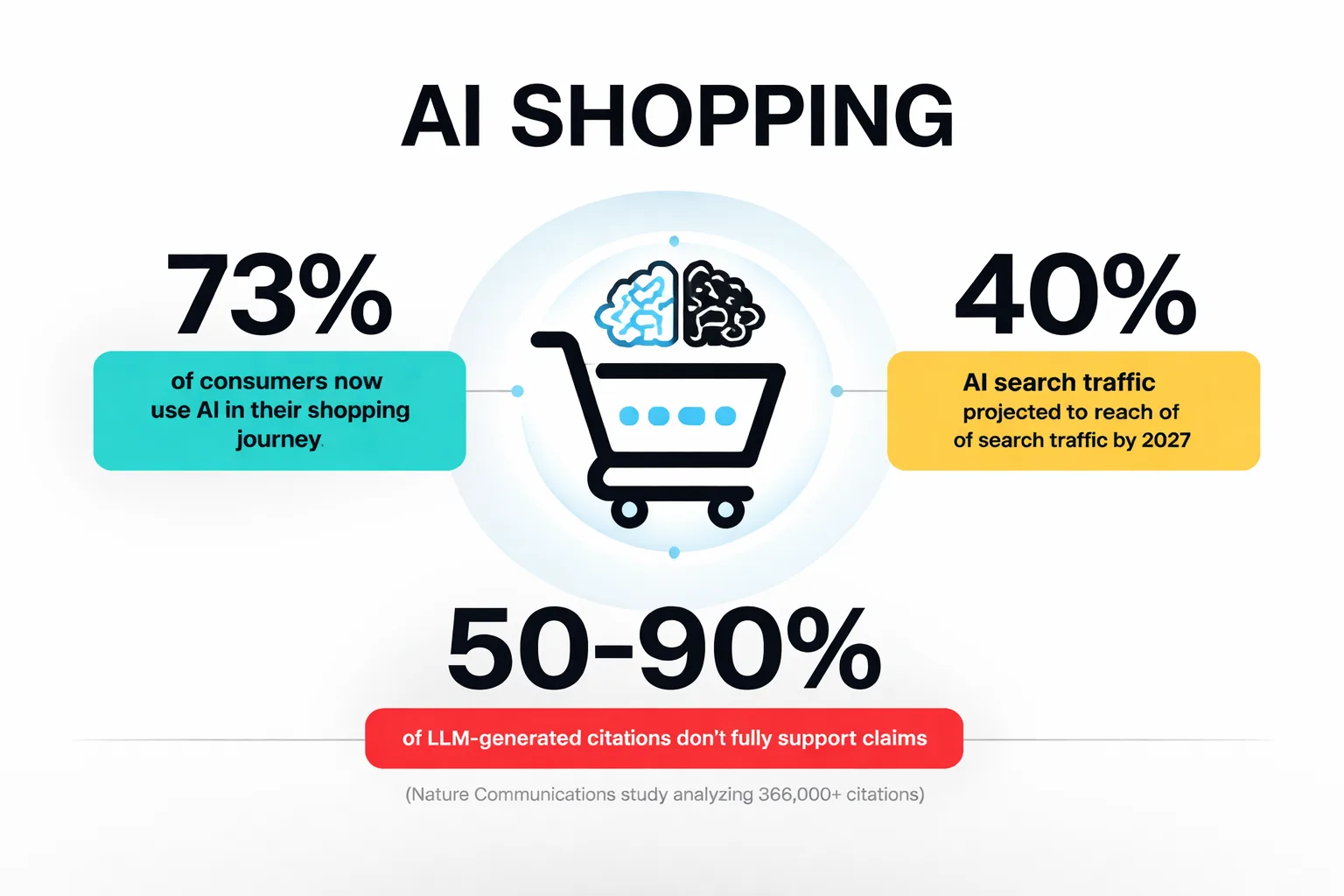
- 73% of consumers now use AI in their shopping journey, so brands must optimize for Perplexity Shopping's live pricing and direct purchase links.
- A peer-reviewed study of 366,000+ citations found 50-90% of LLM citations fail to fully support claims, requiring merchants to prioritize structured data integrity over organic mentions.
- AI search traffic will hit 40% of total search by 2027, making visibility in answer engines a survival metric for ecommerce brands.
- Perplexity Shopping pulls from structured feeds, retailer APIs, and web content, so merchants should audit these sources to secure featured placement with cited answers.
Perplexity Shopping uses AI to answer product questions with live pricing, reviews, and direct purchase links, and 73% of consumers now use AI in their shopping journey. The platform pulls product data from structured feeds, retailer APIs, and web-crawled content, then synthesizes answers with cited sources. A peer-reviewed Nature Communications study analyzing 366,000+ citations found that 50-90% of LLM-generated citations don't fully support their attached claims, meaning merchants must focus on structured data integrity rather than hoping for organic mentions. AI search traffic is projected to reach 40% of total search traffic by 2027, making visibility in answer engines a survival metric for ecommerce brands.**
I've spent the last year building content systems that help brands get cited by AI engines, and Perplexity Shopping represents the most aggressive fusion of conversational AI and ecommerce I've seen. In my work auditing content ops at Meev, I track how brands appear across every major AI search surface. The pattern is clear: merchants who understand how perplexity shopping works win disproportionate visibility, while those treating it like traditional Google Shopping bleed budget with zero attribution.
The Citation Economy Has a Trust Problem
Here's what nobody in the ecommerce GEO space wants to acknowledge. The entire premise of AI-driven shopping rests on citation accuracy, and that foundation is cracked.
The Nature Communications peer-reviewed study analyzed over 366,000 citations across ChatGPT, Perplexity, Google AI Overviews, and Claude. The finding that should stop every ecommerce director cold: between 50% and 90% of LLM-generated citations don't fully support the claims they're attached to. The best-performing platform accuracy sits around 66%. The worst drops below 50%.
Think about what that means for your product listings. A shopper asks Perplexity whether your sunscreen is reef-safe. The AI generates an answer citing your product page, but the citation context doesn't actually match the claim. The user sees a citation link and assumes verification. They click buy. The product isn't reef-safe. That's not a minor attribution error. That's a liability pipeline running at scale.
The Cloudflare crawler study adds another layer to this problem. AI crawlers consume content at rates 38,000 times higher than they refer traffic back to sources. ClaudeBot's crawl-to-refer ratio sits at 38,065:1. Your product pages are being scraped, parsed, and regurgitated into AI answers, but the traffic you get back is a rounding error.
The metric that matters isn't referral clicks. It's whether AI names your brand, recommends your product, and accurately represents your specifications. If you're measuring perplexity shopping success through Google Analytics referral traffic, you're measuring the wrong thing entirely. This is why AI search visibility tools have become essential rather than optional for ecommerce teams.
The disconnect between crawl volume and referral traffic creates a measurement crisis for ecommerce directors. I've sat in strategy meetings where teams proudly report that their product pages are being crawled by PerplexityBot daily, only to find zero referral traffic in their analytics. They interpret this as failure. It's not. It's the expected behavior of an answer engine that synthesizes information rather than redirecting users. The crawl means your data is being consumed. The lack of referral traffic means the AI is answering the user's question inline. Your job is to ensure the answer is accurate, not to drive clicks to a page the user no longer needs to visit.
This is the fundamental shift that AEO vs SEO forces on ecommerce teams. Traditional SEO measures success in sessions, bounce rate, and conversion. Answer engine optimization measures success in mention presence, citation accuracy, and sentiment. The KPIs are different because the user behavior is different. A user who gets their answer from Perplexity doesn't visit your site. They visit your checkout page if Perplexity includes a buy link, or they visit a retailer's product page if that's where the AI sourced the data.
How Does Perplexity Shopping Work?
Perplexity Shopping combines a conversational answer engine with real-time product data retrieval to generate cited purchase recommendations. When a user asks a shopping-related question, Perplexity's system parses the query, retrieves product information from structured data sources and retailer integrations, synthesizes an answer with inline citations, and presents buy links directly in the response.
The platform was built as a citation-driven answer engine competing against ad-based incumbents. It's now studied in Harvard Business School's Generative AI for Business Leaders course. That origin matters for merchants because it means Perplexity's design philosophy prioritizes sourced answers over sponsored placements. There's no auction-based ad slot to buy your way into.
For merchants, the mechanism breaks down into three layers. First, the retrieval layer: Perplexity crawls the web for product information, pulls from retailer APIs (Amazon, Best Buy, and other major retailers), and accesses structured data feeds. Second, the synthesis layer: the AI model combines retrieved information into a coherent answer, weighing source authority and data freshness. Third, the citation layer: each claim in the answer links back to a source URL.
The critical insight is that Perplexity doesn't operate a traditional merchant program where you upload a feed and manage bids. There's no Perplexity Merchant Center equivalent to Google Merchant Center. Visibility is earned through structured data, entity presence, and third-party authority signals. This is answer engine optimization applied to ecommerce, and it requires a fundamentally different playbook than paid shopping ads.
Let me walk through a concrete example of how this works in practice. A user types: "What's the best espresso machine under $500 for a small kitchen?" Perplexity's retrieval layer kicks off multiple parallel fetches. It crawls review sites like Serious Eats and Wirecutter for expert recommendations. It queries retailer APIs for current pricing and availability on machines mentioned in those reviews. It scans product pages for specification data (dimensions, water tank capacity, pressure rating). The synthesis layer then combines this into a narrative answer: "The Breville Bambino Plus is the top pick for small kitchens under $500. It measures 12.5 inches wide, has a 1.4-liter water tank, and reaches brewing pressure in 3 seconds. Current price: $399 at Amazon." Each claim has a citation. The dimensions cite the manufacturer's product page. The price cites Amazon's API. The recommendation cites the review publication.
Now look at what happens if the manufacturer's product page has no Product schema. The AI can't find a machine-readable dimensions field. It scans the page text, finds "compact design fits any kitchen" in the marketing copy, and either omits the specifications or infers them from a third-party source. The citation now points to a retailer page instead of the manufacturer. The manufacturer has lost control of their own product narrative. This is the stakes of structured data in the AI shopping era.
Stop Treating AI Shopping Like Paid Search
This is where most ecommerce teams go wrong. They hear "AI shopping" and immediately map it to their existing paid search mental model. They want to know the CPC, the ROAS, the bid strategy. That entire framework is useless here.
Perplexity Shopping doesn't operate on a pay-per-click model. There's no sponsored product placement (at least not in the way Google Shopping advertisers recognize). When Perplexity recommends a product, that recommendation is generated by the AI model based on retrieved information, source authority, and query relevance. You can't buy placement. You earn it.
This terrifies performance marketers who have spent their careers optimizing bids and budgets. But it should energize SEO and content teams who understand AEO vs SEO dynamics. The playing field just shifted from "who pays the most" to "who provides the most authoritative, structured, citable information."
Here's the contrarian take that most ecommerce consultants won't give you: the death of paid shopping attribution in AI search is actually good for merchants with strong brands and terrible for those relying on arbitrage. If your entire business model depends on outbidding competitors for bottom-funnel keywords, AI shopping engines are your existential threat. If your model depends on brand authority, product quality, and structured data hygiene, AI shopping engines are your opportunity to capture demand without paying a toll.
Consider the economics. A merchant spending $50,000/month on Google Shopping ads pays for every click, including clicks from users who never convert. That same merchant appearing in Perplexity Shopping answers pays nothing per mention. The cost shifts from media spend to content infrastructure: schema implementation, entity grounding, earned media outreach. These are fixed costs that compound over time rather than variable costs that stop the moment you pause campaigns.
The merchants I see succeeding in AI shopping aren't the ones with the largest ad budgets. They're the ones who invested early in structured data, built relationships with authoritative review publications, and maintained clean, fresh product information across every surface where AI engines might find them. The ROI curve is different. It starts slower because you're building infrastructure rather than buying traffic. But it compounds because each citation reinforces your entity authority, making future citations more likely.
What Sources Does Perplexity Actually Use?
Understanding source retrieval is the foundation of ecommerce GEO. Perplexity's shopping answers are only as good as the data the model can access, and that data comes from a specific set of channels.
Web-crawled product pages. Perplexity's crawler (PerplexityBot) indexes product pages across the open web. Pages with clean schema markup, descriptive titles, and structured specifications get parsed more accurately. Pages buried under JavaScript rendering walls or blocked by robots.txt directives are invisible.
Retailer API integrations. Perplexity integrates with major retailers to pull live pricing, availability, and product specifications. Amazon, Best Buy, and other large retailers feed structured data directly. If you sell exclusively through these marketplaces, your products may appear through these integrations. But you have zero control over how the AI describes your product.
Third-party review sites. Product reviews on established publications carry significant weight. When Perplexity synthesizes a product recommendation, it pulls sentiment and evaluation data from review sites. The finding from my accumulated research is clear: 84-89% of AI-generated answers come from earned media, not owned content. Your product page matters, but what authoritative third parties say about your product matters more.
Knowledge graph data. Perplexity accesses entity information from Wikidata and other knowledge graph sources. If your brand or product has a Wikidata entry with structured attributes (manufacturer, category, specifications), that data feeds directly into Perplexity's entity grounding. Brands without knowledge graph presence are at a structural disadvantage.
The overlap between AI engines is surprisingly low. Only 11% of citations overlap between ChatGPT and Perplexity, according to the research I've examined. This means optimizing for one AI engine doesn't automatically transfer to others. You need platform-specific visibility tracking, which is why tools like our Perplexity AI visibility checker exist separately from ChatGPT tracking.
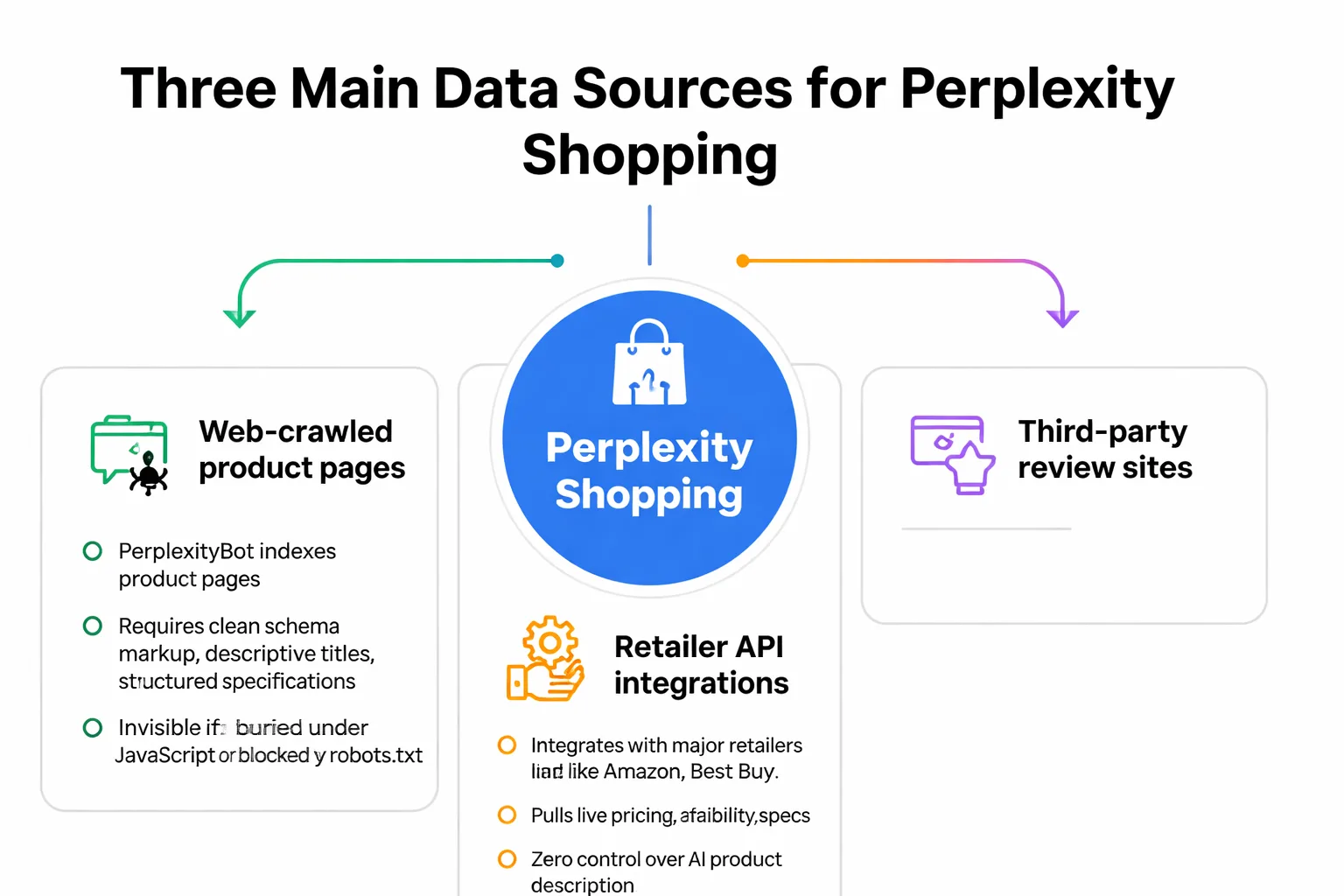
The practical implication of these source channels is that you need a multi-surface optimization strategy. A brand that only optimizes its own product pages is addressing one of four retrieval channels. A brand that also manages its marketplace listings, actively pitches review publications, and maintains Wikidata entries is addressing all four. The brands that dominate Perplexity Shopping answers are the ones with presence across every retrieval surface, not just the one they control directly.
Why Does Structured Data Determine Visibility?
Structured data is the language AI engines speak. Without it, your product information is just unstructured text that the model has to interpret, and interpretation introduces errors.
When Perplexity's model retrieves product information, it prioritizes data it can parse with high confidence. Product schema markup (specifically Product, Offer, AggregateRating, and Review types) gives the model machine-readable fields for price, availability, ratings, and specifications. A product page with complete schema is orders of magnitude more likely to be accurately represented in an AI answer than a page with just HTML text.
The problem I see repeatedly in my work is that most ecommerce sites have incomplete or incorrect schema. They implement Product schema but omit Offer fields. They include AggregateRating but forget to update availability status. They have Review schema pointing to reviews that no longer exist. Each gap is a potential citation error waiting to happen.
And remember the Nature Communications finding: 50-90% of AI citations don't fully support their claims. Incomplete structured data is a primary driver of that failure rate. When the model can't find a clear price field, it infers from context. When it can't find availability status, it guesses based on page content. Those guesses become citations, and those citations become purchase decisions.
65% of AI citations come from content published in the past year. This means stale product pages with outdated pricing or discontinued items can still get cited if they rank well. Freshness signals matter. If your product page hasn't been updated in 18 months, it's a candidate for misinformation propagation through AI engines.
Let me give you a specific example of how schema gaps create real damage. I audited a DTC skincare brand that was losing visibility in AI shopping answers despite having strong organic search rankings. The root cause: their Product schema included the brand name and product description but omitted the Offer schema entirely. No price, no availability, no condition field. When Perplexity retrieved their product page, it could identify the product but couldn't extract pricing or stock status. So it either omitted the product from price-sensitive answers or pulled pricing from a third-party retailer selling the same product at a different price. The brand was losing recommendations not because of product quality or authority, but because of a missing JSON-LD block that would have taken 15 minutes to implement.
The fix isn't just about adding schema. It's about maintaining schema accuracy over time. I recommend a monthly schema audit for ecommerce sites with more than 100 products. Check that every product page has valid Product, Offer, and AggregateRating schema. Verify that prices in schema match prices displayed on page. Confirm that availability status reflects actual inventory. Use Google's Rich Results Test or Schema.org validator to catch errors. Each schema error you fix directly improves the probability that AI engines will represent your product accurately.
Want to know if Perplexity is already citing your competitors instead of you?
Entity Grounding for AI Search
Entity grounding is the process by which AI models connect a brand or product mention to a specific, verifiable entity in a knowledge graph. It's the difference between the AI saying "a popular wireless headphone" and "Sony WH-1000XM5."
For ecommerce brands, entity grounding starts with Wikidata. A Wikidata entry for your brand creates a structured identity that AI models reference when disambiguating mentions. If your brand name is common or shared with products in other categories, entity grounding prevents the AI from conflating your product with something unrelated.
The process for establishing entity presence is straightforward but tedious. Create a Wikidata entry with your brand's canonical name, manufacturer details, product categories, and key specifications. Link it to your official website and authoritative Wikipedia page (if one exists). Add structured identifiers like GTIN, MPN, or brand registry numbers where applicable.
Beyond Wikidata, entity grounding happens through consistent NAP (Name, Address, Phone) information across the web, consistent brand mentions in authoritative publications, and structured about page markup on your own site. The goal is to create a web of interconnected signals that all point to the same entity definition.
I've seen brands with strong organic search presence but weak entity grounding get completely passed over in AI shopping answers. The AI model simply doesn't know who they are. It can't connect their product pages to a verified brand entity. So it defaults to brands it can ground: the ones with Wikidata entries, Wikipedia pages, and consistent structured mentions across high-authority domains.
The mechanics of entity grounding are worth understanding in detail. When Perplexity's model encounters the text "Blue Bottle Coffee" in a product review, it doesn't just treat those words as a string match. It queries its knowledge graph to resolve "Blue Bottle Coffee" to a specific entity with properties: founded in 2002, headquartered in Oakland, California, acquired by Nestle in 2017. This entity resolution allows the model to connect the mention to other information about the brand across its training data and live retrieval sources. If your brand has no knowledge graph entity, the model can't perform this resolution. Your brand name is just text, not an entity with properties and relationships. That distinction determines whether you appear in synthesized answers.
The fix for weak entity grounding involves both Wikidata and your own site architecture. On Wikidata, create entries for your brand and each flagship product. Include structured properties: manufacturer, brand, product category, GTIN, official website URL. On your site, implement Organization schema on your homepage and About page with matching canonical name, logo, and contact information. Create internal links between your product pages and your About page using consistent brand name anchors. The goal is to create a dense network of entity signals that all reinforce the same identity.
How Does Perplexity Compare to Google AI Overviews for Shopping?
This is the question I get most often from ecommerce teams, and the answer reveals why platform-specific tracking matters.
Google AI Overviews and Perplexity both generate synthesized answers with citations, but their shopping behaviors diverge in ways that matter for merchants. Google AI Overviews typically surfaces products from Google Shopping feed data, meaning merchants who already participate in Google's Merchant Center have a structural advantage. The AI synthesizes from the same feed data that powers Google Shopping ads, so your Google Shopping optimization directly influences your AI Overview presence.
Perplexity takes a different approach. It doesn't have access to Google's Merchant Center feed. It relies on web crawling, retailer APIs, and third-party content. This means a merchant who is invisible in Google Shopping (perhaps because they sell DTC and don't use Google Merchant Center) can still appear in Perplexity Shopping answers if their product pages have strong structured data and third-party coverage.
The 11% citation overlap between ChatGPT and Perplexity tells you everything about cross-platform dynamics. These engines source information differently, weigh sources differently, and synthesize answers differently. A brand that dominates Google AI Overviews shopping answers might be completely absent from Perplexity. A brand that Perplexity cites frequently might not appear in Google AI Overviews at all.
This is why I recommend tracking visibility across every major AI search surface independently. Tools that only track Google AI Overviews give you a partial picture. Tools that only track Perplexity miss the Google ecosystem. The enterprise AI rank tracker approach is to monitor all surfaces simultaneously so you can see where you're winning and where you're invisible.
The Shop Like a Pro Feature
Perplexity's "Shop like a Pro" feature represents the platform's most ambitious move toward agentic commerce. It allows users to describe what they want in natural language, and Perplexity handles product discovery, comparison, and purchase routing in a single conversational flow.
For merchants, Shop like a Pro changes the optimization target. Traditional product page optimization focuses on keyword matching and feature lists. Shop like a Pro optimization focuses on answering the underlying questions a shopper has before they buy. Is this product right for my specific use case? How does it compare to alternatives? What do experts say about it?
This means your product content needs to address comparison queries, use-case scenarios, and expert evaluation points. A product page that only lists specifications is invisible to conversational shopping. A product page that includes use-case guidance, comparison context, and answers to common buyer questions becomes citable source material.
The shift here is from keyword-optimized content to question-optimized content. This is the core of generative engine optimization for ecommerce. You're not trying to rank for "best wireless headphones." You're trying to be the source Perplexity cites when someone asks "what are the best wireless headphones for someone who wears glasses and takes a lot of calls."
Consider how this changes your content strategy. A traditional product page for noise-canceling headphones might list: "40-hour battery life, adaptive noise cancellation, Bluetooth 5.3, USB-C charging." That's keyword-optimized content. It matches search queries like "noise canceling headphones bluetooth." But it doesn't answer the questions a conversational shopper asks. A question-optimized product page adds: "Ideal for open-office environments where you need to focus without missing important notifications. The adaptive noise cancellation detects speech and automatically switches to transparency mode." That's the kind of contextual, use-case-specific content that AI engines synthesize into recommendations.
The merchants who win in Shop like a Pro are the ones who think like a sales associate, not a keyword researcher. What questions does a knowledgeable store employee answer before recommending a product? What comparisons do they draw? What use cases do they clarify? That conversational knowledge needs to live on your product pages in structured, parseable formats.
How Can Merchants Optimize for Perplexity?
The optimization playbook for Perplexity Shopping differs from traditional ecommerce SEO. Here's what I recommend based on the data and patterns I've observed.
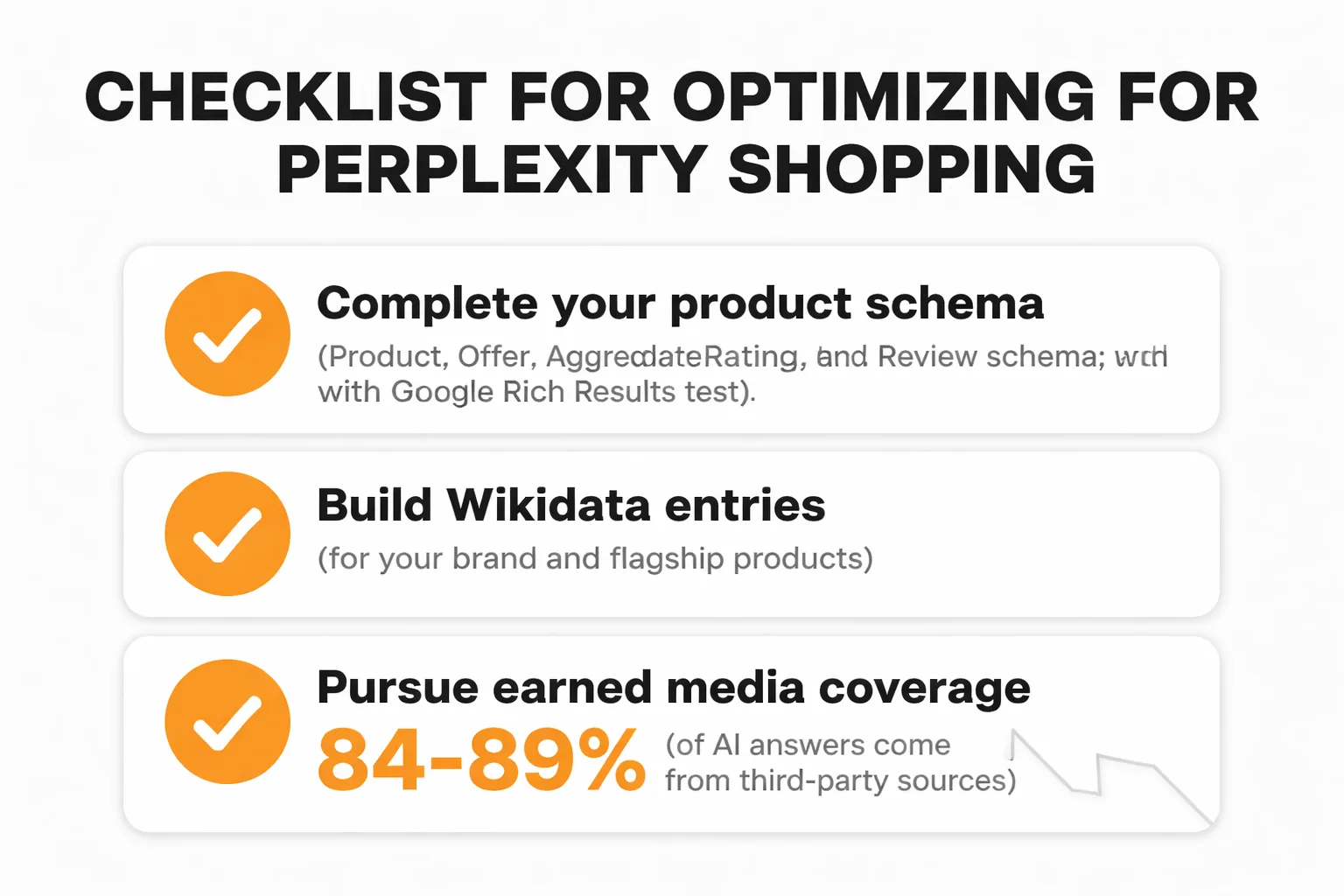
1. Complete your product schema. Every product page needs Product, Offer, AggregateRating, and Review schema. Use Google's Rich Results test to validate. Fix errors immediately. Incomplete schema is worse than no schema because it creates false confidence in the model's retrieval.
2. Build Wikidata entries for your brand and flagship products. This is non-negotiable for entity grounding. If you don't have a Wikidata entry, you don't exist as a verifiable entity in the AI's knowledge graph. I've seen this single change move brands from invisible to cited within weeks.
3. Pursue earned media coverage aggressively. Remember: 84-89% of AI answers come from third-party sources. Your owned content matters for structured data, but your earned media drives citation. Focus on getting reviewed and mentioned by the publications Perplexity actually cites. Use citation path tracking to identify which publications those are.
4. Keep product data fresh. With 65% of citations coming from content less than a year old, stale pages are a liability. Update pricing, availability, and specifications regularly. Publish new reviews and update aggregate ratings.
5. Monitor your AI visibility daily. You can't optimize what you don't measure. Track when your brand appears in Perplexity shopping answers, what position it appears in, and what claims are being made. The Perplexity AI visibility checker handles this, but the principle applies regardless of tool choice.
The sixth element that doesn't appear on most checklists but should: structured FAQ content on product pages. When a shopper asks Perplexity a specific question about your product ("Can this laptop run Adobe Premiere Pro?"), the AI looks for direct answers in retrieved content. A product page with a structured FAQ section answering common compatibility, use-case, and comparison questions gives the model citable answers. Each FAQ answer becomes a potential citation source. This is agentic SEO in practice: you're structuring content to answer the questions autonomous agents ask on behalf of users.
The Role of LLM Citation Tracking in Shopping
LLM citation tracking for ecommerce is fundamentally different from traditional backlink tracking. A backlink tells you who links to your site. A citation tells you who the AI model references when generating an answer about your product category. These are not the same thing.
A site might link to your product page (traditional backlink) but never get cited by an AI engine. Conversely, an AI engine might cite your product page without any traditional backlink relationship. The citation is determined by the model's retrieval and synthesis process, not by hyperlink topology. This means your traditional backlink analytics tools are blind to a significant portion of your AI shopping visibility.
The Nature Communications study finding that 50-90% of citations don't fully support their claims makes citation tracking not just a visibility exercise but an accuracy audit. You need to know not just whether you're cited, but whether the citation is accurate. Is the AI attributing the right price? The right specifications? The right availability status? If the citation is wrong, you need to know so you can fix the underlying data source.
This is where the gap between AEO vs GEO becomes practical. AEO focuses on getting your brand cited accurately. GEO focuses on optimizing content for generative engine retrieval. For ecommerce, you need both. You need content structured for retrieval (GEO) and you need to monitor whether the retrieved content is accurately represented in citations (AEO). They're two halves of the same workflow.
The practical implementation looks like this. Set up daily monitoring across Perplexity, ChatGPT, Claude, Gemini, and Google AI Overviews for your core product queries. For each mention, check three things: position (first mention, listed, or last), accuracy (does the claim match your actual product data), and sentiment (positive, neutral, negative). Track these metrics over time. When accuracy drops, trace the citation back to its source and fix the underlying data. When position drops, investigate which competitor gained visibility and why.
When Should Brands Invest in AI Shopping Visibility?
Now. The window between "early mover advantage" and "table stakes" is closing fast.
AI search traffic is projected to reach 40% of total search traffic by 2027. 67% of organizations are already deploying LLMs for customer-facing applications. The brands that establish entity presence, structured data hygiene, and earned media authority today will have a compounding advantage as AI shopping adoption accelerates.
The cost of waiting isn't just lost visibility. It's the cost of letting competitors establish the entity definitions, citation patterns, and source authority that AI engines learn from. Once an AI model learns to cite a competitor for a product category, that pattern reinforces with every query. Breaking established citation patterns is far harder than establishing them first.
For small teams without dedicated AI optimization resources, the priority order is: structured data first (because it's the highest-impact, lowest-effort win), entity grounding second (because it creates durable brand identity), earned media third (because it drives citation volume), and monitoring fourth (because you need to measure the other three).
The compounding nature of AI visibility cannot be overstated. Every accurate citation reinforces the model's confidence in your brand as an authoritative source for that product category. Every third-party review that mentions your brand alongside specific product attributes strengthens the entity association. Every schema update that improves data accuracy makes future retrieval more reliable. This is a flywheel that starts slow but accelerates. The merchants who start now will have a 12-18 month head start on brands that wait for "proven ROI" before investing.
What This Means for Ecommerce Teams
Perplexity Shopping isn't a channel you can buy into. It's a visibility system you earn through structured data, entity presence, and authoritative third-party coverage. The merchants who win will be those who treat AI citation accuracy as a product quality metric, not a marketing afterthought.
The data is unambiguous. Citation accuracy across AI engines ranges from below 50% to 66%. AI crawlers consume your content 38,000 times more than they send traffic back. Only 11% of citations overlap between ChatGPT and Perplexity. These numbers tell me that the current approach most ecommerce teams take to AI visibility is fundamentally broken.
Stop measuring AI shopping success through referral traffic. Start measuring it through brand mention rate, citation accuracy, and sentiment. Stop trying to buy placement in AI answers. Start earning it through structured data integrity and earned media authority. Stop treating AI visibility as a separate channel. Start treating it as the natural extension of your brand's information architecture.
In my work at Meev, I've seen brands go from zero AI visibility to consistent citation in Perplexity shopping answers within 60-90 days by following this framework. The ones who succeed aren't the ones with the biggest budgets. They're the ones who understand that perplexity shopping rewards information quality over advertising spend. If you want to see where your brand stands today across Perplexity and other AI engines, the first step is an AI visibility audit to establish your baseline.
FAQ
Can merchants pay to be featured in Perplexity Shopping results?
No. Perplexity Shopping generates product recommendations based on AI model retrieval and synthesis, not paid placement. There is no equivalent to Google Shopping's auction-based ad system. Merchants earn visibility through structured data, entity grounding, and authoritative third-party coverage. This is why AI search optimization matters more than ad spend for this channel.
How is Perplexity Shopping different from Google Shopping?
Google Shopping operates on a paid advertising model where merchants bid on keywords and upload product feeds to Merchant Center. Perplexity Shopping operates on an organic citation model where the AI synthesizes answers from web-crawled content, retailer APIs, and third-party sources. There's no merchant feed to upload and no bid to manage. Visibility is earned through data quality and source authority.
What product schema types matter most for Perplexity Shopping?
Product, Offer, AggregateRating, and Review schema are the most critical. Product schema provides basic identity, Offer schema provides pricing and availability, AggregateRating provides social proof signals, and Review schema provides detailed evaluation context. Missing any of these creates gaps the AI model fills with inference, which introduces citation errors.
How often should merchants update product data for AI visibility?
Given that 65% of AI citations come from content published within the past year, product pages should be reviewed and updated at least quarterly. Pricing, availability, and specifications should be current at all times. Stale data doesn't just hurt visibility. It actively contributes to the 50-90% citation inaccuracy problem documented in the Nature Communications study.
Does selling on Amazon help with Perplexity Shopping visibility?
Yes, but indirectly. Perplexity integrates with major retailer APIs including Amazon, so products listed there may appear through that integration. However, you have no control over how the AI describes your product when it pulls from retailer data. Your own product pages with complete schema give you more control over citation accuracy and brand representation.
What's the difference between optimizing for Perplexity vs ChatGPT shopping queries?
Only 11% of citations overlap between ChatGPT and Perplexity, meaning the two engines source information differently. Perplexity emphasizes real-time web crawling and retailer API integration. ChatGPT relies more on its training data and web search integration. Brands need platform-specific visibility tracking rather than assuming optimization for one transfers to the other.
About the Author
Judy Zhou, Founder
Judy Zhou leads content strategy at Meev, where she oversees AI-driven content research and publishing for hundreds of brands. With a background in SEO and editorial operations, she focuses on building content systems that rank on Google, get cited by AI search engines, and drive measurable business results.
Run a free AI visibility audit to see exactly where your brand appears across Perplexity, ChatGPT, and every major AI search engine.