

Navigational intent is no longer just a search category — it's the single clearest signal of brand authority in AI search.
When someone types "\[your brand name\]" into Google instead of clicking a bookmark, they're telling you something more valuable than any keyword ranking report can capture. They already know you exist. They've decided you're worth finding. That behavioral signal — the deliberate act of searching for a specific destination — is what separates brands with genuine authority from those still chasing informational traffic that AI is rapidly absorbing.
TLDR>
- Navigational search intent — queries aimed at reaching a specific site or brand — is the clearest measurable proxy for brand authority in 2025.
- AI Overviews and zero-click results are cannibalizing informational and transactional traffic, making navigational demand more strategically valuable, not less.
- The shift from "typing a URL" to "prompting an AI" means GEO (Generative Engine Optimization) is now the new navigational battleground.
- Brands that build E-E-A-T depth, structured data, and topical authority are the ones AI systems surface when users navigate via prompt — not keyword.
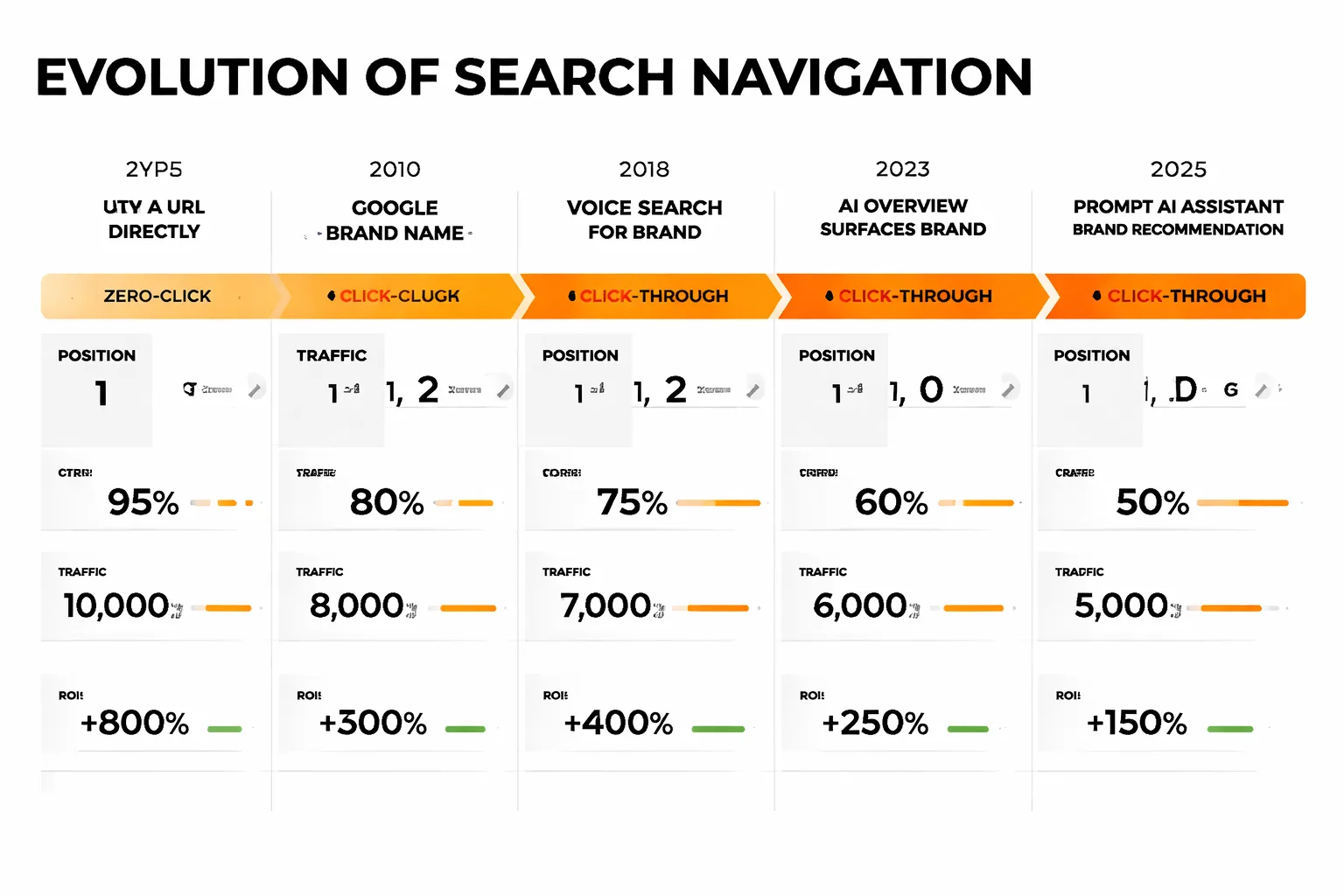
What’s the Zero-Click Problem Nobody Is Solving?
Here's the finding that reframes everything: SparkToro's analysis of 332 million queries tracked over 21 months revealed that a substantial share of all searches are navigational — people using Google as a shortcut to reach a specific destination. That number matters because it's the slice of search behavior that AI Overviews can't easily steal.
Informational queries? Google's AI Overviews answer them directly. Transactional queries? Shopping panels and AI-generated comparison summaries intercept the click. But navigational queries — "Meev AI blog tool," "Ahrefs login," "HubSpot pricing" — exist because the user has already made a brand decision. The search is just the mechanism of arrival. No AI Overview can redirect that intent without fundamentally breaking the user's experience.
The practical implication is stark: teams that have been optimizing exclusively for informational traffic are building on a foundation that AI is actively eroding. The brands that will hold ground are the ones generating enough brand demand that users search for them by name — not by topic.
Why Is Navigational Intent a Brand Authority Metric?
Semrush defines navigational keywords as intent-driven queries toward a specific site or page — and that definition, while accurate, undersells the strategic weight of what's happening. Navigational search volume for a brand isn't just a traffic source. It's a lagging indicator of every brand-building investment made upstream: content quality, earned media, word-of-mouth, community presence, and yes, E-E-A-T signals that make a brand memorable enough to search for directly.
The pattern across high-performing content programs is consistent: brands that invest in topical authority and named authorship — real humans with verifiable credentials attached to content — generate navigational search demand at a measurably higher rate than brands publishing anonymous AI-generated clusters. This isn't a coincidence. When a reader encounters a piece of content that's genuinely useful, written by someone they can look up, they remember the brand. That memory converts into a navigational query the next time they need something in that space. The content-to-brand-search pipeline is real, and it's one of the most underreported mechanisms in content ROI discussions. Most analytics setups don't connect the dots between a blog post read six weeks ago and a branded search today — but the connection exists, and calculating SEO ROI without accounting for it produces systematically undervalued content programs.
Branded search volume is the one SEO metric AI can't manufacture for you.
How Has AI Search Rewired Navigational Behavior?
The shift from "type a URL" to "prompt an AI" is not a future scenario — it's already the default behavior for a growing segment of users. When someone opens ChatGPT or Perplexity and asks "what's the best tool for automated blog publishing," they're performing a navigational act. They're not browsing. They're trying to get somewhere specific — they just don't know the destination yet. The AI becomes the navigator.
This is where GEO (Generative Engine Optimization) intersects with navigational intent in a way most SEO frameworks haven't caught up to. Traditional navigational SEO assumed the user already knew the brand. AI-mediated navigation creates a new category: assisted navigational intent, where the user knows the category but delegates brand selection to the AI. Whoever the AI surfaces in that moment owns the navigational outcome — even if the user never typed the brand name themselves.
The mechanics of getting surfaced in AI responses are different from traditional ranking signals. Structured data in Google Search Console, clear entity definitions, consistent brand mentions across authoritative sources, and content that answers questions in extractable, quotable formats — these are the signals that AI systems use to decide which brand to navigate users toward. The Google Search Console structured data report is now as strategically important as the Performance report for teams thinking about AI-era navigational visibility.
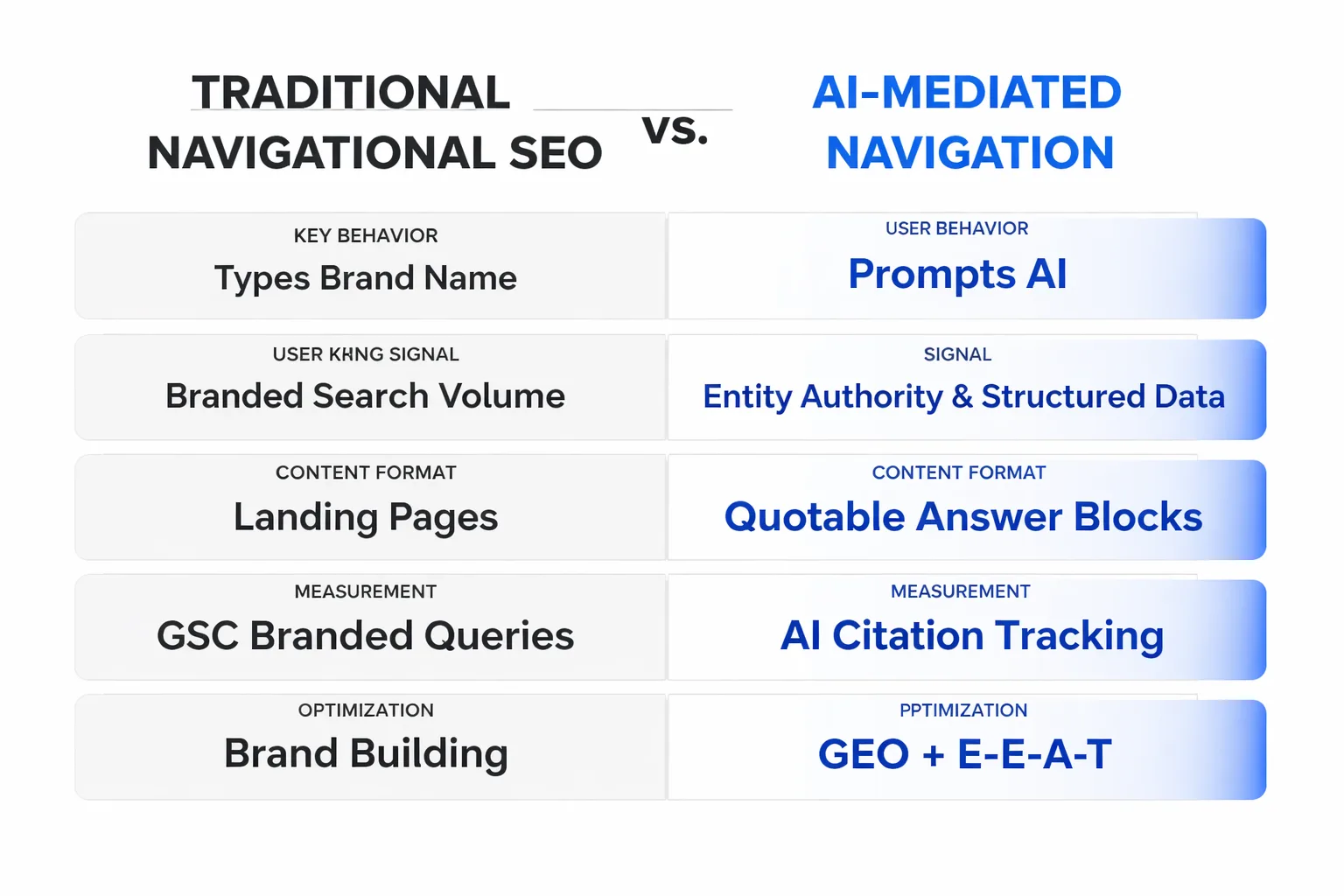
What Is the E-E-A-T Connection Most Teams Miss?
Google's quality rater guidelines have always treated navigational intent as a special case — a query type where getting the user to the right destination is the entire job. But the connection between E-E-A-T and navigational demand runs deeper than most content teams recognize.
Here's the mechanism: E-E-A-T signals — named authors, verifiable credentials, original research, consistent topical coverage — are what make a brand memorable enough to search for by name. A site that publishes anonymous content on generic topics doesn't build the kind of brand recognition that generates navigational queries. A site with a recognizable voice, documented expertise, and content that gets cited elsewhere does. The E-E-A-T framework isn't just about satisfying Google's quality raters. It's the upstream driver of the brand authority that eventually shows up as navigational search volume.
The mistake teams make is treating E-E-A-T as a compliance checklist — add an author bio, check the box, move on. The brands generating real navigational demand are doing something different: they're building content programs where the expertise is genuinely visible, the authors are findable outside the site, and the content is specific enough to be cited. That specificity is what creates the memory that drives a navigational search six weeks later.
Google's own research shows that consumer touchpoints range from 20 to 500 before a purchase — depending on the category. In high-consideration purchases, users encounter brands a dozen times across different channels before they ever type the brand name into a search bar. Every one of those touchpoints is an E-E-A-T opportunity. The brands that show up consistently, with credible content, across those 20-to-500 interactions are the ones that eventually own the navigational query.
Does Zero-Click Mean Zero Value?
The conventional wisdom on zero-click results is that they're bad for publishers — Google answers the question, the user never visits the site, traffic is lost. That framing is accurate for informational queries. For navigational intent, it inverts completely.
When a user searches for a brand by name and Google surfaces a Knowledge Panel, a sitelinks block, or an AI Overview that confirms the brand's identity and offerings — that's not a zero-click loss. That's a zero-click win. The user got confirmation that the brand is legitimate, well-established, and worth visiting. The click that follows is higher-intent than almost any informational traffic source. The average landing page converts around 2–2.5% of visitors, while top-quartile pages consistently hit 5% or higher — and navigational traffic skews heavily toward that upper quartile because the user arrived with a decision already partially made.
The practical implication: optimizing for navigational SERP features — Knowledge Panels, sitelinks, brand-specific rich results — is not a defensive play. It's an offensive one. A brand that controls its navigational SERP real estate is a brand that converts at higher rates from lower traffic volumes. That's a better ROI equation than chasing informational volume that AI is absorbing anyway.
The brands winning in AI search aren't the ones with the most content — they're the ones users already know to search for.
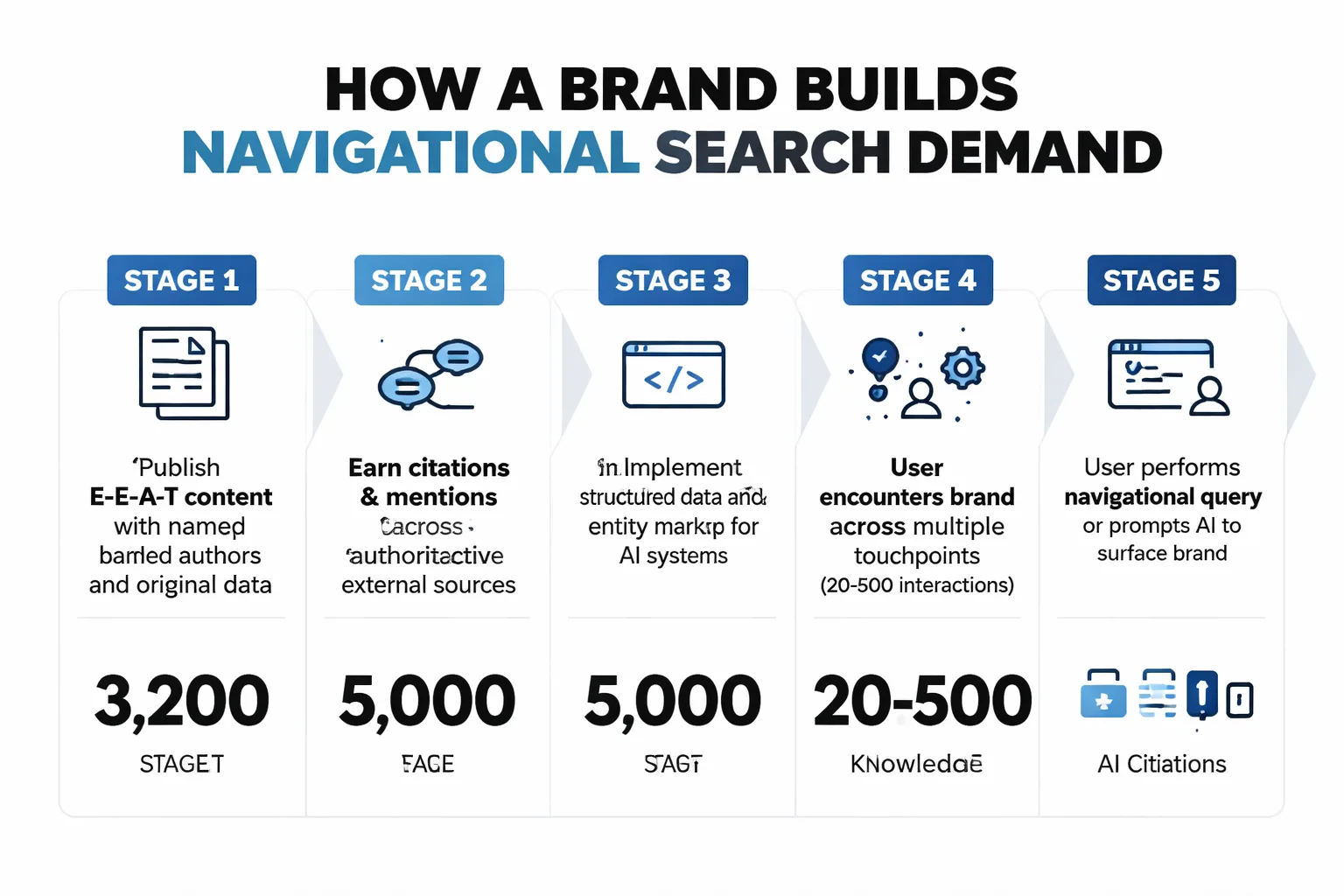
What Should You Build for Navigational Dominance?
The strategic shift required here is less about tactics and more about reorienting what content programs are optimizing toward. Most content teams measure success by organic sessions, keyword rankings, and backlink counts. None of those metrics capture navigational demand directly. Here's what to build instead.
Track branded search volume in Google Search Console as a primary KPI. Filter the Performance report by queries containing your brand name. That number, tracked monthly, is your navigational demand metric. If it's growing, your brand-building is working. If it's flat while your informational traffic grows, you're building an audience that doesn't remember you.
Implement structured data for entity clarity. AI systems need to understand what your brand is, what it does, and why it's authoritative before they'll surface it in assisted navigational queries. Organization schema, author schema on every bylined piece, and FAQ schema on high-intent pages are the minimum. The Google Search Console structured data report will show you what's being parsed and what's failing.
Build content that's quotable at the sentence level. AI Overviews and Perplexity citations pull specific sentences, not pages. Every article should contain at least 6 standalone, specific, opinionated sentences that make sense extracted from context. This is the GEO equivalent of the meta description — the unit of content that gets surfaced when an AI navigates a user toward your brand.
Invest in named authorship with verifiable credentials. The correlation between named authors and navigational demand is real. A reader who can look up an author, find their LinkedIn, see their other work — readers remember the brand and search for it again. Anonymous content doesn't build the brand memory that drives navigational queries.
The teams that will own navigational search in 2026 aren't the ones publishing the most content. They're the ones building brands that users — and AI systems — already know to look for. That's a fundamentally different content strategy than keyword-volume optimization, and the gap between the two approaches is widening every quarter that AI Overviews expand their footprint.
Navigational intent drives results. Track it in Google Search Console starting today.
What is navigational search intent?
Navigational search intent describes queries where a user is trying to reach a specific website, brand, or page — rather than discover information or complete a transaction. Examples include searching "\[brand name\] login" or "\[tool name\] pricing." These queries signal that the user has already made a brand decision and is using search as a navigation mechanism.
How does AI search affect navigational intent?
AI search tools like ChatGPT and Perplexity create a new form of assisted navigational intent — where users know the category they want but delegate brand selection to the AI. Brands that appear in AI-generated responses effectively capture navigational outcomes even when users never type the brand name directly.
Why is navigational traffic higher-converting?
Navigational visitors arrive with a prior brand decision already partially formed. They've encountered the brand before, decided it's worth returning to, and searched deliberately. This pre-qualification means navigational traffic consistently converts at rates closer to the top-quartile 5%+ benchmark rather than the 2–2.5% average for cold informational traffic.
How do you optimize for navigational search?
Optimization for navigational search centers on brand authority signals: structured data markup for entity clarity, named authorship with verifiable credentials, consistent topical coverage that builds brand memory, and monitoring branded query volume in Google Search Console as a primary KPI rather than a secondary metric.
What is GEO and how does it relate to navigational intent?
GEO (Generative Engine Optimization) is the practice of structuring content so AI systems can extract, cite, and surface it in generated responses. Its connection to navigational intent is direct — when an AI surfaces your brand in response to a category query, it's performing a navigational function on the user's behalf. GEO is the new navigational SEO.
Does zero-click search hurt navigational brands?
For informational queries, zero-click results reduce traffic. For navigational queries, zero-click SERP features — Knowledge Panels, sitelinks, brand-specific rich results — function as trust signals that increase conversion rates on the clicks that do occur. Navigational brands should optimize for SERP feature ownership, not just click volume.
FAQ
What is navigational intent?
Navigational intent refers to searches where users aim to reach a specific website or brand, like typing a brand name into Google instead of using a bookmark or direct URL. This behavior signals strong brand recognition and authority, as users already know the brand exists and deliberately seek it out. It's distinct from informational or transactional searches that AI is increasingly dominating.
Why is navigational intent the future of SEO?
As AI dominates search, AI Overviews and zero-click results are absorbing informational and transactional traffic, making navigational queries the most valuable signal of genuine brand authority. Brands with high navigational demand demonstrate user trust that's harder for AI to fully intercept. This shift positions navigational intent—and emerging GEO (Generative Engine Optimization)—as the key battleground for 2025 SEO.
What does SparkToro's research reveal about navigational searches?
SparkToro's analysis of 332 million queries over 21 months shows a substantial portion of searches are navigational, with users treating Google as a shortcut to specific sites. This underscores that navigational demand isn't declining despite zero-click trends—it's becoming more strategically critical. It reframes brand success around authority signals rather than broad keyword rankings.
How can brands optimize for navigational intent in the AI era?
Brands should focus on building E-E-A-T (Experience, Expertise, Authoritativeness, Trustworthiness) depth, implementing structured data, and establishing topical authority to get surfaced in AI prompts and overviews. The evolution from typing URLs to prompting AI assistants means GEO tactics ensure your brand appears in recommendation flows. Prioritize direct brand searches as a measurable proxy for authority over chasing vanishing informational traffic.