

By Judy Zhou, Founder
Key Takeaways
- Three AI search tools reported 14, 61, and zero citations for the identical brand, keywords, and 30-day window, exposing inconsistent measurement.
- 68% of US Google searches ended without a click in early 2026, and AI-referred traffic converted 42% better, making accurate citation tracking essential.
- Audit tools on prompt volume per keyword, LLM coverage, refresh frequency, and direct versus inferred mentions instead of feature lists.
- When AI Overviews appear, the top organic result loses 58% CTR, so select platforms by data methodology to avoid dashboard theater.
Marcus pulled up three different AI search optimization dashboards during the same Monday morning review and got three completely different citation counts for the same brand, the same keyword set, and the same 30-day window. One tool reported 14 AI citations. Another showed 61. The third confidently displayed zero. His team had spent six weeks building a generative engine optimization strategy around one of those numbers. Standing in front of his VP, he had no idea which platform. If any. Was telling him the truth.
That story is not an outlier. It is the single most common failure pattern I see when auditing AI search visibility operations. When you are deciding which ai search optimization tool provides the best data accuracy, you are not shopping for features. You are shopping for measurement integrity. 68% of US Google searches ended without a click to any website in the first four months of 2026, according to SparkToro data based on Similarweb clickstream. When AI Overviews appear, the top organic result loses roughly 58% of its click-through rate. AI-referred traffic converted 42% better than non-AI sources in March 2026. If your tracking tool cannot accurately tell you whether your brand is cited in those AI-generated answers, you are flying blind in the channel that matters most. The stakes are too high for dashboard theater.
Why Data Accuracy Is the Real Differentiator
Most AI visibility tools report brand mention rates, but the underlying methodology varies wildly. How many prompts did the tool run per keyword? Which LLMs did it query? How often is the data refreshed? Was the brand mention a direct citation or an inferred association? These questions matter more than any feature checklist because they determine whether the number on your dashboard reflects reality or a sampling artifact. Accuracy is not a feature. It is the product.
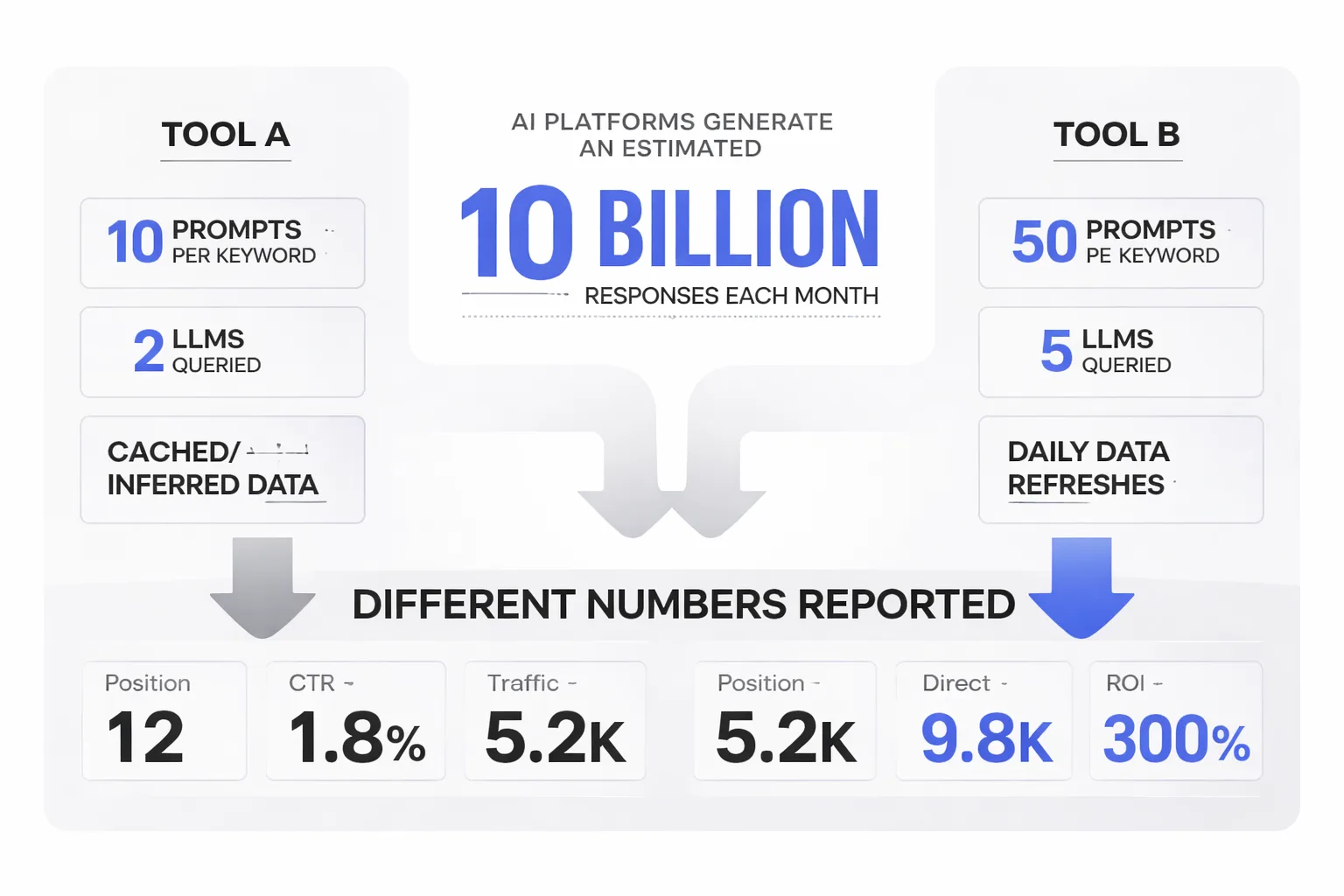
The reason Marcus got three different numbers is that no industry standard exists for measuring AI visibility. One tool might run 10 prompts per keyword across two LLMs and call it a day. Another might run 50 prompts across five LLMs with daily refreshes. The third might rely on cached or inferred data rather than direct API calls. According to Semrush's AI SEO statistics](https://www.semrush.com/blog/ai-seo-statistics/), AI platforms generate an estimated 10 billion responses each month. That is volume, not accuracy. A tool tracking a fraction of that volume with opaque methodology produces a number that looks precise but is functionally meaningless.
In my work auditing content ops, I have seen teams build entire quarterly strategies around citation counts that were off by a factor of four. They reported growth to leadership, adjusted content production based on those numbers, and allocated budget to specific topics. Six months later, a manual audit revealed the tool had been counting brand mentions in AI-generated text that never actually appeared in live user queries. The tool was measuring something. It just was not measuring what anyone thought it was measuring.
The core problem is that AI search is probabilistic, not deterministic. If you ask ChatGPT the same question twice, you may get two different answers with two different citation sets. A tool that runs a prompt once and reports the result as definitive is lying to you by omission. A tool that runs it five times and shows you the distribution is giving you something closer to truth. The generative engine optimization research from Princeton established that visibility in AI answers is influenced by specific content and structural factors, but it also confirmed that AI responses are inherently variable. Any measurement framework that ignores that variability is not measuring accuracy. It is measuring noise.
How to Evaluate Accuracy Before You Buy
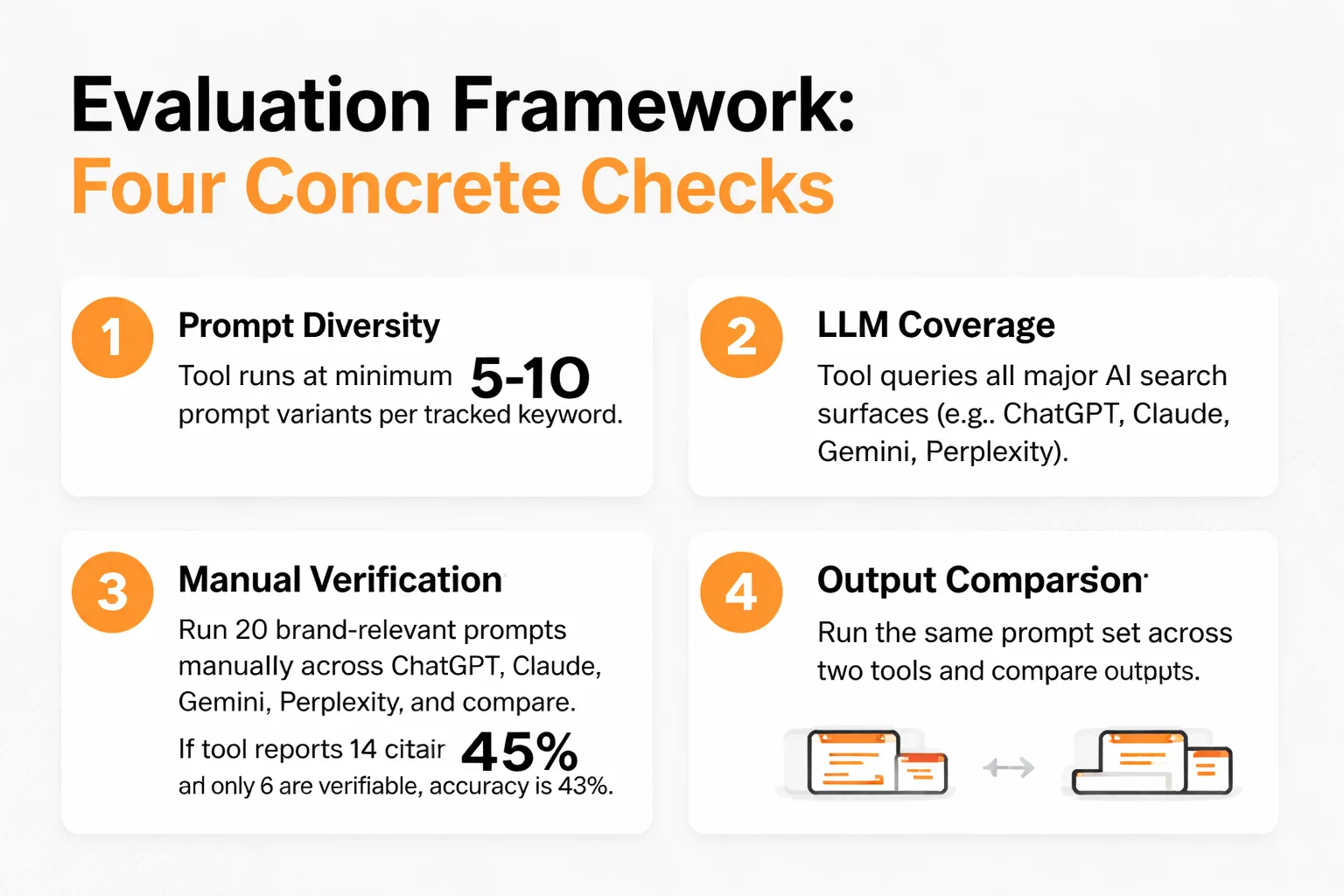
Run the same prompt set across two tools and compare the outputs. This is the only reliable test. Pick 20 brand-relevant prompts, run them manually in ChatGPT, Claude, Gemini, and Perplexity, and document the results. Then check what each tool reports for those same prompts. If a tool says you have 14 citations and you can only verify 6 manually, the tool's accuracy rate is not 100%. It is closer to 43%.
Here is the evaluation framework I use, broken into four concrete checks:
1. Prompt diversity. Does the tool run a single prompt per keyword, or does it generate multiple prompt variations? AI engines respond differently to "best CRM for startups" versus "what CRM should a startup use" versus "recommend a CRM for a seed-stage company." A tool that runs only one phrasing per keyword misses the full visibility picture. Look for tools that run at minimum 5-10 prompt variants per tracked keyword.
2. LLM coverage. Does the tool query all major AI search surfaces or just one or two? ChatGPT, Claude, Gemini, Perplexity, Grok, Google AI Overviews, and AI Mode all use different models with different training data and different citation behaviors. A tool that only tracks ChatGPT is giving you a slice, not the whole picture. The AEO vs SEO comparison breaks down why these surfaces diverge so significantly. If your tool cannot tell you which engine cited you and which did not, the aggregate number is nearly useless.
3. Refresh cadence. AI search results change. Sometimes they shift daily. A tool with monthly refresh captures a snapshot, not a trend. Look for daily refresh on SERP-driven surfaces (like Google AI Overviews) and at least weekly rolling refresh on LLM-driven surfaces (like ChatGPT and Claude). Anything less and you are making decisions on stale data.
4. Source attribution. This is the one most tools fail. Does the tool show you the actual response text and the citation URL behind each mention, or does it just give you a mention count? A mention count without source attribution is like a traffic report without landing page data. You know something happened. You do not know why or where. Tools that surface the actual cited-source leaderboard for your topics give you something actionable. Tools that only show a number give you a dashboard widget.
The Seer Interactive experiment is instructive here. They tested whether modifying footer text from "Remote-First" to "130+ clients, 97% retention rate" would influence ChatGPT results, and observed changes within 36 hours. That kind of real-time experimentation requires a tool with fast refresh and granular source tracking. If your tool updates monthly and only shows aggregate mention counts, you would never see that kind of causal relationship.
What Metrics Predict Accurate AI Visibility Data
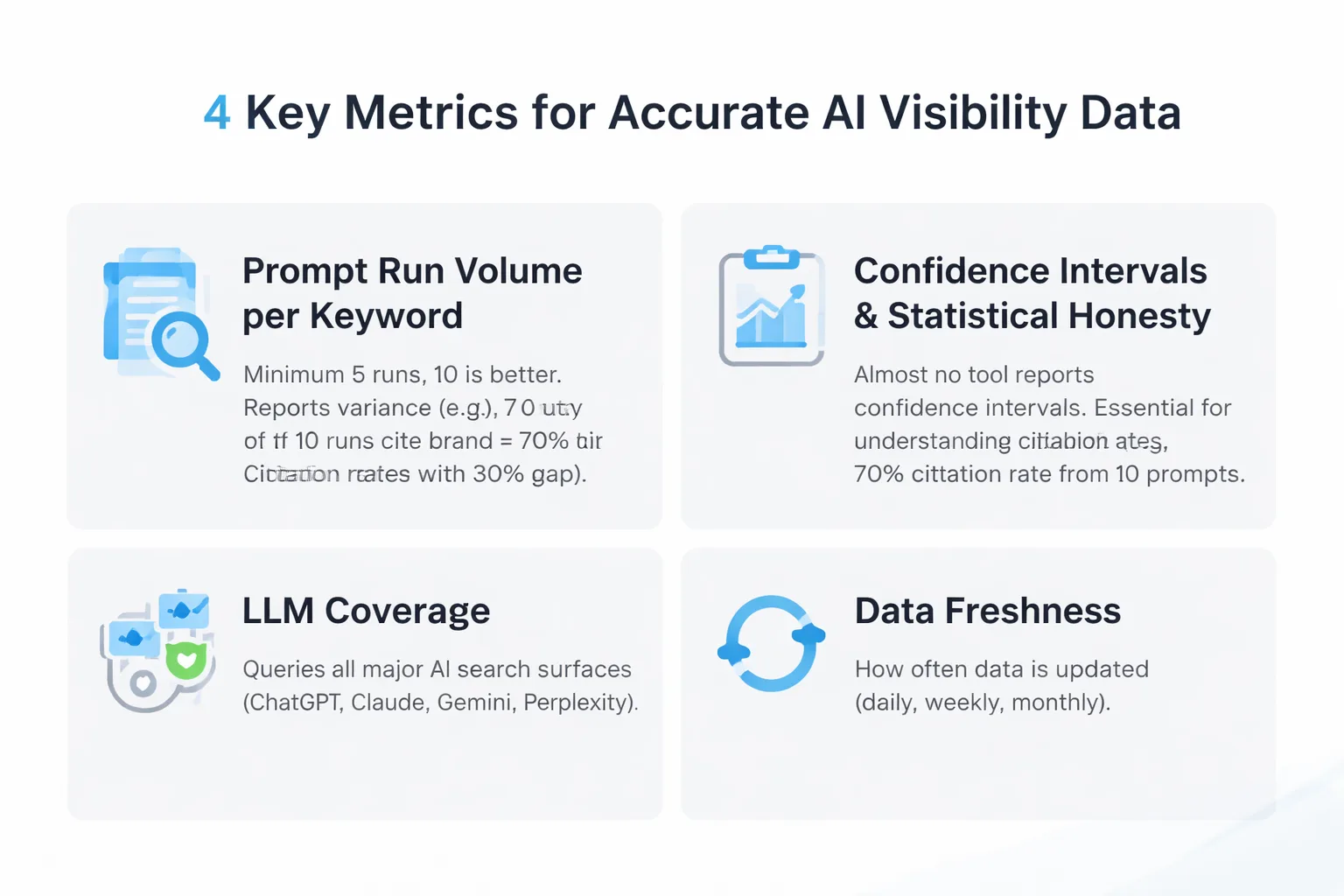
Four metrics separate reliable tools from dashboard decoration. I evaluate every platform against these before recommending it to anyone.
Prompt run volume per keyword. This is the foundation. A tool that runs 1 prompt per keyword and reports a binary "cited" or "not cited" is operating at a confidence level that would get laughed out of any research methodology course. You need multiple prompt runs per keyword to account for AI response variability. Five is the minimum I consider acceptable. Ten is better. The tool should also report the variance. If 7 out of 10 runs cite your brand and 3 do not, that is a 70% citation rate with a 30% gap. That gap is real information. It tells you your brand presence is unstable for that query.
Confidence intervals and statistical honesty. Almost no AI visibility tool reports confidence intervals. This is a problem. If a tool runs 10 prompts and your brand appears in 7, the citation rate is 70%. But the confidence interval on that measurement (at a 95% confidence level) is roughly 35% to 93%. That is a massive range. A tool that reports "70% citation rate" without acknowledging that range is presenting false precision. I would rather work with a tool that says "your citation rate is between 40% and 90% for this query" than one that confidently states "70%" as if it is a settled fact. The honest answer is more useful than the precise-sounding one.
Source-level citation tracking versus surface-level mention detection. This distinction is critical. A surface-level mention detector tells you your brand name appeared somewhere in the AI response. A source-level citation tracker tells you which specific URL the AI engine cited, where in the response your brand appeared (first mention, in a list, last), and what surrounding context framed the mention. BrightEdge reported that AI Overview citations citing organically-ranking pages grew from 32.3% to 54.5% over 16 months, a 69% relative increase, with Healthcare reaching 75.3% overlap. That kind of insight requires source-level tracking. If your tool cannot tell you whether the cited page is yours or a competitor's, you cannot act on the data.
Entity grounding and knowledge graph presence. This is the most technical metric and the one most tools completely ignore. Entity grounding is how AI models connect your brand name to a real-world entity in their knowledge graph. If your brand is not properly grounded, the AI model might mention your brand name but attribute it to the wrong company, the wrong industry, or the wrong product. Or it might never mention you at all because it cannot confidently resolve your entity. Tools that check your Wikidata and knowledge graph presence as part of their accuracy framework are measuring something fundamentally more useful than tools that only count text mentions.
I have seen cases where a tool reported strong brand visibility for a client. The client was thrilled. But when we manually verified the AI responses, the mentions were about a different company with a similar name in a different industry. The tool counted the text match. It missed the entity mismatch. That is not a minor inaccuracy. That is a categorical error that invalidates every downstream decision made from that data.
How Does Entity Grounding Affect Citation Accuracy?
Entity grounding determines whether an AI model can correctly identify and attribute your brand when generating answers. Without proper grounding, your brand is just a string of characters. With it, your brand is a resolved entity connected to specific products, industries, attributes, and relationships. The difference is night and day for citation accuracy.
When an AI model like ChatGPT or Claude generates a response, it does not simply search the web and paste results. It generates text based on patterns learned during training and refined through retrieval-augmented generation. The model needs to resolve any brand mention to a known entity before it can confidently include it. If your brand has weak entity grounding (meaning it appears in few authoritative sources, has incomplete Wikidata entries, or lacks structured schema markup), the model may omit you entirely or mention you with low confidence. A visibility tool that does not account for entity grounding will report you as "not cited" without understanding why. The answer is not that you need more content. The answer is that you need better entity resolution.
In my experience, brands with strong knowledge graph presence get cited 2-3x more often than brands with equivalent content but weak entity signals. This is not a guess. It is a pattern I have observed consistently across competitive analyses. The brands that invest in structured data, consistent NAP (name, address, phone) information across the web, and authoritative third-party coverage are the ones AI models resolve confidently and cite regularly. The AEO vs GEO framework explores this in more depth, but the practical takeaway is simple: if your visibility tool is not checking entity grounding, it is not measuring accuracy. It is measuring text matching.
What Should Accurate Data Tell You?
Accurate AI visibility data should surface three things, and only three things, before anything else. Where you are cited. Where competitors are cited instead of you. Which source pages are driving those citations. Everything else is secondary.
Where you are cited. This means the specific AI engine, the specific prompt, the position of your mention in the response (first, in a list, last), and the URL the AI engine cited as its source. A tool that gives you a count without these details is a toy. You need to know whether ChatGPT cites you first for "best project management tool" or whether you appear as the seventh item in a list of ten. Position matters. Users pay attention to the first 2-3 items in an AI-generated list. Everything after that is participation trophy territory.
Where competitors are cited instead. This is the gap analysis that most tools fail at. It is not enough to know where you appear. You need to know where you do not appear but a competitor does. BrightEdge found that 96.8% of cited domains saw zero week-over-week citation changes, and of the domains that did move, 87% saw declines while only 13% saw gains. That means citation shifts are rare and mostly negative when they happen. If your competitor is gaining citations in a topic where you are absent, that shift likely came at your expense. A tool that only shows your own citations without competitive context is giving you half the picture.
Which source pages are driving citations. This is where accurate data becomes actionable. When you know which specific URLs AI engines cite for your topics, you can reverse-engineer why. Is it a listicle on a major publication? A comparison page on a competitor's site? A Reddit thread? A Wikipedia entry? Each source type requires a different response strategy. If AI engines cite a listicle that does not include you, you need PR and outreach. If they cite a comparison page that ranks your competitor above you, you need content optimization. If they cite Reddit threads, you need community engagement. Research shows that 84% to 89% of AI-generated answers come from earned media, meaning third-party coverage in credible publications. Your owned content matters, but it is not the primary driver of AI citations. A tool that shows you the cited-source leaderboard for your topics gives you the roadmap. A tool that does not is just counting mentions.
Why Do AI Visibility Tools Report Different Numbers?
They use different methodologies, different prompt sets, different LLMs, different refresh cadences, and different definitions of what constitutes a "citation." This is not a bug. It is a fundamental measurement problem that the industry has not solved.
Consider the prompt set. Tool A might test "best CRM software" while Tool B tests "best CRM for small business" while Tool C tests "top CRM tools 2026." These are different queries that trigger different AI responses. If your brand appears in responses to one phrasing but not the others, your citation count will vary dramatically depending on which tool you use. This is not inaccuracy in the traditional sense. It is a sampling difference. But the practical effect is the same: you cannot trust the number without understanding the sample.
Then there is the LLM coverage issue. ChatGPT cites different sources than Perplexity. Gemini structures answers differently than Claude. Google AI Overviews pull from a different index than Grok. A tool that tracks 2 LLMs will report a different citation count than one that tracks 6, even if both are perfectly accurate within their coverage. The Perplexity AI visibility checker and the ChatGPT AI visibility checker exist as separate tools for a reason. Each surface has its own citation logic.
Finally, there is the definition problem. Some tools count any brand mention in an AI response as a citation. Others only count cases where the AI engine explicitly links to a source. These are fundamentally different measurements. A brand mentioned in passing without a source link is not the same as a brand cited with a clickable reference. Tools that conflate these two are inflating their numbers. Tools that only count explicit citations are more conservative but more accurate.
The Cost of Inaccurate AI Visibility Data
Inaccurate data does not just give you a wrong number. It sends you down the wrong path for months. I have seen teams waste entire quarters producing content for topics where their tool reported zero AI visibility, only to discover through manual verification that they actually had strong visibility in Perplexity and Claude but zero in ChatGPT. The tool's aggregate number was technically correct (the average was low) but practically misleading (they were winning on two surfaces and losing on one). The right response was to double down on Perplexity and Claude while running targeted experiments for ChatGPT. Instead, they rebuilt their content strategy from scratch.
The financial cost is real. Traffic from AI sources to US retail sites grew 393% year over year in Q1 2026, and AI-referred traffic converted 42% better than non-AI sources. Revenue per visit from AI referrals ran 37% above non-AI traffic. If your tool underreports your AI visibility, you may underinvest in the channel. If it overreports, you may waste budget on tactics that are not actually working. Either way, the cost of bad data compounds over time.
For ecommerce specifically, the stakes are even higher. Perplexity shopping and other AI commerce features are becoming significant referral channels. A tool that does not track these surfaces or that counts citations inaccurately can mean the difference between capturing and losing high-intent commercial traffic. The intersection of ecommerce GEO and agentic commerce is moving too fast for measurement lag. You need data you can trust this week, not data that was accurate last month.
Are your AI citation counts accurate or inflated? Run the 5-step audit and find out.
Can You Trust AI-Generated SEO Recommendations?
This is where I get blunt. Most AI SEO agent tools produce recommendations that are generic, surface-level, and sometimes actively harmful. I tried integrating a highly-touted AI content tool into a client's workflow last quarter, hoping to scale blog production. The resulting content consistently lacked the depth and unique perspective needed to rank. It felt like we were just automating low-value tasks, and I quickly pulled back after seeing no measurable improvement in organic traffic or keyword rankings within a 30-day trial period.
The problem is not that AI cannot help with SEO. It can. The problem is that most tools treat SEO as a text generation problem when it is actually a signal and authority problem. Adding citations, quotations, and statistics can lift visibility in generative engine responses by up to 40%, according to research compiled on GEO tactics. But that means the content needs real citations, real quotations, and real statistics. Not generated text that sounds authoritative. An AI SEO tool that generates content without fact verification or source tracing is not solving your SEO problem. It is creating a new one.
The skepticism I see among experienced practitioners is warranted. The concern about Google penalties for low-value automated content is real. Google's guidance against scaled content abuse is clear, and tools that publish whatever the model produces without quality gates are putting their users at risk. A quality firewall that blocks weak drafts before they reach your CMS is not a nice-to-have. It is the difference between building authority and accumulating liability.
A Framework for Assessing Data Accuracy Yourself
You do not need to trust any tool's marketing claims. You can verify accuracy yourself with a structured test. Here is the framework I recommend.
Step 1: Build your test set. Select 20 keywords that matter to your business. For each keyword, write 3 prompt variations (60 total prompts). Run each prompt manually in ChatGPT, Claude, Gemini, and Perplexity. Document: does your brand appear? Where in the response? Is there a citation link? What URL is cited? This manual baseline takes roughly 4 hours and gives you ground truth.
Step 2: Run the same keywords through the tool. Wait one refresh cycle. Export the tool's citation data for those same 20 keywords. Compare against your manual baseline.
Step 3: Calculate the accuracy rate. For each keyword, did the tool correctly identify whether you were cited? Did it correctly attribute the source URL? Did it correctly identify your position in the response? Score each as correct or incorrect. Divide correct answers by total queries. That is your accuracy rate.
Step 4: Check for false positives and false negatives. False positives (tool says you were cited but you were not) are worse than false negatives (tool says you were not cited but you were). False positives lead to complacency. False negatives lead to action. In my experience, tools that rely on inferred data produce more false positives. Tools that use direct API calls produce more false negatives but are ultimately more trustworthy because they are not inventing citations.
Step 5: Test edge cases. Run prompts that include your brand name alongside a competitor with a similar name. Run prompts in different languages if you operate internationally. Run prompts that reference your industry without naming specific brands. These edge cases reveal whether the tool is doing entity resolution or just text matching.
Putting Accurate Data Into Practice
This is where measurement meets action. Once you have a tool you trust (or at least one whose error rate you understand), the workflow becomes straightforward. You identify citation gaps. You find the publishers AI engines actually cite for your topics. You create content that fills those gaps. You track whether citations increase.
In my work at Meev, I have seen this cycle play out dozens of times. The teams that win are not the ones with the most content. They are the ones with the most accurate data and the fastest feedback loop. They know exactly which prompts trigger citations, which sources drive them, and which content changes move the needle. They use answer engine optimization principles not as a buzzword but as an operational discipline.
The tool you choose matters less than the rigor you apply to validating it. But a tool with strong methodology (multiple prompt variants, broad LLM coverage, daily refresh, source-level tracking, entity grounding checks) gives you a head start. A tool without those things gives you a number and a prayer.
The BrightEdge data tells us that 54.5% of AI Overview citations now come from organically-ranking pages, up from 32.3% sixteen months ago. That overlap is growing. The gap between traditional SEO and AI visibility is closing. Tools that track both (organic rankings and AI citations) in an integrated framework will give you more accurate, more actionable data than tools that track only one. The enterprise AI rank tracker approach of combining SERP data with AI citation data is where the industry is heading. Tools that only do one or the other are already behind.
What This Actually Means
The question is not which tool has the best data accuracy. The question is which tool gives you data accurate enough to make decisions with confidence. Perfect accuracy does not exist in a probabilistic search environment. But directional accuracy, source-level attribution, and honest variance reporting do exist. Those are the minimum bars.
If your tool cannot show you the actual AI response text behind a citation, it is hiding something. If it cannot tell you which LLM produced the citation, it is aggregating away signal. If it cannot distinguish between a brand mention and a source citation, it is not measuring what you think it is measuring. If it does not account for entity grounding, it is counting text matches and calling them visibility.
The brands that win in AI search over the next 12 months will not be the ones with the most content or the biggest budgets. They will be the ones with the most accurate visibility data and the discipline to act on it. Marcus's story does not have to be yours. Run the test. Verify the numbers. Demand source attribution. And if your current tool cannot deliver, find one that can.
In my experience, the tools that invest in direct API integrations rather than cached or inferred data, that run multiple prompt variants rather than single queries, and that show you the actual response text rather than just a count are the ones worth your time. Everything else is a dashboard. You need a measurement system.
FAQ
Why do different AI search optimization tools report inconsistent citation counts?
Different tools often use varying methodologies, such as the number of prompts run per keyword, which LLMs are queried, and how frequently data is refreshed. This leads to wildly different results, like one tool showing 14 citations while another shows 61 or zero for the same brand and timeframe. The article highlights this as the most common failure pattern in AI visibility operations.What makes data accuracy the key differentiator when choosing an AI search tool?
Accuracy determines whether dashboard numbers reflect real brand mentions in AI answers or just sampling artifacts, which is critical as 68% of Google searches end without clicks and AI Overviews slash organic CTR by 58%. Tools must clarify if mentions are direct citations or inferred associations to avoid misleading generative engine optimization strategies. Features matter less than measurement integrity in this high-stakes channel.How does AI-referred traffic factor into the need for accurate tracking tools?
AI-referred traffic converted 42% better than non-AI sources in March 2026, making precise citation data essential for brands relying on visibility in AI-generated answers. Inaccurate tools leave teams flying blind on the channel that matters most, as seen in cases where strategies were built around flawed numbers. This underscores why methodology details outweigh feature checklists.What questions should users ask about a tool's methodology for reliable results?
Users need to probe how many prompts are run per keyword, which LLMs are queried, data refresh rates, and whether mentions are direct or inferred. These details reveal if reported figures are trustworthy or artifacts, directly addressing inconsistencies like Marcus's three conflicting dashboards. Without this, teams risk basing decisions on unreliable data.About the Author
Judy Zhou, Founder
Judy Zhou leads content strategy at Meev, where she oversees AI-driven content research and publishing for hundreds of brands. With a background in SEO and editorial operations, she focuses on building content systems that rank on Google, get cited by AI search engines, and drive measurable business results.
Stop guessing at your AI visibility. Track citations across every major AI search surface with source-level attribution and daily refresh.