
ChatGPT Shopping for Merchants: How Listings Work and How to Appear
By Judy Zhou, Founder
Key Takeaways
- 75% of business owners and 86% of SEO professionals already use AI tools, yet most merchants have no strategy for appearing in ChatGPT Shopping answers.
- AI assistant-referred traffic converts 54% better and drives 53% more time on site than other channels.
- Submit clean, entity-grounded product data via Shopify or Etsy feeds to render rich listings with imagery, pricing, reviews, and direct links inside ChatGPT.
- Treat ChatGPT Shopping as a discovery and qualification engine, since in-chat checkout converts three times worse than a plain link.
ChatGPT Shopping for merchants is OpenAI's in-chat product discovery layer that pulls structured product data from merchant feeds (Shopify, Etsy) and renders rich listings with imagery, pricing, and reviews directly inside ChatGPT conversations. It is currently US-only and requires clean, entity-grounded product data to surface. 75% of business owners already use AI tools in some capacity, and 86% of SEO professionals have integrated AI into their workflows, yet most merchants have no strategy for being found inside AI shopping answers.
I lead content strategy at Meev, where I oversee AI-driven content research and publishing for hundreds of brands. Watching the ChatGPT Shopping rollout has convinced me of one thing: most merchants are treating this like a new sales channel when they should be treating it like a discovery and qualification engine. The data backs this up. Walmart measured in-chat checkout conversion at 3 times worse than a plain link, and only about 12 Shopify merchants went live with agentic commerce checkout before it was retired after roughly six months. But here is the twist: AI assistant-referred traffic converted 54% better than other channels as of May 2026, with 53% more time on site.
The agent is a mediocre cashier and an effective qualifier. That reorders everything about how you prepare.
How do ChatGPT Shopping listings work?
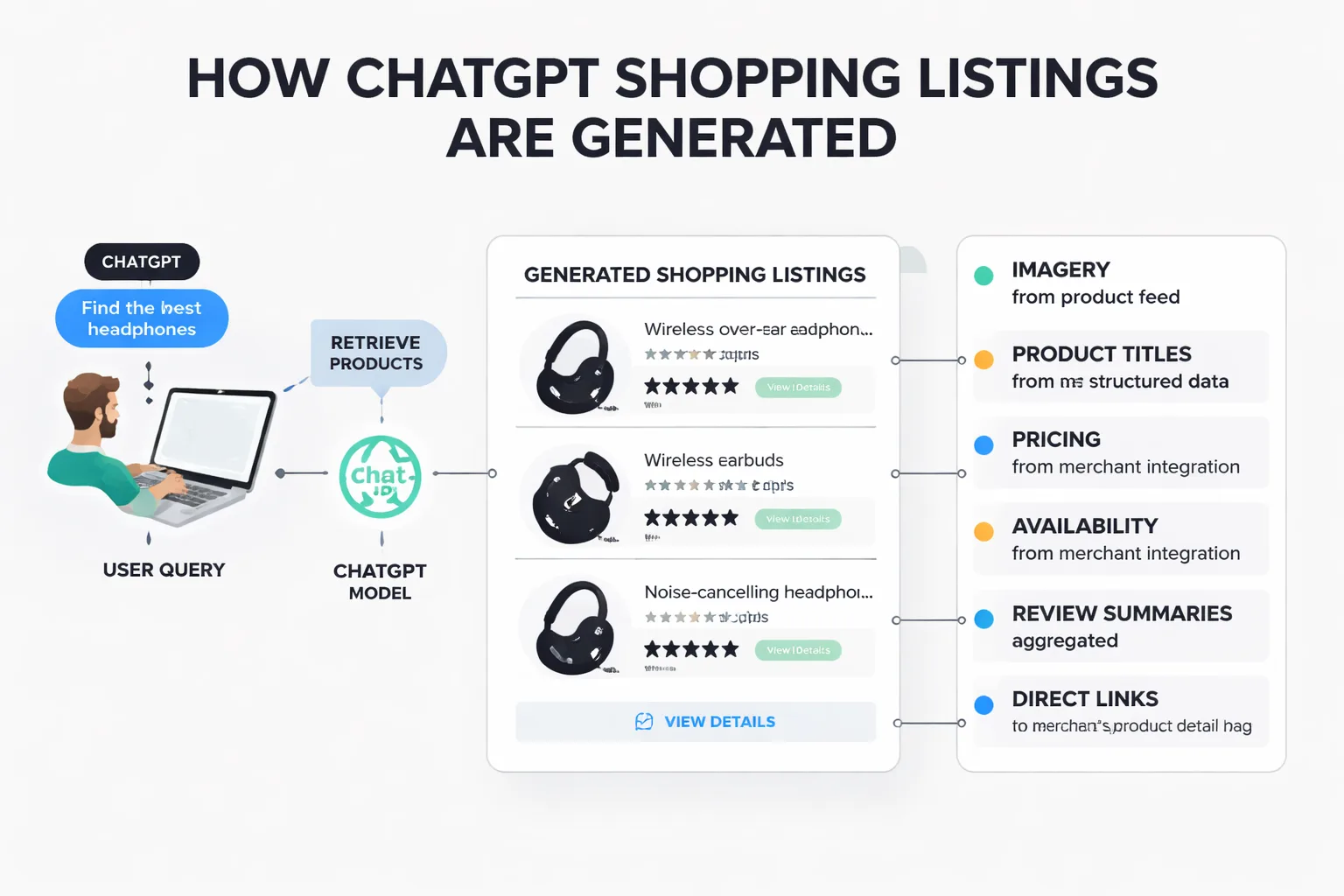
ChatGPT Shopping listings are not a marketplace. They are a rendering layer that pulls from your existing product data and displays it inside a conversational answer. When a user asks ChatGPT about a product category, the model retrieves matching products and presents them with imagery, product titles, pricing, availability, review summaries, and direct links to the merchant's product detail page.
Think of it like Google's Shopping Graph, but instead of surfacing in a dedicated shopping tab, the results appear inline within a conversation. The user never leaves ChatGPT to browse. They ask, they see, they click through.
The listing itself contains several components. Product imagery is pulled from your feed. Product details (title, description, attributes) come from your structured data. Pricing and availability are synced from your merchant integration. Reviews are aggregated and summarized. And direct links send the user to your PDP for checkout.
Currently, the merchant integrations are limited. Shopify is the primary integration, with Shopify confirming that ChatGPT Shopping is now a sales channel enabling direct product sales within ChatGPT conversations. Etsy is also integrated. The feature is US-only, which means merchants outside the United States cannot currently participate, and international users may see limited or different shopping results.
The limitation that matters most is not geography. It is data quality. If your product feed, collection structure, PDP content, reviews, availability, pricing, and technical signals are weak, AI shopping discovery will pass over your brand entirely. The model simply has better-structured alternatives to choose from.
Let me give you a concrete example of what this looks like in practice. Imagine two merchants selling the same category of product: ceramic coffee mugs. Merchant A has a product title that reads "Ceramic Coffee Mug, 12oz, Matte Black, Dishwasher Safe by ClayHouse." Their feed includes attributes for material (stoneware ceramic), capacity (12oz), color (matte black), care instructions (dishwasher and microwave safe), weight (14 oz), and dimensions (4.5 x 3.5 inches). Their PDP includes a 300-word description explaining the craftsmanship, the glazing process, and the intended use cases. They have 127 reviews with an average rating of 4.8 stars, and their review schema is valid and synced.
Merchant B sells a similar mug. Their product title reads "Mug-Blk-Cer." Their feed has a title and price but no attributes. Their PDP description is two sentences: "Nice ceramic mug. Great for coffee." They have 14 reviews with no schema markup.
When a user asks ChatGPT "What is a good ceramic coffee mug that is dishwasher safe?" Merchant A appears in the results. Merchant B does not. The model had enough structured data to confidently match Merchant A's product to the query. It could not parse Merchant B's product at all. The difference was not product quality. It was data quality.
How Does ChatGPT Shopping Work for Product Discovery?
ChatGPT Shopping works by retrieving products from structured merchant feeds and rendering them as rich listings inside conversational responses. When a user asks about a product, the model queries available merchant integrations, matches products to the query intent, and displays results with imagery, pricing, and direct links. The entire flow depends on one thing: your product data being machine-readable and semantically clear.
Here is what happens behind the scenes. A user types something like "I need a lightweight hiking backpack under $100 with good reviews." ChatGPT parses the query for intent (hiking backpack), constraints (under $100, lightweight), and social proof signals (good reviews). It then retrieves matching products from connected merchant feeds. The results are ranked not just by relevance but by data completeness. A product with rich attributes, high-quality images, structured reviews, and accurate pricing will outrank one with a bare-bones title and no reviews.
This is where most merchants fail. They treat their product feed as a necessary evil for Google Shopping or Meta ads, not as the primary input for an LLM that is trying to understand and recommend their products. The Eva.guru Shopify ChatGPT Shopping guide puts it well: Shopify brands should prepare their product data for AI discovery, strengthen collection and PDP content, keep pricing and availability accurate, improve structured data, and connect AI-search visibility to conversion and retention.
The goal is not only to appear in AI shopping results. The goal is to turn new discovery into profitable customers.
There is a critical distinction between how traditional search engines and LLMs handle product retrieval. Google's Shopping Graph uses keyword matching, bid signals, and feed attribute mapping to rank products. If your title contains the right keywords and your bid is competitive, you appear. The ranking is mechanical. ChatGPT's retrieval is semantic. The model reads your product title, description, and attributes as natural language and forms an understanding of what the product is, who it is for, and what problems it solves. Then it matches that understanding against the user's conversational query.
This means that keyword stuffing, which barely works on Google anymore, is actively harmful in ChatGPT Shopping. A title like "Hiking Backpack Backpacking Bag Travel Pack 40L Black Waterproof Lightweight" might trick Google's matching algorithm. But ChatGPT reads it as spammy, incoherent text and deprioritizes it in favor of a clean, natural language title. The model is optimizing for user experience, and a keyword-stuffed title creates a bad user experience.
Why Direct Checkout Failed and What Replaced It
Here is where the story gets interesting, and where most of the industry coverage got it wrong.
When ChatGPT Shopping first launched, the headline feature was instant checkout. The idea was that users could buy products directly inside the chat without ever leaving the conversation. It was pitched as the future of frictionless commerce. Investors loved it. Merchants rushed to enable it.
Then the data came in.
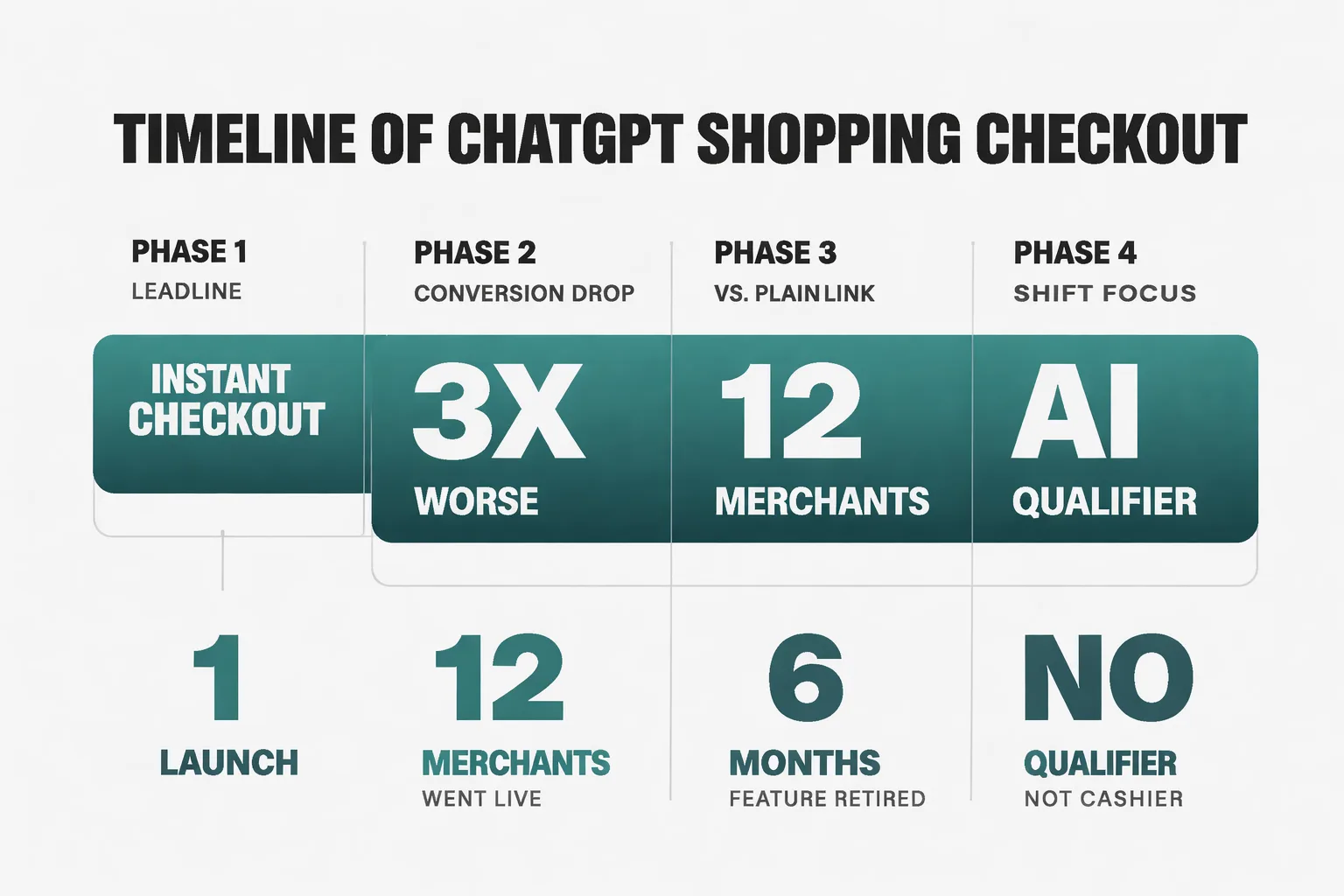
Walmart measured in-chat checkout conversion at 3 times worse than a plain link. Only around 12 Shopify merchants ever went live with agentic commerce checkout. The feature was retired by its own author after roughly six months.
The industry declared agentic commerce a failure. They were wrong.
What actually happened is that the AI agent turned out to be a terrible cashier but an exceptional qualifier. When merchants stopped trying to close the sale inside ChatGPT and instead optimized their product data for discovery and qualification, the results flipped. AI assistant-referred traffic started converting 54% better than other channels, with users spending 53% more time on site.
The lesson is clear. Do not optimize for in-chat conversion. Optimize for answer engine discovery. Make your product data so clear, so complete, and so semantically rich that when ChatGPT recommends your product, the user clicks through already qualified and ready to buy.
Let me unpack why in-chat checkout failed so badly, because the mechanics matter. When a user shops inside a chat interface, they lose three things that traditional e-commerce relies on: visual browsing, comparison context, and trust signals from the page itself. In a traditional PDP, the user sees multiple product images, reads detailed specifications, scans reviews at their own pace, checks the return policy, and feels the weight of a branded environment. In a chat window, they get a compressed recommendation card. That compression kills conversion for high-consideration purchases.
The 54% conversion lift on AI-referred traffic makes perfect sense in this context. When ChatGPT recommends a product and the user clicks through to the merchant's PDP, they arrive already qualified. The AI has done the work of filtering by attributes, comparing options, and selecting this specific product. The user lands on the PDP with intent already established. They are not browsing. They are confirming a decision the AI helped them make. That is why they convert 54% better and spend 53% more time on site. They are validating, not exploring.
This is the core of answer engine optimization for e-commerce. It is not about being the final step in the purchase journey. It is about being the first step.
Are your products appearing in ChatGPT Shopping answers, or are competitors capturing that visibility?
Optimizing Product Data for LLM Consumption
This is the section I wish existed when I first started auditing AI visibility for e-commerce brands. Most product feed optimization guides were written for Google Shopping in 2019. They cover feed attributes, bidding strategies, and campaign structure. None of that applies here.
LLMs do not bid on keywords. They retrieve, rank, and recommend based on semantic understanding. Your product data needs to be optimized for comprehension, not for bidding.
Here is the framework I use, broken into five layers.
Layer 1: Structured Product Titles
Your product title is the single most important signal for LLM retrieval. It needs to contain the product type, key attributes, brand name, and differentiators in a natural language format. Not keyword-stuffed. Not truncated. Natural.
Bad: "Backpack-Blk-40L-Hike"
Good: "TrailWeight 40L Lightweight Hiking Backpack in Black by SummitGear"
The LLM needs to parse your title and understand what the product is, who made it, and what makes it different. If your title is a SKU code with abbreviated attributes, the model will skip you.
Layer 2: Complete Attribute Coverage
Every attribute the LLM might use as a filter needs to be populated. Weight, dimensions, materials, color options, size options, warranty, intended use, gender, age range. The model will not guess. If a user asks for a "lightweight backpack under 2 pounds" and your weight attribute is empty, you will not appear.
Forrester's July 2025 Consumer Pulse research found that 29% of US online adults struggle to buy apparel because they "can't tell the material and quality" from product pages. That same gap kills you in LLM retrieval. If the model cannot determine material and quality from your data, it cannot recommend you with confidence.
Layer 3: Semantic Product Descriptions
Your product description needs to read like a knowledgeable salesperson explaining the product, not like a search engine optimization exercise. The LLM is trying to understand the product well enough to recommend it. Give it context, use cases, comparisons, and benefits in natural language.
Include answers to common questions inside the description. What is it made of? Who is it for? What activities is it suited for? How does it compare to alternatives? The LLM will extract these answers and use them to match your product to user queries.
Layer 4: Structured Data and Schema
Product schema markup is non-negotiable. The LLM needs to find structured data that confirms what your unstructured content says. If your product page says "$89.99" but your schema says nothing, the model has to guess. If your schema confirms the price, availability, rating, and review count, the model can recommend you with confidence.
Use Product schema, Offer schema, AggregateRating schema, and Review schema. Make sure they are valid, complete, and synced with your live product data. Stale schema is worse than no schema because it teaches the model to distrust your data.
Layer 5: Reviews as Entity Signals
Reviews are not just social proof for humans. They are entity grounding signals for LLMs. The model reads review content to understand product attributes, common use cases, and quality indicators. A product with 500 reviews that mention "lightweight," "durable," and "great for day hikes" is more likely to be recommended for a query about lightweight day hiking backpacks than a product with 50 generic reviews.
Encourage detailed reviews. Respond to reviews with specific product information. Use review schema to structure the data. And monitor your review content for the attributes and use cases that match your target queries.
How Does Entity Grounding Affect AI Shopping Visibility?
Entity grounding is the process of connecting your brand and products to a structured knowledge graph that AI models use to verify and disambiguate information. In the context of ChatGPT Shopping, entity grounding determines whether the model can confidently identify your brand, associate it with the right products, and recommend those products with trust.
Without entity grounding, your products are floating in an unstructured sea of product data. The model might find them, but it cannot verify them. It cannot confirm that your brand is real, that your products are legitimate, or that your pricing is accurate. So it defaults to brands it can verify.
This is where Wikidata and knowledge graph presence becomes critical. Knowledge graphs provide the structured, verified relationships that LLMs use to ground their responses. If your brand has a Wikidata entry with correct product categories, official URLs, and key relationships (parent company, subsidiaries, brand aliases), the model can verify your identity and associate your products with confidence.
The pattern I keep seeing is that merchants with strong knowledge graph presence get cited more often, even when their product data is comparable to competitors. The model prefers what it can verify. And verification comes from structured, authoritative sources, not from your product page alone.
Here is what to do. Create a Wikidata entry for your brand if one does not exist. Ensure it includes your official website, product categories, founding date, and any notable relationships. Add structured data on your site that references the same entity identifiers. Build consistency between your Wikidata entry, your website schema, and your product feed. The more consistent signals the model finds, the more confidently it will recommend your products.
Let me walk through a real-world scenario to make this concrete. Say you sell artisanal hot sauce under the brand name "FireForge." You have a Shopify store, a decent product feed, and some positive reviews. But you have no Wikidata entry, no Wikipedia page, and no presence in any structured knowledge graph.
When a user asks ChatGPT "What are some good artisanal hot sauces with habanero?" the model retrieves products from merchant feeds. It finds your FireForge Habanero Sauce. But then it tries to verify the brand. It searches its knowledge graph for "FireForge" and finds nothing. It searches for your domain and finds no structured entity. It cannot confirm that FireForge is a real, established brand. So it deprioritizes your product in favor of a competitor whose brand it can verify through Wikidata, structured data, and consistent external references.
Now imagine you create a Wikidata entry for FireForge. You include your official URL (fireforge.com), your product category (artisanal hot sauce), your founding date, your key ingredients, and your brand alias ("FireForge Sauces"). You add Organization schema to your website that references your Wikidata entity ID. You get listed in a few reputable hot sauce directories that also reference your brand consistently.
Now when the model retrieves your product, it can verify your brand instantly. It finds consistent signals across Wikidata, your website schema, and external directories. The verification is fast and confident. Your product moves up in the recommendation order. Not because your product changed, but because your entity grounding improved.
The Agentic Commerce Protocol Explained
The Agentic Commerce Protocol is a technical framework that standardizes how AI agents interact with merchant systems for product discovery, data retrieval, and transaction execution. It is the plumbing beneath the surface of ChatGPT Shopping, and understanding it gives you a strategic advantage over merchants who treat the protocol as a black box.
At its core, the protocol defines how an AI agent queries a merchant's product catalog, how the merchant responds with structured product data, and how the agent renders that data for the user. It covers product discovery (querying by attributes, categories, or natural language), data retrieval (pulling product details, pricing, availability, reviews), and transaction handling (checkout, payment, order confirmation).
The protocol matters because it determines what data the agent can access and how it interprets that data. If your merchant integration exposes a rich, well-structured product feed through the protocol, the agent can retrieve comprehensive product information and render a rich listing. If your integration exposes a minimal feed with missing attributes, the agent will either skip your products or render a bare listing that users ignore.
The strategic implication is this: protocol selection is less important than data quality. Omar Berrabeh's analysis of agentic commerce makes this point directly. Product data quality and channel measurement move to the front. Protocol selection moves to the back.
I agree with this reordering, and I would take it one step further. Merchants should treat the protocol as a data delivery mechanism, not as a sales channel. Your job is to make your product data so complete and so well-structured that any AI agent, using any protocol implementation, can discover, understand, and recommend your products. The protocol is the pipe. Your data is what flows through it.
From a technical perspective, there are three things merchants need to understand about how the protocol handles data. First, the protocol expects product data in a structured format that maps to specific fields: product identifier, title, description, price, availability, images, attributes, and reviews. If any of these fields are missing or malformed, the protocol cannot deliver them to the agent. Second, the protocol handles real-time availability and pricing updates. If your feed is stale, the agent will show outdated information, which erodes user trust and leads to higher bounce rates when users click through. Third, the protocol includes a trust layer that checks whether the merchant is verified and whether the product data is consistent with external signals.
That third point is where most merchants fail. They focus on the data delivery (getting their feed into the protocol) but ignore the trust layer (ensuring their data is consistent with external sources). The trust layer cross-references your product data against knowledge graph entries, review platforms, and other structured sources. If your feed says your product costs $49.99 but review platforms list it at $39.99, the trust layer flags the inconsistency and the agent may deprioritize your listing.
Tracking Your Visibility Inside AI Shopping Answers
This is the gap that frustrates me most. Merchants are spending real money optimizing product data for ChatGPT Shopping, but most have no way to measure whether they are actually appearing in shopping answers. They are flying blind.
The problem is that traditional SEO tools do not track AI shopping visibility. Google Search Console tells you about Google traffic. Analytics tells you about referral traffic. Neither tells you whether ChatGPT is recommending your products when users ask about your category.
You need AI visibility tracking that monitors how often your brand and products appear in AI-generated shopping answers across every major AI search surface. This means tracking ChatGPT specifically, but also Claude, Gemini, Perplexity, and Google AI Overviews, because shopping queries are distributed across all of them.
In my work auditing content ops, I have seen merchants discover that they are being recommended by Perplexity but completely absent from ChatGPT, or vice versa. Without per-engine tracking, you would never know. You would assume that optimizing for one engine optimizes for all, and you would be wrong.
The tracking you need covers three dimensions. First, mention presence: are your products appearing in AI shopping answers at all? Second, mention position: when you do appear, are you the first recommendation, buried in a list, or mentioned last? Third, citation sources: which domains and sources is the AI engine using to ground its recommendation of your product? That third dimension is critical because it tells you which external signals are driving your visibility.
If you want to start with a specific engine, the ChatGPT AI visibility checker is the most direct way to see whether your products are surfacing. For broader coverage, an AI visibility tool that tracks multiple engines gives you the full picture.
Let me walk through how LLM citation tracking works in practice and why it matters for e-commerce specifically. When ChatGPT recommends a product, it does not just pull from your merchant feed in isolation. It grounds the recommendation in external sources. It might reference a review site, a blog post, a Reddit thread, or a publisher's buying guide. These citations are the model's way of verifying that the recommendation is trustworthy.
Understanding which sources the model cites when it recommends your product tells you where to focus your outreach and content efforts. If the model consistently cites a specific review site when recommending products in your category, you need to be reviewed on that site. If it references buying guides from specific publishers, you need to be featured in those guides. This is where the concept of Machine Relations comes in. 84% to 89% of AI-generated answers come from earned media, meaning third-party coverage in credible publications. Your owned content matters, but earned media is what the model actually cites.
For merchants, this means your AI visibility strategy cannot stop at product feed optimization. You need to track which sources the model cites, identify gaps where competitors are cited but you are not, and close those gaps through targeted outreach to publishers and review sites. This is exactly the kind of closed-loop workflow that separates merchants who are visible in AI shopping answers from those who are not.
What Role Does Wikidata Play in Product Discoverability?
Wikidata serves as a machine-readable knowledge base that AI models use to verify entity information, disambiguate brands, and ground product recommendations in verified data. For ChatGPT Shopping, Wikidata presence is one of the strongest trust signals a merchant can send to an LLM.
The model's reasoning is straightforward. When it encounters a product recommendation, it checks whether the brand behind the product is a verified entity in its knowledge graph. If the brand has a Wikidata entry with consistent information (official URL, product categories, founding date, headquarters), the model treats the recommendation as verified and surfaces it with confidence. If the brand has no Wikidata presence, the model either skips it or surfaces it with lower confidence, which means it appears lower in the recommendation order or gets replaced by a verified competitor.
I have seen this pattern repeatedly. Two merchants with comparable product data, comparable pricing, and comparable reviews. One has a Wikidata entry. One does not. The one with Wikidata presence consistently appears in AI shopping answers. The one without does not. The model is not making a quality judgment. It is making a trust judgment based on what it can verify.
Building your Wikidata presence is not complicated, but it requires precision. Create an entry for your brand. Include your official website URL, your primary product categories, your founding date, and any parent company or subsidiary relationships. Add aliases (brand name variations, common misspellings) so the model can find you regardless of how users refer to you. Reference your Wikidata entity ID in your website schema to create a bidirectional link between your structured data and the knowledge graph.
There is a broader knowledge graph ecosystem beyond Wikidata that matters. Google's Knowledge Graph, Amazon's Product Graph, and proprietary LLM training data all contribute to how models verify your brand. You cannot directly edit most of these, but you can influence them through consistent structured data, authoritative external coverage, and a strong entity presence on Wikidata (which feeds into multiple knowledge graphs).
The key insight is that knowledge graphs are interconnected. Wikidata feeds into Google's Knowledge Graph. Google's Knowledge Graph influences what appears in Google AI Overviews. Amazon's Product Graph influences Amazon's AI recommendations. By establishing your entity on Wikidata, you are planting a seed that propagates across multiple AI search surfaces. This is why Wikidata is the highest-leverage entity grounding action a merchant can take. It is the one knowledge graph you can directly edit, and its influence radiates outward.
Answer Engine Optimization for E-commerce
Answer engine optimization for e-commerce is the practice of structuring your product data, content, and entity signals so that AI search engines can discover, understand, and recommend your products with confidence. It is not traditional SEO. It is not product feed optimization. It is a distinct discipline that sits at the intersection of both.
The distinction matters. Traditional SEO optimizes for search engine crawlers that index pages and rank them by relevance and authority. Product feed optimization structures data for comparison shopping engines that match products to queries. Answer engine optimization does something different. It optimizes for LLMs that retrieve, synthesize, and recommend products based on semantic understanding.
The GEO research paper on generative engine optimization established the theoretical foundation for this discipline. The practical application for e-commerce is what we are building now, and the merchants who get there first will have a compounding advantage.
Here is why. AI search engines are still in early adoption. The merchants who establish strong entity signals, clean product data, and knowledge graph presence today will be the ones that AI models learn to trust and recommend. Once the model builds confidence in your brand, that confidence compounds. Your products appear more often, which generates more clicks and reviews, which reinforces the model's confidence. It is a positive feedback loop that rewards early movers.
The merchants who wait will face an uphill battle. They will be trying to dislodge competitors who have already been established in the model's recommendation patterns. That is much harder than being there first.
For a deeper comparison of how AEO differs from traditional SEO and GEO, the breakdown of AEO vs SEO and AEO vs GEO covers the strategic differences in detail.
The practical implementation of e-commerce AEO involves three workstreams running in parallel. The first is data structuring: auditing your product feed, completing attribute coverage, validating schema markup, and cleaning up stale or inconsistent data. The second is entity building: creating your Wikidata entry, establishing consistent brand signals across the web, earning coverage on authoritative sites that the model cites, and building a citation graph that reinforces your brand's legitimacy. The third is visibility monitoring: tracking your appearance in AI shopping answers across every major AI search surface, identifying gaps where competitors appear but you do not, and measuring the conversion impact of AI-referred traffic.
Most merchants approach this sequentially. They do data structuring first, then entity building, then monitoring. That is a mistake. All three workstreams inform each other. Visibility monitoring tells you which entity signals are actually driving appearances. Entity building reveals data gaps that need structuring. Data structuring improves the quality of your entity signals. Run them in parallel and the flywheel spins faster.
Preparing for Expansion Beyond Current Limits
ChatGPT Shopping is US-only today. It supports Shopify and Etsy integrations. It renders a specific set of listing components. These constraints will not last.
OpenAI will expand geographically. They will add merchant integrations beyond Shopify and Etsy. They will enrich listing components with more data. And they will face competition from Google AI Overviews shopping features, Perplexity Shopping, and whatever Amazon builds with its AI search capabilities.
The merchants who win this expansion are not the ones who wait for it. They are the ones who build the infrastructure now. Clean product data. Complete attribute coverage. Valid schema markup. Strong entity grounding. Wikidata presence. AI visibility tracking across every major AI search surface.
When expansion happens, these merchants will be ready. Their product data will already be structured for LLM consumption. Their entities will already be grounded in knowledge graphs. Their visibility will already be tracked. They will flip the switch and be live on day one.
The merchants who have not done this work will spend the first six months of expansion playing catch-up. They will be optimizing product feeds, creating Wikidata entries, and building tracking infrastructure while their competitors are already capturing market share.
This is the broader implication of agentic SEO for e-commerce. ChatGPT Shopping is the precursor, not the endpoint. Every major AI search surface will eventually have a shopping layer. The infrastructure you build today for ChatGPT Shopping will serve you across all of them. The investment compounds.
If you are looking for the right tools to build this infrastructure, the landscape of best GEO tools is a good starting point. The key is finding a platform that combines AI visibility tracking with content generation and citation gap analysis, because you need all three working together.
Let me be specific about what expansion will look like and how to prepare for each phase. Geographic expansion is the most obvious next step. When ChatGPT Shopping opens to the UK, EU, or Asian markets, merchants who already have multi-currency pricing, localized product descriptions, and region-specific attribute data in their feeds will be positioned to capture demand immediately. If your feed only supports USD and English-language descriptions, you will need weeks or months to localize.
Integration expansion is the second phase. Today it is Shopify and Etsy. Tomorrow it will be WooCommerce, BigCommerce, Magento, and direct API integrations. Merchants on non-Shopify platforms should not wait for their integration to be supported. They should structure their product data now using open standards (Product schema, GTIN identifiers, structured feeds) so that when their platform is supported, their data is already clean.
Competitive expansion is the third phase. Google AI Overviews is already surfacing product recommendations in search results. Perplexity is building shopping features. Amazon's AI search capabilities will evolve. Each surface will have its own retrieval and ranking logic, but all of them will reward the same fundamentals: clean data, strong entity signals, and verified brand presence. The work you do for ChatGPT Shopping transfers directly to every other AI shopping surface.
What This Actually Means for Merchants
The conventional wisdom about ChatGPT Shopping is that it is a new sales channel where merchants should optimize for in-chat conversion. That is wrong. The data is unambiguous: in-chat checkout converted 3 times worse than plain links and was retired after six months. The merchants who succeeded were not the ones who optimized for checkout. They were the ones who optimized for discovery and qualification.
AI assistant-referred traffic converted 54% better than other channels and drove 53% more time on site. That is the number that should drive your strategy. Not checkout conversion. Discovery conversion.
Your priorities should be ordered accordingly. Product data quality comes first. Entity grounding comes second. AI visibility tracking comes third. Protocol selection comes last. This is the opposite of what most merchants are doing, which is why most merchants are invisible in AI shopping answers.
The merchants who get this right will build a compounding advantage that is very hard to dislodge. AI models learn to trust brands that provide complete, verified, consistent data. Once your brand is trusted, it gets recommended more often. More recommendations mean more clicks, more reviews, more data. The flywheel spins.
Start with your product data. Audit every SKU for attribute completeness, title clarity, and schema validity. Then build your entity presence on Wikidata. Then set up AI visibility tracking so you can measure whether any of it is working. Do these three things before you worry about protocol selection or geographic expansion.
The agent is not your cashier. It is your best qualifier. Treat it accordingly.
FAQ
What is ChatGPT Shopping for merchants?
ChatGPT Shopping is OpenAI's in-chat product discovery layer that pulls structured product data from merchant feeds such as Shopify and Etsy. It renders rich listings with imagery, pricing, reviews, and direct links inside conversations. The feature is currently available only in the US and requires clean, entity-grounded product data.How do ChatGPT Shopping listings work?
Listings function as a rendering layer rather than a marketplace, pulling directly from a merchant's existing product data when users ask about categories. The model retrieves matching products and displays titles, pricing, availability, review summaries, and links to the merchant's site. This operates similarly to Google's Shopping Graph but appears within conversational answers.What data do merchants need to appear in ChatGPT Shopping?
Merchants must supply clean, structured product feeds that are entity-grounded to surface in results. Integration with platforms like Shopify or Etsy is the primary method for providing this data. Without accurate and complete feeds, products will not be selected for display.How does traffic from ChatGPT compare to other channels?
AI assistant-referred traffic has shown 54% better conversion than other channels, along with 53% more time on site. In contrast, in-chat checkout conversions have measured three times worse than plain links, positioning the agent as a strong qualifier rather than a direct cashier.About the Author
Judy Zhou, Founder
Judy Zhou leads content strategy at Meev, where she oversees AI-driven content research and publishing for hundreds of brands. With a background in SEO and editorial operations, she focuses on building content systems that rank on Google, get cited by AI search engines, and drive measurable business results.
Stop guessing whether AI engines recommend your products. Track your visibility across every major AI search surface and close the citation gaps that are costing you sales.