

By Judy Zhou, Founder
Key Takeaways
- Roughly 60% of searches now yield zero clicks while Google AI Overviews reach 2 billion monthly users, making zero-click visibility the new baseline for AI SEO.
- Generative engines systematically favor third-party authoritative sources over brand-owned content, requiring separate playbooks for classic rankings and AI citations.
- Website traffic from AI search may surpass traditional search by 2028, with nearly 70% of businesses already reporting higher ROI from AI-driven SEO tactics.
- Nearly 35% of US Gen Z now uses AI chatbots for search, so AI SEO strategies must target ChatGPT, Perplexity, Gemini, and Google AI Overviews simultaneously.
AI search doesn't rank your content. It either cites you or erases you.
Roughly 60% of searches now yield zero clicks, and Google AI Overviews reach 2 billion monthly users. If your ai seo services strategy only targets blue links, you're invisible in the fastest-growing search layer. Nearly 35% of US Gen Z uses AI chatbots to search, and research on Generative Engine Optimization shows AI search systematically favors third-party authoritative sources over brand-owned content. Here's how I'd build a strategy from scratch in 2026.
What an AI SEO Strategy Actually Covers in 2026
A complete AI SEO strategy covers two surfaces simultaneously: classic Google organic rankings and AI answer engine visibility. The AI layer includes ChatGPT, Perplexity, Gemini, Google AI Overviews, AI Mode, Claude, Grok, and DeepSeek. If your strategy ignores any of these, it's incomplete. That's not opinion. It's structural reality.
The shift is measurable. According to SE Ranking's AI statistics compilation, website traffic from AI search may surpass traffic from traditional search by 2028. Nearly 70% of businesses report higher ROI from using AI in SEO. And Omnibound's analysis of 57+ data points documents the organic traffic decline that coincides with zero-click search growth.
Here's the part most teams miss. AI search doesn't reward the same signals as classic SEO. Research published on arXiv shows generative engines systematically favor earned media (third-party, authoritative sources) over brand-owned and social content. Google's results mix all three. AI engines heavily weight the first. This means your strategy needs two distinct playbooks running in parallel: one for ranking, one for citations.
In my work auditing content ops at Meev, I see teams treat AI visibility as an afterthought. They run their classic SEO playbook, then wonder why ChatGPT never mentions them. The disconnect is that classic SEO optimizes for crawling, indexing, and ranking. Answer engine optimization optimizes for extraction and citation. Different mechanics. Different signals. Different strategy.
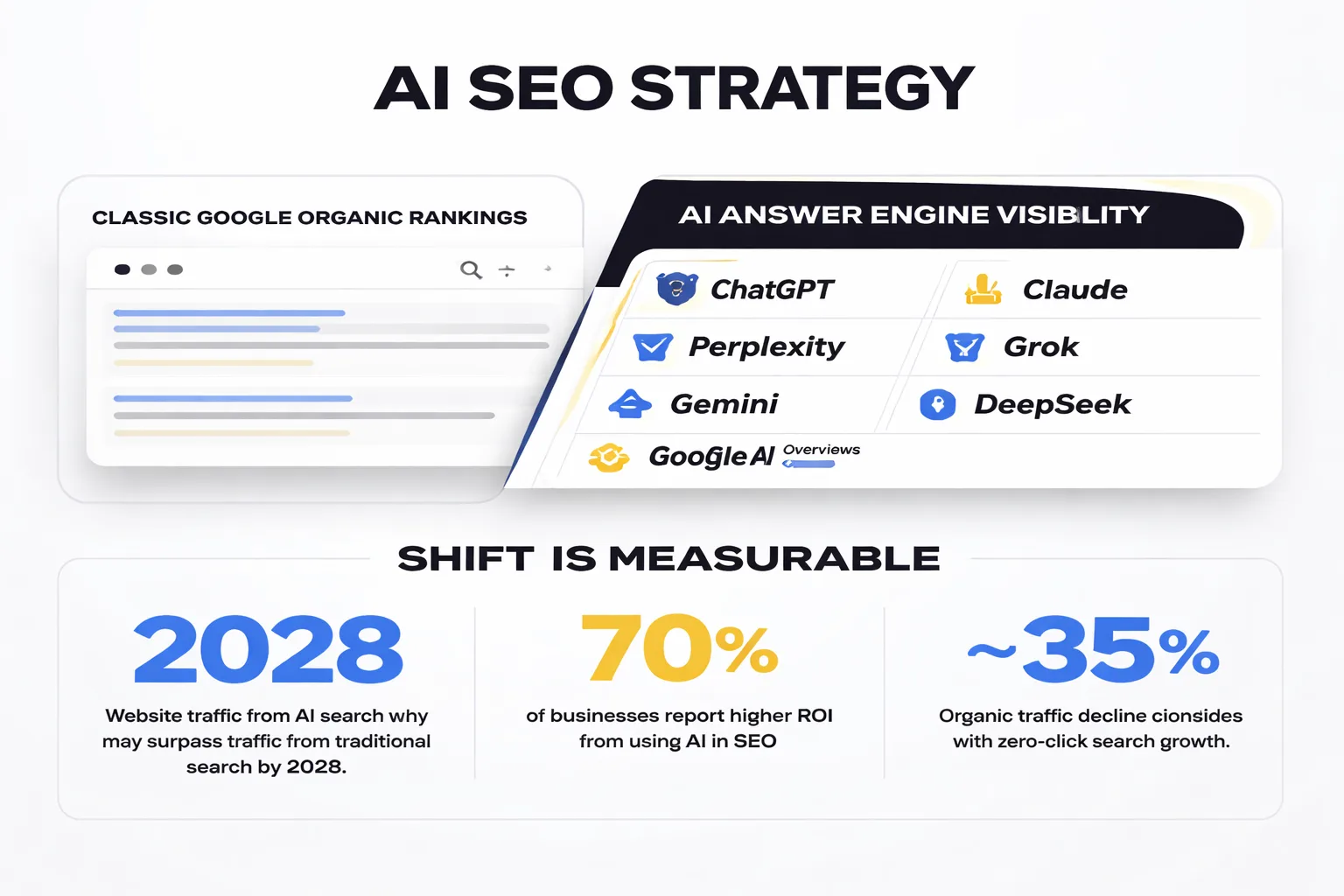
The AEO vs SEO distinction matters because it determines how you allocate resources. If you're spending 100% of your budget on traditional ranking signals and zero on citation signals, you're building for 2023. The market has moved.
Step 1. Audit Your Current AI and Organic Visibility
Before building anything, you need a baseline. Where does your brand appear today across classic search and AI engines? Most teams have Google Search Console data but zero visibility into AI surfaces. That gap is your starting point.
Here's what a proper audit looks like in practice. Pull your last 90 days of Search Console data: top-ranking keywords, CTR, impressions, and pages driving the most traffic. Then run brand prompts across every major AI search surface. I'm talking about prompts like "What are the best [your product category] tools?" and "How does [your brand name] compare to [competitor]?" Log whether your brand appears, where in the answer you appear (first mention, in a list, not at all), and which sources the AI engine cites.
This is where a tool like our AI visibility tracker becomes essential. Manual checking across ChatGPT, Claude, Gemini, Perplexity, Grok, AI Overviews, AI Mode, and DeepSeek takes hours per prompt. Automated tracking with daily refresh gives you trend data you can act on.
The audit should produce three deliverables:
1. Classic SEO baseline: Top 50 keywords, average position, CTR, and total organic traffic. Pull this from Search Console. Time investment: 30 minutes. 2. AI visibility baseline: Brand mention rate across each AI engine, mention position, and which competitors appear when you don't. Time investment: 2-4 hours manually, or near-zero with automated tracking. 3. Mention-citation gap analysis: Prompts where competitors are cited but you aren't. This is your content opportunity pipeline. Ahrefs studied 75,000+ brands and millions of AI citations across ChatGPT, Google AIO, Perplexity, and Gemini. The patterns they found confirm what I see in practice: topical authority drives citations, not random mentions.
Don't skip the gap analysis. It's the most valuable output of this entire audit. Every prompt where a competitor gets cited and you don't is a content brief waiting to be written.
How Do You Map Content to AI Search Intent?
AI engines don't read content the way humans do. They extract. They synthesize. They cite. Your content needs to be structured for extraction, not just readability. This means understanding what queries AI engines answer in your niche and formatting your content to be the source they pull from.
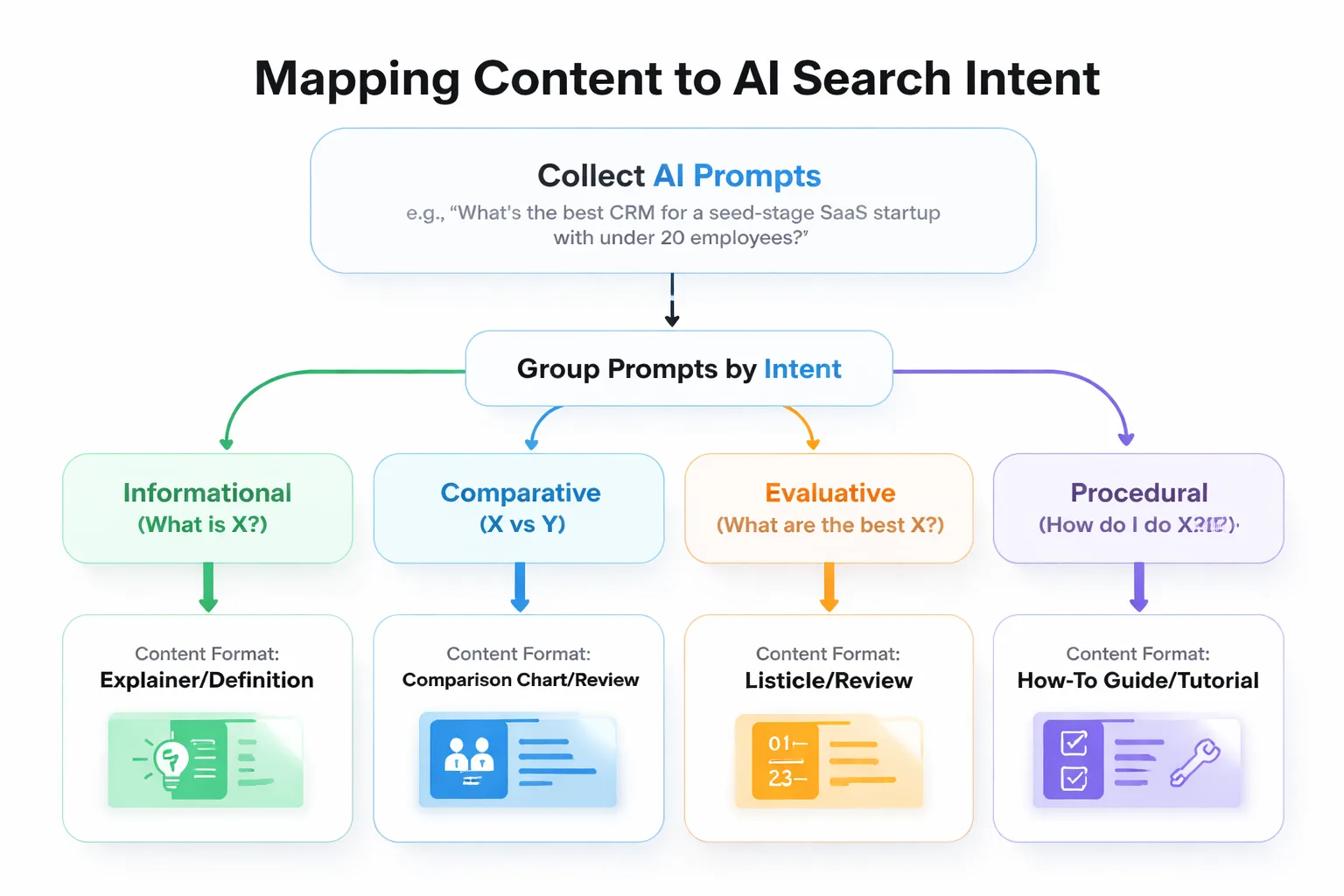
Start by collecting the prompts your target audience types into AI engines. These differ from Google search queries. Google queries are keyword fragments. AI prompts are full questions. "Best CRM for startups" becomes "What's the best CRM for a seed-stage SaaS startup with under 20 employees?" The intent is richer, and the content that gets cited addresses the full question, not just the keyword.
Here's my approach to clustering these prompts by intent. Group them into four buckets: informational ("What is X?"), comparative ("X vs Y"), evaluative ("What are the best X?"), and procedural ("How do I do X?"). Each bucket maps to a content format that AI engines extract from efficiently. Informational prompts need explainers with clear definitions in the first paragraph. Comparative prompts need side-by-side tables. Evaluative prompts need listicles with criteria. Procedural prompts need step-by-step how-tos.
The AEO vs GEO framework helps here. Answer engine optimization focuses on structuring content so AI engines can extract and cite it. Generative engine optimization focuses on building the authority signals that make AI engines choose you as a source. You need both. Structure without authority means you're extractable but never selected. Authority without structure means you're trusted but unparseable.
One pattern I keep seeing: teams publish one format for everything. Every topic gets a 2,000-word blog post. That's a mistake. AI engines extract differently from different formats. A comparison table is more extractable for "X vs Y" prompts than a 2,000-word essay. A FAQ block is more extractable for informational prompts than a narrative explainer. Match the format to the intent.
Step 2. Build Your Topical Authority Map
Topical authority is the single biggest driver of AI citations. Not backlinks. Not domain authority. Topical authority. When an AI engine decides who to cite, it looks for the source that has demonstrated depth across a topic cluster, not the source with the most link equity.
This is where most DIY AI SEO strategies fail. Teams publish scattered content. One post about keyword research. One post about link building. One post about technical SEO. No connective tissue. No cluster strategy. AI engines see isolated pages, not a topical authority signal.
A topical authority map fixes this. Here's how to build one. List your core topic (the one you want to be cited for). Break it into 5-7 subtopics. For each subtopic, identify 3-5 questions your audience asks AI engines. Each question becomes a content brief. Each brief targets a specific AI prompt pattern. Each article links to the others in the cluster.
For a deeper dive on this process, our guide on building a topical authority map for AI search walks through the clustering methodology in detail. The key principle: depth beats breadth. Ten articles covering one topic cluster will get you more AI citations than thirty articles scattered across ten topics.
Research on generative engine optimization confirms this. The study found that AI search favors sources with demonstrated expertise in a specific domain. Broad, shallow content doesn't trigger citation. Narrow, deep content does.
Want to know which AI engines cite your competitors but not you?
When Should You Use AI for Content Creation?
This is where I get blunt. Most AI content strategies fail not because of Google penalties but because the content is garbage. I've seen it firsthand. A client invested heavily in an AI-powered content platform for six months. They ended up with content full of errors, so generic it felt robotic, and almost no organic traffic growth. The AI could generate text. It couldn't replicate the nuanced understanding needed to create valuable content.
The problem isn't AI itself. It's the absence of a quality gate. Tools that promise seamless AI-to-publish workflows produce volume but fail at quality. The subtle tells are everywhere: overuse of certain punctuation, generic transitions, stacked intensifier adjectives. By late 2024, this content became harder to detect on first pass but obvious on closer inspection. Verbatim publication of AI content, no matter how good it seems initially, is a fast track to diminishing brand trust.
So when should you use AI for content creation? Use it when you have a quality firewall in place. That means every AI-assisted draft gets checked against specific quality criteria before it reaches your CMS. At Meev, I work with a 16-dimension quality firewall that blocks weak drafts before publish. Eleven article-quality signals plus a 5-dimension Google Penalty Risk Matrix. Articles below 70 out of 100 get blocked. No exceptions.
The point isn't to pitch our tool. The point is that content scaling without a quality gate is malpractice. If you're building an AI SEO strategy from scratch, your content engine needs three things: archetype-aware writing (different formats have different structures and quality criteria), fact verification (every claim source-traced before publish), and cannibalization detection (don't publish two articles competing for the same query).
Step 3. Publish, Monitor, and Iterate Weekly
A strategy without a publishing cadence is a wish. You need consistent output. Weekly at minimum. Here's the workflow I recommend for small teams that don't have a full content operation.
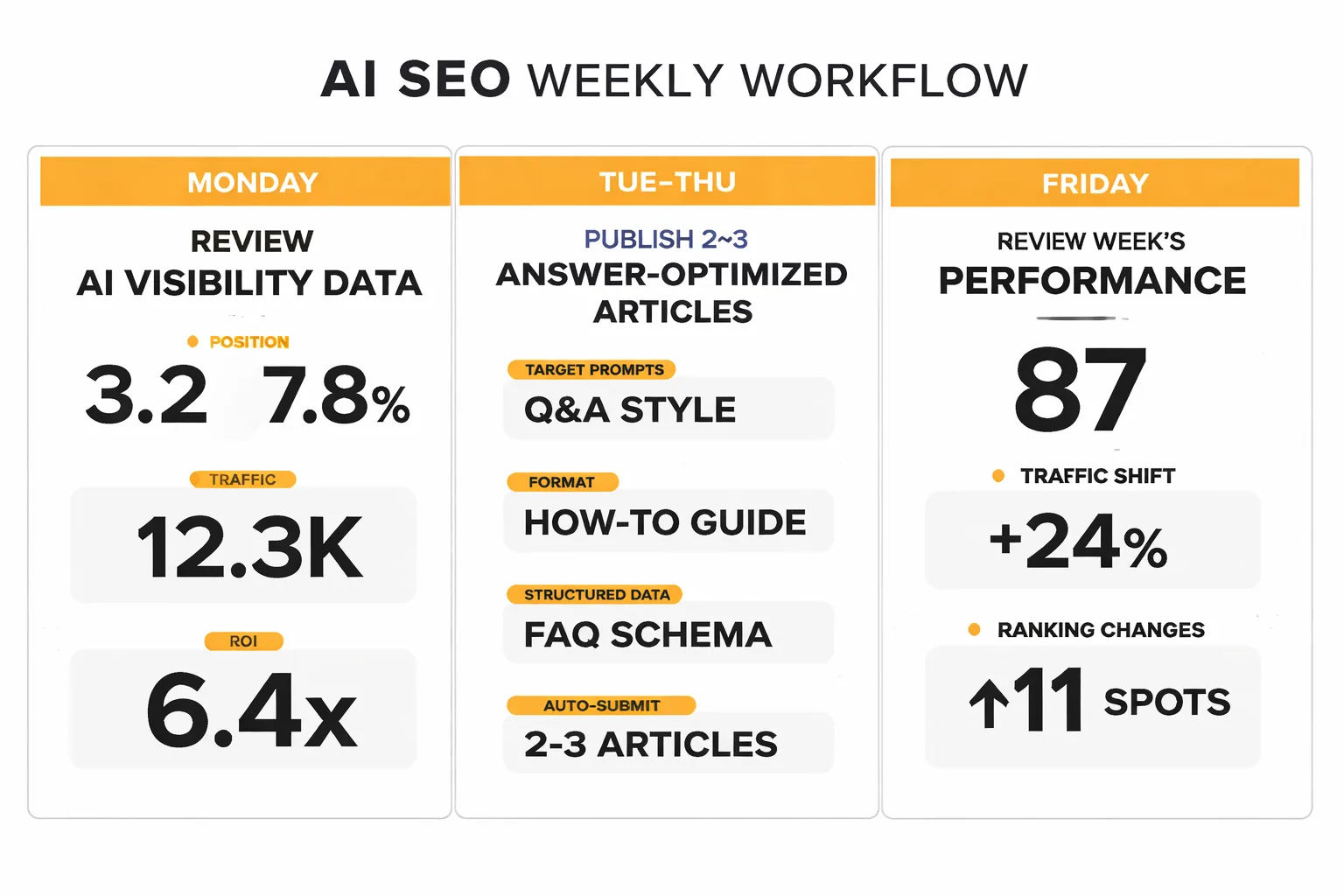
Monday: Review your AI visibility data. Which prompts showed new competitor citations? Which of your existing pages lost mentions? This data drives your content priorities for the week. Use brand mention tracking to spot trends early.
Tuesday-Thursday: Publish 2-3 answer-optimized articles targeting the gap prompts you identified. Each article should target a specific AI prompt pattern, use the right format (FAQ, how-to, comparison, explainer), and include structured data markup. Auto-submit to Google Search Console and IndexNow on publish. This is where content scaling with quality gates becomes essential. You need volume without sacrificing quality.
Friday: Review the week's performance. Check new AI mentions, citation rate changes, and organic traffic movement. Update underperforming pages using AI visibility data, not gut feel. If a page isn't getting cited for its target prompt, revise the structure. Add a direct answer in the first 100 words. Add a comparison table. Add an FAQ block.
The iteration loop is critical. AI engines update their training data and retrieval indexes regularly. A page that was getting cited last month might lose its citation this month because a competitor published something better. You need to monitor and respond. This is where a content decay strategy becomes important. Don't just publish new content. Refresh and improve existing content that's losing visibility.
What Metrics Actually Matter for AI SEO?
This is where I part ways with a lot of practitioners. The debate around AI visibility scores is real. On one hand, you have folks pushing for a defined set of metrics like LLM visibility and citation frequency as vital for strategizing by 2026. On the other hand, a significant portion (myself included) views these scores as unreliable without first-party model data.
Here's my honest position. AI visibility scores from third-party tools are directionally useful but not precise. We're dealing with probabilistic outputs from AI models that don't disclose their ranking or citation logic. Trying to distill that into a neat score feels like a vanity metric waiting to happen. I've seen articles that scored high on AI visibility potential based on third-party tools fail to show any meaningful lift in actual AI-driven traffic or citations over a six-month period.
So what should you track? Focus on metrics you can verify:
- Mention rate: Percentage of target prompts where your brand appears in AI answers. Track per engine. This is your most reliable top-of-funnel metric. - Citation rate: Percentage of AI answers that link to your domain. Different from mentions. You can be mentioned without being cited. - Mention position: Where in the AI answer you appear. First mention matters more than last. This correlates with perceived authority. - Share of voice: What percentage of AI answers cite you versus competitors. This is your competitive positioning metric. - Organic traffic from AI referrals: Track referral traffic from Perplexity, ChatGPT, and other AI engines in your analytics. This is the bottom-line metric.
Nearly 70% of businesses report higher ROI from using AI in SEO, but that ROI only materializes when you measure the right things. Don't optimize for a visibility score. Optimize for mentions, citations, and referral traffic.
For tracking these metrics across AI engines, the Perplexity AI visibility checker is a good starting point for one surface. For comprehensive tracking across all major AI engines, you need a platform that monitors daily and shows trend data.
How Does Generative Engine Optimization Differ from Traditional SEO?
Generative engine optimization (GEO) is the practice of optimizing content to be cited by AI search engines. It overlaps with traditional SEO but emphasizes different signals. Traditional SEO optimizes for crawlability, relevance, and authority. GEO optimizes for extractability, citation worthiness, and topical depth.
The GEO research paper published on arXiv established the academic foundation for this field. The key finding: AI engines prioritize content that is structurally easy to extract (clear headings, direct answers, structured data) and topically authoritative (demonstrated depth across a subject area).
Here's what changes when you shift from traditional SEO to GEO. Your keyword research shifts from search volume to prompt frequency. Your content format shifts from long-form articles to structured, extractable formats. Your link building shifts from acquiring backlinks to earning citations from authoritative third-party sources. Your measurement shifts from rank positions to mention and citation rates.
The practical implication: you need both. Traditional SEO still drives Google traffic. GEO drives AI engine visibility. A complete ai seo strategy runs both playbooks in parallel. The AEO vs GEO distinction helps you understand which playbook to apply to which surface.
One more thing. AI Overviews search ads are now appearing in Google's AI-generated answers. This means paid and organic are converging inside AI surfaces. Your strategy needs to account for how ads affect citation patterns in AI Overviews. If a competitor bids on your target prompt and their ad appears in the AI Overview, your organic citation might get pushed down or excluded.
Where This Breaks Down
This framework assumes you have the resources to produce quality content weekly. If you're a solo founder with zero content budget, this won't work as described. You'll need to narrow your scope to one topic cluster and one AI engine before expanding.
Second, this breaks if your industry has low AI search volume. If your target audience doesn't use AI engines to research your category, your AI visibility efforts won't move revenue. Check your analytics for AI referral traffic before investing heavily. If Perplexity and ChatGPT combined send you less than 50 visits per month, prioritize classic SEO first.
Third, this fails without human oversight. I've seen teams set up automated content pipelines and walk away. The content degrades within weeks. Subtle quality issues compound. Brand voice drifts. Facts go unchecked. AI content without human review is a liability, not a strategy. The quality firewall approach works because it catches problems before they reach your audience. Without it, you're publishing slop and hoping nobody notices. They will.
What This Actually Means
Building an AI SEO strategy from scratch in 2026 means accepting two truths. First, traditional Google rankings still matter. They drive traffic today and will for the foreseeable future. Second, AI search visibility matters now and will matter more every quarter. Roughly 60% of searches yield zero clicks. AI Overviews reach 2 billion users. Gen Z is abandoning traditional search for AI chatbots.
The teams that win will be the ones running both playbooks. Classic SEO for Google. GEO and AEO for AI engines. Quality-gated content production for scale. Weekly monitoring of mention and citation rates. Iteration based on data, not assumptions.
The strategy I've outlined here isn't theoretical. It's the same framework I use at Meev to manage content and visibility for hundreds of brands. Audit your baseline. Map content to AI intent. Build topical authority. Publish with quality gates. Monitor and iterate weekly. The execution is unglamorous. The results compound.
If you're starting from zero today, don't try to do everything at once. Pick one topic cluster. Pick one AI engine. Get cited there first. Then expand. That's how you build an AI SEO strategy that lasts.
FAQ
What does a complete AI SEO strategy cover in 2026?
A complete AI SEO strategy simultaneously targets classic Google organic rankings and visibility across AI answer engines including ChatGPT, Perplexity, Gemini, Google AI Overviews, Claude, Grok, and DeepSeek. Ignoring any of these platforms leaves the strategy incomplete because AI search now operates as a distinct layer that can cite or erase content entirely.Why does AI search favor third-party sources over brand-owned content?
Research on generative engines shows they systematically prioritize earned media from authoritative third-party sites rather than brand-owned or social content. This differs from traditional Google results, which mix signals, requiring separate playbooks for rankings versus citations.How is search traffic shifting due to AI Overviews and zero-click searches?
Roughly 60% of searches now produce zero clicks, while Google AI Overviews already reach 2 billion monthly users and nearly 35% of US Gen Z relies on AI chatbots. Projections indicate AI-driven traffic could surpass traditional search by 2028, making strategies focused only on blue links increasingly ineffective.What measurable business impact comes from adopting AI in SEO?
Nearly 70% of businesses report higher ROI when using AI for SEO tasks. This stems from adapting to the structural decline in organic traffic caused by zero-click growth and the need to optimize for citation in generative engines rather than classic ranking factors.About the Author
Judy Zhou, Founder
Judy Zhou leads content strategy at Meev, where she oversees AI-driven content research and publishing for hundreds of brands. With a background in SEO and editorial operations, she focuses on building content systems that rank on Google, get cited by AI search engines, and drive measurable business results.
Stop guessing about your AI search visibility. Track every mention, citation, and gap across all major AI engines, then publish quality-gated content that gets cited.