

Topical Authority vs. AI Citations: Are You Optimizing for the Wrong Thing?
By Judy Zhou, Founder
Key Takeaways
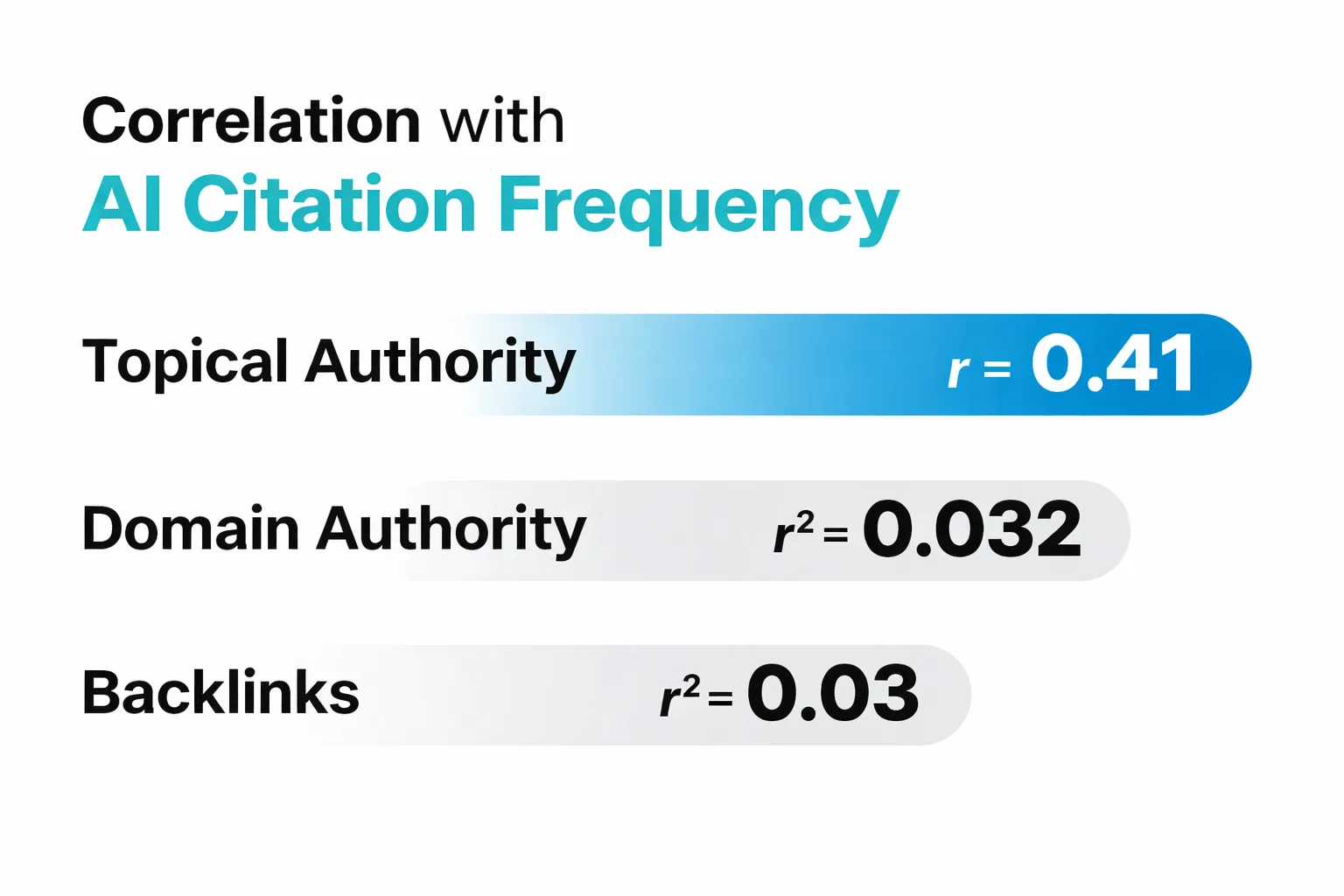
- Topical authority correlates with AI citation frequency at r=0.41, outperforming domain authority (r²=0.032) and backlinks (r²=0.038).
- Pages ranked #6-#10 with strong topical authority earn 2.3x more AI citations than #1 pages with weak topical authority.
- Chasing individual AI citations as featured snippets 2.0 fails because rank position no longer predicts whether engines will reference your content.
- Shift from backlink-driven domain authority to semantic clusters and internal linking, since the former does not transfer to AI search visibility.
Marcus had spent eighteen months building what his agency called a "bulletproof topical authority strategy" for a mid-size SaaS client. Hundreds of articles, tight semantic clusters, internal linking so thorough it looked like a spider's fever dream. Then one Monday morning, he pulled the traffic report and noticed something strange: impressions were up, clicks were down, and the queries his client used to own were now answered in full by a Google AI Overview that cited two competitors and one Reddit thread. His content was nowhere. The strategy had worked perfectly. For the wrong era.
The conventional wisdom about ai for seo is wrong. Most teams are chasing individual AI citations as if they're featured snippets 2.0, tweaking paragraphs and praying for a mention. Topical authority has a correlation of r=0.41 with AI citation frequency, outperforming Domain Authority (r²=0.032) and backlinks (r²=0.038), according to Omniscient Digital's citation analysis. That gap is not marginal. It's the difference between optimizing for a tactic and building for a system. Pages ranking #6-#10 with strong topical authority get cited 2.3x more than pages ranking #1 with weak topical authority. Your rank position is becoming a poor proxy for whether AI engines will reference you at all.
I see this pattern constantly in my work auditing content operations at Meev. Teams have spent years building domain authority through backlinks and now assume that authority transfers automatically to AI search. It doesn't. The rules changed, and most content strategies haven't caught up.
The Citation Trap Most Teams Fall Into
Here's the contrarian take that will upset some SEOs: chasing direct AI citations is a tactical trap. It feels productive. You see a competitor cited in a Perplexity answer, you reverse-engineer their format, you optimize a paragraph, maybe you get cited next week. You celebrate. Then the model updates, your paragraph gets paraphrased differently, and the citation vanishes.
This is whack-a-mole dressed up as strategy.
The problem is that citations are outputs, not inputs. When you optimize for the output (getting mentioned in one specific answer), you're building on sand. The AI model's retrieval layer shifts constantly. What doesn't shift is the model's understanding of which sources have deep, reliable coverage of a topic. That understanding is built through topical authority, not through individual page optimization.
Think of it this way. If an AI engine is a student writing an exam, a citation-optimized page is like a single flashcard. It might get referenced for one question. A topically authoritative site is like the textbook the student studied from. They might not cite it on every question, but it shaped their understanding of the entire subject. That influence is invisible in any single citation count, but it's the difference between being a source and being the source.
In my own work at Meev, I've watched teams obsess over AI visibility for individual prompts while ignoring the structural gap in their content. They'll celebrate getting cited in a ChatGPT answer about "best CRM for startups" while their site has zero coverage of CRM integrations, CRM pricing comparisons, CRM implementation guides, or CRM security considerations. They won the battle and lost the war.
Why Does Topical Authority Predict AI Citations?
Topical authority predicts AI citations because generative engines don't just retrieve individual pages. They build knowledge graphs from clusters of content, and sources that demonstrate consistent depth across a topic get weighted more heavily in retrieval. According to ZipTie.dev's study, topical authority is the strongest predictor of AI citation frequency, surpassing traditional signals like domain authority and backlink count.
The mechanism is straightforward once you understand how retrieval-augmented generation (RAG) works. When an AI engine receives a prompt, it doesn't search the web in real time the way Google does. It queries a retrieval index that has already processed and categorized content. Sources that cover a topic comprehensively get tagged as high-relevance for that topic cluster. When a query falls within that cluster, those sources surface first.
This is why a page ranking #6 can out-cite a page ranking #1. The #1 page might have more backlinks and better on-page optimization for that specific query. But if the #6 page belongs to a site that has fifty articles covering every angle of the topic, the retrieval layer tags that domain as authoritative for the cluster. The individual page's rank position matters less than the domain's demonstrated expertise.
Reviews and social proof account for 57% of all citations across ChatGPT, Perplexity, Gemini, AI Mode, and AI Overviews, per the Semrush AI Overviews study. This tells you something important: AI engines are not just looking for content. They're looking for evidence of real-world authority. User-generated content, reviews, and third-party mentions signal that a brand has actual customers and actual traction. That's a form of topical authority that goes beyond what you publish on your own site.
How Do AI Engines Actually Choose Sources?
Different AI engines cite sources differently, and understanding those differences should shape your strategy. Ahrefs analyzed 76M AI Overviews and 950K ChatGPT and Perplexity prompts, revealing that Wikipedia dominates ChatGPT citations at 16.3% mention share, while Reuters holds 4%. That's a massive concentration. ChatGPT leans heavily on encyclopedic, consensus-driven sources. Perplexity, by contrast, pulls from a wider mix of publishers and blogs.
This matters because it means your content strategy for AI search can't be one-size-fits-all. If you want ChatGPT citations, you need encyclopedic coverage that reads like a reference source. If you want Perplexity citations, you need opinionated, original analysis that adds something the consensus sources don't have. Google AI Overviews sit somewhere in the middle, prioritizing pages that already rank well organically but pulling in diverse source types.
The GEO (Generative Engine Optimization) research paper from ArXiv laid the academic foundation for this field. It showed that specific content modifications, like adding citations within text and using statistics, increased source visibility in AI-generated answers by up to 40%. But here's what the paper doesn't emphasize enough: those tactics only work if your domain already has topical relevance in the retrieval index. Adding statistics to a page on a site with no topical depth is like putting a fresh coat of paint on a house with no foundation.
Stop Optimizing for Keywords, Start Building Knowledge Graphs
Traditional SEO asks: "What keyword does this page target?" AI for seo asks a different question: "What does this site know about?"
That shift sounds subtle. It's not. It changes everything about how you plan, produce, and structure content.
In the keyword era, you'd identify a high-volume term, write an article targeting it, build links to it, and move on to the next term. Each article was an island. Internal linking connected them, but the strategy was fundamentally page-by-page. You optimized each page for a keyword, and Google ranked each page for that keyword.
In the AI era, each article is a node in a knowledge graph. An article about "CRM pricing" doesn't just rank for "CRM pricing." It tells the retrieval layer that your domain understands CRM financial considerations. When someone asks an AI engine "how much should I budget for a CRM," your domain's cluster of CRM-related content gets activated, even if no single article perfectly matches the query.
This is why topical authority for ai search requires a fundamentally different planning approach. Instead of starting with keywords, you start with topics. You map the topic to its sub-questions, edge cases, and adjacent concerns. You build coverage that demonstrates you understand the topic from every angle a user might care about. Then you let keywords emerge naturally from that coverage.
If you're looking for a practical framework, I'd recommend starting with our guide on building a topical authority map for AI search. The mapping process is what separates strategic content from keyword-stuffed content, and it's the single highest-leverage activity for any team serious about AI visibility.
Are you building topical authority or just chasing citations? See where you stand across every major AI engine.
When Should You Chase Direct Citations vs. Build Authority?
Not all citation-chasing is wasteful. There's a time and place for tactical citation optimization, and pretending otherwise would be intellectually dishonest.
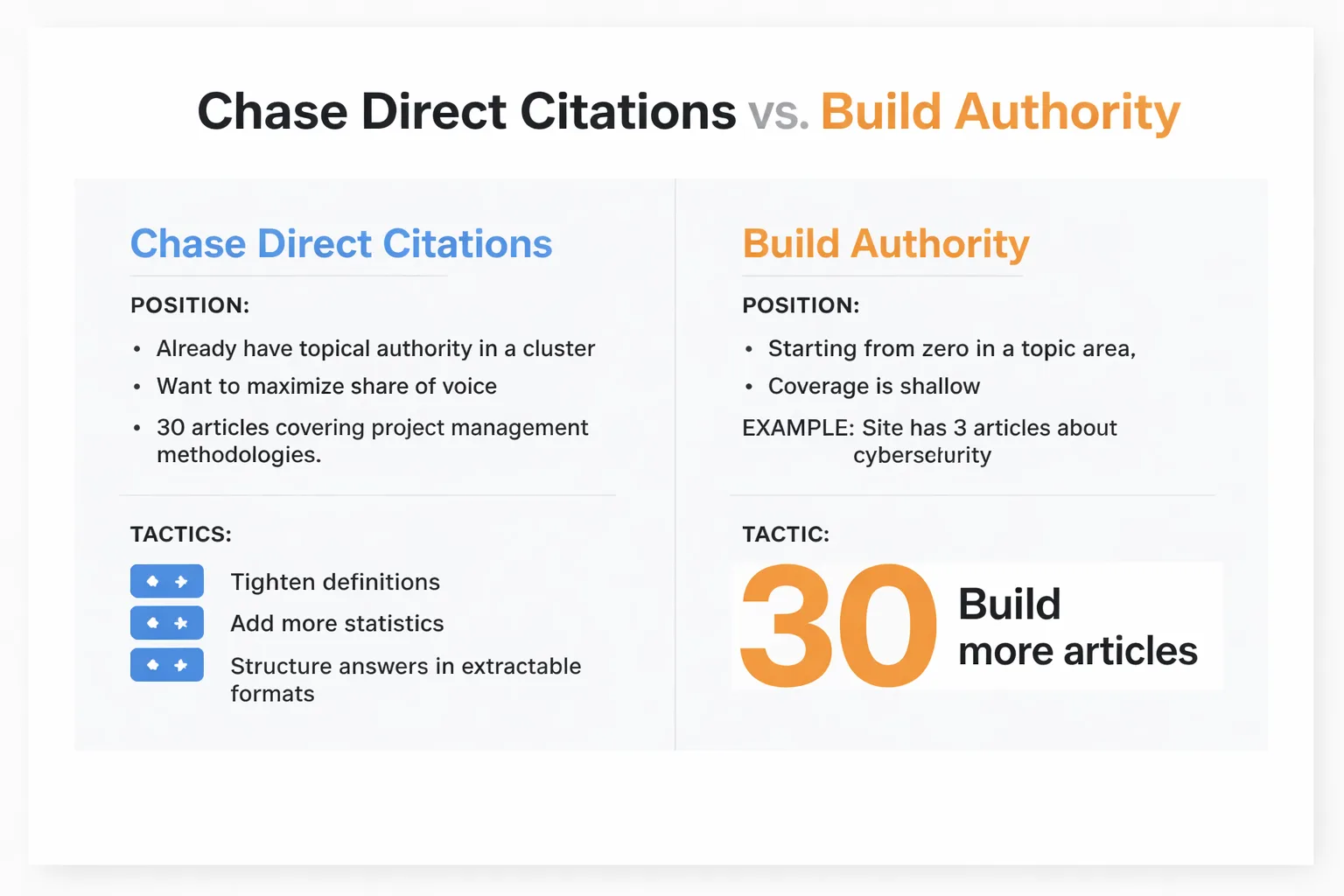
Chase direct citations when you already have topical authority in a cluster and want to maximize your share of voice within it. If you've built thirty articles covering project management methodologies and you're getting cited sometimes but not always, tactical optimization makes sense. Tighten your definitions. Add more statistics. Structure your answers in extractable formats. These are the answer engine optimization tactics that compound on top of existing authority.
Build authority when you're starting from zero in a topic area, or when you have coverage but it's shallow. If your site has three articles about cybersecurity and you're wondering why ChatGPT doesn't cite you for cybersecurity questions, the answer isn't to optimize those three articles harder. It's to build thirty more.
The tension I see most often is with ai seo agencies that promise citation wins without building the underlying authority. It's the SEO equivalent of promising someone a fish instead of teaching them to fish. You might get a citation this month. You won't get citations next quarter when the model retrains and your shallow coverage gets deprioritized.
Here's a practical decision framework:
| Situation | Strategy | Timeframe |
| No topical coverage in target area | Build authority first | 3-6 months |
| Shallow coverage (under 10 articles) | Expand depth before optimizing | 2-4 months |
| Deep coverage (20+ articles) but low citation rate | Tactical citation optimization | 2-4 weeks |
| Deep coverage and high citation rate | Maintain and expand to adjacent topics | Ongoing |
| Strong brand authority but thin content | Invest in content depth | 3-6 months |
The Brand Authority Counterargument
I need to address a legitimate counterargument here, because it's gaining traction and I don't think it's wrong. Search Engine Land argues that brand authority beats topical authority in AI search, and they have a point. Their argument is that AI engines reward brands with visibility, mentions, and real demand, not just sites with lots of content on a topic.
The data partially supports this. The Omniscient Digital study found that reviews and social proof account for 57% of all citations across major AI engines. That's brand authority manifesting as user-generated content. When people review your product on G2, mention you on Reddit, or discuss you in industry publications, those mentions become citation fuel for AI engines.
But here's where I land: brand authority and topical authority aren't opposing strategies. They're two halves of the same system. Brand authority gets you mentioned in the sources AI engines crawl. Topical authority ensures that when AI engines crawl those sources and encounter your brand, your own content provides the depth they need to cite you directly.
Think of it as a two-loop system. Loop one: build brand awareness that generates third-party mentions. Loop two: build topical depth that converts those mentions into direct citations. Skip either loop and the system breaks. Brand mentions without topical depth mean AI engines know about you but can't cite you. Topical depth without brand mentions means you're a well-kept secret that AI engines haven't discovered yet.
This is why I've shifted my own strategy at Meev to focus on what I call "Machine Relations" alongside content depth. I'm not just trying to rank our own site. I'm actively pursuing mentions from high-authority external sources because that's what the AI models actually cite. And when they do cite us, our topical depth ensures we have the coverage to be cited again and again across different queries in the same cluster.
How to Measure Topical Authority in an AI-First World
Measuring topical authority used to be straightforward. You'd track keyword rankings across a topic cluster, count your backlinks, and check your Domain Authority. If you ranked for more keywords in the cluster than your competitors, you had topical authority. Simple.
That measurement framework is broken now. You can rank #1 for fifty keywords in a cluster and still get out-cited by a competitor who ranks #6 for those same keywords but has deeper, more interconnected content. The old metrics measure visibility in the old system. You need new metrics for the new system.
Here's what I track instead:
Citation share of voice. What percentage of AI answers in your topic area cite your domain versus competitors? This is the direct measure of whether AI engines consider you authoritative. Tools like our AI visibility tool track this across every major AI search surface, from ChatGPT to Google AI Overviews.
Topic cluster coverage ratio. How many distinct subtopics within your target area do you have published content for? If your competitor has coverage on 40 subtopics and you have 15, they have more than twice your topical surface area. Map your cluster, count your coverage, and identify gaps.
Entity density. When AI engines process your content, they extract entities (people, places, concepts, tools, companies). Content with higher entity density and richer entity relationships signals deeper topical understanding. This isn't about keyword stuffing. It's about naturally referencing the concepts, tools, and people that define a topic.
Citation persistence rate. When you do get cited, how stable is that citation across model updates? If your citations disappear every time an AI engine updates its model, your authority is shallow. If they persist, you've built real topical depth.
Third-party mention velocity. How often is your brand mentioned in new third-party content each month? This feeds the brand authority loop and signals to AI engines that you're an active, relevant entity in your space.
These five metrics give you a much more accurate picture of your AI search position than traditional ranking reports. They're also harder to game, which is the point. You can't fake citation persistence or third-party mention velocity. You have to earn them through genuine authority.
The Long-Term Play for AI Search Visibility
The teams that will win in AI search over the next two years are not the ones with the best ai seo tools or the most aggressive citation optimization tactics. They're the ones building content systems that make their domains indispensable knowledge sources for their topics.
This requires a philosophical shift that I don't think most organizations have made yet. In the keyword era, content was a marketing expense. You produced content to capture demand that already existed. In the AI era, content is infrastructure. You produce content to build a knowledge asset that AI engines rely on, and that asset generates compounding returns across every query related to your topic.
The analogy I keep coming back to is academic publishing. A researcher who publishes one landmark paper gets cited for a few years. A researcher who publishes twenty papers across a field becomes the authority that other researchers default to. Their name comes up in literature reviews even when the citing paper doesn't directly reference their work. That's what topical authority does in AI search. It makes you the default source for your topic, not because you optimized for any single citation, but because your coverage is too deep to ignore.
If you're working with a search engine optimization agency or evaluating ai seo service providers, ask them one question: "Are you building topical authority or chasing citations?" The answer tells you everything about whether they understand the shift. If they talk about citation optimization tactics without mentioning topic mapping, cluster coverage, or entity relationships, they're building on sand.
The same applies if you're evaluating search engine optimization tools. A tool that helps you optimize individual pages for citations is useful. A tool that helps you map topic clusters, identify coverage gaps, and track citation share of voice across AI engines is essential. The former is a tactic. The latter is a system.
What This Actually Means
The shift from keyword optimization to topical authority isn't a trend. It's a structural change in how search works. AI engines don't retrieve pages. They retrieve knowledge. And knowledge is built through depth, not density.
If you take one thing from this article, let it be this: stop asking "how do I get cited by AI?" and start asking "what does my domain know more about than anyone else?" The citations will follow. They always do, once the underlying authority is real.
In my work at Meev, I've seen this play out across hundreds of brands. The ones that invest in topical depth get cited more, persist longer in AI answers, and build defensible visibility that survives model updates. The ones that chase individual citations get temporary wins that evaporate. The choice is between being a flashcard and being the textbook.
Ai for seo in 2026 means building for the system, not the snippet. The teams that understand this gap between tactical citations and structural authority will dominate AI search. The ones that don't will keep waking up to traffic reports that look like Marcus's, wondering why their perfect strategy stopped working.
FAQ
What is topical authority and why does it matter more than domain authority for AI citations?
Topical authority measures how comprehensively and semantically a site covers a subject through clustered content and internal linking. Research shows it correlates at r=0.41 with AI citation frequency, far outperforming domain authority at r²=0.032. This makes it a stronger predictor of whether AI engines will reference your content.Should I optimize my content specifically to get cited in AI Overviews?
Chasing individual AI citations as if they were featured snippets is ineffective because it focuses on tactics rather than the underlying system. Strong topical authority drives citations even for pages ranking #6–#10, delivering 2.3x more citations than top-ranked pages with weak authority. The better approach is building broad topical coverage instead of tweaking individual paragraphs.Do backlinks still help with visibility in AI-generated answers?
Backlinks show very low correlation (r²=0.038) with AI citation frequency compared to topical authority. Many teams assume traditional domain authority transfers to AI search, but the data indicates it does not. AI engines prioritize semantic depth and content clusters over link-based signals.Can lower-ranking pages outperform top results in AI citations?
Yes, pages ranking #6–#10 with strong topical authority are cited 2.3x more often than #1 pages with weak topical authority. Rank position is becoming a poor proxy for AI visibility. This shift rewards comprehensive topic coverage over isolated high rankings.About the Author
Judy Zhou, Founder
Judy Zhou leads content strategy at Meev, where she oversees AI-driven content research and publishing for hundreds of brands. With a background in SEO and editorial operations, she focuses on building content systems that rank on Google, get cited by AI search engines, and drive measurable business results.
Stop guessing at your AI search visibility. Track your citation share of voice across all major AI engines and identify the topical gaps costing you citations.