

By Judy Zhou, Head of Content Strategy
Key Takeaways
- Perplexity's citation rate is 13.8% — nearly 20x higher than ChatGPT's 0.7% — making it the highest-attribution AI platform available to publishers right now.
- Just 6% of URLs account for 47% of all Perplexity citations, meaning structural optimization (BLUF leads, FAQ schema, data tables) is the primary lever for breaking into that top tier.
- Domains with 10+ interlinked pages on a topic cluster earn AI citations at 2-3x the rate of single-page competitors — hub-and-spoke internal linking pushes citation rates from ~12% to 41% on pillar queries.
- Content reformatted for Perplexity (shorter leads, conversational framing, FAQ schema) can reduce ChatGPT citation rates on the same pages — platform-specific optimization is not optional, it's the strategy.
A B2B SaaS marketer named Dana ran a citation audit on her company's top twenty competitors last March. She searched thirty high-intent questions in Perplexity, logged every source that appeared, and built a spreadsheet. Her own domain showed up zero times. A competitor she had dismissed as low-quality appeared nineteen times. When she reverse-engineered the difference — page structure, sourcing habits, topical depth — she found a pattern tight enough to turn into a repeatable content process. What she discovered maps almost perfectly onto the five steps in this article.
Perplexity source selection is not random, and it is not simply "whoever ranks #1 on Google." According to Trensee's platform citation analysis, Perplexity's citation rate sits at 13.8% — nearly twenty times higher than ChatGPT's 0.7% — which means there is real, attributable traffic on the table for publishers who understand how the engine selects sources. 64% of URLs Perplexity encounters are never cited at all, while just 6% of URLs account for 47% of all citations. That concentration is the whole game. And the structural signals that push a page into that top 6% are learnable. Pages with proper schema markup earn 2.8x higher citation rates than poorly formatted content, according to Discovered Labs' 2026 Perplexity optimization analysis.
How Perplexity Actually Selects Its Sources
Perplexity runs on Retrieval-Augmented Generation (RAG) — a system that queries a live index, retrieves candidate pages, and then synthesizes an answer from what it finds. This matters because it means Perplexity is not drawing on a static training snapshot the way a base LLM does. It is actively fetching pages at query time, which makes recency, crawlability, and answer density far more important than they are for, say, getting cited by ChatGPT.
What Perplexity appears to weight heavily, based on practitioner testing and the Discovered Labs analysis: structured content in BLUF format (Bottom Line Up Front — your direct answer in the first 40-60 words), entity clarity (the page should be unambiguously about a named concept, person, product, or event), third-party validation (outbound citations to authoritative sources signal that your claims are grounded), and schema markup (FAQ schema and Article schema in particular help the retrieval layer parse what your page is actually answering).
Recency is a separate factor. Perplexity's index weights freshness because its users expect current answers. A page published in 2022 with no updates is competing against a page published last month with the same structural quality — and it will usually lose on recency alone. This is different from Google's traditional ranking, where a well-aged page with strong backlinks can hold position for years.
The piece that surprises most practitioners: domain authority in the traditional SEO sense matters less here than topical authority. Research aggregated by PassionFruit from the Slate 2026 AI SEO Benchmark Dataset and FuelOnline's April 2026 prompt-testing study found that domains with 10 or more interlinked pages on a topic cluster earn AI citations at 2-3x the rate of single-page competitors, and that hub-and-spoke internal linking pushes citation rates from roughly 12% to 41% on pillar-topic queries. A domain with a DA of 30 but fifteen tightly interlinked articles on a single subject can outperform a DA-70 domain with one orphaned page on that topic.
That is the core mechanic. Now here is how to exploit it.
Step 1–2: Audit Your Content Against Perplexity's Apparent Criteria
Before you rewrite anything, you need to know exactly what Perplexity is currently citing for your target queries — and why. This is the gap audit, and it takes about two hours per topic cluster if you do it properly.
Step 1: Build your citation map. Pull your top 15-20 target queries — the questions your content is supposed to answer. Run each one in Perplexity. For every response, log: (a) which URLs are cited, (b) the domain, (c) the approximate position of the cited content on the source page (is it in the first paragraph? a definition block? a data table?), and (d) whether the cited page has schema markup (right-click → View Page Source → search for "@type"). Do this in a spreadsheet. After 20 queries, patterns will be obvious.
What you are looking for: Are cited pages consistently leading with a direct answer to the query? Are they data-heavy? Do they have FAQ schema? Are they from a cluster of related pages on the same domain, or isolated pages? The answers tell you which signals Perplexity's retrieval layer is responding to in your specific niche.
Step 2: Score your own pages against the same criteria. Take your existing content on those same topics and run it through the same checklist. For each page, note: Does it open with a direct answer in the first 50 words? Does it have a definition block for the primary concept? Does it include data with named sources? Does it link to at least 5-8 related pages on your domain? Is it updated within the last 90 days?
The gap between what cited pages do and what your pages do is your rewrite priority list. Rank by query volume and business value, then start at the top. This is not a one-time exercise — I run a version of this audit quarterly for content programs I oversee, because Perplexity's citation patterns shift as its index and retrieval weights evolve.
One thing I flag for teams doing this for the first time: do not confuse "Perplexity cites this domain" with "Perplexity cites this specific page." The citation concentration data makes this critical. Trensee's analysis shows that 6% of URLs account for 47% of citations — meaning even on high-authority domains, most pages are invisible. You need to identify which specific pages are getting cited and reverse-engineer those, not the domain in aggregate.
For teams evaluating dedicated ai search visibility tools to automate this process, the comparison of Meev vs Peec AI breaks down which platforms track citation frequency versus citation attribution — a distinction that matters a lot once you're running this audit at scale.
Step 3–4: Reformat and Enrich Your Content for Citation Likelihood
This is where the work actually happens. The audit tells you what's missing. These two steps tell you how to fix it.
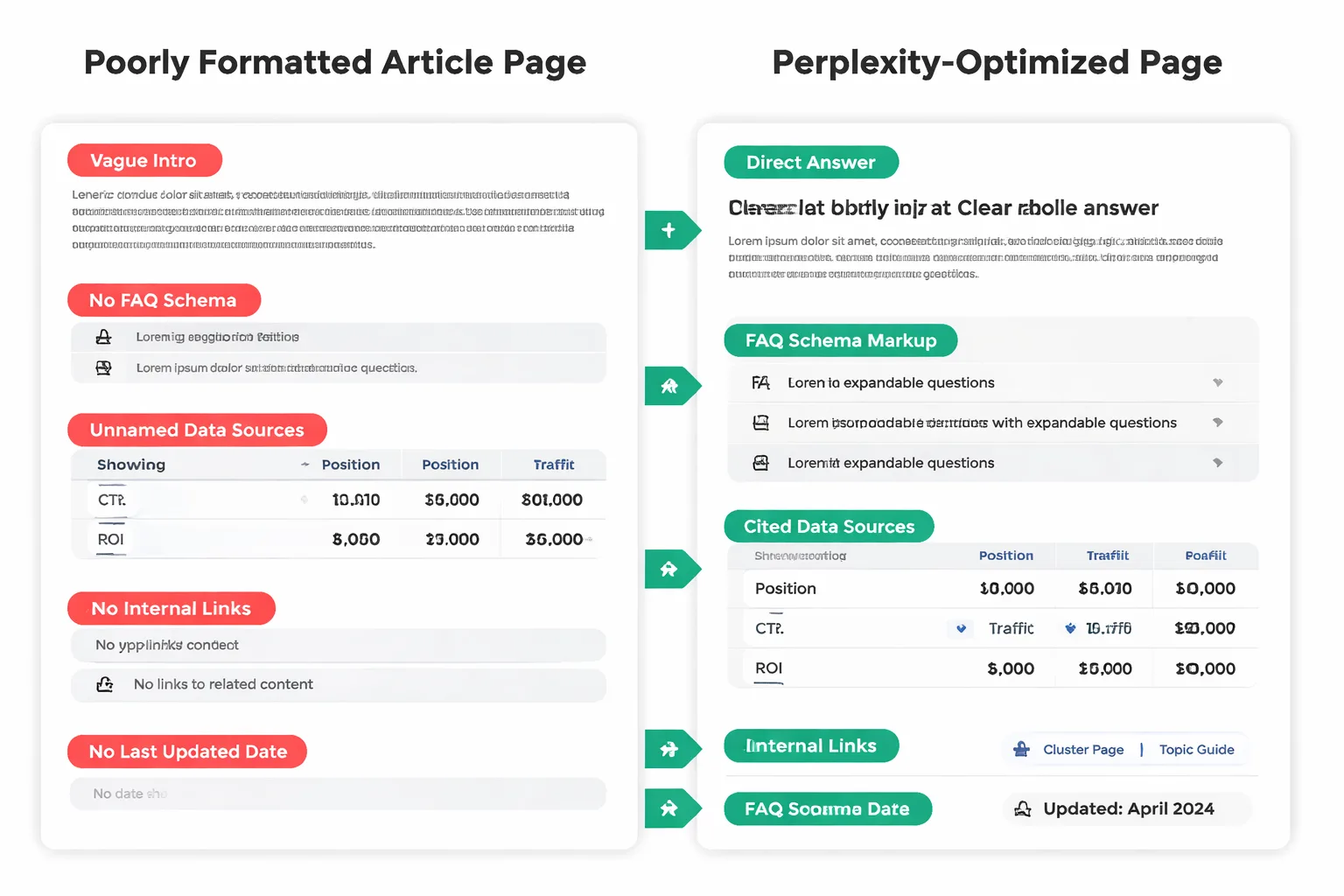
Step 3: Reformat for the retrieval layer. The single highest-leverage rewrite you can make is adding a direct-answer lead paragraph — 40-60 words, opening sentence answers the query explicitly, no preamble. Perplexity's RAG system is looking for the most extractable answer to the user's question. If your page buries the answer in paragraph four after two paragraphs of throat-clearing context, you will lose to a page that leads with the answer even if your overall content is better.
After the lead, add a structured definition block for your primary concept. Format it clearly — a bolded term, a colon or line break, and a 2-3 sentence definition that includes the concept's category, its distinguishing features, and why it matters. This is the format Perplexity's retrieval layer extracts from most reliably for definitional queries.
Data tables are the third structural element worth adding. If your content makes comparative claims — "Platform A does X better than Platform B" or "This approach produces results in Y timeframe" — put that comparison in a markdown table with named sources in the caption. Discovered Labs' analysis specifically identifies structured data as a citation signal, and in my own content work I've seen tables get extracted verbatim into Perplexity responses more often than any other content format.
Step 4: Enrich with topical depth and internal architecture. This is where the citation rate multiplier lives. A single well-formatted page on a topic will perform better than an unformatted one — but a well-formatted page that sits inside a cluster of 10+ interlinked pages on the same topic will perform dramatically better than either. The PassionFruit research puts the citation rate jump at 12% to 41% when hub-and-spoke internal linking is in place. That is not a marginal improvement.
The practical implementation: your pillar page on a topic should link explicitly to every supporting article in the cluster, and each supporting article should link back to the pillar and to at least 2-3 sibling articles. The internal links should use descriptive anchor text that signals the topical relationship — not "click here" or "learn more," but "our analysis of Perplexity source selection criteria" or "how AI citation rates differ by platform."
Add outbound citations to primary sources wherever you make factual claims. This is counterintuitive for some publishers who worry about sending readers away — but Perplexity's retrieval layer treats outbound citations as a trust signal. A page that cites a peer-reviewed study, a named industry report, and a primary platform source reads as more authoritative to the RAG system than a page making the same claims without attribution.
Finally, add FAQ schema. Use the questions your gap audit identified as high-frequency Perplexity queries. Structure each Q&A with a 40-80 word answer that is self-contained — it should make sense if extracted without the surrounding context. This is directly what Perplexity's retrieval layer pulls from when generating its answer panels.
If you are running this process across dozens of pages simultaneously, the AI content creation workflow overview at Meev covers how to maintain quality gates at scale without the reformatting becoming a bottleneck.
Want to know which of your pages Perplexity is already citing — and which ones are being skipped?
Step 5: Monitor and Iterate With a Citation Tracking Workflow
Most content teams stop after the reformat. That is a mistake. Perplexity's citation patterns shift — new competitors enter the index, Perplexity updates its retrieval weights, your own pages age. Without a monitoring workflow, you will not know whether your reformatting worked, and you will not catch citation losses before they compound.
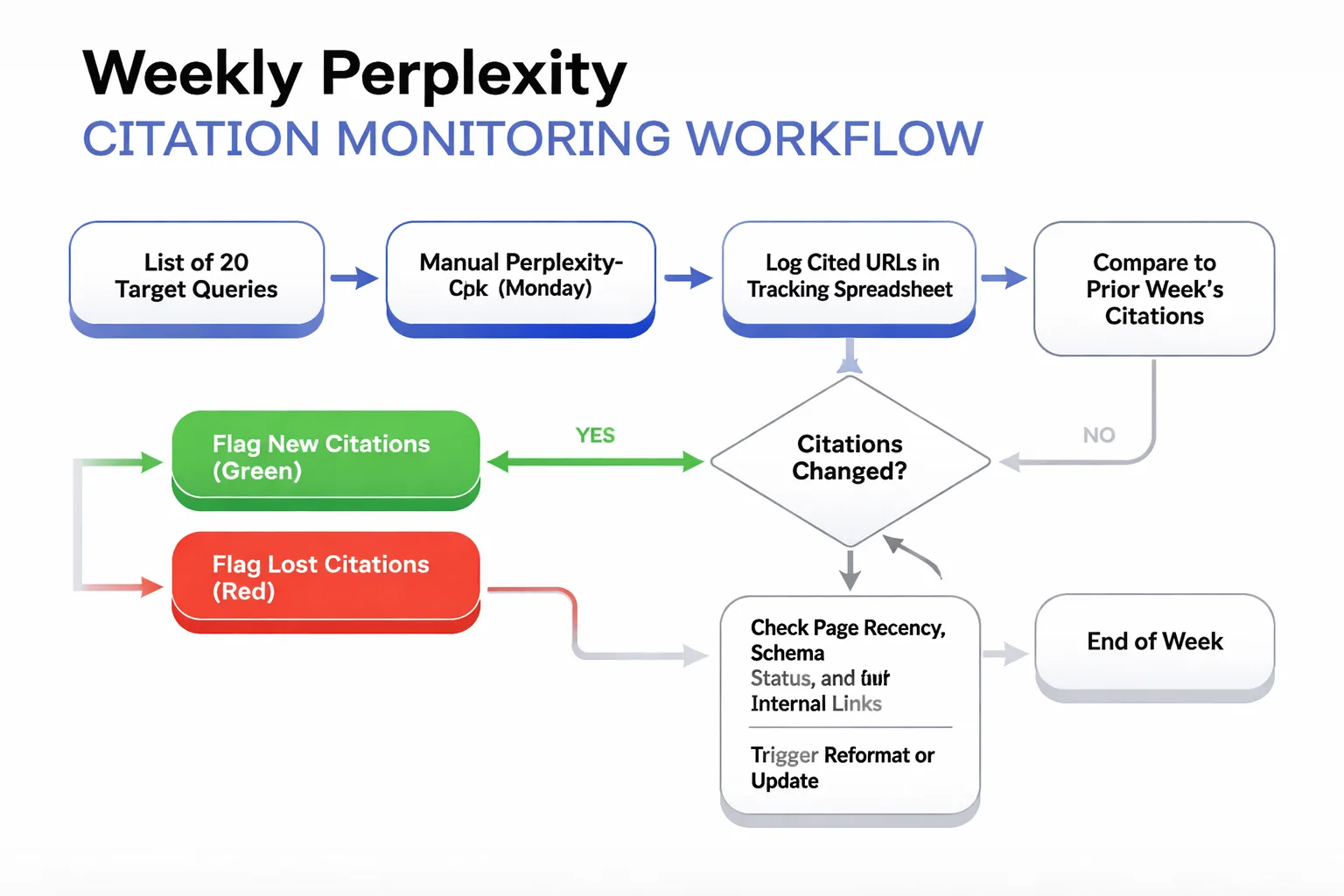
The lightest viable version of this workflow is manual spot-checking. Pick your 20 most important target queries. Run them in Perplexity once a week. Log the cited URLs. Compare to the previous week. Flag anything that changed — a new URL appearing, your page dropping out, a competitor appearing for the first time. This takes about 45 minutes per week and gives you a directional read on whether your optimization is working.
For teams with more volume, dedicated ai search visibility tools automate this. The best AI visibility tools roundup for 2026 compares platforms that track Perplexity citations specifically versus those that aggregate across all LLMs — an important distinction, because the citation mechanics differ enough by platform that aggregated tracking can obscure what's actually happening.
The platform difference is worth dwelling on. My own experience — and the data from Trensee's platform citation analysis — confirms that ChatGPT and Perplexity are pulling from structurally different source types. ChatGPT favors institutional, encyclopedic content. Perplexity skews toward direct-answer, community-style formats. Content I've reformatted specifically for Perplexity citation — shorter lead paragraphs, conversational framing, FAQ schema — has in some cases seen a drop in ChatGPT citation rate on the same pages. You cannot fully optimize for both simultaneously. Your tracking workflow needs to be platform-specific, not lumped into a single "AI visibility" metric.
For the iteration cadence: I recommend a 30-day recheck after any significant page reformat. Perplexity's crawl frequency varies, and it can take 2-4 weeks for a reformatted page to be re-indexed and re-evaluated. If a page shows no citation improvement after 30 days, go back to the gap audit for that specific query — something in the competitive set has changed, or the reformat missed a signal.
One metric worth tracking separately: the mention-citation gap. This is the difference between how often your brand or content is mentioned in AI-generated answers (without a citation link) versus how often it is actually cited with an attributable URL. A high mention rate with a low citation rate usually means Perplexity's retrieval layer knows your content exists but is not confident enough in its structure to surface it as a primary source. The fix is almost always structural — better schema, cleaner direct-answer leads, stronger internal linking. If you're evaluating tools that surface this gap specifically, the Meev vs Profound comparison covers how different platforms handle mention tracking versus citation attribution.
The contrarian take I'll close this section with: most practitioners are over-indexing on outreach as the primary lever for AI citation. I spent six weeks running a brand-pitching campaign for a client content program — emailing journalists, pitching editors — and saw almost no measurable lift in Perplexity citation rate. What moved the needle was getting a well-structured, direct-answer piece into a relevant community thread that already had traction, and then reformatting the client's own pages to match the structural signals those cited pages shared. Outreach is an amplifier. It works when you already have domain authority and structural quality. If you're starting from low AI visibility, the five steps in this article are where the leverage actually is.
The Citation Rate Gap Is Closing Fast
Perplexity's 13.8% citation rate — compared to ChatGPT's 0.7% — means this is the highest-attribution AI platform available to publishers right now. SE Ranking's AI traffic research found that AI-referred traffic converts at 14.2% versus Google's 2.8%, and that AI referral visits grew 357% year-over-year. The audience arriving from Perplexity citations is not just large — it is disproportionately high-intent.
But the citation concentration is tightening. The top 6% of URLs already account for 47% of citations. As more publishers learn to optimize for Perplexity source selection, the structural bar for inclusion will rise. The teams running gap audits and reformatting their content now are building citation moats. The teams waiting are watching that window close.
The five steps are not complicated. Audit what Perplexity is currently citing for your queries. Score your pages against those signals. Reformat for direct-answer leads, structured definitions, and FAQ schema. Build topical clusters with hub-and-spoke internal linking. Monitor weekly and iterate on a 30-day cadence. Dana's competitor wasn't doing anything magical — they were doing these five things consistently, and she wasn't doing any of them.
Frequently Asked Questions
Does Perplexity cite paywalled content? Rarely. Perplexity's RAG system needs to retrieve and read the full page content to evaluate it as a citation source. Pages behind hard paywalls — where the crawler cannot access the body text — are effectively invisible to the retrieval layer. If you publish research or data behind a paywall, consider publishing a free executive summary or abstract page that is fully crawlable, with the key findings in direct-answer format. That page can earn citations even if the full report is gated.
How long does it take to see citation gains after reformatting a page? Typically 2-4 weeks for Perplexity to re-crawl and re-evaluate a reformatted page. Some practitioners report faster turnarounds on high-traffic pages that Perplexity crawls more frequently. I use 30 days as the standard recheck window — anything shorter doesn't give you a reliable read on whether the change worked or whether you caught a random crawl cycle.
Does social media activity influence Perplexity citations? Not directly. Perplexity's source selection operates on page-level signals — structure, recency, entity clarity, schema — not social engagement metrics. Indirectly, social activity that drives traffic and backlinks can improve a page's crawl priority and domain signals, which may marginally help. But treating social promotion as a primary citation strategy is the wrong model. Structural optimization is the direct lever.
Should I optimize for Perplexity citations or Google AI Overviews first? Depends on your traffic mix. If you are primarily a B2B publisher, Perplexity is the higher-priority platform — its citation rate is higher, its audience skews more professional, and the conversion data from AI-referred traffic strongly favors it. If you are a consumer brand with high Google organic traffic, Google AI Overviews optimization may have more immediate volume impact. The structural signals overlap significantly — direct-answer leads, FAQ schema, and topical clustering help both — but Perplexity rewards conversational formatting more heavily than Google's AIO does.
Can a low-DA domain realistically earn Perplexity citations? Yes — and this is one of the clearest differences between Perplexity source selection and traditional Google ranking. The topical authority cluster research is unambiguous: a domain with 10+ tightly interlinked pages on a specific topic can earn citations at 2-3x the rate of a high-DA domain with a single orphaned page on that topic. Domain authority is a weaker signal here than topical coherence and structural quality. A new domain that publishes 15 well-structured, interlinked articles on a narrow topic and updates them regularly has a realistic path to Perplexity citations within 60-90 days.
About the Author
Judy Zhou, Head of Content Strategy
Judy Zhou leads content strategy at Meev, where she oversees AI-driven content research and publishing for hundreds of brands. With a background in SEO and editorial operations, she focuses on building content systems that rank on Google, get cited by AI search engines, and drive measurable business results.
Run your first Perplexity citation audit with Meev and find out exactly which structural gaps are keeping your content out of AI answers.