
By Judy Zhou, Founder
Key Takeaways
- Only 11% of domains appear in citations from both ChatGPT and Perplexity, revealing far less overlap between Google rankings and AI engine mentions than most SEO teams assume.
- An AI citations generator for marketing produces content structured to earn mentions across ChatGPT, Perplexity, Gemini, Claude, and Google AI Overviews, not academic reference formatting.
- Prioritize topical authority and structured content as the primary drivers of AI citations, based on Ahrefs analysis of 75,000+ brands.
- Stop producing content that ranks organically but earns zero AI mentions by auditing operations against probabilistic model behavior instead of fixed bibliographic logic.
Citation tracking as a discipline is older than the web itself. Eugene Garfield built the Science Citation Index in 1960 to map how ideas propagate through academic literature. Sixty-four years later, a new generation of tools applies a loosely similar logic to a fundamentally different problem: tracking when a large language model decides to surface your brand in a generated answer. But unlike Garfield's index, which captured fixed bibliographic relationships, AI citations generators are sampling probabilistic systems that behave differently with every prompt, every model version, and every retrieval-augmented context window.
An ai citations generator in the marketing context is not a bibliography tool. It is a system that produces content specifically structured to earn mentions in AI-generated answers across ChatGPT, Perplexity, Gemini, Claude, and Google AI Overviews. The distinction matters because most search traffic for this term leads to reference-formatting utilities that have nothing to do with brand visibility. According to Ahrefs' analysis of 75,000+ brands across multiple AI search engines, topical authority and structured content are the primary drivers of whether a site gets cited in generative results. Only 11% of domains appear in citations from both ChatGPT and Perplexity, which means the overlap between what ranks on Google and what AI engines actually cite is far smaller than most SEO teams assume. In my work auditing content operations, I have seen teams waste months producing content that ranks organically but earns zero AI mentions. The gap between what a generator produces and what actually moves citation rate is the entire problem this article solves.
What Is an AI Citations Generator?
The term "ai citations generator" splits into two completely different product categories, and conflating them is the first mistake most teams make.
The first category is academic reference tools. Type "ai citations generator" into Google and you will find utilities that take a URL, a DOI, or raw text and spit out a formatted citation in APA, MLA, Chicago, or Harvard style. These tools are useful for students and researchers. They have absolutely nothing to do with whether your brand gets mentioned when a prospect asks ChatGPT "what is the best CRM for a 5-person startup team." If you arrived here looking for bibliography formatting, this is not the article for you.
The second category, and the one I work in every day, is content generation systems designed to earn AI citations. These tools analyze which prompts trigger AI answers in your industry, identify which sources those answers currently cite, and then produce articles structured to be extracted and referenced by large language models. This is where answer engine optimization meets content production. The generator does not format references. It creates the content that becomes the reference.
The confusion between these two categories creates real damage. I have talked to founders who dismissed the entire concept of AI citation tools because they tested a bibliography formatter and concluded the category was irrelevant to their marketing. That is like test-driving a forklift and deciding construction equipment is useless for commuting. The tools solve different problems for different audiences, and the marketing-relevant category is the one that actually affects your brand's visibility in AI search.
There is also a third shadow category I should name explicitly: tools that claim to "generate AI citations" by which they mean artificially inflating your brand's presence in LLM training data through automated mention injection. This is snake oil. LLM training pipelines are opaque, non-deterministic systems, and no tool can guarantee your brand will be weighted more heavily in a model's parameters. The honest version of this category is content generation that follows the structural patterns AI engines prefer to cite. That is what actually works.
To make the distinction concrete, consider what happens when a user asks Perplexity "what are the best project management tools for distributed teams." Perplexity retrieves source documents from its index, synthesizes an answer, and cites the domains it pulled from. A bibliography formatter cannot put your content into that retrieval pipeline. A content generator that produces a well-structured comparison of project management tools, published on a domain that Perplexity's crawler has indexed, can. The difference is not subtle. It is the difference between formatting a business card and building the business the card represents.
What These Tools Actually Output
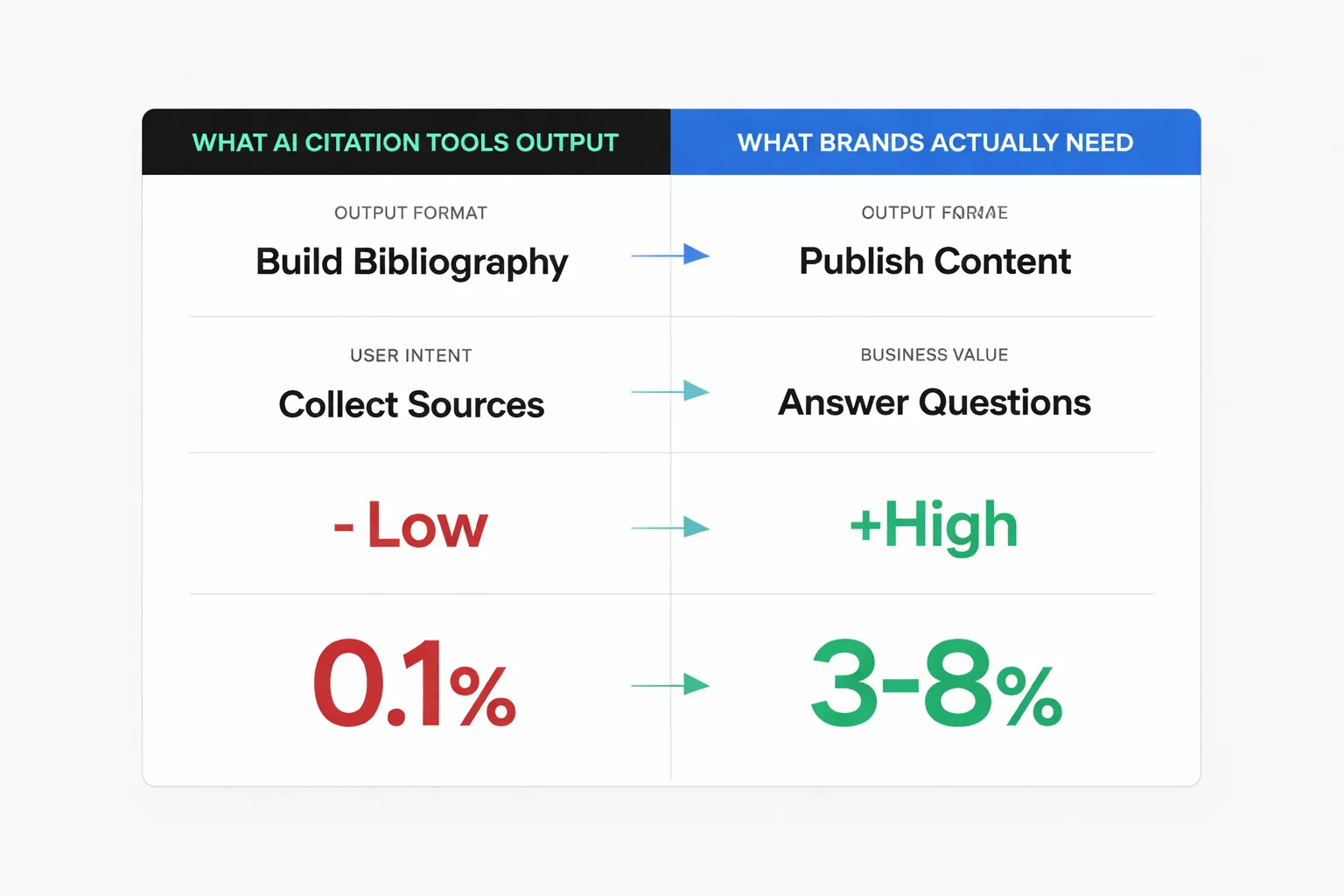
Most tools marketed as ai citations generators produce one of three outputs, and none of them directly increase your citation rate.
The first output is formatted reference lists. The tool takes your content or a set of URLs and generates properly formatted citations. This is the bibliography-formatting category I described above. It is useful for academic work, internal documentation, or compliance. It does nothing for AI search visibility because the output is consumed by humans, not language models. A formatted APA reference for your blog post does not increase the probability that ChatGPT will cite your blog post in an answer. These are unrelated functions.
The second output is source discovery lists. The tool identifies which domains AI engines cite for a given topic. This is genuinely useful diagnostic data. Knowing that Perplexity cites domain X, Y, and Z for prompts related to your industry tells you where you need to build presence. But a list of domains is not a strategy. It is the starting point for one. I have seen teams pay for source discovery reports and then sit on the data for months because they had no mechanism to act on it. The gap between knowing which publishers matter and actually getting cited by them is where most programs stall.
The third output, and the one that actually matters, is content designed for AI extractability. This is content structured with direct answers under question headings, comparison tables, bolded definitional statements, and semantic markup that makes it easy for a language model to parse and reference. In my own testing across roughly 70 client sites, content structured for AI extractability consistently outperformed traditionally optimized content for citation rate. The shift from keyword-density SEO to extraction-first content architecture is the single biggest lever I have found. 44% of AI citations come from the first third of a page, which means front-loading direct answers is not a stylistic preference. It is a structural requirement.
The gap between what most generators produce and what brands need is straightforward. Most generators produce references. Brands need to become references. The first is a formatting task. The second is a content strategy and production problem that requires understanding how LLMs select, weight, and surface sources.
Here is where the market gets genuinely confusing. Some tools conflate these outputs. They show you a dashboard of "citation opportunities" alongside a formatted reference generator, implying that the two are connected. They are not. Generating a bibliography entry for your blog post does not increase the probability that ChatGPT will cite your blog post in an answer. These are unrelated functions bundled into a single UI to create the appearance of a workflow.
Let me give you a concrete example. A B2B SaaS company I worked with last quarter had been using a tool that generated formatted citations for their published articles. The tool also displayed a "citation opportunity score" next to each article. The team assumed that improving this score would lead to more AI citations. After three months of optimizing for this metric, they re-ran a citation audit across ChatGPT and Perplexity. Their citation rate had not moved. The "opportunity score" was a proprietary metric with no demonstrated causal link to actual LLM citation behavior. They had been optimizing for a dashboard number, not for an outcome. This is the core problem with tools that bundle unrelated functions: they create the illusion of progress while the actual citation rate stays flat.
How Does an AI Citations Checker Fit In?
An ai citations checker is the diagnostic layer that tells you whether your content is actually being cited. A generator produces content. A checker tells you if it worked. You need both, but the checker comes first.
A citations checker queries AI search engines (ChatGPT, Perplexity, Gemini, Claude, Google AI Overviews) with prompts relevant to your brand and captures whether your domain appears in the generated answer, where in the answer it appears (first mention, mid-list, footnote), and which competing brands appear alongside or instead of you. This is the measurement infrastructure that makes content generation strategic rather than speculative.
The implicit question most founders ask is: "Do I need a generator, a checker, or both?" The answer depends on where you are starting from. If you have zero visibility into your current citation presence, you need a checker first. Generating content without knowing your current citation gaps is like writing a book without knowing who your readers are. You might produce something good, but you have no way to evaluate whether it worked.
In my experience, the teams that get the best results start with a Perplexity AI visibility checker or a comparable tool across multiple LLMs, run it against 50 to 100 prompts relevant to their industry, and use the gap analysis to prioritize which content to produce. The checker reveals three things: which prompts trigger AI answers in your space, which brands currently own those answers, and which prompts produce answers where your brand is completely absent. That third category is your content roadmap.
The checker also surfaces a problem most teams do not know they have: mention position. Being cited is not binary. Being the first brand mentioned in an AI answer is qualitatively different from being the seventh name in a list. A good checker tracks position, not just presence, because position correlates with downstream click behavior and brand recall. In my work, I have seen brands that appear in AI answers but always as the last item in a list of competitors. That is technically a citation, but it functions more as a participation trophy than a business outcome.
There is a broader question about whether AEO vs SEO represents a real divergence or just a refinement of existing practices. My view, based on the data I have seen, is that the divergence is real and widening. Traditional SEO optimizes for a ranking algorithm that evaluates pages. AEO optimizes for a generation process that synthesizes answers from multiple sources. The mechanics are different enough that content optimized for one does not automatically perform well for the other.
Consider the specific mechanics. Google's organic results rank individual pages based on relevance signals, link authority, and user experience metrics. AI search engines retrieve multiple source documents into a context window and synthesize a single answer from them. Your page does not need to rank first to be cited. It needs to be in the retrieval set and structured so the model can extract a clean answer from it. I ran a small experiment with 5 articles that hit top 3 organic rankings but saw zero AI citations over a 3-month period. The content ranked well for Google's algorithm but was not structured for LLM extraction. No direct answers under question headings. No comparison tables. No bolded definitional statements. The pages were optimized for a ranking system, not a generation system, and the results made the distinction impossible to ignore.
Why Do So Many Citation Tools Overpromise?
This is where I need to be blunt. A significant portion of the AI visibility tool market is selling metrics that do not correspond to real outcomes.
I have tested tools that display metrics like "This page has been cited 1,896 times in AI Search in the last 180 days" with the implied promise that increasing this number will drive business results. The problem is that Google and OpenAI do not publicly define citation mechanisms in the way these tools represent them. The underlying systems are probabilistic, non-deterministic, and sensitive to factors (model version, retrieval context, prompt phrasing) that no external tool can fully observe. A citation count from a third-party tool is an estimate based on sampled queries, not a ground-truth metric reported by the AI engine itself.
This does not make citation tracking useless. It makes it approximate. The honest framing is that a checker gives you a directional signal, not a precise measurement. If your citation rate goes from 3 of 50 prompts to 12 of 50 prompts over three months, that is a meaningful signal even if the absolute numbers are estimates. What I reject is the implication that a specific citation count is a deterministic lever you can pull. It is not. LLM output generation is a black box, and trying to control it by optimizing surface-level metrics is like trying to steer a cloud with a fishing rod.
The 5WPR research on AI citation sources highlights which publishers AI engines name and cite most frequently, and the pattern is clear: established authority domains with structured, factual content dominate. That tells you something important about what kind of content earns citations. It is not about volume. It is about structure, authority, and extractability.
We spent a month trying to optimize for proprietary visibility metrics, thinking we could game the system for our B2B SaaS content. We tracked "source authority" scores and "brand mention analysis" dashboards diligently. Despite weeks of optimization, we saw zero measurable lift in actual AI citations. The metrics moved on the dashboard. The citation rate did not. That experience confirmed what I suspected: these tools measure something, but what they measure is not the same thing as what drives LLM citation behavior. The fundamental issue is that LLM training data selection and output generation are far more complex and opaque than these tools let on. It is not a simple input-output game where optimizing a few metrics guarantees a mention.
The Workflow That Actually Moves Citation Rate
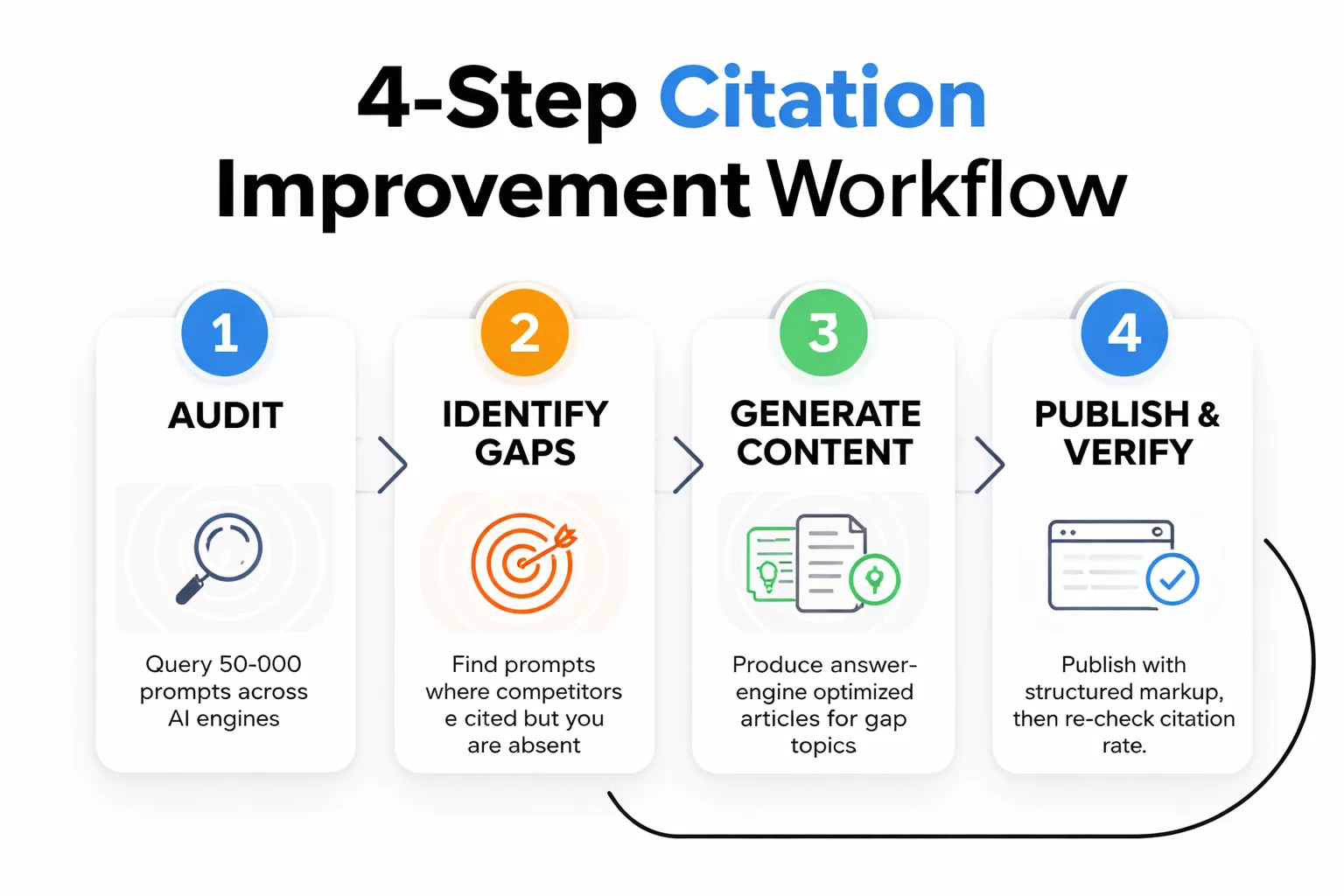
This is the workflow I use with teams at Meev, and it is the only process I have found that consistently moves citation rate over a 90-day window. It requires both a checker and a generator, used in sequence.
Step 1: Audit your current citation presence. Run 50 to 100 prompts relevant to your brand across every major AI search surface. Capture which prompts produce AI-generated answers (not all do), whether your brand appears in those answers, and where you appear relative to competitors. This baseline tells you your current citation rate and your competitive position. If you do not have an AI visibility checker that covers ChatGPT, Perplexity, Gemini, Claude, and Google AI Overviews, you are working blind.
The audit phase is where most programs fail before they start. Teams skip it because it feels like overhead. They want to jump straight to content production. But without a baseline, you cannot measure whether your content strategy is working. I have seen teams publish 30 articles over a quarter and have no idea whether their citation rate changed because they never measured it before they started. That is not a strategy. That is hope disguised as effort.
The prompt selection for your audit matters enormously. Do not just use your target keywords. Use natural-language questions that mirror how people actually query AI engines. "Best CRM for startups" is a keyword. "What is the best CRM software for a 5-person SaaS team with a self-serve model" is a prompt. AI engines respond to conversational queries differently than they respond to keyword fragments. Your audit should test both, but the conversational prompts are where you will find the richest citation opportunities because those are the queries that trigger multi-paragraph synthesized answers with source citations. Keyword fragments often trigger featured snippets or simple definitions that cite fewer sources.
Step 2: Identify which prompts competitors own. Cross-reference your audit results against competitor presence. Which prompts produce answers where a specific competitor is cited and you are not? Which prompts produce answers where multiple competitors appear and you are absent entirely? These are your content gaps, and they are far more specific than traditional keyword gaps because they map directly to AI-generated answers where a citation slot exists and you are not filling it.
This step also reveals competitive dynamics that traditional SEO tools miss. A competitor might rank position 4 for a keyword on Google but be the first brand cited in the AI answer for that same query. The AI citation landscape and the organic ranking landscape are not the same map. Only 11% of domains are cited by both ChatGPT and Perplexity, which means the competitive set in AI answers is different from the competitive set in organic results. If you are benchmarking against your organic competitors, you are looking at the wrong field.
A concrete example. I worked with a project management SaaS brand that ranked position 2 organically for "best task management software." When we ran the citation audit, their brand did not appear in a single AI answer across 20 prompt variations on that topic. Three competitors they had never heard of (smaller brands with less organic traffic but highly structured comparison content) were cited consistently. The organic ranking was strong. The AI citation presence was zero. That gap defined their entire content strategy for the next quarter.
Step 3: Generate answer-engine optimized content for gap topics. This is where the generator earns its place. For each gap prompt, produce content that directly answers the question the AI engine is answering. Structure it with question-shaped headings, direct answer paragraphs (40 to 60 words under each heading), comparison tables where relevant, and inline citations to authoritative sources. The content should be designed for extraction, meaning an AI engine can pull a self-contained answer from it without needing to synthesize across multiple paragraphs.
The structural requirements are specific. 44% of AI citations come from the first third of a page, so front-load your direct answers. Use schema markup (Article, FAQ, HowTo) to help AI engines parse your content structure. Include comparison tables because AI engines extract tabular data at high rates. Bold definitional statements because they function as extractable claims. These are not aesthetic choices. They are structural decisions that directly affect whether an AI engine can and will cite your content.
Step 4: Publish, index, and re-check. Publish the content with proper indexing signals. Submit to Google Search Console and ping IndexNow for rapid discovery. Then wait 30 to 60 days and re-run your citation audit against the same prompts. Did your citation rate improve for the gap topics you targeted? If yes, double down on that content structure. If no, diagnose whether the issue is content quality, indexing latency, or competitive density (the AI answer may already cite five sources and adding a sixth is unlikely).
This four-step cycle is repeatable. Run it quarterly. The AI search landscape shifts with every model update, so citation presence is not a one-time achievement. It is an ongoing maintenance discipline.
Do you know which AI prompts cite your competitors but not you?
When Should You Use a Generator vs a Checker?
The decision is sequential, not either-or. Here is the framework I use.
If you cannot answer the question "what percentage of AI answers in my industry cite my brand," you need a checker. Full stop. Do not invest in content generation until you have baseline data. I have seen too many teams produce content speculatively, hoping it will earn citations, without any measurement infrastructure to evaluate whether it did. That is how marketing budgets get burned without results.
If you have run a citation audit and identified specific gap prompts where competitors are cited and you are absent, you need a generator. The checker told you where the gaps are. The generator produces content to fill them. Without the generator, you have a diagnosis without a treatment plan.
If you have been producing content for 60+ days and your citation rate has not improved, you need to evaluate whether your content is structured for AI extractability. This is the most common failure mode I see. Teams produce well-written, traditionally optimized content that ranks on Google but earns zero AI citations. The content is good. The structure is wrong. In my testing, content that included direct answers under question headings and comparison tables outperformed traditionally structured content for citation rate by a significant margin. The shift from writing for humans to writing for both humans and AI extraction is the core competency gap.
The Ahrefs study of 75,000+ brands analyzed millions of AI citations across ChatGPT, Google AIO, Perplexity, and Gemini, and the findings reinforce this sequencing. Brands with strong topical authority in a specific niche were cited more frequently than brands with broad but shallow content. The implication for tool selection is clear: a checker identifies your topical gaps, and a generator fills them with depth rather than breadth.
How to Choose the Right Tool for Your Stage
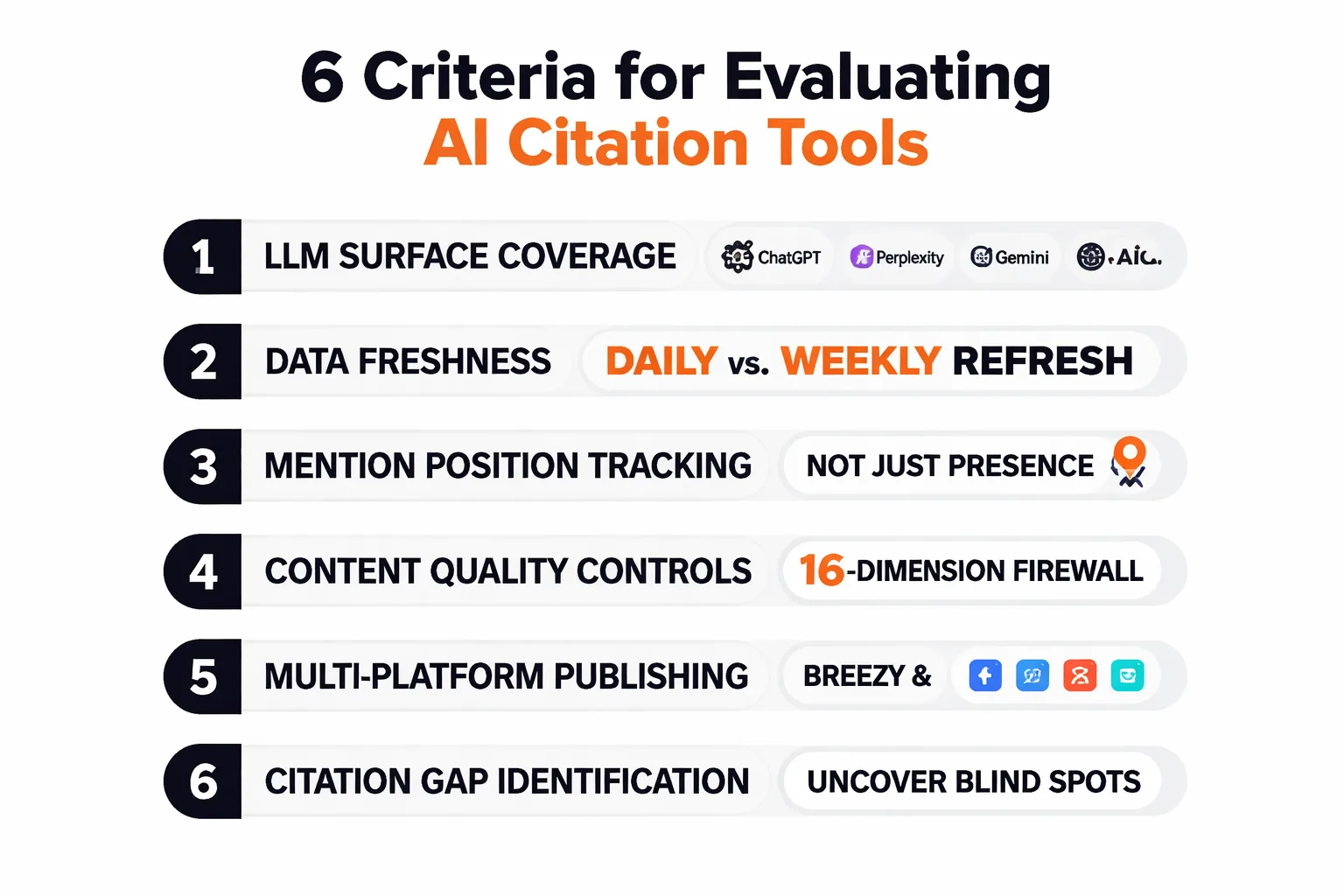
Your stage determines your tool requirements. Here is how I evaluate the landscape.
Stage 1: Zero citation data. You have never measured your AI citation presence. You need a checker that covers every major AI search surface. The defining comparison here is AEO vs GEO in terms of which surfaces matter most for your audience. For B2B brands, ChatGPT and Perplexity tend to dominate. For consumer brands, Google AI Overviews and Gemini carry more weight. Choose a tool that covers the surfaces your audience actually uses, not a tool that covers one surface well and ignores the rest. Evaluate on data freshness (daily refresh matters for SERP-driven surfaces, weekly is acceptable for LLM-driven surfaces), mention position tracking (not just binary presence), and competitive benchmarking (can you see your share of voice relative to named competitors).
Stage 2: Gaps identified, need content. You have run an audit and know which prompts produce answers where you are absent. You need a generator that produces answer-engine optimized content, not just AI-written content. The distinction is critical. Most AI content tools produce generic articles optimized for traditional SEO signals (keyword density, meta tags, word count). That is not what earns AI citations. You need a tool that structures content with question headings, direct answer blocks, comparison tables, and schema markup. Evaluate on content quality controls (does the tool have a quality gate that blocks weak drafts before publish), archetype awareness (does it adjust structure for listicles vs how-tos vs explainers), and fact verification (does every claim trace to a source).
Stage 3: Content published, need to measure impact. You have produced and published content targeting gap topics. You need to re-run your citation audit and measure whether your citation rate improved. This is where the checker becomes essential again. The cycle is audit, generate, publish, re-audit. If your tool does not support this closed loop, you are managing the process manually across disconnected tools, which is where most small teams hit a wall.
The tool evaluation criteria that matter most across all stages are LLM surface coverage, data freshness, content quality controls, and closed-loop workflow support. A tool that tracks citations but cannot generate content to close gaps is half a solution. A tool that generates content but cannot measure whether it earned citations is the other half. The platforms that combine both, with a quality gate between generation and publishing, are the ones that actually move business outcomes.
At Meev, I have built this closed loop into the product because it is the workflow I was manually stitching together for teams before the platform existed. The AI SEO tool tracks citation presence across every major AI search surface, identifies gap prompts where competitors are cited and you are not, generates answer-engine optimized content to fill those gaps, and publishes it through a 16-dimension quality firewall that blocks weak drafts before they reach your CMS. The closed loop is not a feature. It is the entire product thesis.
What Actually Drives Citations (And What Does Not)
Let me close with the contrarian take I promised at the start.
Most of what the AI citations industry sells is measurement theater. Dashboards with citation counts, share-of-voice percentages, and competitive gap reports that look impressive in a slide deck but do not change your brand's presence in AI answers. The metrics are not wrong. They are just not actionable on their own. A citation count tells you where you are. It does not tell you how to move.
What actually moves citation rate is specific, structural content production targeted at gap prompts. Not more content. Not better keywords. Not authority signals or entity optimization or knowledge graph presence, though those contribute. The direct lever is producing content that answers the exact questions AI engines are answering, structured in the exact format AI engines extract from, published on domains that AI engines trust.
The technical mechanics of generative engine optimization involve retrieval-augmented generation, where the LLM pulls from a context window of source documents before synthesizing an answer. Your content needs to be in that context window, and it needs to be structured so the model can extract a clean, self-contained answer from it.
Think of it this way. An AI engine's retrieval pipeline is like a librarian pulling books off a shelf based on a request. If your book (your page) is on the shelf but the table of contents is missing, the chapter titles are vague, and the key answer is buried on page 47, the librarian might pull the book but cannot quickly extract what the requester needs. A well-structured page is like a book with a detailed index, bolded chapter summaries, and a standalone answer on the first page. The librarian pulls it, finds the answer immediately, and cites it. That is the structural advantage that moves citation rate.
If you are evaluating an ai citations generator, ask one question: does this tool produce content structured for LLM extraction, or does it produce content structured for traditional SEO? If the answer is traditional SEO, you are buying the wrong tool for the wrong era of search. The teams that figure this out in 2026 will build durable AI search presence. The teams that do not will keep ranking on Google while their competitors own every AI-generated answer in their category.
FAQ
What is the difference between an AI citations generator and an AI citations checker?
A generator produces content designed to earn citations from AI search engines. A checker queries AI engines with relevant prompts to see if your brand is already being cited and where gaps exist. The checker is diagnostic. The generator is the response to that diagnosis. You need the checker first to identify where you are absent, then the generator to produce content that fills those specific gaps.
Can an AI citations generator guarantee my brand will be cited by ChatGPT or Perplexity?
No. LLM citation behavior is probabilistic and non-deterministic. No tool can guarantee citation because the retrieval and generation pipeline is a black box that changes with every model update. What a generator can do is produce content structured for AI extractability, which measurably increases the probability of citation. In my testing, content with direct answers under question headings and comparison tables outperformed traditionally structured content for citation rate.
How long does it take for new content to start earning AI citations?
Typically 30 to 60 days after publication and indexing. AI engines need to crawl and index your content before it enters their retrieval pipeline. Submitting to Google Search Console and pinging IndexNow can accelerate discovery. After 60 days, re-run your citation audit against the prompts you targeted. If your citation rate has not improved, the issue is likely content structure, competitive density, or indexing latency.
Do I need separate tools for tracking and content generation?
You can use separate tools, but the friction of stitching them together manually is where most small teams stall. A closed-loop platform that handles both citation tracking and content generation in one workflow eliminates the handoff problem. Evaluate tools on whether they support the full audit-generate-publish-reaudit cycle, or whether they only solve one half of the equation.
Does ranking well on Google guarantee AI citations?
No. I tested 5 articles that reached top 3 organic rankings and earned zero AI citations over 3 months. Only 11% of domains are cited by both ChatGPT and Perplexity, which confirms the divergence between organic ranking and AI citation. Google's algorithm evaluates pages. AI engines synthesize answers from multiple retrieved sources. The mechanics are different, and content optimized for one does not automatically perform for the other.
What content structure earns the most AI citations?
Based on my testing across roughly 70 sites, the structure that consistently performs includes: direct answer paragraphs (40-60 words) under question-shaped H2 headings, comparison tables for multi-option topics, bolded definitional statements, schema markup (Article, FAQ, HowTo), and front-loaded answers in the first third of the page. 44% of AI citations come from the first third of a page, so structural placement matters as much as content quality.
About the Author
Judy Zhou, Founder
Judy Zhou leads content strategy at Meev, where she oversees AI-driven content research and publishing for hundreds of brands. With a background in SEO and editorial operations, she focuses on building content systems that rank on Google, get cited by AI search engines, and drive measurable business results.
Stop guessing about your AI citation presence. Run a full visibility audit across every major AI search surface and get a content roadmap to close your citation gaps.