AI Citation Strategy for B2B SaaS Founders: A No-Agency Playbook
By Judy Zhou, Founder
Key Takeaways
- B2B SaaS founders can earn AI citations without an agency by owning three prompt categories, publishing one pillar page per quarter, and tracking branded search lift as the primary ROI signal.
- Ahrefs' analysis of 75K+ brands shows AI search engines favor topical authority and earned media over brand-owned content, giving small teams with niche expertise an edge.
- The arXiv GEO study confirms generative engines systematically prefer third-party authoritative sources over brand-owned and social content, unlike Google's balanced mix.
- Focus on entity grounding and answer-engine optimized structures rather than raw organic traffic to increase citations in tools like ChatGPT for niche B2B SaaS queries.
B2B SaaS founders can earn AI citations without an agency by owning three prompt categories, publishing one pillar page per quarter, and tracking branded search lift as the primary ROI signal. Research from Ahrefs' analysis of 75K+ brands shows that AI search engines favor topical authority and earned media over brand-owned content, which means small teams with deep niche expertise actually have an advantage if they structure content correctly. The arXiv GEO study confirms that generative engines systematically prefer third-party authoritative sources over brand-owned and social content, contrasting with Google's more balanced mix. I have seen this play out in my own work at Meev: brands that focus on entity grounding and answer-engine optimized content structures get cited more often than those chasing raw organic traffic.
I am Judy Zhou, founder and head of content strategy at Meev, where I oversee AI-driven content research and publishing for hundreds of brands. Over the past year, I have audited content operations across B2B SaaS companies and tested what actually moves the needle on AI citations. What I found is that most founders are either ignoring AI search entirely or throwing money at agencies that do not understand how LLM attribution works.
Why B2B SaaS Founders Face a Unique AI Citation Problem
The standard GEO advice flooding LinkedIn and Twitter right now is built for enterprise teams with dedicated content departments, dedicated SEO managers, and budgets that support weekly publishing cadences. That advice breaks down completely for a three-person SaaS startup trying to get cited in ChatGPT when a prospect asks "what is the best tool for automated customer onboarding?"
Here is the core problem. B2B SaaS buying prompts are incredibly niche. When someone asks ChatGPT or Perplexity for tool recommendations, the queries are specific: "best CRM for B2B SaaS companies under 50 employees" or "how to reduce churn for subscription billing software." These are not head-term queries where your competitor's massive content operation dominates. They are long-tail, intent-rich prompts where deep expertise wins.
But most founders do not know where they stand. They have never run their brand through a ChatGPT AI visibility checker or tested how they appear (or do not appear) across AI search surfaces. I have talked to founders who assumed their Google rankings would carry over to AI answers. They do not. We ran an experiment with 5 articles that hit top 3 organic rankings on Google and saw zero AI citations over a 3-month period. Organic visibility alone does not drive AI mentions.
The broader data backs this up. Only about 11% of domains are cited by both major LLMs, which means the overlap between Google visibility and AI visibility is shockingly thin. If you are a founder relying on your SEO rankings to carry you into AI answers, you are leaving citations on the table.
Enterprise teams solve this by throwing bodies at the problem. They hire agencies to produce hundreds of pages of content, build out knowledge graphs, and run PR campaigns to earn third-party mentions. That works if you have the budget. But for a solo founder or a small team, the playbook needs to be different. You need to be surgical.
The advantage you have is niche depth. AI engines reward topical authority. Ahrefs' study of 75K+ brands found that sites with concentrated topical authority in a specific niche get cited more frequently than generalist sites with higher overall domain authority. Your three-person team that lives and breathes B2B SaaS onboarding has more genuine expertise than a 50-person agency writing surface-level content about it.
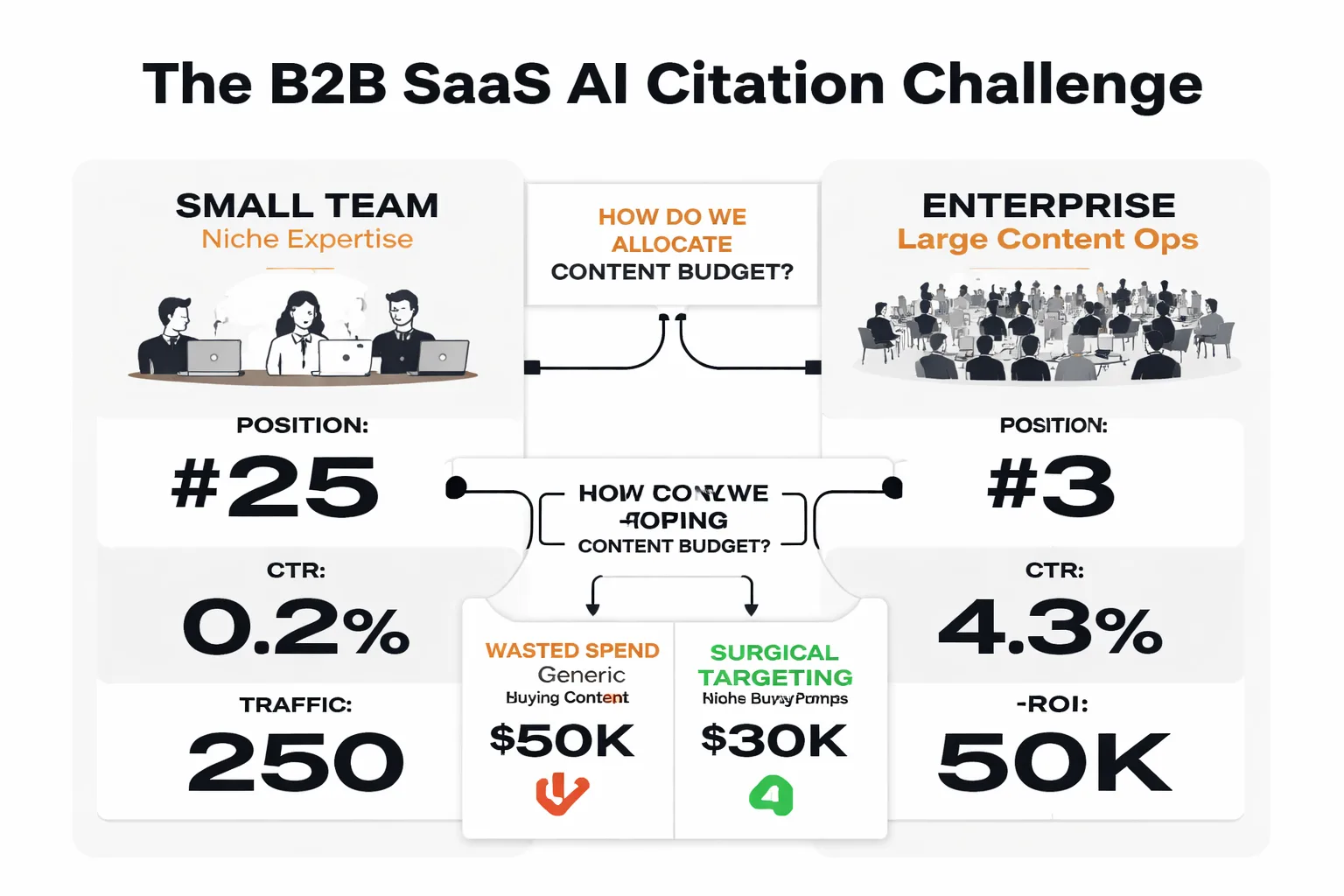
The mistake founders make is trying to compete on volume. You will never out-publish a competitor with a 15-person content team. But you can out-depth them. One deeply researched, expertly structured article on "how to calculate NRR for B2B SaaS" will earn more AI citations than ten generic listicles your competitor's agency churns out.
Let me give you a concrete example. I worked with a B2B SaaS founder in the contract management space. Their competitor had a DR 70 domain, 500+ blog posts, and a full content team. The founder had a DR 25 domain and 12 blog posts. But those 12 posts were deeply technical, written by the founder herself, and covered exact prompts their buyers were typing into ChatGPT: "how to automate contract renewal tracking" and "best CLM software for SaaS companies." Within four months, the founder was cited in ChatGPT and Perplexity for three of those prompts. The competitor with 500 posts was cited for one. Depth beat volume.
This is the fundamental shift. In the Google era, more content meant more surface area to rank. In the AI search era, more citable content means more surface area for extraction. The bar is not quantity. It is extractability.
The Three Prompts Every B2B SaaS Founder Must Own
Every B2B SaaS buying journey involves three types of AI search prompts. If you are not cited in at least one of these three categories for your niche, you are invisible to AI-assisted buyers.
Category Definition Prompts
These are prompts where the user asks an AI engine to define or explain a category. "What is AI search visibility?" or "What is answer engine optimization?" If your brand is not cited when someone asks about your category, you are not positioned as an authority. These prompts are your category ownership play.
I have seen brands win category definition prompts by publishing definitive explainer articles that structure the answer clearly: a direct definition in the first paragraph, a comparison table, and a FAQ section. AI engines extract from the top of the page. 44% of AI citations come from the first third of a page, so front-loading direct answers became critical in our testing.
To audit where you stand today, use a Perplexity AI visibility checker to test category definition prompts relevant to your product. Run the same prompts across ChatGPT and Google AI Overviews. Track which competitors appear and which sources they cite.
Here is how to run the audit concretely. List 10 category definition prompts relevant to your product. For a billing platform, these might include: "What is usage-based billing?" "What is subscription dunning?" and "How does proration work in SaaS billing?" Run each prompt in ChatGPT, Perplexity, Google AI Overviews, and Claude. Record four data points per prompt: which brands are mentioned, which URLs are cited, the position of your brand (first, in a list, last, absent), and the sentiment of the mention (positive, neutral, negative). This gives you a baseline citation rate. If you are cited in 2 out of 10 prompts, your citation rate is 20%. Your goal is to identify the 8 gaps and prioritize them by buying intent.
Comparison Prompts
These are the highest-intent prompts. "Best [category] tools" or "Alternative to [competitor]." When a prospect types this into ChatGPT, they are evaluating options. Being cited here means being in the consideration set.
The challenge with comparison prompts is that AI engines heavily favor third-party sources over brand-owned content. The arXiv GEO study found that AI search systematically favors earned media (third-party, authoritative sources) over brand-owned and social content. This means your comparison page on your own site has limited citation power. What moves the needle is getting mentioned on third-party comparison articles, roundup posts, and community discussions.
This is where outreach matters. You need to find the publishers AI engines cite for comparison prompts in your niche and build relationships with them. At Meev, we built our Citation Path feature specifically for this workflow: find publishers AI engines actually cite, surface verified contacts, and draft personalized outreach pitches grounded in your knowledge base.
Let me walk through a real scenario. Say you sell AI-powered customer feedback analytics software. You run the prompt "best customer feedback tools for SaaS" in Perplexity. The answer cites a G2 comparison article, a Reddit thread, and a blog post from a product management publication. Your brand is absent. The citation path is clear: you need to get mentioned on G2, participate in that Reddit thread, and pitch a guest post or product inclusion to that PM blog. Each of these is a tactical action you can take in a week. The arXiv GEO study confirms that AI search systematically favors earned media over brand-owned content, which means your own comparison page will almost never get cited for these prompts. You need third-party validation.
Use-Case Prompts
These are prompts tied to specific problems. "How to reduce SaaS churn" or "Best way to automate customer onboarding." They are problem-first, not product-first. AI engines cite content that answers the problem comprehensively, not content that pitches a product.
Use-case prompts are where small teams have the biggest advantage. Your competitor's agency writer does not know what it is like to reduce churn for a B2B SaaS company. You do. Write from experience. Include specific frameworks, real numbers, and actionable steps. AI engines favor content with genuine depth and expertise signals.
To audit your citation rate across all three prompt categories, I recommend using a dedicated AI visibility tool that tracks mentions across every major AI search surface. Run 10-15 prompts per category, record where you appear (first mention, in a list, absent), and identify the gap between where you are cited and where competitors are cited.
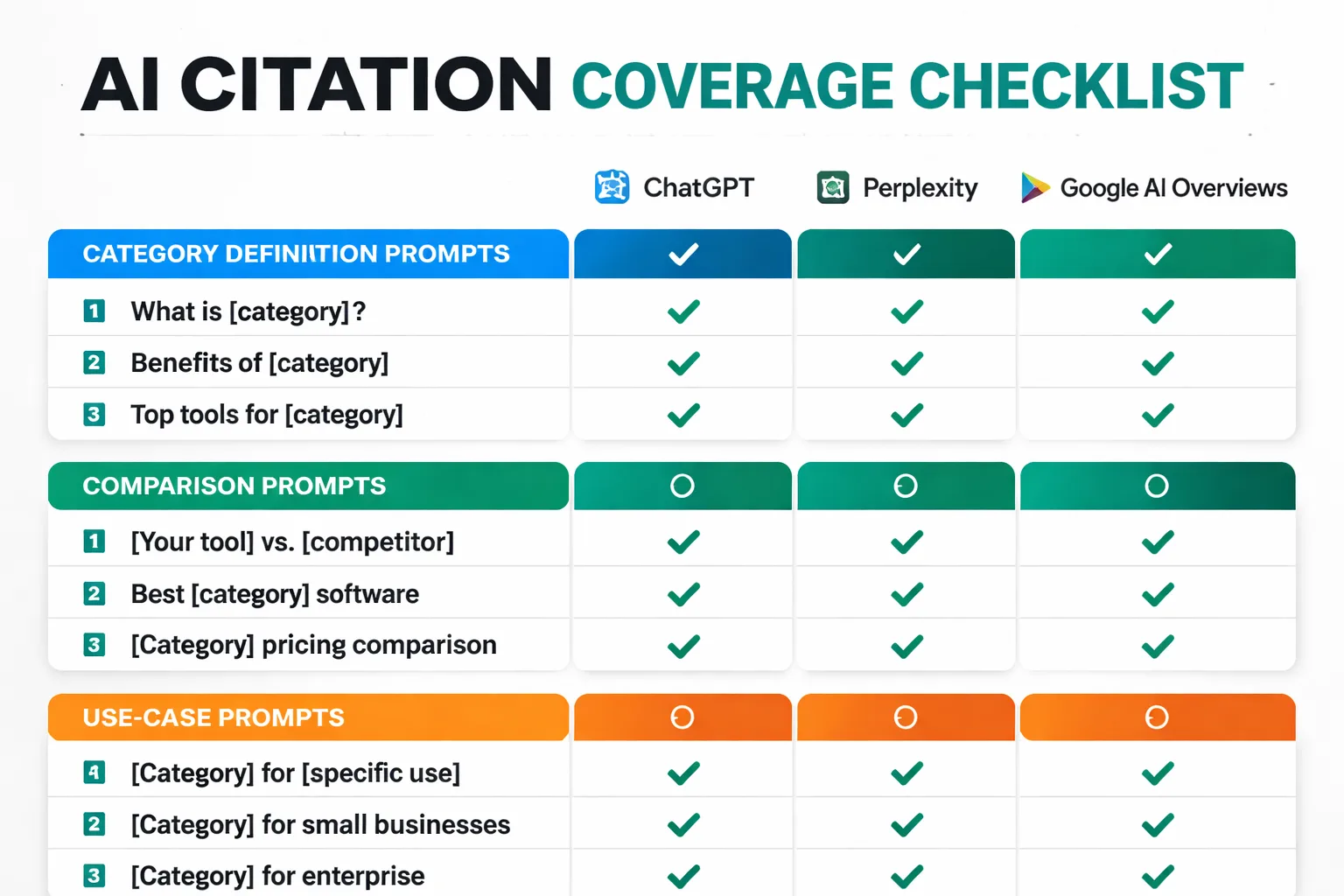
The audit should also capture the sources AI engines cite for each prompt. If ChatGPT cites a specific URL when answering "how to reduce SaaS churn," record that URL. These cited sources are your outreach targets. If you can get your brand mentioned on those exact pages, you increase the probability of being cited in the next AI answer refresh. This is the closed-loop system: audit to find gaps, create content to fill gaps, outreach to earn third-party mentions, and re-audit to measure progress.
How to Build a Citation-Earning Content Operation
You do not need an agency. You need a system. Here is the minimum viable workflow I have tested and refined across multiple B2B SaaS brands.
One Pillar Page Per Quarter
A pillar page is a comprehensive resource on a single topic that demonstrates deep expertise. For a B2B SaaS company selling onboarding software, your pillar might be "The Complete Guide to SaaS Customer Onboarding." For a billing platform, it might be "How to Optimize Subscription Billing for B2B SaaS Companies."
The pillar page should be 3,000-5,000 words, structured for AI extractability. That means: direct answers under question headings, structured data (Article, FAQ, HowTo schema), a comparison table where relevant, and a TLDR section at the top. AI engines extract preferentially from structured, answer-dense content.
One pillar per quarter is not a lot. But the depth matters more than frequency. I have seen a single well-structured pillar page earn more AI citations over six months than 20 generic blog posts from an agency. The pillar becomes the source that AI engines return to when answering category definition and use-case prompts.
Here is what makes a pillar page citable. First, it answers a specific question that AI engines get asked. Not a broad topic. A specific question. "How to calculate NRR for B2B SaaS" is citable. "Everything about SaaS metrics" is not. Second, it includes original data or frameworks. AI engines favor content that contributes new information, not content that paraphrases what already exists. If you can run a survey of 50 B2B SaaS companies and publish the results, that data becomes a citation magnet. Third, it is structured with question-shaped H2s, bolded answer sentences in the first paragraph of each section, and a comparison table. These structural elements make it easy for AI engines to extract and cite your content verbatim.
Spoke Articles Targeting Prompt Gaps
Around each pillar, publish 4-6 spoke articles per quarter. These target specific prompt gaps you identified in your audit. If your pillar is about customer onboarding, your spokes might cover: "how to reduce time-to-value in SaaS," "onboarding metrics to track," "best onboarding tools for B2B SaaS."
Each spoke should be 1,500-2,500 words and link back to the pillar with descriptive anchor text. This builds topical authority, which Ahrefs' research confirms is a strong predictor of AI citation frequency.
The key is targeting prompts where you are currently absent. If your audit showed you are missing from comparison prompts in your category, write a comparison article. If you are missing from use-case prompts, write a problem-solving guide. Let the audit drive the content calendar, not guesswork.
A common mistake I see is writing spokes that are too broad. "Onboarding metrics" is a broad topic. "How to measure time-to-first-value for B2B SaaS onboarding" is a specific prompt you can own. The more specific your spoke, the more likely it is to be cited when someone asks that exact question in ChatGPT. AI engines match prompts to content semantically. If your content is the most comprehensive answer to a specific question, it gets cited.
Structured Publishing Without a Content Team
This is where most founders give up. They know what to write but cannot sustain the publishing cadence. Here is the system that works:
1. Batch research on Mondays. Spend 90 minutes identifying sources, pulling data, and outlining. Do this for 2-3 articles at once. 2. Draft on Tuesdays and Wednesdays. Write the first draft yourself or use an AI SEO tool that generates archetype-aware content grounded in your knowledge base. The tool should enforce quality standards, not just generate text. 3. Review and publish on Thursdays. Edit for clarity, add internal links, insert structured data, and publish.
The non-negotiable is quality control. In my work auditing content ops, I have seen AI-generated content fail at a 60% rate when published without a quality gate. That is why we built a 16-dimension quality firewall at Meev that blocks weak drafts before they reach your CMS. Whether you use Meev or another tool, you need a gate. Publishing low-quality content does not just fail to earn citations. It actively hurts your brand authority.
For indexing, use Google Search Console and IndexNow. Submit your sitemap to GSC and ping IndexNow on every publish. Most auto-bloggers do not integrate either. If your content is not indexed, it cannot be cited.
The publishing system also needs to handle internal linking. Each spoke should link back to the pillar with descriptive anchor text. Each pillar should link to 2-3 spokes. This internal linking structure signals topical authority to both Google and AI engines. At Meev, we automate internal linking with archetype-aware anchor placement, but you can do this manually with a simple spreadsheet tracking which articles link to which.
Measuring ROI Beyond Citation Count
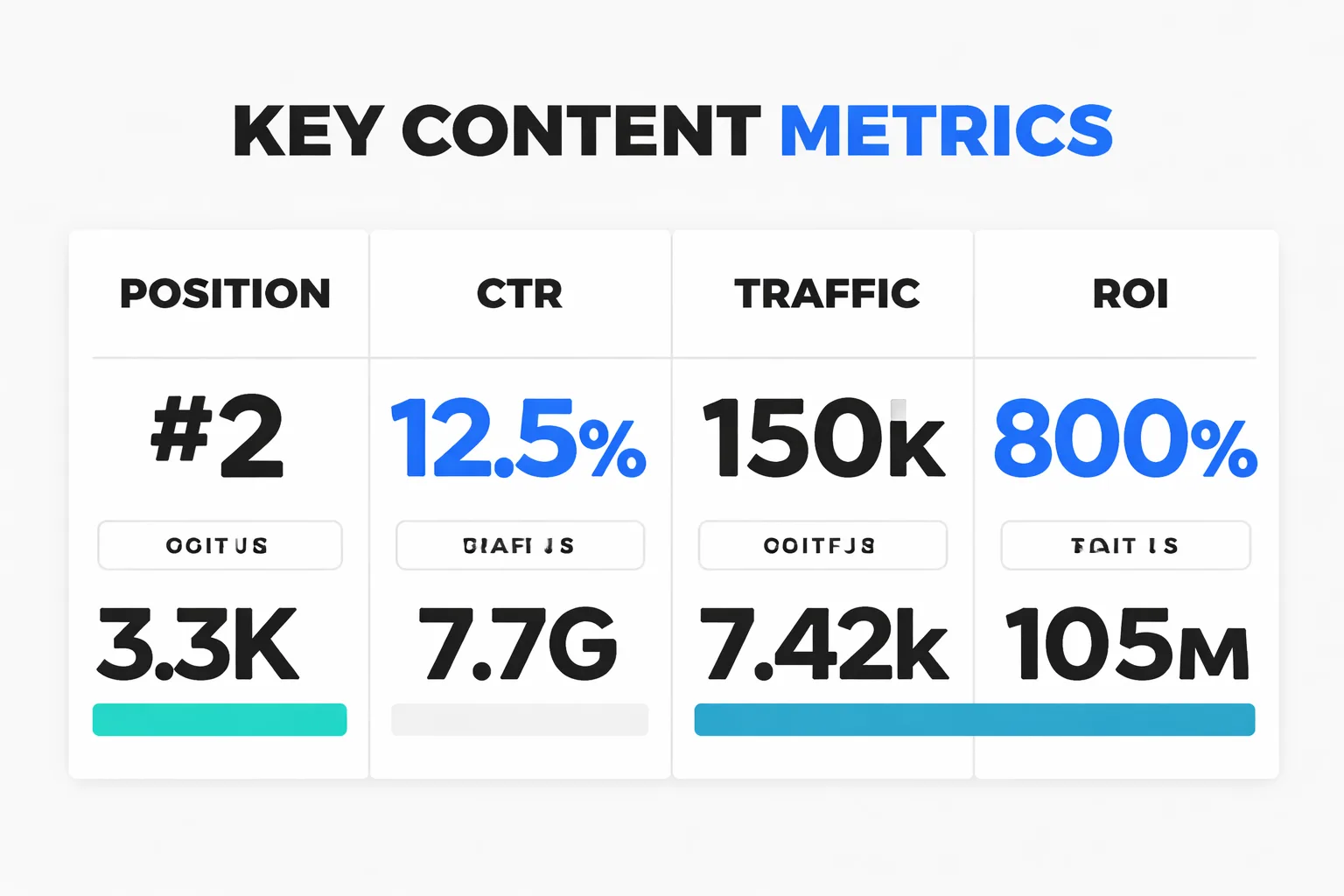
This is where most AI visibility advice falls apart. People talk about citation count as if it is a business metric. It is not. A citation in ChatGPT means nothing if it does not drive pipeline.
Here is what I track instead:
Branded Search Lift
When your brand gets cited in AI answers, more people search for your brand name on Google. This is the most reliable proxy for AI citation impact. Track branded search volume in Google Search Console week over week. If you start earning citations in comparison prompts, you should see branded search lift within 4-8 weeks.
In my experience, the correlation is not 1:1. Some citations drive more branded search than others. A first-position mention in a comparison prompt drives significantly more branded search than a list mention in a category definition prompt. Use an AI visibility tracker to monitor your mention position, not just whether you are mentioned.
Demo Request Attribution
Ask every demo request source: "How did you hear about us?" Track the percentage that mention ChatGPT, Perplexity, or AI search. It will be a small percentage at first. But it grows. I have seen B2B SaaS companies go from zero AI-attributed demos to 15-20% of inbound pipeline sourced from AI search within six months of focused citation work.
The key is asking the question. Most founders do not track AI as a source. They lump it into "organic" or "other." If you want to justify the investment to yourself and your investors, you need to track it explicitly.
Inbound Mention Quality
Track the quality of inbound mentions. Are prospects mentioning specific features they read about in an AI answer? Are they referencing comparison content where you were listed? This qualitative signal tells you which citations are actually influencing buying decisions.
I track this in a simple spreadsheet. Every inbound lead that mentions AI search gets logged with the specific prompt they used and the context of the mention. Over time, patterns emerge. You start to see which prompt categories drive the highest-quality leads.
The ROI Equation
Here is how I calculate ROI for AI citation work:
(Branded search lift x conversion rate) + (AI-sourced demos x close rate x ACV) > Content investment cost
If the left side exceeds the right, you are winning. If it does not, you need to either improve your citation rate (more content, better targeting) or improve your conversion rate (better landing pages, clearer positioning).
The investment cost should include tooling, time, and any outreach costs. For a solo founder spending 5 hours per week on content and using a tool like Meev at $99-269/month, the break-even point is typically 2-3 AI-sourced demos per quarter for a SaaS product with a $5K+ ACV. That is achievable.
Let me break down the math. Say your ACV is $10,000. Your close rate on inbound demos is 20%. You need $2,000 in monthly revenue to cover a $269/month tool plus 20 hours of founder time at $100/hour ($2,000). That is $2,269 in monthly costs. At a 20% close rate, you need 1.13 closed deals per month from AI-sourced demos to break even. That means roughly 5-6 AI-sourced demos per month. If you are cited in 10+ comparison prompts across AI engines, generating 5-6 demos per month is realistic once the citations compound. The first quarter may show zero ROI. The second quarter should show break-even. By the third quarter, the citations are compounding and the ROI curve bends upward.
The Contrarian Take: Stop Chasing Brand Mentions
Everyone in the AI visibility space is talking about brand mention tracking. Tools promise to track your "share of voice" across AI engines and measure your "recommendation rate." I have spent time testing these metrics, and my honest take is that they are largely noise.
Brand mentions are a vanity metric. What matters is URL citations. When an AI engine cites a specific page on your site, that is a direct endorsement of your content authority. When your brand is mentioned in passing in a list, that is barely better than nothing.
I have seen too many instances where a brand is mentioned in an AI answer but the prospect never clicks through, never searches for the brand, and never enters the pipeline. The mention exists but it drives zero business value.
Focus on earning URL citations from AI engines for specific, high-intent prompts. That means creating content that is so good and so structurally extractable that AI engines cite it as a primary source. Not a list mention. A primary source citation with a link.
This is why I emphasize pillar pages and structured spokes. They are designed to be cited. They answer specific questions comprehensively. They include data, frameworks, and original analysis that AI engines cannot find elsewhere.
The brands winning AI citations in 2026 are not the ones with the most content. They are the ones with the most citable content. There is a difference.
Entity Grounding and Knowledge Graph Presence
Content alone is not enough. AI engines need to understand who you are as an entity. This is where entity grounding comes in.
Entity grounding means ensuring your brand is recognized as a distinct entity across the knowledge sources AI engines use. The most important of these is Wikidata. If your company has a Wikidata entry with accurate structured information (founding date, industry, key people, product category), AI engines can ground their responses to your entity.
I have seen a clear pattern: brands with Wikidata entries get cited more accurately in AI answers. Not necessarily more frequently, but more accurately. When ChatGPT mentions your brand, it describes you correctly because it has structured entity data to draw from.
Beyond Wikidata, ensure your entity is consistent across your website's About page, your LinkedIn company page, your Crunchbase profile, and any industry directory listings. The consistency of entity information across sources signals to AI engines that your brand is established and authoritative.
This is not glamorous work. It is foundational. But it matters. Think of it as the plumbing behind your AI citation strategy. You do not see it, but if it is broken, nothing works.
For a deeper comparison of how AEO differs from GEO, I recommend reading our breakdown. The distinction matters because B2B SaaS founders need both: AEO for structuring their own content for extraction, and GEO for earning citations across the broader AI search ecosystem.
Here is a practical entity grounding checklist for B2B SaaS founders. First, create a Wikidata entry for your company if one does not exist. Include: official name, founding date, headquarters location, industry classification, website URL, and key people (founder, CEO). Second, ensure your About page uses the same entity descriptors. If Wikidata says you are a "SaaS company specializing in contract lifecycle management," your About page should use similar language. Third, create or update your Crunchbase profile with matching information. Fourth, ensure your LinkedIn company page uses consistent industry and size classifications. Fifth, if you have been featured in any industry reports or directories (G2, Capterra, TrustRadius), make sure your profiles there match your entity descriptions. Consistency across five or more sources is what signals entity authority to AI engines.
Which AI search prompts are your competitors winning right now?
How Does an AI SEO Agent Fit Into This Playbook?
An AI SEO agent can automate parts of this workflow, but only if it models user intent correctly. I have seen early adopters get burned by agents that cluster keywords without semantic understanding, producing content that ranks but does not earn citations. The content misses the user's underlying "why."
The right AI SEO agent for B2B SaaS founders does three things: discovers topics from actual AI search prompt gaps (not just keyword volume), generates archetype-aware content that structures answers for extraction, and enforces quality gates that block weak drafts before publish. If the agent you are evaluating does not do all three, it is a content generator, not a citation strategy tool.
In my testing, AI SEO agents that rely solely on keyword volume data produce content that misses the prompt entirely. You get an article optimized for "contract management software" (a keyword) instead of an article structured to answer "how to automate contract renewal tracking" (a prompt). The difference is structural. Keyword-optimized content tells Google what your page is about. Prompt-optimized content tells AI engines what question your page answers. You need both, but the prompt optimization is what drives citations.
When Generative Engine Optimization Services Make Sense
I have argued against agencies in this article, but let me be fair. There is a point where doing it yourself stops making sense.
If your team has grown past 20 people, your content needs scale beyond what a founder can manage part-time. If you are entering multiple product categories, you need coordinated content across topics. If you are raising a Series B and investors want to see AI visibility metrics in your pitch deck, you need professional reporting.
That is when generative engine optimization services start to make sense. But even then, I would hire a specialist consultant before hiring a full-service agency. You need someone who understands LLM attribution mechanics, not someone who will assign a junior writer to produce generic content.
The best generative engine optimization tool is the one that fits your team's workflow and enforces quality standards. I am biased because I built Meev, but the principle stands regardless of which tool you choose. You need something that tracks citations across every major AI search surface, identifies gaps, and helps you close them with structured, quality-gated content.
If you are evaluating tools, check our comparison of the best GEO tools to see what is available. The key features to look for are multi-surface tracking (ChatGPT, Claude, Gemini, Perplexity, Grok, Google AI Overviews), citation position tracking (not just mention detection), and content generation with quality gates.
A practical framework for deciding whether to hire a consultant versus using a tool: if your team has a dedicated content person (even a junior marketer who can write), use a tool and keep the workflow in-house. The tool enforces quality and the content person provides the domain expertise. If you have no one who can write and the founder cannot spare 5 hours per week, hire a consultant for a fixed scope (one pillar page and 4 spokes per quarter) rather than an open-ended retainer. Fixed scope means fixed cost. Open-ended retainers are where agencies extract margin by assigning junior staff.
What This Actually Means for Founders
The AI search landscape is not waiting for you to catch up. Every day, prospects are asking ChatGPT and Perplexity for tool recommendations in your category. Either you are cited or you are invisible.
The good news is that the bar is still low. Most B2B SaaS companies have done zero work on AI citations. Their content is not structured for extraction. Their entity data is incomplete. They have never audited their citation rate across prompt categories.
If you do the work I described in this article, you will be ahead of 90% of your competitors. Not because the playbook is secret. Because most founders are too busy building product to think about AI search visibility.
That is your opening. Spend one quarter building one pillar page, four spoke articles, and a Wikidata entry. Audit your citation rate across three prompt categories. Track branded search lift. If you see movement, double down. If you do not, adjust your targeting.
The founders who treat AI citations as a distribution channel in 2026 will build a compounding advantage. Every cited article earns more citations. Every entity mention strengthens your knowledge graph presence. Every prompt you own is a prompt your competitor does not.
Start with the audit. Use an answer engine optimization framework to structure your content. Track your results. Iterate.
The playbook is here. The question is whether you execute it before your competitors do.
FAQ
How long does it take to see AI citations after publishing new content?
In my experience, it takes 4-8 weeks for new content to start appearing in AI answers. AI engines need to crawl, index, and process your content before citing it. Submitting to Google Search Console and pinging IndexNow on publish speeds up the indexing phase. The citation phase depends on how often AI engines refresh their retrieval for your topic.
Do I need structured data schema to earn AI citations?
Structured data helps but is not strictly required. What matters more is content structure: direct answers under question headings, comparison tables, and clear definitions in the first paragraph. That said, adding Article, FAQ, and HowTo schema makes your content more machine-readable, which improves extraction probability.
Can I track AI citations without a dedicated tool?
You can manually test prompts in ChatGPT, Perplexity, and Google AI Overviews. But manual tracking does not scale. You need to test dozens of prompts across multiple AI engines regularly to track trends. A dedicated tool automates this and gives you historical data to measure progress.
What is the difference between AI citations and traditional backlinks?
AI citations are mentions or source attributions in AI-generated answers. Backlinks are links from other websites to yours. They overlap but are not the same. A site can be cited by AI engines without having traditional backlinks, and a site with strong backlinks may not be cited if its content is not structured for AI extraction.
Should I prioritize ChatGPT or Perplexity for citation tracking?
Track both, plus Google AI Overviews. Different AI engines cite different sources. The arXiv GEO study found that AI search engines have distinct citation patterns. Prioritizing one over the other means missing citations (and prospects) on the others. Start with the engines your prospects use most, which for B2B SaaS is typically ChatGPT and Perplexity.
How does B2B SaaS AI citation strategy differ from e-commerce?
B2B SaaS citations are driven by expertise and topical authority. E-commerce citations are driven by product data and structured listings. The Unosearch case study shows how GEO works for product discovery in retail. For B2B SaaS, focus on pillar content, entity grounding, and prompt gap targeting instead of product feed optimization.
About the Author
Judy Zhou, Founder
Judy Zhou leads content strategy at Meev, where she oversees AI-driven content research and publishing for hundreds of brands. With a background in SEO and editorial operations, she focuses on building content systems that rank on Google, get cited by AI search engines, and drive measurable business results.
Run your first AI visibility audit today and see exactly where your brand is cited, where competitors appear, and which prompts to target next.