

By Judy Zhou, Founder
Key Takeaways
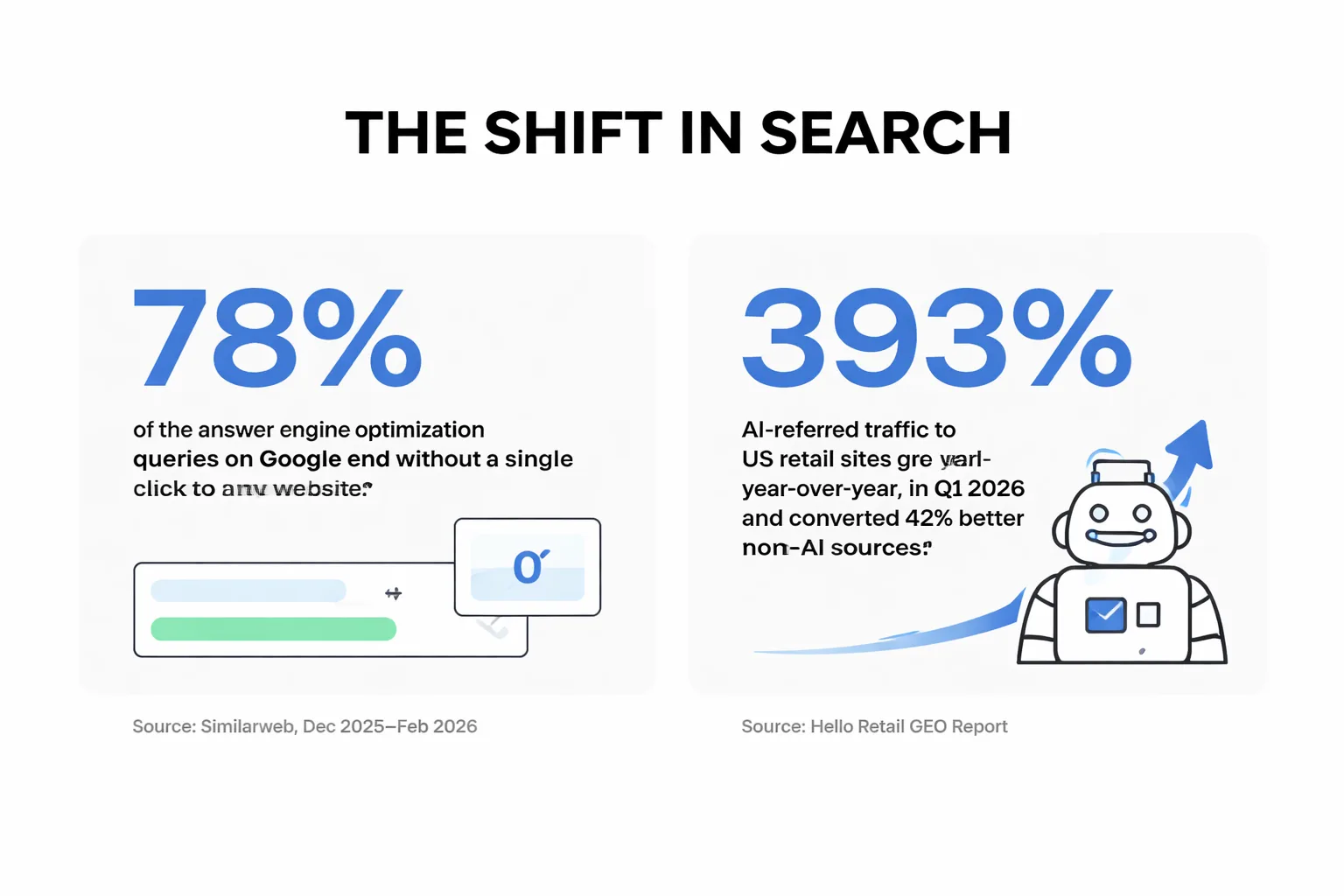
- 78% of answer engine optimization queries on Google end without a single click, rendering traditional blue-link keyword research obsolete.
- AI-referred traffic to US retail sites grew 393% year-over-year in Q1 2026 and converted 42% better than non-AI sources.
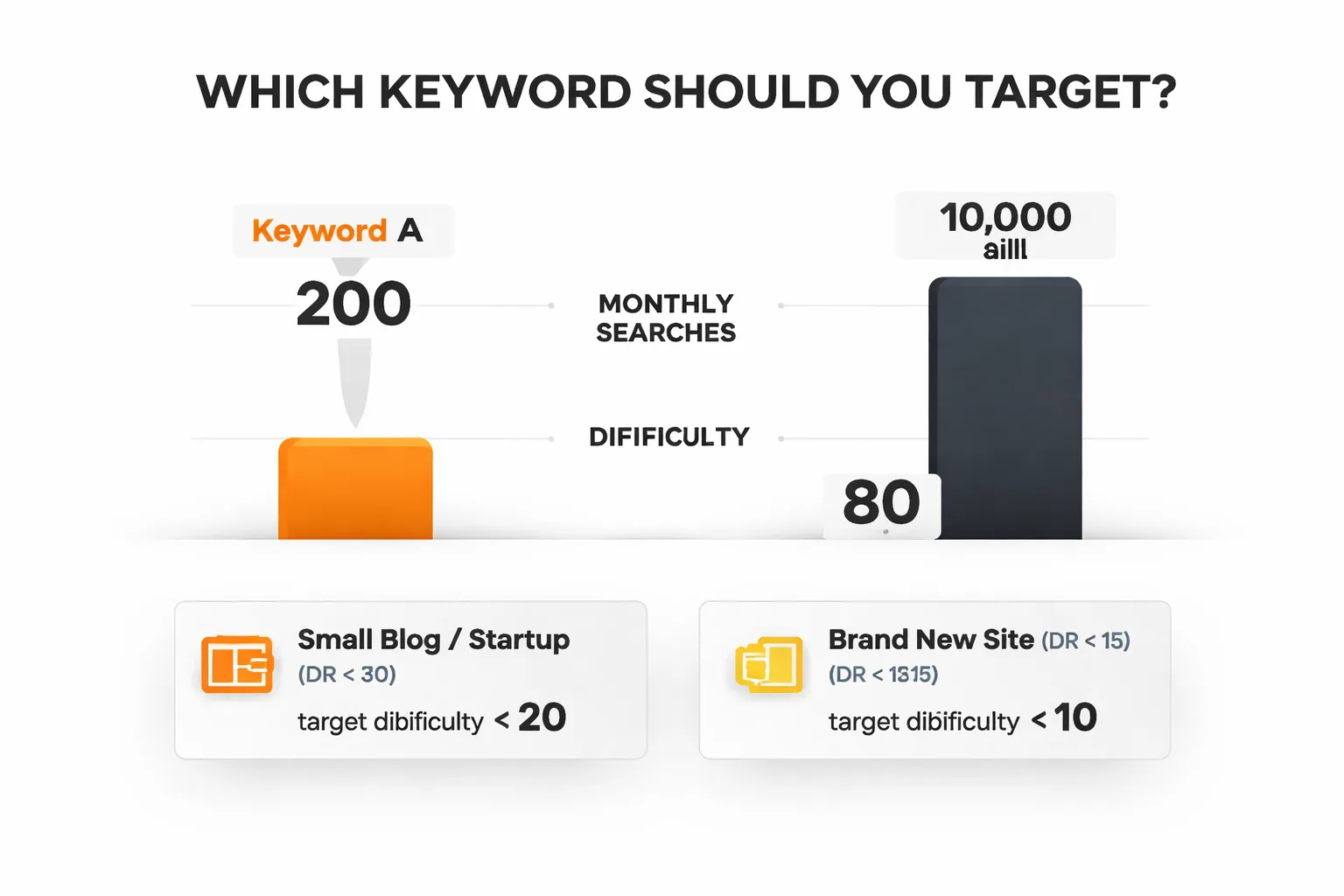
- Small sites should target keywords with 200 monthly searches and difficulty of 7 instead of head terms with 10,000 searches and difficulty of 80.
- Only pursue keywords where the top-ranking pages are also small sites with low domain authority to guarantee winnable traffic.
Most bloggers are researching keywords for a search engine that no longer exists.
The old keyword research playbook was built for blue links on a page. Today, 78% of "answer engine optimization" queries on Google end without a single click to any website (Similarweb, Dec 2025. Feb 2026). AI-referred traffic to US retail sites grew 393% year-over-year in Q1 2026 and converted 42% better than non-AI sources (Hello Retail GEO Report). If your keyword strategy ignores how AI engines cite sources, you are invisible to the fastest-growing traffic channel in search. Here is how to find keywords for blogs in a world where ChatGPT, Perplexity, and Google AI Overviews are the new front page.
Why Keyword Choice Determines Whether Anyone Reads Your Blog
Pick the wrong keyword and you have already lost.
I see this constantly in my work auditing content ops at Meev. A founder spends two weeks writing a 2,000-word guide targeting a head term with 10,000 monthly searches and a difficulty score of 80. The article ranks nowhere. Not because the writing is bad. Not because the site is slow. Because the keyword was never winnable for a site with a domain authority of 12 going up against Forbes, HubSpot, and Wikipedia.
The math is brutal and simple. If you are a small site, you need to target keywords where the top-ranking pages are also small sites. A keyword with 200 monthly searches and a difficulty of 7 will bring you actual readers. A keyword with 10,000 monthly searches and a difficulty of 80 will bring you nothing. Zero. Not reduced traffic. Zero.
Here is where it gets worse. When Google AI Overviews appear, top organic results lose roughly 58% of their click-through rate (Ahrefs, 2025). And according to Pew Research, users click results only 8% of the time when AI summaries are present, compared to 15% without them. So even if you rank, AI is eating your clicks. This means keyword selection now serves two masters: traditional ranking difficulty and AI citation likelihood. You need keywords where AI engines need to cite external sources because they cannot answer from their training data alone.
That is the shift. Keywords are no longer just about ranking on page one. They are about being the source AI engines pull from when they construct an answer. A keyword like "what is answer engine optimization" might have moderate search volume, but if Perplexity and ChatGPT consistently cite three specific domains when answering it, those domains are capturing the real value. The keyword itself is just the entry point. The citation is the prize.
The Conductor 2026 AEO/GEO Benchmarks Report analyzed 10 industries and found that AI is creating a "parallel surface of visibility" where brand exposure happens before users ever click through to a website. This means your keyword strategy needs to account for visibility on surfaces you cannot track with traditional rank checkers. The report's main takeaway: "AI isn't replacing search. It's replacing your website as the first place customers engage with your brand." That should change how you think about every keyword you target.
How to start with real searcher questions?
Do not brainstorm keywords in a vacuum. Your audience is already telling you what they want to know. You just need to look.
The best keyword sources are free and sitting right in front of you. Google's People Also Ask boxes reveal the exact questions users ask after their initial search. Search autocomplete shows what people type before they finish thinking. Reddit threads expose the raw, unfiltered language your audience uses when they are stuck and asking for help.
Here is my process. I start with a broad seed term related to my niche. Let us say I am writing about answer engine optimization. I type that into Google and scroll to the People Also Ask section. Every question there is a potential article or a section within an article. I then open an incognito window and type the seed term letter by letter into the search bar, noting every autocomplete suggestion. These are real queries typed by real people in real volume.
Then I go to Reddit. I search for my topic across relevant subreddits and sort by "Top" and "This Year." I look for thread titles that are questions. The language people use in Reddit threads is gold because it is unpolished. They do not say "generative engine optimization tools." They say "what is the best GEO tool for tracking AI citations." That phrasing is your keyword.
This matters more than ever for AI search. When someone types a question into ChatGPT or Perplexity, they use natural language, not keyword-stuffed fragments. If your blog keyword research surfaces the actual phrasing people use in conversation, your content is more likely to match the semantic intent AI engines look for when deciding what to cite. I have seen this firsthand. Articles targeting natural-language questions get cited by AI engines more often than articles targeting terse keyword fragments. The AEO vs SEO gap is real, and it starts with how you phrase your target query.
Let me give you a specific workflow. Pull up Google Trends and type your seed term. Scroll to "Related Queries" and filter by "Rising." These are queries growing in popularity. Now cross-reference each one with Google's People Also Ask box by searching it directly. If a rising query from Trends also appears in PAA, you have found a keyword with growing demand and existing SERP feature opportunity. That is a high-confidence target.
One more source I use: Google Search Console. If you already have some traffic, look at the queries bringing people to your existing pages. You will find long-tail phrases you did not intentionally target. Those are your lowest-effort, highest-return keyword opportunities because your site already has some relevance for them. Sort by impressions (to find queries Google shows your page for) and then filter for positions 11-30. Those are keywords where you are close to page one but not quite there. A content refresh targeting those specific queries can push you onto page one fast.
Community forums deserve more attention than they get. Beyond Reddit, I check Quora, Stack Exchange (for technical topics), and niche Facebook groups. These platforms surface pain points that keyword tools miss because the volume is too low for tools to register. But a question asked by 50 people on a forum represents real demand. And because no keyword tool shows it, competition is near zero. Some of the best-performing articles I have ever published targeted questions I found on niche forums with zero apparent search volume in any tool.
How to evaluate difficulty before committing?
This is where most bloggers freeze. They find a keyword, see decent volume, and skip the difficulty check entirely. Then they wonder why nothing ranks.
Keyword difficulty scores are not perfect, but they are directional. Most tools (Ahrefs, Semrush, Moz) use a 0-100 scale. The number itself is less important than understanding what it measures: roughly, how hard it is to rank in the top 10 results for that keyword, based on the authority of pages already ranking there.
For a small blog or a startup site with domain authority under 30, here is my rule of thumb. Target keywords with difficulty under 20. If your site is brand new (under 15 DR), aim under 10. You will not rank for anything above 30 without significant backlink investment, and even then, it is a multi-month effort.
Let me give you a concrete example. Say you are choosing between two keywords. Keyword A has 200 monthly searches and difficulty 7. Keyword B has 10,000 monthly searches and difficulty 80. Keyword A wins every time for a small site. Here is why. That 200-volume keyword might rank within 4-6 weeks with a well-structured article. You get real readers, real engagement signals, and a foothold that builds your site's topical authority. Keyword B will take 12-18 months and a backlink campaign you probably cannot afford.
But here is the nuance most guides miss. Difficulty scores do not account for AI Overviews. A keyword might have a difficulty of 15 (very winnable for Google's organic results) but already have a comprehensive AI Overview that answers the question fully. In that case, even if you rank #1 organically, you are below the AI answer box and getting a fraction of the clicks you expected. You need to check whether an AI Overview already appears for your target keyword before committing to it.
This is where AI visibility tracking changes the game. Instead of just checking organic difficulty, you can check whether AI engines already answer a query and who they cite. If AI engines are citing weak sources or not answering the question well, that is your opening. The content gap is real, and the citation opportunity is wide open.
I have shifted my entire keyword evaluation framework to include what I call "citation difficulty." It works like this. Pull the top 10 organic results for your keyword. Then pull what ChatGPT, Perplexity, and Google AI Overviews cite when answering the same query. If the organic results are dominated by high-authority domains but the AI citations include smaller, niche sites, you have found a keyword where AI engines are looking for fresh perspectives. That is your target.
There is another dimension to difficulty that almost no one talks about: content freshness. Go to the top 5 results for your target keyword. Check when they were last updated. If all five were published in 2023 or earlier and have not been refreshed, you have a freshness advantage. Google and AI engines both favor recently updated content for many query types. I have seen a brand-new article outrank a 2023 article with 3x more backlinks simply because the new article reflected 2026 data and the old one was stale. Check the publish date and last-updated date of every page in the top 10. If they are old, that keyword is easier than the difficulty score suggests.
Step 3. Map Keywords to Search Intent
Search intent is not a buzzword. It is the single biggest factor in whether your content earns clicks, featured snippets, and AI citations.
Google classifies intent into four buckets. Informational (the user wants to learn something). Commercial (the user is comparing options before buying). Navigational (the user is looking for a specific site or page). Transactional (the user is ready to buy right now). For most blogs, you will live in the informational and commercial buckets.
The mistake I see repeatedly is intent mismatch. A blogger targets a commercial-intent keyword like "best AI search engine optimization tools" with a 2,000-word educational guide. The user searching that term wants a comparison table, not a tutorial. They bounce. Google notices. The article never ranks.
Here is how to get it right. Before you write a single word, search for your target keyword in an incognito window. Read the top 5 results. What format are they using? Is it a listicle? A how-to guide? A comparison review? A definition page? That format is what Google and AI engines have determined users want for that query. Match it.
The Princeton-led GEO paper found that adding citations, quotations, and statistics can lift visibility in generative engine responses by up to 40% (Go Fish Digital GEO Case Study). This means intent matching now affects AI citation likelihood, not just organic ranking. If your article format matches what AI engines expect for a given query type, you are more likely to be cited as a source.
For informational keywords, structure your article as a clear, authoritative explainer. Use question-based H2s. Provide direct answers in the first paragraph of each section. AI engines extract from these patterns. For commercial keywords, build comparison tables, pros-and-cons lists, and clear recommendations. For navigational keywords, make sure your brand entity is clearly defined and connected to the topic through entity grounding signals like schema markup and consistent NAP information.
The intent-to-format mapping also determines whether you earn featured snippets. Google's featured snippets (and by extension, AI Overviews) pull from content that directly answers the implied question behind the keyword. If someone searches "how to do keyword research," the implied question is "what is the process of finding and selecting keywords for a blog." Your article needs to answer that question in a scannable, extractable format within the first few paragraphs.
Let me walk you through a real intent analysis. Take the keyword "AI search optimization." At first glance, this looks informational. But search it in Google and look at the results. If you see tool comparison pages, vendor landing pages, and listicles, the intent is actually commercial. Users searching this term are evaluating solutions, not learning theory. Now search "what is AI search optimization." The results probably shift to educational explainers and definition pages. Same topic, different intent, different format required. The keyword modifier ("what is") signals informational intent. The bare phrase signals commercial intent. Missing this distinction is how bloggers end up with the wrong format for the right keyword.
For AI search specifically, intent mapping has an extra layer. When someone asks ChatGPT or Perplexity a question, the intent is always conversational. They want a direct answer, not a list of links. This means your content needs to front-load the answer. Put the key takeaway in the first 100 words. Then elaborate. AI engines extract from the top of the page. If your answer is buried in paragraph six, you will not get cited even if your content is better than the competition.
Want to see which keywords AI engines already cite you for?
Step 4. Cluster Keywords Into One Article
Writing one article per keyword is a strategy from 2014. It wastes effort and invites cannibalization.
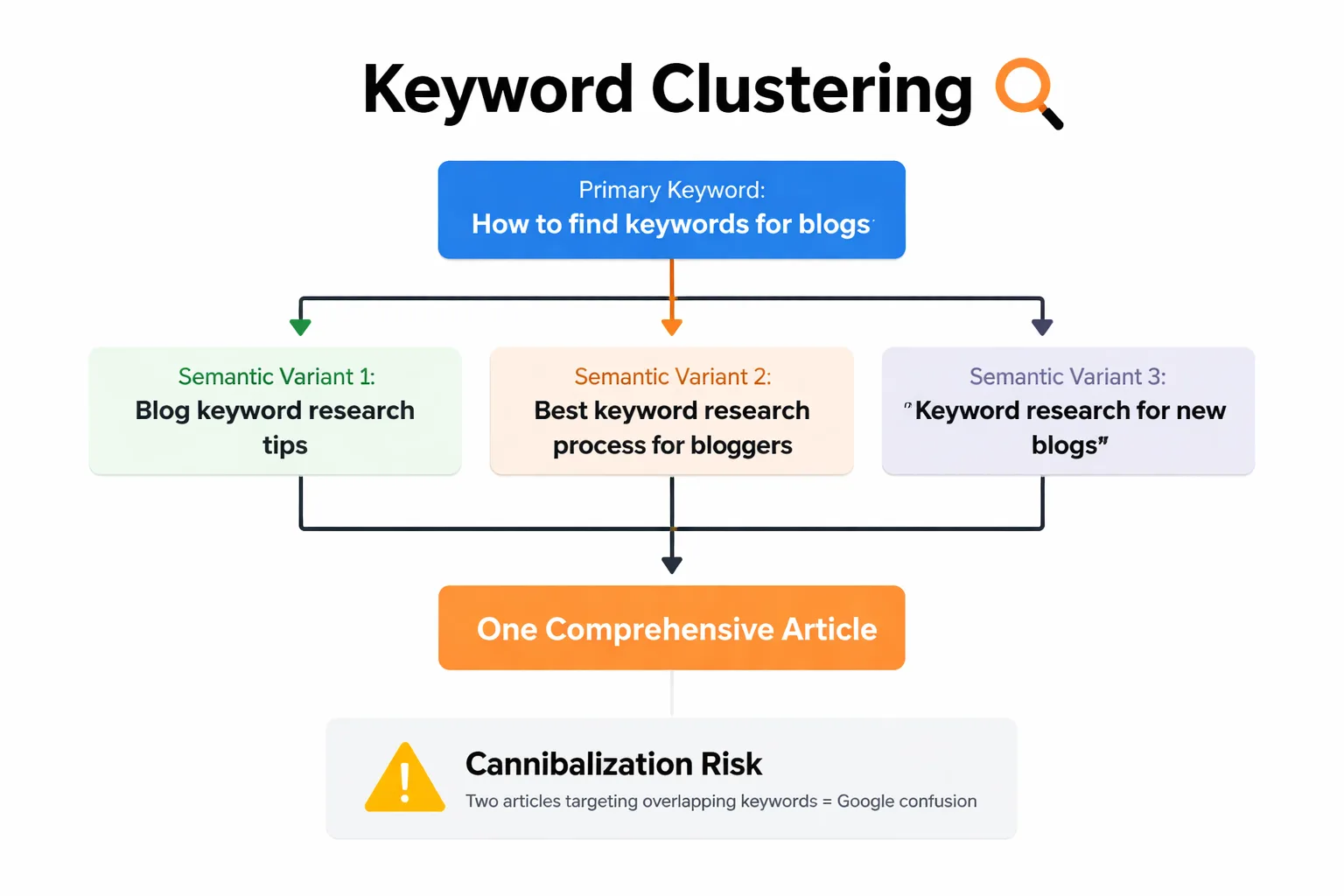
Keyword clustering means grouping a primary keyword with 2-4 semantic variants so one article ranks for multiple related queries. Instead of writing five separate articles for five similar keywords, you write one comprehensive piece that covers the topic deeply enough to rank for all of them.
Here is how I cluster. I take my primary keyword (say, "how to find keywords for blogs") and identify its semantic variants. These are not just synonyms. They are related queries that share the same search intent. "Blog keyword research tips," "best keyword research process for bloggers," "keyword research for new blogs." If all of these have the same intent (a beginner wants to learn the keyword research process), they belong in one article.
The risk here is cannibalization. If you have two articles on your site targeting overlapping keywords, Google may not know which one to rank. Neither performs well. The fix is to map each cluster to one URL and use internal linking to signal the hierarchy. Your pillar article targets the primary keyword. Supporting articles target adjacent, non-overlapping keywords and link back to the pillar.
This is also where topic clusters connect to AI search. When you build a cluster of articles around a central topic, you create an entity relationship that AI engines can understand. The internal linking structure signals to LLMs that your site has deep expertise on this topic, which increases citation likelihood across the entire cluster. I have seen this pattern in my own work. Sites with well-structured topic clusters get cited by AI engines more often than sites with isolated, one-off articles.
The mechanics are straightforward. Pick your primary keyword. Identify 3-5 variants with the same intent. Map them to sections within your article. Use the primary keyword in your H1 and one H2. Use variants in other H2s and body copy. Write comprehensively enough that each variant is naturally addressed.
Let me give you a concrete clustering example. Suppose your primary keyword is "blog keyword research" with 1,300 monthly searches. Your variants might be "how to do keyword research for a blog" (same intent, question form), "blog keyword strategy" (same intent, different phrasing), and "keyword research tips for bloggers" (same intent, list-format angle). You create one pillar article targeting all four. The H1 uses the primary keyword. One H2 uses the question form. Another H2 uses the "tips" phrasing. The body naturally incorporates the "strategy" variant. One article, four keywords, one unified intent.
Now compare this to the alternative. If you wrote four separate articles, each would compete with the others for the same intent. Google would see four thin pages on the same topic and rank none of them. Worse, AI engines would see a fragmented content footprint and conclude your site lacks depth on the topic. Clustering is not just an SEO tactic. It is an authority signal that benefits both traditional ranking and AI citation.
Step 5. Validate With AI Search Before You Write
This step did not exist two years ago. Now it is the most important step in the process.
Before you write anything, you need to know whether AI engines already answer your target query. If ChatGPT gives a complete, satisfying answer without citing any external sources, your content gap might not exist. If Perplexity cites three competitors but not you, the gap is real and you know exactly who you are competing against for the citation.
Here is my validation process. I take my target keyword and phrase it as a natural-language question. Then I ask it to ChatGPT, Perplexity, Google AI Overviews, and Claude. I note four things. Does the AI answer the question fully? Does it cite external sources? If so, which ones? Is the answer accurate and complete, or does it have gaps I can fill?
If the AI answers fully and cites high-authority sources like Wikipedia or major publications, you need a very specific angle to break in. But if the AI answer is incomplete, outdated, or cites weak sources, you have found a real content gap. That is your article.
AI-referred traffic to US retail sites grew 393% year-over-year in Q1 2026 and converted 42% better than non-AI sources (Hello Retail GEO Report). This is not a marginal channel. AI search is becoming a primary discovery surface, and the keywords you choose determine whether your brand appears in those answers.
This is where a tool like the ChatGPT AI visibility checker or the Perplexity AI visibility checker becomes essential. You can see exactly whether your brand is mentioned, where in the answer you appear (first, in a list, last), and which sources the AI is pulling from. That data tells you whether your keyword strategy is working for AI search or just for traditional Google rankings.
The validation step also reveals something traditional keyword research cannot: the framing of your mention. I learned this the hard way. Early on, I focused on boosting raw mention rates, thinking more mentions equaled more leads. But an AI can recommend your brand as a "good starting point" before suggesting a more "advanced" competitor, effectively funneling users away from you. Visibility alone is insufficient. The context and framing of the citation is what drives B2B buying decisions. When you validate with AI search, you are not just checking whether you appear. You are checking how you appear and whether the narrative supports your business goals.
Let me walk you through a real validation. I was evaluating the keyword "generative engine optimization" for a client. I asked ChatGPT, Perplexity, and Google AI Overviews the question "what is generative engine optimization?" ChatGPT gave a decent answer citing two academic papers and one marketing blog. Perplexity cited four sources, including a competitor's landing page. Google AI Overviews cited Wikipedia and a Medium post. The gap I spotted: every answer was theoretical. None mentioned specific tools, workflows, or measurable results. That gap became the article's angle. "Generative engine optimization: a practical workflow with real results." The article got cited within three weeks because it filled a gap the AI engines could not answer from their existing sources.
The Go Fish Digital GEO case study from September 2025 confirms this approach. Their three-month implementation centered on four levers: Prompt Mapping, Benchmarking, Content Structuring, and Citation Optimization. The result was a 3X increase in leads. They did not just target keywords. They mapped the exact prompts users were typing into AI engines, benchmarked who was getting cited, structured content to match what AI engines extract, and optimized citations. That is the blueprint. Keyword research is step one. Prompt mapping and citation validation are what close the loop.
How Does Entity Grounding Change Keyword Strategy?
Entity grounding is the layer beneath keywords. It is how AI engines decide whether your brand is a legitimate source worth citing, independent of the keywords on your page.
Think of it this way. Keywords tell search engines what your content is about. Entities tell search engines who you are and why they should trust you. AI engines like ChatGPT and Perplexity build knowledge graphs that map relationships between people, companies, concepts, and topics. When they decide whether to cite your blog, they check whether your brand exists as a recognized entity connected to the topic. A keyword without entity grounding is a billboard in the desert. Nobody is driving by to see it.
The Wikidata Embedding Project, launched October 1, 2025, makes this concrete. It provides the first freely accessible vector database enabling direct use of open Wikidata for generative AI development. As Wikimedia Deutschland noted, this creates infrastructure for AI applications built on "verifiable, free and open data." If your brand or topic is not represented in Wikidata, you are invisible to the growing segment of AI development that relies on open knowledge graphs.
What does this mean for keyword research? When you target a keyword, you should also check your entity presence. Search for your brand on Wikidata. If you do not have an entry, create one. Ensure your schema markup defines your organization as an entity with clear attributes (name, description, founding date, industry, key people). Create content that establishes relationships between your brand and the topics you want to be cited for. Internal linking is part of this. When you link from your article about "blog keyword research" to your author bio page, your about page, and related topic pages, you are building an entity graph that AI engines can parse.
The practical integration is this. For every keyword you target, ask three entity questions. Is my brand a recognized entity in Wikidata and Google's Knowledge Graph? Does my schema markup connect my brand to this topic? Do other authoritative sites mention my brand in the context of this topic? If the answer to any of these is no, you have entity work to do before keyword optimization will move the needle for AI search.
Competitor Keyword Analysis for AI Search
Traditional competitor keyword analysis still works. You find keywords competitors rank for that you do not, then target the gaps. But for AI search, you need to add a layer.
Here is what I do. I identify three to five competitors in my niche. I use a tool like Ahrefs or Semrush to pull keywords they rank for that I do not. That gives me the organic gap. Then I check which of those keywords trigger AI Overviews and which competitors are cited in those AI answers. That gives me the AI citation gap.
The overlap between organic gaps and AI citation gaps is where I focus. If a competitor ranks organically for a keyword AND gets cited by AI engines for the same query, that keyword is doubly valuable. If they rank organically but are not cited by AI engines, the AI citation opportunity is open. If they are cited by AI engines but do not rank organically, the organic opportunity is open.
I prioritize keywords where competitors are cited by AI engines but I am not. That is the most actionable gap because it directly measures AI visibility. Tools like the AI visibility tool can show you this gap across every major AI search surface. You see which competitors appear in AI answers for your target topics, what position they appear in, and what sources the AI cites for them. That data drives your content priorities.
A specific workflow. Pull your competitor's top 20 organic keywords. For each one, ask ChatGPT and Perplexity the natural-language version of that query. Note whether the competitor is cited. Note whether you are cited. Note which sources the AI references. The keywords where competitors are cited and you are not become your content roadmap. Each one is an article you need to write, structured to match the intent and formatted for AI extraction.
How Do You Organize and Prioritize Keywords?
Once you have a list of 30-50 keyword candidates, you need a system to prioritize them. Most bloggers prioritize by search volume alone. That is a mistake.
I use a simple scoring system. For each keyword, I score four factors on a 1-5 scale. Search volume (higher is better). Difficulty (lower is better, so I invert the score). AI citation gap (larger gap is better). Business relevance (higher is better). A keyword with high volume, low difficulty, a large AI citation gap, and high business relevance gets a score of 20. That is your top priority.
Here is a concrete example. Keyword A: 8,100 monthly searches, difficulty 45, no AI citation gap (AI already answers well), moderate business relevance. Score: 4 + 2 + 1 + 3 = 10. Keyword B: 390 monthly searches, difficulty 12, large AI citation gap (AI cites weak sources), high business relevance. Score: 2 + 4 + 5 + 5 = 16. Keyword B wins. Lower volume, but the AI citation opportunity and lower difficulty make it a better use of your time.
This scoring system prevents two common mistakes. Chasing high-volume keywords you will never rank for. And ignoring low-volume keywords where AI citation opportunity is high. The second mistake is the more expensive one in 2026 because AI-referred traffic is growing 393% year-over-year while organic click-through rates are declining. A keyword with 200 monthly searches where you get cited by Perplexity might drive more actual traffic than a keyword with 5,000 searches where you rank #4 organically.
Once you have scored and prioritized, organize keywords into a content calendar. Group them by topic cluster. Assign each cluster a pillar article and 2-3 supporting articles. Map the intent for each keyword. Note the AI citation gap for each. Schedule the highest-scoring keywords first. This is not complicated, but it requires discipline. Most bloggers skip prioritization and write whatever feels interesting. That is why most blogs get zero traffic.
The Entity Layer: Why Keywords Are Not Enough for AI Search
Here is my contrarian take. Keyword research as a standalone practice is becoming obsolete. Not because keywords do not matter. They do. But because keywords are now table stakes. The real differentiator is entity grounding.
AI engines do not just match keywords to content. They build knowledge graphs. They understand entities (people, companies, concepts) and the relationships between them. When ChatGPT decides whether to cite your blog, it is not just checking whether your article contains the right keywords. It is checking whether your brand is a recognized entity in the knowledge graph, connected to the topic through structured data, consistent mentions across the web, and authoritative backlinks.
This is where the Wikidata Embedding Project becomes relevant. Launched October 1, 2025, it provides the first freely accessible vector database enabling direct use of open Wikidata for generative AI development. As Wikimedia Deutschland noted, this creates infrastructure for AI applications built on "verifiable, free and open data." If your brand or topic is not represented in Wikidata, you are invisible to the growing segment of AI development that relies on open knowledge graphs.
The implication for keyword research is this. Your keyword strategy needs to include entity signals. When you target a keyword, you should also be building entity presence. That means claiming your Wikidata entry, ensuring your schema markup defines your brand as an entity, and creating content that establishes clear relationships between your brand and the topics you want to be cited for.
Think of it this way. Keywords tell search engines what your content is about. Entities tell search engines who you are and why they should trust you. In the AI search era, you need both. A keyword without entity grounding is a billboard in the desert. Nobody is driving by to see it.
The LLMs.txt validator is another tool worth checking in this context. It ensures your site is properly readable by AI crawlers. If AI engines cannot parse your site structure, your entity signals and keyword optimization do not matter. Think of it as the technical foundation that makes all your keyword work visible to AI systems.
Where This Breaks Down
This 5-step process works for most blogs, but it has limits. Here are three scenarios where it falls apart.
First, brand-new domains with zero history. If your site was registered last week, even low-difficulty keywords will take months to rank. Google's indexing priorities have shifted toward entity recognition and content quality signals over raw sitemap submission. I have seen pages sit in "Crawled, currently not indexed" for over three months despite proper submission. For new sites, focus on building entity presence first (claim your Google Business Profile, create Wikidata entries, get listed in relevant directories) before expecting keyword-driven traffic.
Second, hyper-competitive niches with no long tail. If you are in a space like insurance, legal services, or pharma, even the long-tail keywords have high difficulty because the commercial value per click is enormous. The 5-step process still works, but your timeline stretches from weeks to months. You will need to invest in backlinks and entity signals before content alone moves the needle.
Third, topics AI engines already answer perfectly. If you target a keyword where ChatGPT gives a complete, accurate answer with no gaps, your content will not break in regardless of how well it is optimized. Some queries are effectively closed. The validation step in Step 5 exists to catch these before you waste time writing.
FAQ
Should I still use Google Keyword Planner for blog keyword research?
Yes, but with caveats. Google Keyword Planner is free and gives you direct search volume data from Google. The limitation is that it groups similar terms and rounds volumes, so it is better for directional guidance than precise numbers. Use it for volume benchmarking, then validate with a tool like Ahrefs or Semrush for difficulty scoring. For AI search, pair it with manual checks in ChatGPT and Perplexity to see whether AI engines already answer the query.
How many keywords should one blog post target?
One primary keyword and 3-5 semantic variants clustered into the same article. Do not try to rank one article for unrelated keywords. If the variants share the same search intent, they belong together. If they serve different intents, they need separate articles linked through a topic cluster structure.
What is a good keyword difficulty score for a new blog?
Under 20 for sites with domain authority under 30. Under 10 for brand-new sites. The exact number depends on the tool (Ahrefs and Semrush calculate difficulty differently), but the principle is the same. If the top-ranking pages are all high-authority domains, your small blog will not break in. Target keywords where smaller sites already rank in the top 10.
How do I know if AI engines will cite my content?
Check whether AI engines already answer your target query and who they cite. Use the Perplexity AI visibility checker or manually ask ChatGPT and Perplexity your target question. If they cite weak sources or leave gaps, your content has a citation opportunity. If they answer fully with strong sources, pick a different angle or a more specific variant of the keyword.
Does keyword research still matter for AI search?
Yes. HubSpot notes there is significant overlap between traditional keyword research and answer engine optimization keyword research. The difference is that AI search adds a layer. You still need keywords to identify demand and structure content. But you also need entity grounding, structured data, and content that AI engines can extract and cite. Keywords are the starting point, not the finish line.
What tools do I need for keyword research in 2026?
You need three categories. A traditional keyword tool (Ahrefs, Semrush, or Google Keyword Planner) for volume and difficulty data. A community research method (Reddit, PAA, Google autocomplete) for natural-language phrasing. And an AI visibility tool for checking whether AI engines cite you or competitors for your target queries. Most bloggers have the first category covered. The third is what separates 2026 keyword research from 2020 keyword research.
How long does it take for a new blog post to rank?
For a low-difficulty keyword (under 20) on a site with some existing authority, expect 4-8 weeks. For a brand-new site, expect 3-6 months even for low-difficulty keywords. For medium-difficulty keywords (30-50), expect 6-12 months on an established site. High-difficulty keywords (50+) are a 12-18 month play with active backlink building. These timelines assume you have done the intent mapping and content formatting correctly. Bad intent matching doubles the timeline.
The 5-step process I walked through here is the same one I use at Meev. Start with real questions. Evaluate difficulty. Map intent. Cluster. Validate with AI. The difference between bloggers who get read and bloggers who get ignored is not writing talent. It is keyword selection. Pick keywords where you can win organically and where AI engines need your perspective. That is how to find keywords for blogs in 2026.
About the Author
Judy Zhou, Founder
Judy Zhou leads content strategy at Meev, where she oversees AI-driven content research and publishing for hundreds of brands. With a background in SEO and editorial operations, she focuses on building content systems that rank on Google, get cited by AI search engines, and drive measurable business results.
Stop guessing which keywords will get cited by AI engines. Check your AI visibility across every major surface and close the citation gaps your competitors are winning.